Hansi Becomes 23rd District of Haryana: A Case Study in State Reorganisation and Local Governance
The creation of Hansi as Haryana’s 23rd district is an important development in state-level governance and administrative restructuring. It offers a useful case study for UPSC aspirants on how states reorganise territories to improve service delivery, deepen local representation and catalyse regional development.
Background: Hansi was notified as a New District
In December 2025, the Haryana Cabinet approved the creation of Hansi as a separate district, carved out of the existing Hisar district. Following the Cabinet decision, the state government issued the formal notification, making Hansi the 23rd district of Haryana.
This is the latest in a series of reorganisations of the larger Hisar region, from which Bhiwani, Sirsa and Fatehabad districts had earlier been created. The government has projected the move as part of its effort to bring administration closer to the people and to promote balanced regional development.
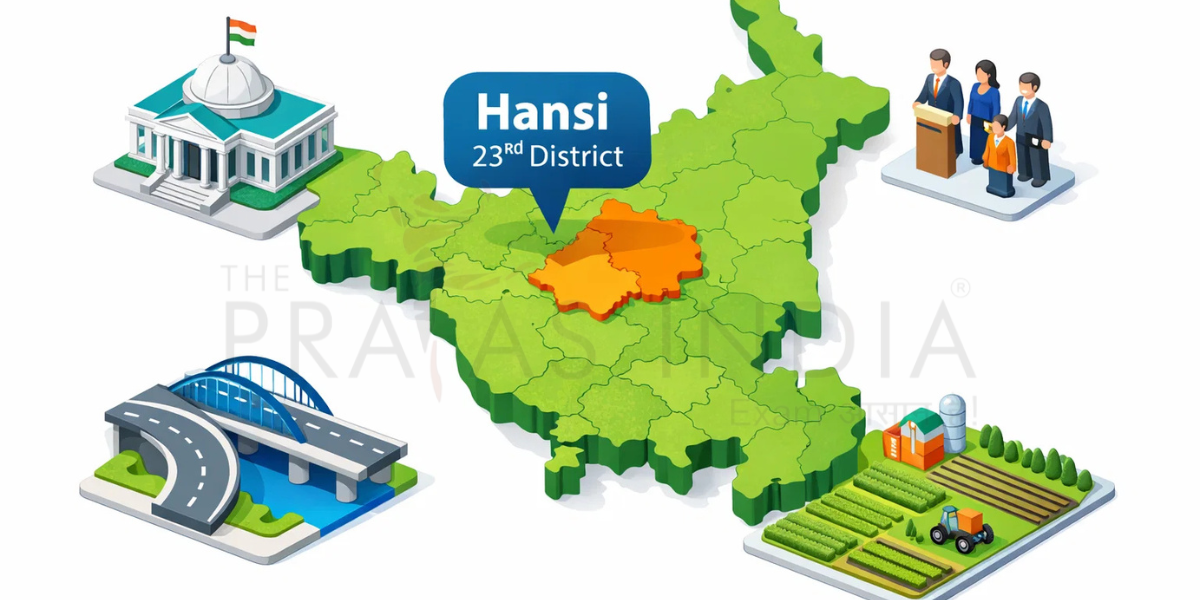
Administrative Structure and Territorial Composition
According to official announcements and Cabinet notes, the broad administrative contours of the new district are as follows:
- Sub-divisions: 2 – Hansi and Narnaund
- Tehsils: 3 – Hansi, Narnaund, and Bass
- Sub-tehsil: 1 – Kheri Jalab
- Blocks: 3 – Hansi‑1, Hansi‑2 and Narnaund
- Villages: Around 110 villages, drawn mainly from the Hansi and Narnaund Assembly constituencies, now fall under the new district’s jurisdiction.
Before district status, Hansi had already been functioning as a police district since 2016, which provided prior experience in handling law and order locally. The upgrade to a full district adds a separate Deputy Commissioner (DC), Superintendent of Police (SP) and other line departments to manage governance independently from Hisar.
Why Was Hansi Made a Separate District?
1. Administrative Efficiency
The state government has argued that the size and population of Hisar district made administration cumbersome and reduced the efficiency of service delivery. By creating a dedicated district headquarters at Hansi, the government expects:
- Reduced travel distance for citizens to access district-level offices such as revenue, police, health and education.
- Faster decision-making and grievance redressal through a focused DC and SP for the Hansi region.
- Better monitoring of welfare schemes, rural development programmes and infrastructure projects.
- 2. Region-Focused Development
Hansi and its surrounding rural belt have distinct development needs linked to agriculture, irrigation, urban growth and heritage tourism. District status allows:
- Targeted planning for local roads, markets, irrigation projects and urban amenities.
- More granular data collection and district-level development strategies.
- Greater scope to position Hansi as a growth centre within central Haryana.
3. Historical and Cultural Identity
Chief Minister Nayab Singh Saini described Hansi as a land of “valour and sacrifice”, referring to its role in the 1857 revolt and historical sites such as Asigarh Fort. District status is also framed as recognition of this distinct cultural and historical identity, which can be leveraged for heritage tourism and civic pride.
Governance Implications: State Reorganisation as Reform
Decentralisation and Cooperative Federalism
The decision to carve out Hansi followed examination by a state-level committee that considered population, geography, connectivity and administrative workload. This reflects:
- Evidence-based reorganisation rather than purely political redrawing of boundaries.
- An example of how states exercise their powers under the Constitution to reorganise internal administrative units for better governance.
From a federalism perspective, it demonstrates how state governments function as key laboratories of governance innovation within India’s broader federal framework.
Strengthening Local Governance
With a new district headquarters, the following gains are anticipated:
- Closer alignment between district administration and Panchayati Raj institutions, enabling better integration of Gram Panchayat plans with district plans.
- Enhanced capacity for disaster management, law and order, and implementation of centrally sponsored schemes at the local level.
- Improved coordination among departments, as all major offices will now be co-located within the new district.
This makes Hansi a practical example of how administrative restructuring can be used to advance the constitutional goal of decentralisation.
Development Opportunities and Challenges
Opportunities
- Infrastructure creation: New district offices, courts, hospitals, educational institutions, staff housing and civic infrastructure will be developed, boosting local construction and services.
- Employment generation: Government posts, support services and private economic activity around the new headquarters can create local jobs.
- Focused schemes: Flagship programmes on education, health, agriculture and social welfare can be reoriented specifically to Hansi’s socio-economic profile.
Challenges
- Fiscal burden: Establishing a new district requires significant capital and recurring expenditure on buildings, staff salaries and operations. This can strain state finances if not carefully budgeted.
- Administrative capacity: The success of the new district will depend on the availability of adequately trained officers and staff, as well as effective coordination with Hisar and neighbouring districts.
- Balanced regional development: The state must ensure that carving out Hansi does not lead to neglect of the remaining areas in Hisar district, and that resources are distributed equitably.
These points are important for UPSC answers that critically assess state reorganisation decisions.
Why Hansi District Matters for UPSC Aspirants
Hansi’s formation is relevant across multiple parts of the syllabus:
- GS Paper II (Polity & Governance):
- State government powers, district administration, local governance and decentralisation.
- Implementation of welfare schemes and public service delivery.
- GS Paper I (Indian Society & Geography):
- Regional identities, urbanisation and spatial reorganisation within states.
- Essay / Interview:
- Themes like “administrative reforms for better service delivery”, “role of states in deepening democracy” and “balanced regional development”.
Aspirants can quote Hansi as a recent, concrete example of state-level administrative restructuring aimed at improving governance.
Conclusion
The notification of Hansi as Haryana’s 23rd district represents more than just a redrawing of administrative maps. It reflects an attempt to enhance administrative efficiency, acknowledge regional identity and drive decentralised development in central Haryana. For UPSC aspirants, it offers a timely case study on how states use district creation as a tool of governance reform, and how such changes involve both opportunities and challenges in terms of finance, capacity and regional balance.
If effectively implemented, Hansi district could strengthen local governance, improve access to public services and become a model for evidence‑based state reorganisation in India.
FAQs on Hansi Becomes 23rd District of Haryana
Q1. From which district has Hansi been carved out?
Hansi district has been carved out of Hisar district, which had earlier given rise to Bhiwani, Sirsa and Fatehabad as separate districts.
Q2. How many villages and administrative units fall under the new Hansi district?
The new district is planned to include around 110 villages, with 2 sub-divisions (Hansi, Narnaund), 3 tehsils (Hansi, Narnaund, Bass), 1 sub‑tehsil (Kheri Jalab) and 3 blocks (Hansi‑1, Hansi‑2, Narnaund).
Q3. Why did the Haryana government create Hansi district?
Key reasons include improving administrative efficiency in the large Hisar region, bringing district‑level services closer to people in Hansi and Narnaund, and promoting region‑specific development while recognising Hansi’s historical identity.
Q4. Since when was Hansi functioning as a separate administrative unit?
Before district status, Hansi had already been functioning as a police district since 2016, giving it prior experience in managing law and order independently from Hisar.
Q5. How is this development useful for UPSC preparation?
Hansi’s creation is a contemporary case study for topics such as state reorganisation, district administration, decentralisation, and cooperative federalism in GS‑II and Essay papers.