
How The Prayas India Helps Students Prepare for SBI Clerk 2026 | Best SBI Clerk Coaching in Mumbai
Preparing for SBI Clerk 2026 is not simply about completing the syllabus and appearing for the examination. With thousands of aspirants competing for a limited number of opportunities, the difference often comes from how systematically a candidate prepares, how consistently they practise and how effectively they learn from their mistakes.
For a student starting SBI Clerk preparation, the challenge is usually not a lack of study material. There is plenty of it available. The bigger challenge is knowing what to study, how much to study, when to practise, how to analyse performance and when to change the preparation strategy.
This is where structured coaching can become relevant.
A candidate can certainly prepare through self-study, particularly if they are disciplined, comfortable creating their own schedule and capable of evaluating their performance objectively. But for students who need a structured roadmap, regular practice, faculty guidance and accountability, joining an organised SBI Clerk Coaching in Mumbai can make the preparation process easier to manage.
The Prayas India approaches competitive-exam preparation through this broader preparation framework. Instead of treating coaching as a collection of classroom lectures, the focus should be on creating a system in which learning, practice, testing, revision and performance improvement work together.
For an aspirant considering Best SBI Clerk Coaching in Mumbai, this distinction is important. The right question is not simply which institute has the biggest name. The better question is: Will the preparation system help me become more consistent, accurate and exam-ready?
SBI Clerk 2026 Preparation: What Makes the Exam Challenging?
SBI Clerk is often considered accessible because its syllabus is familiar to many competitive-exam aspirants. However, familiarity should not be confused with ease.
The major challenge is often the combination of speed, accuracy and competition.
A candidate may know how to solve a particular Mathematics question but still lose valuable time if the calculation is slow. Another candidate may understand Reasoning concepts but make mistakes when solving quickly. Similarly, a student may know a considerable amount of General Awareness but struggle to retain information without systematic revision.
This means that SBI Clerk preparation has to move beyond theoretical understanding.
A useful preparation cycle is:
Learn → Practise → Test → Analyse → Correct → Revise
Each stage has a different purpose.
Learning creates conceptual understanding. Practice develops familiarity. Tests reveal performance under pressure. Analysis identifies mistakes. Correction addresses weaknesses. Revision ensures that previously studied material remains accessible when needed.
A coaching institute should ideally support this complete cycle.
What Students Actually Need During SBI Clerk Preparation
Before discussing how The Prayas India can help, it is useful to understand the practical requirements of a serious SBI Clerk aspirant.
A Clear Study Roadmap
Students often begin preparation with enthusiasm but without a realistic plan. They may study Mathematics for several hours one day, switch to Current Affairs the next day and then spend an entire weekend watching Reasoning lectures.
A roadmap gives preparation direction.
Students should know which topics need to be covered, how much practice each topic requires and when testing should begin.
Consistent Practice
Competitive exams reward application rather than passive learning.
Watching a lecture does not guarantee that you can solve the corresponding questions independently. Practice is what converts understanding into usable exam skills.
Performance Feedback
Without testing and analysis, students may not know whether their preparation is actually improving.
A student who feels confident may discover through a mock that their accuracy is poor. Another student who believes Mathematics is their weakest subject may discover that their actual problem is time management.
Objective performance data can correct these assumptions.
Doubt Resolution
A small conceptual doubt can become a recurring mistake if it remains unresolved.
Students therefore benefit from having access to faculty or a structured doubt-solving mechanism rather than repeatedly guessing their way through difficult topics.
Revision
SBI Clerk preparation includes information that can easily be forgotten.
Revision cannot be postponed until the final days. It needs to be built into the preparation cycle from the beginning.
How The Prayas India Can Bring Structure to SBI Clerk Preparation
The role of coaching should be to reduce unnecessary uncertainty around preparation.
At The Prayas India, students preparing for banking examinations can approach their preparation within a structured learning environment where classroom learning is supported by practice and examination-oriented preparation.
The objective is not simply to complete lessons.
A student should gradually move from understanding concepts to solving questions independently and then to performing under time constraints.
This progression is especially important for banking examinations because knowing the solution method is only one part of the challenge. Candidates also need to decide which questions to attempt, how much time to spend and when to move forward.
A structured coaching environment can help students work on these skills consistently rather than treating them as something to develop immediately before the examination.
Building Concepts Before Chasing Speed
Speed is important in SBI Clerk, but trying to become fast before becoming accurate can create problems.
Suppose a student has difficulty with percentages, profit and loss or simplification. If they immediately start solving large timed sets, they may simply practise the wrong approach faster.
The better progression is:
Concept clarity → Basic questions → Mixed practice → Timed practice
The first stage ensures that the student understands the underlying method.
The second stage develops familiarity.
The third stage tests whether the student can identify the correct approach when question patterns change.
The final stage introduces time pressure.
This sequence allows speed to develop from familiarity rather than from rushing.
For students who are weak in Mathematics, this can be particularly important. A structured classroom environment can help break larger topics into manageable components and provide a sequence for practice.
Strengthening Quantitative Aptitude for SBI Clerk
Quantitative Aptitude can become a major differentiator in banking examinations because calculation efficiency directly affects the number of questions a candidate can attempt.
The preparation should therefore address more than formulas.
Students need to develop:
- Conceptual understanding
- Calculation speed
- Question recognition
- Efficient solving methods
- Accuracy under pressure
- Ability to leave time-consuming questions
A useful coaching system should expose students to different levels of questions rather than keeping practice limited to basic examples.
For instance, after learning a particular arithmetic concept, students should encounter questions that test the same concept in different formats.
This prevents preparation from becoming dependent on memorising one solution pattern.
At The Prayas India, students preparing for banking examinations can use structured classroom learning and practice to gradually build these skills.
The important part is consistency. A single intensive practice session cannot replace repeated exposure over several weeks.
Developing Reasoning Skills the Right Way
Reasoning is another section where students often make a distinction between “knowing the concept” and “being able to solve the question.”
Topics such as puzzles, seating arrangements, inequalities, syllogisms, coding-decoding and other reasoning patterns require different approaches.
Some questions can be solved quickly once the pattern becomes familiar. Others require more detailed arrangement or interpretation.
Students therefore need to learn not only how to solve a question but also how to identify the effort required before committing time to it.
This is an important part of exam strategy.
During preparation, students can gradually move from topic-wise practice to mixed sets. Mixed practice is valuable because the student no longer knows in advance what type of question is coming.
That more closely resembles the decision-making required in an actual examination.
Making English Preparation More Practical
English preparation is sometimes underestimated by students who believe that grammar and vocabulary can be improved only through memorisation.
In reality, English preparation for competitive examinations requires familiarity with question patterns as well as language fundamentals.
Depending on the candidate’s current level, preparation can include:
- Grammar fundamentals
- Vocabulary building
- Reading comprehension
- Error detection
- Sentence-based questions
- Cloze tests
- Para-based questions
- Regular reading practice
Students should also learn to distinguish between a language weakness and a question-selection problem.
For example, a candidate may understand English reasonably well but spend too much time on a lengthy reading-comprehension passage. Another may solve grammar questions quickly but lose marks through careless errors.
These are different problems and require different corrective strategies.
Regular sectional testing can help identify which one applies to the student.
Building a Sustainable General Awareness Routine
General Awareness is one area where inconsistent preparation can become expensive.
Students often postpone it because Mathematics and Reasoning appear more immediately measurable. They may then attempt to cover months of current affairs in a short period.
A better strategy is to make General Awareness a recurring part of the daily or weekly routine.
The goal should not be to consume every available source.
Instead, students should:
- Follow a manageable source.
- Make concise notes.
- Revise regularly.
- Practise relevant questions.
- Track areas where recall is weak.
The value of coaching in this area can come from structure and prioritisation. Students can avoid spending excessive time on information that has little relevance to their preparation and focus more consistently on revision and recall.
Turning Classroom Learning into Exam Practice
One of the most important transitions in competitive-exam preparation is moving from classroom understanding to independent solving.
A student may understand a faculty member’s explanation completely during class. But during a test, there is no teacher explaining the question.
The student has to identify the method, perform the calculations and make the final decision independently.
This is why practice should follow learning quickly.
A useful learning cycle can look like:
Classroom Lesson
↓
Guided Examples
↓
Independent Practice
↓
Timed Questions
↓
Sectional Test
↓
Performance Analysis
↓
Revision
This creates a bridge between teaching and examination performance.
For a student evaluating SBI Clerk Coaching in Mumbai, this is one of the areas worth examining before admission. Ask whether the institute’s system actually provides opportunities for independent practice and testing or whether preparation remains primarily lecture-oriented.
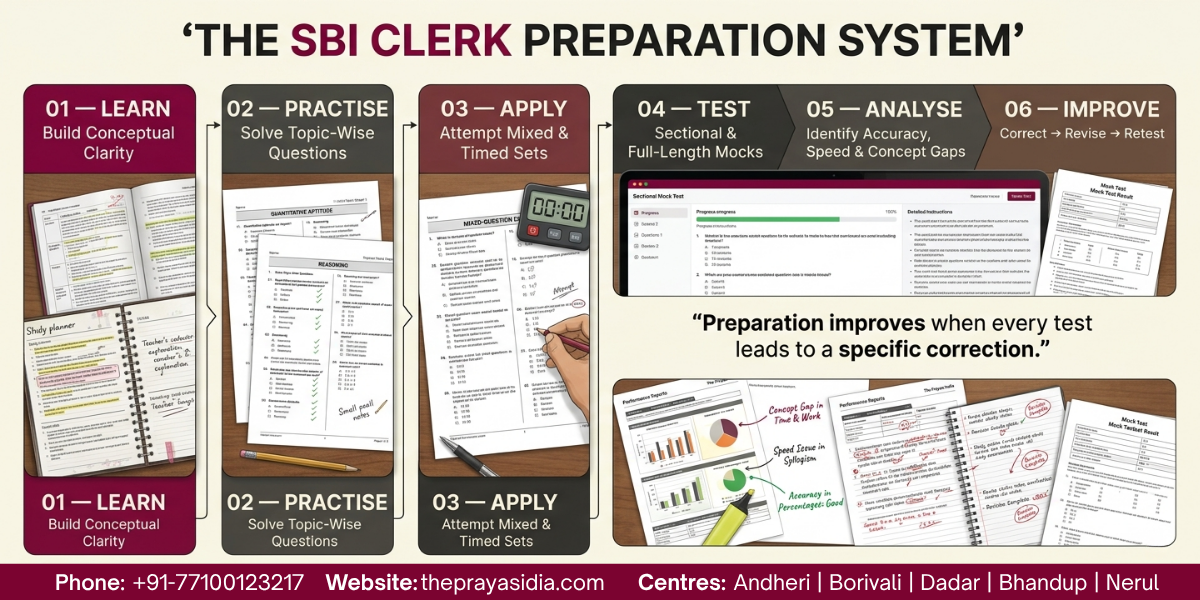
Mock Tests as a Tool for Improvement, Not Just Scoring
Mock tests are often treated as a scoreboard.
A student takes a test, sees the marks, compares them with a target and moves to the next test.
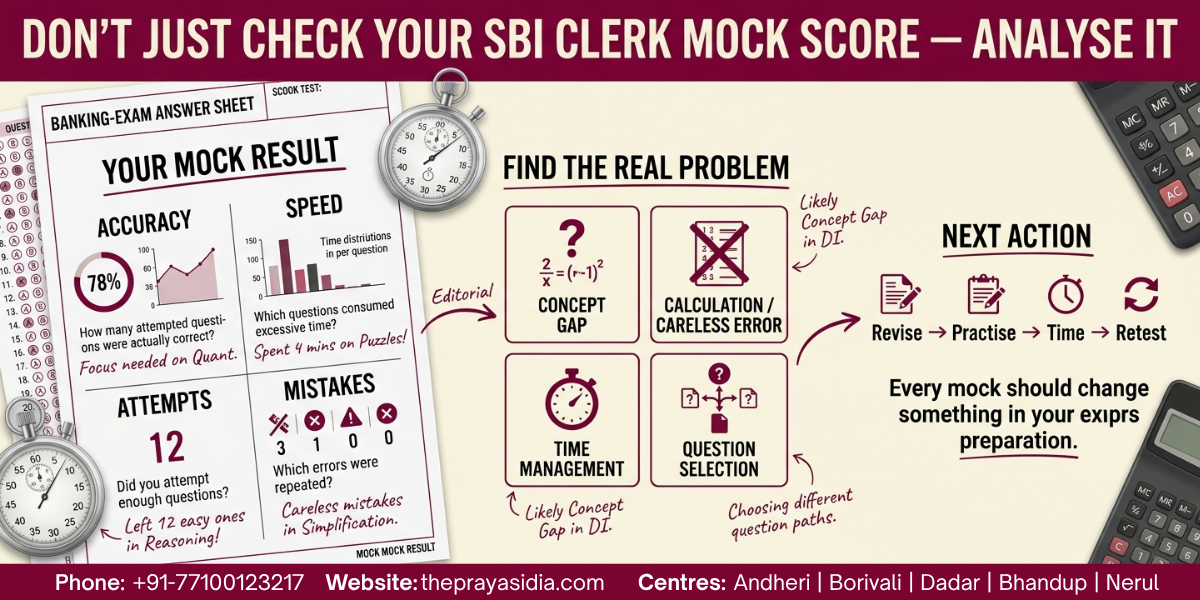
But the real value of a mock lies in the information it provides.
A good analysis should answer questions such as:
- Which questions were incorrect?
- Which questions were guessed?
- Which questions took too long?
- Which topics repeatedly caused mistakes?
- Where did accuracy fall?
- Did the candidate spend too much time on one section?
- Which questions could have been skipped?
- What should change before the next test?
This transforms mock tests from measurement tools into learning tools.
For example, if a student scores poorly in Quantitative Aptitude because they attempted too many time-consuming questions, the solution may not be another five chapters of Mathematics.
The student may need better question selection.
If the same student loses marks through calculation errors, targeted calculation practice may be more valuable.
If the problem is conceptual, they may need to revisit specific topics.
This is why mock-test analysis should be integrated into coaching rather than treated as an optional activity.
Helping Students Understand Speed vs Accuracy
Banking examinations require candidates to work quickly, but speed without accuracy can reduce the benefit of additional attempts.
Imagine two students.
Student A attempts 75 questions but makes a significant number of avoidable mistakes.
Student B attempts fewer questions but maintains considerably better accuracy.
Simply looking at attempts would make Student A appear stronger. Looking at actual performance tells a different story.
Students therefore need to develop an individual balance between speed and accuracy.
Regular testing helps identify this balance.
A structured coaching environment can also expose students to timed practice before they reach the final examination stage. This allows them to experiment with question-selection strategies while there is still enough time to correct them.
Identifying Weak Areas Before They Become Exam Problems
Students frequently know which subjects they dislike. That does not necessarily mean they know their actual weaknesses.
A student may say:
“My Reasoning is weak.”
But the real issue could be puzzles.
Another may say:
“My Maths is weak.”
But the problem could specifically be calculation speed.
Another may believe that English is their weakness when their actual problem is reading speed.
Performance data helps make weaknesses more specific.
At The Prayas India, regular practice and testing can help students evaluate their preparation more objectively. Once a weakness becomes specific, corrective practice becomes easier to plan.
This is one of the practical reasons students may prefer structured coaching over completely unplanned self-study.
Providing a More Disciplined Preparation Routine
Consistency is often harder than understanding.
A student may know exactly what should be done but still struggle to follow the schedule every day.
College, work, social commitments, fatigue and changing motivation can all affect preparation.
A structured coaching environment introduces fixed learning routines that can help students maintain continuity.
The objective is not to make every student follow exactly the same timetable. Students still need individual self-study plans.
Instead, classes, assignments, tests and revision schedules can create external structure around the student’s independent preparation.
This can be particularly valuable for aspirants who have previously started competitive-exam preparation several times but struggled to maintain it.
What Makes a Good SBI Clerk Coaching Institute?
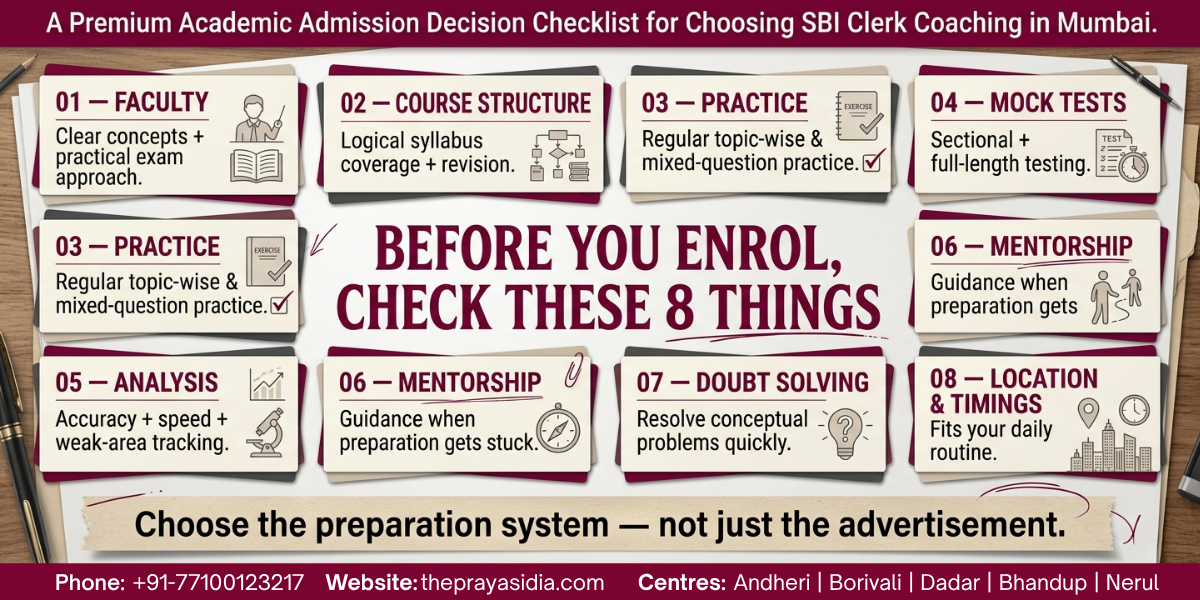
Before joining any institute, students should evaluate the preparation system rather than relying entirely on promotional claims.
A useful checklist includes:
| Factor | What Students Should Evaluate |
|---|---|
| Faculty | Concept clarity and teaching approach |
| Course Structure | Whether the syllabus follows a logical progression |
| Practice | Availability of regular question practice |
| Mock Tests | Frequency and quality of testing |
| Analysis | Whether students receive useful performance insights |
| Doubt Solving | Accessibility of faculty/support |
| Study Material | Relevance, clarity and usability |
| Mentorship | Guidance on preparation strategy |
| Batch Timing | Compatibility with your routine |
| Location | Practicality of daily travel |
| Revision | Whether revision is built into preparation |
The purpose of this checklist is not to find an institute that promises the most.
It is to find an institute whose system matches the way you need to prepare.
Mentorship That Goes Beyond Classroom Teaching
A student does not necessarily need someone to tell them what to study every hour. What they often need is someone who can help them make better preparation decisions.
For example, consider a student whose mock-test score has remained almost unchanged for several weeks.
The obvious response might be to study for more hours.
But additional hours may not solve the real problem.
Perhaps the student is spending too much time on difficult questions. Perhaps their concepts are reasonably strong but their accuracy is poor. Perhaps they are completing the syllabus but not revising it. Or perhaps they are taking mocks without analysing them properly.
Mentorship becomes valuable when preparation needs diagnosis rather than simply more content.
The Prayas India’s banking preparation ecosystem includes personalised mentorship, mock tests, doubt-solving support and performance-oriented preparation as part of its broader bank-exam approach.
For an SBI Clerk aspirant, the practical benefit of this type of support is that preparation can be adjusted according to performance instead of following one rigid timetable throughout the year.
Regular Mock Tests Create an Objective Picture
Students sometimes evaluate themselves based on how much they have studied.
A better measure is what they can actually do under examination conditions.
Mock tests provide that measurement.
A student who has completed ten chapters of Quantitative Aptitude may feel confident. But if a timed test reveals that the student cannot complete questions within the available time, preparation still has an important gap.
Similarly, a candidate may perform well in untimed Reasoning practice but struggle when faced with a mixed set.
Regular testing exposes these differences.
The Prayas India describes its banking preparation offering as including topic-wise tests, sectional tests, full-length mock exams and performance reports.
This progression matters because testing should evolve with preparation.
Early Preparation
Use topic-wise tests to check conceptual understanding.
Middle Preparation
Use sectional tests to evaluate speed and accuracy.
Advanced Preparation
Use full-length mocks to simulate examination pressure.
Final Preparation
Use mock analysis and targeted revision to eliminate recurring mistakes.
The objective is not to collect the largest number of mock-test scores.
The objective is to make each test useful.
Turning Mock-Test Analysis into a Study Plan
A mock score is only a number until you understand what created it.
After every important test, students should look beyond the total score.
Suppose a candidate attempted a large number of questions but lost marks because of avoidable errors. The next study plan should include accuracy-focused practice.
If the candidate’s accuracy is strong but attempts are low, the priority may be speed.
If both speed and accuracy are poor in one specific topic, that topic needs conceptual revision followed by practice.
This creates a simple loop:
Mock → Diagnosis → Targeted Practice → Retest
Without this loop, students can fall into the trap of taking test after test without addressing the reasons behind their performance.
Helping Students Build a Revision System
Revision is often the least exciting part of preparation, which is precisely why students postpone it.
A candidate may enjoy learning a new chapter because it feels like progress. Revising something already studied can feel repetitive.
But competitive examinations do not reward the amount of information you once studied. They reward your ability to recall and apply it when the question appears.
A practical revision system should operate at multiple levels.
Daily Revision
Review formulas, vocabulary, difficult concepts or important facts from recent study sessions.
Weekly Revision
Revisit the week’s major topics and mistakes.
Monthly Revision
Review previously completed portions through mixed questions and tests.
Mock-Based Revision
Use test performance to identify what needs immediate revision.
This creates a continuous revision cycle instead of leaving the entire burden for the final weeks.
Making Doubt Solving Part of the Preparation Process
One unresolved doubt can sometimes create multiple mistakes.
For example, if a student misunderstands a particular mathematical concept, they may repeatedly use the wrong approach in different questions.
Similarly, an unclear reasoning rule can affect several question types.
This is why doubt solving should not be considered an additional facility that students use only occasionally.
It should be part of the learning process.
Students should be encouraged to identify doubts during practice and resolve them before moving too far ahead.
The Prayas India highlights doubt-solving support as part of its banking preparation approach.
For students who prefer classroom learning, this can reduce the tendency to accumulate unresolved questions and postpone clarification until revision.
Helping Beginners Start Without Feeling Overwhelmed
Not every SBI Clerk aspirant begins at the same level.
Some students have already prepared for banking examinations.
Others may be appearing for their first competitive examination.
A beginner may initially struggle with basic terminology, calculation methods, question patterns and time management. Comparing their preparation with an experienced aspirant can create unnecessary pressure.
The solution is to establish a baseline.
The student should first understand where they currently stand and then build from there.
The Prayas India also positions its banking preparation as suitable for beginners, with concept building, faculty guidance, mock tests, mentorship and updated study resources.
This is important because good coaching should not assume that every student enters the classroom with the same background.
A beginner needs fundamentals.
A repeat aspirant may need performance correction.
A stronger candidate may need advanced practice and exam strategy.
The preparation should therefore be responsive to the student’s current level.
Supporting Repeat Aspirants with a Different Approach
A repeat candidate does not necessarily need to start from zero.
If someone has already prepared for SBI Clerk or another banking examination, repeating the entire preparation exactly as before may not be the most efficient approach.
The first question should be:
Why did the previous attempt not produce the desired result?
Was it:
- Insufficient syllabus coverage?
- Low mock-test performance?
- Poor accuracy?
- Weak General Awareness?
- Slow calculation?
- Poor question selection?
- Inconsistent revision?
- Lack of exam strategy?
The answer determines the next preparation plan.
For a repeat aspirant, performance analysis can therefore be more important than simply increasing study hours.
This is another area where mentorship can add practical value.
Creating a Competitive but Student-Focused Learning Environment
Preparation becomes easier when students are surrounded by others who are working toward similar goals.
A classroom environment can provide a sense of routine and seriousness that may be difficult to create through completely unstructured self-study.
At the same time, healthy competition should not become constant comparison.
The objective should be to use peer performance as information.
If another student is consistently performing better in Reasoning, that can encourage you to examine their approach.
But your actual target should remain your own improvement.
A student who moves from 55 to 70 has made meaningful progress even if another candidate is already scoring 80.
The right learning environment should encourage improvement without making students feel that every test is a judgement of their ability.
Why Location Matters When Choosing SBI Clerk Coaching in Mumbai
Mumbai students often underestimate the effect of daily travel on preparation.
A coaching centre may have an excellent academic environment, but if reaching the centre requires excessive travel every day, the resulting fatigue can affect self-study, revision and consistency.
This is why location should be considered alongside faculty and course quality.
The Prayas India has banking-exam preparation centres across locations including Andheri, Borivali, Dadar, Nerul and Bhandup, giving students different options based on convenience.
The practical decision should be based on your routine.
Ask:
- How long will I spend travelling?
- Can I attend classes consistently?
- Will I still have enough time for self-study?
- Are batch timings compatible with college or work?
- Can I reach the centre comfortably during the preparation period?
These questions may appear simple, but consistency is one of the most important factors in long-term preparation.
Offline Coaching vs Self-Study: Which Is Better for SBI Clerk?
There is no universal answer.
Self-study can work extremely well for students who are disciplined, understand the syllabus, have access to reliable resources and can objectively analyse their performance.
Coaching can be useful for students who need structure, faculty guidance, regular testing, mentorship and accountability.
The decision should therefore depend on your preparation style.
| If You Prefer… | Consider |
|---|---|
| Complete flexibility | Self-study |
| Fixed learning routine | Classroom coaching |
| Independent resource selection | Self-study |
| Faculty-led concept building | Coaching |
| Self-managed testing | Self-study |
| Structured mock-test system | Coaching |
| Independent performance analysis | Self-study |
| Mentorship and regular guidance | Coaching |
There is also a middle ground.
Students can combine classroom or online coaching with substantial independent practice.
The important thing is to ensure that coaching does not replace self-study.
No institute can practise every question on behalf of the candidate.
How to Decide Whether The Prayas India Is Right for You
Choosing The Prayas India for SBI Clerk preparation should be an informed decision rather than an impulse decision.
Before enrolling, discuss the course structure and understand what the preparation system includes.
You should ideally evaluate:
Course Coverage
Does the programme cover the relevant banking-exam subjects and provide a logical sequence for learning?
The Prayas India currently offers a broader bank-exam preparation programme covering SBI Clerk, SBI PO, IBPS Clerk, IBPS PO and other banking examinations.
Faculty Support
Do you understand concepts comfortably in the teaching environment?
Practice
Are there enough opportunities to move from classroom learning to independent question solving?
Mock Tests
How frequently will you be tested, and how will performance be reviewed?
Mentorship
Can you receive guidance when your preparation strategy needs adjustment?
Doubt Solving
Can you clarify difficult concepts without allowing them to accumulate?
Study Material
Is the material organised enough to support both learning and revision?
Centre Accessibility
Can you realistically attend classes without disrupting your self-study routine?
These questions are more useful than choosing an institute purely because of a promotional label such as “best coaching.”
SBI Clerk Preparation Should Be a Process, Not a Last-Minute Sprint
The most effective preparation usually develops gradually.
At the beginning, the focus should be on understanding concepts.
Then comes practice.
Then timed practice.
Then sectional testing.
Then full-length mocks.
Finally, the emphasis shifts toward revision and exam readiness.
This progression prevents students from attempting to solve advanced-level questions before their fundamentals are ready.
It also prevents the opposite problem — spending months studying concepts without testing whether those concepts can actually be applied.
The Prayas India’s banking preparation approach is built around this broader ecosystem of structured learning, practice, mock tests, mentorship and performance improvement.
A Practical SBI Clerk Preparation Framework
Students can use the following framework regardless of whether they choose coaching or self-study.
| Stage | Main Objective | What to Do |
|---|---|---|
| Foundation | Build concepts | Learn fundamentals |
| Practice | Develop application | Solve topic-wise questions |
| Speed | Improve efficiency | Attempt timed sets |
| Testing | Measure performance | Take sectional/full mocks |
| Analysis | Identify weaknesses | Study errors and time usage |
| Correction | Fix problems | Target weak areas |
| Revision | Improve retention | Revisit important topics |
| Final Preparation | Stabilise performance | Mocks + revision + strategy |
The key is that these stages should overlap.
You should not wait until the entire syllabus is complete before beginning practice.
You should not wait until the final month before taking mocks.
And you should not wait until the last week before revising.
A Student’s Preparation Journey at The Prayas India
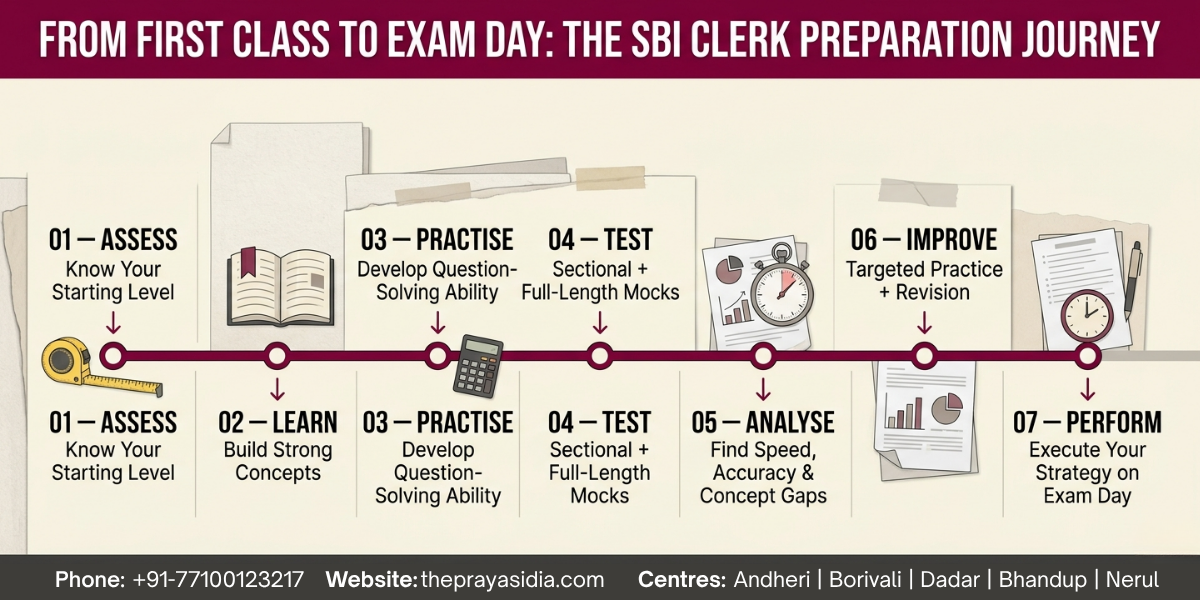
A useful way to look at coaching is to imagine the student’s journey over several stages.
Stage 1: Starting Point
The student enters with a certain level of knowledge and a set of weaknesses.
Stage 2: Structured Learning
Concepts are taught systematically and the student begins regular practice.
Stage 3: Performance Building
Timed sets and sectional tests reveal whether concepts are translating into marks.
Stage 4: Diagnosis
Mock-test performance highlights specific weaknesses.
Stage 5: Mentorship
The student receives guidance on where to spend more time and where to change strategy.
Stage 6: Revision
The student revisits formulas, concepts, mistakes and important information.
Stage 7: Exam Readiness
The focus shifts from learning more material to executing the preparation effectively.
This is the real purpose of a coaching system.
The institute should not simply provide information. It should help students build the ability to use that information under examination conditions.
What Should Students Expect After Joining Coaching?
Joining coaching should not create the expectation that preparation becomes effortless.
Students still need to attend classes regularly, complete assignments, practise independently, revise topics and take tests seriously.
Coaching works best when the student actively uses the resources available.
A useful division of responsibility is:
Institute
Teach → Guide → Test → Analyse → Mentor
Student
Attend → Practise → Revise → Correct → Repeat
The two sides need to work together.
A student who attends every class but does not practise independently cannot expect classroom teaching alone to produce examination readiness.
Similarly, an institute’s resources become valuable only when students consistently engage with them.
Final 30-Day SBI Clerk Preparation Focus
As the examination approaches, preparation should become increasingly exam-oriented.
Days 30–21
Focus on completing remaining important concepts and increasing sectional practice.
Days 20–11
Increase full-length mock frequency, analyse performance and target recurring weaknesses.
Days 10–6
Prioritise revision, important formulas, difficult question types and accuracy improvement.
Days 5–3
Reduce unnecessary new learning. Review short notes, errors and high-priority topics.
Days 2–1
Keep preparation light and organised. Avoid panic-driven resource changes or excessive late-night study.
The exact timeline can be adjusted according to the official SBI notification and the candidate’s preparation level. The important principle is to gradually shift from learning mode to execution mode.
Why the Right SBI Clerk Coaching Decision Matters
Choosing coaching is a financial and time commitment, so students should not make the decision only because an institute appears frequently in advertisements.
The better approach is to compare the actual preparation experience.
Look at:
Faculty + Course Structure + Practice + Tests + Analysis + Mentorship + Doubt Solving + Location
When these components work together, coaching can become more than a place where lectures are delivered.
It becomes a preparation system.
For students in Mumbai who want structured banking-exam preparation, The Prayas India offers banking preparation programmes covering examinations including SBI Clerk and SBI PO, with classroom and online preparation options.
The institute also has multiple Mumbai-area centres, which can make classroom preparation more accessible depending on where a student lives or studies.
Students should still assess the current batch structure, timings, course details and support system before taking admission.
Frequently Asked Questions About SBI Clerk Coaching and Preparation
1. Is coaching necessary to prepare for SBI Clerk 2026?
No. SBI Clerk can be prepared through self-study if a candidate is disciplined and has reliable resources. Coaching can be useful for students who need structured planning, faculty guidance, regular tests, mentorship and accountability.
2. How can The Prayas India help with SBI Clerk preparation?
The Prayas India provides a structured banking-exam preparation environment involving concept learning, practice, mock tests, performance analysis, mentorship and doubt-solving support.
3. Is The Prayas India suitable for beginners?
The institute’s banking preparation offering is designed to support beginners as well as aspirants with prior competitive-exam experience, with emphasis on fundamentals, structured learning and regular evaluation.
4. Are mock tests important for SBI Clerk preparation?
Yes. Mock tests help candidates understand their speed, accuracy, question-selection ability and performance under time pressure. Their greatest value comes from analysing the results and correcting weaknesses.
5. How important is speed for SBI Clerk?
Speed is important because banking examinations operate under strict time constraints. However, speed should be developed alongside accuracy. Attempting more questions at the cost of avoidable mistakes may not improve overall performance.
6. Does The Prayas India provide mock tests and performance analysis?
The Prayas India states that its banking preparation includes topic-wise tests, sectional tests, full-length mock exams and detailed performance reports.
7. Does The Prayas India provide mentorship?
Yes. Personalised mentorship is listed as part of its banking-exam preparation approach, including guidance related to study planning, time management, weak-area improvement and preparation strategy.
8. Where can I find The Prayas India centres in Mumbai?
The Prayas India lists centres in locations including Andheri, Borivali, Dadar, Nerul and Bhandup. Students should confirm the current centre details and batch availability before admission.
9. Should I join SBI Clerk coaching early?
Starting early can provide more time for concept building, practice, revision and mock-test improvement. However, the right time also depends on your existing preparation level and the examination schedule.
10. What should I check before taking admission?
Evaluate faculty, course structure, study material, practice system, mock tests, performance analysis, doubt solving, mentorship, batch timings and centre accessibility. Most importantly, understand whether the course fits your personal preparation requirements.
Final Takeaway: Choosing a Preparation System That Works for You
Preparing for SBI Clerk 2026 is not simply a matter of accumulating study hours.
The quality of those hours matters.
A student who studies without a plan may spend considerable time without knowing whether preparation is actually improving. A student who follows a structured cycle of learning, practice, testing, analysis and revision has a clearer way to measure progress.
This is the role a good coaching system can play.
The Prayas India can be considered by students looking for structured SBI Clerk Coaching in Mumbai, particularly those who want classroom or online preparation supported by faculty guidance, regular testing, mentorship, doubt solving and performance-oriented practice. Its broader banking programme includes SBI Clerk among the examinations covered.
But the final decision should always be personal.
Do not choose an institute simply because someone calls it the “best.” Understand what is actually offered. Speak with the academic team, review the course structure, consider batch timings, assess your travel requirements and determine whether the teaching and testing system matches your preparation needs.
Once you make that decision, consistency becomes the next responsibility.
Attend classes regularly.
Practise independently.
Analyse your mocks honestly.
Revise before you forget.
Work on weak areas instead of avoiding them.
And most importantly, treat every test as feedback rather than simply a score.
For an SBI Clerk aspirant, the goal is not to know everything on the first day. The goal is to become more accurate, faster, more confident and better prepared with every stage of the journey.
That is where structured preparation can make a meaningful difference.
Contact Us
📞 Call Now: +91-77100 13217
🌐 Website: theprayasindia.com