How to Balance RRB Preparation with College or a Job? | Best RRB Coaching in Mumbai | The Prayas India
Preparing for an RRB exam while attending college or working a full-time job can feel like a difficult balancing act. College students have lectures, assignments, practicals and examinations, while working professionals have fixed office hours, commuting, deadlines and responsibilities outside the workplace. Adding competitive-exam preparation to this routine can easily make the day feel overcrowded.
But the real challenge is not necessarily the lack of available hours. It is the lack of a preparation system that fits realistically around your existing commitments.
RRB aspirants who study alongside college or a job often make one common mistake: they create a timetable designed for someone who has the entire day available. When that timetable becomes impossible to follow, they conclude that they are not disciplined enough. In reality, the schedule itself may have been unrealistic.
A successful RRB preparation strategy for a working professional or college student needs to be different from the routine of a full-time aspirant. Instead of trying to study for extremely long hours, the focus should be on consistency, prioritisation, efficient practice and regular revision. Even limited study hours can become productive when they are used deliberately.
For students considering RRB Coaching in Mumbai, this distinction is important. A coaching programme should fit into an aspirant’s existing routine rather than making it impossible to manage college, employment and preparation together. The right academic structure can help reduce the time spent deciding what to study while allowing the student to focus more directly on learning and practice.
Start by Accepting That Your Schedule Will Be Different
The first step towards balancing RRB preparation with college or a job is to stop comparing your routine with that of a full-time aspirant.
Someone preparing throughout the day may be able to devote six to eight focused hours to examination preparation. A college student may realistically have two to four useful hours on weekdays, while a working professional may have even less after commuting and completing household responsibilities.
That does not automatically put you at a disadvantage.
What matters is the quality and consistency of those hours.
If you have two focused hours every weekday and several productive hours on your weekly off or weekends, those hours can be organised into a meaningful preparation system. The objective is not to imitate somebody else’s timetable. It is to build a routine that you can maintain for several months.
RRB preparation is a long-term process. A schedule that looks impressive for five days but becomes impossible after two weeks is much less useful than a modest routine that you can follow continuously.
This mindset also prevents unnecessary guilt. Missing an occasional study session because of an important college submission or an urgent work commitment does not mean that your preparation has failed. The important thing is to return to the routine instead of abandoning it altogether.
Calculate Your Real Study Time Before Making a Timetable
Before creating a timetable, track your normal day.
Write down when you wake up, when you leave for college or work, how much time you spend commuting, when your classes or working hours end, and how much time remains after meals and other responsibilities.
Then identify the periods during which you can genuinely concentrate.
This last point matters more than simply counting free hours.
For example, a student may technically have three hours available after college but be mentally exhausted during that period. Another candidate may have only ninety minutes in the morning but be much more focused at that time.
Your timetable should therefore be based on usable study time, not theoretical free time.
Once you understand your actual routine, divide your available time into preparation blocks. One block can be used for concepts, another for practice and a shorter session for revision or current affairs.
This approach makes the schedule more realistic because every study session has a defined purpose.
Use College and Workdays Differently From Your Weekly Off
Trying to follow exactly the same study routine every day is difficult when your college or job schedule changes.
A better approach is to create two preparation modes.
On regular college or working days, focus on shorter and highly targeted sessions. These may include concept revision, practice sets, vocabulary, calculation drills, Reasoning questions or a small number of Quantitative Aptitude problems.
Your weekly off can then be used for longer activities such as full-length mock tests, detailed mock analysis, difficult topics and broader revision.
This creates a natural division of effort.
Weekdays maintain continuity.
The weekly off provides depth.
This system is particularly useful for working professionals because it prevents the expectation that every day must contain several hours of intensive study.
Build Your RRB Preparation Around Priorities
A busy aspirant cannot afford to spend equal time on every activity.
Your preparation should be organised according to the examination requirements and your personal weaknesses.
If your Quantitative Aptitude fundamentals are weak, a greater share of your available study time should go towards concept building and targeted practice. If your concepts are already strong but your mock performance is poor, more attention may be required for speed, accuracy and question selection.
Similarly, candidates who are comfortable with Reasoning but struggle with General Awareness should not continue allocating identical study time to both areas simply because they appear as separate sections.
The goal is not to create a perfectly symmetrical timetable.
The goal is to create a useful timetable.
A practical priority system can divide tasks into three categories:
| Priority | Type of Work | Example |
|---|---|---|
| High | Weak or high-impact areas | Difficult Quant topics, repeated Reasoning errors |
| Medium | Regular practice | Sectional questions, English practice |
| Maintenance | Retention-based work | Revision, formulas, vocabulary, General Awareness |
This prevents limited study hours from being consumed by activities that provide relatively little improvement.
Make Your Commute Useful Without Turning Every Minute Into Study Time
College students and working professionals often spend significant time travelling.
If you use public transport, some of this time can become useful revision time. Vocabulary, formulas, short notes, General Awareness revision and previously recorded lessons can be reviewed during suitable parts of the commute.
However, this does not mean that every minute of your day needs to become a study session.
Rest is also important.
If you continuously try to convert travel, lunch breaks, evenings and weekends into study time, mental fatigue can eventually affect the quality of your preparation.
Use commuting as a supporting study window, not as the foundation of your preparation.
Your most demanding work—such as learning difficult concepts, solving lengthy questions and taking mock tests—should ideally happen when you can sit down with proper concentration.
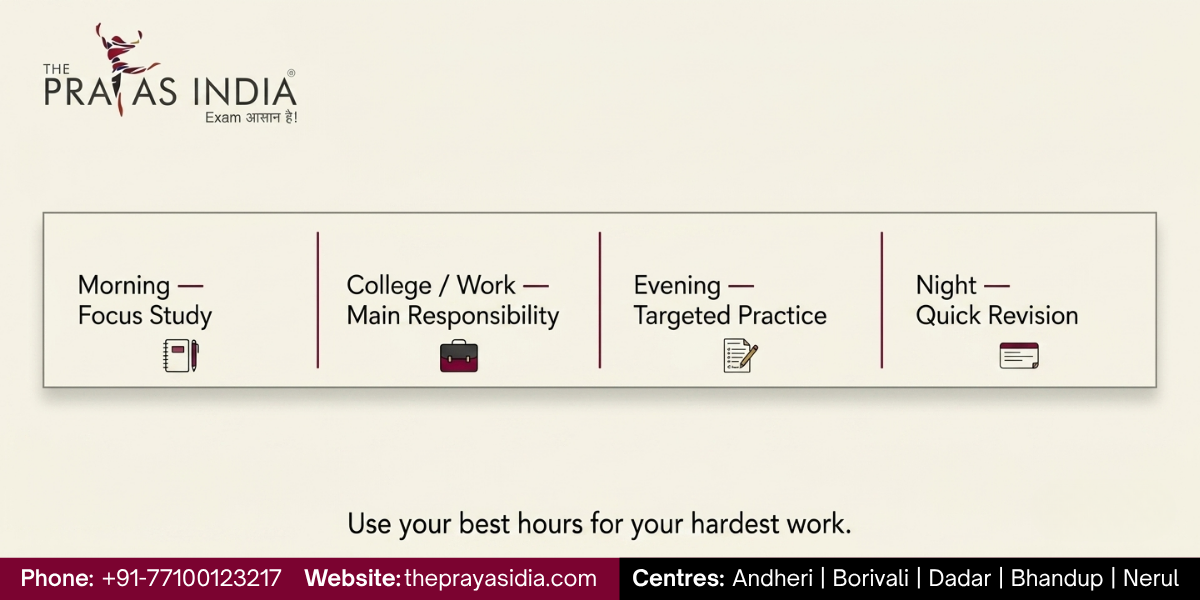
Divide Study Sessions According to Mental Energy
Not every study task requires the same level of concentration.
Learning a completely new Quantitative Aptitude concept requires more mental energy than revising formulas you already know. Solving a difficult Reasoning set requires more concentration than reviewing vocabulary.
This becomes particularly important for people balancing preparation with college or employment.
Use your freshest hours for difficult academic work. If you are naturally more alert in the morning, use that period for concepts or challenging practice. If you are more productive after returning from work, create a focused evening session.
Lower-energy periods can be reserved for lighter tasks such as revision, vocabulary, General Awareness or reviewing your error log.
This simple adjustment can make a short study schedule considerably more effective.
The objective is not to increase the number of hours you study. It is to increase the amount of meaningful work you accomplish during those hours.
Follow the “One Session, One Objective” Rule
A common problem among busy aspirants is trying to accomplish too many things during a single study session.
A student may open Quant notes, switch to Reasoning questions, check current affairs and then watch an English lecture—all within an hour. The session feels busy but produces little measurable progress.
Instead, give every study block one primary objective.
For example:
45 minutes — Percentage concepts and practice
or
60 minutes — Reasoning seating arrangement
or
30 minutes — English error revision
or
20 minutes — General Awareness revision
This creates a clear beginning and end to each task.
It also makes it easier to measure progress. At the end of the week, you can see exactly what you completed instead of simply remembering that you “studied every day.”
For a college student or working professional, this level of clarity is particularly valuable because available study time is limited.
Keep Weekday Targets Small but Non-Negotiable
When your daily schedule is busy, large study targets can become psychologically difficult.
A target such as “finish Quantitative Aptitude today” is vague and unrealistic. A target such as “complete one concept and solve 25 relevant questions” is measurable.
Small targets also reduce the tendency to postpone preparation.
You do not need to wait for a completely free evening to make progress. If your schedule allows only one focused session, use it effectively and continue the next day.
Consistency is built through repeated completion of manageable tasks.
Over several weeks, these small sessions can add up to substantial preparation.
Protect Your Weekend for Deep Work
Weekends or weekly offs can become the most valuable preparation periods for college students and working professionals.
Instead of using the entire day for random study, assign specific deep-work activities to these longer windows.
A weekly off might include a full-length RRB mock test, detailed analysis, revision of weak topics and targeted practice. The exact combination can change according to your preparation stage.
The important point is that the weekend should not become an unstructured catch-up session for everything you could not complete during the week.
If you carry an enormous backlog into every weekend, the cycle becomes exhausting.
Keep weekday targets realistic so that your weekly off can be used for high-value preparation rather than constant backlog clearance.

Don’t Try to Cover the Entire RRB Syllabus Every Day
One of the biggest sources of stress for working and college-going aspirants is the feeling that they are always behind.
The RRB syllabus can appear extensive when viewed as one large list. Looking at the entire syllabus every day makes the preparation seem much larger than it actually is.
Break it into smaller weekly targets.
Instead of thinking, “I need to complete Mathematics, Reasoning, General Awareness and the entire English syllabus,” identify the specific areas you will cover this week.
For example, one week may focus on selected arithmetic topics, a few Reasoning chapters, a defined General Awareness revision target and regular English practice.
The next week can build on that foundation.
This creates visible progress and makes it easier to balance preparation with your academic or professional responsibilities.
Build a Minimum Study Routine for Difficult Days
Not every day will go according to plan.
There may be college examinations, project submissions, office deadlines, overtime, travel or family responsibilities. If your preparation system assumes that every day will be perfect, one difficult week can completely disrupt it.
Create a minimum study routine for such days.
This could be a short revision session, a small practice set or a limited number of questions.
The purpose is not to achieve a full day’s target. It is to maintain continuity.
Once the busy period ends, return to the normal routine.
This approach is much more sustainable than either forcing yourself to complete an unrealistic target or abandoning preparation completely.
Balance Preparation With Sleep and Recovery
A preparation plan that consistently reduces your sleep is not a sustainable plan.
Working professionals may already spend long hours at work, while college students may have early classes, practicals or assignments. Adding several hours of late-night preparation every day can eventually reduce concentration and memory.
The solution is not to eliminate rest.
Instead, identify where your preparation can become more efficient.
A focused 90-minute session can be more productive than three distracted hours. A carefully analysed mock can teach you more than several unplanned practice sets.
Protecting recovery time is therefore part of the preparation strategy itself.
The goal is to arrive at the examination with sufficient knowledge, practice and mental stamina—not simply with the maximum possible number of study hours.
Where Professional RRB Coaching Can Fit Into a Busy Schedule
For college students and working professionals, coaching can be useful when it provides structure without unnecessarily consuming the time required for self-study.
The value of professional guidance should not be measured only by the number of classroom hours. A good preparation system should help students understand what to study, how to practise, how to assess performance and what to revise next.
This can be especially useful for aspirants who have limited time and cannot afford to spend weeks experimenting with different resources and strategies.
Students considering RRB Coaching in Mumbai should therefore evaluate the complete learning structure before taking admission. Faculty support, study material, practice resources, mock tests, doubt resolution, revision support and schedule flexibility can all matter when preparation has to coexist with college or employment.
The right coaching environment should complement your routine, not compete with it.
Admission Should Solve a Preparation Problem
Joining coaching should not be treated as a compulsory step simply because you are preparing for an RRB examination.
The better question is whether structured guidance solves a genuine problem in your preparation.
If you are able to understand the syllabus, choose reliable resources, maintain a routine and analyse your mock tests independently, you may be comfortable with self-study.
If you repeatedly lose time deciding what to study, struggle with concepts, cannot maintain consistency or do not know how to interpret your mock performance, structured coaching may provide useful support.
For an aspirant evaluating The Prayas India or other RRB coaching options in Mumbai, the decision should therefore be based on personal requirements rather than general claims.
Consider your available time, current preparation level, learning style and the kind of academic support you actually need before choosing a programme.
Key Takeaway
Balancing RRB preparation with college or a job is challenging, but it is entirely possible when the preparation strategy is designed around your actual life.
You do not need to study like a full-time aspirant. You need a routine that you can sustain.
Start by calculating your genuine study time. Separate college or workdays from weekly-off preparation. Use shorter sessions for focused weekday tasks and longer windows for mocks and deeper practice. Prioritise weak areas instead of dividing time equally across everything, and protect your sleep so that your preparation remains sustainable.
Most importantly, stop measuring preparation only by the number of hours spent studying.
Measure it by what you learned, what you practised, what you corrected and what improved.
For aspirants who need additional structure, professional RRB coaching can provide a more organised learning and testing environment. But the best admission decision is one that fits your circumstances and genuinely addresses the gaps in your preparation.
Build a Weekly RRB Study Plan Instead of Planning Every Hour
When your college or work schedule changes frequently, creating a rigid hourly timetable can become difficult to maintain. A weekly study plan is often more practical because it gives you direction without making every unexpected change feel like a failure.
Start each week by identifying the topics that require attention. Then distribute them across the available study windows. Difficult topics should receive your freshest and longest sessions, while revision and lighter practice can be placed into shorter periods.
For example, a working professional may use weekday evenings for focused topic practice and reserve the weekly off for a mock test, analysis and revision. A college student may use mornings for difficult subjects and evenings for practice, while adjusting the schedule around lectures and assignments.
The exact timetable will differ from person to person. What matters is that the weekly plan answers three questions: what needs to be completed, when it will be completed and how progress will be measured.
This approach also makes coaching easier to integrate. If you are considering RRB Coaching in Mumbai, look for a programme whose schedule leaves sufficient room for independent practice and revision instead of filling every available hour with classes.
Use a Three-Level Priority System
A busy aspirant should not treat every pending task as equally urgent.
A simple priority system can make the weekly schedule much easier to manage. Classify your preparation into three levels: essential, improvement and maintenance.
Essential tasks are those that directly affect your current preparation, such as learning an important weak topic or completing a scheduled mock. Improvement tasks include targeted practice in areas where your performance is inconsistent. Maintenance tasks include vocabulary revision, formula review and General Awareness revision.
This prevents a common problem where students spend most of their available time on comfortable topics because those topics feel easier to complete.
Your preparation time should instead be directed towards activities that produce measurable improvement.
Make Mock Tests Fit Around Your Existing Routine
Working professionals and college students often postpone mock tests because they believe they need an entire uninterrupted day to take and analyse one.
That is not necessary.
A full-length mock should ideally be attempted under realistic examination conditions, but the surrounding analysis can be organised according to your schedule. If your weekly off provides a longer uninterrupted period, use it for the mock and initial analysis. More detailed review can then be completed in smaller sessions during the following days.
The important point is that mock analysis should not be skipped.
A mock without analysis tells you how many questions you got right. Analysis tells you why.
Look at incorrect answers, unanswered questions, questions that consumed excessive time and questions that you solved correctly but inefficiently. These observations should influence your next week’s study plan.
Track Preparation Through Performance, Not Hours
A student who studies four focused hours and improves accuracy may be progressing faster than someone who studies eight distracted hours.
This is why hours alone should not become the primary measure of preparation.
Track indicators such as the number of topics completed, accuracy in practice sets, mock-test performance, repeated errors and average time spent on different question types.
Over several weeks, these indicators provide a much clearer picture of whether your preparation is moving forward.
For a busy aspirant, this is particularly useful because it prevents unnecessary guilt about not studying for the same number of hours as a full-time candidate.

Prevent Backlog From Becoming a Permanent Problem
Backlog is one of the biggest challenges for aspirants balancing RRB preparation with college or work.
A missed study session may not seem important. But if several missed sessions accumulate, the student can suddenly find themselves carrying weeks of unfinished topics. At that point, the preparation begins to feel overwhelming.
The solution is not to create extremely long catch-up sessions.
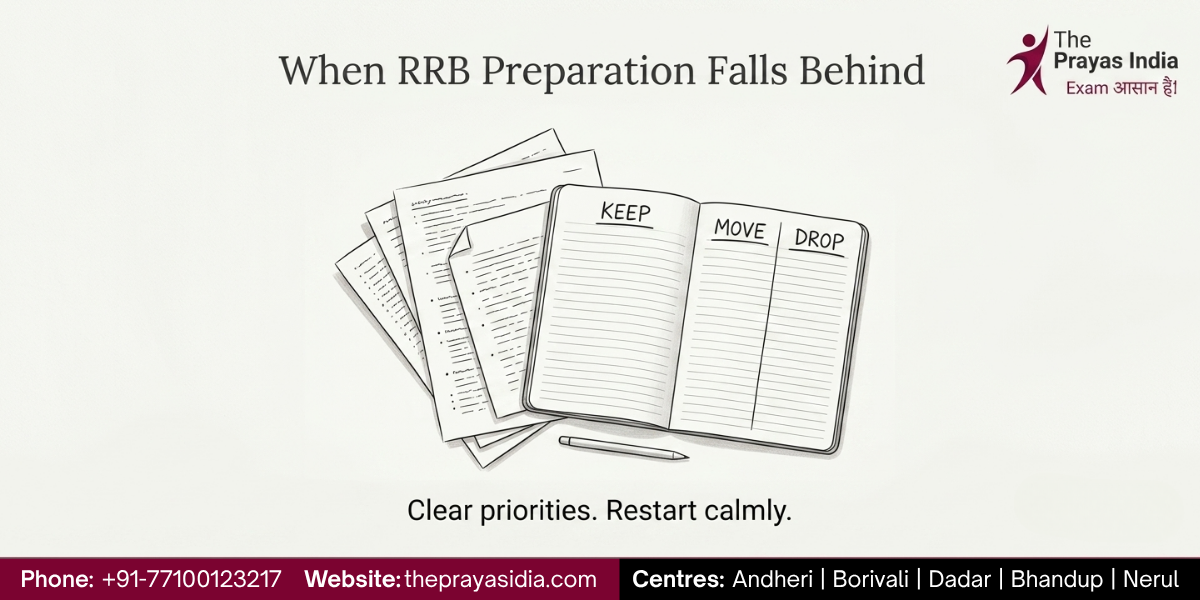
Instead, maintain a small backlog list and review it once a week. Divide unfinished tasks into those that are essential, those that can be postponed and those that are no longer relevant because your preparation has moved forward.
This last category is important. Not every missed task needs to be completed.
Sometimes a student spends valuable time finishing an old low-priority topic simply because it was originally written in the timetable. A flexible preparation plan should allow you to reassess priorities.
Create a Recovery Plan for Busy College or Work Weeks
There will be periods when your normal preparation routine becomes impossible.
College examinations, project submissions, office deadlines, travel or unexpected responsibilities can reduce your study time considerably.
Instead of considering such weeks a complete loss, switch temporarily to a maintenance routine.
The goal during a busy period is to preserve continuity. You might revise formulas, practise a short set of questions, review your error log or spend a limited amount of time on General Awareness.
Once the busy period ends, return to your regular schedule.
This prevents the common cycle of studying intensely for several days, becoming exhausted, stopping completely and then starting again from the beginning.
Use Your Weekly Off for High-Value Tasks
Your weekly off should not become an eight-hour punishment for everything you could not complete during the week.
Use it strategically.
A longer uninterrupted window is particularly valuable for activities that are difficult to complete in short sessions. Full-length mock tests, detailed analysis, difficult Reasoning sets, lengthy Quantitative Aptitude practice and comprehensive revision can be placed here.
At the same time, reserve some portion of the day for rest.
A productive weekly off should leave you prepared for the next week, not exhausted before it begins.
Build Revision Into the Schedule From the Beginning
Revision should not be postponed until the syllabus is complete.
When preparation continues for several months, topics studied at the beginning can become less familiar if they are not revisited.
Use short revision cycles throughout the week. Review formulas, important concepts, error-log entries and previously difficult questions at regular intervals.
This does not require rereading entire chapters every time.
The purpose of revision is to maintain recall while allowing most of your available time to move towards new learning and targeted practice.
For working professionals and college students, short revision windows can be especially effective because they can be integrated into mornings, commuting periods or lighter evenings.
Make Preparation Sustainable for Several Months
RRB preparation is not simply about creating an impressive schedule for the first few weeks. The real challenge is maintaining the routine long enough to cover the syllabus, practise sufficiently, revise and become comfortable with mock tests.
This is why sustainability should be treated as a preparation requirement.
A sustainable routine includes realistic study targets, sufficient sleep, regular breaks and flexibility for unavoidable responsibilities.
It also means accepting that some days will be more productive than others.
Instead of expecting perfect consistency, aim for consistent return. If a difficult week disrupts your schedule, return to preparation as soon as possible instead of waiting for a new month or a new Monday.
Use Technology to Reduce Wasted Study Time
Technology can be useful when it reduces friction in preparation rather than creating additional distractions.
Keep your study resources organised. Use digital notes where they genuinely save time, maintain a simple error log and use mock-test platforms to track performance where appropriate.
At the same time, avoid constantly switching between apps, channels and resources.
Every new resource creates a temptation to explore something else.
Busy aspirants benefit from a relatively limited resource set because their available preparation time is already restricted. The objective should be depth of practice rather than endless resource collection.
How Coaching Can Help College Students and Working Professionals
For some aspirants, the biggest problem is not a lack of motivation but a lack of structure.
When students are managing college or employment alongside RRB preparation, they may not have enough time to experiment with different books, classes, teachers and test strategies.
A structured coaching programme can reduce some of this decision-making burden by providing an organised academic pathway.
However, coaching should not replace self-study.
Classes introduce or clarify concepts, while individual practice builds application. Mock tests reveal performance gaps, while revision addresses them.
For students evaluating RRB Coaching in Mumbai, it is therefore useful to examine whether an institute offers a complete preparation ecosystem rather than simply a schedule of lectures.
The practical questions include whether the programme has suitable timings, quality study material, regular testing, doubt support, performance analysis and enough flexibility for students who have college or professional commitments.
Choosing RRB Coaching When You Have a Job or College
An aspirant with a full-time job has different requirements from someone who can study throughout the day. A college student may have an entirely different schedule again.
Therefore, the admission decision should begin with your own routine.
Ask yourself whether you need structured classes, better study material, regular testing, faculty guidance, accountability or help with planning.
Then evaluate coaching options based on those requirements.
The best programme is not necessarily the one with the longest timetable or the largest collection of resources. It is the one that helps you make effective use of the time you genuinely have.
This is particularly relevant when considering The Prayas India for RRB preparation. Students should assess the programme, schedule and academic support based on their individual requirements before deciding whether admission is appropriate.
Signs That You May Benefit From Structured RRB Preparation
You may want to consider professional guidance if you repeatedly experience the same preparation problems.
You might know what to study but struggle to create a workable schedule. You may keep changing resources because you are unsure which ones to trust. Your mock scores may remain stagnant because you cannot identify the underlying problem. Or you may understand concepts but lack consistency because college or work keeps disrupting your routine.
In such cases, structured coaching can potentially provide direction and accountability.
However, admission should remain a considered decision. If your existing self-study system is working well, coaching is not automatically necessary.
A Practical Weekly Model for a Busy RRB Aspirant
A simple weekly structure can look like this:
- Monday to Friday: Use short focused sessions for concepts, targeted practice and revision.
- One longer weekly session: Attempt a full-length mock under realistic conditions.
- After the mock: Analyse incorrect, skipped and time-consuming questions.
- Following sessions: Target the weaknesses identified through the analysis.
- Weekly review: Check what was completed, what remains pending and what should be prioritised next.
This structure can be adjusted according to your college timetable or work shifts.
The purpose is not to create a universal timetable. It is to create a repeatable system.
Final Takeaway
Balancing RRB preparation with college or a job requires a different definition of productivity.
You may not have the same number of study hours as a full-time aspirant, but you can make your available hours purposeful.
Build your week around your real commitments. Prioritise weak areas. Use short study windows for focused tasks and longer windows for mocks and deeper practice. Keep revision active throughout the preparation cycle and maintain a recovery routine for particularly busy weeks.
Most importantly, avoid measuring your preparation only through hours.
Measure progress through conceptual understanding, practice quality, accuracy, mock performance and the reduction of repeated mistakes.
If you can manage these elements independently, self-study may be sufficient. If you need direction, accountability or a structured testing environment, professional RRB coaching can become a useful option.
For aspirants considering RRB Coaching in Mumbai, make the admission decision based on your actual preparation needs, schedule and learning requirements.
The objective is not to find the timetable that looks the most impressive.
It is to build the preparation routine that you can actually sustain until the examination.
Contact Us
- Call Now: +91-77100 13217
- Website: theprayasindia.com
- Centres: Andheri | Borivali | Dadar | Nerul | Bhandup
Frequently Asked Questions
1. Can I prepare for RRB exams while working full-time?
Yes. Many working professionals prepare alongside their jobs by using shorter weekday study sessions and longer weekly-off sessions. The key is to build a realistic routine rather than trying to replicate a full-time aspirant's schedule.
2. How many hours should a working professional study for RRB exams?
There is no universal number of hours. The quality and consistency of study matter more than a fixed target. Even a limited number of focused hours can contribute significantly when used for targeted preparation.
3. Can college students prepare for RRB exams effectively?
Yes. College students can use mornings, evenings, weekends and suitable breaks according to their academic timetable. The preparation schedule should remain flexible around examinations, assignments and other academic responsibilities.
4. Should I join RRB coaching if I have very little time?
Coaching can be useful if you need structured guidance, organised study material or regular testing. Before taking admission, evaluate whether the class schedule and learning system genuinely fit your available time.
5. How can I manage RRB preparation with a full-time job?
Divide preparation into manageable blocks. Use your most focused periods for difficult topics, reserve shorter sessions for revision and use weekly offs for mocks, analysis and deeper practice.
6. How should I handle RRB preparation during college exams?
Temporarily reduce your preparation target and maintain a small revision routine if possible. Once your college examinations are over, return to your regular RRB schedule rather than trying to compensate through extreme study hours.
7. Should I take RRB mock tests every day?
Not necessarily. Mock frequency should depend on your preparation stage. More important than taking a large number of mocks is analysing each one and using the findings to improve subsequent performance.
8. What should I do if I have a large RRB preparation backlog?
Do not attempt to complete everything simultaneously. Categorise pending topics according to importance, prioritise high-impact areas and remove low-priority tasks that are no longer necessary.
9. How can I stay consistent with RRB preparation?
Keep your daily targets realistic, prepare a weekly plan and create a minimum routine for busy days. Consistency becomes easier when the schedule is achievable.
10. Is weekend study enough for RRB preparation?
Weekend study alone may not provide sufficient continuity for most aspirants. Ideally, combine shorter weekday sessions with longer weekend or weekly-off sessions.
11. What should I look for in RRB coaching in Mumbai?
Consider faculty, study material, mock tests, doubt support, revision structure, schedule flexibility and the overall academic system. If you are working or studying in college, ensure the programme fits your existing routine.
12. Can The Prayas India help working professionals prepare for RRB exams?
The Prayas India can be considered as one of the coaching options for RRB preparation. Before taking admission, students should evaluate the available academic support, schedule and preparation structure according to their individual requirements.