How to Crack RRB NTPC in 90 Days | Best RRB Coaching in Mumbai | The Prayas India
RRB NTPC is one of the most sought-after railway examinations for candidates looking for stable government-sector career opportunities. But preparing for a competitive examination like this is not simply about completing the syllabus. The real challenge is converting limited preparation time into measurable improvement in concepts, accuracy, speed and exam temperament.
For many aspirants, 90 days may appear to be a short preparation window. However, three months can still be used effectively when preparation is organised around clear priorities. Instead of trying to study everything every day, candidates should divide the period into phases and gradually move from concept building to intensive practice, mock tests and revision.
This is where a well-planned RRB NTPC 90 Days Strategy becomes important. The objective should not be to study for the maximum number of hours but to ensure that every week produces some measurable improvement.
For students preparing independently, the same principles can be applied through self-study. For those who struggle with planning, consistency, doubt solving or performance analysis, structured RRB NTPC Coaching Mumbai can provide an organised preparation environment.
Is 90 Days Enough to Crack RRB NTPC?
The answer depends largely on your starting level.
A candidate who already has experience preparing for SSC, banking or other competitive examinations may already have familiarity with Mathematics, Reasoning and general competitive-exam techniques. Such an aspirant can use the 90 days primarily for strengthening weak areas, practising questions, taking mocks and improving speed.
A beginner, on the other hand, may need to spend more time building fundamental concepts before moving into intensive test practice. That does not mean 90 days are useless. It means the preparation has to be more disciplined and the candidate cannot afford to spend several weeks studying without testing progress.
The first mistake to avoid is assuming that everyone needs the same timetable.
Before starting your RRB NTPC Preparation, take a diagnostic test. Do not worry about the score. The purpose is to understand your present position.
After the test, analyse your performance across four broad areas:
| Area | Questions to Ask |
|---|---|
| Concepts | Which topics do I genuinely not understand? |
| Accuracy | Where am I making avoidable mistakes? |
| Speed | Which sections or topics take too much time? |
| Retention | Which information do I forget despite studying it? |
This assessment gives you a starting point.
For example, if Mathematics is taking too much time but your accuracy is reasonable, your problem may be calculation speed rather than conceptual knowledge. If your Reasoning attempts are high but accuracy is poor, you may need better question selection and careful practice. If General Awareness scores fluctuate significantly, your preparation may need a stronger revision system.
The goal of the first week should therefore be diagnosis rather than blindly trying to complete as many chapters as possible.
What Should Your 90-Day Preparation Actually Look Like?
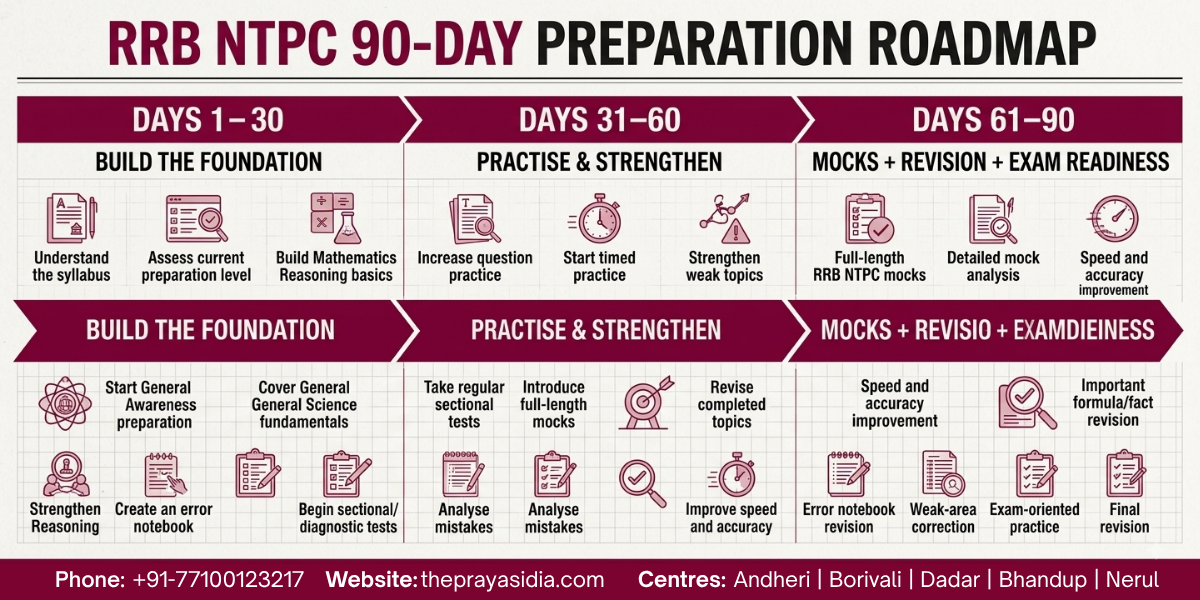
A practical RRB NTPC Preparation Strategy should be divided into three broad phases.
| Phase | Days | Main Objective | Preparation Focus |
|---|---|---|---|
| Phase 1 | 1–30 | Build the foundation | Concepts, basic practice and diagnosis |
| Phase 2 | 31–60 | Strengthen performance | Intensive practice, sectional tests and revision |
| Phase 3 | 61–90 | Become exam-ready | Full mocks, analysis, revision and speed |
These phases should not be treated as completely separate blocks. Revision should start from the first month, while testing should also begin early.
What changes is the proportion of time allocated to each activity.
During the first 30 days, concept learning may take the largest share of your study time. During the middle 30 days, practice and timed tests should become more important. During the final 30 days, full-length tests, revision and performance analysis should dominate.
This gradual transition is much more practical than following the same timetable for all 90 days.
Phase 1: Days 1–30 — Build a Strong Foundation
The first month should focus on building a reliable foundation.
One common mistake is to begin preparation with difficult questions and shortcuts because they appear more productive. In reality, shortcuts are useful only after the underlying concepts are understood.
Start by mapping the syllabus into smaller topics. Mark each topic as strong, average or weak. This gives you a realistic picture of where your time needs to go.
For every topic you study, follow a simple sequence:
Understand the concept → Solve basic questions → Practise mixed questions → Attempt timed questions → Record mistakes
This process prevents passive learning.
Mathematics During the First 30 Days
Your RRB NTPC Maths Preparation should begin with conceptual clarity. Topics that involve calculations should receive regular practice because mathematical speed generally improves through repetition.
Do not spend an entire day watching lectures or reading explanations. After learning a concept, immediately solve questions based on it. If you cannot solve them without looking at the solution, return to the concept and identify exactly where the difficulty lies.
Maintain a separate formula and mistake notebook. However, do not fill it with every formula you encounter. Include formulas and approaches that you actually tend to forget or misuse.
Calculation practice should also become part of your daily routine. Even a short, consistent calculation session can be more useful than doing large amounts of untimed practice once a week.
Reasoning During the First 30 Days
RRB NTPC Reasoning Preparation requires a combination of understanding and pattern recognition.
Initially, accuracy is more important than speed. When you encounter a new question type, take time to understand the logic behind the solution. Once you become familiar with it, start solving similar questions with a time limit.
Avoid randomly solving hundreds of questions without analysing your performance. If you repeatedly make the same mistake, more questions alone will not necessarily solve the problem. You need to understand why the mistake is occurring.
General Awareness During the First 30 Days
General Awareness needs a different study strategy because the subject involves a large amount of information.
The biggest danger is trying to consume too much material. Candidates often collect multiple books, PDFs, videos and current-affairs sources and end up revising none of them properly.
Choose a manageable source and build concise notes. The objective should be repeated exposure and recall rather than reading the maximum amount of information.
A useful approach is to divide your preparation material into smaller revision units. Instead of waiting until the end of the month to revise everything, revisit previous topics regularly.
General Science During the First 30 Days
For RRB NTPC General Science Preparation, focus on fundamental understanding and important factual information.
Science becomes easier to retain when concepts are connected to basic principles rather than memorised as disconnected statements. After studying a topic, solve practice questions to check whether you can apply or recall what you studied.
Maintain short revision notes for information that requires repeated recall.
Phase 1 Weekly Structure
The first month can be divided into four weekly objectives.
| Week | Primary Focus | Expected Outcome |
|---|---|---|
| Week 1 | Diagnostic test + syllabus mapping | Identify strengths and weaknesses |
| Week 2 | Core concepts + basic practice | Build fundamentals |
| Week 3 | Wider topic coverage + practice | Increase question familiarity |
| Week 4 | Revision + sectional testing | Identify first performance gaps |
The important point is that Week 4 should not be used simply to rush through unfinished chapters. Use it to evaluate whether the topics already studied are actually producing results.
If your mock or sectional test shows that you have forgotten a topic studied two weeks earlier, that is a revision problem. If you understand the concept but cannot solve questions quickly, that is a practice or speed problem.
Identifying the type of problem is more valuable than simply recording the score.
Phase 2: Days 31–60 — Convert Knowledge into Performance
The second month marks the transition from learning to performance.
By this point, you should already have covered a substantial portion of the important concepts. Now the question changes from “What should I study?” to “Can I solve questions accurately under time pressure?”
This is where your preparation should become more test-oriented.
Topic-wise practice should gradually be replaced by mixed practice. For example, instead of solving only one type of Mathematics question for a long period, combine different topics in a timed set. This forces your brain to identify the appropriate method rather than solving questions in a predictable sequence.
The same approach should be applied to Reasoning.
At this stage, sectional tests become increasingly important because they reveal whether your preparation works under time constraints.
Why Timed Practice Matters
A candidate may perform extremely well during relaxed practice and still struggle in a mock test.
The reason is simple: examination conditions change the way you solve questions.
Under time pressure, you have to make decisions quickly. You cannot spend several minutes trying to understand one difficult question. You have to decide whether to solve it immediately, leave it for later or skip it.
This is why RRB NTPC Time Management should be developed before the final weeks.
Timed practice teaches you to recognise familiar patterns quickly and prevents individual questions from consuming disproportionate amounts of time.
However, do not confuse speed with rushing.
If increasing your speed causes accuracy to fall sharply, slow down and identify the underlying issue. The ideal objective is to develop RRB NTPC Speed and Accuracy together.
How to Divide Your Study Time
Your daily schedule should reflect your weaknesses rather than following an arbitrary fixed formula.
For a full-time aspirant, approximately 6–8 focused study hours can provide a practical framework. Candidates with college, work or other responsibilities may have fewer hours available and should create a schedule around their actual availability.
A sample structure could look like this:
| Study Block | Suggested Focus |
|---|---|
| Session 1 | Mathematics concepts + practice |
| Session 2 | Reasoning practice |
| Session 3 | General Awareness |
| Session 4 | General Science |
| Session 5 | Timed practice / sectional test |
| Session 6 | Revision + error analysis |
These sessions do not have to follow the exact same timings every day.
What matters is that your daily schedule contains four essential elements: learning, practice, testing and revision.
For example, spending six hours only watching lectures is not equivalent to six hours of preparation. Similarly, solving questions continuously without revising mistakes can create the illusion of productivity without addressing weaknesses.
A Better Weekly Study Cycle
Instead of measuring preparation only in hours, measure it through weekly outcomes.
At the beginning of the week, identify three priorities. These might be completing particular Mathematics topics, improving Reasoning accuracy and revising a specific portion of General Awareness.
During the week, track completion and performance.
At the end of the week, spend some time reviewing your results.
Ask:
- Which topics did I complete?
- Which topics still feel weak?
- What was my sectional-test accuracy?
- Which mistakes repeated?
- Did my solving time improve?
- Which topic needs more time next week?
This creates a feedback loop.
Without weekly review, students often continue following the same schedule even when it is not producing improvement.
Subject-Wise Time Allocation in a 90-Day Strategy
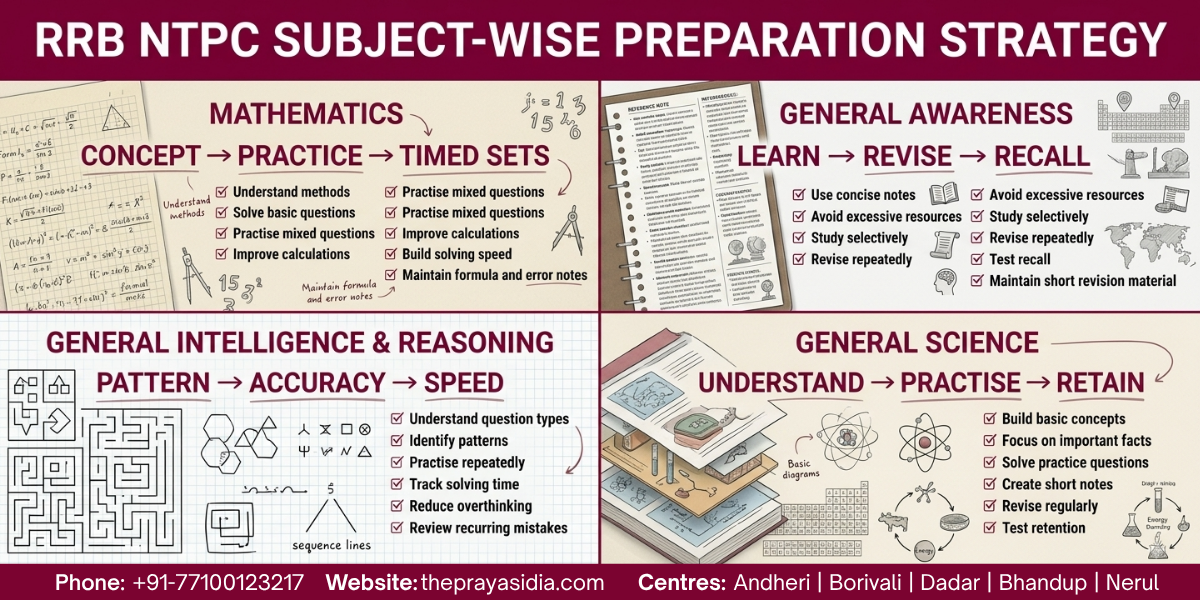
There is no single perfect percentage for every aspirant. Still, a balanced starting framework can help.
| Subject/Activity | Approximate Priority |
|---|---|
| Mathematics | High |
| General Intelligence & Reasoning | High |
| General Awareness | High and continuous |
| General Science | Moderate and continuous |
| Mock Tests & Sectional Tests | Increasing priority |
| Revision & Error Analysis | Essential throughout |
The important word is continuous.
General Awareness should not be postponed until the final month. Likewise, revision should not be treated as something you will “do after completing the syllabus.”
A 90-day plan has very little room for forgetting what was studied in the first 30 days.
How to Handle Weak Subjects Without Losing Time
Weak subjects create a psychological problem as well as an academic one. Students often avoid difficult topics because they are uncomfortable with them. This gives temporary relief but makes the weakness more dangerous as the examination approaches.
The solution is to break a weak subject into smaller problems.
Instead of saying, “My Maths is weak,” identify the exact issue. Perhaps arithmetic calculations are slow, certain concepts are unclear, or you make mistakes when solving under pressure.
Similarly, instead of saying, “General Awareness is difficult,” identify whether the problem is lack of coverage, poor retention or insufficient revision.
Once a weakness becomes specific, it becomes easier to solve.
Use short targeted practice sessions rather than spending entire days on a weak subject. Continue maintaining your stronger subjects so that they do not deteriorate while you are repairing weaker areas.
When Should Mock Tests Enter Your Preparation?
Mock tests should not be reserved for the last 15–20 days.
The nature of testing should simply change as your preparation progresses.
In the first month, diagnostic and sectional tests can help you identify weaknesses. During the second month, sectional tests and occasional full-length tests can help you develop time management. In the final month, full-length mocks should become a major part of your preparation.
A useful principle is:
Early stage: Test to identify.
Middle stage: Test to improve.
Final stage: Test to simulate.
This distinction prevents candidates from becoming obsessed with mock scores too early.
A low score in an early diagnostic test is not necessarily a problem. What matters is whether you understand why the score is low and whether your subsequent preparation addresses those weaknesses.
What Should You Look for Before Joining RRB Coaching in Mumbai?
If you are considering professional guidance, do not choose an institute simply because it is described as the Best RRB Coaching in Mumbai or the Top RRB Coaching in Mumbai.
The more important question is whether the institute provides the kind of structure you need during your preparation period.
Before taking admission, evaluate factors such as faculty accessibility, class schedule, study material, practice assignments, mock-test frequency, doubt-solving support, mentorship and performance analysis.
Also consider whether the coaching system leaves enough time for self-study. Coaching classes should support preparation, not consume so much time that you cannot revise and practise independently.
For a 90-day preparation plan, structure becomes particularly important. You should be able to understand what will be taught, when it will be revised, when tests will be conducted and how your performance will be evaluated.
A good Railway Exam Coaching in Mumbai should therefore be assessed as a complete preparation system rather than simply as a classroom.
Phase 3: Days 61–90 — Mock Tests, Revision & Exam Readiness
Is phase mein focus new syllabus complete karne se zyada performance stabilise karne par hona chahiye. Ab tak concepts aur substantial practice ho chuki honi chahiye, isliye preparation ka centre full-length mocks, detailed analysis, revision, speed and accuracy improvement aur weak-area correction hona chahiye.
Days 61–75:
Full-length mocks + sectional tests + detailed analysis + weak-topic practice.
Days 76–85:
Frequent exam-oriented mocks + error notebook revision + important formulas/facts + time-management refinement.
Days 86–90:
Final revision + recurring mistakes + short notes + selected practice + exam-readiness routine.
How to Analyse Your RRB NTPC Mock Tests
Taking an RRB NTPC Mock Test is only half of the process. The more important half begins after you submit the test.
Many aspirants look at their score, check a few incorrect answers and immediately start preparing for the next mock. This approach can create the appearance of regular testing without producing meaningful improvement. A mock test should tell you exactly what needs to change in your preparation.
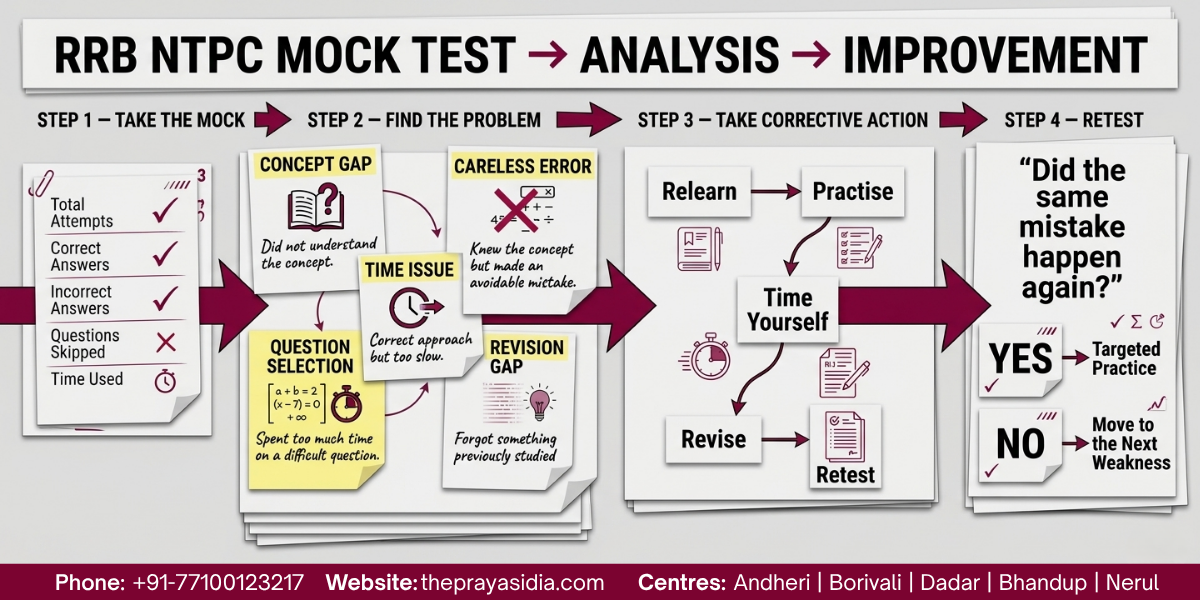
After every serious mock, divide your performance into four categories: questions you answered correctly, questions you answered incorrectly, questions you left unanswered and questions that consumed excessive time.
The last category is particularly important. A question can be correct and still be a problem if it takes too long. In a competitive examination, the time spent on one question can affect several other questions.
A useful RRB NTPC Mock Test Analysis system is to classify every important mistake.
| Problem | Possible Reason | Corrective Action |
|---|---|---|
| Wrong answer | Concept not clear | Relearn the concept |
| Wrong calculation | Careless approach | Practise calculations |
| Correct but slow | Method inefficient | Timed practice |
| Question left | Lack of confidence | Practise similar questions |
| Repeated mistake | Weak revision | Add to revision cycle |
| Easy question missed | Poor question selection | Improve test strategy |
Do not simply write “wrong answer” in your notebook. Write why it was wrong.
For example, if you incorrectly solve a percentage question because you applied the wrong method, record the method. If you knew the method but made a calculation error, record that separately. These two mistakes require different solutions.
Over time, your error notebook should reveal patterns. If the same type of error appears repeatedly, that topic deserves additional attention.
How to Improve Speed and Accuracy Together
Speed is one of the most discussed aspects of competitive-exam preparation, but speed should never be developed independently of accuracy.
Suppose a candidate increases attempts significantly but also makes many avoidable mistakes. The higher attempt count does not necessarily represent better performance.
The better objective is to increase the number of questions you can solve correctly within the available time.
Start by improving familiarity. When you repeatedly solve similar question types, the time required to identify the method usually decreases naturally.
Next, work on calculation efficiency. This is particularly important for Mathematics. You should become comfortable with basic calculations so that simple arithmetic does not consume unnecessary time.
Finally, improve question selection. Not every question deserves immediate attention. A strong test-taking strategy involves recognising which questions are straightforward, which require moderate effort and which should be postponed.
During practice, try using three broad categories:
First priority: Questions you can solve confidently and quickly.
Second priority: Questions that require some calculation or thinking but are manageable.
Third priority: Questions that appear time-consuming, confusing or unfamiliar.
This approach helps prevent one difficult question from disrupting your entire section.
How to Build Better Time Management
Time management should be practised before the final examination.
Start by observing how much time you naturally spend on each section or question type. You may discover that one area is consuming a disproportionate amount of your test time.
Once you identify the issue, use sectional tests to correct it.
Do not attempt to copy another candidate’s exact time allocation. Your strategy should develop according to your strengths and weaknesses.
For example, a candidate who is strong in Reasoning may be able to complete that section relatively quickly and reserve additional attention for Mathematics. Another candidate may have the opposite profile.
The important thing is to develop a reliable approach through repeated testing.
How to Revise Effectively During 90 Days
Revision should not begin after the syllabus is completed. It should happen alongside learning.
A simple revision cycle can be:
First Revision: Within a few days of learning a topic.
Second Revision: After approximately one to two weeks.
Third Revision: During the relevant mock-test or sectional-test phase.
Final Revision: During the last two weeks.
The exact timing can vary, but the principle remains the same: revisit information before it becomes completely unfamiliar.
For General Awareness and General Science, repeated short revision sessions can be particularly useful. For Mathematics and Reasoning, revision should include problem-solving rather than only reading notes.
If you solved a topic successfully three weeks ago, that does not automatically mean you can solve it under exam pressure today. Revision should therefore test recall and application.
The Importance of an Error Notebook
A well-maintained error notebook can become one of the most valuable resources during the final weeks.
It should not become another huge book. Keep it concise.
Include:
- Formulas you repeatedly forget
- Question types you repeatedly misunderstand
- Common calculation mistakes
- Important facts that are difficult to retain
- Questions where your approach was inefficient
- Mistakes repeated across multiple tests
The advantage is that your final revision becomes personalised.
Instead of revising an entire book again, you can spend time reviewing the areas that have historically caused problems for you.
This is especially useful during a 90-day preparation window because time is limited.
Common Mistakes Aspirants Make During 90-Day Preparation
A short preparation period increases the cost of poor planning. Some mistakes are particularly common among candidates preparing for railway examinations.
Trying to Complete Everything Before Starting Tests
Some candidates postpone tests because they believe they need to finish the entire syllabus first. This is a mistake.
Testing is not only for measuring final preparation. It is also a way of identifying weaknesses. Start testing early and increase the intensity as preparation progresses.
Changing Study Resources Too Frequently
There are countless books, videos, PDFs, apps and test series available today. More resources do not automatically mean better preparation.
Frequent switching can create fragmented learning. Choose a manageable set of resources and use them consistently.
Focusing Only on Comfortable Subjects
It is easy to spend more time on subjects you enjoy because they produce a sense of progress. Weak subjects often remain untouched because they are uncomfortable.
Your schedule should give adequate attention to weaknesses without completely neglecting your strengths.
Ignoring Previous Mistakes
A mistake that is corrected once but never revisited can easily return.
Repeated mistakes should be treated as signals. If the same error appears in several tests, your preparation system needs to change.
Studying for Extremely Long Hours
Long study hours can be useful only when they are sustainable and productive.
A candidate who studies intensely for three days and then struggles to maintain the schedule for the next four days has not created a reliable preparation system.
Consistency is particularly important during a 90-day plan.
Collecting Rather Than Studying
Saving PDFs, joining multiple groups and downloading study material can create the feeling of preparation without actual learning.
The important question is not how much material you possess. It is how much you can recall and apply during a test.
When Should You Consider RRB Coaching?
There is no rule that every RRB NTPC aspirant must join coaching. Some students are capable of building and following an effective preparation system independently.
However, coaching can become useful when the difficulty is not simply understanding a topic but managing the complete preparation process.
Consider professional guidance if you find yourself repeatedly struggling with:
- Creating and following a realistic study schedule
- Identifying the right topics to prioritise
- Understanding difficult concepts
- Maintaining consistent practice
- Finding suitable mock tests
- Analysing test performance
- Revising systematically
- Solving doubts efficiently
- Maintaining accountability
The value of coaching is therefore not limited to classroom lectures.
For a candidate with only 90 days, structured guidance can reduce the time spent experimenting with different preparation methods.
What to Look for in the Best RRB Coaching in Mumbai
Searching for the Best RRB Coaching in Mumbai should not begin and end with advertisements or promotional rankings.
Before taking admission, look at the actual preparation system.
Faculty and Teaching Approach
Faculty should be able to explain concepts clearly and help students understand how those concepts translate into examination questions.
The teaching style should also leave enough room for practice and revision.
Study Plan
A structured syllabus schedule is important when you have a limited preparation window. You should know how the course moves from concepts to practice, tests and revision.
Mock Tests
Ask how frequently tests are conducted and whether students receive meaningful performance feedback.
A test series is more useful when it helps you identify where improvement is required.
Doubt Solving
Difficult questions should not remain unresolved for days. An accessible doubt-solving mechanism can help prevent small conceptual gaps from becoming larger weaknesses.
Mentorship
Mentorship can help students understand what to prioritise when their performance changes.
A candidate may need additional practice in one month and more revision in another. A structured mentor-led approach can help make these adjustments.
Self-Study Support
Coaching should complement self-study. Check whether the schedule and workload allow sufficient time for independent practice.
Location and Accessibility
Mumbai involves significant travel time. Andheri, Borivali, Dadar, Nerul and Bhandup are geographically different areas, so convenience can influence consistency.
A coaching centre that fits realistically into your daily routine is more useful than one that creates excessive travel-related fatigue.
Why Structured Mentorship Can Help During a 90-Day Preparation
The biggest advantage of structured preparation is often clarity.
When studying alone, an aspirant may spend several days trying to decide which topic to study, which resource to use or which mock test to attempt. These decisions may seem small, but repeated uncertainty consumes preparation time.
A structured system can provide a sequence:
Learn → Practise → Test → Analyse → Revise
The student can then spend more energy on actual preparation rather than repeatedly rebuilding the study plan.
Mentorship is also useful when performance does not improve as expected.
Suppose your mock scores remain stagnant despite studying for several hours every day. The answer may not be “study more.” The problem could be inefficient revision, poor question selection, lack of mock analysis or inadequate practice in specific topics.
An experienced faculty or mentor can help identify such patterns.
Why Consider The Prayas India for RRB NTPC Preparation?
Candidates looking for RRB Coaching Mumbai can consider The Prayas India if they prefer a structured preparation environment supported by guidance, practice and mentorship.
The purpose of joining an institute should not be to outsource preparation. The candidate still needs to practise independently, revise consistently and analyse mock tests.
Instead, coaching can provide a framework around these activities.
For a 90-day strategy, a structured environment can be particularly useful because the preparation has to move through several stages within a limited period. Concept building, question practice, testing and revision need to happen in the right sequence rather than randomly.
The Prayas India can be considered by aspirants who want this kind of organised preparation approach for railway examinations.
Its Mumbai centres include Andheri, Borivali, Dadar, Nerul and Bhandup, giving students options based on location and convenience.
Before taking admission, however, candidates should evaluate the course structure, faculty support, batch timings, test system, study material, doubt-solving process and mentorship according to their individual requirements.
There should be no expectation of a guaranteed result simply because an aspirant joins coaching. Selection still depends on preparation quality, consistency and examination performance.
The right coaching institute should instead help create an environment in which serious preparation becomes easier to organise and sustain.
Final 15-Day RRB NTPC Revision Strategy
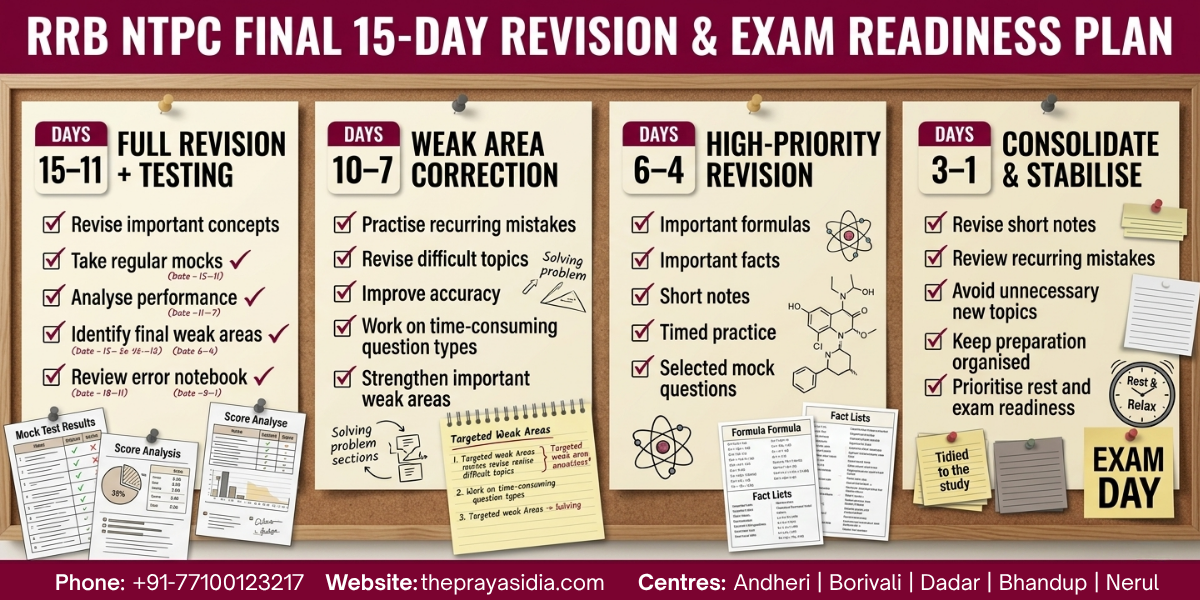
The final 15 days should be treated as a consolidation period.
This is not the ideal time to completely change your preparation strategy or start collecting new resources.
Your priority should be to revise what you already know, strengthen frequently tested areas, analyse your remaining mocks and reduce avoidable mistakes.
Days 15–11: Full Revision and Testing
Continue full-length or appropriate practice tests and analyse them carefully.
Revise important formulas, concepts and facts. Review your error notebook and identify mistakes that continue to appear.
Days 10–7: Focus on Weak Areas
At this stage, do not attempt to repair every weakness in the syllabus.
Prioritise weaknesses that are realistic to improve within the remaining time.
If a topic is repeatedly causing mistakes but can be corrected through focused practice, work on it. If a completely unfamiliar area requires extensive study, consider whether the time investment is justified.
Days 6–4: High-Priority Revision
Reduce the amount of new learning.
Focus on short notes, important formulas, factual revision and selected practice questions.
Your revision should become faster and more targeted.
Days 3–2: Consolidation
Review the material you have personally marked as important.
Go through your error notebook, formulas, difficult facts and recurring mistakes.
Avoid unnecessary experimentation with new resources.
Final Day: Keep Preparation Light
The final day should not be turned into an all-night study session.
Review only high-value material and ensure that you are mentally prepared for the examination.
Your objective at this point is not to increase the size of your syllabus. It is to enter the examination with a stable and organised approach.
A Simple 90-Day Performance Framework
The entire preparation can be remembered through five stages:
| Stage | Question You Should Ask |
|---|---|
| Learn | Do I understand the concept? |
| Practise | Can I solve questions correctly? |
| Time | Can I solve them within a reasonable time? |
| Test | Can I perform under exam conditions? |
| Analyse | What exactly should I improve next? |
This framework prevents preparation from becoming a collection of disconnected activities.
If you are studying Mathematics, do not stop at understanding formulas. Practise them. If you are taking mocks, do not stop at checking scores. Analyse them. If you identify a weak topic, do not simply mark it as weak. Create a plan to improve it.
That is how preparation becomes measurable.
Final Takeaway: Make Your 90 Days Count
Cracking RRB NTPC in 90 days requires more than a timetable. It requires a system that continuously connects learning with practice, testing, analysis and revision.
The first 30 days should establish your foundation. The next 30 should turn that knowledge into performance through intensive practice and timed tests. The final 30 should focus increasingly on mock tests, analysis, revision, speed and exam readiness.
At the same time, do not compare your preparation blindly with another aspirant’s schedule. A beginner and an experienced competitive-exam candidate will not have the same requirements. Your study plan should be based on your starting level and performance data.
For candidates who can organise their preparation independently, disciplined self-study remains a viable option. But if you are struggling to maintain structure, identify weaknesses, find the right practice material, analyse mocks or stay accountable, professional guidance can add value.
This is where choosing the right RRB Coaching in Mumbai becomes important. Look beyond the label of “best” or “top” and examine the actual system offered by the institute: faculty guidance, structured planning, practice, mock tests, doubt solving, performance analysis, mentorship and revision support.
For aspirants considering an organised preparation environment, The Prayas India is an option worth evaluating for RRB NTPC and railway exam preparation in Mumbai. With centres across Andheri, Borivali, Dadar, Nerul and Bhandup, students can consider the location that best fits their routine while evaluating the course and support system on its actual merits.
Ultimately, coaching can provide structure, but the candidate has to convert that structure into preparation. The 90-day period should therefore be approached as a measurable project.
Know your starting level. Set weekly targets. Practise consistently. Analyse every important test. Revise before you forget. Correct recurring mistakes. Gradually improve speed without sacrificing accuracy.
That is the practical foundation of a strong RRB NTPC Preparation Strategy.
And if you decide to take professional guidance, choose an institute not because it promises an easy route, but because its preparation system helps you use your limited time more effectively.
Contact Us
📞 Call Now: +91-77100 13217
🌐 Website: theprayasindia.com