
How to Improve Calculation Speed for SBI Clerk Prelims | Best Bank Coaching in Mumbai | The Prayas India
Preparing for the SBI Clerk Prelims is not only about learning formulas or completing the syllabus. One of the biggest factors that separates high scorers from average performers is calculation speed. Many candidates understand concepts perfectly but lose valuable marks because they spend too much time on basic calculations, percentage conversions or lengthy arithmetic operations. Since the SBI Clerk Preliminary Examination gives candidates only 20 minutes for Numerical Ability, every second matters.
The challenge becomes even greater because the Numerical Ability section includes 35 questions, and every wrong answer attracts one-fourth negative marking. This means candidates need both speed and accuracy—not rushed solving. The official SBI Junior Associate examination pattern confirms that Numerical Ability carries 35 questions for 35 marks with a separate 20-minute time limit, making efficient calculation an essential skill for clearing the examination.
For aspirants looking for Best Bank Coaching in Mumbai, preparation should therefore focus on building calculation efficiency from the beginning rather than trying to improve speed only during the final weeks. At The Prayas India, students can develop this skill through structured concept-building, calculation drills, topic-wise practice and mock-test analysis that gradually transform slow calculations into confident exam-day performance.
Why Calculation Speed Matters More Than You Think
Many SBI Clerk aspirants believe that solving difficult questions is the key to improving their score. In reality, a significant amount of time is often lost on simple calculations. Spending ten extra seconds on multiple questions can eventually cost several attempts by the end of the section.
For example, if a candidate repeatedly pauses to calculate percentage values, multiplication or fraction conversions, the total time lost can become substantial. Even candidates who know the correct method may fail to maximise their score simply because execution is slow.
This is why calculation speed should be viewed as a foundational exam skill rather than an advanced trick. A student who performs routine calculations confidently can spend more time on questions that genuinely require reasoning instead of wasting valuable seconds on arithmetic.
At The Prayas India, this philosophy becomes an important part of SBI Clerk preparation. Instead of encouraging students to memorise countless shortcuts immediately, preparation should first build reliable calculation habits that remain useful across Quantitative Aptitude topics.
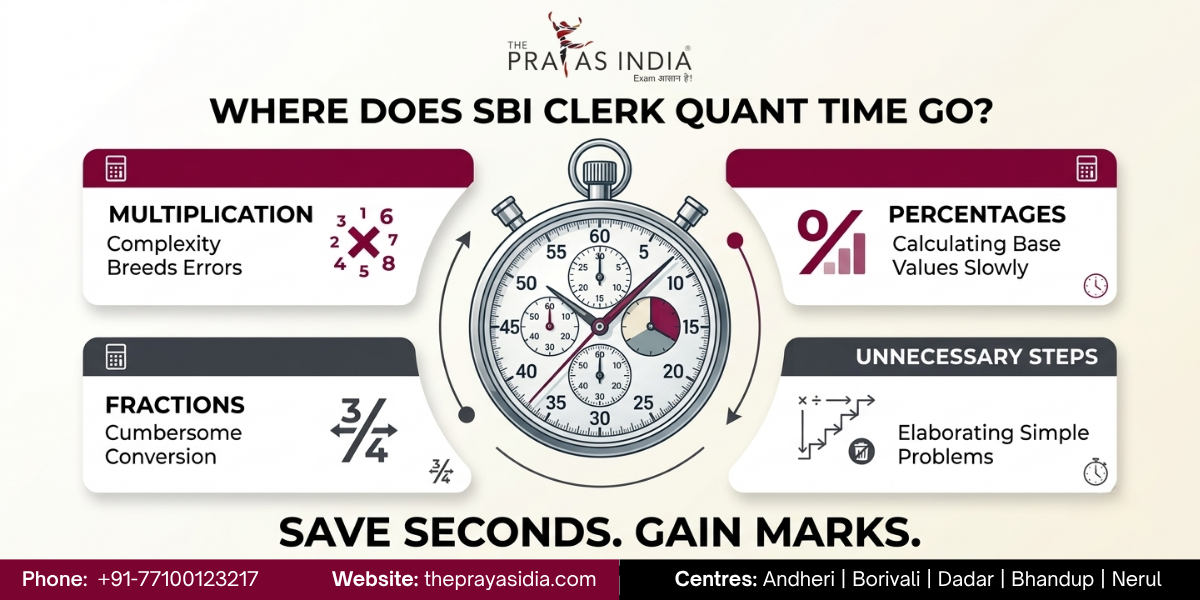
Understand Where Time Is Actually Lost
Before trying to become faster, students should identify exactly why they are slow.
Some candidates lose time because multiplication tables are not automatic. Others struggle with percentage-fraction conversions. Some repeatedly write unnecessary calculation steps, while others hesitate because they are unsure which method to use.
The solution is not the same for everyone.
A useful preparation strategy is to observe your performance during practice sessions and identify recurring delays. Questions such as these can help:
- Do I take too long to multiply two-digit numbers?
- Do percentage calculations slow me down?
- Do I rewrite calculations unnecessarily?
- Do I hesitate before selecting a method?
- Do I spend extra time verifying easy answers?
Once these patterns become visible, improvement becomes much more targeted.
Rather than practising randomly, The Prayas India can help students focus on the calculation habits that actually affect their SBI Clerk performance.
Strong Basics Create Faster Calculations
A surprising number of candidates try to improve speed by learning advanced shortcuts before strengthening basic arithmetic. This often creates confusion because shortcuts work best when the underlying calculations are already comfortable.
Instead, preparation should begin with strengthening the calculations that appear repeatedly across the SBI Clerk syllabus.
Students should become increasingly comfortable with:
- Multiplication and division
- Percentage calculations
- Fraction-decimal-percentage conversions
- Squares and cubes
- Approximation
- Ratio calculations
These skills do not belong to just one chapter. They appear across Simplification, Arithmetic, Data Interpretation and Number Series.
At The Prayas India, this interconnected preparation approach helps students build calculation confidence that supports multiple Quant topics rather than improving only one chapter.
Percentage and Fraction Conversions Should Become Automatic
One of the biggest opportunities for improving calculation speed is reducing the time spent converting percentages into fractions and vice versa.
Instead of calculating everything from scratch, candidates should become familiar with commonly used relationships.
For example:
| Percentage | Fraction |
|---|---|
| 50% | 1/2 |
| 25% | 1/4 |
| 20% | 1/5 |
| 10% | 1/10 |
| 75% | 3/4 |
The goal is not to memorise an endless chart. The objective is to become so familiar with common values that they can be recognised instantly during the examination.
When students repeatedly practise these relationships, calculations become noticeably smoother.
This is one reason structured coaching at The Prayas India can make practice more effective—students repeatedly apply these conversions across different question types instead of learning them only theoretically.
Calculation Drills Build Long-Term Speed
Many students solve full Quant questions every day but never practise calculations independently. As a result, they improve concepts but not execution.
Short daily calculation drills can gradually strengthen speed without requiring long study sessions.
A useful drill can include:
- Quick multiplication
- Percentage conversions
- Approximation
- Square recognition
- Fraction comparisons
The purpose is not to create pressure. The purpose is to make familiar calculations require less mental effort.
Over several weeks, these small improvements begin to reduce solving time across the entire Numerical Ability section.
At The Prayas India, these calculation drills can become part of a broader SBI Clerk preparation routine rather than existing as isolated exercises.
Learn to Eliminate Unnecessary Calculation
Another important way to improve speed is learning when not to calculate everything exactly.
Many SBI Clerk questions allow candidates to eliminate options or simplify relationships before performing detailed calculations.
For example, ratio relationships, approximation-based comparisons or obvious option elimination can reduce unnecessary work.
However, students should be careful not to overuse approximation where exact calculation is required. The key is recognising which questions genuinely benefit from a faster approach.
This judgement develops through repeated exposure, topic-wise practice and mock-test analysis.
Rather than treating every question as a lengthy mathematical exercise, students should learn to identify the shortest reliable path to the correct answer.
Build Calculation Confidence Before Chasing Timers
Many aspirants immediately start timing themselves and become discouraged when they cannot finish quickly.
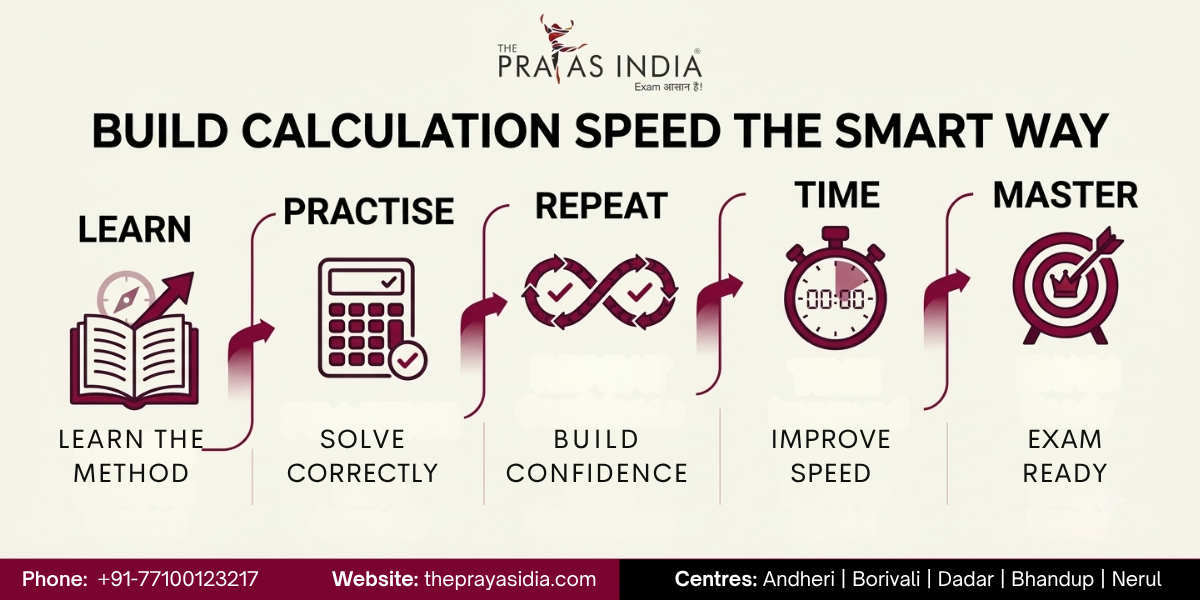
A better sequence is:
- Learn the method.
- Practise accurately.
- Repeat the calculation.
- Introduce a timer.
- Improve gradually.
This progression prevents unnecessary frustration and creates sustainable improvement.
At The Prayas India, students can build calculation confidence first and then transition into timed practice, making speed improvement more natural instead of forced.
Why Structured Practice Makes a Difference
Many SBI Clerk aspirants spend months studying Quant but still struggle to improve their calculation speed because their practice lacks direction. Solving random questions from different sources often creates activity without measurable progress.
A structured preparation system helps students connect concept learning, calculation drills, topic-wise practice and timed testing into one continuous improvement cycle.
At The Prayas India, this approach can help banking aspirants gradually transform slow calculations into faster and more accurate execution, making Numerical Ability a stronger scoring section instead of a time-consuming challenge.
Topic-Wise Calculation Strategy for SBI Clerk Prelims
Calculation speed becomes genuinely useful when it is applied across the topics that appear in the Numerical Ability section. Candidates should therefore avoid treating calculation practice as a separate activity that has no connection with the actual syllabus. The objective is to make arithmetic execution faster while solving the same types of questions that are likely to appear in the examination.
The SBI Clerk Preliminary Examination gives Numerical Ability a separate 20-minute window for 35 questions. The official SBI pattern also specifies one-fourth negative marking for an incorrect answer. This makes the ability to calculate quickly while maintaining accuracy particularly important.
Simplification and Approximation: The First Speed-Building Area
Simplification and approximation are among the most useful areas for developing calculation speed because they repeatedly expose students to basic arithmetic operations. Instead of simply trying to finish these questions quickly, candidates should focus on reducing unnecessary written calculations.
Start by strengthening multiplication, division, addition and subtraction with numbers that commonly appear in banking examinations. Then gradually introduce fractions, percentages, decimals and approximation. The objective is to recognise familiar numerical relationships instead of calculating every value from the beginning.
For approximation questions, students should also learn how much precision is actually necessary. Carrying several decimal places when the answer options are widely separated wastes time. However, approximation should never become careless estimation. The right approach is to simplify only as much as the question safely permits.
Number Series: Recognise Before You Calculate
Number Series questions can become time-consuming when candidates immediately begin performing multiple calculations without first identifying the pattern. Calculation speed is therefore connected with pattern recognition.
Before calculating every consecutive difference, examine whether the series may involve addition, subtraction, multiplication, division, squares, cubes or a combination of operations. With regular practice, the brain begins to recognise common structures faster.
The goal is not to memorise hundreds of possible patterns. It is to develop the habit of looking at a sequence strategically before committing time to detailed calculations.
Arithmetic: Reduce the Calculation Burden
Arithmetic topics such as Percentage, Ratio and Proportion, Average, Profit and Loss, Simple and Compound Interest, Time and Work, and Time, Speed and Distance often require multiple steps. Here, calculation speed alone cannot solve the problem. Candidates must first understand the relationship between the quantities involved.
For example, percentage-fraction conversions can significantly reduce the work involved in many percentage questions. Similarly, familiar ratio relationships can make proportion-based calculations faster. In Time and Work, understanding the concept of work efficiency can eliminate unnecessary calculations.
This is where structured preparation becomes important. At The Prayas India, students preparing for banking examinations can work on conceptual clarity and calculation efficiency together instead of treating them as completely separate skills.
Data Interpretation: Calculate Selectively
Data Interpretation is another area where calculation speed can directly affect the number of questions a candidate attempts. However, the fastest solver is not necessarily the candidate who performs every calculation manually. The stronger approach is to first understand what the question is asking and then calculate only what is required.
Students should practise reading tables, charts and numerical data quickly. They should also become comfortable with percentages, ratios, averages and comparisons because these operations frequently form the basis of DI questions.
During practice, ask yourself whether the question requires an exact value or whether the options allow a faster route. Over time, this develops the ability to distinguish between calculations that deserve detailed attention and those that can be simplified.
Build a Daily Calculation Routine
Calculation speed improves through repetition, but repetition must be consistent. A student who practises calculations for several weeks and then stops is unlikely to retain the same level of fluency.
A practical daily routine can begin with a short calculation warm-up. Spend a few minutes on multiplication, fraction-percentage conversions, squares and basic arithmetic. Follow this with topic-wise questions and finish with a short timed set.
The purpose of this routine is to make calculation practice a habit rather than an occasional activity before mock tests.
A simple progression can look like this:
Daily Warm-Up → Topic Practice → Timed Set → Error Review
The important point is that the routine should remain sustainable. Candidates do not need to spend hours doing calculations separately from their regular preparation. Even a focused daily session can produce noticeable improvement when maintained consistently.
Measure Speed Instead of Guessing It
One of the most common mistakes students make is assuming they are becoming faster simply because they are solving more questions. Improvement should be measured objectively.
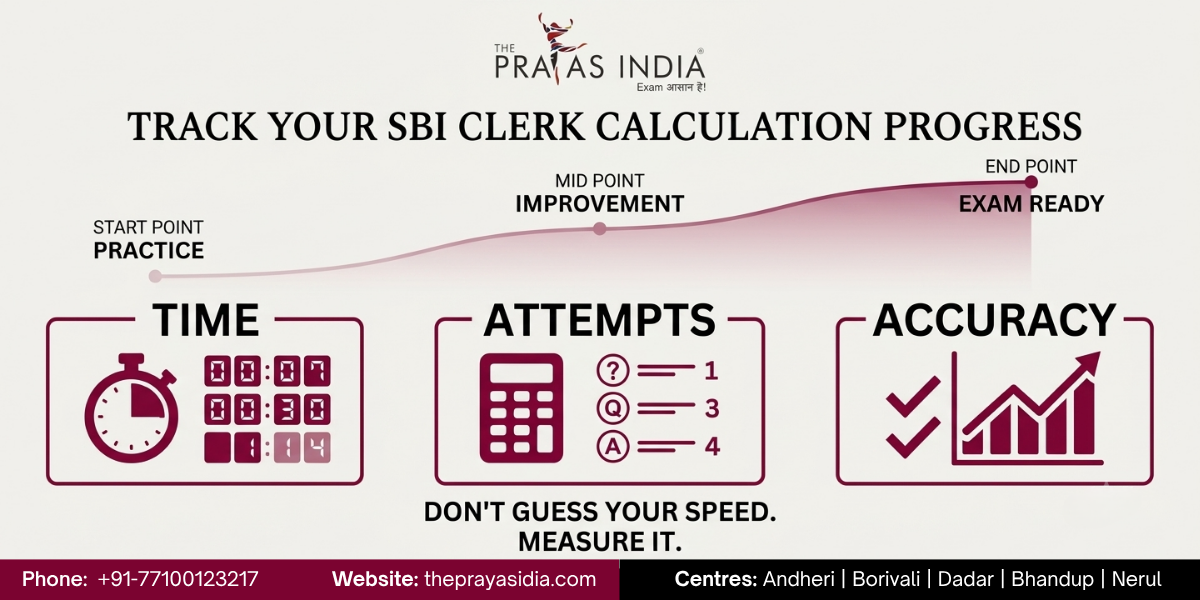
During practice, record three things:
Time taken + Questions attempted + Accuracy
Suppose you initially solve 20 questions in 15 minutes with 80% accuracy. After consistent practice, you may reach 20 questions in 12 minutes with 90% accuracy. That is meaningful progress even if you have not yet reached your desired attempt level.
This measurement-based approach is especially useful in coaching because teachers can identify whether the student’s primary issue is conceptual understanding, calculation speed, question selection or accuracy.
At The Prayas India, mock-test performance and practice analysis can be used to identify these gaps and create a more targeted preparation approach for banking aspirants.
Use Mock Tests to Improve Calculation Speed
Mock tests should not be treated only as a way to predict your score. They are one of the most effective environments for improving calculation speed because they recreate the pressure of limited time.
However, simply taking one mock after another will not automatically make you faster. The real improvement comes from analysing what happened after the test.
After every Quant or full-length mock, identify questions where you:
- spent too much time;
- used a longer method than necessary;
- made a calculation error;
- knew the concept but could not execute quickly;
- continued with a difficult question instead of moving ahead.
This analysis can reveal patterns that are difficult to notice during normal practice.
For instance, if you repeatedly spend more than a minute on questions that should be solved quickly, the issue may not be your mathematical ability. It may be question selection or a lack of familiarity with the most efficient method.
Develop the Habit of Leaving a Time-Consuming Question
Improving calculation speed does not mean forcing yourself to solve every question faster. Sometimes the smartest calculation is the one you decide not to perform.
In a time-bound examination, a difficult calculation can consume the time required to solve two easier questions. Candidates should therefore learn to recognise warning signs. If a question involves unusually lengthy calculations, unclear data or repeated corrections, it may be better to move ahead and return only if time permits.
This is particularly important because SBI’s Preliminary Examination uses separate section timings, so candidates cannot freely transfer unused time from one section to another.
Question selection and calculation speed should therefore develop together.
Accuracy Must Remain the Priority
Fast calculation is valuable only when it produces correct answers. A candidate who increases attempts from 20 to 28 but makes several avoidable calculation errors may not improve the final score.
Because the SBI Clerk Preliminary Examination carries negative marking of one-fourth of the marks assigned to a question, careless calculations can directly affect the score.
Candidates should therefore follow a simple principle:
First become accurate. Then become faster. Finally, become faster without losing accuracy.
This progression is far more reliable than trying to rush through questions from the beginning.
Common Calculation Mistakes SBI Clerk Aspirants Should Avoid
One common mistake is trying to memorise too many shortcuts at once. Shortcuts are useful when students understand the underlying calculation, but excessive shortcut learning can create confusion and lead to errors under pressure.
Another mistake is ignoring basic arithmetic because it appears too easy. Candidates sometimes spend most of their preparation time on advanced arithmetic while their multiplication, division or fraction conversions remain slow. These small delays accumulate across the section.
A third problem is practising without a timer. Untimed practice is useful during the learning stage, but eventually candidates must learn to perform under the same time constraints they will face in the examination.
Finally, many students take mocks but do not analyse them. Without analysis, the same calculation errors and time-management mistakes are likely to repeat.
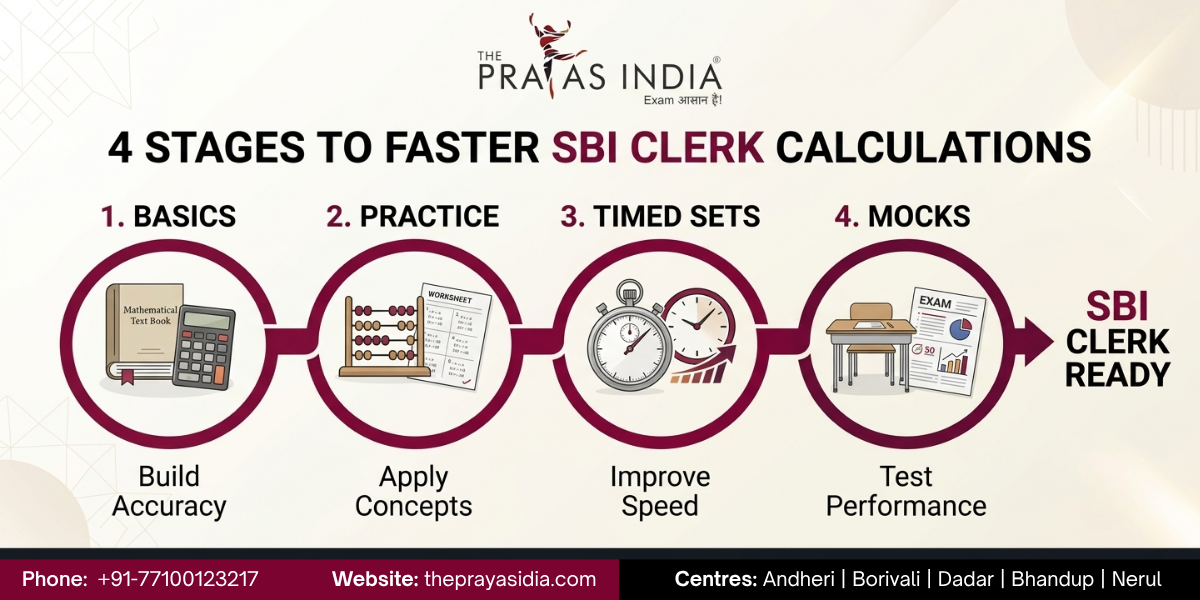
A Four-Stage Calculation Speed Improvement Plan
A structured approach can make the process much easier.
Stage 1: Strengthen the Basics
Build familiarity with multiplication, division, squares, fractions, percentages and decimals. Do not worry excessively about speed at this stage. Accuracy and confidence are the priorities.
Stage 2: Apply the Skills to Topics
Use these calculation skills while solving Simplification, Approximation, Number Series, Arithmetic and Data Interpretation. This is where basic calculation ability begins translating into actual exam performance.
Stage 3: Introduce Time Pressure
Start using short timed sets. The objective is not to finish everything at maximum speed but to gradually reduce the time required for familiar question types while maintaining accuracy.
Stage 4: Validate Through Mocks
Use full-length mocks and sectional tests to determine whether the improvement works under examination conditions. Analyse mistakes, identify recurring delays and repeat the cycle.
This Learn → Apply → Time → Analyse approach is more sustainable than attempting to become fast overnight.
How The Prayas India Can Help Improve Calculation Speed
Calculation speed is one part of a larger SBI Clerk preparation strategy. Students need to know which topics deserve priority, how much practice is sufficient, when to introduce timed tests and how to interpret mock-test performance.
This is where a structured banking coaching environment can be useful. At The Prayas India, students preparing for bank examinations can work through a systematic learning process that combines concepts, practice, doubt resolution, testing and performance analysis.
For an aspirant who repeatedly struggles with slow calculations, the solution should not simply be “solve more questions.” The preparation needs to identify the reason for the delay and then work on that specific weakness. Whether the issue is multiplication, percentage conversion, lengthy methods, question selection or exam pressure, targeted practice can make improvement more measurable.
For students looking for Bank Coaching in Mumbai, choosing an institute should therefore involve more than checking the number of classes offered. The quality of practice, faculty guidance, mock-test ecosystem, doubt support and consistency of preparation can all influence how effectively a student develops exam-ready speed.
Calculation Speed Should Support Your SBI Clerk Preparation, Not Replace It
Candidates should remember that calculation speed is not the entire Quantitative Aptitude section. A student may calculate extremely quickly but still struggle if concepts, question selection or accuracy are weak.
The strongest preparation combines all four elements:
Concept Clarity + Calculation Speed + Accuracy + Question Selection
When these skills develop together, students become better equipped to handle the pressure of the 20-minute Numerical Ability section. The official SBI pattern provides 35 questions for 35 marks in that section, with a separate 20-minute duration.
The objective should therefore be to develop a balanced Quant strategy rather than chasing an unrealistic calculation speed.
From Prelims Preparation to the Bigger SBI Clerk Goal
Although this article focuses on calculation speed for Prelims, students should keep the complete SBI Clerk selection journey in mind. The Preliminary Examination is a screening stage for candidates who are shortlisted for the Main Examination. SBI’s official pattern states that candidates are shortlisted for Mains based on aggregate Preliminary marks, subject to the Bank’s prescribed process and availability.
This means preparation should not stop at clearing Prelims. Students should gradually build Quantitative Aptitude skills that remain useful for Mains as well. The latest SBI Junior Associate pattern includes 50 Quantitative Aptitude questions for 50 marks in the Main Examination with a separate 45-minute timing.
A strong calculation foundation can therefore benefit candidates beyond the first stage of the examination.
Final Strategy: Make Every Calculation Count
Improving calculation speed is not about becoming a human calculator. It is about reducing avoidable time loss while solving questions accurately.
Start with basic arithmetic. Build familiarity with fractions and percentages. Practise calculations regularly. Apply them to actual SBI Clerk topics. Introduce time pressure gradually. Analyse mock-test performance. Most importantly, learn to distinguish between a question worth solving and one that is consuming too much time.
For aspirants preparing for SBI Clerk in Mumbai, The Prayas India can provide a structured environment where calculation practice becomes part of a broader bank-exam preparation strategy.
The most effective progression is simple:
Learn the concept → Practise accurately → Improve calculation fluency → Introduce time pressure → Analyse performance → Repeat.
With consistent practice and the right guidance, calculation speed can move from being a major obstacle to becoming one of your strongest advantages in SBI Clerk Prelims.
Contact Us
- Call Now: +91-77100 13217
- Website: theprayasindia.com
- Centres: Andheri | Borivali | Dadar | Nerul | Bhandup
Frequently Asked Questions
How can I calculation speed for SBI Clerk Prelims?
Start with basic arithmetic, multiplication, division, squares, fractions, percentages and decimals. Practise these regularly and gradually apply them to Simplification, Number Series, Arithmetic and Data Interpretation. Once accuracy becomes consistent, introduce timed sets and mock-test practice.
How much time should I spend on calculation practice every day?
A short, focused daily session is generally more useful than occasional long sessions. The exact duration can vary according to your current level, but consistency should be the priority. Calculation drills can also be integrated into your regular Quant preparation rather than treated as a completely separate subject.
Which calculations should SBI Clerk aspirants practise first?
Begin with multiplication, division, fraction-percentage conversions, squares, basic percentage calculations and approximation. These skills are repeatedly useful across different Numerical Ability topics.
Should I focus on speed or accuracy first?
Accuracy should come first. Once your method becomes reliable, gradually introduce time limits. The ultimate objective is to increase speed without sacrificing accuracy.
Can mock tests improve calculation speed?
Yes, provided you analyse them properly. Mocks reveal where you spend excessive time, which calculation errors you repeat and which question types slow you down. Simply taking mocks without reviewing performance will not provide the same benefit.
Is calculation speed important only for SBI Clerk Prelims?
No. A strong calculation foundation can support performance in other banking-exam Quant sections as well. SBI's Main Examination also includes Quantitative Aptitude, making calculation efficiency useful beyond the Preliminary stage.
Is joining bank coaching in Mumbai necessary for improving calculation speed?
Self-study can certainly build calculation skills, but structured coaching can provide a more organised practice system, regular testing, faculty feedback and performance analysis. Students should choose an approach based on their learning needs, consistency and level of preparation.
How does The Prayas India support SBI Clerk preparation?
The Prayas India focuses on structured banking-exam preparation through concept building, practice, testing, doubt resolution and performance improvement. For students struggling with calculation speed, the focus should be on identifying specific weaknesses and improving them through targeted practice.