
How to Improve Maths and Reasoning Speed for SSC Exams | The Prayas India Bhandup
Speed and accuracy are two of the most important skills required to perform well in Staff Selection Commission (SSC) examinations. Whether you are preparing for SSC CGL, SSC CHSL, SSC MTS or another SSC recruitment exam, you need to solve questions correctly within a limited time. Understanding a concept is essential, but you must also learn to apply it efficiently under exam conditions.
Many students understand Maths and Reasoning concepts but struggle to finish the paper on time. They may spend too long on calculations, repeatedly attempt the same type of question or lose time on difficult problems. The solution is not simply to solve questions faster. It is to build strong fundamentals, recognise question patterns, practise regularly and learn how to manage time.
If you are preparing for SSC exams, these practical strategies can help you improve your speed while maintaining accuracy.
Understand the SSC Exam Pattern Before You Practise
Before starting speed-building exercises, understand the exam you are targeting. SSC CGL, CHSL, MTS and other examinations can differ in their structure, sections, marking schemes and time limits. Always check the latest official notification and syllabus for your specific examination.
Make a list of the Maths and Reasoning topics included in your exam. Then assess your current level by solving a short diagnostic test under timed conditions.
Record three things:
- The topics in which you answer questions correctly and quickly.
- The topics in which you understand the concept but take too long.
- The topics in which you make frequent mistakes or need to revise fundamentals.
This assessment helps you focus on your actual weaknesses instead of practising every topic equally. It also gives you a baseline against which you can measure progress.
Strengthen Your Maths Fundamentals
Fast calculations begin with a clear understanding of basic concepts. If your fundamentals are weak, even familiar questions can take longer because you have to stop and recall formulas or calculation methods.
For Quantitative Aptitude, build a strong foundation in percentages, ratio and proportion, averages, profit and loss, simple and compound interest, time and work, speed and distance, number systems and basic algebra, according to your examination syllabus.
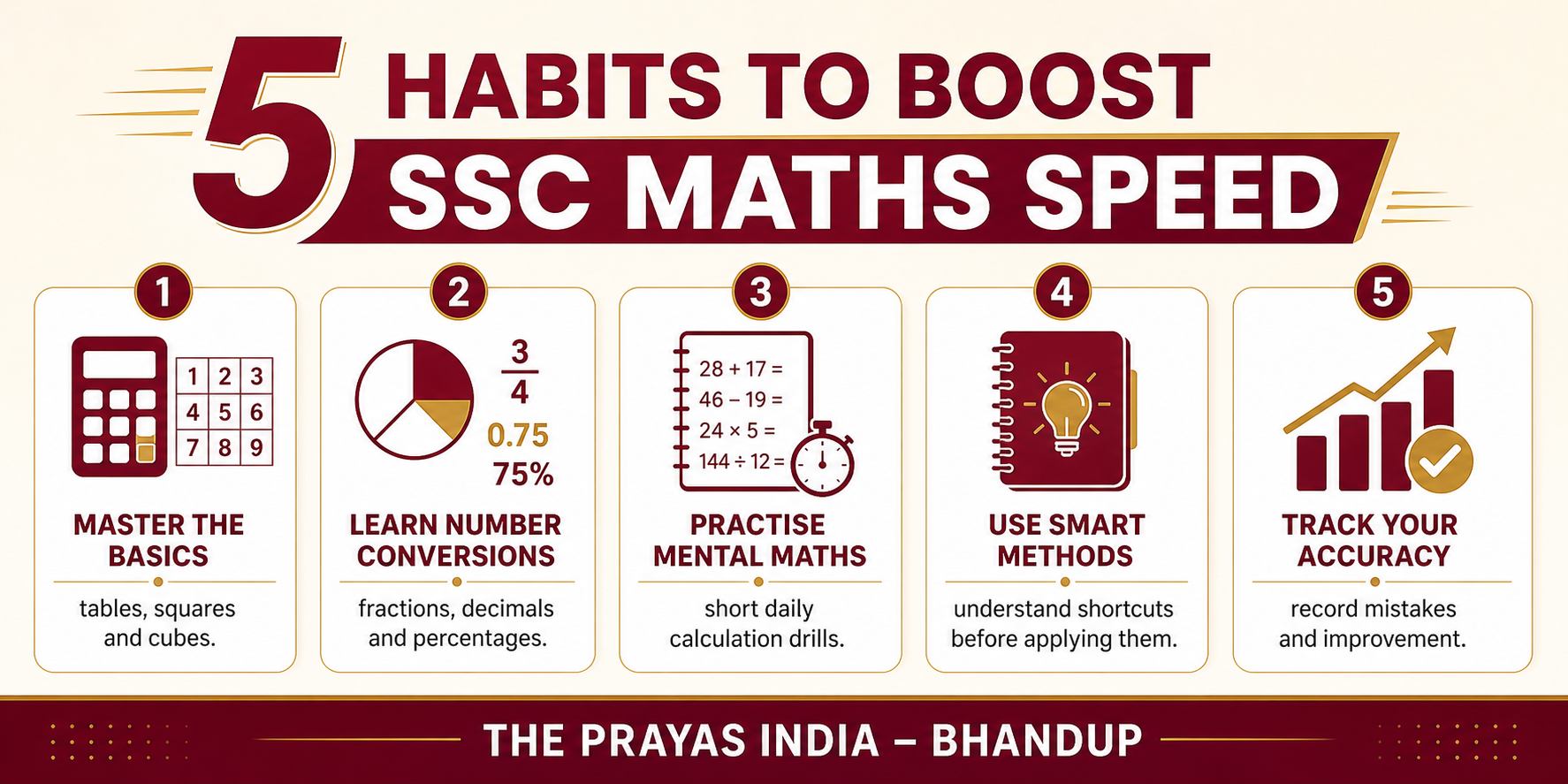
Practise multiplication tables, squares, cubes and common fraction-to-percentage conversions. These can reduce unnecessary calculation time when used correctly.
For example, remembering that 1/4 = 25%, 1/5 = 20% and 1/8 = 12.5% can make certain percentage questions easier to solve mentally.
Do not try to memorise every shortcut without understanding why it works. Learn the standard method first, then practise faster techniques and check that they produce the correct result.
Build a Daily Calculation Practice Routine
Consistent, focused practice is more effective than occasional long sessions. Set aside a short daily slot specifically for calculation speed.
Your practice may include:
- Mental addition, subtraction, multiplication and division.
- Squares and cubes of commonly used numbers.
- Fraction, decimal and percentage conversions.
- Simplification and approximation questions, where relevant to your syllabus.
- Timed sets of arithmetic questions.
Start at a comfortable pace and prioritise accuracy. Once you can solve a particular type of question correctly, gradually reduce the time allowed. Keep a record of both your completion time and your mistakes.
Avoid rushing simply to achieve a faster time. An incorrect answer does not demonstrate improvement. Your goal is to become consistently faster without sacrificing accuracy.
Learn Maths Shortcuts the Right Way
Shortcuts can save time, but only when you know when and how to use them. A shortcut that works for one type of question may not work for another. Blindly applying memorised tricks can lead to incorrect answers.
For each topic, first learn the standard method. Next, study a reliable alternative method and compare the two. Practise both on different question types, then use the method that is fastest and most reliable for you.
For example, percentage questions can sometimes be simplified using fraction equivalents. Ratio questions may become easier when the terms can be reduced to smaller numbers. In other problems, a direct formula may be safer than a lengthy mental calculation.
Maintain a personal formula and shortcut notebook. Keep the notes organised by topic, with a short example showing when each technique is useful. Review this notebook regularly instead of repeatedly collecting new tricks.
Improve Reasoning Speed by Recognising Patterns
Reasoning questions often test your ability to identify relationships, follow logical rules and recognise patterns. Students may lose time when they try to solve every question from scratch.
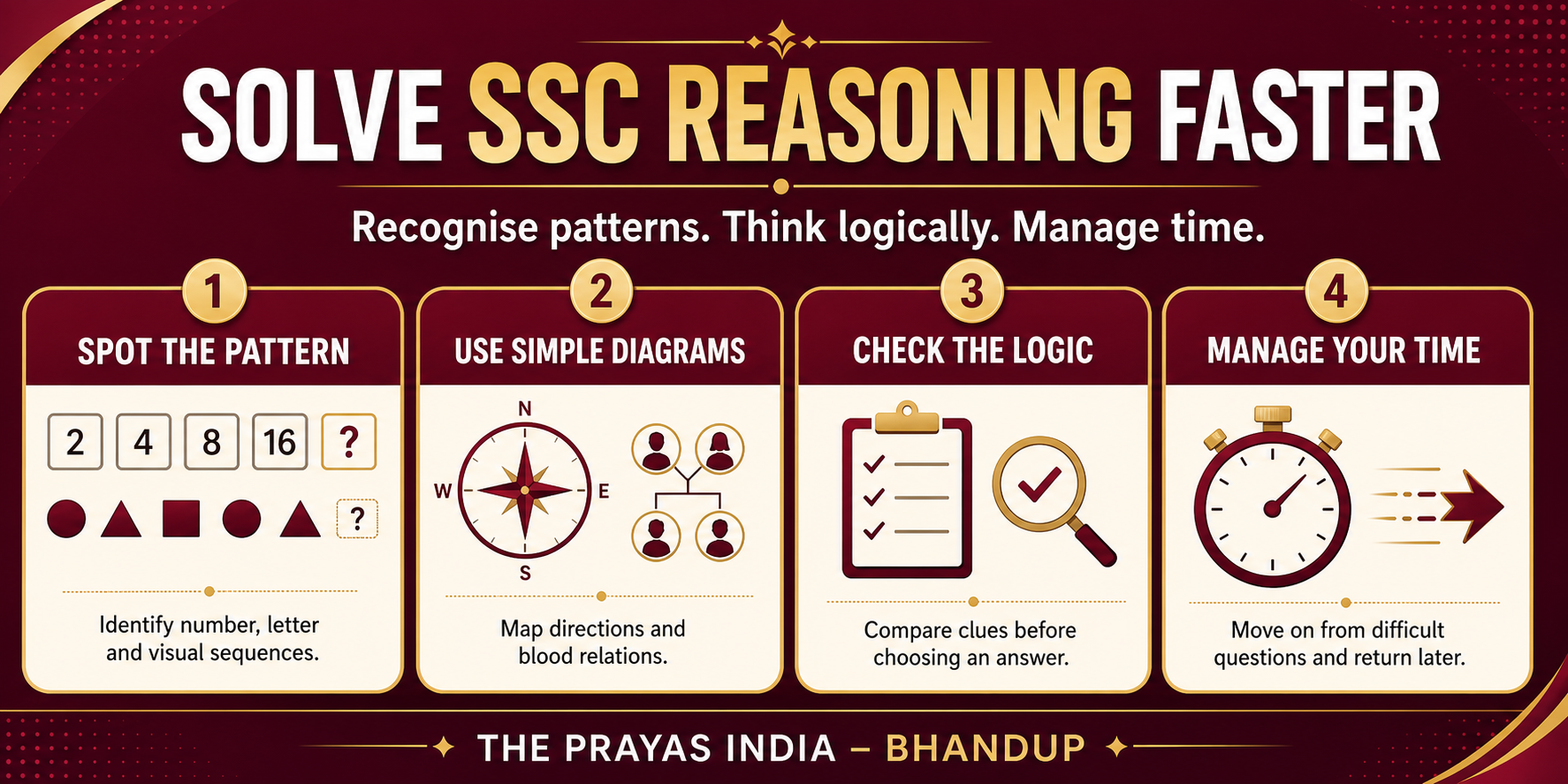
Depending on your exam syllabus, practise topics such as analogy, classification, number and alphabet series, coding-decoding, direction sense, blood relations, syllogisms and non-verbal reasoning.
For series questions, check common patterns such as differences between consecutive numbers, alternating sequences, multiplication or division patterns, and changes involving squares or cubes. In coding-decoding, compare the original letters or numbers with their coded forms before assuming a rule.
For direction-sense problems, draw a small diagram instead of repeatedly imagining every turn. For blood-relation questions, use a simple family tree when necessary. In syllogisms, focus on the logical relationship between statements rather than relying on real-world assumptions.
The more varied questions you practise, the easier it becomes to recognise familiar structures. However, avoid forcing a pattern where the information does not support one. Accuracy should always come first.
Use a Time Limit for Every Practice Set
Untimed practice is useful when you are learning a new concept, but speed improvement requires timed practice too. Once you understand a topic, solve a small set of questions against a realistic time limit.
Begin with a manageable target. For example, you might solve ten questions and record the time taken, the number of correct answers and the questions that caused difficulty. Repeat a similar set later and compare your performance.
Do not compare your speed with another student’s speed without considering the difficulty of the questions. Your most useful benchmark is your own previous performance on comparable sets.
As you improve, practise mixed-topic sets. These help you learn to switch between different question types instead of relying on the familiarity of a single topic.
Take Mock Tests and Analyse Every Mistake
Mock tests help you practise under exam-like conditions and understand how well your preparation is translating into performance. But taking tests alone is not enough. The review afterwards is where much of the learning happens.
After each mock test, classify your mistakes:
- Conceptual errors: You did not understand the method or rule.
- Calculation errors: Your approach was correct, but you made an arithmetic mistake.
- Time-management errors: You spent too long on a question.
- Reading errors: You missed a condition, sign or important detail.
Revise the relevant concept and solve similar questions before taking another test. Note recurring mistakes in an error notebook and revisit them every week.
Also identify questions that consumed too much time despite being answered correctly. These may reveal opportunities to improve your method or recognise when to move on.
Learn When to Skip and Return to a Question
Speed is not only about solving individual questions quickly. It is also about deciding how to use the available time.
During practice, notice which questions you can solve confidently and which ones require lengthy calculations or unfamiliar reasoning. In a mock test, avoid spending too much time on one difficult question while several manageable questions remain unanswered.
A useful approach is to solve familiar questions first, mark time-consuming questions for review where the test interface allows it, and return to them if time remains. Apply this strategy according to the actual examination format and its rules.
Remember to consider the marking scheme. Where negative marking applies, random guessing may reduce your score. Read the latest exam instructions and make decisions accordingly.
Follow a Consistent Daily Study Plan
A realistic study routine helps you improve steadily without exhausting yourself. Adjust the duration according to your preparation stage, other subjects and available time.
Here is one example of a focused 90-minute Maths and Reasoning session:
| Duration | Activity |
|---|---|
| 15 minutes | Mental Maths and calculation drills |
| 25 minutes | Quantitative Aptitude topic practice |
| 25 minutes | Reasoning question practice |
| 15 minutes | Timed mixed-question set |
| 10 minutes | Error review and formula revision |
This is a suggested routine, not a compulsory timetable. If you are weak in a particular topic, allocate additional time to understanding it before increasing speed. On other days, you can use a full mock test and a detailed review instead of the mixed-question session.
Consistency matters more than following an unrealistic schedule for a few days. Keep track of your practice sessions and adjust your plan using your results.
Avoid Common Mistakes That Reduce Speed
Students often slow their progress by trying to do too much at once. Avoid learning several shortcuts for the same problem before mastering the basic method. Do not attempt only easy questions, because unfamiliar question types will continue to cause delays in the exam.
Another common mistake is ignoring accuracy while chasing a faster time. Instead, increase speed gradually after your method becomes reliable. Review recurring errors rather than simply solving more questions.
Finally, do not depend entirely on mock-test scores. Use them alongside topic-wise practice, revision and mistake analysis to build a more complete picture of your preparation.
Choose Structured SSC Preparation Support
If you find it difficult to identify your weak areas or follow a consistent study plan, structured coaching can provide guidance, regular practice and opportunities to review your performance. The right learning environment should help you understand concepts, clear doubts and practise questions according to your examination goals.
Students looking for SSC preparation in Bhandup, Mumbai, can contact The Prayas India – Bhandup to enquire about available courses and batches. Before enrolling, confirm the current batch schedule, course details and fees directly with the institute.
Conclusion
Improving Maths and Reasoning speed for SSC exams requires more than memorising tricks. Build strong fundamentals, practise calculations daily, learn to recognise reasoning patterns, solve timed question sets and analyse every mock test carefully.
Start with accuracy, measure your progress and gradually increase the level of difficulty. With a consistent routine and a clear understanding of your weaknesses, you can develop better time management and approach SSC exam questions with greater confidence.
If you are preparing in Bhandup, contact The Prayas India – Bhandup to enquire about available SSC preparation options and choose a study plan that fits your goals.
Frequently Asked Questions About SSC Maths & Reasoning Preparation in Bhandup
1. How can I improve Maths speed for SSC exams?
Practise mental calculations, multiplication tables, percentage conversions, and important formulas daily. Solve topic-wise questions and gradually introduce timed practice while maintaining accuracy. Students preparing in Bhandup can also explore suitable SSC preparation options at The Prayas India.
2. How can I increase Reasoning speed for SSC CGL and CHSL?
Practise number series, coding-decoding, analogy, classification, and direction-sense questions regularly. Learn to recognise patterns, eliminate incorrect options logically, and review the questions that take too long to solve.
3. How much time should I spend on Maths and Reasoning daily?
A useful starting point is 30 minutes of Quantitative Aptitude practice and 30 minutes of Reasoning practice daily, along with calculation drills and revision. Adjust your schedule according to your preparation level and the latest syllabus for your target SSC examination.
4. Are mock tests useful for improving SSC exam speed?
Yes. Mock tests help you evaluate speed, accuracy, question selection, and time management. Analyse incorrect answers after every test and maintain an error notebook to track the topics that need more practice.
5. Where can I enquire about SSC coaching in Bhandup West, Mumbai?
You can contact The Prayas India, Bhandup, to enquire about current SSC preparation courses, batch timings, fees, and admission availability. Visit the centre at Neptune Magnet Mall, D-322, Lal Bahadur Shastri Marg, near Metro, Ganesh Nagar, Bhandup West, Mumbai, Maharashtra 400078.
6. How can I contact The Prayas India Bhandup branch?
Call +91-7710013217 to enquire about available courses and admission procedures. You can also use the Google Maps location to check directions to the branch.
Improve Your SSC Maths & Reasoning Skills in Bhandup
Preparing for SSC CGL, CHSL, MTS, or other SSC examinations? Build a consistent study routine, practise regularly, and enquire about available preparation programmes at The Prayas India, Bhandup.
Visit Our Bhandup Branch
Address:
Neptune Magnet Mall, D-322, Lal Bahadur Shastri Marg, near Metro, Ganesh Nagar, Bhandup West, Mumbai, Maharashtra 400078
Phone:
+91-7710013217
Contact the institute to confirm current SSC courses, fees, batch timings, and admission availability.