How to Prepare Maths for RRB NTPC 2026: Topic-Wise Strategy | The Prayas India
Mathematics is one of the most important sections in the RRB NTPC 2026 examination. While the questions are generally based on school-level concepts, the real challenge is not always the difficulty of the questions. For many aspirants, the bigger challenge is solving familiar concepts quickly, avoiding calculation errors, managing time across sections, and maintaining accuracy when negative marking is involved.
With 5,165 RRB NTPC 2026 vacancies, including 3,477 Graduate-level and 1,688 Undergraduate-level vacancies, the examination is expected to attract a large number of candidates. This makes a systematic preparation strategy particularly important. Candidates preparing for both Graduate and Undergraduate posts should therefore treat Mathematics as a scoring section that requires consistent practice rather than last-minute revision.
The RRB NTPC Mathematics syllabus covers topics such as Number System, Decimals and Fractions, LCM and HCF, Ratio and Proportion, Percentage, Mensuration, Time and Work, Time and Distance, Simple and Compound Interest, Profit and Loss, Elementary Algebra, Geometry and Trigonometry, and Elementary Statistics.
The right approach is not to study every chapter with the same amount of time. Instead, aspirants should identify the topics that are frequently tested, strengthen their basic concepts, develop calculation speed, practise questions under time pressure, and regularly analyse their mistakes.
This article explains a practical topic-wise strategy for preparing Maths for RRB NTPC 2026, along with a structured study plan that can help beginners as well as candidates who have already started preparation.
RRB NTPC Notification 2026 Out!
The Railway Recruitment Board has officially announced 5,165 vacancies for both Graduate and Undergraduate posts. Check out the complete details including eligibility, dates, and salary structure.
RRB NTPC 2026 Maths: Understand the Exam Before You Prepare
Before starting topic-wise preparation, candidates should understand how Mathematics is positioned in the RRB NTPC examination.
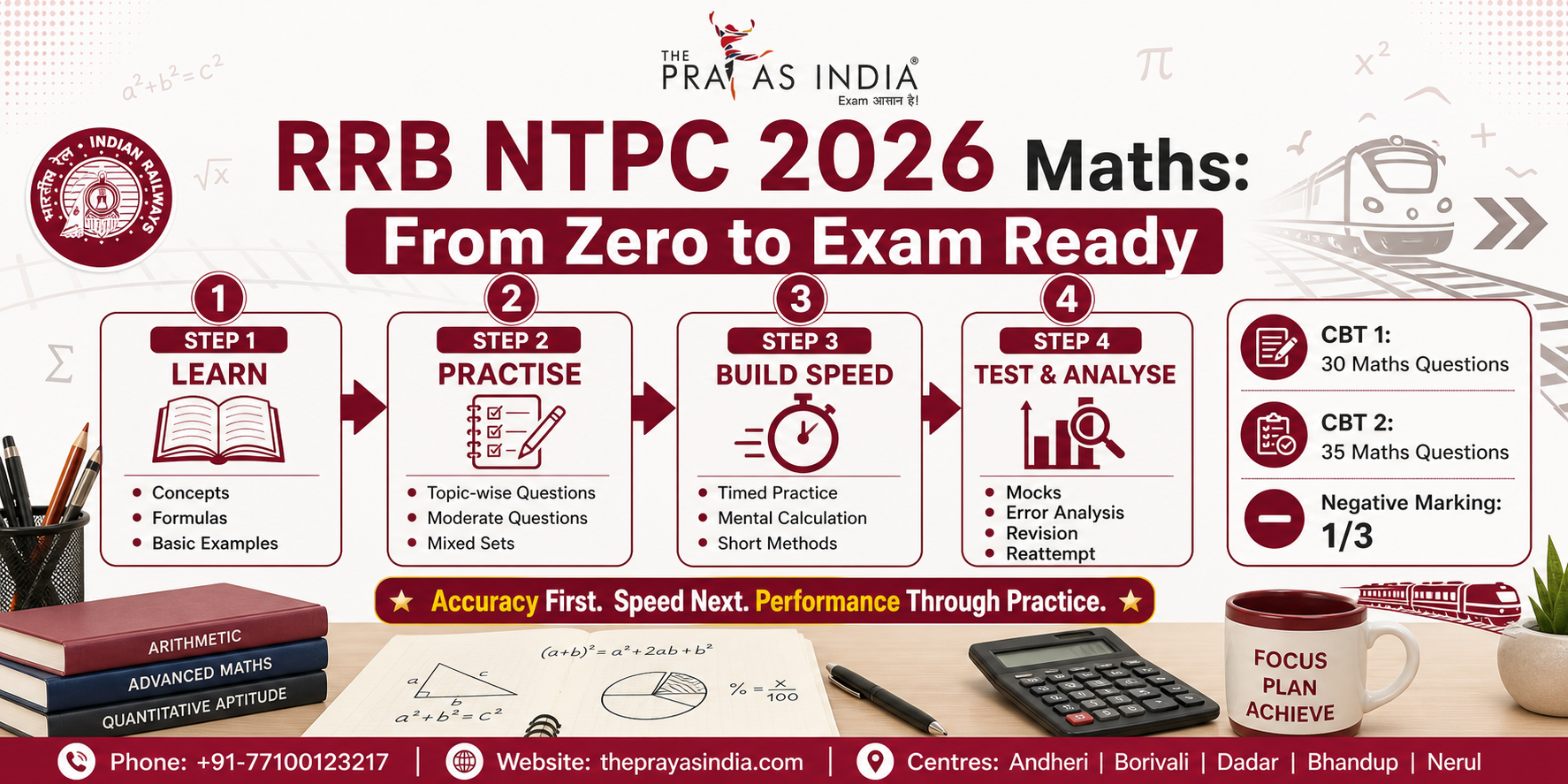
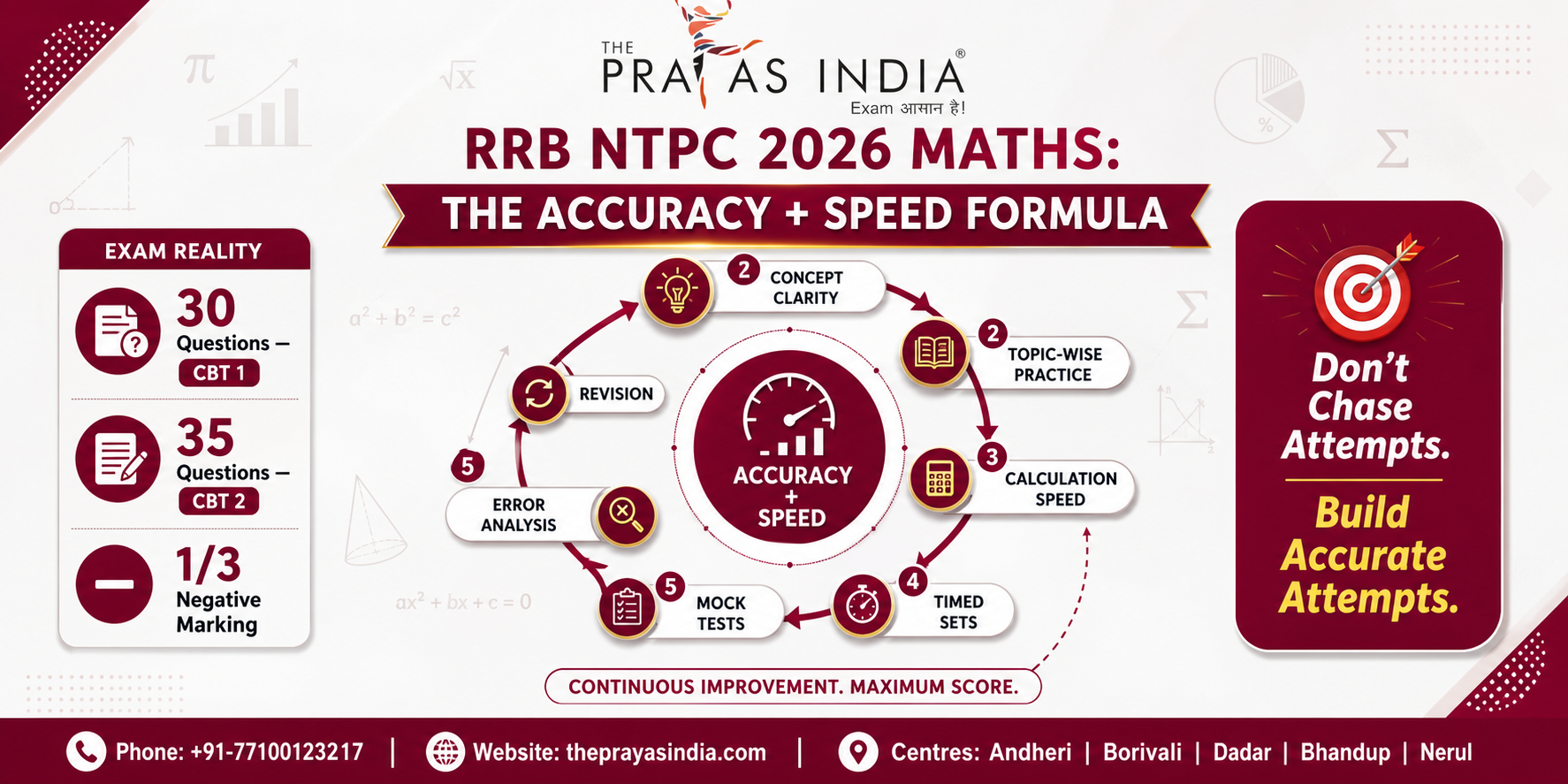
For CBT 1, Mathematics contains 30 questions for 30 marks. The complete CBT 1 paper has 100 questions from General Awareness, Mathematics and General Intelligence & Reasoning, with a total duration of 90 minutes.
For CBT 2, Mathematics carries 35 questions for 35 marks, while the complete examination consists of 120 questions for 120 marks and is conducted for 90 minutes.
There is also a negative marking of one-third mark for every incorrect answer. Therefore, blindly attempting questions simply to increase the number of attempts can negatively affect the final score.
RRB NTPC Maths Pattern at a Glance
| Stage | Maths Questions | Maths Marks | Total Questions | Duration |
|---|---|---|---|---|
| CBT 1 | 30 | 30 | 100 | 90 minutes |
| CBT 2 | 35 | 35 | 120 | 90 minutes |
The objective of preparation should therefore be to develop three qualities simultaneously:
- Conceptual clarity
- Calculation speed
- Accuracy under time pressure
A candidate who knows the formula but takes too long to solve a question may struggle in the actual examination. Similarly, a candidate who solves questions quickly but makes frequent calculation mistakes may lose marks because of negative marking.
Maths preparation for RRB NTPC should therefore be viewed as a combination of learning, practice, speed-building and analysis.
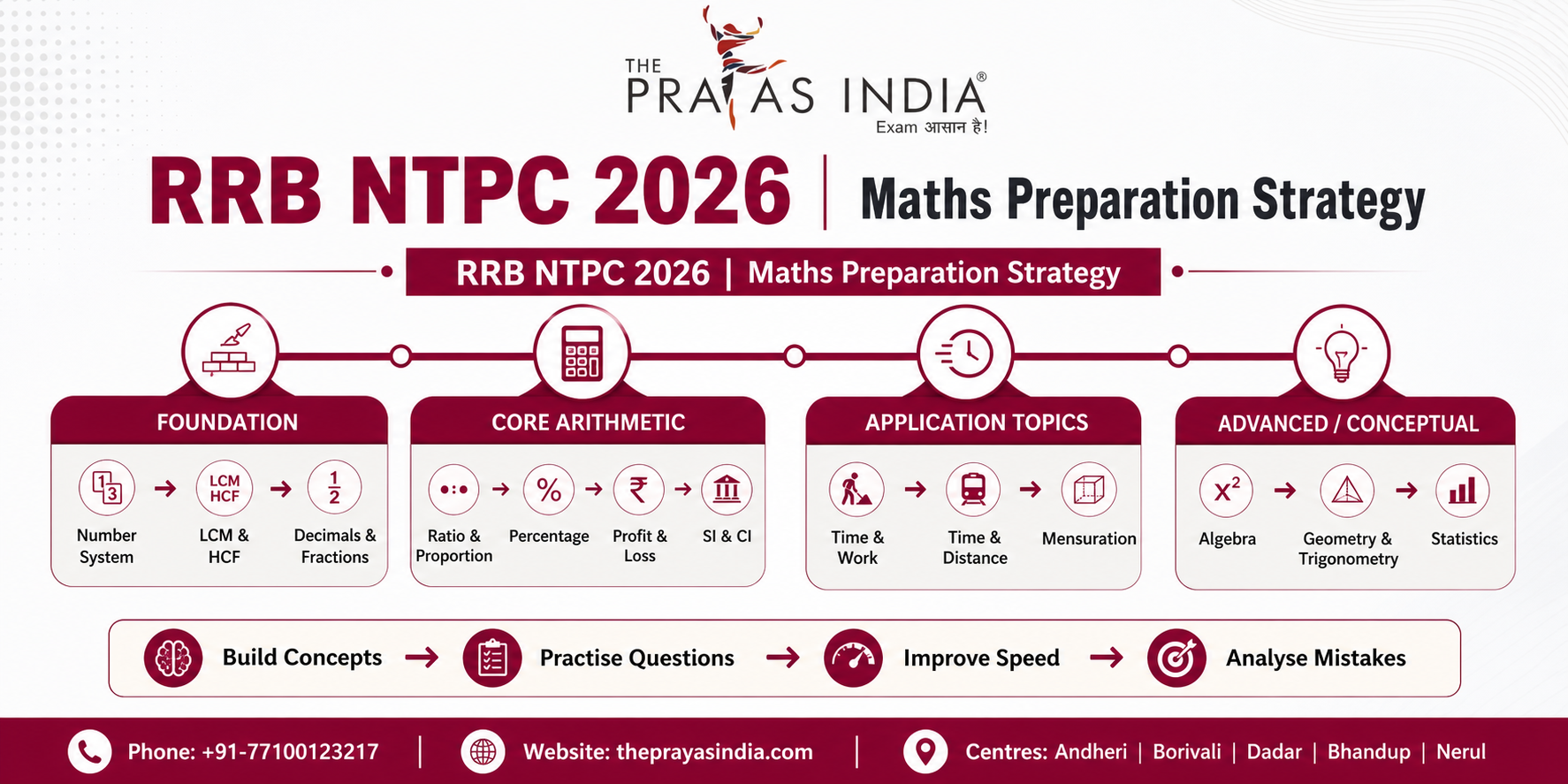
RRB NTPC Maths Syllabus: Topic-Wise Preparation Approach
The syllabus may appear extensive when viewed as one list, but it becomes much more manageable when divided into logical groups.
A useful preparation sequence is:
- Number System and basic arithmetic
- LCM and HCF
- Decimals and Fractions
- Ratio and Proportion
- Percentage
- Profit and Loss
- Simple and Compound Interest
- Average and related arithmetic applications
- Time and Work
- Time and Distance
- Mensuration
- Algebra
- Geometry and Trigonometry
- Elementary Statistics
The exact distribution of questions can vary from one examination to another. Therefore, candidates should not assume that a particular chapter will definitely produce a fixed number of questions. Instead, the strategy should be based on complete syllabus coverage combined with greater practice in core arithmetic topics.
1. Number System: Build Your Mathematical Foundation
Number System should be one of the first topics you study because several mathematical concepts depend on basic numerical understanding.
The chapter generally involves concepts related to natural numbers, whole numbers, integers, rational numbers, divisibility, factors, multiples and different numerical properties.
Beginners should not rush through this chapter simply because the concepts appear easy. The objective is to become comfortable with calculations and numerical relationships.
Focus on:
- Natural and whole numbers
- Integers
- Prime and composite numbers
- Factors and multiples
- Divisibility rules
- Even and odd numbers
- Basic numerical properties
- Remainder-based concepts
- Simplification techniques
How to Prepare Number System
Start with the basic concepts and then solve questions of increasing difficulty. Learn common divisibility rules and practise mental calculations instead of depending on a calculator.
For example, you should become comfortable identifying whether a number is divisible by 2, 3, 5, 9 or 11 without performing lengthy calculations.
Once the basics are clear, move towards mixed practice sets. The purpose is to recognise the underlying concept quickly when the question is presented in an unfamiliar form.
2. LCM and HCF: Master the Relationship Between Numbers
LCM and HCF are relatively compact topics but can become confusing when candidates rely only on memorised procedures.
Understand what LCM and HCF actually represent and how they are related to factors and multiples.
Focus on:
- Prime factorisation
- Finding HCF
- Finding LCM
- Relationship between LCM and HCF
- Word problems involving recurring events
- Fractions and numerical applications
Preparation Strategy
First practise direct questions. Once you are comfortable, solve application-based questions where LCM or HCF is hidden inside a word problem.
Try to recognise the requirement of the question before beginning the calculation. This reduces unnecessary steps and improves speed.
3. Decimals and Fractions: Improve Calculation Accuracy
Decimals and fractions are fundamental to several arithmetic chapters. Candidates should be comfortable converting between fractions and decimals and performing basic operations.
Important areas include:
- Addition and subtraction
- Multiplication and division
- Fraction-to-decimal conversion
- Decimal-to-fraction conversion
- Comparison of fractions
- Simplification
- Applications in percentage and ratio questions
A strong command of fractions can significantly improve calculation speed in percentage, profit and loss, ratio and other arithmetic questions.
Practical Tip
Memorise commonly used fraction-percentage relationships.
For example:
- 1/2 = 50%
- 1/4 = 25%
- 1/5 = 20%
- 1/10 = 10%
- 1/8 = 12.5%
The objective is not to memorise every possible conversion. Instead, learn the common ones and understand how to derive others quickly.
4. Ratio and Proportion: Focus on Application
Ratio and Proportion is an important arithmetic topic because questions can appear in different forms.
You should understand:
- Simplification of ratios
- Equivalent ratios
- Proportion
- Direct proportion
- Inverse proportion
- Division of quantities in a given ratio
- Application-based problems
How to Study
Do not restrict your practice to direct formula-based questions. Solve problems involving quantities, ages, work, money and other real-world relationships.
A good approach is to first convert the information into a mathematical relationship and then solve it.
The more comfortable you become with translating words into ratios, the faster you will become at solving application-based questions.
5. Percentage: One of the Most Important Arithmetic Topics
Percentage deserves special attention because it is connected to several other topics.
Questions involving percentage may appear directly or may form the foundation of questions on:
- Profit and Loss
- Discount
- Interest
- Population
- Salary
- Marks
- Data interpretation
- Ratio-based calculations
Start by understanding the basic meaning of percentage.
Then practise:
- Percentage increase
- Percentage decrease
- Successive percentage changes
- Finding the original value
- Percentage comparison
- Conversion between fraction, decimal and percentage
The Important Concept: Successive Changes
Suppose a value increases by 20% and then decreases by 20%. Many students assume that the final value will return to the original value. It does not.
This is why understanding the underlying calculation is more useful than memorising isolated rules.
Practise different variations until you can identify the appropriate method almost immediately.
6. Profit and Loss: Understand the Basic Relationships
Profit and Loss questions become much easier once the relationship between Cost Price, Selling Price, Profit and Loss is clear.
You should be comfortable with:
- Cost Price
- Selling Price
- Profit
- Loss
- Profit percentage
- Loss percentage
- Discount
- Marked Price
- Successive discounts
- Application-based problems
Do not simply memorise formulas. Understand which value is used as the base when calculating a percentage.
This is a common source of mistakes. Profit percentage is calculated with respect to Cost Price, while discount percentage is generally calculated with respect to Marked Price.
Preparation Strategy
Start with direct questions, followed by questions involving discounts and multiple conditions. Once you become comfortable, practise mixed questions where the question does not explicitly tell you which formula to use.
7. Simple and Compound Interest: Learn the Difference
Interest questions require both formula knowledge and careful calculation.
For Simple Interest, understand:
SI = (P × R × T) / 100
where P represents principal, R represents rate and T represents time.
For Compound Interest, understand how interest is added to the principal over successive periods.
Focus on:
- Principal
- Rate
- Time
- Simple Interest
- Compound Interest
- Amount
- Difference between SI and CI
- Annual and other compounding situations where applicable
The most important part is understanding what happens to the amount after each compounding period.
Practise basic questions first and then move towards comparison-based questions.
8. Time and Work: Convert Work into a Rate
Time and Work can appear difficult initially because questions are presented through workers, days and efficiency. The key is to convert the information into a common work rate.
Important concepts include:
- Work efficiency
- Individual work rate
- Combined work
- Work completed in a particular number of days
- Men and days
- Efficiency comparisons
Instead of thinking only in terms of “how many days,” train yourself to think in terms of how much work is completed in one day.
For example, if a person completes a particular job in 10 days, their one-day work can be represented as 1/10 of the total work.
This simple approach makes many combined-work questions easier to understand.
How to Improve
Practise questions involving two people first. Then move to three-person problems, efficiency comparisons and situations where one worker joins or leaves the work.
9. Time and Distance: Speed, Time and Distance Must Be Automatic
Time and Distance is another important arithmetic area.
The fundamental relationship is:
Distance = Speed × Time
From this, you can derive the other relationships:
Speed = Distance ÷ Time
Time = Distance ÷ Speed
The basic formulas are simple, but questions can become more challenging when different units or conditions are introduced.
Practise:
- Basic speed-distance-time questions
- Unit conversions
- Relative speed
- Average speed
- Problems involving different speeds
- Application-based questions
Special Attention to Unit Conversion
Candidates frequently lose time because they calculate using inconsistent units.
For example, if distance is given in kilometres and speed is given in metres per second, convert the units before beginning the calculation.
Building this habit will reduce avoidable mistakes.
10. Mensuration: Memorise Core Formulas and Practise Applications
Mensuration requires a balance between formula retention and practical application.
Important figures include:
- Square
- Rectangle
- Triangle
- Circle
- Cuboid
- Cube
- Cylinder
- Other commonly tested geometric shapes
Focus on:
- Area
- Perimeter
- Volume
- Surface area
- Basic geometric measurements
Create a compact formula sheet and revise it regularly.
However, simply memorising formulas is not enough. You must know which measurement the question is asking for and identify the correct shape.
Smart Strategy for Mensuration
Keep separate notes for:
2D figures: Area and perimeter
3D figures: Volume and surface area
Practise diagrams whenever possible. Visualising the shape can prevent formula-selection errors.
11. Elementary Algebra: Strengthen the Basics
RRB NTPC does not require advanced-level algebra, but candidates should be comfortable with elementary concepts.
Focus on:
- Basic algebraic expressions
- Simple equations
- Linear equations
- Simplification
- Basic identities
- Substitution-based problems
The most important skill here is translating the information given in a question into an equation.
For example, if a number is described as being five more than another number, represent that relationship algebraically instead of trying to solve it through lengthy verbal reasoning.
Preparation Strategy
Start with one-variable equations and basic simplification. Gradually introduce word problems.
Do not spend excessive time on advanced algebraic concepts that are outside the required syllabus. The objective is examination-oriented mastery.
12. Geometry and Trigonometry: Learn the Core Concepts
Geometry and Trigonometry can appear intimidating to candidates who have not studied mathematics recently. However, the RRB NTPC level requires a focused understanding of fundamental concepts rather than advanced mathematics.
For Geometry, focus on:
- Lines and angles
- Triangles
- Quadrilaterals
- Circles
- Basic properties of geometric figures
- Perimeter and area relationships
For Trigonometry, focus on:
- Basic trigonometric ratios
- Standard angles
- Basic identities
- Right-angled triangle relationships
How to Prepare
Create a formula and property sheet. Revise it repeatedly rather than trying to memorise everything in one sitting.
For geometry, draw figures while studying. For trigonometry, practise standard values until they become easy to recall.
13. Elementary Statistics: Keep It Simple
Statistics is generally manageable when the basic concepts are clear.
Focus on:
- Mean
- Basic statistical calculations
- Interpretation of numerical information
- Simple data-based questions
Do not overcomplicate this topic. First understand the formulas and then practise different numerical arrangements.
The key is accuracy because a small calculation error can change the final answer.
RRB NTPC Maths: Which Topics Should Beginners Study First?
A beginner should not start with the most complicated-looking topic.
A practical sequence is:
Phase 1: Build the Foundation
- Number System
- LCM and HCF
- Decimals and Fractions
- Ratio and Proportion
Phase 2: Strengthen Arithmetic
- Percentage
- Profit and Loss
- Simple and Compound Interest
Phase 3: Master Application-Based Topics
- Time and Work
- Time and Distance
- Mensuration
Phase 4: Complete Remaining Concepts
- Algebra
- Geometry
- Trigonometry
- Statistics
This sequence allows you to build interconnected concepts. For example, percentage knowledge helps with Profit and Loss and Interest, while basic numerical understanding supports many other chapters.
How to Prepare Maths for RRB NTPC 2026 from Zero
Candidates who are starting from zero should avoid trying to complete the entire syllabus in a few days.
A better approach is to divide preparation into three stages.
Stage 1: Concept Building
During the first stage, focus on understanding the basics.
Read the concept, study solved examples and then attempt basic questions without looking at the solution.
At this stage, speed should not be your primary concern. If you try to solve every question as quickly as possible before understanding the concept, you may develop incorrect methods.
Your first target should be:
“Can I solve this type of question correctly without assistance?”
Once the answer becomes yes, move towards speed.
Stage 2: Question Practice
After learning a topic, solve a reasonable number of questions from that topic.
Do not randomly solve questions from the entire syllabus every day during the initial phase. Topic-wise practice helps you understand patterns.
For example, after completing Percentage, solve a dedicated Percentage practice set. Once you have developed confidence, combine Percentage with Profit and Loss and other arithmetic topics.
This gradually moves you from topic recognition to mixed-question recognition.
Stage 3: Speed and Accuracy
Once most topics are covered, introduce timed practice.
Suppose you have 20 questions. Give yourself a fixed amount of time and attempt them without interruption.
After completing the set, calculate:
- Attempted questions
- Correct questions
- Incorrect questions
- Unattempted questions
- Time taken
- Accuracy percentage
The purpose is not merely to increase attempts. It is to determine whether your additional attempts are producing correct answers.
Daily Maths Study Plan for RRB NTPC 2026
A good daily schedule does not necessarily mean spending several hours continuously solving mathematics.
The quality of practice matters more than simply counting study hours.
For candidates preparing multiple subjects, around 1.5 to 2 hours of focused Maths preparation can be structured effectively.
First 25–30 Minutes: Concept Revision
Revise the formulae and concepts of the current topic.
Do not read the entire chapter every day. Focus on the areas where you previously made mistakes.
Next 40–50 Minutes: Topic-Wise Practice
Solve questions from the topic currently being studied.
Initially focus on accuracy. Gradually introduce time limits.
Next 20–30 Minutes: Mixed Questions
Solve questions from older topics.
This is important because the actual examination will not tell you which chapter a question belongs to.
Final 10–15 Minutes: Error Analysis
Review your mistakes.
Ask yourself:
- Did I misunderstand the concept?
- Did I use the wrong formula?
- Did I make a calculation mistake?
- Did I misread the question?
- Did I spend too much time?
- Did I make an unnecessary guess?
This final step can be more valuable than simply solving another set of questions.
RRB NTPC Maths Calculation Speed: How to Improve It
Calculation speed can make a significant difference in a competitive examination.
However, speed should not be developed by randomly rushing through questions.
Instead, develop calculation efficiency.
Practise:
- Tables
- Squares
- Cubes of commonly used numbers
- Fraction-percentage conversions
- Basic multiplication
- Division
- Approximation where appropriate
- Mental addition and subtraction
You should also learn to recognise when a lengthy calculation can be simplified.
For example, if a percentage can be converted into a familiar fraction, use the fraction rather than performing a long decimal calculation.
But Avoid Shortcut Overload
Short tricks can be useful, but learning dozens of shortcuts without understanding the underlying concept can create confusion.
First learn the standard method. Then identify shortcuts that genuinely save time.
How to Maintain Accuracy in RRB NTPC Maths
Accuracy is especially important because of the one-third negative marking.
A candidate should therefore develop the habit of checking whether an answer is logically reasonable before moving on.
For example, if a question asks for a percentage increase and your answer is extremely large compared with the original values, pause and verify the calculation.
Common Causes of Maths Errors
- Reading the question too quickly
- Using the wrong formula
- Calculation mistakes
- Unit conversion errors
- Sign errors in algebra
- Confusing profit percentage with discount percentage
- Confusing average speed with simple average of speeds
- Attempting questions without sufficient confidence
The goal is not to eliminate every error overnight. The goal is to identify your recurring error patterns and systematically reduce them.
How to Use Previous-Year Questions for RRB NTPC Maths
Previous-year questions are extremely useful because they show how concepts are converted into examination questions.
Instead of simply solving them once, use them in three ways.
First: Topic Identification
After completing a chapter, solve previous-year questions from that topic.
Second: Pattern Recognition
Observe how similar concepts are presented differently.
Third: Timed Practice
Once your syllabus is substantially complete, solve mixed previous-year sets under examination-like conditions.
Maintain a record of questions you could not solve or solved incorrectly.
This creates a personalised revision list.
RRB NTPC Maths Mock Test Strategy
Mocks should not be treated only as score-generating exercises.
Their real value comes from analysis.
After every mock, divide your Maths questions into four categories:
| Category | Meaning | Action |
|---|---|---|
| Correct & Fast | Strong area | Maintain practice |
| Correct but Slow | Concept understood | Improve speed |
| Incorrect | Weakness/error | Relearn and practise |
| Not Attempted | Lack of confidence/time | Analyse reason |
This approach tells you much more than the overall score.
If you are consistently making mistakes in Percentage and Profit & Loss, repeating full-length mocks will not automatically solve the problem. You need targeted practice in those topics.
Create an RRB NTPC Maths Error Notebook
An error notebook is one of the simplest ways to improve.
Whenever you make an important mistake, record:
Question type → Mistake → Correct concept → Correct method
For example:
Topic: Time and Distance
Mistake: Used the wrong unit
Correct approach: Convert both quantities into compatible units before applying the formula
Over time, this notebook becomes a personalised revision resource.
Before a mock test, revise your error notebook rather than reading every chapter from the beginning.
How Many Maths Questions Should You Attempt in RRB NTPC?
There is no universal number of attempts that guarantees a particular result because the difficulty level, competition, candidate accuracy and overall paper can vary.
Instead of chasing a fixed attempt number, focus on the relationship between attempts and accuracy.
If you are attempting 25 questions but getting 6 wrong, simply increasing your attempts may not be beneficial.
On the other hand, if you can consistently solve questions accurately and have sufficient time remaining, you can gradually increase your attempts.
A better performance metric is:
High accuracy + controlled speed + selective attempts
This is particularly important because of negative marking.
How to Balance Maths with Other RRB NTPC Subjects
Mathematics should receive consistent attention, but RRB NTPC preparation cannot depend on Maths alone.
The CBT includes:
- General Awareness
- Mathematics
- General Intelligence and Reasoning
A candidate who spends the entire preparation period only on Maths may leave other sections underprepared.
A practical daily schedule can therefore include:
Maths: Concept + practice
Reasoning: Topic-wise practice
General Awareness: Current affairs + static/general knowledge
Revision: Previous mistakes and formulas
The exact time allocation should depend on your current strengths and weaknesses.
RRB NTPC Maths Preparation: Common Mistakes to Avoid
Studying Only Easy Topics
Some candidates repeatedly practise chapters they already understand because it feels productive.
This creates a false sense of preparation.
Once a topic becomes comfortable, reduce its practice frequency and shift more time towards weaker areas.
Memorising Without Understanding
Formula memorisation has value, but formulas must be connected to concepts.
If you forget the formula during the exam, understanding the underlying relationship may help you reconstruct it.
Ignoring Calculation Practice
Knowing how to solve a question conceptually is not enough when the paper is time-bound.
Include calculation practice in your daily routine.
Solving Without Analysis
Completing 100 questions and never reviewing mistakes is less useful than completing 50 questions and carefully analysing where you went wrong.
Taking Too Many Untimed Tests
Untimed practice is useful during the learning phase. However, examination performance also requires timed practice.
Gradually introduce time limits as your concepts improve.
Using Too Many Study Sources
Switching constantly between different books, videos, PDFs and question banks can create unnecessary confusion.
Choose a reliable source for concepts and a dependable question bank for practice, then stay consistent.
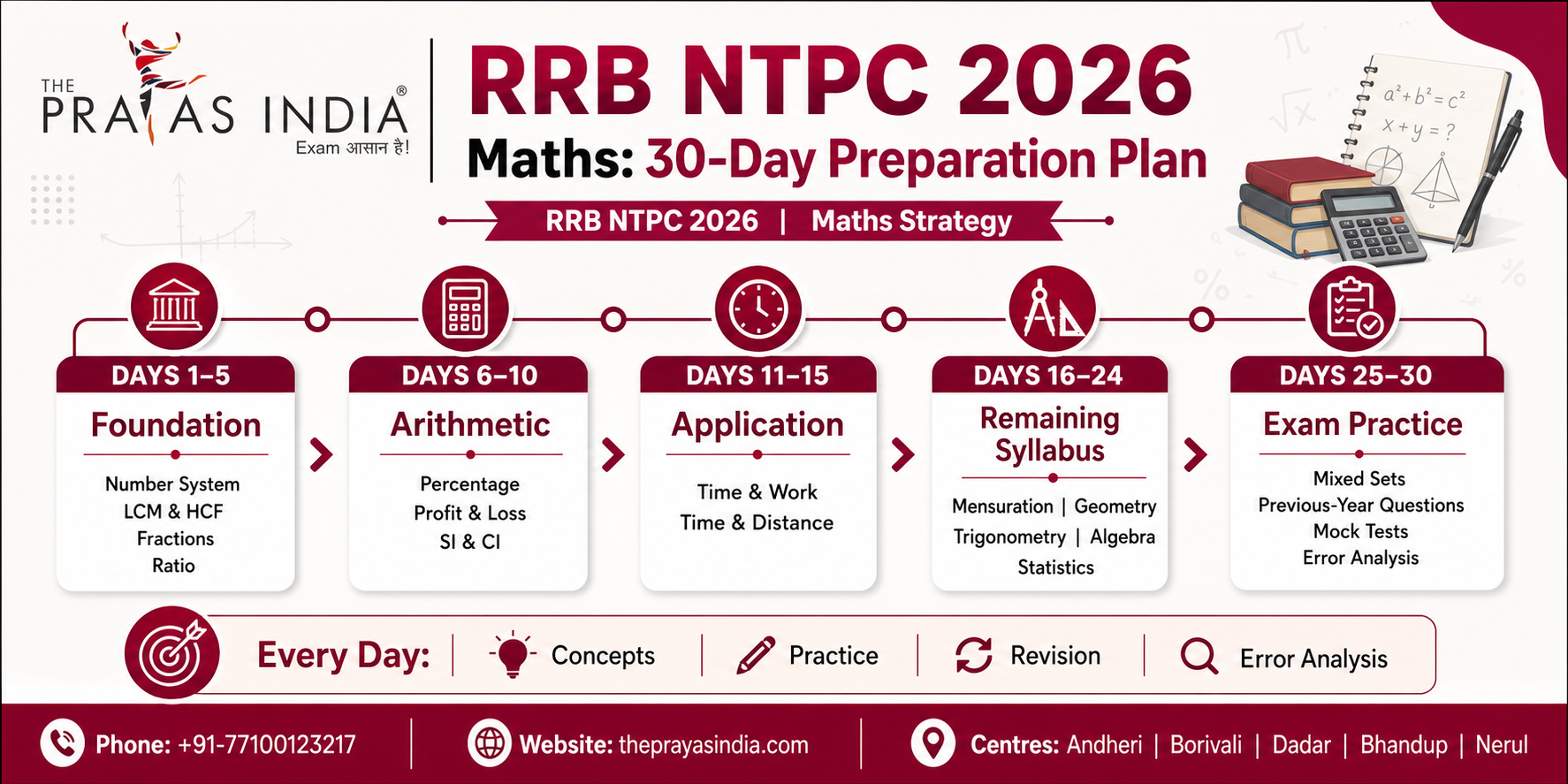
A 30-Day Maths Preparation Strategy for RRB NTPC 2026
Candidates who have limited time can use a structured 30-day approach.
Days 1–5: Foundation
Cover:
- Number System
- LCM and HCF
- Decimals and Fractions
- Ratio and Proportion
Spend most of the time building conceptual clarity.
Days 6–10: Percentage and Commercial Arithmetic
Cover:
- Percentage
- Profit and Loss
- Discount
- Simple Interest
- Compound Interest
These topics should receive extensive practice because of their interconnected nature.
Days 11–15: Work and Movement
Cover:
- Time and Work
- Work efficiency
- Time and Distance
- Speed
- Relative speed
- Basic application questions
Days 16–20: Geometry and Measurement
Cover:
- Mensuration
- Geometry
- Basic Trigonometry
- Important formulas and properties
Days 21–24: Algebra and Statistics
Cover:
- Elementary Algebra
- Linear equations
- Simplification
- Elementary Statistics
Days 25–27: Mixed Practice
Start solving mixed Maths sets containing questions from all completed topics.
The purpose is to develop topic recognition.
Days 28–30: Mock Tests and Revision
Attempt timed mock tests and analyse them thoroughly.
Revise:
- Formula sheet
- Error notebook
- Frequently missed question types
- Calculation techniques
- Weak chapters
How Coaching Can Help in RRB NTPC Maths Preparation
Self-study can help candidates build a strong foundation, but structured guidance can be useful when candidates struggle to decide what to study, which questions to prioritise or how to analyse their performance.
A focused RRB NTPC preparation programme can bring together concept classes, topic-wise practice, doubt resolution, mock tests and performance analysis within one preparation structure.
For Maths specifically, guided preparation can help candidates identify whether their problem is conceptual understanding, calculation speed, question selection or accuracy.
However, coaching should complement personal practice rather than replace it. Even the most structured course cannot substitute for regular question solving and revision.
For aspirants targeting RRB NTPC 2026, The Prayas India can provide a structured preparation environment with focused guidance and practice for the examination. Candidates should evaluate the course structure, faculty support, test series, doubt-solving system and schedule before choosing a preparation programme.
Final Strategy: How to Prepare Maths for RRB NTPC 2026
Preparing Maths for RRB NTPC 2026 is not about learning hundreds of shortcuts or solving thousands of random questions. It is about developing a systematic process.
Start with the fundamentals. Build your arithmetic foundation through Number System, Fractions, Ratio and Percentage. Then move towards application-based topics such as Profit and Loss, Interest, Time and Work, Time and Distance and Mensuration. Complete the remaining areas such as Algebra, Geometry, Trigonometry and Statistics without neglecting them.
Once the concepts are covered, shift the focus towards mixed practice, previous-year questions and timed tests.
Most importantly, maintain an error notebook and analyse your performance regularly. Your preparation should evolve based on your mistakes.
For RRB NTPC 2026, the objective should be:
Understand the concept → Solve accurately → Improve calculation speed → Practise under time pressure → Analyse mistakes → Revise repeatedly.
With 5,165 vacancies announced for the current recruitment cycle, candidates who are serious about the examination should avoid waiting until the final weeks to build their Maths preparation. Starting early gives you enough time to strengthen fundamentals, practise systematically and develop the speed required for a computer-based examination.
FAQs on How to Prepare Maths for RRB NTPC 2026
1. What is the syllabus for the RRB NTPC Mathematics section?
The RRB NTPC Mathematics syllabus primarily focuses on Arithmetic and Basic Algebra. Core topics include Number System, Percentages, Profit and Loss, Ratio and Proportion, Simple and Compound Interest, Time and Work, Time, Speed and Distance, and Data Interpretation. At The Prayas India, we cover each of these topics from foundational concepts to advanced shortcut methods.
2. How can I improve my calculation speed for RRB NTPC Maths?
Improving calculation speed requires daily practice of Vedic Maths tricks, mental math drills, square/cube tables, and fraction-to-percentage conversions. The Prayas India provides exclusive speed-building sessions and shortcut tricks designed by expert faculty to help you solve Quant questions in less than 30 seconds.
3. Which Mathematics topics carry the maximum weightage in RRB NTPC?
Arithmetic topics like Percentages, Profit and Loss, Ratio and Proportion, and Interest calculations form the backbone of both CBT 1 and CBT 2. Additionally, Data Interpretation (DI) sets carry significant weightage. Our targeted RRB coaching program emphasizes these high-yield topics through intense classroom mock drills.
4. How does mock test analysis help in improving my Maths score?
Simply attempting mocks won’t elevate your percentile. You need to analyze which math question types consume excessive time or lead to negative marks. The Prayas India offers individual performance tracking and mentorship to pinpoint your calculation or conceptual gaps, converting weak topics into high-scoring strengths.
5. Can a beginner crack RRB NTPC Maths by starting preparation from scratch?
Yes, absolutely. A beginner should start by mastering basic NCERT level arithmetic and then gradually adapt to competitive shortcuts. Our fresh batches for RRB NTPC 2026 are specifically structured from basic to advanced levels, ensuring even students from non-math backgrounds achieve elite accuracy.
6. Where can I join the best coaching classes for RRB NTPC Maths in Mumbai?
The Prayas India is widely recognized as the best coaching institute for RRB NTPC preparation in Mumbai. With offline learning centers located across convenient hubs—Andheri, Borivali, Dadar, Nerul, and Bhandup—along with highly flexible online interactive sessions, we offer unmatched mentorship, comprehensive study material, and elite mock test infrastructure. Admissions are currently open for new exam-oriented batches!
Score 100% in RRB NTPC Maths! Admissions Open for New Batches
Mastering shortcut formulas, calculation tricks, and data interpretation is the only way to beat the heavy competition. Join the premium classroom program at The Prayas India and learn under the guidance of top Quant experts to secure your selection.
Official Website: theprayasindia.com
Visit Our Mumbai Centres:
Andheri | Borivali | Dadar | Nerul | Bhandup