How to Stay Consistent During CAT Preparation | Best CAT Coaching in Mumbai | The Prayas India
CAT preparation is often described as a test of aptitude, but for most aspirants, the bigger challenge begins much earlier: staying consistent long enough to see the preparation actually work.
At the beginning, preparation usually feels exciting. You make a timetable, download study material, set ambitious targets and imagine yourself solving CAT questions with confidence. For a few days, everything appears under control. Then college, work, social commitments, fatigue, difficult topics or a disappointing mock test enter the picture. One missed study session becomes two, two become a week, and eventually you find yourself trying to restart the preparation all over again.
This cycle is common among CAT aspirants.
The problem is not always a lack of ambition. In many cases, the problem is that the preparation system depends too heavily on motivation.
Motivation changes from day to day. Consistency needs a system that continues to function even on days when you do not feel particularly motivated.
For an examination like CAT, this distinction matters because the syllabus cannot be mastered through occasional bursts of intense preparation. Quantitative Aptitude, VARC and DILR improve through repeated exposure, practice, analysis and revision. The skills required for CAT are built progressively.
Therefore, if you are preparing for CAT and looking for the best CAT coaching in Mumbai, one of the most important questions to ask is not simply, “How many hours should I study?” It is:
“Can I create a preparation routine that I can realistically follow for several months?”
That is the foundation of consistency.
Consistency Is Not the Same as Studying for Long Hours
One of the biggest mistakes CAT aspirants make is confusing consistency with extremely long study sessions.
Studying for eight hours on Sunday and doing almost nothing for the next four days is not necessarily better than studying for two focused hours every day.
CAT preparation benefits from regular contact with the subjects.
You need to repeatedly encounter:
- Reading comprehension
- Vocabulary and verbal reasoning
- Arithmetic and algebra
- Data interpretation
- Logical reasoning
- Previous CAT questions
- Mock-test analysis
This repeated exposure gradually improves recognition, calculation ability, comprehension and decision-making.
Think of CAT preparation as skill training rather than a chapter-completion exercise. You are not simply trying to finish a textbook. You are trying to develop the ability to recognise patterns, choose the right approach and solve unfamiliar questions under time pressure.
That requires continuity.
A sustainable routine of three productive hours can be far more valuable than an unrealistic schedule promising ten hours every day.
The Real Reason CAT Aspirants Lose Consistency
Before creating a better routine, it is useful to understand why consistency breaks down.
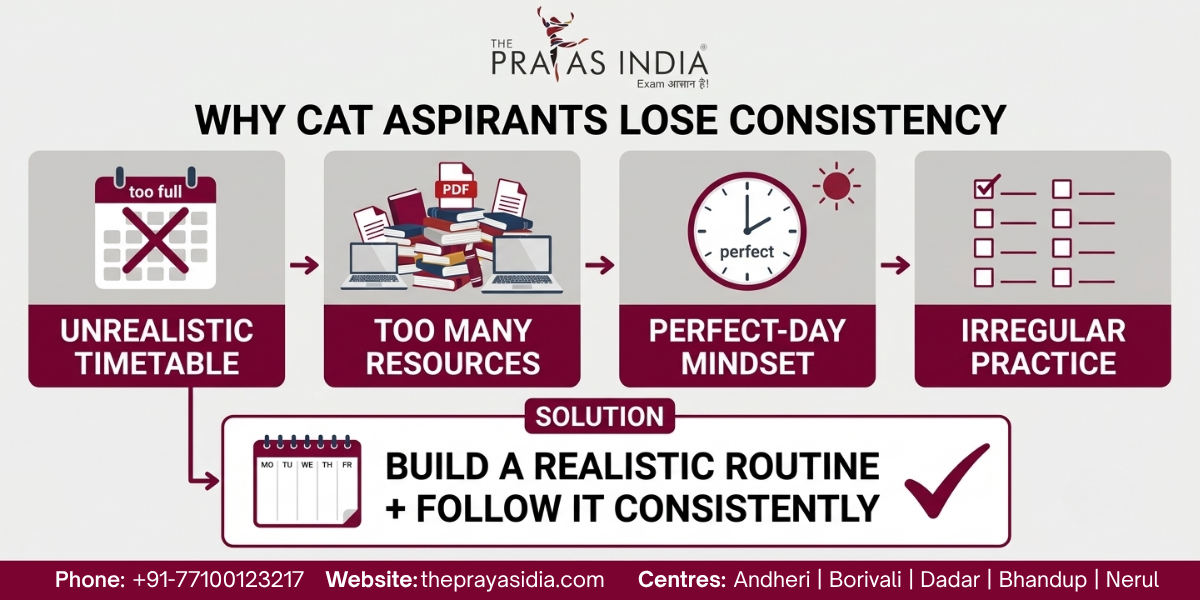
Unrealistic Timetables
Many aspirants prepare schedules based on their ideal version rather than their actual daily life.
A working professional may create a timetable designed for someone with unlimited study time. A college student may plan an entire day around CAT preparation despite classes, assignments and other responsibilities.
When the schedule becomes impossible to follow, the student starts feeling that the preparation itself is failing.
The solution is not necessarily more discipline. It is a more realistic schedule.
Too Many Resources
Another common problem is resource overload.
One student follows multiple YouTube channels, three test series, several Telegram groups, different books and numerous PDFs. Every new resource creates the feeling that something important is being missed.
Instead of improving preparation, the abundance of material creates confusion.
CAT preparation does not require you to solve every question available online.
You need a reliable primary source, structured practice, quality previous-year questions, mocks and meaningful analysis.
Once your resources are sufficient, stop searching for more and start working with what you already have.
Chasing the Perfect Day
Some aspirants believe that preparation should begin only when they have a completely free day.
But CAT preparation rarely works that way.
There will be days when you are tired. There will be college work, office deadlines, family responsibilities and unexpected commitments.
If your preparation system works only under perfect circumstances, consistency will always remain fragile.
A better approach is to create a minimum study commitment.
For example, even on a difficult day, you may decide to complete:
- One RC passage
- Ten Quant questions
- One DILR set
- Fifteen minutes of revision
The goal is not to achieve your maximum output every day.
The goal is to avoid completely disconnecting from preparation.
Build a Minimum Viable CAT Routine
One of the most effective ways to remain consistent is to create a routine with two layers.
The first is your ideal routine. This is what you follow when your day goes according to plan.
The second is your minimum routine. This is what you follow when your schedule becomes difficult.
For example:
| Situation | CAT Preparation |
|---|---|
| Normal day | 2–3 hours |
| Busy day | 60–90 minutes |
| Extremely busy day | 30–45 minutes |
| Mock-test day | Full mock + analysis |
This prevents the “all or nothing” mindset.
Suppose you planned three hours but could only study for 45 minutes because of an unexpected commitment. Instead of considering the day a failure, complete your minimum routine and continue normally the next day.
This approach protects momentum.
The objective is to make missing preparation unusual rather than normal.
Give Each CAT Section a Regular Place in Your Week
Consistency becomes easier when every section has a defined role in your weekly schedule.
A common mistake is to spend several consecutive days on Quant because it feels productive, then realise that VARC or DILR has received almost no attention.
CAT requires balance.
A weekly structure could look something like this:
| Day | Primary Focus | Secondary Focus |
|---|---|---|
| Monday | Quant | VARC |
| Tuesday | DILR | Quant |
| Wednesday | VARC | DILR |
| Thursday | Quant | VARC |
| Friday | DILR | Quant |
| Saturday | Mixed Practice | Revision |
| Sunday | Mock Test | Analysis |
This is only an example. Your actual schedule should depend on your current strengths, weaknesses and available time.
The important principle is regular rotation.
You should not allow any section to disappear from your preparation for several weeks.
Use Weekly Targets Instead of Only Daily Targets
Daily targets can sometimes create unnecessary pressure.
Imagine you decide to solve 40 Quant questions every Monday. On Monday, you become busy and complete only 15. You then feel behind before the week has properly started.
Weekly targets provide more flexibility.
Instead of saying:
“I must complete 40 questions today.”
you can set:
“I will complete 120 quality Quant questions this week.”
Now you have room to adjust the workload according to your schedule.
The same principle can be applied to reading and DILR.
For example:
VARC: 10–15 RC passages per week
DILR: 10–15 quality sets per week
Quant: A defined number of questions based on your level
Mocks: One or two mocks, depending on your stage of preparation
The numbers should not be treated as universal targets. Quality of practice and analysis matters more than raw volume.
Don’t Measure Preparation Only in Hours
Study hours are easy to count, but they do not always represent learning.
Two hours spent actively solving, reviewing mistakes and revising concepts can be more valuable than five hours of passive video watching.
Track outputs such as:
- Questions attempted
- Questions solved correctly
- Concepts revised
- RCs completed
- DILR sets solved
- Mock tests taken
- Mock errors analysed
- Weak areas identified
- Previously incorrect questions revisited
This gives you a much more realistic picture of your preparation.
A useful weekly review should answer:
What did I actually improve this week?
That question is more meaningful than:
How many hours did I sit at my desk?
Make Mock Tests Part of Your Routine, Not a Final-Stage Activity
Many CAT aspirants postpone mocks because they are afraid of low scores.
This is counterproductive.
A mock test is not merely an assessment. It is a diagnostic tool.
Early mocks may reveal:
- Poor time management
- Weak question selection
- Slow calculations
- Difficulty identifying easy questions
- Inconsistent reading speed
- DILR set-selection problems
- Over-attempting
- Avoidable errors
These weaknesses cannot be discovered properly through chapter-wise practice alone.
Your initial mock scores do not define your final CAT performance.
What matters is whether your preparation system helps you learn from each mock and improve the next one.
The Most Important Part of a Mock Is What Happens After It
Taking a mock and immediately moving to the next one is one of the biggest mistakes in CAT preparation.
Suppose you score 65 percentile in a mock. The useful question is not simply:
“Why did I score 65?”
Instead ask:
Which questions should I have attempted?
Which questions consumed too much time?
Which mistakes were conceptual?
Which mistakes were calculation errors?
Which questions did I leave despite knowing the approach?
Which DILR set should I have selected?
Did I spend too long on difficult questions?
This analysis converts a mock into a learning exercise.
In fact, the value of a mock often comes less from the score itself and more from the quality of the analysis that follows it.

Consistency Becomes Easier When You Track Your Weak Areas
CAT preparation can become overwhelming when you think about the entire syllabus at once.
Instead, maintain a small weak-area tracker.
For Quant, you might identify:
- Arithmetic
- Algebra
- Geometry
- Number Systems
- Modern Math
For VARC:
- RC inference
- Main idea
- Para summary
- Odd sentence
- Para jumbles
For DILR:
- Arrangements
- Games and tournaments
- Tables
- Charts
- Venn diagrams
- Distribution sets
The tracker should not simply say that you are “weak in Quant.”
That is too broad.
Instead, identify the specific skill that needs work.
Then assign targeted practice to that weakness.
This creates a much clearer path forward.
Use the “One Weakness at a Time” Rule
When students see several weak areas, they sometimes try to fix everything simultaneously.
This creates another form of inconsistency.
Suppose your Quant accuracy is poor, your DILR selection is weak and your VARC reading speed is slow.
Trying to completely solve all three problems in one week may lead to superficial practice.
Instead, prioritise.
For example:
Week 1: Arithmetic accuracy
Week 2: DILR set selection
Week 3: RC inference
Week 4: Time management
You will still practise all three sections, but one particular weakness receives additional attention.
This makes improvement measurable.
Key Takeaway
Consistency during CAT preparation is not about forcing yourself to study for an extraordinary number of hours every day.
It is about creating a preparation system that survives busy days, low motivation, difficult topics and disappointing mock scores.
A realistic schedule, regular section-wise practice, weekly targets, mock analysis and a clear weakness tracker can make preparation much more sustainable.
Most importantly, stop treating an imperfect study day as a failed day.
If you can study for three hours, do three productive hours.
If circumstances allow only one hour, use that hour well.
If the day is exceptionally difficult, complete your minimum routine and return to your normal schedule the next day.
Consistency is built by returning to the plan—not by never breaking it.
Balance CAT Preparation With College or Work
A large number of CAT aspirants prepare while managing another major responsibility. Some are college students, while others are working professionals.
The mistake is to copy the schedule of a full-time aspirant.
Your preparation plan should reflect your actual circumstances.
A working professional may have only two hours on weekdays but more time on weekends. A college student may have flexible afternoons but irregular schedules during examinations and assignments.
Instead of comparing your daily hours with someone else’s, calculate your own realistic weekly study capacity.
For example:
Monday–Friday: 2 hours per day
Saturday: 4 hours
Sunday: 5 hours
That gives you a manageable weekly framework.
The schedule may look smaller than an unrealistic 8–10 hour timetable, but if you follow it consistently for several months, the cumulative preparation can be substantial.
Consistency turns limited daily time into significant long-term preparation.
Use Time Blocks Instead of Waiting for Free Time
One useful way to protect CAT preparation is to assign fixed time blocks.
For example:
Morning: 45 minutes of reading/VARC
Evening: 60–90 minutes of Quant or DILR
Weekend: Mock + detailed analysis
The exact timings are not important.
What matters is that CAT preparation receives a pre-decided place in your day.
If you simply tell yourself, “I will study whenever I get time,” other activities will usually consume that time.
Scheduled preparation reduces the number of daily decisions you need to make.
Avoid the Motivation Trap
Motivation is useful for starting preparation.
It is not reliable enough to manage preparation for several months.
Some days you will feel energetic and may want to solve 100 questions.
Other days, even opening your study material may feel difficult.
Your routine should not depend entirely on how you feel.
A better approach is to separate:
Motivation → Why you are preparing
from
Discipline → What you do today
You do not need to feel highly motivated every morning.
You need to know what today’s task is and complete it.
This simple shift can make preparation considerably more stable.
Create a “Low-Energy” Study Plan
Not every study session needs to involve difficult problem-solving.
On low-energy days, use activities that still contribute to preparation.
You could:
- Revise formulas
- Review previous mistakes
- Read editorials
- Solve easier Quant questions
- Revisit previously attempted DILR sets
- Analyse a mock
- Revise vocabulary in context
- Review your short notes
This allows you to maintain continuity without forcing yourself into an unrealistic workload.
The purpose is not to lower standards permanently.
It is to prevent one difficult day from turning into a week-long break.
Don’t Let One Bad Mock Destroy Your Routine
Mock-test scores can be emotionally difficult.
You may perform well in one test and poorly in the next. Percentiles can fluctuate because of question selection, difficulty levels and your own performance on that particular day.
A low score should be treated as information, not identity.
Instead of saying:
“I am not good enough for CAT.”
ask:
“What exactly caused this performance?”
Perhaps your Quant accuracy dropped.
Perhaps you spent too long on one DILR set.
Perhaps you attempted too many difficult VARC questions.
Perhaps you were unfamiliar with the question types.
Each problem has a different solution.
A poor mock is useful when it changes your preparation strategy.
It becomes harmful only when it changes your confidence without changing your approach.
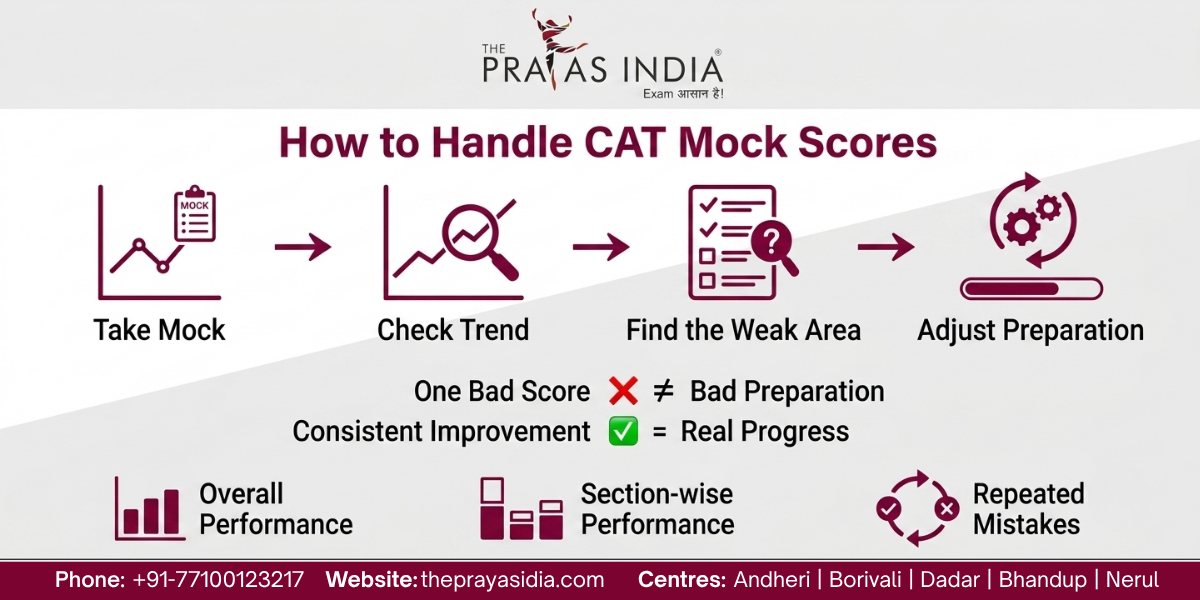
Track Progress Through Trends, Not Individual Scores
One mock score tells you very little.
A series of mocks tells you much more.
Maintain a simple tracker containing:
| Mock | Overall Score | VARC | DILR | QA | Major Issue |
|---|---|---|---|---|---|
| 1 | — | — | — | — | Time management |
| 2 | — | — | — | — | DILR selection |
| 3 | — | — | — | — | QA accuracy |
| 4 | — | — | — | — | RC inference |
The purpose is not to create another complicated spreadsheet.
It is to identify patterns.
If your VARC performance improves consistently while DILR remains unstable, you know where additional effort is required.
This makes preparation evidence-based rather than emotion-driven.
Build a Weekly Review System
A weekly review is one of the simplest ways to prevent your preparation from becoming directionless.
Set aside 20–30 minutes every week and answer five questions:
What did I complete?
Look at actual work rather than planned work.
What improved?
Identify skills that became stronger.
What remained weak?
Do not avoid uncomfortable areas.
What mistakes repeated?
Repeated mistakes are more important than isolated mistakes.
What will I change next week?
Make one or two specific adjustments.
This creates a feedback loop:
Plan → Study → Test → Analyse → Adjust → Repeat
Over several months, this process can significantly improve the efficiency of preparation.
Use the 80:20 Principle in Revision
As CAT approaches, you cannot keep giving equal time to everything.
Your revision should increasingly focus on:
- Frequently tested concepts
- Your weak areas
- Repeated mistakes
- Important formulas
- Question-selection patterns
- Previous CAT questions
- Mock-test learnings
This does not mean ignoring the rest of the syllabus.
It means allocating more time to areas where additional practice can produce meaningful improvement.
For example, if you repeatedly make mistakes in arithmetic despite understanding the concepts, additional targeted practice may be more valuable than reading another chapter of theory.
Make Previous CAT Questions a Regular Part of Preparation
Previous CAT questions are among the most valuable resources available to an aspirant because they provide insight into the nature of the examination.
Use them not simply as another question bank but as a learning resource.
While solving them, observe:
- How questions are framed
- What concepts are repeatedly tested
- How difficulty varies
- Which options create traps
- How much information the question provides
- Which questions can be solved through elimination
- How much time different question types require
Over time, this develops familiarity with the language and decision-making patterns of CAT.
Learn to Stop When a Question Is Not Worth Your Time
Consistency is not only about studying regularly.
It is also about developing the right exam habits.
One of the most important CAT skills is knowing when to move on.
During practice, observe how much time you spend on difficult questions.
If a question requires several minutes without meaningful progress, learn to recognise the signal and move ahead.
This skill should be developed during preparation rather than discovered for the first time in the actual examination.
The goal is not to solve every question.
The goal is to maximise your score from the questions you choose to attempt.
Protect Your Reading Habit for VARC
VARC preparation benefits from regular reading.
You do not need to read for hours every day.
A consistent 20–30 minute reading habit can help improve:
- Reading speed
- Comprehension
- Concentration
- Ability to follow complex arguments
- Familiarity with different writing styles
Read material beyond your preferred subjects.
Include areas such as:
- Economics
- Science
- Philosophy
- Sociology
- Politics
- History
- Technology
- Culture
The objective is not to memorise information.
It is to become comfortable reading unfamiliar and complex arguments.
DILR Requires Consistent Exposure
DILR can be particularly frustrating because improvement is not always linear.
You may solve several sets successfully one week and struggle with unfamiliar sets the next.
This is normal.
The solution is not to abandon DILR when it feels difficult.
Regular exposure helps develop:
- Pattern recognition
- Data organisation
- Logical sequencing
- Set selection
- Calculation efficiency
- Ability to abandon an unproductive approach
A small number of quality DILR sets solved consistently can be more beneficial than attempting a huge number without analysing your approach.
Quant Preparation Needs Revision Alongside Practice
Quantitative Aptitude is another area where consistency matters.
Learning a concept once does not guarantee that you will remember the fastest approach several weeks later.
Maintain short revision notes for:
- Important formulas
- Standard approaches
- Shortcuts you genuinely understand
- Common traps
- Questions you previously got wrong
Then revisit them periodically.
The purpose of revision is to make the correct approach increasingly automatic.
Avoid the “Backlog Explosion”
A common reason for losing consistency is accumulating unfinished work.
You miss one day.
Then you try to compensate by doubling the next day’s workload.
The next day becomes difficult.
More work gets postponed.
Eventually, the backlog becomes so large that preparation feels overwhelming.
The better solution is to reset quickly.
Do not try to complete every missed task immediately.
Prioritise:
Essential → Important → Optional
Resume your normal schedule and gradually clear the genuinely important backlog.
A missed study session is a small problem.
A missed month because you were trying to recover one missed session is a much bigger problem.
Build Accountability Into Your Preparation
Accountability can make consistency easier.
This can come through:
- A study partner
- A mentor
- A coaching programme
- A weekly test schedule
- A preparation group
- A teacher who reviews progress
The objective is not to depend completely on someone else.
It is to create a system where your preparation is visible and measurable.
For example, knowing that you have a mock test every Sunday can create a natural weekly deadline.
Similarly, regular mentor reviews can help identify when preparation has started drifting.
How CAT Coaching Can Support Consistency
Self-study can absolutely be part of CAT preparation, but many aspirants struggle with maintaining structure on their own.
A well-designed coaching programme can provide an external framework through:
Structured Classes → Practice Material → Sectional Tests → Full-Length Mocks → Performance Analysis → Mentorship
This structure can reduce the time spent deciding what to study next.
However, coaching should not become a substitute for self-discipline.
The best outcome occurs when coaching provides the framework and the student consistently executes it.
What to Look for in CAT Coaching in Mumbai
If you are searching for the best CAT coaching in Mumbai, do not evaluate an institute only by classroom infrastructure or promotional claims.
Look at the academic ecosystem.
Structured Curriculum
Does the programme cover the CAT syllabus systematically?
Quality Practice Material
Does the material include basic, intermediate and challenging questions?
Mock Tests
Are there sufficient sectional and full-length mocks?
Mock Analysis
Does the institute teach students how to analyse performance?
Doubt Resolution
Can students get timely clarification when concepts remain unclear?
Mentorship
Is there guidance on strategy, time management and preparation planning?
Personalised Feedback
Does the system identify individual strengths and weaknesses?
Revision
Are there structured revision opportunities instead of only first-time teaching?
For CAT, a good learning environment should help students remain consistent, accountable and focused.
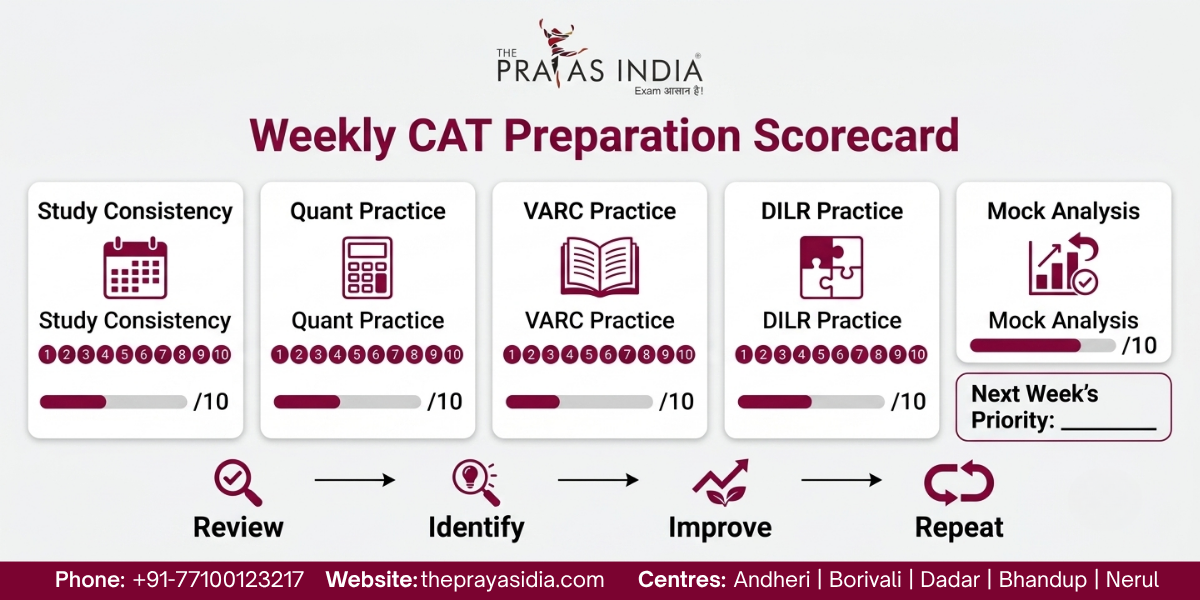
Create Your Own CAT Preparation Scorecard
At the end of every week, rate your preparation across five areas:
| Area | Rating |
|---|---|
| Study Consistency | /10 |
| Quant Practice | /10 |
| VARC Practice | /10 |
| DILR Practice | /10 |
| Mock Analysis | /10 |
Then write one sentence:
“Next week, my biggest improvement will be ______.”
This keeps the review simple.
You do not need a complicated productivity system.
You need a system you will actually use.
A Practical Daily Routine for CAT Aspirants
A sustainable daily routine could look like this:
30 Minutes — Reading
Read an editorial, long-form article or challenging passage.
60 Minutes — Primary Section
Work on your current priority area, such as Arithmetic or DILR.
45 Minutes — Secondary Section
Practise another section to maintain continuity.
15 Minutes — Revision
Review formulas, mistakes or short notes.
This is only a framework.
Your actual routine may be shorter or longer depending on your schedule.
The important principle is that each session should have a clear purpose.
Avoid sitting with your books open without knowing what you intend to accomplish.
What to Do When You Completely Lose Motivation
Sometimes the problem is not ordinary tiredness. You may reach a point where CAT preparation feels repetitive and you simply do not want to study.
Instead of forcing a huge session, reduce the starting barrier.
Tell yourself:
“I will study for just 15 minutes.”
Open one RC.
Solve five Quant questions.
Attempt one DILR set.
Once you start, continuing often becomes easier.
If you genuinely need rest, take planned rest rather than disappearing from preparation without a plan.
There is an important difference between:
Resting intentionally
and
Avoiding preparation indefinitely.
Both may look like “taking a break,” but their impact is very different.
Protect Sleep and Recovery
Consistency does not mean studying at the expense of basic recovery.
Poor sleep can affect:
- Concentration
- Memory
- Reading comprehension
- Calculation accuracy
- Decision-making
- Emotional stability
If your routine regularly leaves you exhausted, it is not sustainable.
CAT preparation is a long-term process. Your schedule should allow sufficient recovery so that you can continue performing consistently.
The goal is sustainable productivity, not constant exhaustion.
The Last Phase Requires More Discipline, Not More Panic
As CAT approaches, some students suddenly abandon their routine and attempt to study everything.
This creates unnecessary pressure.
The final phase should become more focused:
Revision → Mocks → Analysis → Weak-area Practice → Revision
Avoid constantly introducing new resources.
At this stage, your preparation should increasingly revolve around converting existing knowledge into exam-ready performance.
Consistency during the final weeks can be particularly valuable because small improvements in question selection, accuracy and time management can influence overall performance.
The Consistency Formula for CAT Preparation
There is no single perfect timetable for CAT.
But a useful framework is:
Realistic Schedule + Daily Contact + Weekly Review + Regular Mocks + Error Analysis + Recovery = Sustainable CAT Preparation
If one component is missing, consistency can become harder.
A schedule without review may become outdated.
Practice without analysis may repeat mistakes.
Mocks without analysis may create anxiety.
Hard work without recovery may lead to burnout.
Consistency is therefore not one habit.
It is the result of a well-designed preparation system.
Final Takeaway
Staying consistent during CAT preparation does not mean studying for the same number of hours every day or never experiencing a bad day.
It means maintaining a connection with your preparation even when circumstances are not perfect.
Build a realistic schedule.
Give all three sections regular attention.
Use weekly rather than purely daily targets.
Track your weak areas.
Take mocks regularly.
Analyse every mock carefully.
Use previous CAT questions.
Maintain a reading habit.
Revise formulas and mistakes.
Take planned breaks.
And when you fall behind, restart quickly instead of waiting for the perfect time to begin again.
For aspirants preparing for CAT in Mumbai, the right coaching environment can provide structure, quality study material, regular testing, mentorship and accountability. The Prayas India aims to support students through a systematic preparation approach designed around the demands of competitive management entrance examinations.
If you are evaluating CAT coaching in Mumbai, look beyond the number of classes or study hours. Ask whether the programme can help you maintain a sustainable routine, identify weaknesses, analyse mocks and improve consistently.
Because CAT preparation is rarely won by the student who studies hardest for a few weeks.
It is much more likely to favour the student who can prepare intelligently, stay consistent and keep improving for the entire journey.
Contact Us
📞 Call Now: +91-77100 13217
🌐 Website: theprayasindia.com
📍 Centres: Andheri | Borivali | Dadar | Nerul | Bhandup
Frequently Asked Questions
1. How many hours should I study for CAT every day?
There is no universal number. Your study hours should depend on your starting level, available time and preparation stage. A realistic routine that you follow consistently is more useful than an ambitious schedule that you cannot sustain.
2. How can I stay consistent during CAT preparation?
Create realistic daily and weekly targets, maintain regular practice across VARC, DILR and QA, track your weaknesses, take mocks and review your progress every week.
3. What should I do if I miss a day of CAT preparation?
Do not try to compensate by creating an extreme workload the next day. Resume your normal schedule and prioritise the most important pending work.
4. Should I take CAT mocks from the beginning?
Mocks can be introduced early as diagnostic tools, but their frequency should increase as your preparation develops. The most important part is analysing each mock carefully.
5. Why are my CAT mock scores fluctuating?
Scores can vary because of question difficulty, selection decisions, section-wise performance and individual mistakes. Focus on trends across multiple mocks rather than judging your preparation from one score.
6. How can working professionals stay consistent with CAT preparation?
Working professionals should create realistic weekly targets around their work schedule. Fixed study blocks, weekend mocks and short weekday sessions can make preparation more manageable.
7. Is CAT coaching necessary for consistency?
Not necessarily, but structured coaching can provide a curriculum, practice material, tests, evaluation and mentorship that may make it easier for some aspirants to maintain direction and accountability.
8. What makes The Prayas India a useful option for CAT preparation?
The Prayas India focuses on structured preparation, practice, testing and exam-oriented guidance to help aspirants build their CAT preparation systematically.