IBPS PO Study Plan for 3 Months: Your 90-Day Roadmap to Better Preparation
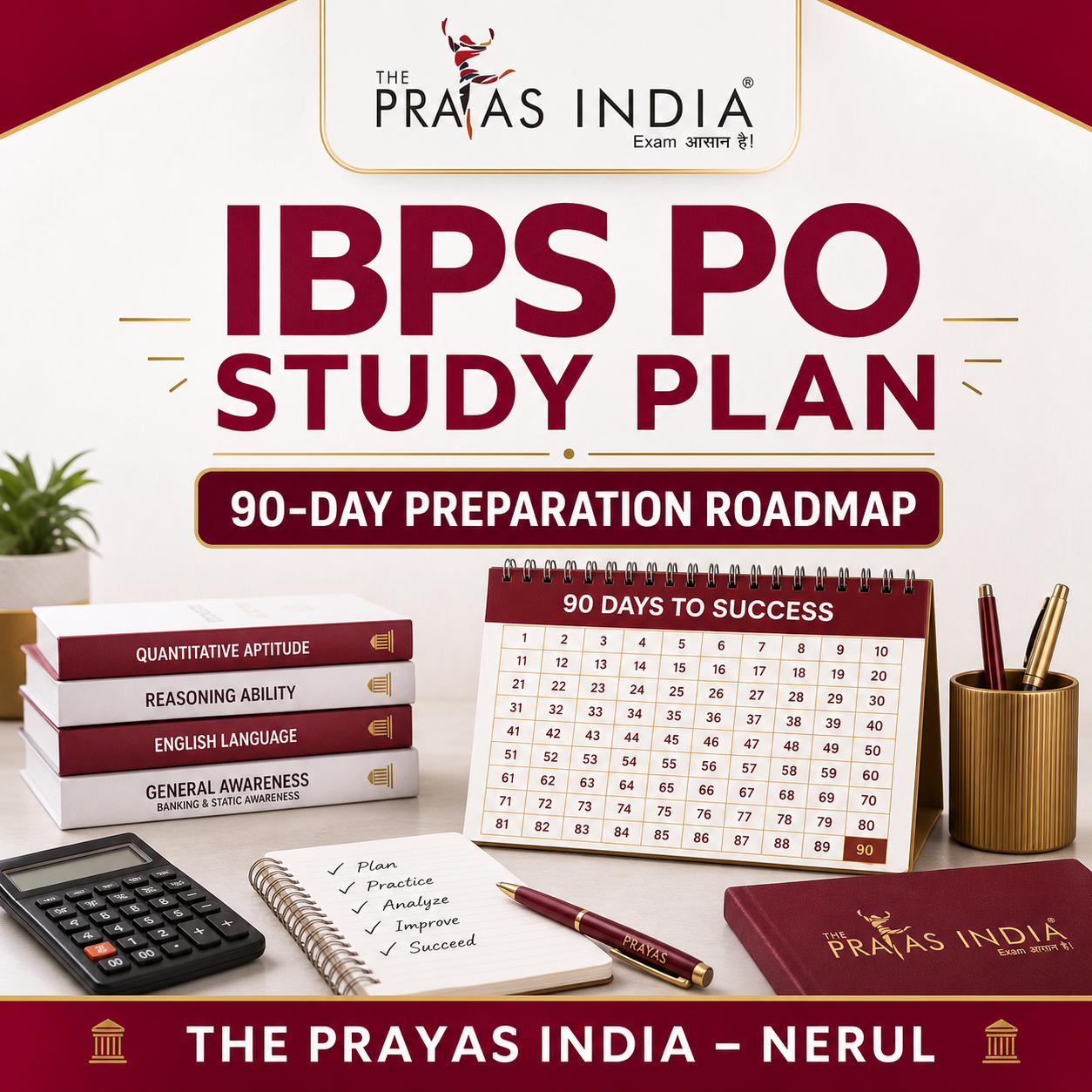
Three months can be a valuable preparation period for candidates targeting the Institute of Banking Personnel Selection Probationary Officer (IBPS PO) examination. However, success in a competitive banking exam depends not simply on how many hours you study, but on how effectively you use those hours.
IBPS PO preparation demands a combination of conceptual understanding, calculation speed, logical thinking, English comprehension, and awareness of banking and current affairs. Candidates must also prepare for different stages of the selection process, including Prelims, Mains, and the interview, as applicable under the recruitment notification.
If you have approximately 90 days available, you need a study plan that balances learning, practice, revision, and self-assessment.
This guide breaks the preparation journey into three manageable months so you can track your progress without feeling overwhelmed.
Before Starting: Understand What You Are Preparing For
IBPS PO preparation generally involves the following areas:
| Subject | Important Areas |
|---|---|
| Quantitative Aptitude | Arithmetic, Simplification, Number Series, Data Interpretation |
| Reasoning Ability | Puzzles, Seating Arrangement, Syllogism, Inequality |
| English Language | Reading Comprehension, Grammar, Vocabulary, Para Jumbles |
| General/Economy/Banking Awareness | Current Affairs, Banking Knowledge, Financial Awareness |
| Computer Aptitude | Computer Fundamentals and related topics |
The exact examination structure, sectional timings, marking scheme, and selection stages should be checked in the latest official IBPS notification.
A good preparation plan should cover the syllabus while developing the ability to solve questions accurately under time pressure.
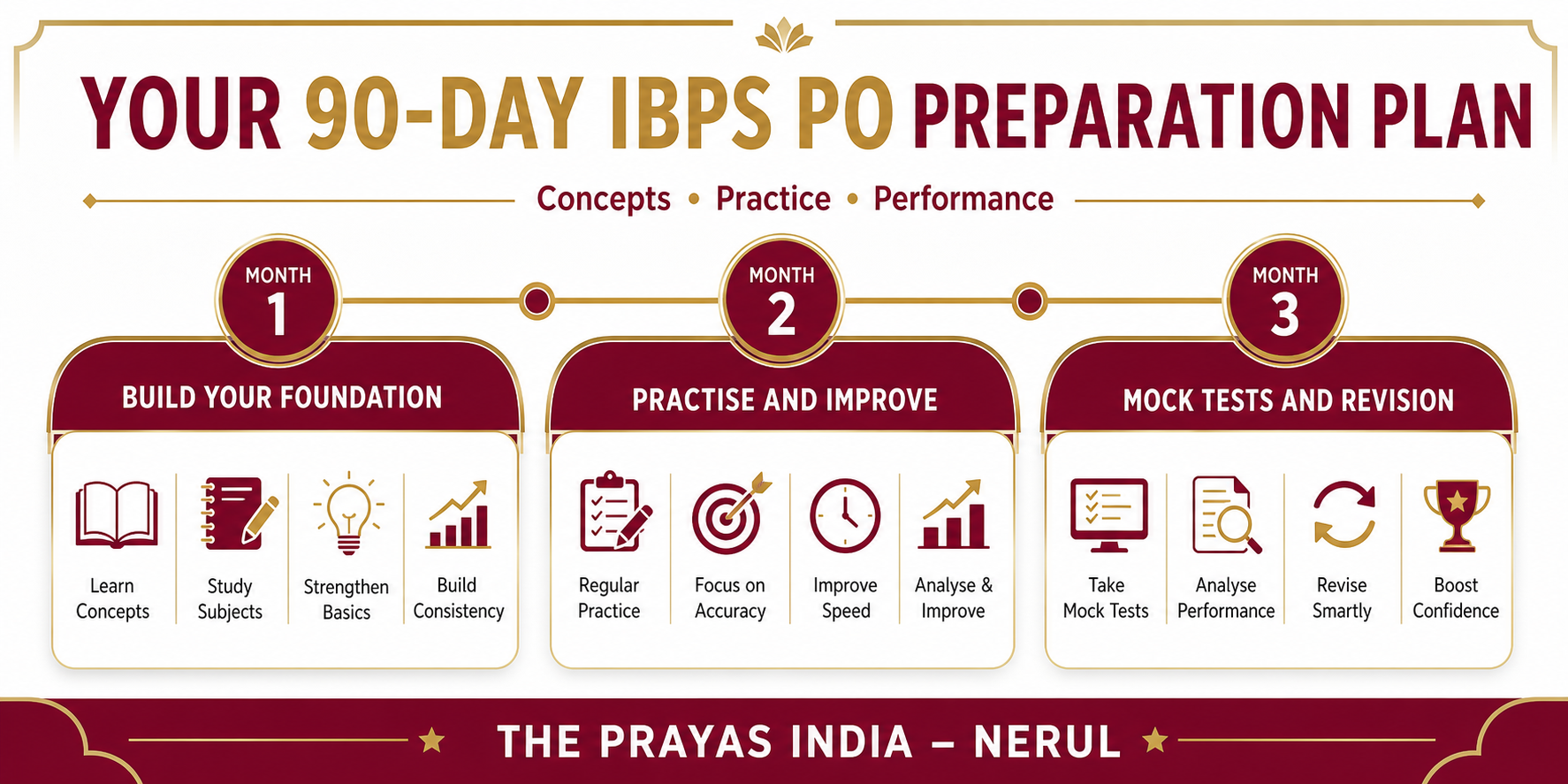
Month 1: Build Your Foundation (Day 1–30)
Your first month should focus on understanding fundamental concepts. Avoid rushing into difficult mock tests before you know the basics.
Week 1: Understand Your Current Level
Start with a diagnostic test to identify your strengths and weaknesses.
Your first week’s targets should include:
- Understand the IBPS PO syllabus and examination structure.
- Attempt a basic assessment in Quantitative Aptitude, Reasoning, and English.
- Identify topics that require additional attention.
- Create a notebook for formulas, vocabulary, and important concepts.
- Set realistic daily and weekly study targets.
Do not worry about your initial test score. Its purpose is to help you understand where to begin.
Week 2: Strengthen Quant and Reasoning
Give extra attention to calculation-based and logical topics.
Quantitative Aptitude:
- Simplification and Approximation
- Number Series
- Percentage
- Ratio and Proportion
- Average
- Profit and Loss
Reasoning Ability:
- Inequality
- Syllogism
- Coding-Decoding
- Direction Sense
- Blood Relations
- Alphanumeric Series
Practise questions after completing each topic. Try to understand multiple solving approaches wherever possible.
Week 3: Develop English and Arithmetic Skills
English preparation should involve regular reading and question practice.
Focus on:
- Reading Comprehension
- Error Detection
- Sentence Improvement
- Fill in the Blanks
- Cloze Test
- Vocabulary Building
Continue studying arithmetic topics such as Time and Work, Time and Distance, Simple Interest, and Compound Interest.
Week 4: Revise and Test Your Learning
The final week of Month 1 should be used to consolidate your learning.
- Revise all completed topics.
- Attempt sectional quizzes.
- Solve basic previous-year questions.
- Identify concepts that still feel difficult.
- Take a preliminary mock test and analyse the result.
Month 1 target: Develop a strong foundation and become comfortable with the basic question formats.
Month 2: Improve Speed and Question-Solving Ability (Day 31–60)
Once your fundamentals are in place, the second month should focus on applying them.
This is where you start moving from understanding questions to solving them efficiently.
Quantitative Aptitude: Move Towards Advanced Practice
Prioritise:
- Data Interpretation
- Quadratic Equations
- Quantity Comparison
- Advanced Arithmetic
- Caselet DI
- Mixed Practice Sets
Practise different question formats rather than repeatedly solving the same type of questions.
Reasoning: Focus on Puzzles and Complex Sets
Reasoning can become challenging when questions involve multiple conditions.
Work on:
- Linear Seating Arrangement
- Circular Seating Arrangement
- Floor-Based Puzzles
- Box-Based Puzzles
- Scheduling Puzzles
- Input-Output
- Logical Reasoning
Start with manageable sets and gradually increase the complexity.
English: Improve Comprehension and Accuracy
Develop a habit of reading English content daily.
Practise:
- Reading Comprehension
- Para Jumbles
- Sentence Rearrangement
- Phrase Replacement
- Word Usage
- Grammar-Based Questions
Instead of memorising long vocabulary lists, learn words in context and revise them regularly.
Introduce Regular Mock Tests
During the second month, start following a structured test routine.
A practical approach:
- Take sectional tests throughout the week.
- Attempt one or two full-length Prelims mocks weekly, depending on your preparation.
- Analyse incorrect answers.
- Record questions that consume excessive time.
- Revisit topics where your accuracy is low.
Do not increase the number of tests at the cost of revision.
Month 2 target: Improve speed, accuracy, question selection, and familiarity with examination-level questions.
Month 3: Mock Tests, Revision and Exam Readiness (Day 61–90)
The final month should focus on strengthening your preparation rather than starting every subject from the beginning.
1. Attempt Full-Length Mock Tests
Practise under conditions that resemble the actual examination.
After every mock test, evaluate:
- Total score
- Accuracy
- Time spent
- Section-wise performance
- Incorrect answers
- Questions left unattempted
Use these observations to make small improvements in your next test.
2. Revise Important Quantitative Aptitude Topics
Focus on:
- Arithmetic formulas
- Data Interpretation
- Simplification
- Number Series
- Quadratic Equations
- Frequently practised question types
Avoid spending too much time learning completely new shortcuts at the last moment.
3. Strengthen Reasoning Performance
Revise puzzle approaches, seating arrangements, syllogisms, inequalities, and other important topics.
Practise selecting manageable questions instead of spending excessive time on a single complicated puzzle.
4. Make English Practice a Daily Habit
Continue reading, solving comprehension questions, and revising grammar concepts.
Pay attention to accuracy. Attempting questions quickly without understanding the passage or sentence can lead to avoidable mistakes.
5. Prepare for the Mains Stage
Do not ignore Mains preparation entirely while studying for Prelims.
Depending on the latest exam pattern, make room for General/Economy/Banking Awareness, descriptive English, and other applicable areas.
Build a habit of reading reliable news and revising important financial and banking developments.
Month 3 target: Improve exam readiness, revise important concepts, and develop a reliable test-taking strategy.
A Practical Daily IBPS PO Study Timetable
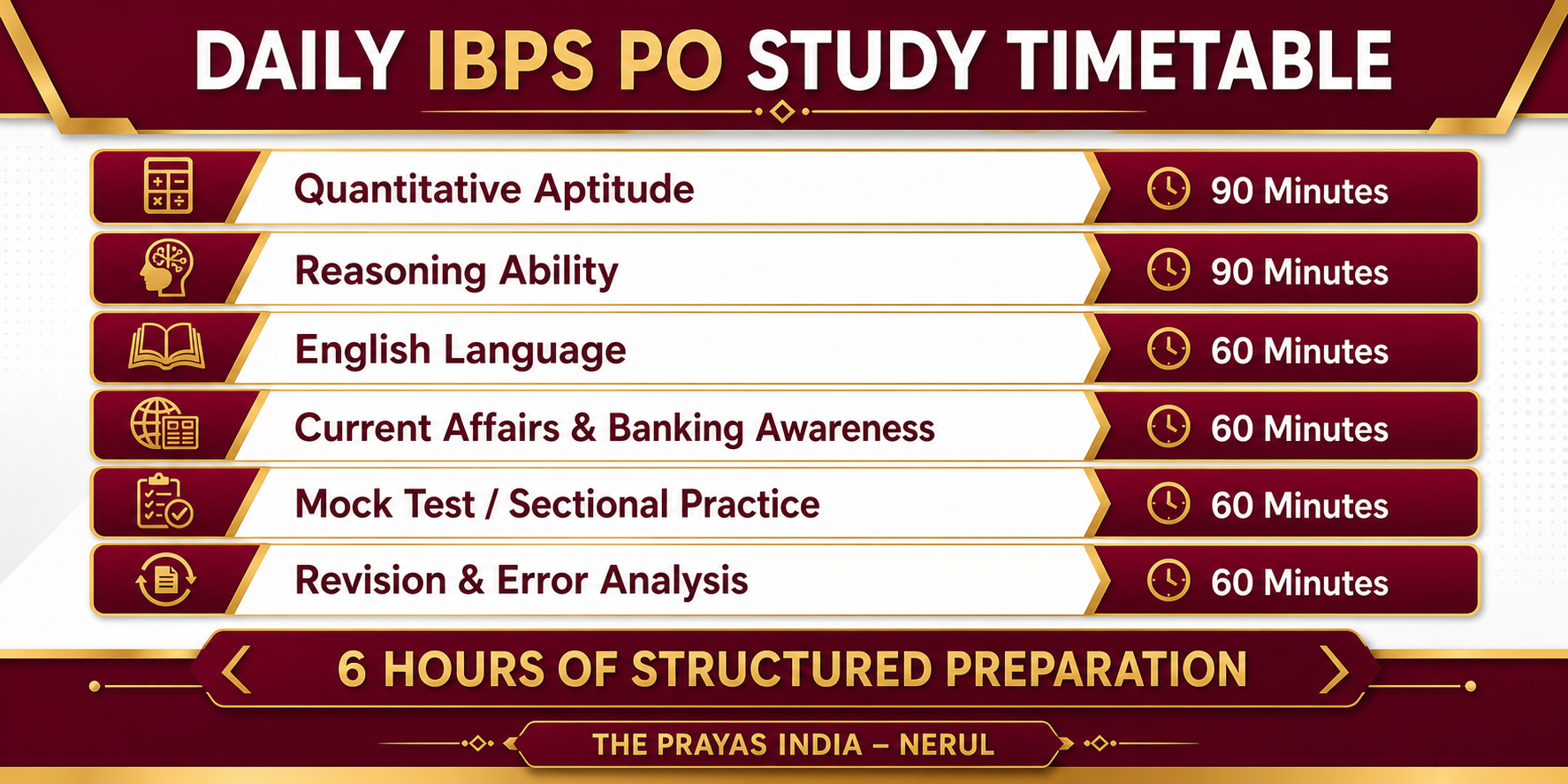
A study timetable should be realistic enough to follow consistently. Here is an illustrative six-hour schedule for candidates who can dedicate a substantial part of their day to preparation.
| Study Activity | Time |
|---|---|
| Quantitative Aptitude | 90 minutes |
| Reasoning Ability | 90 minutes |
| English Language | 60 minutes |
| Current Affairs and Banking Awareness | 60 minutes |
| Mock Test / Sectional Practice | 60 minutes |
| Revision and Error Analysis | 60 minutes |
| Total | 6 hours |
If you are a working professional or college student, you can reduce the duration and distribute the remaining practice across weekends.
The priority should be consistent learning rather than blindly following someone else’s timetable.
How to Prepare Current Affairs for IBPS PO?
Current Affairs and Banking Awareness require a different approach from Quantitative Aptitude and Reasoning.
Instead of trying to memorise everything, focus on relevant developments and regular revision.
Consider following these habits:
- Read a reliable news source daily.
- Maintain short notes on important banking developments.
- Revise financial and economic terminology.
- Study important government schemes.
- Practise banking awareness quizzes.
- Revise monthly current affairs notes.
Give special attention to topics relevant to banking, finance, the economy, and national developments.
Five Mistakes That Can Affect Your 90-Day Preparation
Even a well-designed study plan may not work if you repeatedly make these mistakes.
- Studying without a priority list: Trying to complete everything simultaneously can lead to confusion. Set weekly targets.
- Ignoring weak subjects: Spending all your time on your favourite subject creates an imbalance. Give additional practice time to difficult areas.
- Taking mock tests without analysis: A mock test is useful only when you understand what went wrong and how to improve.
- Ignoring revision: New topics are important, but previously studied concepts must also remain fresh.
- Following unrealistic schedules: A timetable that you cannot maintain will not support consistent preparation. Adjust your targets according to your actual availability.
Should You Join IBPS Coaching for a 3-Month Preparation Plan?
Self-study can help candidates prepare independently, but some aspirants prefer structured academic guidance to organise their preparation.
If you are exploring Best IBPS Coaching in Navi Mumbai, consider the quality of teaching, subject coverage, practice resources, doubt-solving support, and batch schedules.
For students looking for IBPS PO Coaching in Nerul, a nearby institute may make it easier to attend classes regularly while maintaining sufficient time for self-study.
Before enrolling, ask about:
- Subject-wise teaching methodology.
- Coverage of Prelims and Mains topics.
- Availability of mock tests and practice sets.
- Performance feedback and doubt-solving support.
- Currently available batches and course schedules.
The right programme should complement your self-study routine rather than replace it.
Why Consider The Prayas India for IBPS PO Preparation in Nerul?
Students searching for Top IBPS Coaching in Navi Mumbai can consider The Prayas India as one of the institutes to contact for information about banking exam preparation.
The Prayas India has a branch in Nerul West, making it a convenient local option for aspirants from Nerul and nearby areas.
Candidates can enquire about currently available programmes, subject coverage, batch timings, classroom guidance, and preparation support.
Whether you are starting your banking exam preparation or looking for a more organised study routine, discuss your goals and current preparation level with the institute before choosing a programme.
The Prayas India – Nerul Branch
- Address: F-105, 1st Floor, Nerul West, Nerul, Maharashtra 400706
- Call: +91 77100 13217
Final 90-Day Preparation Checklist
Before your three-month preparation period ends, check whether you have completed these important tasks:
Conclusion
A well-planned IBPS PO Study Plan for 3 Months can help you make your preparation more focused and manageable. Use the first month to build concepts, the second month to improve problem-solving skills, and the third month to strengthen performance through mock tests and revision.
Remember that a 90-day timetable is a preparation framework, not a guarantee of selection. Your progress will depend on your starting level, consistency, accuracy, and ability to learn from mistakes.
If you are looking for Best IBPS Coaching in Nerul or Best IBPS Coaching in Navi Mumbai, explore the available preparation options at The Prayas India and enquire about the programmes that match your requirements.
Start with a realistic target, follow your daily routine, and make every study session count.
Frequently Asked Questions About IBPS PO Preparation
1. Can I prepare for IBPS PO in 3 months?
Yes, three months can be used for focused IBPS PO preparation. Your progress will depend on your existing knowledge, daily study time, and consistency. Follow a structured plan covering Quantitative Aptitude, Reasoning, English, and General Awareness.
2. How many hours should I study daily for IBPS PO?
The required study time varies from candidate to candidate. An illustrative six-hour schedule can provide time for concepts, practice, current affairs, mock tests, and revision. Working candidates can adjust the schedule according to their availability.
3. What should I study first for IBPS PO?
Begin with the fundamentals of Quantitative Aptitude, Reasoning Ability, and English Language. Gradually introduce advanced questions, previous-year papers, and mock tests.
4. When should I start taking IBPS PO mock tests?
Start with topic-wise tests after learning the basic concepts. Introduce sectional tests as your preparation progresses and full-length mocks when you have covered a reasonable portion of the syllabus.
5. Is IBPS PO Mains preparation different from Prelims preparation?
Yes. Mains preparation requires additional focus on areas such as General/Economy/Banking Awareness and descriptive English, as applicable under the latest examination pattern. Candidates should plan for both stages.
6. Where can I enquire about IBPS PO coaching in Nerul?
You can contact The Prayas India at F-105, 1st Floor, Nerul West, Navi Mumbai, to enquire about currently available banking exam preparation programmes.
Plan Your IBPS PO Preparation with The Prayas India
Looking for IBPS PO preparation guidance in Nerul or Navi Mumbai? Contact The Prayas India to enquire about currently available programmes, batch schedules, and academic support.