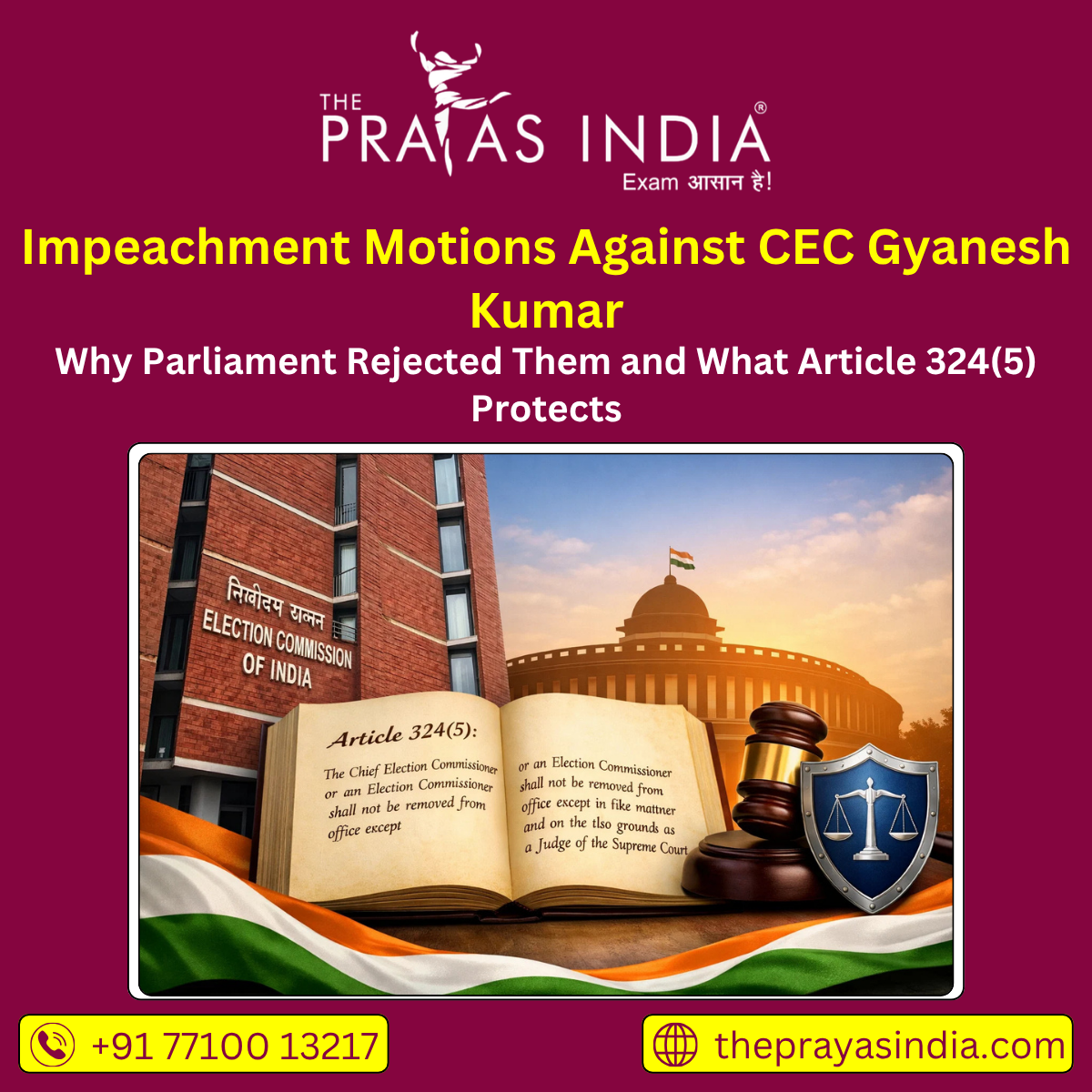
Impeachment Motions Against CEC Gyanesh Kumar: Why Parliament Rejected Them and What Article 324(5) Protects
The rejection of removal notices against Chief Election Commissioner Gyanesh Kumar on 6 April 2026 is a major constitutional moment because it shows how strongly Indian law protects the independence of the Election Commission. The episode is important for UPSC because it combines Article 324(5), parliamentary procedure, judicial safeguards, and the larger question of electoral neutrality.
What happened
On 12 March 2026, Opposition MPs from the INDIA bloc submitted removal notices against the CEC, backed by 193 MPs in total, including 130 Lok Sabha members and 63 Rajya Sabha members. On 6 April 2026, both the Rajya Sabha Chairman and the Lok Sabha Speaker rejected the motions at the initial stage, making it the first time such notices had been formally filed against a sitting Chief Election Commissioner and then declined before any inquiry process began.
The notices alleged partisan conduct, irregularities in electoral roll revision, and obstruction in electoral fraud-related matters. The presiding officers reportedly found that the materials did not meet the high constitutional threshold of “proved misbehaviour,” which is the standard required for removal under the Constitution.
Constitutional protection
Article 324(5) of the Constitution gives the Chief Election Commissioner strong security of tenure. It states that the CEC can be removed only in the same manner and on the same grounds as a judge of the Supreme Court, and that the service conditions of the CEC cannot be altered to his disadvantage after appointment.
This protection is deliberate. The constitutional design is meant to insulate the Election Commission from political pressure, so that it can conduct free and fair elections without fear of arbitrary removal by the executive or the ruling majority. In UPSC terms, this is a classic example of how constitutional safeguards preserve the independence of a key democratic institution.
Removal process
The removal of the CEC follows the same framework as the removal of a Supreme Court judge under Article 124(4), read with the Judges (Inquiry) Act, 1968. A notice must be signed by at least 100 members in the Lok Sabha or 50 members in the Rajya Sabha, after which the Speaker or Chairman may decide whether to admit it.
If admitted, a three-member inquiry committee is constituted, usually comprising a Supreme Court judge, a High Court Chief Justice, and a distinguished jurist. Only after the committee finds guilt can Parliament vote on the removal, and even then the motion must pass in each House by a special majority: a majority of total membership and at least two-thirds of members present and voting.
Removal steps
- Notice by 100 Lok Sabha MPs or 50 Rajya Sabha MPs.
- Speaker or Chairman decides whether to admit the motion.
- Inquiry by a three-member committee if admitted.
- Special majority vote in both Houses if guilt is proved.
Why the rejection matters
The rejection is important because it shows that removal of a CEC is not a political vote of no confidence. It is a constitutional process requiring evidence, inquiry, and a very high threshold of proof. The presiding officers’ decision also indicates that the allegations were either not sufficiently substantiated or were tied to matters already under judicial scrutiny.
At the same time, the episode has reopened debate about whether the Election Commission itself needs deeper institutional reform, especially in relation to transparency, accountability, and parity among Election Commissioners. The CEC enjoys stronger constitutional protection than other Election Commissioners, who can be removed on the recommendation of the CEC, and this asymmetry remains a recurring issue in constitutional discussions.
CEC and ECs
A useful UPSC distinction is that the Chief Election Commissioner has stronger removal protection than the other Election Commissioners. Article 324(5) gives the CEC protection similar to a Supreme Court judge, while the other Election Commissioners do not enjoy the same level of constitutional insulation.
This creates an asymmetrical structure within the Election Commission. Many constitutional commentators argue that if the institution itself is meant to function collectively, then the independence of all commissioners should be protected more evenly. That debate is likely to remain relevant in future reforms.
UPSC relevance
This topic is highly relevant for UPSC Prelims because it covers Article 324, Article 124, the Judges (Inquiry) Act, and the constitutional status of the Election Commission. It also tests knowledge of parliamentary procedure and the difference between general political criticism and a formal removal process.
For Mains, this is a strong GS Paper 2 topic on constitutional bodies, democratic institutions, separation of powers, and electoral integrity. It can also be used in answers on institutional accountability, constitutional morality, and the balance between independence and oversight.
Mains angles
- Independence of constitutional bodies.
- Article 324 and electoral fairness.
- Removal safeguards and democratic accountability.
- Reform of the Election Commission.
- Judicial standards in constitutional removal processes.
Why The Prayas India
The Prayas India is one of the best UPSC coaching in Mumbai because it teaches aspirants how to read a current affair like this beyond the headline. A topic on the CEC’s removal is not only about one person or one motion; it is about constitutional design, institutional independence, and the deeper mechanics of India’s democracy, which is exactly how UPSC expects answers to be written.
For UPSC preparation in Mumbai, The Prayas India gives students structured current affairs classes, polity integration, answer-writing practice, and revision support that help convert complex constitutional developments into clear, exam-ready points. Aspirants searching for IAS coaching in Mumbai or the best UPSC classes in Mumbai benefit from this because such topics often appear in Prelims as factual provisions and in Mains as analytical questions.
What makes The Prayas India especially useful is its ability to bridge static polity with live constitutional events. For example, a student reading about the CEC motion should be able to recall Article 324(5), Article 124(4), the Judges (Inquiry) Act, the role of the Speaker/Chairman, the concept of special majority, and the broader issue of Election Commission independence—all in one answer. That kind of structured recall is hard to build alone and is where guided coaching matters most.
The Prayas India also helps aspirants develop the kind of balanced perspective UPSC rewards. This means understanding both sides of the debate: the need to protect the Election Commission from political pressure, and the need for legitimate accountability when serious allegations arise. That analytical maturity is essential for high-scoring Mains answers and confident interview responses.
FAQs
No. The CEC cannot be removed politically or at will. Removal follows the constitutional process laid down in Article 324(5) and is similar to the removal of a Supreme Court judge.
The grounds are only “proved misbehaviour” or “incapacity”.
The Speaker or Chairman decides whether to admit it. If admitted, an inquiry committee investigates the charges before Parliament can vote.
The notices were not found to meet the high constitutional bar required for removal, and the concerns were considered insufficient or speculative at that stage.
It connects constitutional law, Parliament, the Election Commission, and democratic safeguards, making it highly relevant for Prelims and Mains. Can the CEC be removed like a minister?
What are the grounds for removal?
What happens after a removal notice is filed?
Why were the motions against Gyanesh Kumar rejected?
Why is this important for UPSC?

![Prayas-तेजस [UPSC CSE Sociology Optional] – Online & Offline](https://theprayasindia.com/wp-content/uploads/2025/09/Prayas-तेजस-UPSC-CSE-Optional-Subject-The-Prayas-India-300x300.png)
![Prayas-सूत्र [UPSC CSE Materials (Hardcopy)]](https://theprayasindia.com/wp-content/uploads/2025/09/Prayas-सूत्र-UPSC-CSE-Study-Materials-Hardcopy-The-Prayas-India-300x300.png)
![Prayas-मंत्रा [UPSC CSE CSAT]](https://theprayasindia.com/wp-content/uploads/2025/09/Prayas-मंत्रा-UPSC-CSE-CSAT-The-Prayas-India-300x300.png)
![Prayas सारथी [UPSC CSE One on One Mentorship]](https://theprayasindia.com/wp-content/uploads/2025/09/Prayas-सारथी-UPSC-CSE-One-on-One-Mentorship-The-Prayas-India-300x300.png)