
Important Lakes in India: Types, Classification, Distribution, Ecological Roles & Conservation
- GS Paper 1: Physical Geography, Geomorphology, Hydrology, Indian Geography
- GS Paper 3: Environment, Wetland Conservation, Ramsar Sites, Climate Change Impact
- Prelims: Lakes (freshwater, saltwater), Ramsar Sites, Wetland Ecology, Biodiversity
- Geography Optional: Hydrology, Fluvial & Lacustrine Landforms, Environmental Geography, Wetland Management
Introduction
A lake is a naturally occurring, enclosed depression on the Earth’s surface that holds water throughout the year or seasonally. In physical geography, a lake is defined as a body of standing water surrounded by land, occupying a basin formed by geological, hydrological, or climatic processes.
India has an exceptional variety of lakes due to its diverse relief, climate zones, tectonic history, and hydrological systems. Lakes in India range from:
- Tectonic freshwater lakes like Wular
- High-altitude glacial lakes such as Pangong Tso and Gurudongmar
- Lagoon lakes like Chilika and Pulicat
- Oxbow lakes formed by river meandering
- Saltwater lakes like Sambhar
- Artificial reservoirs created by dams
Lakes play a crucial role in India’s hydrological cycle by storing water, regulating river flow, supporting biodiversity, enhancing microclimates, and sustaining livelihoods.
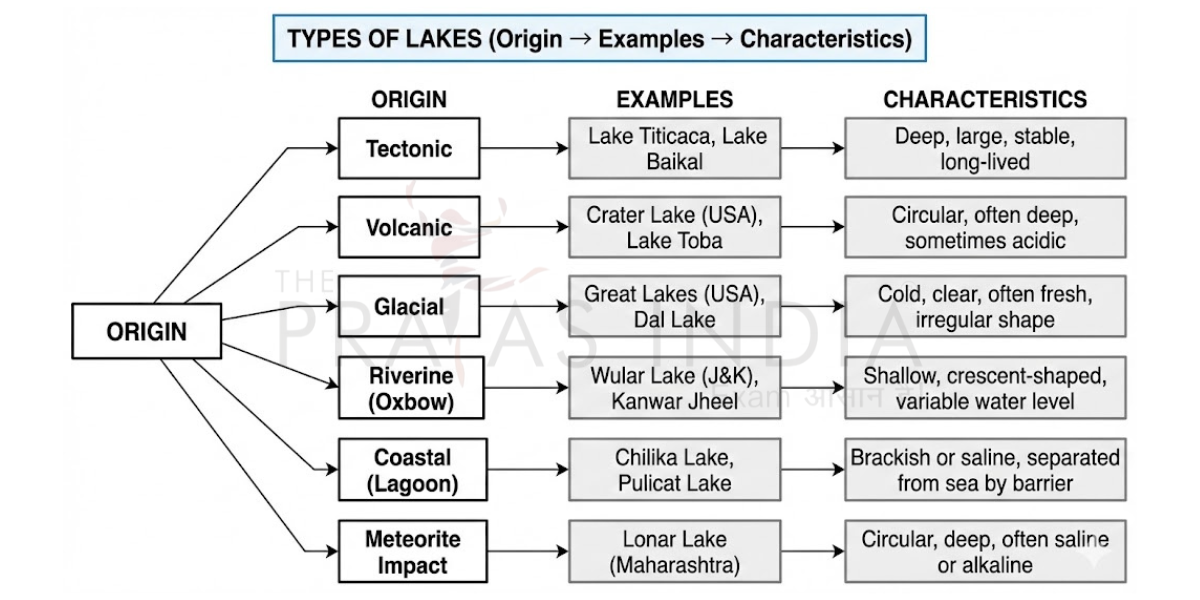
Classification of Lakes in India
India’s lakes can be categorized using multiple criteria.
A. Based on Origin
1. Tectonic Lakes
Formed by faulting, warping, or subsidence.
Examples: Wular Lake, Loktak Lake
2. Glacial Lakes
Created by glacial erosion and deposition in the Himalayan region.
Examples: Pangong Tso, Tso Moriri, Dal Lake
3. Volcanic (Crater) Lakes
Formed in volcanic craters.
Example: Lonar Lake
4. Lagoon Lakes
Separated from the sea by sandbars or spits.
Examples: Chilika, Pulicat, Vembanad
5. Oxbow / Riverine Lakes
Created by river meandering.
Examples: Kanwar Lake, Deepor Beel
6. Solution / Karst Lakes
Formed by dissolution of limestone.
Examples: Karst depressions in Meghalaya and the Himalayas
7. Artificial / Reservoirs
Created by damming rivers.
Examples: Gobind Sagar, Hirakud, Nagarjuna Sagar
B. Based on Salinity
- Freshwater Lakes: Dal, Wular
- Brackish Lakes: Chilika, Vembanad
- Saltwater Lakes: Sambhar, Lunkaransar
C. Based on Permanence
- Permanent Lakes: Wular, Dal
- Seasonal Lakes: Rann of Kutch salt pans, some Rajasthan lakes
Major Lakes in India (Type-wise Classification)
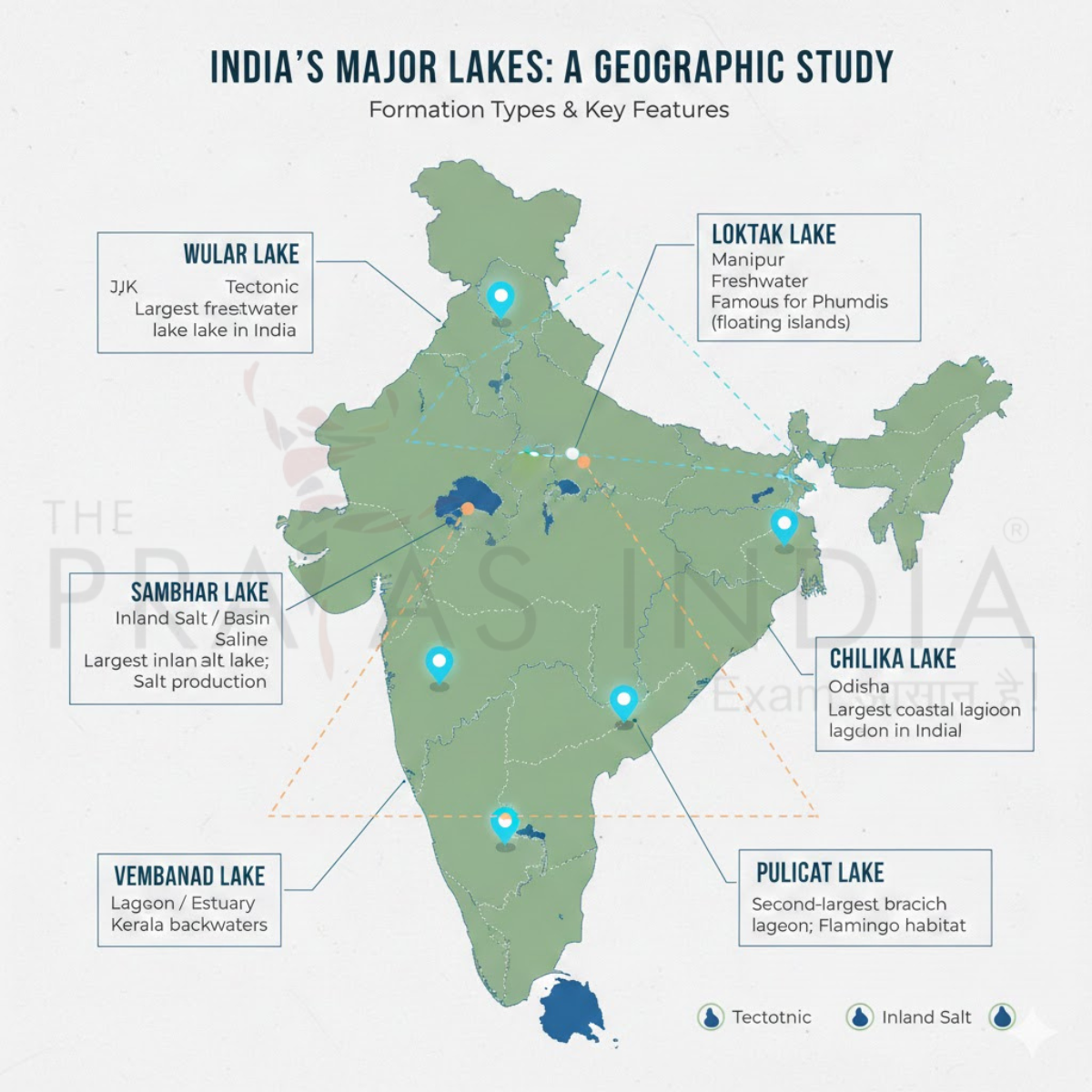
Below is a structured overview of India’s most important lakes for exams.
A. Tectonic Lakes
1. Wular Lake (Jammu & Kashmir)
- Type: Tectonic freshwater lake
- Significance: One of the largest freshwater lakes in Asia
- River Basin: Jhelum
- Features: Flood buffering, Ramsar site, rich fishery
- Threats: Encroachment, siltation, willow plantations
2. Loktak Lake (Manipur)
- Type: Tectonic + wetland mosaic
- Unique Feature: Phumdis (floating biomass)
- Key Ecological Feature: Keibul Lamjao National Park, the only floating national park
- Significance: Habitat of Sangai deer
- Threats: Hydrological imbalance due to Ithai Barrage
3. Chilika Lake (Odisha)
- Type: Brackish lagoon formed due to tectonic and depositional processes
- Importance: Largest brackish water lagoon in Asia
- Biodiversity: Migratory birds, Irrawaddy dolphins
- Ramsar Site: Yes
- Threats: Siltation, salinity changes, tourism pressure
B. Glacial Lakes
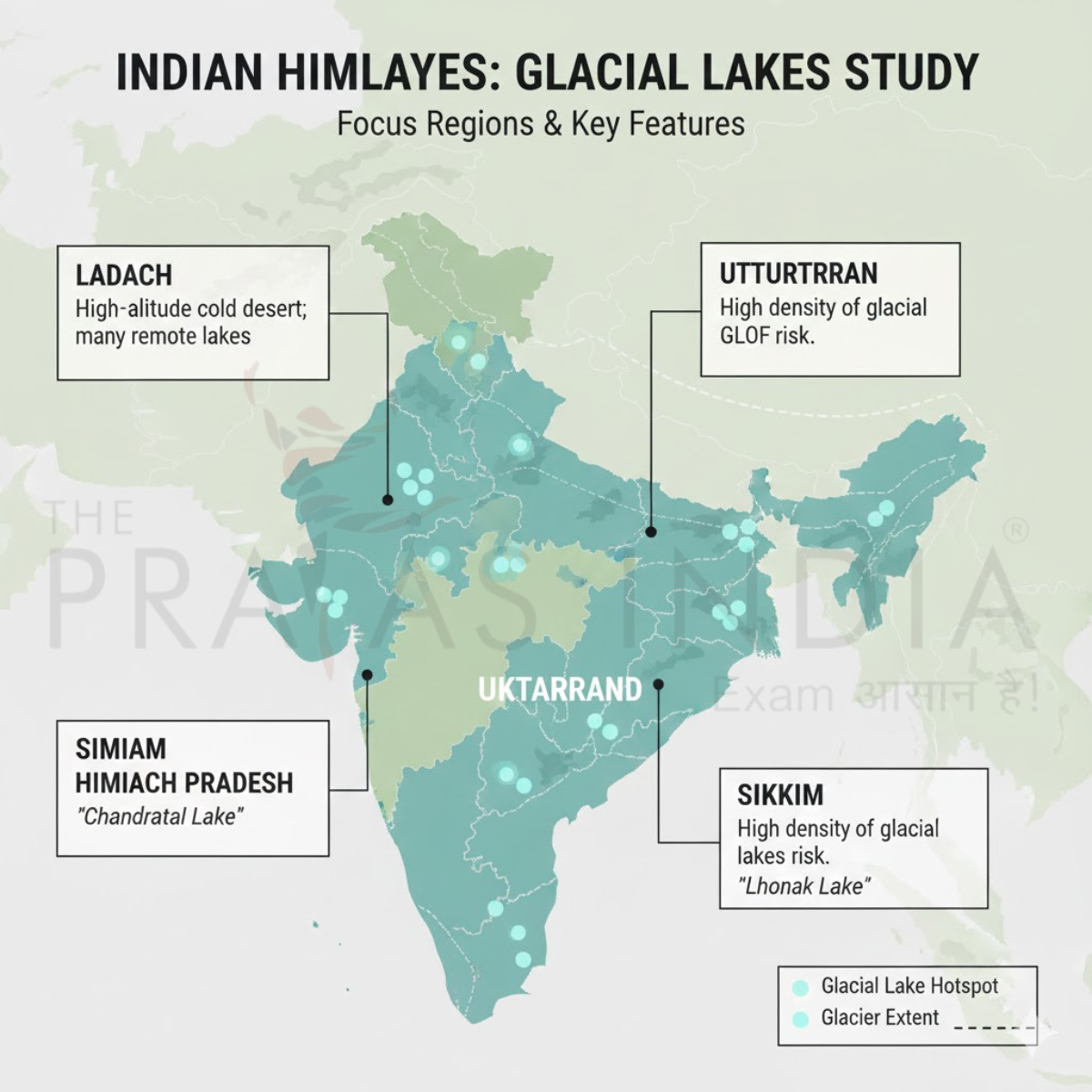
Found predominantly in the Himalayan region, formed by glacial scouring.
1. Dal Lake (Jammu & Kashmir)
- Type: Glacial origin, urban lake
- Importance: Tourism, houseboats
- Threats: Pollution, encroachment, eutrophication
2. Pangong Tso (Ladakh)
- Type: Glacial/tectonic; endorheic
- Salinity: Brackish to saline
- Unique Feature: Extends into China
- Threats: Fragile ecology, military activity
3. Tso Moriri (Ladakh)
- Type: High-altitude glacial lake
- Significance: Ramsar site
- Ecology: Habitat of black-necked cranes, kiang
4. Gurudongmar Lake (Sikkim)
- Type: Glacial lake
- Significance: One of the highest lakes in India
- Cultural Value: Sacred to Sikh and local communities
C. Oxbow / Riverine Lakes
1. Kanwar Lake (Bihar)
- Type: Oxbow lake
- Significance: Asia’s largest oxbow lake
- Threats: Siltation, invasive weeds
- Conservation: Proposed Ramsar status
2. Deepor Beel (Assam)
- Type: Oxbow/basin lake
- Status: Designated Ramsar site
- Importance: Bird habitat, flood buffer
- Threats: Garbage dumping, railway line pressure
D. Lagoon Lakes
1. Chilika Lake (Odisha) – Already detailed above
2. Vembanad Lake (Kerala)
- Type: Lagoon
- Significance: Longest lake in India
- Ecology: Vembanad-Kol wetland (Ramsar site)
- Threats: Reclamation, backwater pollution
3. Pulicat Lake (AP–Tamil Nadu)
- Type: Lagoon
- Significance: Second-largest lagoon in India
- Location: Between Sriharikota barrier island and mainland
- Ecology: Flamingos, mangroves
E. Saltwater / Inland Drainage Lakes
1. Sambhar Lake (Rajasthan)
- Type: Inland saline lake
- Importance: Largest inland salt lake in India
- Ecology: Flamingos, brine shrimp
- Threats: Illegal salt mining
2. Lunkaransar Lake (Rajasthan)
-
Type: Paleo-saline (now mostly dry salt basin)
F. Crater / Volcanic Lakes
1. Lonar Lake (Maharashtra)
- Type: Crater lake formed by meteorite impact
- Geology: Basaltic
- Water Type: Hypersaline and alkaline
- Issues: Pollution, unregulated tourism
G. Man-made Lakes
Gobind Sagar (Himachal Pradesh)
Formed by Bhakra Dam on Sutlej River.
Uses: Irrigation, hydropower, fisheries.
Hirakud Reservoir (Odisha)
Longest dam reservoir in India; controls floods in Mahanadi basin.
Nagarjuna Sagar Lake (Telangana/Andhra Pradesh)
Large artificial lake created by Nagarjuna Sagar Dam.
H. Other Special Lakes
- Bhojtal (Bhopal): Large urban freshwater lake
- Sela Lake (Arunachal Pradesh): High-altitude pass lake
- Pookode Lake (Kerala): Freshwater tourist lake
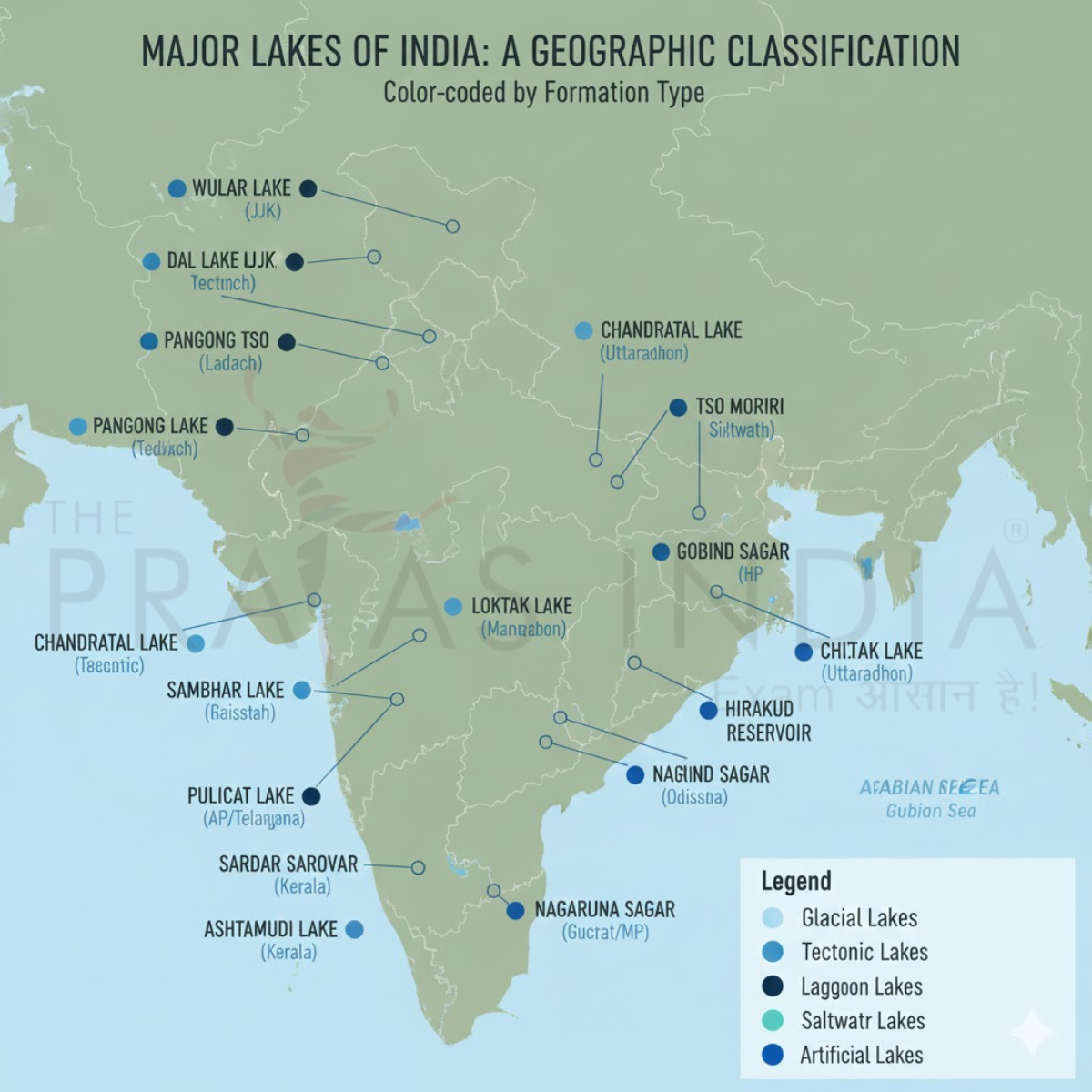
India Map – Important Lakes (State-wise Plotting)
Ecological & Economic Importance of Lakes
A. Ecological Importance
- Support biodiversity – fish, birds, aquatic plants
- Provide key ecosystem services – nutrient cycling, carbon sequestration
- Act as habitats for migratory birds (Chilika, Deepor Beel)
- Regulate microclimate and mitigate floods
B. Economic Importance
- Fisheries support millions of livelihoods
- Backwater tourism (Kerala), shikara tourism (Dal Lake)
- Water storage for irrigation and drinking
- Salt production (Sambhar)
- Hydropower support through reservoirs
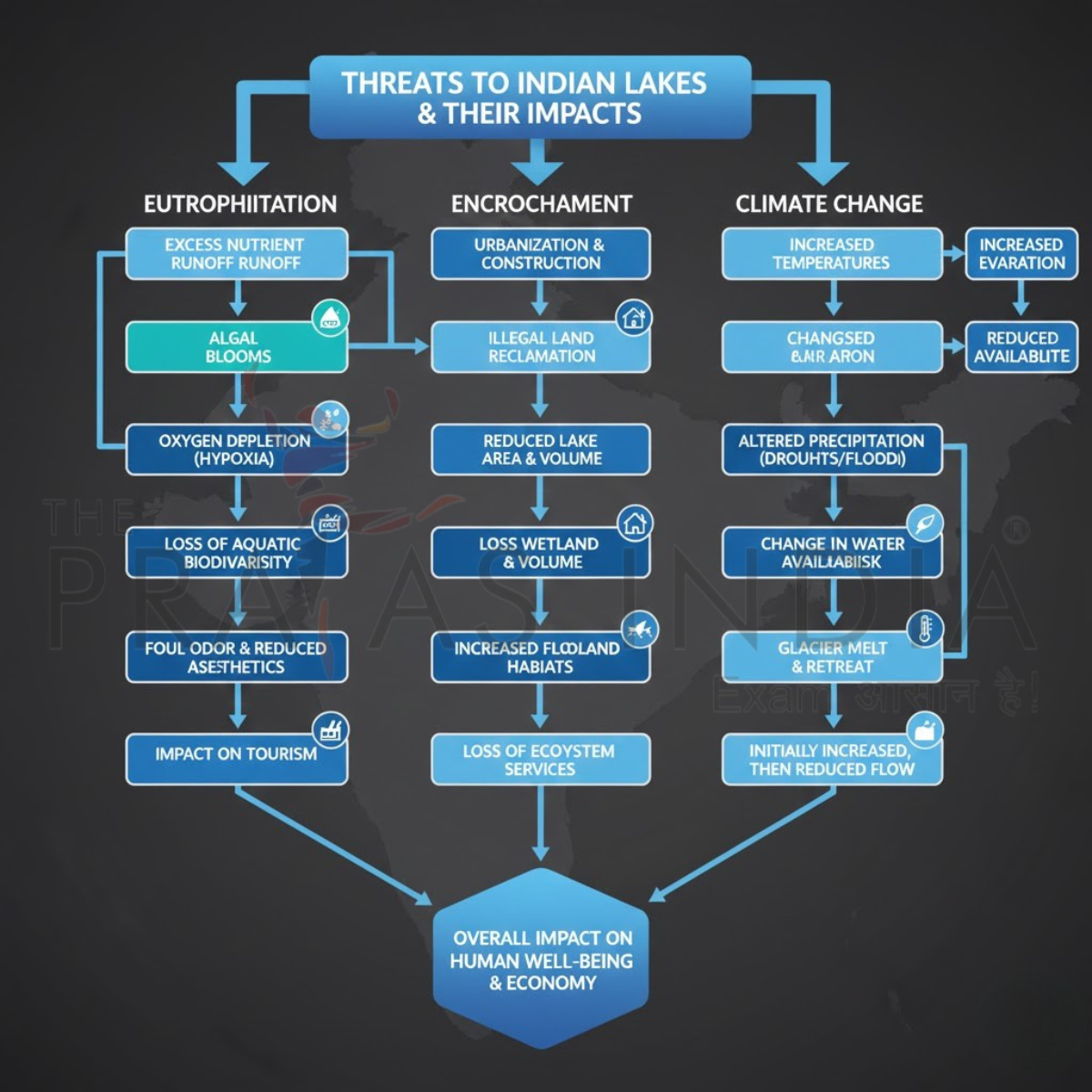
Threats to Lakes in India
1. Eutrophication
Unchecked nutrient inflow → algal blooms → loss of oxygen.
2. Invasive Species
Water hyacinth dominates Vembanad and many urban lakes.
3. Urban Encroachment
Dal Lake, Deepor Beel, Bhojtal face shrinking boundaries.
4. Climate Change
Reduction in glacial meltwater; changes in rainfall.
5. Pollution
Sewage inflow in Dal, Vembanad; industrial waste in Sambhar.
6. Siltation
Affects Loktak, Kanwar, Chilika.
Conservation Efforts
1. Ramsar Convention
India has 75 Ramsar sites, many of which are lakes/wetlands.
2. NPCA (National Plan for Conservation of Aquatic Ecosystems)
Merged NLCP + NWCP → holistic lake & wetland conservation.
3. State Wetland Authorities
Implement management plans, regulate land-use.
4. Chilika Development Authority
Model example of community-based restoration.
5. Smart Cities & Lake Rejuvenation Plans
Urban lakes being restored: Bengaluru, Hyderabad, Bhopal.
Exam-Focused Tables
A. Lake Type vs Examples
| Type | Examples |
|---|---|
| Tectonic | Wular, Loktak |
| Glacial | Dal, Pangong Tso, Tso Moriri |
| Lagoon | Chilika, Pulicat, Vembanad |
| Oxbow | Kanwar, Deepor Beel |
| Saltwater | Sambhar, Lunkaransar |
| Crater | Lonar |
| Artificial | Hirakud, Gobind Sagar |
B. State-wise Lake List
| State/UT | Major Lakes |
|---|---|
| J&K | Wular, Dal |
| Ladakh | Pangong Tso, Tso Moriri |
| Manipur | Loktak |
| Odisha | Chilika, Hirakud Reservoir |
| Kerala | Vembanad, Pookode |
| Rajasthan | Sambhar, Lunkaransar |
| Bihar | Kanwar |
| Assam | Deepor Beel |
| Maharashtra | Lonar |
| Himachal Pradesh | Gobind Sagar |
| Sikkim | Gurudongmar |
C. Lakes that are Ramsar Sites
| Lake | State |
|---|---|
| Chilika | Odisha |
| Loktak | Manipur |
| Wular | J&K |
| Deepor Beel | Assam |
| Sambhar | Rajasthan |
| Vembanad-Kol Wetland | Kerala |
| Bhojtal | Madhya Pradesh |
| Tso Moriri | Ladakh |
D. High-Altitude Lakes (Himalayas)
| Lake | State/UT |
|---|---|
| Pangong Tso | Ladakh |
| Tso Moriri | Ladakh |
| Gurudongmar | Sikkim |
| Suraj Tal | Himachal Pradesh |
| Sela Lake | Arunachal Pradesh |
Contemporary Issues
- Loktak Lake: Decline in water bird populations and phumdis fragmentation
- Vembanad: Severe eutrophication; fish kill incidents
- Dal Lake: Pollution and loss of surface area
- Lonar Lake: Geochemical imbalance due to sewage inflow
- Deepor Beel: Solid waste dumping, threats to Ramsar status
These issues highlight the urgent need for wetland governance and climate-resilient water management.
Conclusion
Lakes in India are vital ecological systems supporting biodiversity, livelihoods, hydrological balance, and climate regulation. However, increasing pollution, encroachment, invasive species, and climate change pose significant threats.
Effective conservation requires:
- Scientific wetland management
- Community participation
- Strong regulatory frameworks
- Restoration of degraded lakes
- Integration of traditional knowledge
Protecting India’s lakes is essential for sustainable development and ecological security.
FAQs: Important Lakes in India
1. Which is the largest freshwater lake in India?
Wular Lake in Jammu & Kashmir.
2. Which is the largest lagoon lake in India?
Chilika Lake in Odisha.
3. What is an oxbow lake?
A crescent-shaped lake formed due to river meandering and cutoff.
4. Which is the largest saline lake in India?
Sambhar Lake in Rajasthan.
5. How many Ramsar lake sites does India have?
India has 75 Ramsar sites, several of which are lake ecosystems.