India’s COP33 Stance in 2026: Why the Withdrawal Matters for Climate Diplomacy, Development, and Global Leadership
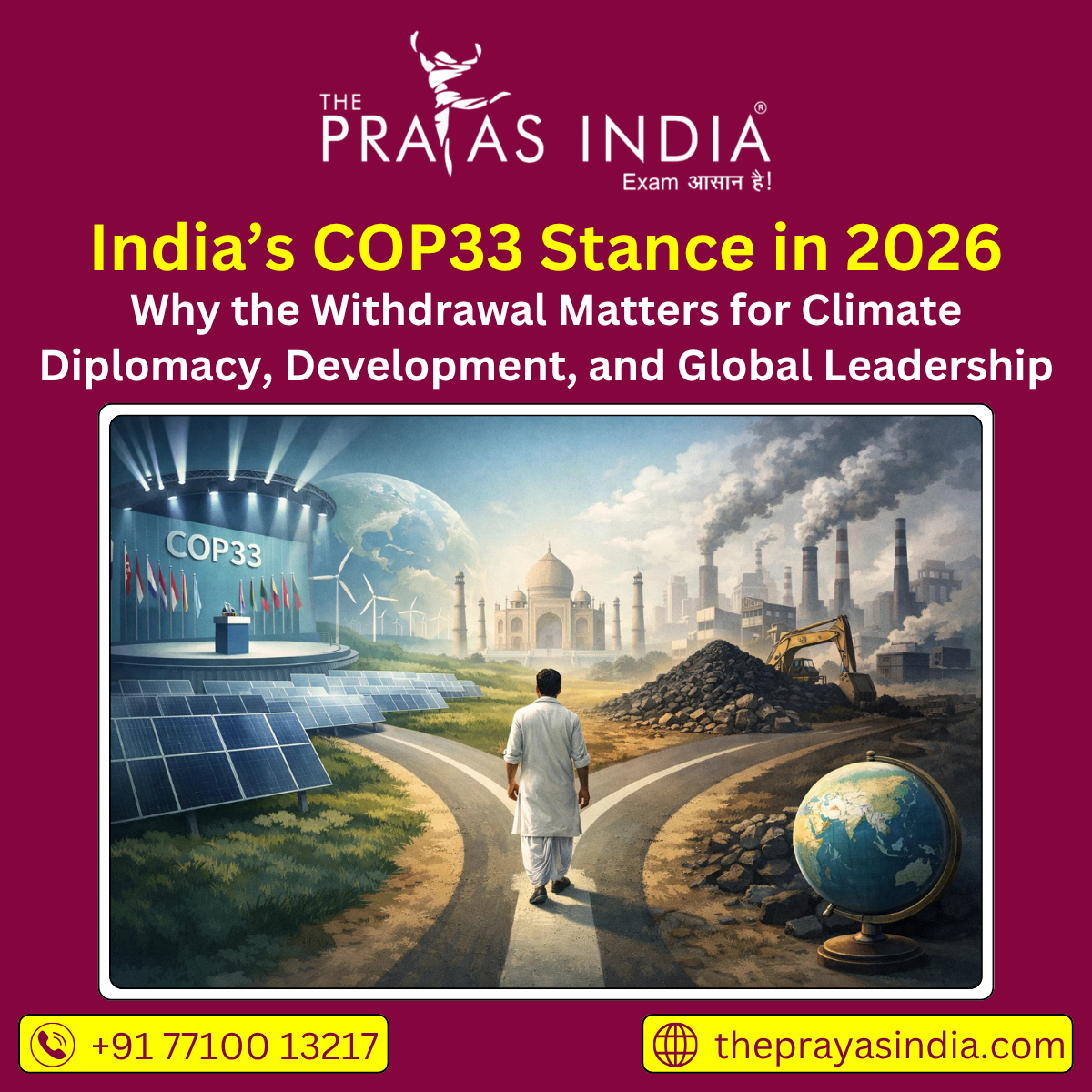
India’s decision to withdraw its bid to host COP33 in 2028 marks an important shift in climate diplomacy, not a retreat from climate action. The move reflects a more cautious balancing act between global leadership ambitions and domestic development priorities, especially as India prepares to advance its updated 2031–2035 climate targets.
What happened
India had earlier offered to host COP33 on the sidelines of COP28 in Dubai, but in April 2026 it formally conveyed its withdrawal to the Asia-Pacific Group after reviewing its 2028 commitments. Reporting indicates that the decision was communicated to relevant countries and that the Ministry of Environment, Forest and Climate Change did not issue a detailed public explanation.
The timing is significant because COP33 would have been a high-profile opportunity for India to shape the global climate narrative from a home मंच. Instead, India has chosen to step back from hosting while continuing to push its domestic climate agenda through updated Nationally Determined Contributions, or NDCs.
Why the shift matters
Hosting a COP is not just a ceremonial event. It requires massive logistical, diplomatic, and political coordination, and the host country is often expected to demonstrate stronger climate ambition while managing intense international scrutiny.
By withdrawing, India appears to be protecting negotiating flexibility on energy security, industrial growth, and coal dependence, while avoiding the pressure that often comes with hosting a global climate summit. This is why experts have described the move as either a strategic recalibration or a missed opportunity, depending on whether one values symbolic leadership or practical policy autonomy.
India’s climate balance
India’s climate stance has always been shaped by a developmental imperative. As a large emerging economy, it argues that climate action must be compatible with poverty reduction, energy access, infrastructure expansion, and industrial growth.
That position has not changed. What has changed is the diplomatic choice not to host COP33, even as India continues to raise its ambition domestically through an updated climate framework that targets a 47% reduction in emissions intensity from 2005 levels by 2035 and a 60% non-fossil share in installed power capacity by 2035.
Updated NDCs
India’s revised NDCs for 2031–2035 show that the country is not stepping away from climate commitments. In fact, the updated framework strengthens multiple targets, including emissions intensity reduction and clean energy expansion.
The official data show that India had already achieved 52.57% non-fossil installed capacity by February 2026, five years ahead of the earlier goal, and the new target has now been raised further to 60% by 2035. This is important because it shows that domestic climate action continues even if India chooses not to host a summit that could bring extra international pressure.
Key updated targets
- Emissions intensity reduction of 47% by 2035 from 2005 levels.
- 60% non-fossil fuel-based installed electricity capacity by 2035.
- Expansion of carbon sink through forests and tree cover, aligned with long-term decarbonisation.
Strategic reading
From a strategic perspective, India may have calculated that hosting COP33 would create obligations beyond symbolism. A host country can face pressure to announce stronger phase-out timelines, accept diplomatic compromises, and absorb a huge administrative burden.
There is also a geopolitical angle. Global climate negotiations are currently taking place amid major international uncertainty, and countries are increasingly wary of committing political capital to events where consensus is difficult and outcomes are often diluted. For India, this may have made implementation at home more valuable than prestige abroad.
Global South and leadership
India has often positioned itself as a voice for the Global South in climate talks, especially on fairness, climate finance, equity, and differentiated responsibilities. That role remains relevant even without hosting COP33, but the visibility of leadership will now depend more on India’s diplomatic performance in negotiations than on the venue of the summit.
This makes the decision a classic example of the tension between symbolic leadership and substantive policy delivery. India may be choosing to strengthen its domestic credibility first, so that when it speaks for the Global South, it does so from a position of demonstrated progress rather than event hosting.
UPSC relevance
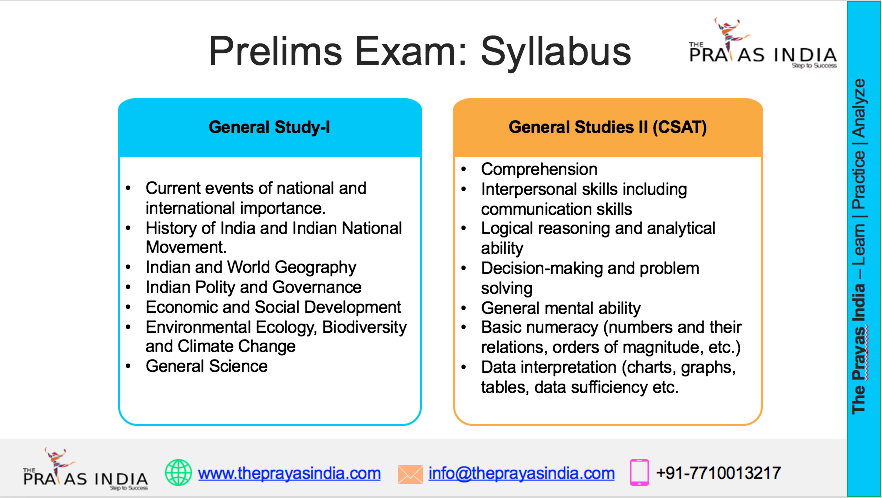
This topic is highly relevant for UPSC Prelims because it connects COP, UNFCCC, NDCs, emissions intensity, non-fossil capacity, and climate diplomacy. It can also test the difference between a climate summit host role and actual national commitments.
For Mains, it fits GS Paper 2 and GS Paper 3. It can be used in answers on international relations, multilateralism, sustainable development, climate justice, energy transition, and India’s foreign policy balancing development with environmental responsibility.
Possible answer angles
- India’s climate diplomacy versus domestic developmental priorities.
- The difference between symbolic leadership and policy implementation.
- COP hosting pressure and its impact on sovereign negotiating space.
- India’s updated NDCs as evidence of continuity in climate action.
Why The Prayas India
The Prayas India is a strong choice for best UPSC coaching in Mumbai because it helps aspirants connect current affairs with deep conceptual understanding. A topic like COP33 is not just about climate news; it combines governance, international relations, environment, and economic development, which is exactly the kind of integrated analysis UPSC demands.
For UPSC preparation in Mumbai, The Prayas India offers structured current affairs coverage, GS integration, answer-writing support, and exam-oriented mentoring that helps students convert complex global issues into high-scoring mains answers and factual prelims points. For aspirants looking for IAS coaching in Mumbai or the best UPSC classes in Mumbai, this kind of preparation is especially valuable.
FAQs
COP33 is the 33rd Conference of the Parties under the UN Framework Convention on Climate Change, where countries negotiate global climate commitments.
Officially, the move followed a review of India’s 2028 commitments. Analysts also point to diplomatic flexibility, resource prioritisation, and domestic political considerations.
No. India has updated its NDCs and strengthened domestic targets for emissions intensity reduction and non-fossil energy capacity.
India aims for a 47% reduction in emissions intensity by 2035 and 60% non-fossil installed electricity capacity by 2035.
It links climate policy, international negotiations, energy transition, and sustainable development, all of which are important UPSC themes. What is COP33?
Why did India withdraw its bid to host COP33?
Does the withdrawal mean India is reducing climate ambition?
What are India’s new climate targets?
Why is this important for UPSC?



![Prayas-तेजस [UPSC CSE Sociology Optional] – Online & Offline](https://theprayasindia.com/wp-content/uploads/2025/09/Prayas-तेजस-UPSC-CSE-Optional-Subject-The-Prayas-India-300x300.png)
![Prayas-सूत्र [UPSC CSE Materials (Hardcopy)]](https://theprayasindia.com/wp-content/uploads/2025/09/Prayas-सूत्र-UPSC-CSE-Study-Materials-Hardcopy-The-Prayas-India-300x300.png)
![Prayas-मंत्रा [UPSC CSE CSAT]](https://theprayasindia.com/wp-content/uploads/2025/09/Prayas-मंत्रा-UPSC-CSE-CSAT-The-Prayas-India-300x300.png)
![Prayas सारथी [UPSC CSE One on One Mentorship]](https://theprayasindia.com/wp-content/uploads/2025/09/Prayas-सारथी-UPSC-CSE-One-on-One-Mentorship-The-Prayas-India-300x300.png)