India’s Maritime Borders and Exclusive Economic Zones (EEZs)
This topic is important for UPSC Prelims (Geography & Current Affairs) and Mains GS Paper 1 (Geography) and GS Paper 3 (Security & Economic Development). Questions can be framed on India’s EEZs, maritime disputes, UNCLOS, and strategic policies like SAGAR Vision, Sagarmala, and the Indian Ocean strategy.
Introduction: Maritime Borders & EEZs under International Law
India’s vast maritime boundaries and Exclusive Economic Zones (EEZs) are critical to its national security, economic growth, and international standing. Maritime borders are boundaries established at sea that separate the territorial waters and zones of neighboring states. These borders are defined and governed primarily by the United Nations Convention on the Law of the Sea (UNCLOS), which came into force in 1994 and sets precise legal standards for the division of maritime space among countries.
UNCLOS divides the sea into several distinct zones:
- Territorial Sea: Up to 12 nautical miles (nm) from the coast, under full sovereignty of the coastal nation.
- Contiguous Zone: Up to 24 nm, permitting limited law enforcement.
- Exclusive Economic Zone (EEZ): Extends up to 200 nm, where a country has exclusive rights to exploit natural resources (fisheries, oil, gas, minerals) and undertake scientific research, though the waters remain international for navigation.
India’s maritime borders and EEZs are determined by these global norms, giving it both opportunities and responsibilities in the surrounding seas.
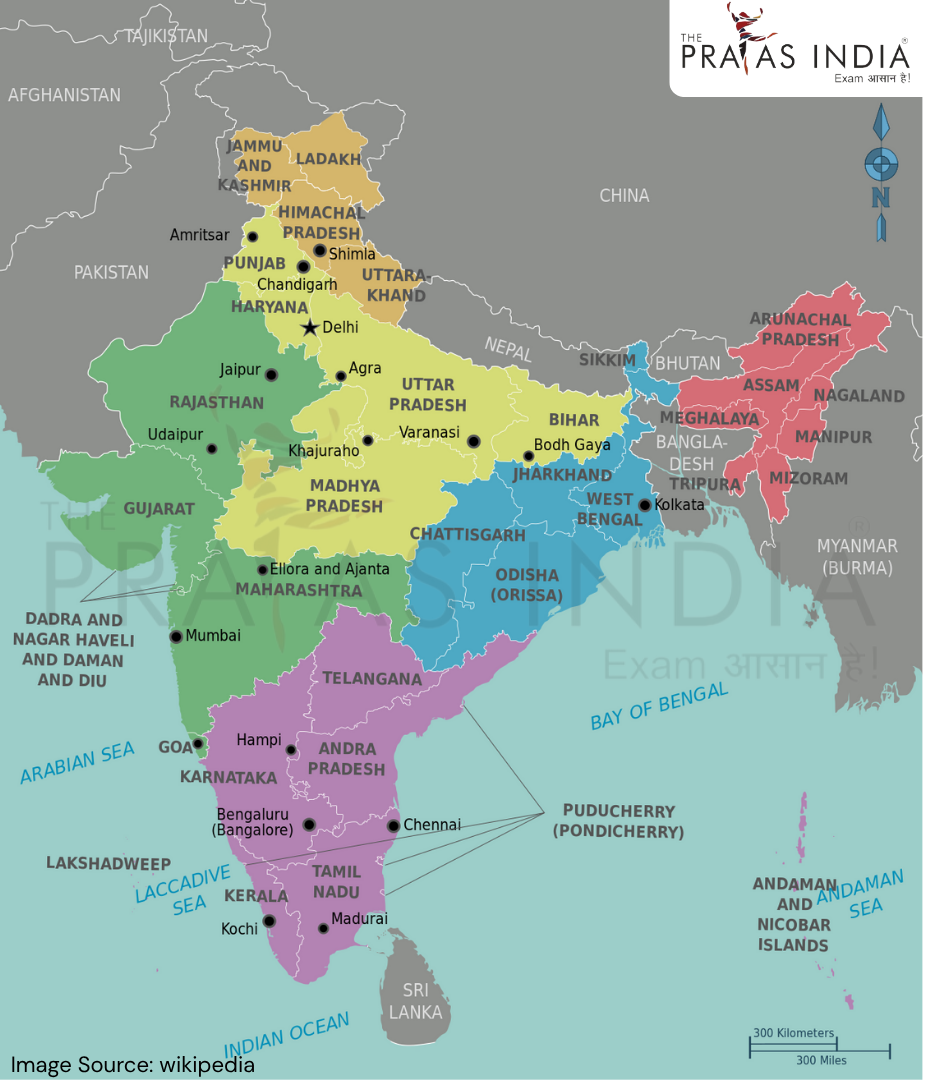
India’s Maritime Boundaries: Geography and Neighboring Countries
India’s peninsular geography gives it a unique maritime advantage, with over 7,500 km of coastline facing three major water bodies:
- The Arabian Sea to the west
- The Bay of Bengal to the east
- The Indian Ocean to the south
India shares maritime borders with several neighboring nations:
- Pakistan (Arabian Sea)
- Sri Lanka (Indian Ocean)
- Maldives (Indian Ocean)
- Bangladesh (Bay of Bengal)
- Myanmar (Bay of Bengal)
- Indonesia (Andaman Sea and Indian Ocean)
Key Maritime Boundary Features:
- The western boundary with Pakistan runs from Gujarat into the Arabian Sea.
- The southern boundaries include intricate proximity to Sri Lanka, Maldives, and Indonesia, especially near the Lakshadweep Islands and Andaman & Nicobar Islands.
- Eastern maritime boundaries are shared with Bangladesh and Myanmar, vital for shipping lanes and marine resources.
The complexity of these borders is due to overlapping EEZs, historic claims, and proximity of islands and archipelagos.
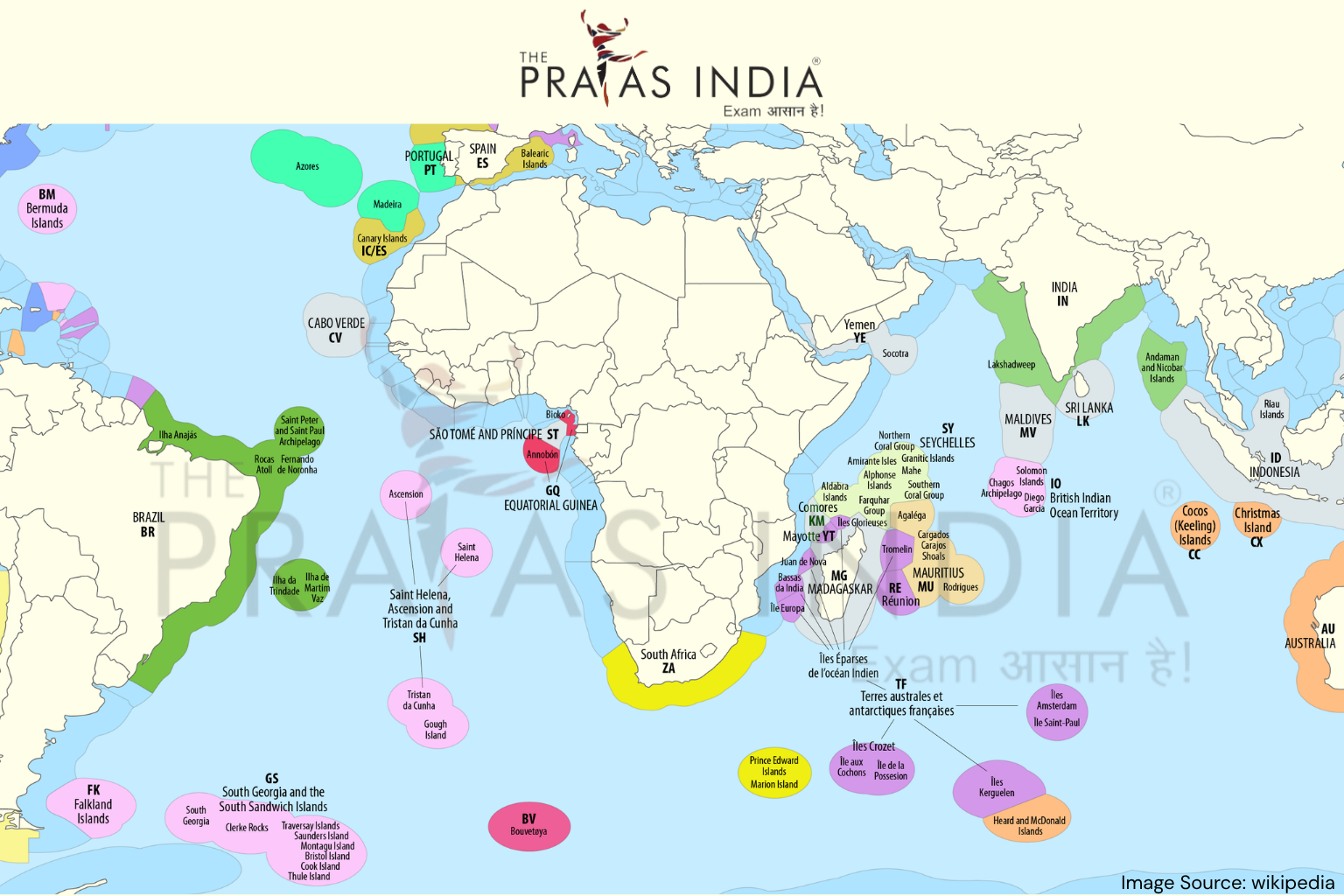
India’s Exclusive Economic Zone (EEZ): Definition, Size & Legal Status
India’s EEZ covers a vast area:
- Legal Definition: An EEZ is the area extending up to 200 nautical miles (370.4 km) from the baseline of the coast, as per UNCLOS.
- India’s EEZ Size: Approximately 2.02 million square kilometers, making it the 18th largest EEZ in the world.
- Jurisdictions: India has exclusive rights over living and non-living resources, for constructing artificial islands, marine research, and environmental protection in this zone.
India’s EEZ extends from its mainland and island territories (Andaman & Nicobar, Lakshadweep), giving strategic depth and socio-economic leverage in the Indian Ocean Region.
Strategic, Economic, and Environmental Importance
Strategic Significance
- National Security: Control over EEZ is critical for maritime domain awareness, naval deployments, coastal surveillance, and countering piracy/terrorism.
- Buffer Zone & Deterrence: Geographic depth for defense and security operations against external threats.
- Geopolitical Influence: Central in Indo-Pacific strategy, SAGAR Vision, and cooperation with neighboring navies or multilateral forums (QUAD, IORA, IONS).
Economic Importance
- Trade Routes: 90% of India’s international trade by volume is seaborne; major shipping lanes traverse EEZs.
- Marine Fisheries: India’s EEZ provides rich fishing grounds supporting millions of livelihoods, coastal industry, and exports.
- Hydrocarbons & Minerals: Offshore reserves of oil, gas, and polymetallic nodules are a focus for energy security and blue economy growth.
- Port Infrastructure: 13 major and 200+ minor ports facilitate maritime commerce and connectivity.
Environmental Importance
- Biodiversity Hotspots: Coral reefs, mangroves, and marine life in Indian EEZ sustain ecological balance.
- Conservation Needs: Mitigating pollution, overfishing, and climate change impacts in fragile marine zones.
- Sustainable Development: Blue economy policy underscores responsible use of ocean resources with conservation.
Maritime Disputes & Resolutions
India–Bangladesh Maritime Boundary Case (2014)
- Bangladesh and India had overlapping claims in the Bay of Bengal. The dispute was settled at the Permanent Court of Arbitration in The Hague, which delivered a verdict in July 2014 largely favoring Bangladesh but giving India substantial maritime entitlement.
- Outcome: Peaceful delimitation and improved bilateral relations, enabling resource exploration and management.
India–Sri Lanka and Katchatheevu Island Issue
- The transfer of Katchatheevu Island from India to Sri Lanka (1974) led to persistent disputes concerning fisheries rights and sovereignty. Indian fishermen often face detention or conflict near contentious waters.
- Current Status: Ongoing bilateral dialogue, coordination on sustainable fisheries and enforcement protocols.
Other Maritime Concerns
- Periodic illegal fishing, poaching, and trafficking in border waters with Pakistan, Bangladesh, and Sri Lanka.
- Cooperative mechanisms and surveillance have reduced major incidents, but regular patrolling remains essential.
Government Initiatives on Maritime Governance
India has launched several strategic projects for ocean management:
Sagarmala Project
- Focus on port modernization, coastal connectivity, and industrial clusters to enhance India’s maritime logistics and blue economy.
SAGAR Vision (Security and Growth for All in the Region)
-
India’s initiative to promote regional maritime security, sustainable development, and cooperative relations in the Indian Ocean Region.
Deep Ocean Mission
-
A multi-ministry project exploring ocean resources, marine technologies, biodiversity mapping, and sustainable energy extraction.
Coastal Security Initiatives
- Coastal Surveillance Radar Networks: Installed on key islands and neighboring states (Maldives, Seychelles, Sri Lanka).
- Integrated Coastal Security: Indian Navy, Coast Guard, Marine Police, and local agencies collaborate for real-time monitoring, disaster response, and maritime law enforcement.
- Modernization of Ports: Use of digital technologies, vessel tracking, and infrastructure upgrades for security and efficiency.
Conclusion
India’s maritime borders and EEZs are central to its geography, economy, and security. They frame how India interacts with its neighbors, pursues regional leadership, and develops its ocean resources for future prosperity. Strengthening maritime governance, safeguarding marine environments, and resolving disputes peacefully remain crucial for India’s continued growth and stability in the Indo-Pacific.
Detailed FAQs: India’s Maritime Borders and EEZs
Q1: What are maritime borders?
Maritime borders are the seaward boundaries where one country’s territorial waters and maritime rights end, and those of another country begin. These boundaries are set according to international laws such as the United Nations Convention on the Law of the Sea (UNCLOS), ensuring peaceful coexistence and resource rights.
Q2: What is an Exclusive Economic Zone (EEZ)?
An EEZ is a sea zone extending up to 200 nautical miles from the baseline of a country’s coast. Within this zone, a coastal state has exclusive rights to explore, exploit, conserve, and manage natural resources, such as fisheries, oil, gas, and minerals, although navigation remains open to all nations.
Q3: How large is India’s EEZ and what areas does it cover?
India’s EEZ spans approximately 2.02 million square kilometers, the 18th largest globally. It encompasses marine territories adjacent to the Indian mainland and archipelagos like the Andaman & Nicobar and Lakshadweep Islands, sheathing India with a vast maritime zone critical to economic and strategic interests.
Q4: Which countries share maritime boundaries with India?
India shares maritime boundaries with Pakistan in the Arabian Sea, Sri Lanka, Maldives, and Indonesia in the Indian Ocean, and Bangladesh and Myanmar in the Bay of Bengal. Each boundary involves complex negotiations due to overlapping EEZs and proximity of coastal and island territories.
Q5: What is the strategic importance of India’s maritime zones?
India’s maritime zones are essential for maintaining national security, securing crucial sea lines of communication for trade, projecting naval power, and countering security threats like piracy and terrorism. They are vital to India’s presence and influence in the Indo-Pacific region.
Q6: How important are India’s maritime zones economically?
Economically, these zones support lucrative fisheries, offshore oil and gas exploration, seabed mining, and burgeoning blue economy sectors like renewable ocean energy and tourism. They facilitate over 90% of India’s foreign trade by volume.
Q7: Can you explain a major maritime boundary dispute India resolved?
In 2014, the Permanent Court of Arbitration settled the maritime boundary dispute between India and Bangladesh in the Bay of Bengal. The court allocated most contested areas to Bangladesh but granted India access to vital maritime areas, improving bilateral relations and maritime cooperation.
Q8: What government initiatives govern India’s maritime zones?
India implements projects such as:
-
The Sagarmala Project to upgrade port infrastructure and enhance connectivity,
-
The SAGAR Vision focusing on regional maritime security and cooperation,
-
The Deep Ocean Mission exploring oceanic resources and biotechnology,
-
Coastal Surveillance Radar systems to monitor maritime traffic and security.
Q9: How does India tackle maritime security challenges?
India employs its Navy and Coast Guard for patrol and surveillance, coordinates with neighboring countries, participates in regional forums like IORA (Indian Ocean Rim Association) and IONS (Indian Ocean Naval Symposium), and invests in technology to fight piracy, illegal fishing, and maritime terrorism.
Q10: What role does the SAGAR Vision play in India’s maritime strategy?
SAGAR (Security and Growth for All in the Region) is a framework for India to promote peaceful maritime cooperation and inclusive growth in the Indian Ocean Region, serving as an extension of the country’s broader Indo-Pacific objectives.