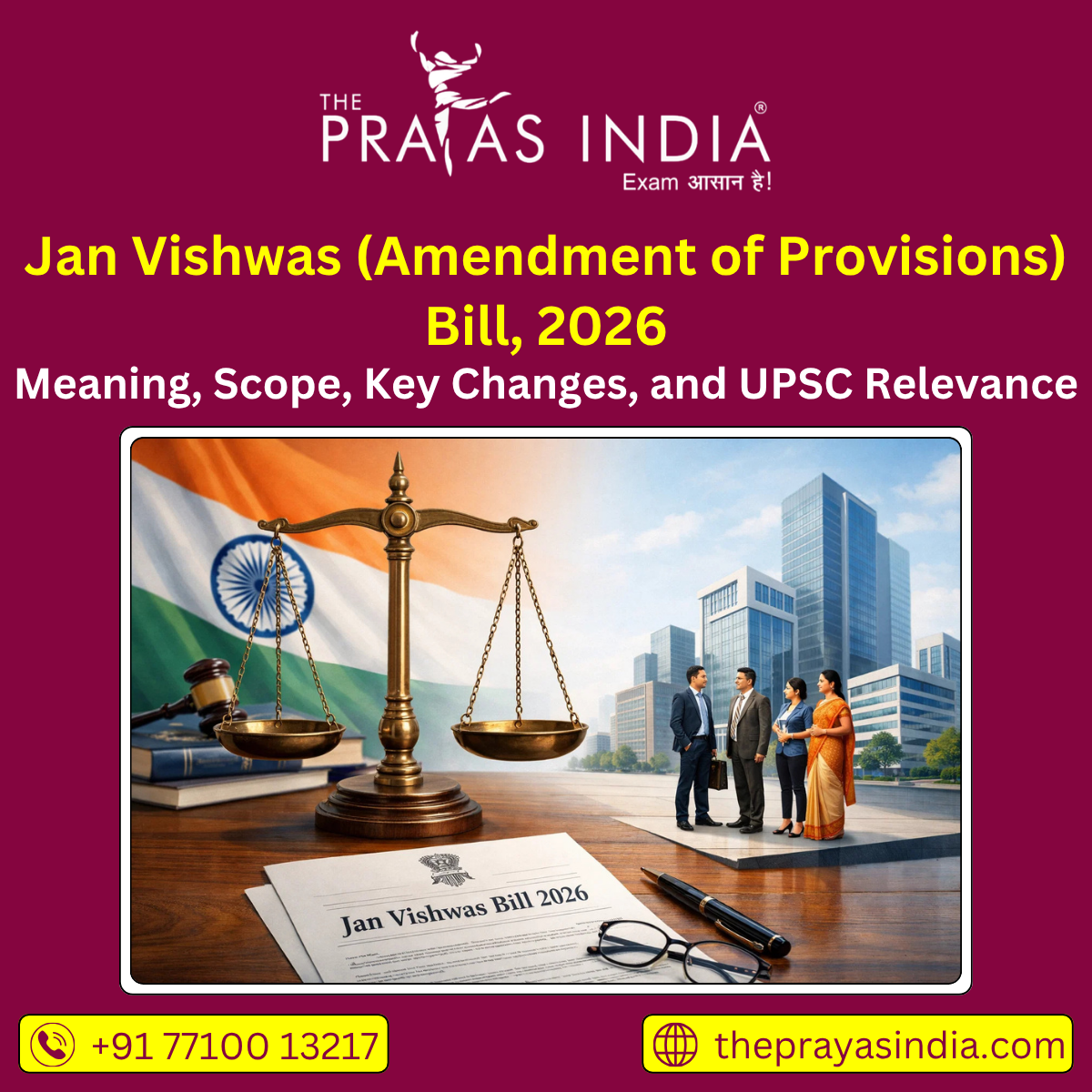
Jan Vishwas (Amendment of Provisions) Bill, 2026: Meaning, Scope, Key Changes, and UPSC Relevance
The Jan Vishwas (Amendment of Provisions) Bill, 2026 is a major reform aimed at reducing the criminalisation of minor regulatory violations and replacing them with civil penalties, warnings, and administrative mechanisms. It proposes amendments to 784 provisions across 79 Central Acts administered by 23 Ministries, with 717 provisions targeted for decriminalisation and 67 provisions aimed at ease of living.
Overview
The Bill is part of India’s broader trust-based governance approach, where the state seeks to punish serious misconduct while easing compliance for minor or technical defaults. According to PIB, the reforms are designed to improve both Ease of Doing Business and Ease of Living by removing outdated and redundant criminal provisions and rationalising penalties.
The legislation was initially introduced in a narrower form as the Jan Vishwas (Amendment of Provisions) Bill, 2025, covering 355 provisions in 16 Central Acts. After the Select Committee, led by Tejasvi Surya, examined it and recommended wider decriminalisation, the scope expanded significantly to 784 provisions across 79 Acts.
Why It Matters
This Bill matters because many Indian laws still treat procedural lapses, technical defaults, or minor compliance errors as criminal offences. That creates fear of prosecution, increases litigation, burdens courts, and raises compliance costs for citizens, MSMEs, and businesses.
By shifting such cases to civil or administrative routes, the government expects quicker resolution, lower regulatory friction, and better predictability for businesses. PIB also notes that the Bill seeks to rationalise more than 1,000 offences overall, combining removal of minor offences with proportionate enforcement.
Core Features
The Bill introduces a more graded enforcement system. Instead of immediate criminal punishment, authorities may first issue advisory notices or warnings for first-time or minor violations, especially where the breach is procedural rather than harmful.
It also promotes proportionate penalties, meaning the punishment should match the seriousness of the default. In addition, adjudicating officers are used to resolve disputes faster than lengthy court proceedings, and some penalties are designed to increase automatically by 10% every three years to keep them effective over time.
Main mechanisms
- Warning before punishment for minor or first-time lapses.
- Civil penalties instead of imprisonment for many technical breaches.
- Faster adjudication through designated officers rather than criminal courts.
- Dynamic penalty framework with periodic revision of fines.
Major Legislative Changes
The Bill amends laws across sectors such as transport, urban governance, food safety, shipping, agriculture, intellectual property, health professions, and industrial regulation. PIB states that reforms include the Motor Vehicles Act, 1988 and the New Delhi Municipal Council Act, 1994, while other reporting also identifies laws such as the National Highways Act, 1956, Copyright Act, 1957, and sector-specific statutes.
For example, the Bill replaces jail terms under some provisions with civil penalties, including cases related to product or operational compliance in regulated sectors. It also addresses procedural defaults in areas like municipal administration and vehicle-related compliance to make everyday governance easier for citizens.
Impact on Businesses
For businesses, especially MSMEs, the biggest gain is reduced fear of criminal prosecution for small compliance errors. PIB highlights that the Bill introduces advisory notices, warnings, and graded enforcement so that firms get a chance to correct mistakes before harsher action is taken.
This matters because compliance uncertainty is often as damaging as the penalty itself. When a minor lapse can trigger criminal proceedings, businesses spend more on legal defence, delay operations, and become cautious about expansion; the Bill aims to reduce that drag.
Impact on Citizens
For ordinary citizens, the Bill is important because it simplifies everyday compliance in areas such as municipal rules, transport, and licensing-related requirements. PIB specifically mentions ease-of-living reforms under laws like the Motor Vehicles Act and the New Delhi Municipal Council Act.
The practical effect should be fewer criminal cases for harmless procedural mistakes and a more reasonable enforcement process. Instead of treating small errors like serious offences, the system moves toward correction, payment, and compliance.
Historical Context
This reform builds on the earlier Jan Vishwas Act, 2023, which decriminalised 183 provisions across 42 Central Acts administered by 19 ministries/departments, according to reporting on the 2026 Bill’s background. The 2026 version is much broader and reflects a stronger push toward regulatory simplification.
The Select Committee’s role was important because it expanded the reform agenda after consultations with ministries and stakeholders. That process turned the earlier limited draft into a far wider decriminalisation exercise.
UPSC Relevance
This topic is highly relevant for UPSC Prelims and Mains because it connects governance, economic reform, regulation, and ease of doing business. It is also a good example of the state moving from punitive governance to trust-based governance, which is a recurring theme in polity and governance answers.
For Mains, it can be used in answers on reform of criminal laws, regulatory state, ease of doing business, MSME promotion, citizen-centric governance, and administrative efficiency. It also fits well under GS Paper 2 and GS Paper 3 themes, especially governance, economic development, and administrative reform.
UPSC angle
- Trust-based governance.
- Decriminalisation of minor offences.
- Ease of Doing Business and Ease of Living.
- MSME support and regulatory reform.
- Decongestion of courts and administrative efficiency.
Why The Prayas India
The Prayas India is a strong choice for UPSC coaching in Mumbai because UPSC preparation needs more than classroom teaching; it needs structured current affairs analysis, answer writing practice, revision support, and exam-oriented guidance. This topic itself shows why guided preparation matters: UPSC questions are increasingly linked to real policy reforms, committee reports, and governance changes.
The Prayas India can help aspirants build exactly that kind of analytical edge through current affairs integration, mains-ready notes, and regular practice. For students in Mumbai who want disciplined preparation with a focus on conceptual clarity and exam relevance, this kind of coaching support is especially valuable.
FAQs
It is a reform bill that decriminalises minor offences and replaces many imprisonment provisions with civil penalties, warnings, and administrative enforcement across 79 Central Acts.
It amends 784 provisions in 79 Central Acts administered by 23 Ministries, of which 717 provisions are proposed for decriminalisation and 67 for ease of living.
Its purpose is to reduce compliance burden, support businesses and citizens, improve regulatory efficiency, and shift from punitive enforcement to trust-based governance.
The Bill affects several laws, including the Motor Vehicles Act, 1988, the New Delhi Municipal Council Act, 1994, and other sectoral laws such as those linked to transport, shipping, health, and intellectual property.
It is important because it links governance reform, administrative efficiency, regulatory simplification, and economic development, all of which are core UPSC themes. What is the Jan Vishwas (Amendment of Provisions) Bill, 2026?
How many provisions does it amend?
What is the purpose of the Bill?
Which laws are affected?
Why is it important for UPSC?



![Prayas-तेजस [UPSC CSE Sociology Optional] – Online & Offline](https://theprayasindia.com/wp-content/uploads/2025/09/Prayas-तेजस-UPSC-CSE-Optional-Subject-The-Prayas-India-300x300.png)
![Prayas-सूत्र [UPSC CSE Materials (Hardcopy)]](https://theprayasindia.com/wp-content/uploads/2025/09/Prayas-सूत्र-UPSC-CSE-Study-Materials-Hardcopy-The-Prayas-India-300x300.png)
![Prayas-मंत्रा [UPSC CSE CSAT]](https://theprayasindia.com/wp-content/uploads/2025/09/Prayas-मंत्रा-UPSC-CSE-CSAT-The-Prayas-India-300x300.png)
![Prayas सारथी [UPSC CSE One on One Mentorship]](https://theprayasindia.com/wp-content/uploads/2025/09/Prayas-सारथी-UPSC-CSE-One-on-One-Mentorship-The-Prayas-India-300x300.png)