Janjatiya Gaurav Divas – The Legacy of Bhagwan Birsa Munda
- GS Paper 1: Modern Indian History, Tribal Movements
- GS Paper 2: Government Policies, Welfare of Vulnerable Sections
- GS Paper 3: Internal Security (Tribal Regions & Administration)
- GS Paper 4: Values, Leadership, Ethics
- Prelims: Tribal revolts, British-era legislations, regional history
- Essay: Tribal identity, leadership, social justice
- State PSCs: Jharkhand, Bihar, Chhattisgarh, Odisha, Madhya Pradesh, North-Eastern States
Introduction
India celebrates Janjatiya Gaurav Divas every year on 15 November to honour the extraordinary sacrifices and contributions of tribal freedom fighters. The date marks the birth anniversary of Bhagwan Birsa Munda, one of the most iconic tribal leaders in Indian history. The observance underscores India’s recognition of the tribal role in anti-colonial struggles, nation-building, cultural preservation, and resistance against socio-economic oppression.
Birsa Munda’s leadership was rooted in the lived experiences of exploitation, cultural displacement, and administrative injustice under British rule. His life symbolises the intersection of tribal identity, resistance, and spiritual revival, making him a key figure in both modern Indian history and the socio-cultural consciousness of India’s Adivasi communities.
Who Was Birsa Munda? – A Brief Profile
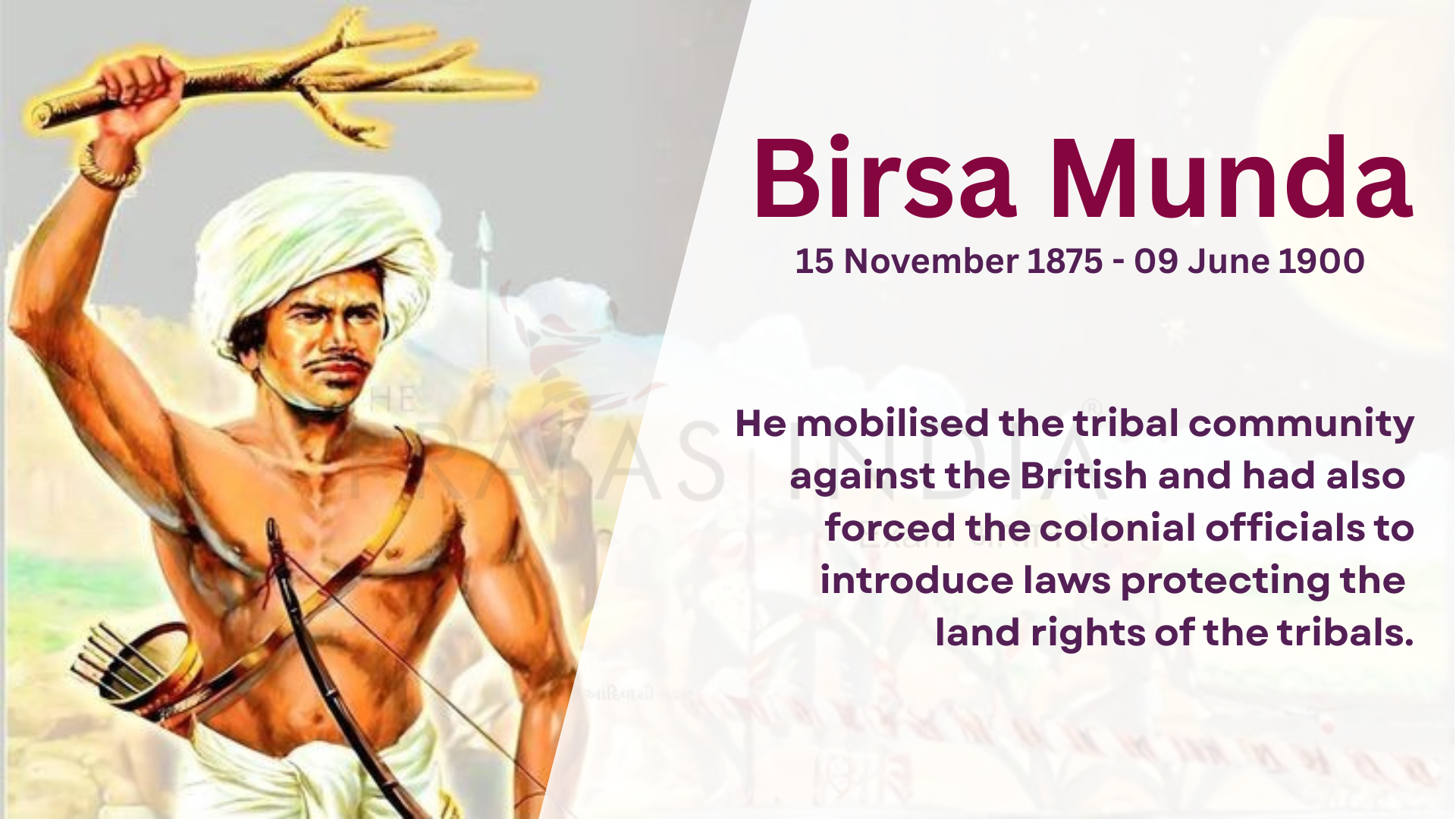
Bhagwan Birsa Munda was born on 15 November 1875 in Ulihatu village of the Chhotanagpur Plateau region, which today spans parts of Jharkhand, Bihar, Chhattisgarh, and Odisha. He belonged to the Munda tribe, known for their deep connection to forest ecosystems, shifting cultivation practices, and communal landholding traditions.
Birsa’s childhood was marked by poverty, frequent displacement, and the fragile livelihoods of tribal families compelled to move in search of work and forest-based resources. This nomadic experience exposed him early to land alienation, economic discrimination, and cultural disruption—conditions that deeply influenced his later activism.
Early Life, Education & Influence of Christianity
Birsa’s formative years were shaped by traditional tribal training, oral culture, and nature-centric learning. His initial formal education began at Salga village school under teacher Jaipal Nag, who encouraged him to pursue further education.
Seeking opportunities, Birsa briefly converted to Christianity and attended the German Mission School at Burju. This exposed him to Western religious thought, literacy, and new socio-cultural interactions. However, over time he grew critical of missionary activities, especially their role in suppressing tribal customs and encouraging cultural assimilation.
By the early 1890s, Birsa distanced himself from Christianity and began rediscovering Munda spiritual traditions, emphasising purity, ancestral worship, community harmony, and resistance to external domination. This ideological shift laid the foundation for his spiritual-political movement.
Emergence of Birsa as a Leader
The late 19th-century socio-political environment of Chhotanagpur was marked by land dispossession, forced labour, missionary conversions, and growing interference of moneylenders and zamindars. Birsa’s exposure to various tribal struggles, including the Sardar agitation (1886–1890) in Chaibasa, sharpened his political consciousness.
By the mid-1890s, Birsa emerged as a charismatic figure preaching self-reform, unity, and resistance. He introduced a new faith known as “Birsait”, which gained immense popularity among the Munda and Oraon communities. His messages blended religion, social reform, and political mobilisation, making him both a spiritual leader and a mass organiser.
The Birsait Movement
The Birsait movement was central to Birsa Munda’s rise. Key features included:
- Rejection of Christian missionary authority
- Restoration of tribal rituals, beliefs, and cultural identity
- Condemnation of witchcraft practices and superstitions
- Promotion of social discipline, cleanliness, and moral reform
- Assertion of tribal autonomy over land, forests, and community life
The Birsait movement evolved from a socio-religious reform platform into a political resistance movement. Birsa’s followers viewed him as a prophet-like figure, often calling him “Dharti Aba” (Father of the Earth). His personality and teachings mobilised large segments of tribal populations across the Chhotanagpur region.
Tribal Issues Under British Rule
The tribal regions of Eastern and Central India witnessed severe disruptions after the British introduction of new land, forest, and revenue systems. Key issues included:
a. Land Alienation
Private property laws replaced traditional communal landholding (Khuntkatti system). Outsiders (Dikus), moneylenders, and zamindars gained control of tribal lands.
b. Forced Labour (Begar)
Tribal groups were subjected to unpaid labour for contractors, forest officers, and zamindars.
c. Restrictive Forest Laws
Forest Acts curtailed access to minor forest produce, shifting cultivation, and hunting—activities central to tribal survival.
d. Administrative Exploitation
Corruption among lower-level British officials, police excesses, and missionary interference created widespread resentment.
These grievances formed the socio-economic foundation of Birsa’s political movement.
The Ulgulan (The Great Tumult) – Birsa’s Rebellion
The Ulgulan, meaning “Great Tumult”, was the peak of Birsa’s revolutionary struggle between 1899–1900. It combined religious revival, agrarian protest, and anti-colonial resistance.
Key Causes:
- Loss of ancestral lands
- Harsh forest regulations
- Cultural discrimination and missionary overreach
- Economic exploitation by Dikus
- Desire for tribal self-rule
Nature of the Revolt:
- Mobilisation of thousands of tribal warriors
- Use of guerrilla warfare tactics in dense forests
- Attacks on police stations, zamindars, and symbols of colonial power
- Calls for restoration of Munda Raj (self-rule)
British Suppression:
The colonial administration responded with military force, arrests, and village raids. After months of pursuit, Birsa was captured on 3 March 1900 at Jamkopai forest.
Death & Martyrdom
Birsa Munda died in Ranchi Jail on 9 June 1900 at the age of 25. The official explanation attributed the cause to cholera, though many scholars argue that the circumstances remain unclear.
His early death did not diminish his influence; instead, he became a martyr and symbol of tribal defiance. His rebellion compelled the British to enact significant reforms, including the Chota Nagpur Tenancy Act (1908), which restricted the transfer of tribal land to non-tribals.
Legacy & Impact
Birsa Munda’s legacy extends far beyond his brief lifetime:
a. Legal Reforms
His movement forced colonial authorities to recognise tribal land rights, leading to protective legislation.
b. Cultural Revival
Birsa revived confidence in tribal identity, traditions, and community solidarity.
c. Political Symbolism
He became an icon in India’s freedom struggle narrative and a source of inspiration for future tribal movements.
d. Creation of Jharkhand
On 15 November 2000, his birth anniversary, the state of Jharkhand was created, symbolising the recognition of tribal aspirations for self-determination.
e. Modern Recognition
Birsa Munda is commemorated in literature, memorials, academic research, and cultural programmes across India. Tribal rights movements often draw inspiration from his life.
Janjatiya Gaurav Divas – Significance
In 2021, the Government of India designated 15 November as Janjatiya Gaurav Divas to ensure national recognition of tribal contributions. The observance aims to:
- Honour tribal freedom fighters such as Tilka Manjhi, Sidho-Kanho, Tantia Bhil, Alluri Sitarama Raju, and others
- Promote awareness about tribal history and culture
- Strengthen national commitment to tribal welfare
- Integrate tribal heritage into mainstream historical discourse
National events, exhibitions, school programmes, and cultural festivals are organised annually. The day serves as both a tribute and a reminder of the need to preserve the unique identities of India’s 700+ tribal communities.
Conclusion
Bhagwan Birsa Munda remains one of the most influential tribal leaders in Indian history. His life reflects a powerful synthesis of cultural revivalism, socio-religious reform, and anti-colonial resistance. Janjatiya Gaurav Divas not only honours his legacy but also reinforces the significance of tribal participation in India’s freedom movement.
For contemporary India, Birsa Munda’s message holds enduring relevance—ensuring land rights, promoting socio-economic justice, strengthening self-governance in tribal regions, and fostering inclusive development. His legacy continues to inspire movements for dignity, identity, and empowerment across the nation.