Lala Lajpat Rai: The Lion of Punjab and the Rise of Assertive Nationalism
- GS Paper 1: Modern Indian History (Freedom Struggle, Extremist Phase)
- GS Paper 4: Ethics – Courage, Nationalism, Moral Conviction
- Prelims: Lal–Bal–Pal trio, INC sessions, movements, journals
- Optional (History): National Movement, Extremist Ideology, Revolutionary Nationalism
Introduction
Lala Lajpat Rai occupies a prominent place in the history of India’s freedom struggle as a fearless nationalist leader, social reformer, and mass mobiliser. Popularly remembered as the ‘Lion of Punjab’, he was one of the towering figures of early twentieth-century Indian nationalism. Along with Bal Gangadhar Tilak and Bipin Chandra Pal, he formed the famous Lal–Bal–Pal triumvirate, which symbolised the rise of assertive and extremist nationalism within the Indian National Congress.
Lajpat Rai’s politics represented a decisive shift from cautious constitutionalism to a more militant and self-reliant nationalist approach. His life and martyrdom embodied courage, sacrifice, and resistance against colonial injustice, making him a lasting symbol of uncompromising patriotism in modern Indian history.
Early Life and Intellectual Formation
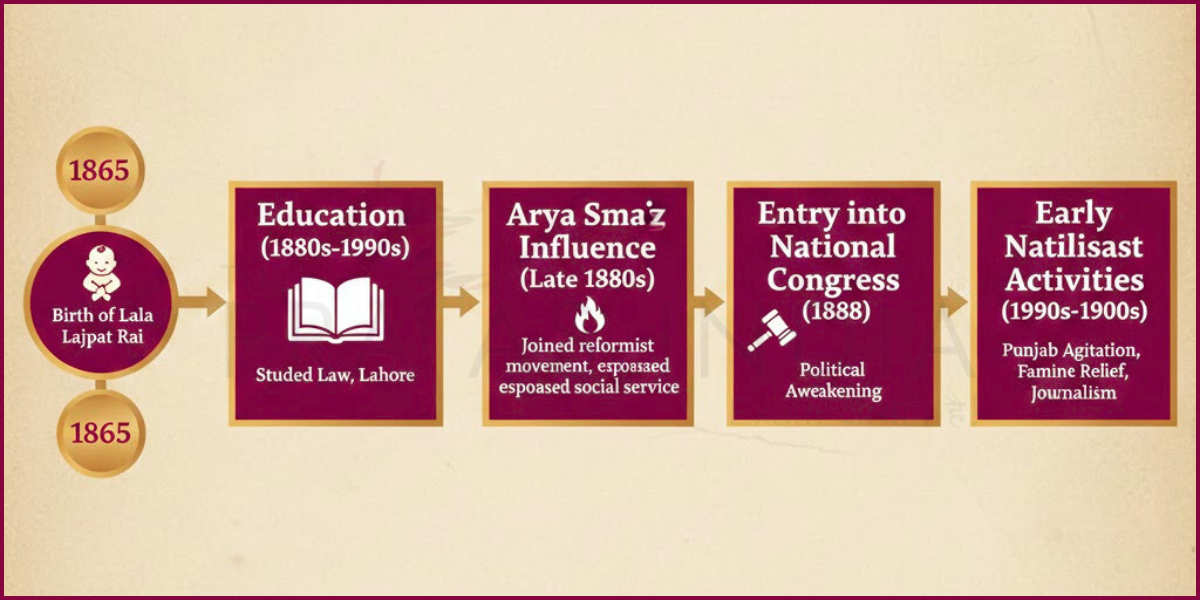
Lala Lajpat Rai was born on 28 January 1865 in Dhudike village, Punjab, into a family deeply influenced by reformist and nationalist ideas. His father was associated with the Arya Samaj, which played a significant role in shaping Lajpat Rai’s intellectual outlook.
Educated in law, Lajpat Rai was exposed to Western liberal thought while remaining firmly rooted in Indian cultural traditions. Early exposure to social reform movements, nationalist literature, and Arya Samaj ideals instilled in him a strong sense of public duty. Unlike many leaders of his generation, his entry into public life was marked by a combination of social reform activism and political engagement, rather than purely legal or administrative pursuits.
Ideological Orientation
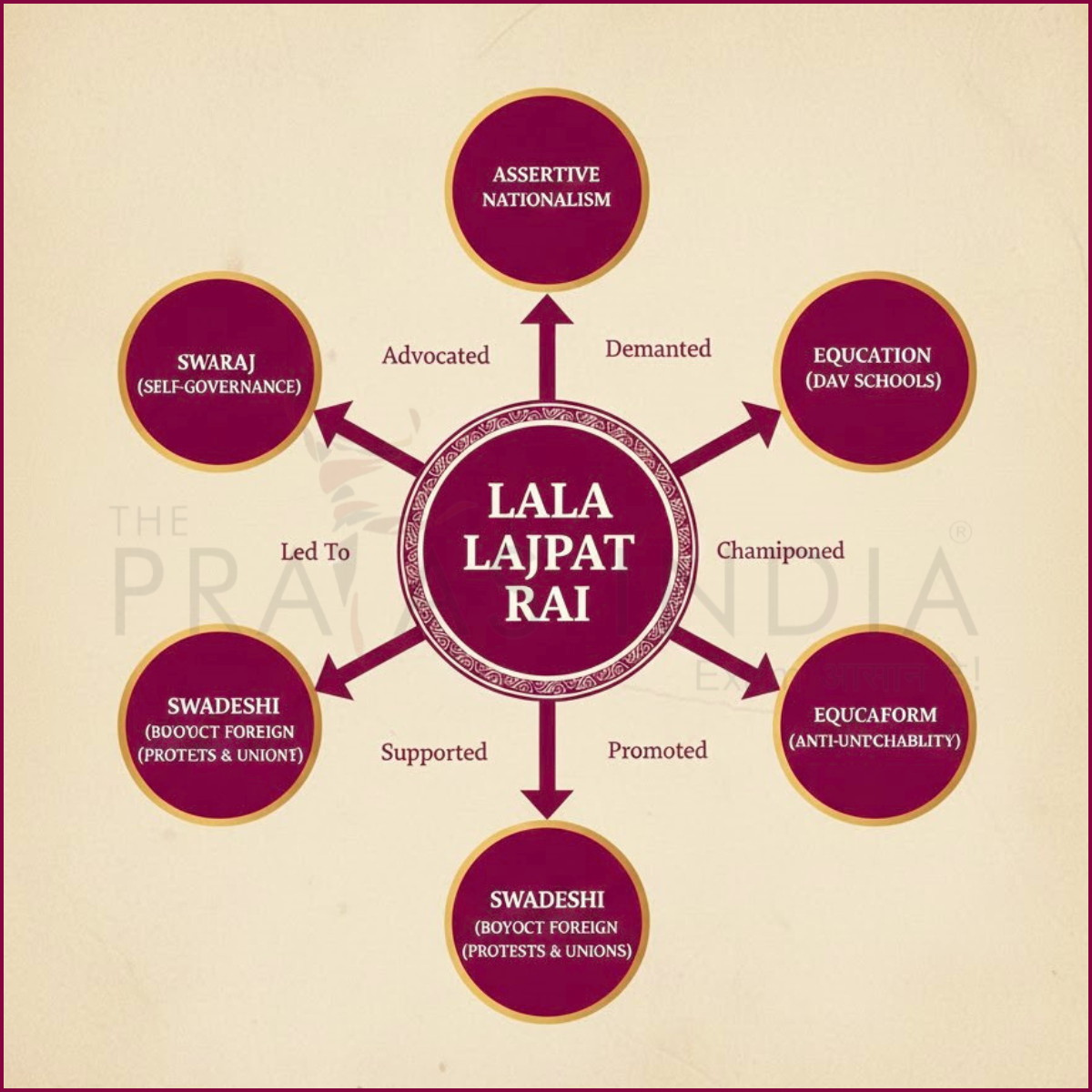
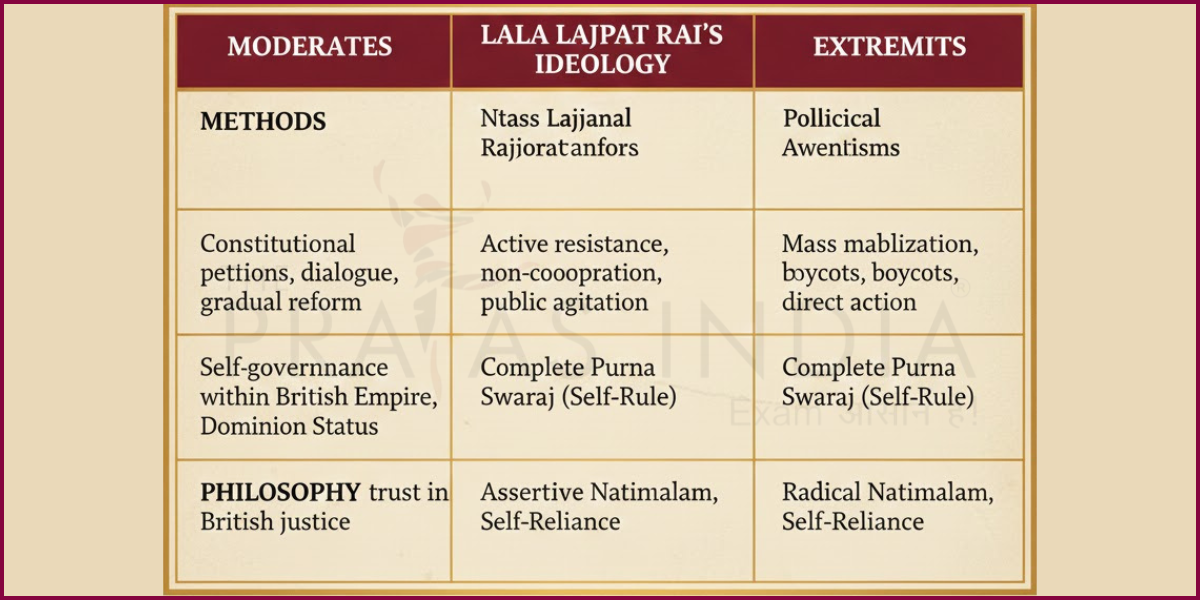
Lala Lajpat Rai emerged as a strong proponent of assertive nationalism, advocating self-reliance, mass mobilisation, and direct resistance to colonial policies. He believed that freedom could not be achieved through petitions and appeals alone but required national self-confidence and organised pressure.
His ideological framework rested on three pillars:
- Self-rule (Swaraj) as the ultimate political goal
- Education and social reform as foundations of national strength
- Active resistance to unjust colonial authority
While influenced by extremist ideology, Lajpat Rai did not reject moral considerations. His nationalism sought to combine cultural revival, social upliftment, and political action. He viewed education as a tool of empowerment and emphasised character-building as essential for nation-making.
Role in the Indian National Congress
Lala Lajpat Rai was an active participant in the Indian National Congress and played a critical role during the Moderate–Extremist phase of the movement. He emerged as a leading voice questioning the effectiveness of moderate constitutional methods.
During the internal ideological debates within the Congress, Lajpat Rai consistently argued for:
- Greater emphasis on self-reliance and boycott
- Mobilisation of the masses beyond elite leadership
- Assertion of national dignity and self-respect
Although the Surat Split of 1907 reflected deep divisions within the Congress, Lajpat Rai’s approach sought to energise the movement rather than fragment it permanently. His role helped popularise extremist ideas without completely severing ties with broader nationalist unity.
Role in Major National Movements
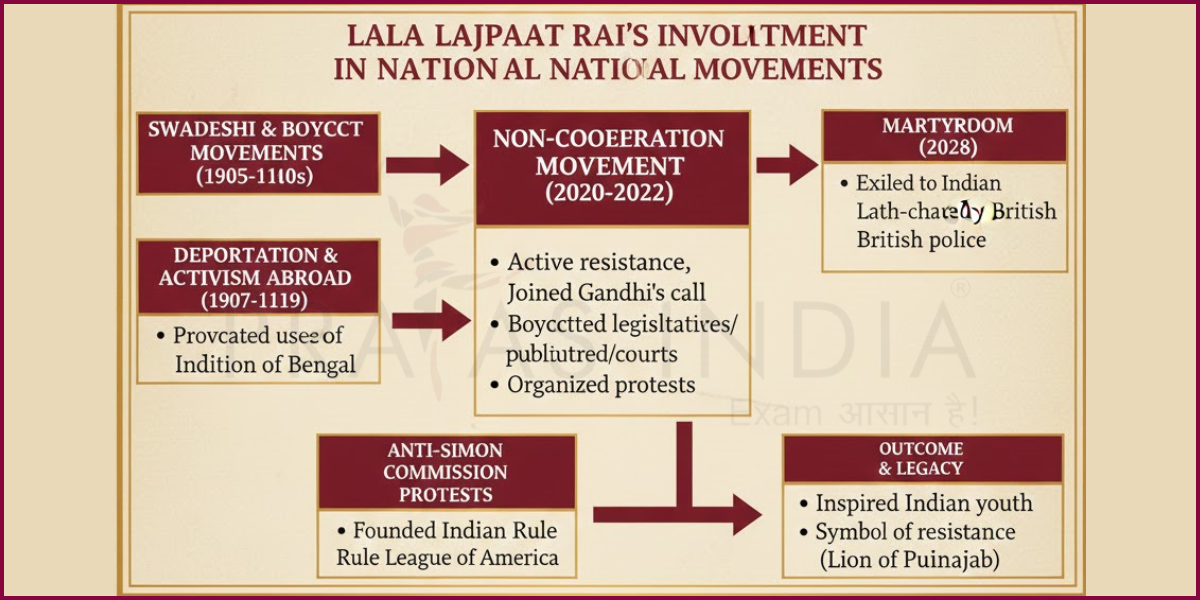
Lala Lajpat Rai was actively associated with several key phases of the national movement:
Support to Anti-Partition and Swadeshi Movement
Although the Partition of Bengal (1905) primarily affected eastern India, Lajpat Rai extended full support to the anti-partition and Swadeshi movements. He promoted the boycott of foreign goods and encouraged indigenous industry, reinforcing the idea of economic nationalism.
Participation in the Non-Cooperation Movement
In the 1920s, Lajpat Rai supported the Non-Cooperation Movement, viewing it as an effective method to mobilise the masses against colonial rule. Though not uncritical, he believed that mass participation was essential for political transformation.
Role in Social Reform and Education
Beyond politics, Lala Lajpat Rai was deeply committed to social reform and educational upliftment. Influenced by Arya Samaj ideals, he worked to eradicate social evils and promote moral regeneration.
His contributions included:
- Advocacy of education for national regeneration
- Support for social harmony and reformist initiatives
- Establishment and promotion of educational institutions
Lajpat Rai believed that political freedom was meaningless without social reform and intellectual awakening. His work helped create a socially conscious nationalism rooted in ethical values.
Protest Against the Simon Commission
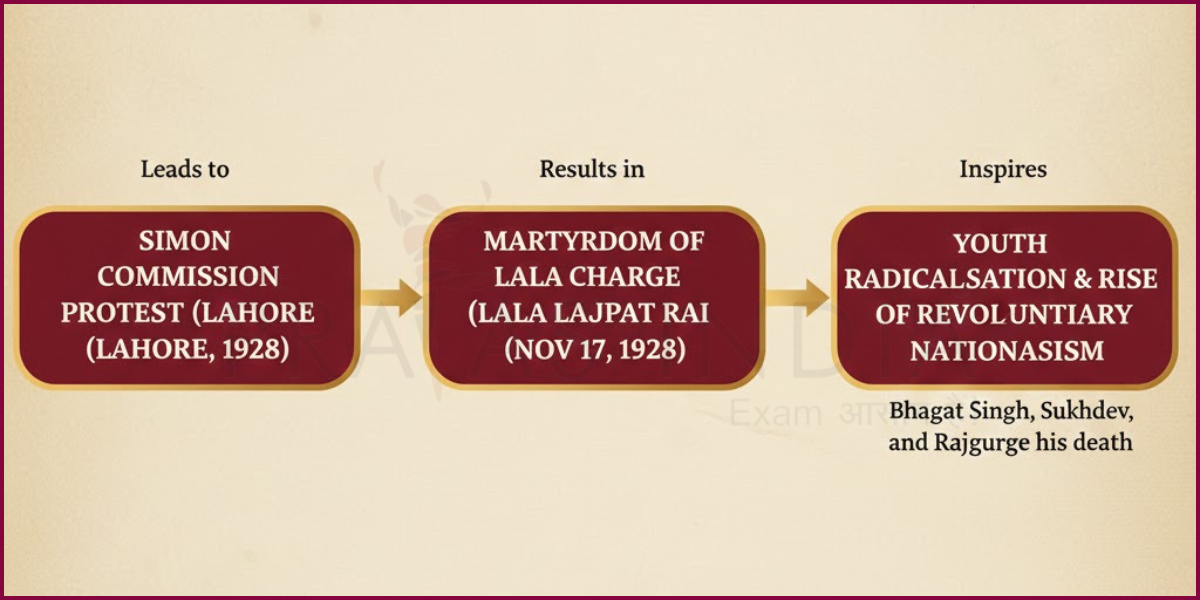
One of the most defining episodes of Lala Lajpat Rai’s life was his leadership of the protest against the Simon Commission in 1928. The Commission, appointed without any Indian member, symbolised colonial disregard for Indian aspirations.
Lajpat Rai led a peaceful protest in Lahore, raising the slogan of opposition against the Commission. The British administration responded with a brutal lathi charge, during which he sustained severe injuries.
Martyrdom and Its Impact
Lala Lajpat Rai succumbed to his injuries on 17 November 1928, turning him into a martyr of the freedom struggle. His death sent shockwaves across the country and intensified nationalist sentiment.
The martyrdom had far-reaching consequences:
- It exposed the repressive nature of colonial rule
- It inspired revolutionary youth, including Bhagat Singh
- It strengthened the resolve of the nationalist movement
His sacrifice became a powerful symbol of resistance and moral courage.
Contributions to National Integration and Political Thought
Lajpat Rai played a crucial role in uniting people across regions through a shared sense of injustice and resistance. His writings, speeches, and leadership helped articulate a vision of nationalism that transcended provincial boundaries.
He influenced later nationalist leaders by:
- Normalising mass-based protest
- Emphasising dignity and self-respect
- Linking social reform with political action
His thought enriched Indian nationalism by adding depth, courage, and moral clarity.
Critical Evaluation
Lala Lajpat Rai’s leadership had significant strengths but also certain limitations.
Strengths:
- Courageous and uncompromising nationalism
- Commitment to mass mobilisation
- Integration of social reform with political struggle
Limitations:
- Limited organisational coherence compared to later mass movements
- Occasional tension between reformist and extremist approaches

Answer Writing Practice
✍️ GS-I 10-Marker
Question: “Assess the role of Lala Lajpat Rai in the rise of extremist nationalism in India.”
Placement: After Section 10 or in a separate “Answer Writing Practice” box
Model Answer (Approx. 150 words):
Lala Lajpat Rai played a crucial role in the rise of extremist nationalism by challenging the limitations of moderate constitutional methods. As part of the Lal–Bal–Pal trio, he advocated assertive nationalism, self-reliance, Swadeshi, and boycott of foreign goods. He emphasised mass mobilisation and national self-respect as essential for achieving Swaraj. His leadership during protests, especially against the Simon Commission, reflected his uncompromising stance against colonial injustice. While he did not reject ethical considerations, his politics marked a decisive shift towards direct resistance. Thus, Lajpat Rai significantly strengthened the ideological and organisational foundations of extremist nationalism in India.
Conclusion
Lala Lajpat Rai stands as a symbol of courage, sacrifice, and assertive nationalism in India’s freedom struggle. His life bridged the transition from moderate constitutionalism to mass-based resistance, and his martyrdom became a turning point that galvanised revolutionary energies.
As a nationalist, reformer, and fearless leader, his legacy continues to inspire the ideals of self-respect, resistance to injustice, and unwavering commitment to national freedom. In the annals of modern Indian history, Lala Lajpat Rai remains an enduring figure whose contribution shaped both the spirit and strategy of India’s struggle for independence.
Frequently Asked Questions (FAQs)
Q1. Why is Lala Lajpat Rai known as the ‘Lion of Punjab’?
Lala Lajpat Rai earned this title due to his fearless opposition to British colonial rule, assertive nationalism, and courageous leadership, especially during the Simon Commission protest where he sacrificed his life.
Q2. What was Lala Lajpat Rai’s contribution to extremist nationalism?
He advocated assertive nationalism, boycott of foreign goods, Swadeshi, mass mobilisation, and rejection of purely constitutional methods, aligning with the extremist phase of the Congress.
Q3. How was Lala Lajpat Rai associated with the Lal–Bal–Pal trio?
Along with Bal Gangadhar Tilak and Bipin Chandra Pal, Lajpat Rai formed the Lal–Bal–Pal trio, representing militant nationalism and mass-based political mobilisation in early 20th-century India.
Q4. What role did Lala Lajpat Rai play in the Simon Commission protest?
He led a peaceful protest against the all-white Simon Commission in Lahore in 1928 and was brutally lathi-charged by the British police, leading to injuries that caused his death.
Q5. How did Lala Lajpat Rai’s martyrdom impact the freedom struggle?
His martyrdom intensified nationalist anger, inspired revolutionary youth like Bhagat Singh, and exposed the brutality of colonial rule, strengthening the freedom movement.
Q6. What were his contributions beyond politics?
Lajpat Rai was deeply involved in education, social reform, and public awareness, believing that national freedom required social upliftment and moral regeneration.
✍️ GS-I 15-Marker
Question: “Examine the contribution of Lala Lajpat Rai to the Indian freedom struggle with special reference to his martyrdom.”
Placement: End of article or dedicated GS-I practice section
Model Answer (Approx. 230–250 words):
Lala Lajpat Rai was a prominent nationalist leader whose contribution to India’s freedom struggle extended across political activism, social reform, and mass mobilisation. As a leader of extremist nationalism, he promoted Swadeshi, boycott, and self-reliance, questioning the efficacy of purely constitutional methods. His participation in the Indian National Congress helped popularise assertive nationalist ideas and expand the movement’s mass base.
The defining moment of his political life came during the protest against the Simon Commission in 1928. Leading a peaceful demonstration in Lahore, he was brutally lathi-charged by the colonial police, suffering fatal injuries. His death transformed him into a martyr and exposed the oppressive nature of British rule. The incident intensified nationalist anger and inspired revolutionary youth, notably Bhagat Singh, marking a radical turn in the freedom struggle.
Lajpat Rai’s martyrdom symbolised sacrifice and resistance, strengthening the moral and emotional foundations of Indian nationalism. His legacy lies not only in his activism but also in the spirit of courage and defiance he instilled in the national movement.