
Lord Mahavira: Life, Teachings, and Historical Significance
- GS Paper 1: Ancient Indian History (Religious Movements, Jainism)
- GS Paper 4: Ethics – Ahimsa, Self-control, Moral Discipline
- Prelims: Jain philosophy, Triratna, Tirthankaras, symbols
- Optional (History / Philosophy): Jainism, Indian Philosophy, Shramana Traditions
Introduction
Lord Mahavira, regarded as the 24th Tirthankara of Jainism, occupies a central position in the religious and philosophical history of ancient India. He is revered as the great systematizer and preacher of Jain doctrines that had evolved over centuries. While Jain tradition traces its origins to earlier Tirthankaras, Mahavira’s contribution lies in organizing, reformulating, and popularizing Jain ethical and philosophical principles in a historical context marked by social change and religious ferment.
Mahavira emerged as one of the most prominent leaders of the Shramana tradition, a heterodox movement that challenged the authority of the Vedas, ritualism, and Brahmanical orthodoxy. Alongside figures such as Gautama Buddha, Mahavira articulated an alternative path centered on renunciation, ethical self-discipline, and liberation from the cycle of rebirth. His teachings emphasized non-violence, truth, and asceticism, leaving a lasting imprint on Indian thought and culture.
Historical Context
The rise of Lord Mahavira must be understood against the backdrop of the 6th century BCE, a period of profound socio-religious transformation in northern India.
This era witnessed:
- The decline of early Vedic sacrificial practices
- Growing dissatisfaction with ritualism, animal sacrifices, and priestly dominance
- The emergence of urban centers, trade, and new social groups
- Questioning of the rigid varna system
These developments led to the rise of heterodox sects, collectively known as the Shramana movements, which emphasized personal effort, ascetic discipline, and ethical living over ritual worship.

Jainism and Buddhism both arose as responses to these conditions, offering moral and philosophical alternatives to the dominant Brahmanical tradition.
Early Life of Mahavira
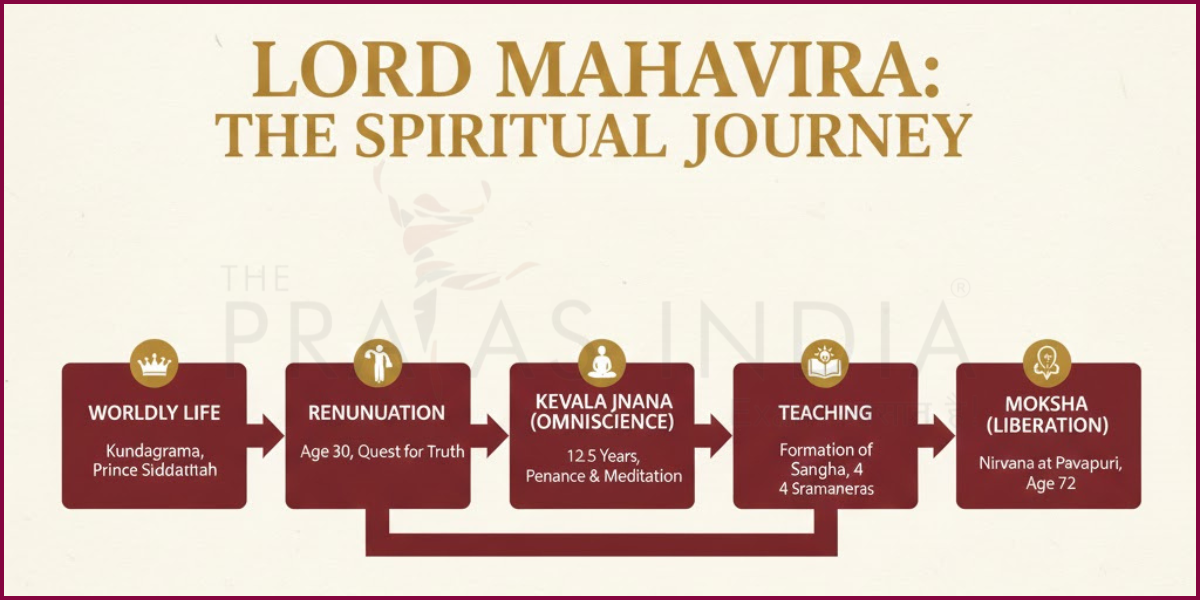
According to Jain tradition, Mahavira was born in 599 BCE at Kundagrama, near Vaishali (in present-day Bihar). His birth name was Vardhamana, meaning “one who grows,” reflecting the belief that prosperity increased in his household after his birth.
Mahavira was born into a Kshatriya clan, the Jnatrikas. His father, Siddhartha, was a local ruler, and his mother, Trishala, was related to the ruling Licchavi clan. This aristocratic background provided him exposure to political authority, social organization, and material prosperity.
Despite his privileged upbringing, Mahavira developed a deep sense of detachment from worldly life. At the age of 30, following the death of his parents, he renounced household life and embarked on a rigorous ascetic path in search of spiritual truth.

Enlightenment and Spiritual Journey
After renunciation, Mahavira practiced severe asceticism for nearly twelve years. His spiritual journey was marked by:
- Extreme self-discipline
- Endurance of physical hardship
- Meditation and introspection
- Detachment from bodily comforts
He practiced absolute non-violence, careful movement, fasting, and silence. Jain texts emphasize his steadfastness in the face of suffering, highlighting his belief that liberation could be achieved only through complete control over desires and passions.
At the age of 42, Mahavira attained Kevala Jnana, or perfect knowledge, under a sal tree. This state of omniscience marked his liberation from karma and rebirth. Thereafter, he spent the remaining thirty years of his life teaching and organizing the Jain Sangha.
Core Teachings of Lord Mahavira
Triratna (Three Jewels)
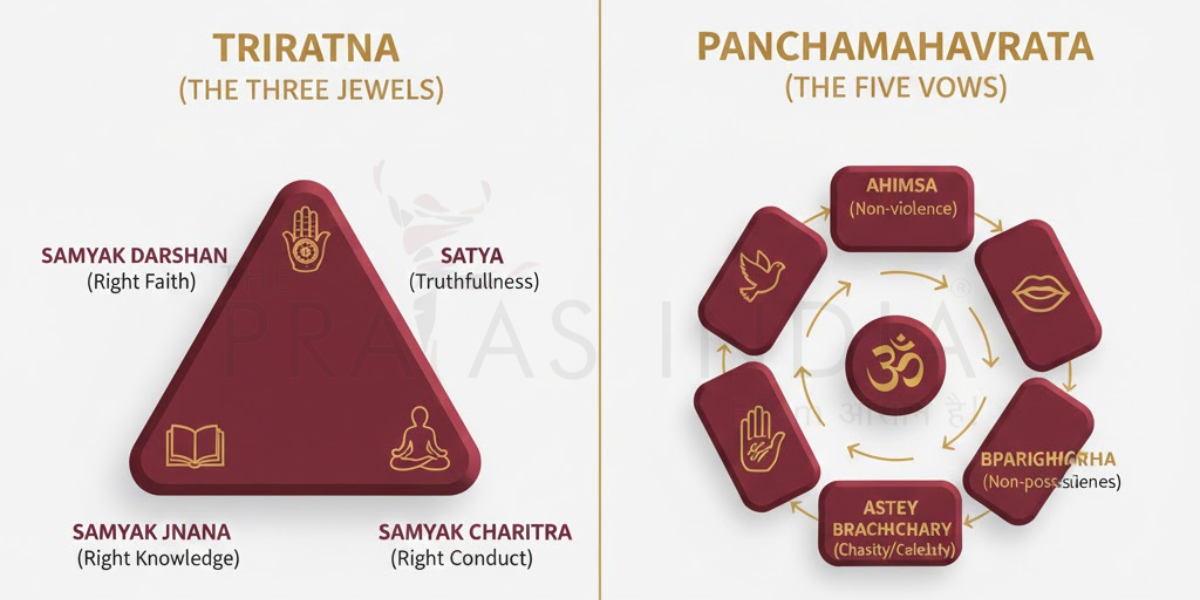
Mahavira emphasized the Triratna, or Three Jewels, as the path to liberation:
- Right Faith (Samyak Darshana): Belief in the truth of Jain teachings
- Right Knowledge (Samyak Jnana): Correct understanding of reality
- Right Conduct (Samyak Charitra): Ethical living and discipline
These three are interdependent and essential for spiritual progress.
Panchamahavrata (Five Great Vows)
Mahavira laid down five fundamental vows for monks and nuns:
- Ahimsa (Non-violence): Absolute avoidance of harm to all living beings
- Satya (Truth): Commitment to truthfulness
- Asteya (Non-stealing): Rejection of theft or exploitation
- Brahmacharya (Celibacy): Control over sensual desires
- Aparigraha (Non-possession): Renunciation of material attachments
Lay followers observed these vows in a milder form.
Philosophy and Metaphysics
Jain philosophy is deeply metaphysical and systematic.
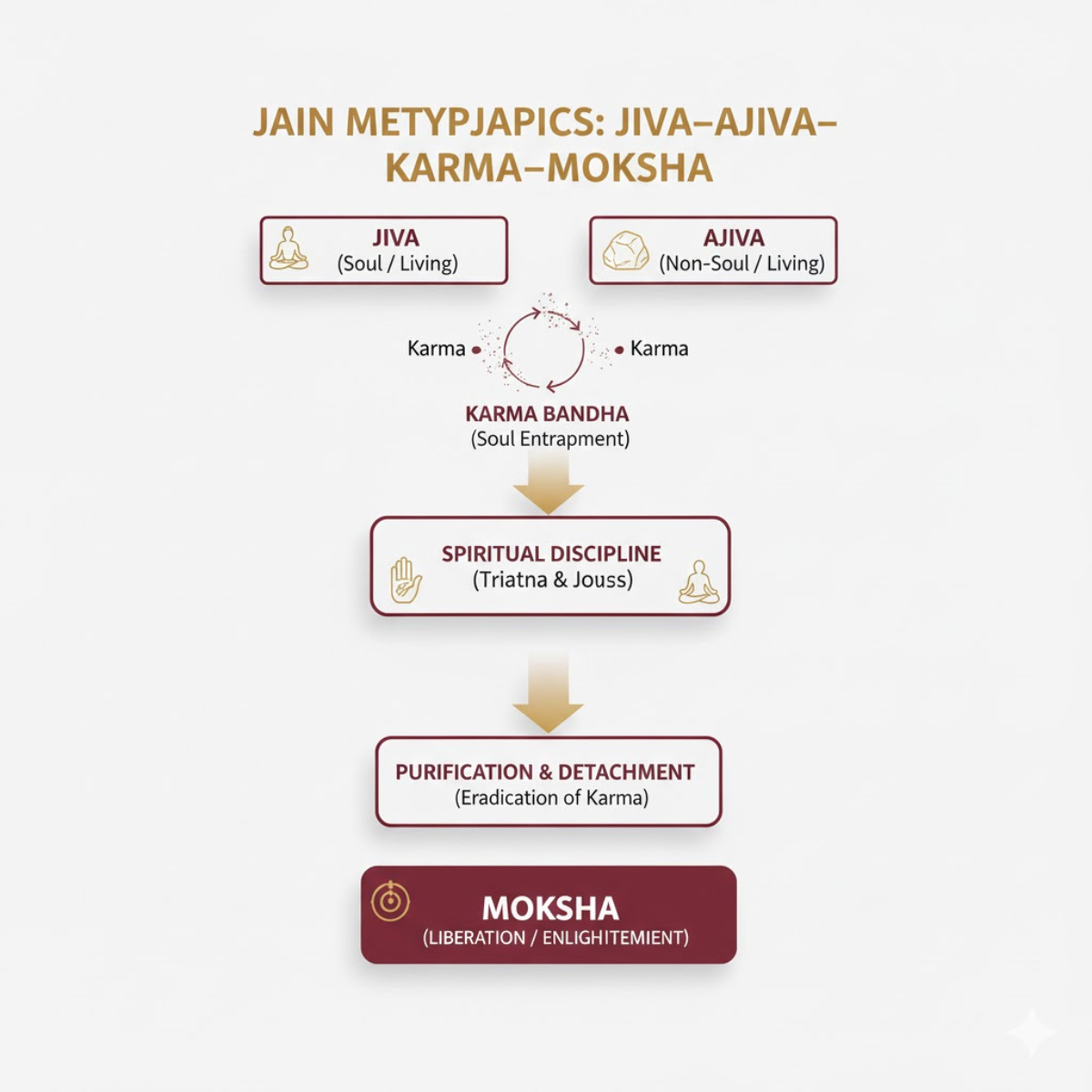
At its core is the distinction between:
- Jiva (soul): Conscious, eternal, and capable of liberation
- Ajiva (non-soul): Matter, space, time, and motion
Mahavira propounded a unique karma theory, where karma is conceived as a subtle material substance that binds to the soul due to actions and passions. Liberation (Moksha) is achieved when all karmic matter is shed through asceticism and ethical conduct.
Jain Sangha and Organization
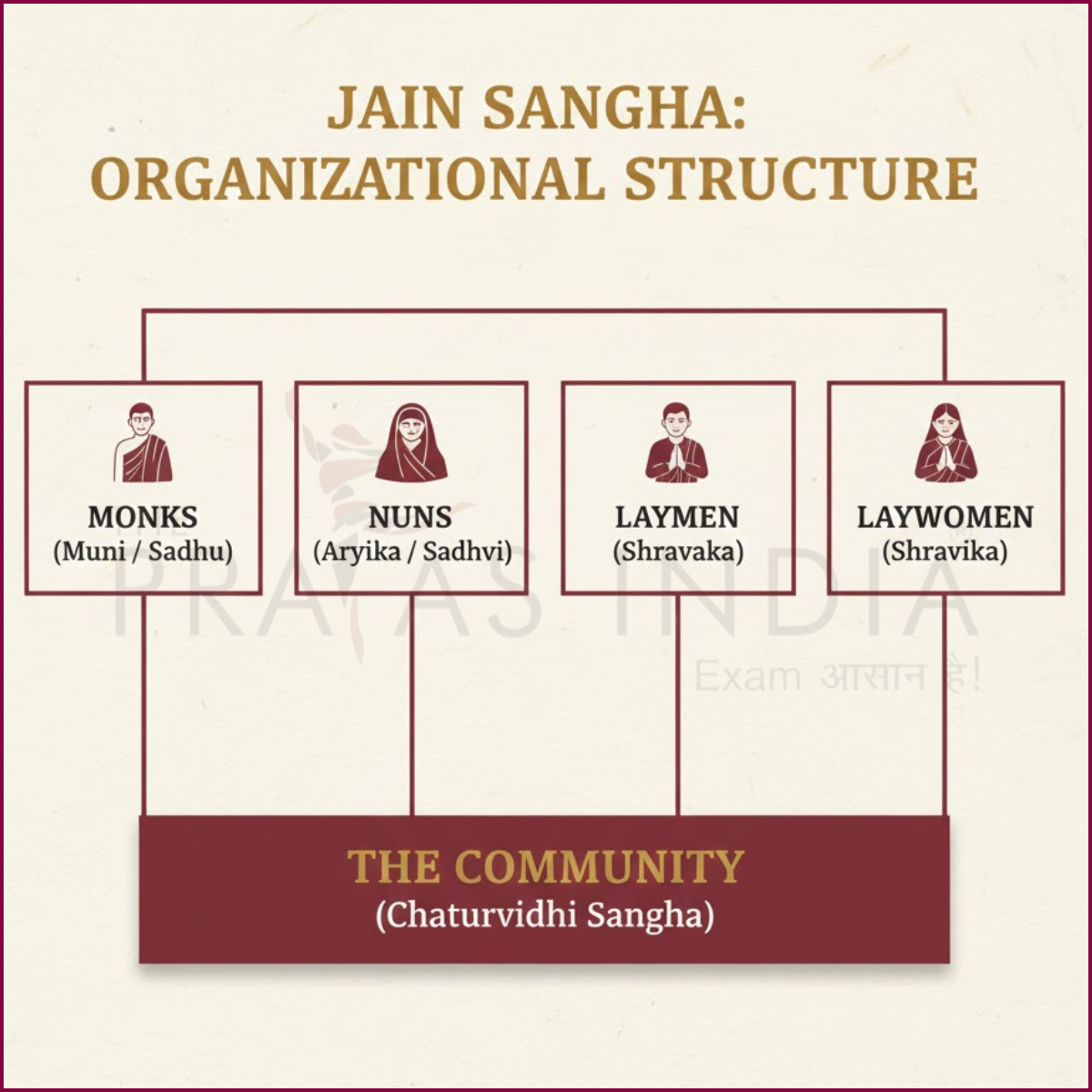
Mahavira organized a well-structured Jain Sangha, consisting of:
- Monks (Sadhus)
- Nuns (Sadhvis)
- Laymen (Shravakas)
- Laywomen (Shravikas)
Monks and nuns followed strict ascetic rules, while lay followers supported the Sangha and practiced ethical living. This organization played a crucial role in the spread and survival of Jainism across generations.
Social and Ethical Impact
Mahavira’s teachings had a profound ethical impact on Indian society:
- He opposed caste rigidity, emphasizing spiritual equality
- Advocated non-violence in thought and action
- Encouraged self-restraint, compassion, and tolerance
His emphasis on Ahimsa deeply influenced later Indian traditions, including Buddhism, Gandhian thought, and environmental ethics.
Contribution to Indian Philosophy and Culture
Jainism contributed significantly to:
- Philosophical pluralism, especially through doctrines like Anekantavada (many-sidedness of truth)
- Development of Prakrit and Ardhamagadhi literature
- Rich traditions of art, architecture, and sculpture, including cave temples and iconography
The Jain emphasis on ethical purity and intellectual rigor enriched India’s cultural heritage.
Comparison with Buddhism (Brief)
While Jainism and Buddhism share common origins, key differences exist:
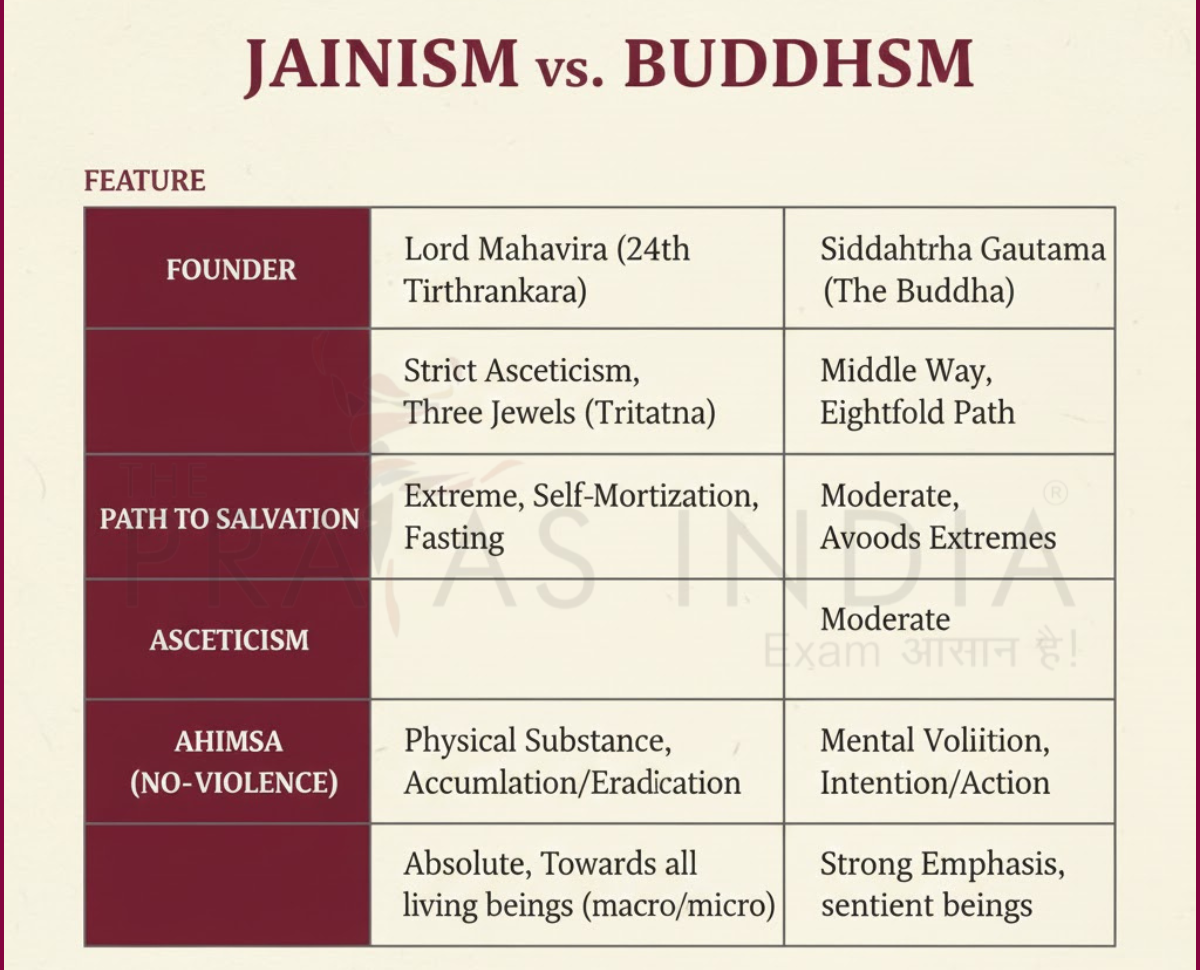
Both rejected Vedic authority, but Jainism emphasized extreme asceticism, while Buddhism advocated a Middle Path.
Historical Significance and Legacy
Lord Mahavira’s teachings ensured the survival and consolidation of Jainism as a distinct religious tradition. Jainism continues to thrive in contemporary India, particularly in western and southern regions, contributing to ethical business practices, education, and philanthropy.
His ideas remain relevant in modern debates on non-violence, sustainability, and ethical living.
Conclusion
Lord Mahavira stands as a moral and spiritual reformer who articulated a rigorous path of self-discipline, compassion, and liberation. His contribution to India’s pluralistic and philosophical traditions is immense. As a central figure of the Shramana movement, Mahavira enriched Indian civilization with values that transcend time, making him a towering figure in the history of world religions.
GS Model Answers (10 & 15 Markers)
GS-I (Ancient History & Culture)
Q (10 Marks):
Discuss the core teachings of Lord Mahavira and their significance in ancient Indian society.
Answer:
Lord Mahavira’s teachings centered on ethical self-discipline and liberation from the cycle of rebirth. The Triratna—Right Faith, Right Knowledge, and Right Conduct—formed the foundation of spiritual progress. His Panchamahavrata, especially Ahimsa, challenged ritual violence and caste rigidity. These ideas promoted moral equality, self-restraint, and compassion, significantly influencing India’s ethical and philosophical traditions.
Q (15 Marks):
Examine the role of Lord Mahavira in the development of Jainism and assess his historical significance.
Answer:
Mahavira played a decisive role in organizing Jainism as a coherent religious system. He systematized earlier doctrines, established a disciplined Sangha, and propagated rigorous ethical principles. His emphasis on asceticism, non-violence, and karma theory distinguished Jainism from Vedic traditions. Historically, his teachings contributed to India’s pluralistic culture and influenced later moral and philosophical thought, making him a key figure of the Shramana movement.
GS-II (Governance / Philosophy Interface)
Q (10 Marks):
How can Mahavira’s teachings contribute to ethical governance in contemporary society?
Answer:
Mahavira’s emphasis on Ahimsa, truthfulness, and non-possessiveness provides a moral framework for ethical governance. These values encourage integrity, restraint in power, and compassion toward all stakeholders, promoting transparent and people-centric administration.
GS-IV (Ethics)
Q (15 Marks):
“Non-violence is not merely a moral principle but a way of life.” Examine this statement in the context of Lord Mahavira’s philosophy.
Answer:
For Mahavira, Ahimsa extended beyond physical non-violence to include thoughts and speech. It required constant self-awareness and ethical discipline. This holistic interpretation makes non-violence a comprehensive way of life rather than a situational ethic. In public life, it promotes empathy, accountability, and sustainable decision-making, highlighting its enduring relevance.
FAQs (UPSC-Oriented)
Q1. Why is Lord Mahavira considered a historical reformer rather than the founder of Jainism?
Lord Mahavira is regarded as the 24th Tirthankara, not the founder of Jainism. Jain tradition existed before him, but Mahavira systematised, reformed, and popularised its doctrines in a historical context, giving Jainism an organised structure.
Q2. How did Mahavira’s teachings challenge the Vedic tradition?
Mahavira rejected Vedic authority, ritualism, animal sacrifice, and Brahmanical supremacy, emphasizing ethical conduct, asceticism, and self-effort as the path to liberation.
Q3. What is the significance of Ahimsa in Jain philosophy?
Ahimsa is the central ethical principle of Jainism, extending to thought, speech, and action. It influenced Indian moral philosophy, including Gandhian ethics and modern environmental consciousness.
Q4. How is Jain karma theory different from other Indian philosophies?
In Jainism, karma is treated as a material substance that binds to the soul, unlike abstract moral causation in other schools. Liberation requires the complete elimination of karmic matter.
Q5. Compare Mahavira’s approach with Buddha’s Middle Path.
Mahavira advocated extreme asceticism, whereas Buddha rejected extremes and proposed a Middle Path. Both sought liberation but differed in methods.