Major Tribes in India: Distribution, Culture, Safeguards and Contemporary Issues
- GS Paper 1: Indian Society, Indian Geography, Tribal Settlements, Demography
- GS Paper 3: Environment, Forest Rights, Conservation, Land Use
- Prelims: Tribal Groups, PVTGs, Constitutional Provisions, Scheduled Tribes List
- Geography Optional: Cultural Geography, Human Geography, Settlement Patterns, Tribal Livelihoods
Introduction
Tribal communities form an integral part of India’s cultural plurality and ecological mosaic. Known for distinct social institutions, customary laws, material culture, and close dependence on natural resources, tribes contribute to the nation’s ethnic, linguistic and ecological diversity. From the high Himalaya to the Andaman Islands and the central forested plateau, tribal lifeways are adapted to a wide variety of environments.
Two complementary perspectives help define “tribe” in the Indian context. The anthropological definition emphasises a community with shared kinship, endogamy, distinct political and economic institutions, unique cultural practices and relative social isolation. The constitutional definition is administrative — the State identifies certain communities as Scheduled Tribes (STs) for the purpose of affirmative action. Under Article 342, the President of India, after consultation with states/UTs, specifies the lists of Scheduled Tribes.
As per the Census 2011, there are 705 notified Scheduled Tribes in India, forming about 8.6% of the country’s population (roughly 10.4 crores). This demographic weight—though numerically a minority—represents a significant share of India’s forested and hilly landscapes and a rich repository of indigenous knowledge.
Basis of Tribal Classification in India
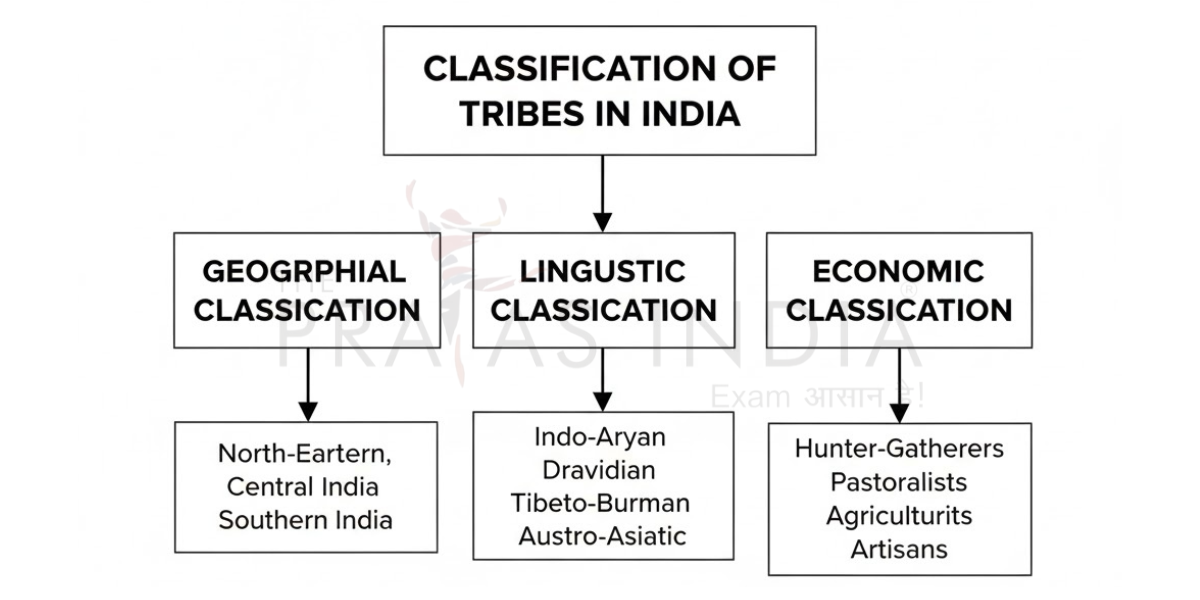
Tribal diversity can be classified from multiple viewpoints. A three-fold framing is useful for administrative and academic purposes:
A. Geographical Classification
Groups are often classified by the ecological and regional zones they inhabit:
- North-East hill tribes (e.g., Naga, Mizo, Khasi)
- Central Indian tribal belt (e.g., Gond, Bhil, Oraon, Munda)
- Western and peninsular tribes (e.g., Banjara, Bhil, Gond pockets)
- Himalayan/Transhumant tribes (e.g., Gaddi, Bhotia)
- Island tribes (e.g., Jarawa, Onge in the Andaman & Nicobar Islands)
B. Ethno-linguistic Classification
Tribes speak diverse languages belonging to major language families:
- Austro-asiatic (Munda, Ho, Santhal)
- Dravidian (Certain South Indian tribes: e.g., Koya, Kondh)
- Tibeto-Burman (Numerous Northeast tribes: Naga, Mizo, Adi)
- Indo-Aryan (Some tribal groups that have undergone cultural assimilation)
C. Socio-economic Classification
From an economic lens, tribes are often categorized as:
- Hunter-gatherers (some vulnerable groups)
- Shifting cultivators (jhum practitioners) — common in hill regions
- Pastoralists/transhumant (Gaddi, Bhotia, Gujjar)
- Settled agriculturalists and forest-dependent communities
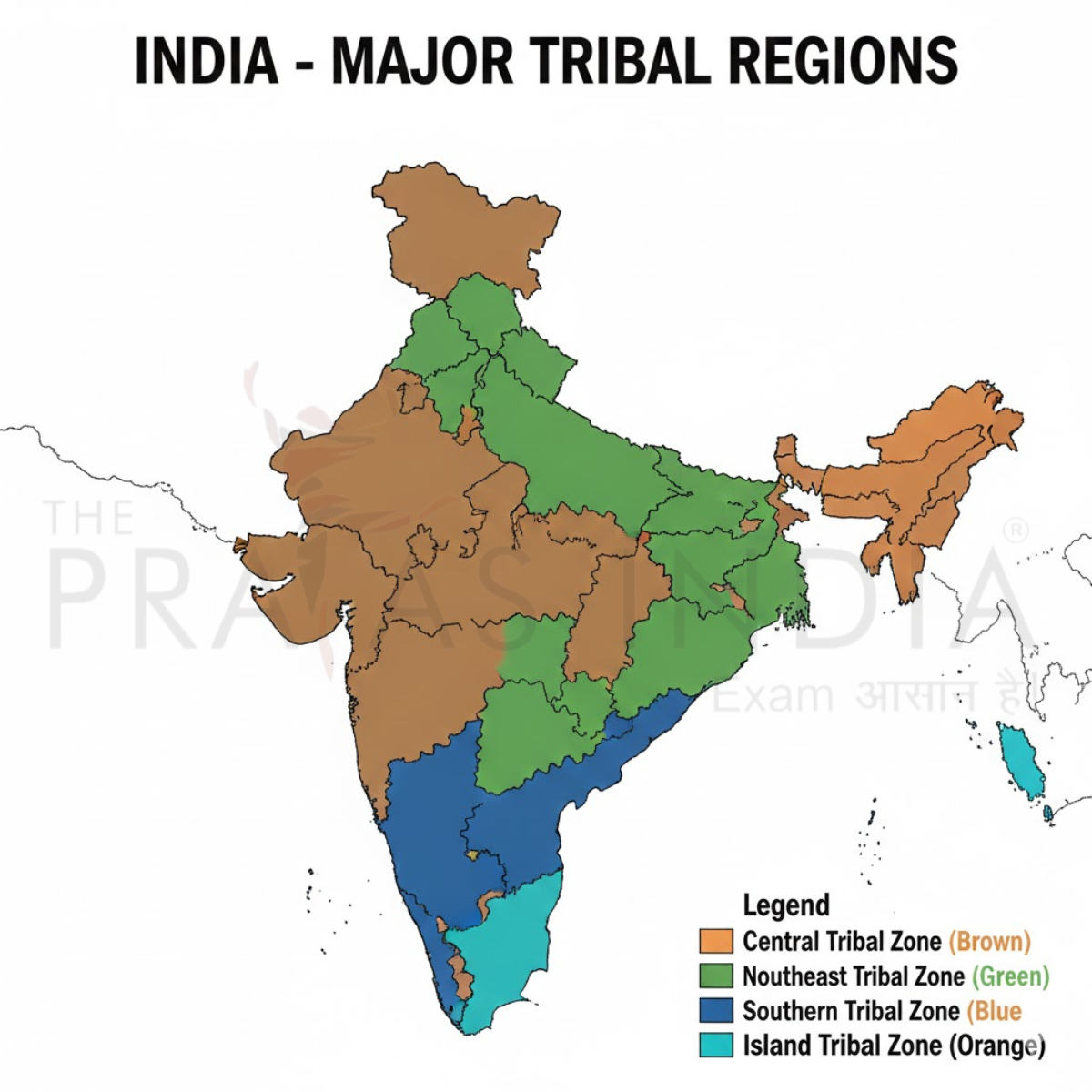
Geographical Distribution of Tribes (Region-wise)
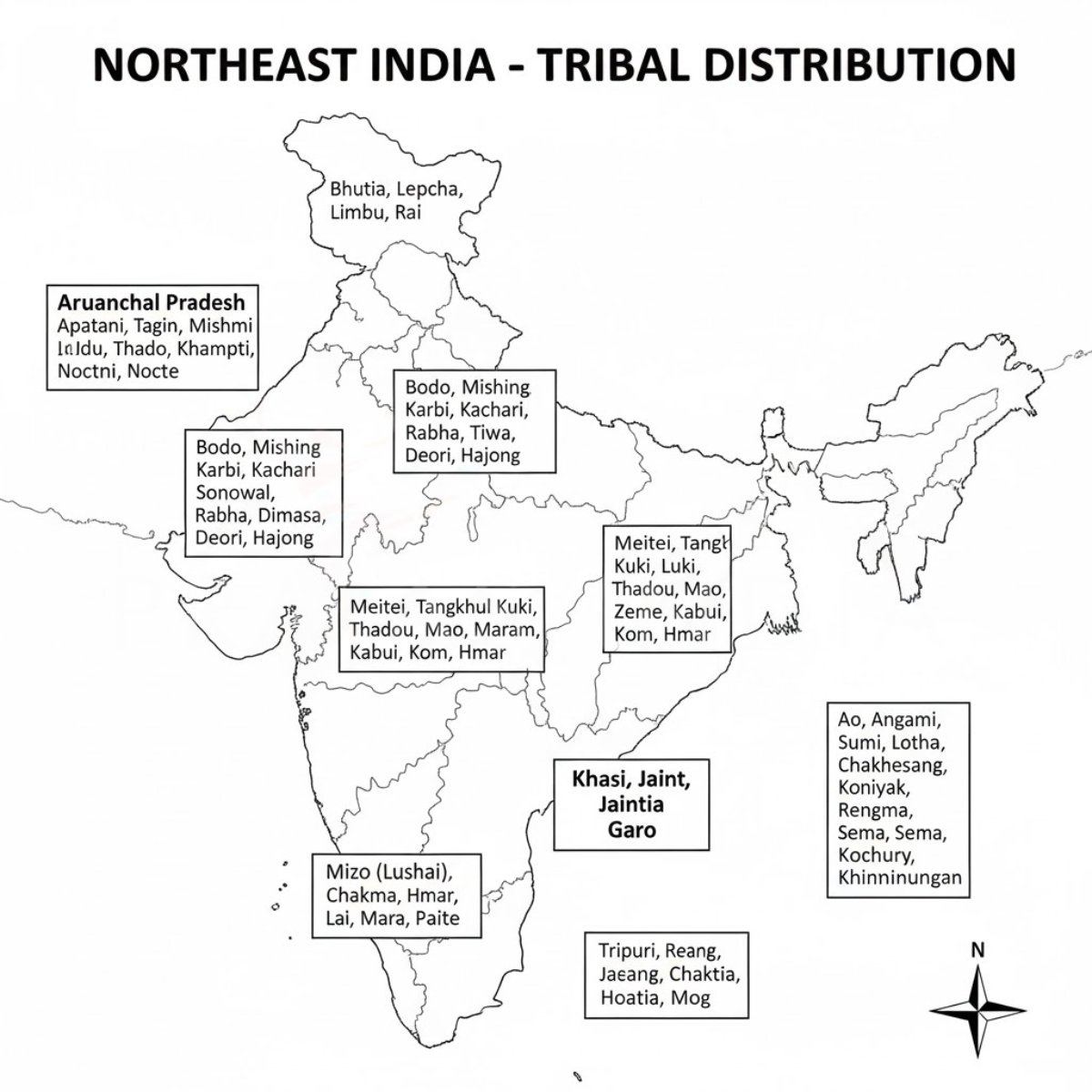
India’s tribal distribution is regionally concentrated; major zones and representative tribes follow.
A. North-East India
The North-East displays the highest regional concentration of tribes and linguistic diversity. Important groups include Bodo, Khasi, Garo, Jaintia, Mizo, Naga (multiple Naga tribes like Angami, Ao), Apatani, Adi, Nyishi.
Settlement and economy: Predominantly hill settlements; shifting cultivation (jhum) is widely practised, although terrace and settled agriculture are increasing. Distinct political histories (princely patterns, headman systems) and strong ethnic mobilisations characterise the region.
B. Central India (Largest Concentration)
The central Indian tribal belt—covering Chhattisgarh, Jharkhand, Odisha, Madhya Pradesh, parts of Maharashtra and West Bengal—hosts the highest absolute numbers. Prominent tribes: Gond, Bhil, Santal, Munda, Ho, Oraon, Baiga, Kol.
Economy and culture: Mixed economy of settled agriculture, forest produce collection (NTFPs), and seasonal labour. Many groups retain customary governance (panch, clan councils) and ritual systems linked to forest ecology.
C. Western India
States like Rajasthan, Gujarat and parts of Maharashtra contain tribes such as Bhil, Garasia, Sahariya, Banjara. Some groups have semi-nomadic pasts (e.g., Banjara) and maintain combinations of pastoralism, agriculture and forest collection.
D. Northern & Himalayan Tribes
Mountain tribes include Gaddi, Bhotia, Gujjar, Jaunsari, Kinnaura. Their economy is adapted to high-altitude ecology: transhumant pastoralism (seasonal migration of herds), alpine agriculture and unique architectural forms.
E. Southern India
Tribes in the Nilgiris, Western Ghats and Deccan include Toda, Kurumba, Paniya, Irula, Chenchu, Koya. They exhibit diverse subsistence systems, from honey and tuber collection to settled cultivation. Many are holders of valuable ethno-botanical knowledge.
F. Andaman & Nicobar Islands
Groups such as Jarawa, Sentinelese, Onge, Shompen, Great Andamanese are critically important for discussions of isolation, minimal contact, and rights. These tribes are legally protected; many have suffered demographic collapse post-contact.
Particularly Vulnerable Tribal Groups (PVTGs)
PVTG is an administrative sub-category for tribes that are more vulnerable due to pre-agricultural technology, small population, low literacy, and subsistence economy. Characteristics include very small populations, stagnant or declining population growth and limited resource use. As per government lists, there are 75 PVTGs spread across several states.
Examples: Birhor, Baiga, Cholanaicken, Konda Reddi, Jarawa, Onge (state-wise distribution varies). PVTG policy prioritises targeted development without cultural disruption.
| State / UT | PVTGs |
|---|---|
| Andhra Pradesh | Chenchu, Bondo Porja, Gadaba, Kondareddi, Konda Savaras, Porja |
| Chhattisgarh | Abujh Maria, Baiga, Kamar, Pahadi Korwa, Birhor |
| Jharkhand | Asur, Birhor, Birjia, Hill Kharia, Korwa, Sauria Paharia |
| Odisha | Bondo, Didayi, Dongria Kondh, Juang, Kharia, Kutia Kondh, Lodha, Paudi Bhuyan, Saura |
| Madhya Pradesh | Baiga, Bharia, Sahariya |
| Maharashtra | Katkari, Kolam, Maria Gond |
| Rajasthan | Sahariya |
| Tamil Nadu | Irular, Konda Reddi, Kurumba |
| Kerala | Kattunayakan, Kurumba, Kani, Cholanaicken |
| Karnataka | Jenu Kuruba, Koraga |
| Gujarat | Siddi |
| West Bengal | Lodha, Birhor |
| Manipur | Maram, Thadou, Paite |
| Tripura | Riang |
| Andaman & Nicobar Islands | Jarawa, Onge, Sentinelese, Great Andamanese, Shompen |
Cultural Features of Major Tribes
Key cultural domains typically include:
- Language: Distinct mother tongues and dialects, often orally transmitted.
- Dress & ornaments: Varied traditional attire (e.g., colourful Mizo garments, bamboo adornments).
- Food habits: Forest-derived staples, millet, rice, tubers, hunting and fishing in some groups.
- Housing: From bamboo thatched huts to stone houses; architecture adapted to climate and mobility.
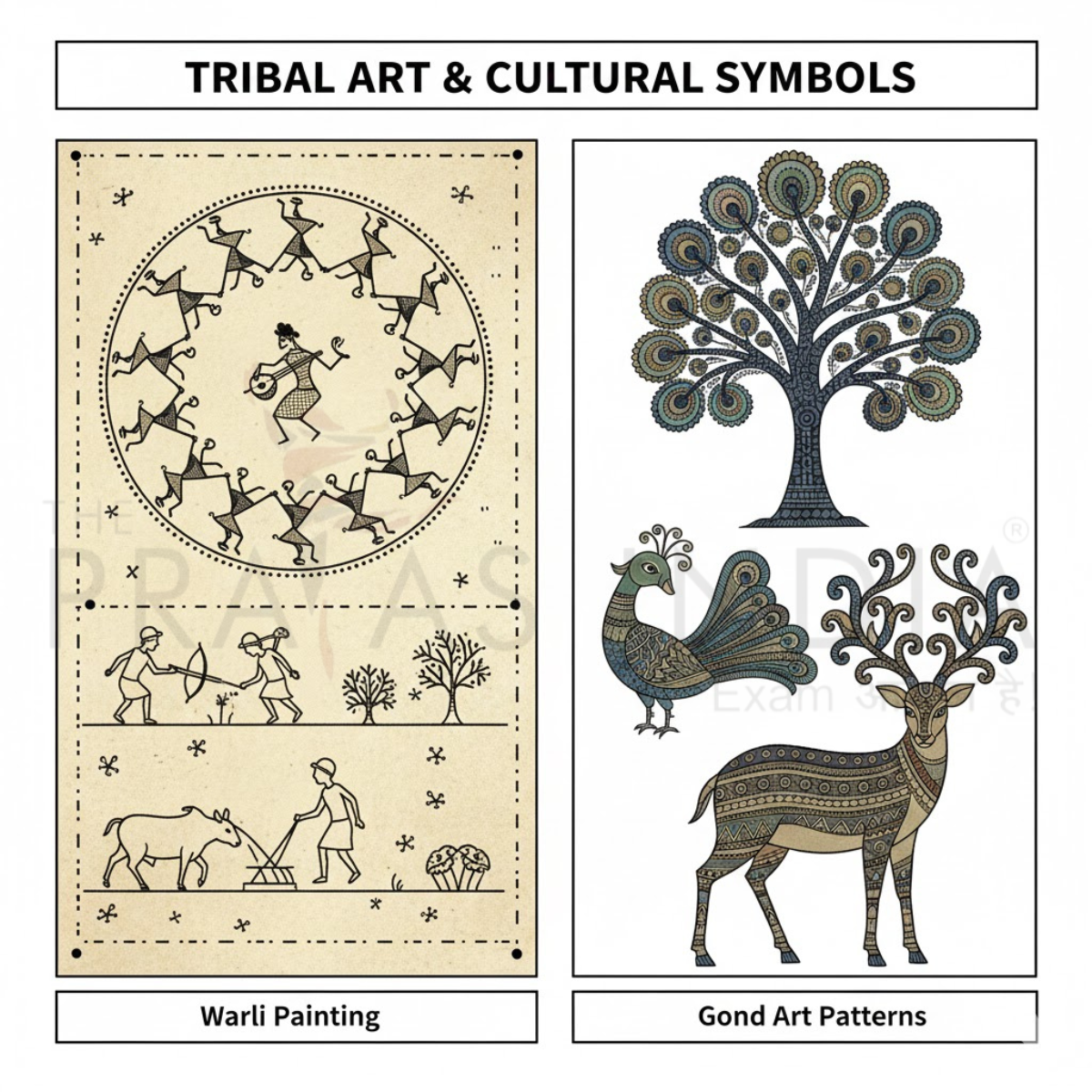
- Art & craft: Rich material culture — Warli painting (Maharashtra), Gond painting (Central India), Dokra metalwork, weaving and basketry.
- Festivals: Social-religious festivals like Hornbill (Nagaland), Mopin (Arunachal), Bhagoria (Madhya Pradesh), Sarhul (Santhals) that mark agricultural cycles and social cohesion.
Tribal Economy
Tribal economies encompass:
- Hunting-gathering: Residual in some PVTGs.
- Shifting cultivation (jhum): Practised in hill regions; rotational fallow maintains soil fertility under lower population pressure.
- Pastoralism and transhumance: Seasonal movement of herds (Gaddi, Bhotia).
- Settled agriculture: Paddy, millets, pulses in many regions.
- Forest produce: Collection of Non-Timber Forest Products (NTFPs) — tendu leaves, mahua, tubers, medicinal plants — forms a major livelihood source.
- Interaction with modern economy: Mining, plantations and commercial logging have led to labour migration, land alienation and monetisation of labour.
Constitutional & Legal Safeguards
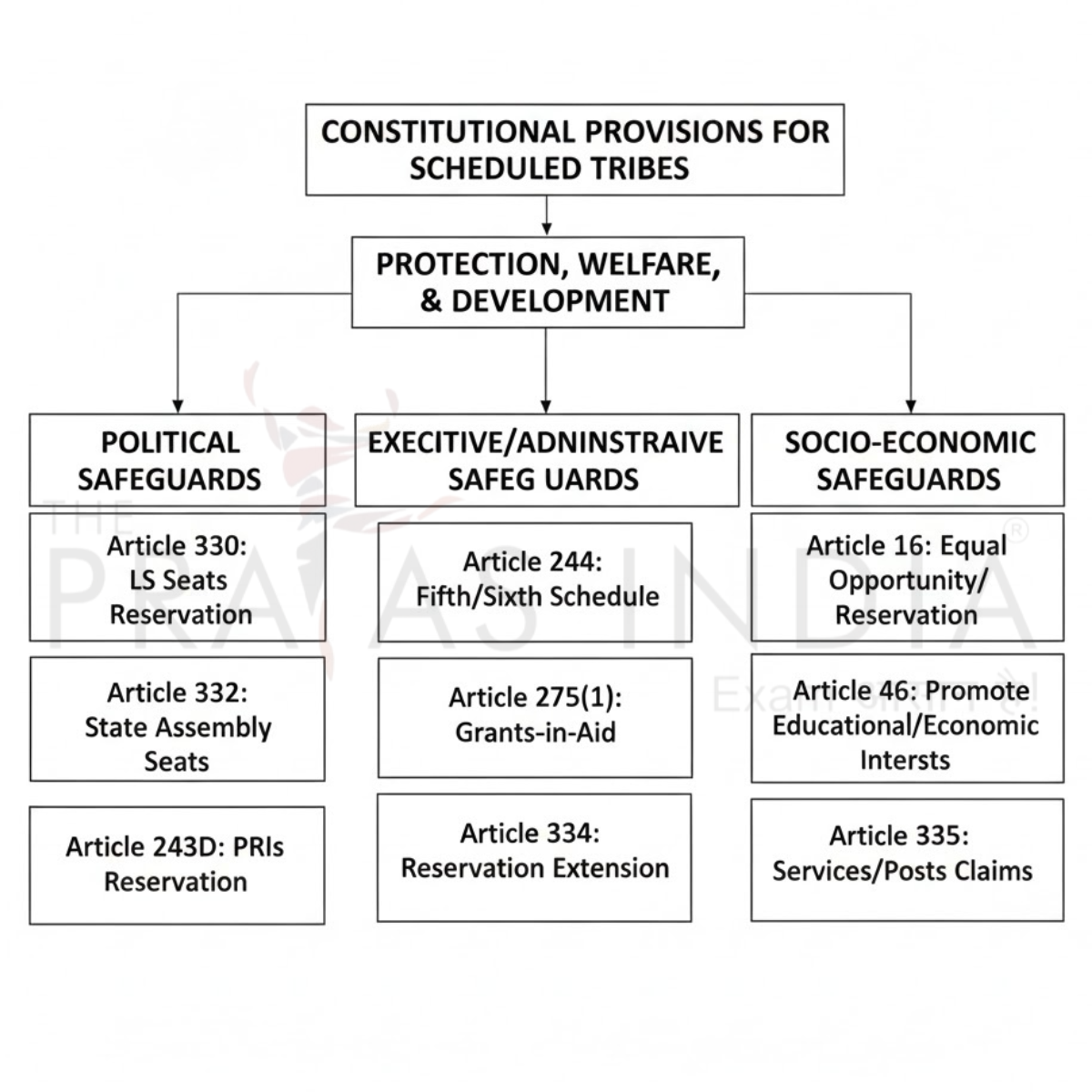
The Constitution and specialised laws provide safeguards and governance mechanisms for tribal rights:
- Articles 15(4), 16(4), 46, 275(1) — provisions for advancement and protective discrimination.
- Fifth Schedule — special administration of scheduled areas in states outside the Northeast (Governor’s role, tribal advisory councils).
- Sixth Schedule — autonomous district councils with legislative, administrative and judicial powers in parts of Assam, Meghalaya, Mizoram and Tripura.
- PESA Act (1996) — Panchayats (Extension to Scheduled Areas) Act recognises customary institutions and self-rule in scheduled areas.
- Forest Rights Act (FRA, 2006) — recognises individual and community forest rights, crucial for tribal land and resource claims.
Government Schemes for Tribes
Major central initiatives include:
- Vanbandhu Kalyan Yojana — integrated development programmes for tribal welfare.
- Eklavya Model Residential Schools (EMRS) — residential schools for quality education in tribal areas.
- TRIFED — Tribal Cooperative Marketing Development Federation; schemes for marketing MFPs, skill development, MSP for minor forest produce.
- PVTG Development Mission (2023) — targeted interventions for priority vulnerable groups.
- Schemes on health, sanitation, and skill development are implemented through ministries and state agencies as well.
Contemporary Challenges Faced by Tribes
Tribal communities face multi-dimensional challenges:
- Land alienation and displacement: Mining, industrial projects and dams have displaced many tribal families, often with inadequate rehabilitation.
- Decline in traditional livelihoods: Commercial exploitation of forests and strict conservation regimes (without participatory governance) can restrict access to resources.
- Low human development indicators: Higher poverty rates, lower literacy and health outcomes (malnutrition, maternal mortality) among many tribal groups and especially PVTGs.
- Cultural erosion: Rapid social change, schooling models unsympathetic to indigenous knowledge and media penetration threaten intangible heritage.
- Environmental vulnerability: Climate change affects tribal livelihoods (crop failure, altered forest phenology), while unsustainable extractive activities degrade ecosystems.
Case Studies (Mains-Relevant)
- Dongria Kondh (Niyamgiri, Odisha): Tribal mobilisation and legal activism led to the Supreme Court recognising community rights and blocking bauxite mining—an example of community rights as environmental protection.
- Bhotia transhumance decline: Socio-economic change and market pressures have affected traditional patterns of high-altitude pastoralism.
- Sentinelese isolation: The legal and ethical framework of protection versus contact; governance emphasises non-intervention.
FAQs on Major Tribes in India
1. Who are considered tribes in India?
In India, tribes are communities that historically lived in isolated or forested areas with distinct cultural, linguistic, and social practices. Constitutionally, tribes listed under Article 342 by a Presidential Order are recognized as Scheduled Tribes (STs).
2. How many Scheduled Tribes are there in India?
As per Census 2011, India has 705 Scheduled Tribes, constituting 8.6% of the population.
3. Which region has the highest concentration of tribal population?
Central India (Chhattisgarh, Jharkhand, Odisha, Madhya Pradesh) has the largest concentration of tribal communities, accounting for more than 50% of India’s total ST population.
4. What are Particularly Vulnerable Tribal Groups (PVTGs)?
PVTGs are tribal groups with:
- Pre-agricultural level of technology
- Low literacy
- Stagnant or declining population
India has 75 PVTGs, identified by the Government of India.
5. What are the major tribes of Northeast India?
Prominent tribes include Bodo, Khasi, Garo, Jaintia, Naga, Mizo, Apatani, Adi, Nyishi, Angami, Ao, and others.
6. What constitutional provisions safeguard tribal communities?
Key safeguards include:
- Article 15(4), 16(4) for affirmative action
- Article 46 for socio-economic protection
- Fifth and Sixth Schedules for administration of tribal areas
- Forest Rights Act (FRA), 2006
- PESA Act, 1996
7. What are the main issues faced by tribal communities?
Major challenges include:
- Land alienation
- Displacement due to mining & dams
- Low literacy and malnutrition
- Weak health indicators
- Threats to traditional livelihoods
- Climate change vulnerabilities
8. Which government schemes support tribal development?
Key schemes include Vanbandhu Kalyan Yojana, Eklavya Model Residential Schools, TRIFED–MSP for MFP, and the PVTG Development Mission (2023).
9. Why is Central India called the Tribal Belt?
Central India has large forested areas and has historically supported tribal communities like Gonds, Bhils, Santals, Mundas, Oraons, making it the largest contiguous tribal region.
10. What is the importance of tribal culture for India?
Tribal culture contributes to India’s linguistic diversity, traditional ecological knowledge, art forms (Warli, Gond), and sustainable resource management.
Conclusion
Tribal communities are custodians of large tracts of India’s natural heritage and repositories of unique cultural knowledge. Meaningful tribal inclusion requires policies that combine economic opportunities with legal security for land and forest rights, preserve cultural autonomy, strengthen local governance institutions (PESA, Sixth Schedule councils) and promote education and healthcare that respect tribal identity. Sustainable development for tribal India must be community-centred, ecologically sensitive and rights-based — a requirement both for social justice and long-term conservation.