
Mountain Ranges in India: Types, Location, and Significance
- GS Paper 1: Physical Geography, Geomorphology, Biogeography
- GS Paper 3: Environment, Climate Change, Disaster Management
- Prelims: Mountain systems, rivers, biodiversity hotspots
- Geography Optional: Mountain geomorphology, ecological significance
Introduction
A mountain range is a series of mountains connected by high ground, often extending over hundreds or thousands of kilometers. Mountains are formed due to tectonic activity, erosion, or volcanic processes. In India, mountain ranges play a crucial role in shaping the physical, ecological, and socio-economic landscape.
Significance of Mountains in Indian Geography:
- Climate: Mountains influence wind flow, rainfall distribution, and monsoon patterns. For example, the Western Ghats induce orographic rainfall, while the Himalayas block cold Central Asian winds.
- Rivers: Mountains are the origin of India’s major perennial rivers such as the Ganga, Brahmaputra, and Godavari. These rivers support agriculture, hydroelectric power, and drinking water supply.
- Biodiversity: Mountains provide unique habitats, from alpine meadows to tropical forests, hosting endemic species.
- Human Settlements: Mountain valleys and foothills are centers of agriculture, trade, and tourism, e.g., hill stations in Himachal Pradesh and Uttarakhand.
Overview of India’s Major Mountain Systems:
- Northern Mountains (Himalayas): Young fold mountains with snow-clad peaks and glaciers.
- Peninsular Ranges (Southern India): Old, stable, erosion-resistant ranges such as Aravalli, Vindhya, Western & Eastern Ghats.
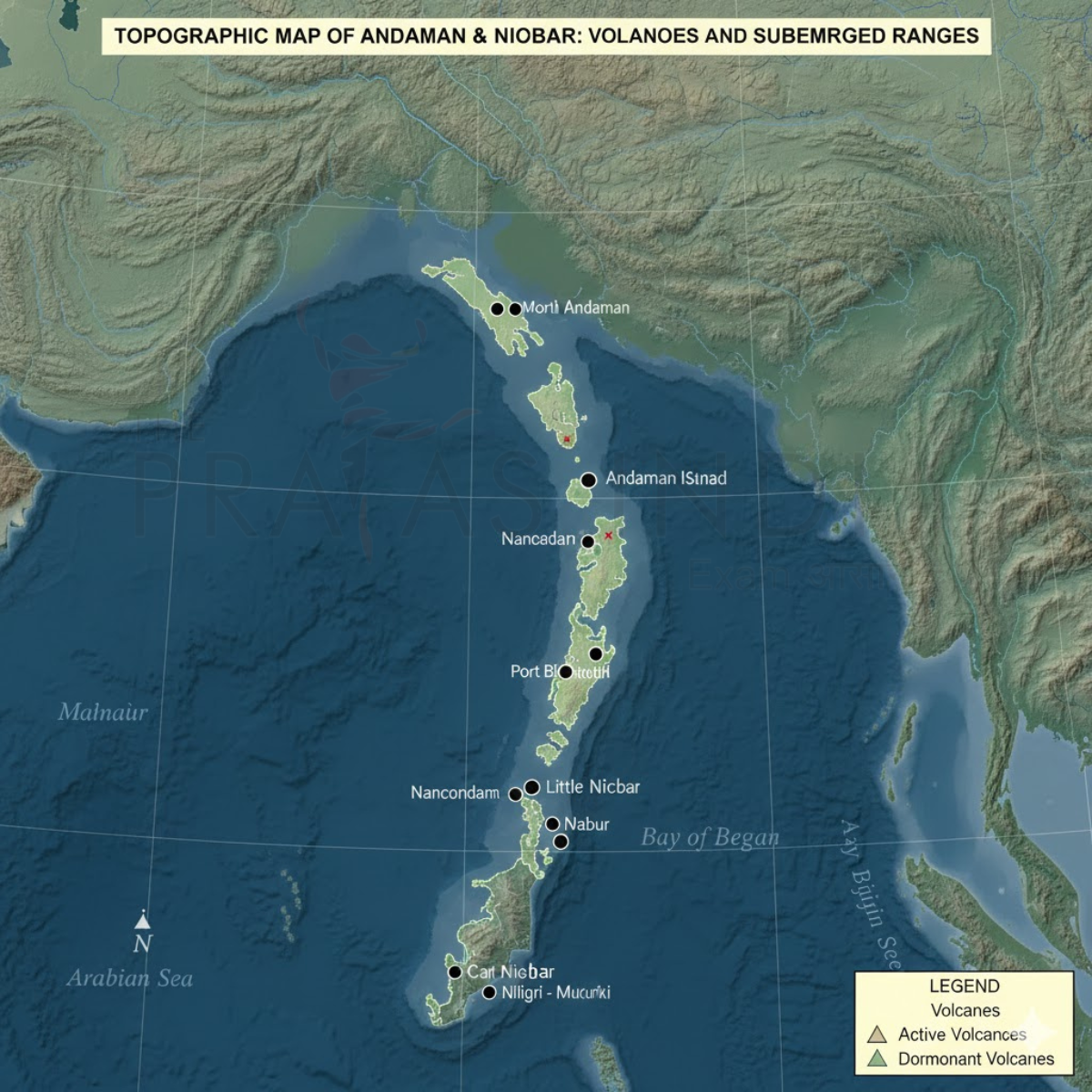
- Island Ranges (Andaman & Nicobar): Volcanic origin, including active volcanoes like Barren Island.
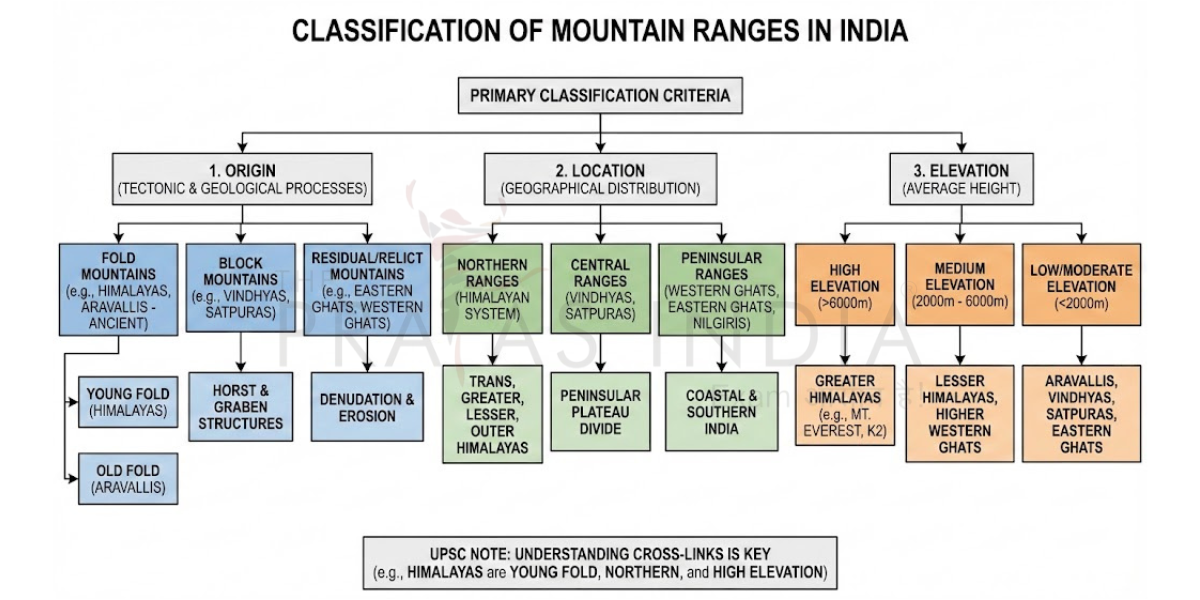
Classification of Mountain Ranges in India
Based on Geological Origin
- Fold Mountains: Himalayas, formed by collision between the Indian and Eurasian plates.
- Block Mountains: Aravalli, Vindhya; result of crustal movements along faults.
- Volcanic Mountains: Barren Island, Narcondam; formed by volcanic activity.
- Residual Mountains: Rajmahal Hills; remnants after prolonged erosion.
Based on Location
- Northern Mountains: Himalayas, Karakoram, and associated ranges.
- Peninsular Mountains: Aravalli, Vindhya, Satpura, Western Ghats, Eastern Ghats, Nilgiris.
- Coastal Mountains: Laccadive and Malabar Hills.
- Island Ranges: Andaman & Nicobar Hills.
Based on Elevation
- High (>6000 m): Kanchenjunga, Nanda Devi.
- Medium (1000–6000 m): Lesser Himalayas, Nilgiri Hills.
- Low (<1000 m): Shiwalik Hills, Aravalli Range.
Northern Mountain Ranges (Himalayas)
Geological Origin
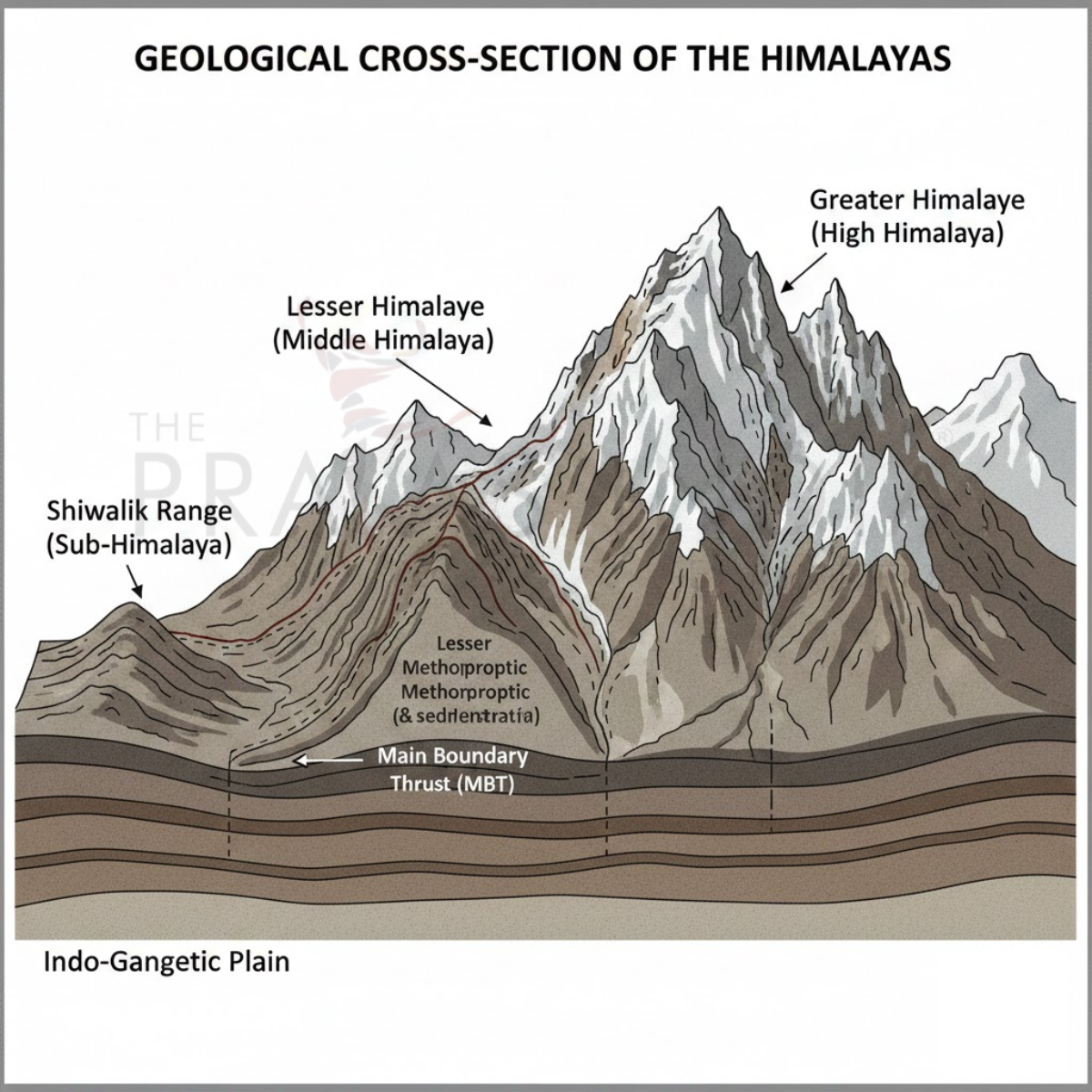
The Himalayas are young fold mountains, formed during the Tertiary period when the Indian plate collided with the Eurasian plate. This collision caused crustal folding, resulting in the tallest mountains in the world.
Divisions
- Himachal Himalayas / Shiwaliks (Outer Himalayas):
- Low hills, composed mainly of unconsolidated sedimentary rocks.
- Foothills with valleys suitable for agriculture and settlements.
- Lesser Himalayas / Lower Himalayas:
- Mid-elevation mountains with steep slopes and narrow valleys.
- Home to hill stations like Shimla, Mussoorie, and Nainital.
- Great Himalayas / Higher Himalayas:
- Lofty, snow-clad peaks, glaciers, and passes.
- Sites of high-altitude ecosystems, alpine meadows, and strategic locations.
Major Peaks
- Kanchenjunga (8,586 m) – Sikkim, 3rd highest in the world
- Nanda Devi (7,816 m) – Uttarakhand, UNESCO Biosphere Reserve
- Kamet (7,756 m) – Uttarakhand
- Saltoro (7,742 m) – Ladakh, near Siachen Glacier
Major Passes
-
Nathu La (Sikkim), Rohtang (Himachal Pradesh), Zoji La (J&K), Shipki La (Himachal), Lipulekh (Uttarakhand)
Rivers Originating
-
Indus, Ganga, Brahmaputra and their tributaries arise from glaciers and snowmelt in the Himalayas.
Peninsular Mountain Ranges
Geological Origin
- Old, stable block mountains, formed during the Archaean and Proterozoic periods.
- Erosion-resistant rocks like granite, gneiss, and basalt dominate.
Major Ranges
- Aravalli Range (Rajasthan):
- One of the world’s oldest fold mountains; low elevation (300–900 m).
- Vindhya Range (Madhya Pradesh, UP, Chhattisgarh):
- Acts as a natural boundary between North and South India.
- Satpura Range (MP, Maharashtra, Chhattisgarh):
- Parallel to Vindhya; supports dense forests and tribal settlements.
- Western Ghats (Kerala, Karnataka, Maharashtra):
- UNESCO World Heritage Site; rich in biodiversity and endemic species.
- Source of rivers like Godavari, Krishna, and Periyar.
- Eastern Ghats (Odisha, AP, Tamil Nadu):
- Discontinuous hills with ancient rocks; lower elevation.
- Nilgiri, Anaimalai, Cardamom Hills (TN/Kerala):
- Extension of Western Ghats; famous for tea, coffee plantations, and wildlife sanctuaries.

Coastal and Island Mountain Ranges
Andaman & Nicobar Islands
- Volcanic origin, with active volcanoes like Barren Island and Narcondam.
- Hills are short but rugged; dense tropical forests present.
Coastal Hills
- Laccadive & Malabar Hills (Kerala): low, parallel to the coast, influencing local drainage.
Importance of Mountain Ranges in India
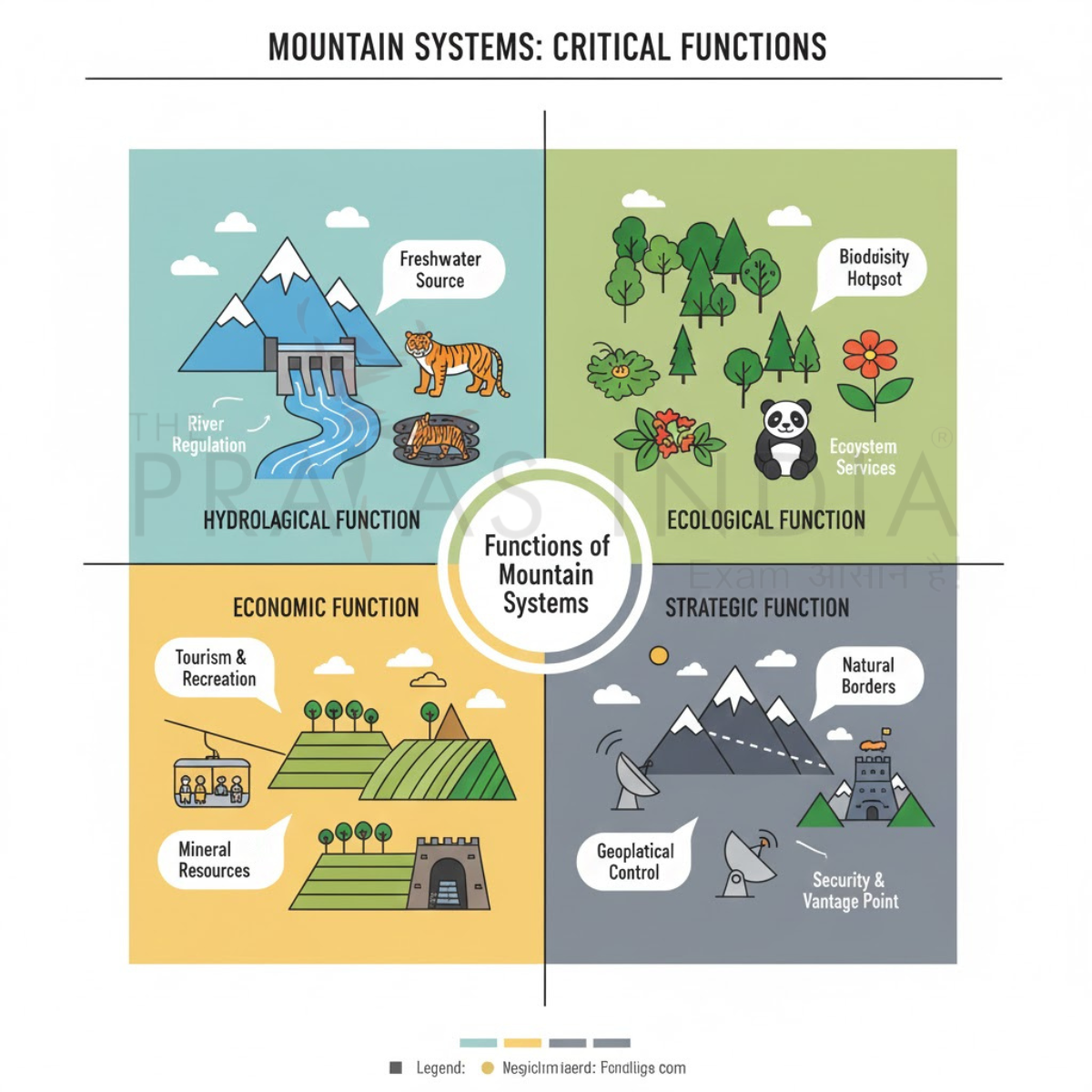
Hydrological
- Source of major rivers and glaciers.
- Watershed areas for irrigation, drinking water, and hydroelectric projects.
Ecological
- Forests, wildlife corridors, and biodiversity hotspots.
- Endemic species and medicinal plants in Himalayan, Western, and Eastern Ghats.
Climatic
- Mountains influence rainfall and temperature patterns.
- Western Ghats trigger orographic rainfall; Himalayas block cold winds.
Economic
- Minerals: Iron, copper, bauxite, limestone in Peninsular ranges.
- Hydropower: Tehri Dam, Bhakra Nangal, Idukki Dam.
- Tourism: Hill stations, trekking, pilgrimage centers.
- Agriculture: Terrace farming in Himalayan slopes, coffee/tea plantations in Nilgiris.
Strategic
- Natural defense barriers, control over mountain passes.
- Border security in Himalayan regions with China and Pakistan.
- Transboundary river management (Ganga, Brahmaputra).
Major Peaks and Passes Table
| Name | Range | State | Elevation / Importance |
|---|---|---|---|
| Kanchenjunga | Greater Himalaya | Sikkim | 8,586 m, 3rd highest in the world |
| Nanda Devi | Greater Himalaya | Uttarakhand | 7,816 m, UNESCO Biosphere Reserve |
| Saltoro | Karakoram | Ladakh | 7,742 m, near Siachen Glacier |
| Dhaulagiri (Indian side) | Himalaya | Sikkim | 8,167 m, snow-clad peak |
| Nathu La | Himalaya | Sikkim | Strategic mountain pass |
| Rohtang | Himalaya | Himachal Pradesh | Tourist & strategic pass |
| Zoji La | Himalaya | Jammu & Kashmir | Key connecting pass |
| Lipulekh | Himalaya | Uttarakhand | India-Nepal-China border pass |
Contemporary Issues
- Himalayan Glacier Retreat: Rapid melting due to climate change threatens water supply.
- Landslides & Soil Erosion: Western Ghats and Shiwalik foothills prone to natural hazards.
- Deforestation & Biodiversity Loss: Habitat destruction affects flora and fauna.
- Floods & Sedimentation: Shiwalik rivers are prone to flash floods and sediment deposition.

Conclusion
Mountain ranges are crucial to India’s physical, ecological, and cultural geography. They regulate climate, hydrology, and biodiversity, support economic activities, and provide strategic defense advantages. Sustainable management and conservation are essential to preserve water resources, forests, and wildlife, while ensuring continued economic and strategic benefits.
FAQs on Mountain Ranges in India:
What are the major types of mountain ranges in India?
India’s mountain ranges can be classified based on their geological origin, location, and elevation. Geologically, they include fold mountains (Himalayas), block mountains (Aravalli, Vindhya), volcanic mountains (Barren Island, Narcondam), and residual mountains (Rajmahal Hills). Based on location, they are categorized into Northern Mountains, Peninsular Mountains, Coastal Hills, and Island Ranges. In terms of elevation, they are grouped as high (>6000 m), medium (1000–6000 m), and low (<1000 m) ranges.
What is the significance of the Himalayas in India?
The Himalayas are young fold mountains and play a critical role in India’s climate, hydrology, and biodiversity. They regulate the monsoon, act as a source of major rivers like the Ganga, Brahmaputra, and Indus, and provide unique habitats for alpine flora and fauna. Strategically, they serve as a natural defense barrier and contain important mountain passes connecting India with neighbouring countries.
Which are the major peaks and passes in India?
Some of India’s notable peaks include Kanchenjunga (Sikkim), Nanda Devi (Uttarakhand), Kamet, and Saltoro (Ladakh). Key passes are Nathu La (Sikkim), Rohtang (Himachal Pradesh), Zoji La (J&K), Shipki La (Himachal Pradesh), and Lipulekh (Uttarakhand). These peaks and passes are important for tourism, trade, and strategic defense.
What is the ecological and economic importance of mountain ranges?
Mountain ranges are biodiversity hotspots, providing habitats for endemic species, forests, and medicinal plants. Economically, they support hydropower generation, mining of minerals, agriculture on terraced slopes, and tourism. They also act as watersheds, ensuring the availability of perennial rivers essential for agriculture and domestic use.
What are the contemporary challenges faced by India’s mountain ranges?
India’s mountain ranges face glacial retreat due to climate change, deforestation, and biodiversity loss. They are also prone to landslides, soil erosion, and flooding, especially in the Shiwalik foothills and Western Ghats. Sustainable management is necessary to protect water resources, forests, and fragile ecosystems.
What are the major Peninsular mountain ranges in India?
The Peninsular ranges include the Aravalli, Vindhya, Satpura, Western Ghats, Eastern Ghats, and Nilgiri Hills. These are older, stable mountains formed during the Archaean period. They influence the climate, river systems, agriculture, and serve as biodiversity-rich zones with endemic flora and fauna.