
National Parks: Definition, Distribution, Importance, Challenges & Conservation Efforts
- GS Paper 1: Physical Geography – Biogeography, Flora & Fauna, Natural Landscapes
- GS Paper 3: Environment, Conservation, Biodiversity, Protected Areas, Wildlife Protection Act
- Prelims: National Parks, Wildlife Species, Tiger Reserves, Map Locations, Biosphere Reserves
- Geography Optional: Biogeography, Ecology, Environmental Geography, Conservation Strategies
Introduction
National Parks are among the highest forms of habitat protection globally. Conceptually, they fall under IUCN Category II, a classification that emphasizes the conservation of ecosystems, species, and large landscapes with minimal human interference. Their purpose is twofold:
- Preserve ecological integrity, and
- Provide long-term opportunities for education, research, and recreation without harming natural systems.
In India, the formal legal definition of National Parks is provided under the Wildlife Protection Act, 1972 (WLPA). Section 35 of the Act allows states to notify a National Park where:
- No human activity, exploitation, grazing or habitat alteration is allowed, unless permitted for conservation.
- Stricter protection exists than in Wildlife Sanctuaries.
- The area receives uniform protection, covering both wildlife and habitat.
Globally, National Parks span a wide range: from Yellowstone in the USA—the world’s first National Park—to African savannah parks like Serengeti, high-latitude parks like Banff, volcanic landscapes in Galápagos, and high-rainfall forests in Fiordland (New Zealand).
India’s Protected Area Network (PA Network) is one of the world’s most diverse. With over 100 national parks, spread across Himalayan, coastal, desert, tropical, island, and wetland ecosystems, they form the core of India’s biodiversity conservation strategy. They safeguard flagship species such as the Bengal tiger, Asiatic lion, one-horned rhinoceros, snow leopard, and thousands of endemic plants and animals.
Criteria for Declaring National Parks
A. Global Criteria (IUCN)
Globally, a National Park is identified by the following features:
- Large, natural areas with exceptional landscape or biological value
- Functioning ecosystems relatively free from human disturbance
- Habitat for threatened, endemic, or keystone species
- Opportunities for ecological research and environmental education
- Legal frameworks securing the area against industrial, commercial, or extractive activities
Criteria in India (Wildlife Protection Act, 1972)
Under WLPA, a National Park is declared through a multi-step government notification process:
- Identification of ecologically important areas
(e.g., habitats for tigers, rhinos, elephants, snow leopards) - Preliminary notification and settlement of rights
- Final notification by the state government
- Complete restriction on human activity
- No grazing, no private land rights, and no removal of forest produce
C. Key Attributes Required
- Unique ecological, geomorphological, or biological significance
- Presence of rare and threatened species
- Landscape that can sustain natural ecological processes
- Scientific, educational, or aesthetic importance
- High conservation urgency (e.g., Western Ghats, Himalayas, northeast)
Global Distribution of National Parks
National Parks are present across all continents except Antarctica (though protected areas exist there too). Notable examples:
- Yellowstone, USA – World’s first National Park (1872), geothermal wonders
- Kruger, South Africa – African savanna megafauna
- Serengeti, Tanzania – Annual wildebeest migration
- Banff, Canada – Rocky Mountains, glacier-fed lakes
- Fiordland, New Zealand – High rainfall temperate forests
- Torres del Paine, Chile – Patagonian ice fields
- Galápagos, Ecuador – Evolutionary laboratory
Many National Parks are also UNESCO World Heritage Sites due to their outstanding universal value.
National Parks in India – An Overview
India has 106 National Parks (as per current records), covering diverse ecosystems:
- Himalayan high-altitude parks (Hemis, Great Himalayan)
- Tropical evergreen & monsoon forests (Periyar, Silent Valley)
- Grasslands and savannas (Kaziranga, Dudhwa)
- Mangroves and wetlands (Sundarbans)
- Desert and semi-arid regions (Desert NP)
- Island ecosystems (Campbell Bay NP, Rani Jhansi NP)
Distribution by Region
- Northeast India – Highest concentration of biodiversity-rich parks
- Western Ghats – Endemism hotspots
- Himalayas – High-altitude, fragile ecosystems
- Andaman & Nicobar Islands – Unique island biota
- Central India – Tiger landscapes (Kanha, Bandhavgarh, Pench)
Link with Biogeographic Zones
India’s 10 biogeographic zones (Rodgers and Panwar classification) strongly influence the distribution of National Parks.
Biogeographic Classification of National Parks in India
A. Himalayan Zone
- Great Himalayan NP – Alpine meadows, glaciers
- Hemis NP – Cold desert, snow leopard habitat
- Valley of Flowers – Floral diversity, high-altitude meadows
B. Western Ghats
- Periyar NP – Elephant and tiger reserve
- Silent Valley NP – Undisturbed evergreen forest
- Eravikulam NP – Nilgiri tahr, shola-grassland ecosystem
C. Indo-Gangetic Plains
- Dudhwa NP – Swamp deer, tall grasslands
- Jim Corbett NP – Oldest NP, tiger habitat in Bhabhar–Terai
D. North-East India
- Kaziranga NP – One-horned rhinoceros, Brahmaputra floodplains
- Manas NP – Tiger reserve, elephant reserve, UNESCO World Heritage Site
- Namdapha NP – Biodiversity hotspot with four big cats
E. Desert & Semi-Arid
- Desert NP – Thar ecosystem, Great Indian Bustard
- Kumbhalgarh NP – Dry deciduous forests
F. Coastal & Island Parks
- Sundarbans NP – Mangroves, estuarine habitat
- Campbell Bay NP – Tropical island biodiversity
Major National Parks of India – Fact Boxes (UPSC-Ready)
Jim Corbett NP (Uttarakhand)
- Established: 1936
- Ecosystem: Sub-Himalayan Bhabhar–Terai
- Species: Bengal tiger, elephants, gharial
- Significance: First NP of India; important for Project Tiger
Kaziranga NP (Assam)
- UNESCO site; world’s largest population of one-horned rhinos
- Grassland ecosystem shaped by Brahmaputra floods
Gir NP (Gujarat)
- Only home of the Asiatic Lion
- Dry deciduous forests and scrublands
Sundarbans NP (West Bengal)
- Largest mangrove forest in the world
- Home to the iconic Royal Bengal Tiger
Hemis NP (Ladakh)
- Highest National Park in India
- Habitat of the endangered snow leopard
Periyar NP (Kerala)
- Elephant reserve, rich tropical biodiversity
- Scenic Periyar Lake supports wet evergreen forests
Ecological Importance of National Parks
National Parks perform critical ecological functions:
A. Biodiversity Conservation
They protect:
- Endemic and endangered species
- Keystone species (tiger, lion, elephant)
- Ecologically fragile ecosystems (mangroves, alpine meadows)
B. Habitat Preservation
Preserves ecological processes such as:
- Predator–prey dynamics
- Floodplain regeneration
- Natural forest succession
C. Climate Regulation
- Forests act as carbon sinks
- Alpine and mangrove parks buffer climate impacts
- Regulate rainfall patterns and microclimates
D. Watershed Protection
Parks like Periyar and Silent Valley are important watershed basins supporting perennial rivers.
E. Genetic Diversity
Prevents extinction of small populations; supports ecological resilience.
Human–Environment Interaction
A. Eco-tourism
Provides revenue and awareness but must be regulated.
B. Man–Animal Conflict
Occurs due to:
- Tiger dispersal from reserves
- Elephant crop raiding
- Leopards entering urban spaces
C. Relocation of Villages
Voluntary relocation helps expand core areas (e.g., Sariska, Kanha).
D. Forest Rights Act, 2006
Recognizes rights of traditional forest dwellers, requiring balance with conservation.
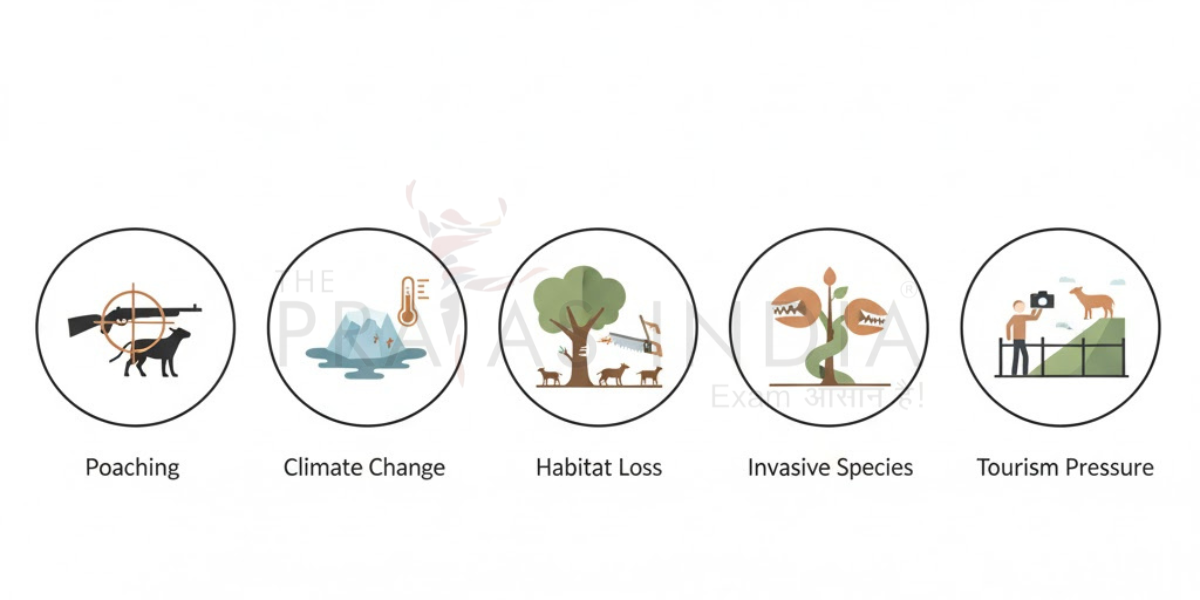
Threats to National Parks
A. Habitat Fragmentation
Due to roads, railway lines, agriculture expansion.
B. Poaching & Illegal Trade
Rhinos, tigers, pangolins are highly targeted.
C. Climate Change
- Glacial retreat impacting Himalayan parks
- Coral bleaching in marine protected areas
- Altered rainfall affecting grassland ecosystems
D. Invasive Species
Lantana, water hyacinth, and prosopis threaten native flora.
E. Tourism Pressure
Unregulated safaris, waste, and pollution.
F. Mining & Infrastructure
Threats near parks like Panna, Bandipur, and Kaziranga.
Conservation Efforts
A. Global Initiatives
- IUCN Red List – Species risk assessment
- CITES – Regulates wildlife trade
- Convention on Biological Diversity
- UNESCO World Heritage Sites
B. India’s Conservation Programs
- Project Tiger – Leading to doubling of tiger numbers
- Project Elephant – Corridor protection
- Crocodile Conservation Project
- CAMPA – Compensatory afforestation
- Eco-Sensitive Zones (ESZs) around parks
- National Wildlife Action Plan (2017–2031)
- Integrated Development of Wildlife Habitats (IDWH)
Success Examples
- Kaziranga’s anti-poaching model with drone surveillance
- Rhino poaching decline in Assam
- Silent Valley movement preventing destructive hydroelectric projects
- Snow Leopard conservation in Ladakh
Case Studies (UPSC Enriched)
A. Kaziranga Anti-Poaching Success
Use of drones, commando units, and flood-adaptive strategy.
B. Palpur-Kuno NP – Cheetah Reintroduction
First transcontinental reintroduction of a large carnivore.
C. Silent Valley NP
People-led movement saved rare evergreen forests.
D. Snow Leopard Project in Hemis
Community-based conservation in high-altitude habitats.
UPSC Previous Year Questions
Prelims PYQs
- Match the following National Parks with states
- Species–Park mapping (Rhino–Kaziranga, Lion–Gir)
- Mangrove-related parks
- High-altitude National Parks identification
GS-III Mains Topics
- Role of protected areas in conservation
- Human–wildlife conflict
- Climate change and biodiversity
- Legal frameworks under WLPA, FRA, ESZs
FAQs on National Parks
1. What is a National Park?
A National Park is a protected area notified by the government under the Wildlife Protection Act, 1972, aimed at conserving wildlife, biodiversity, and natural ecosystems. Human activities like grazing, private rights, and resource extraction are prohibited.
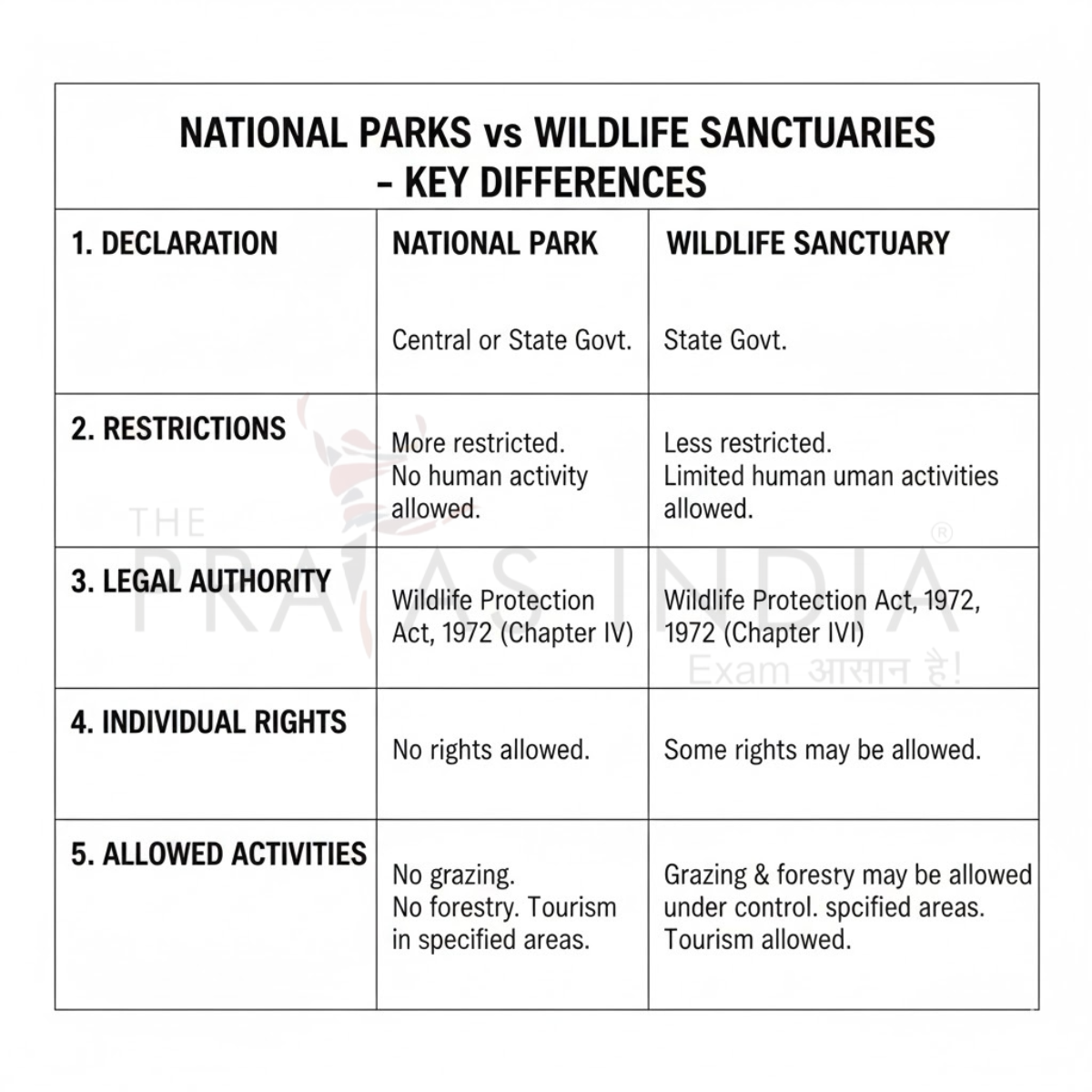
2. How is a National Park different from a Wildlife Sanctuary?
| Feature | National Park | Wildlife Sanctuary |
|---|---|---|
| Legal Status | Higher protection; stricter rules | Less strict compared to National Parks |
| Human Activity | No grazing or private rights allowed | Limited regulated human activity allowed |
| Notifying Authority | State Government | State Government |
3. How many National Parks are there in India (as of 2025)?
India has 108 National Parks, covering around 1.35% of the country’s geographical area.
4. Which is the largest National Park in India?
Hemis National Park (Ladakh) – known for snow leopards and high-altitude wildlife.
5. Which is the smallest National Park in India?
South Button Island National Park (Andaman & Nicobar Islands).
6. What is the first National Park established in India?
Jim Corbett National Park (Uttarakhand) – established in 1936 as Hailey National Park.
7. What is a Biosphere Reserve and how is it different from a National Park?
A Biosphere Reserve is a broader conservation area with core, buffer, and transition zones. National Parks fall entirely within the core region, but Biosphere Reserves allow sustainable human activity in buffer and transition areas.
8. Which National Parks are UNESCO World Heritage Sites?
- Kaziranga National Park
- Keoladeo National Park
- Manas National Park
- Nanda Devi & Valley of Flowers National Park
- Sundarbans National Park
(Useful for UPSC Prelims)
9. What activities are prohibited inside National Parks?
- Commercial forestry
- Grazing or livestock movement
- Hunting/poaching
- Tourism without regulation
- Private land ownership or rights
10. How are National Parks important for UPSC Exam?
- Frequently asked in Prelims (mapping, species, locations)
- Useful in GS Paper 3 (Environment, Biodiversity, Conservation)
- Appears in Environment Optional topics
- Integrated with current affairs—new parks, tiger reserves, corridor projects
11. Which state has the highest number of National Parks?
Madhya Pradesh (11 National Parks).
12. Which National Park is famous for tigers?
Kanha, Bandhavgarh, Ranthambore, Jim Corbett.
13. What is the legal provision governing National Parks?
Wildlife Protection Act, 1972 – Chapter IV.
14. Can National Park boundaries be altered?
Yes, but only by the state government, after due process and central approval in some cases.
15. What is a Marine National Park?
A protected marine ecosystem (e.g., Gulf of Kutch Marine National Park).
Conclusion
National Parks form the backbone of India’s ecological security. They safeguard ecosystems, stabilize climate, support river systems, conserve genetic diversity, and protect flagship species. Yet, they face numerous challenges—from climate change and poaching to human–wildlife conflict.
The way forward lies in:
- Community-inclusive conservation
- Smart eco-tourism regulation
- Technology-based monitoring (drones, camera traps, AI models)
- Expansion and connectivity of protected areas
- Strengthening ecological corridors
Ensuring ecological sustainability of National Parks is essential not just for biodiversity, but for India’s long-term environmental and economic well-being.