New Coastline of India: Changes, Hotspots & Future Risks (2025)
India’s coastline is undergoing rapid change due to both natural and human-driven forces. The “coastline” denotes the official boundary between land and sea at a reference datum, while “shoreline” describes the variable edge of the water—the latter shifts with tides, waves, and storms.
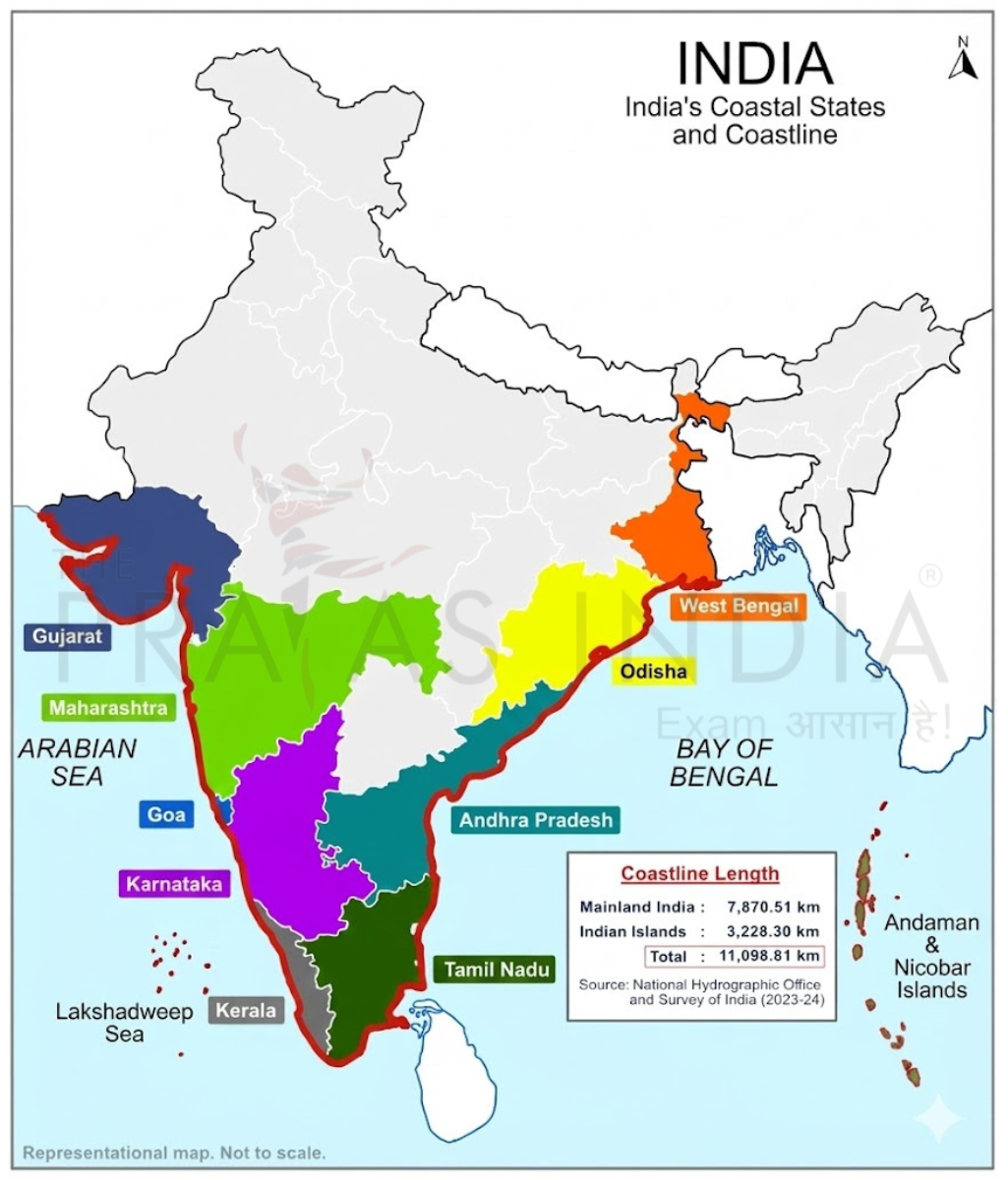
Over one-third of India’s 11,099 km coastline now faces active erosion, with some states witnessing severe land loss and others gaining new land by accretion. These changes affect communities, economic assets, and ecological systems, demanding robust monitoring and management.
How Coastlines Are Measured & Why “New Coastline” Matters
Modern coastline assessments use:
- Satellite Imagery: Multi-spectral images from Landsat, Sentinel-2, and IRS with 10m–30m resolution, allowing comparisons over decades (e.g., 1990–2018 window).
- Tide-corrected mapping: Algorithms that remove the effects of tides to measure the “mean high water line” for consistency in year-to-year comparisons.
- LIDAR & Beach Profiling: Ground-based laser mapping and GPS beach profiles add precision after cyclones or flooding events.
- Methodology upgrades: The recalculated coastline length (now 47% longer vs. 1970s) incorporates bays, estuaries, and complex geomorphology for true representation.
Why it matters: Accurate measurements drive policies—hazard lines, CRZ limits, insurance zones, and disaster planning depend on up-to-date mappings. Every change is a potential risk or opportunity for livelihoods and habitats.
Recent Changes in India’s Coastline — Key Findings
Big Picture
- 33.6% of the coastline is eroding, 26.9% shows accretion, and 39.6% remains stable.
- The fastest erosion occurs in West Bengal (60.5% of coast), Tamil Nadu (42.7%), Kerala (46.4%), and Gujarat by total length under threat.
- Official coastline now stands at 11,099 km (2023-24), up 47% from past methodology which counted 7,516 km in 1970.
Case Studies:
- Sundarbans, West Bengal: Erosion here has destroyed mangrove forests and forced local communities to relocate. Annual shoreline retreat exceeds several metres.
- Tamil Nadu, Chennai coast: Accelerating erosion (up to 3m/year) threatens beaches, roads, and infrastructure; aggravated by urban projects.
- Dighi Port, Maharashtra: Port expansion and altered sediment flows have led to severe erosion of adjacent beaches while shifting sandbars closer to the harbor.
State-wise Length Coastline of India
| State / UT | Coastline Length (km) | % Eroded | % Accreted | % Stable | Key Drivers | Policy/Impact Note |
|---|---|---|---|---|---|---|
| Gujarat | 2,340.62 | 28 | 20 | 52 | Tides, ports, damming | Largest coastline, port-intensive |
| Tamil Nadu | 1,068.69 | 42.7 | 18 | 39.3 | Cyclones, urbanisation | Infrastructure at risk |
| Andhra Pradesh | 1,053.07 | 28.7 | 25 | 46.3 | Deltas, coastal projects | Aquaculture expansion |
| Kerala | 600.15 | 46.4 | 12 | 41.6 | Storms, seawalls | Frequent flooding, managed retreat |
| West Bengal | 721.02 | 60.5 | 22 | 17.5 | Cyclones, mangrove loss | Sunderbans displacement |
| Maharashtra | 877.97 | 30.2 | 19.7 | 50.1 | Ports, sand mining | Mumbai region erosion |
| Odisha | 574.71 | 53.2 | 22.2 | 24.6 | Cyclones, river systems | Mangrove buffer declining |
| Goa | 193.95 | 19.2 | 13.6 | 67.2 | Beach tourism, mining | Resort development impacts |
| Karnataka | 343.30 | 40.8 | 17.6 | 41.6 | Monsoon, ports | Local fishing livelihoods |
| Daman & Diu | 54.38 | 28 | 14 | 58 | Ports, mining | Urbanisation pressure |
| Puducherry | 42.65 | 27 | 18 | 55 | Tourism, coastal structures | Beach nourishment ongoing |
| Lakshadweep Islands | 144.80 | 32.4 | 13.2 | 54.4 | Coral loss, wave action | Climate adaptation needed |
| Andaman & Nicobar Islands | 3,083.50 | 24.1 | 17 | 58.9 | Coral reefs, tidal surges | High ecological sensitivity |
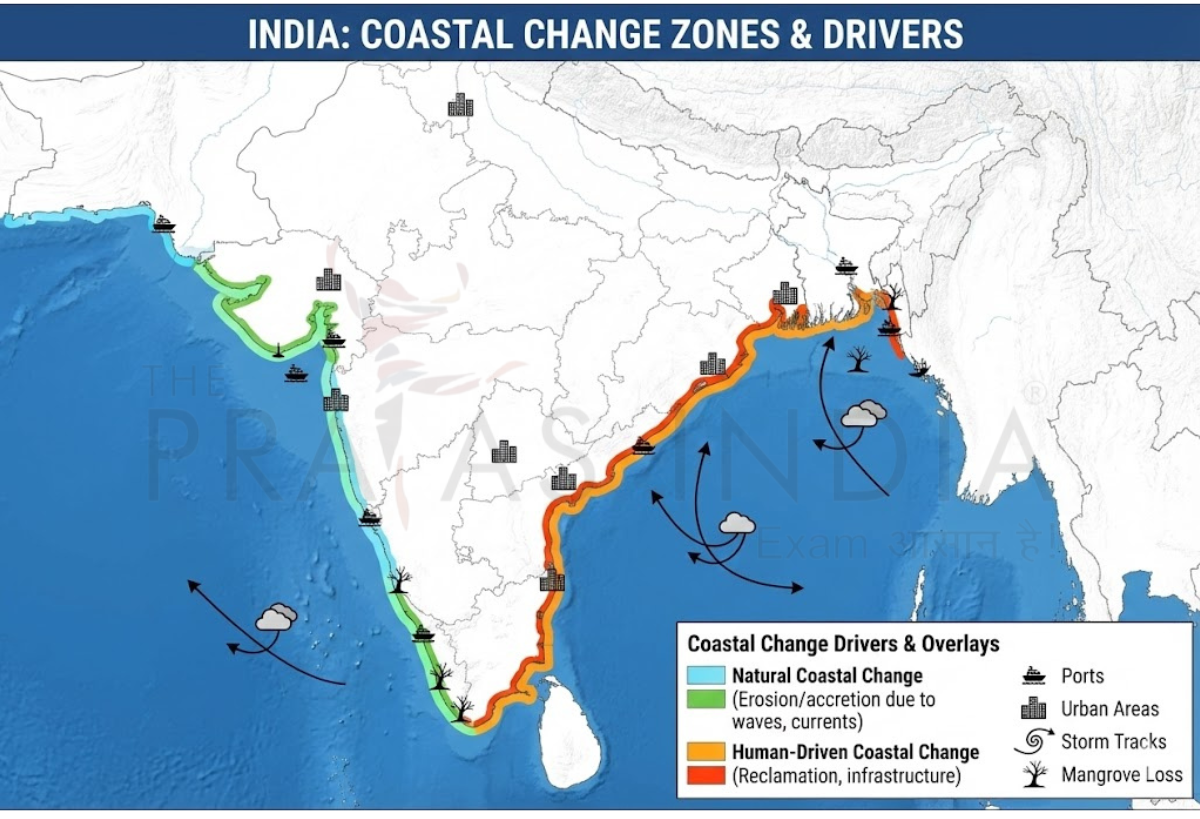
Drivers: Natural vs Anthropogenic
Natural Factors
- Sea-Level Rise: Tide gauges and satellites show rises of 1.7–2.1 mm/year over two decades, increasing frequency of flooding and erosion.
- Storm Surges & Cyclones: Intense cyclones in Bay of Bengal and Arabian Sea deliver strong surges, fragmenting beaches and tidal flats, especially in Odisha, West Bengal, Tamil Nadu.
- Sediment Transport / Monsoon: Monsoon variability and reduced river sediment (due to dams) disrupts shore stability.
Human Factors
- Coastal Development: Ports, seawalls, and harbors break natural sediment cycles, causing updrift accretion and downdrift erosion. Dighi Port and Pentha Geo-Tube examples.
- Sand Mining: Removes sediment that would nourish beaches, reducing their ability to recovery naturally.
- Mangrove/Corridor Clearance: Urban and tourism expansion remove natural buffers, amplifying erosion risks.
- Land Reclamation: Mumbai, Chennai, and others expanding urban borders landward accelerate destabilization of adjacent coasts.
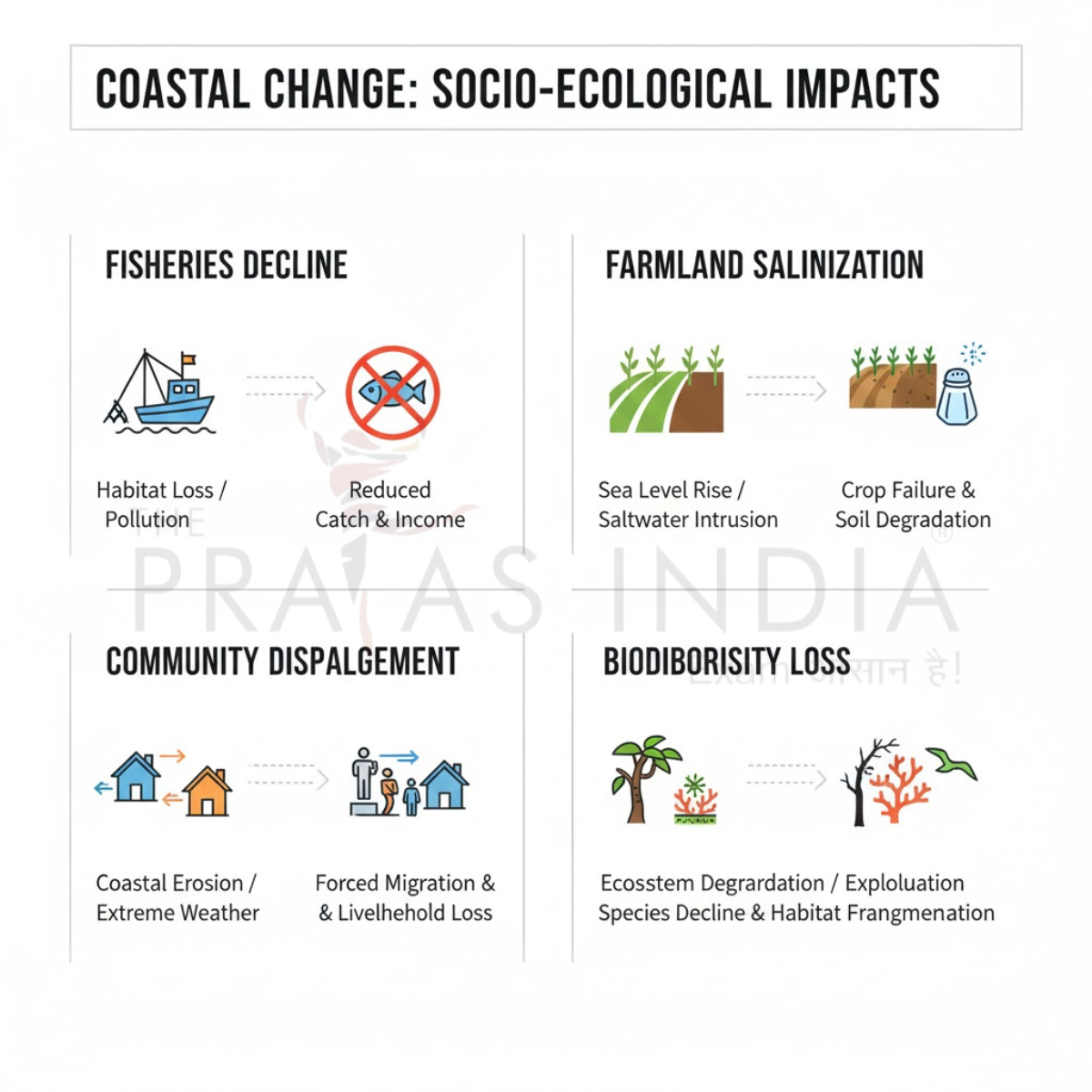
Socio-economic & Ecological Impacts
- Fisheries: Coastal erosion endangers fishing harbours and landing centres; 1–2 million in vulnerable districts face direct livelihood threats.
- Displacement: Odisha, Kerala, West Bengal see recurring displacement due to flood-driven erosion. Sunderban islands are shrinking each year.
- Agriculture: Salinity from encroaching sea damages croplands in Odisha, West Bengal, Andhra Pradesh.
- Biodiversity: Sunderbans mangrove area has shrunk, Lakshadweep reefs lost mass; direct result of erosion, accretion, and development pressures.
- Infrastructure: Ports including Chennai, Paradip, and others see increased maintenance and threatened connectivity from shifting coastlines.
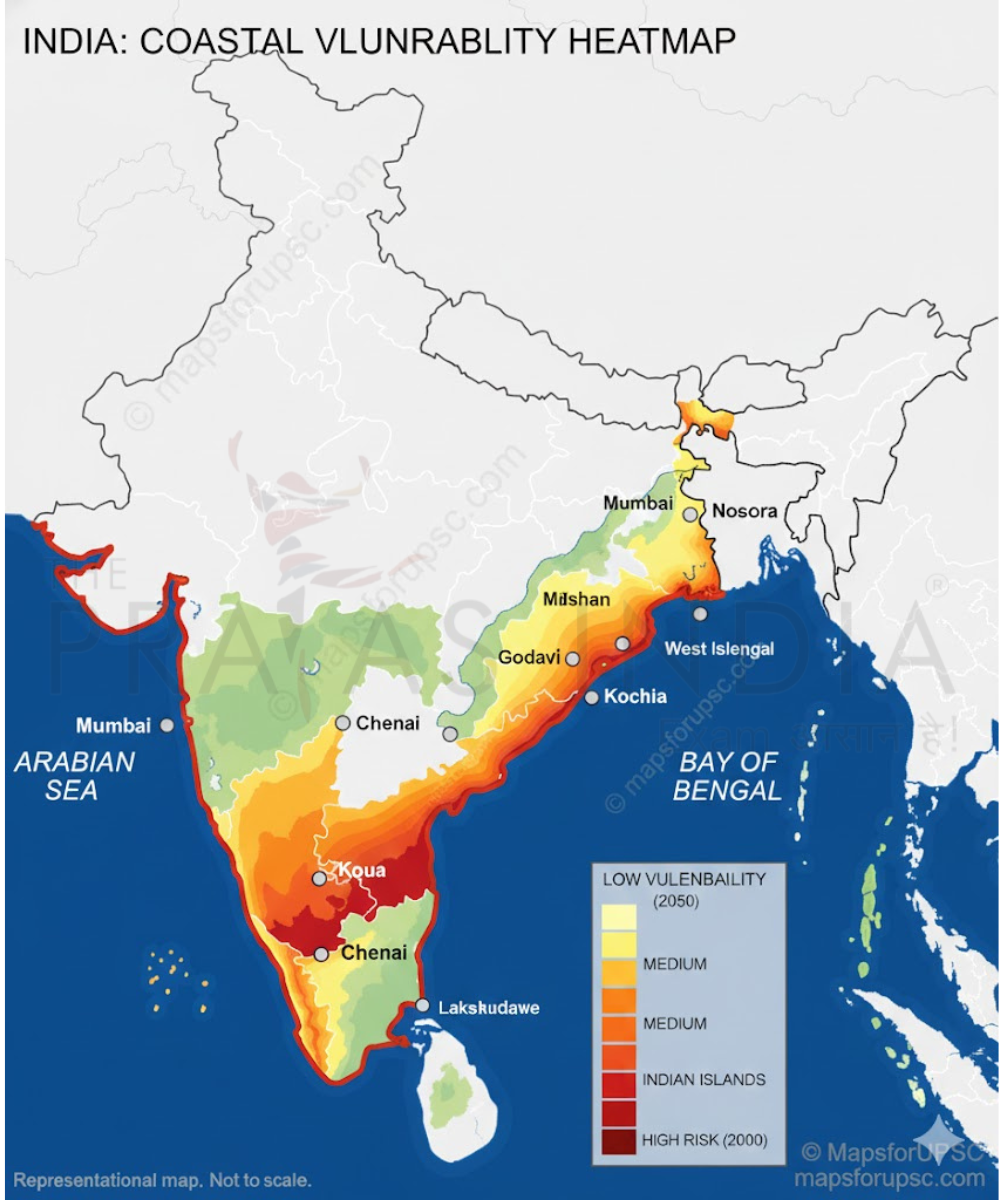
Future Scenarios & Climate Projections
- By 2050: Projected sea-level rise of 30–60 cm in high emission scenario; substantial loss for deltaic and island territories.
- High-risk zones: Sunderbans, Odisha delta, Kutch, Kerala backwaters, Lakshadweep—could face permanent land loss or regular flooding by 2100.
- Cities like Mumbai, Chennai, Kolkata: Expected to see increased frequency of flooding and storm impacts if mitigation is not scaled.
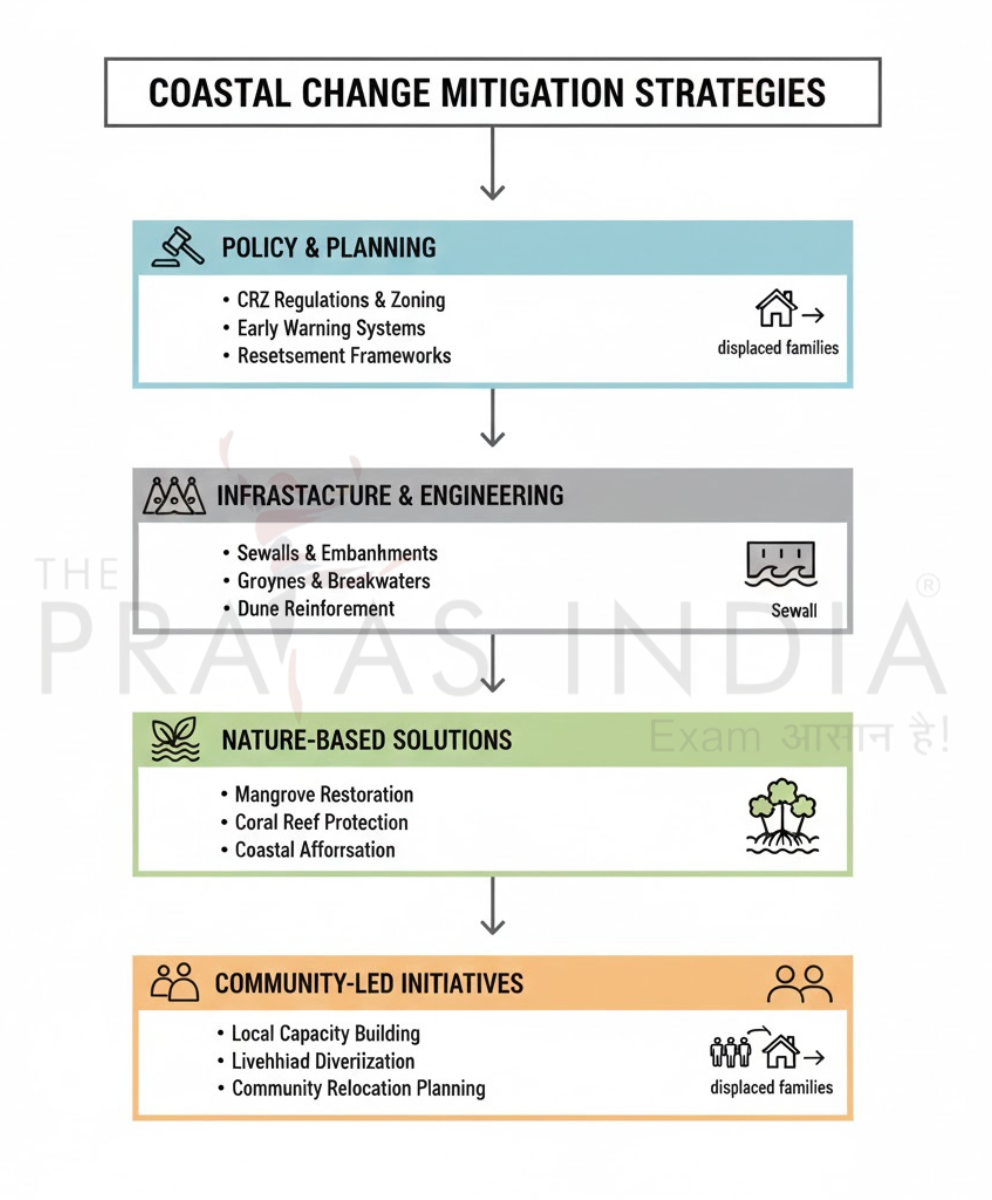
Mitigation, Adaptation & Policy Response
- Hard Engineering
- Seawalls, breakwaters, groynes—local relief but can increase erosion nearby; costly and high maintenance.
- Soft/Nature-Based Solutions
- Mangrove restoration, shelterbelts, beach nourishment—demonstrated success in reducing storm damage and enhancing land accretion.
- Managed retreat and community adaptation (piloted in Kerala, Sundarbans).
- Key Policies
- Coastal Regulation Zone (CRZ) Notification (2019): Erosion controls, NDZ demarcation, mapping hazards
- Integrated Coastal Zone Management Project (ICZMP): Gujarat, Odisha, West Bengal (World Bank-aided)
- Vulnerability Mapping: INCOIS, NCCR indices for zoning
- Hazard Line Demarcation: By Survey of India; updated regularly
- Finance Commission Funding: Rs 2,500 crore earmarked for resettlement and mitigation
Data Sources & Methodology
- NCCR “National Assessment of Shoreline Changes” (1990–2018), latest updates 2024–2025
- Multi-spectral satellite images and high-res mapping (Landsat, Sentinel-2)
- Survey of India field validation, tidal correction algorithms
- Peer-reviewed synthesis papers and official government replies to Parliament (2024–2025)
- Vulnerability maps by INCOIS/NCCR based on 7 key indicators
- Data window for analysis: 1990–2023 (with recalculated lengths using geomorphology-based methods)
Conclusion & Call-to-Action
India’s coastline is longer and more complex than previously thought, but faces mounting risks from erosion, accretion, and climate change. Scientific mapping, communities, and policymakers must work together to ensure smart, resilient adaptation—mixing engineering, restoration, and fair transition for those at risk.
FAQs about New Coastline of India
Q1: What causes India’s coastline to change?
Natural forces (sea-level rise, storms, sediment cycles) and human activity (ports, sand mining, urban expansion) drive constant change.
Q2: Which Indian states face highest coastal erosion?
West Bengal, Odisha, Kerala, and Tamil Nadu report highest rates by percentage, while Gujarat leads in total vulnerable length.
Q3: How reliable are satellite-based coastline maps?
Modern maps use consistent methods and field checks, suitable for long-term trends but low sensitivity to short-term/storm change.
Q4: Can mangroves stop coastal erosion?
Where restored, mangroves offer strong protection, but cannot replace engineered defenses in high-energy coasts or heavily urbanized zones.
Q5: What are the implications for coastal communities and ports?
Erosion affects livelihoods, infrastructure, and often forces relocation—pressing need for smart mitigation and inclusion of community voices.