Objects in Space – Scientific Understanding and Earthly Relevance
- GS Paper 1: Physical Geography, Universe & Solar System
- GS Paper 3: Science & Technology (Space), Emerging Technologies
- Prelims: Astronomy, Space Objects, Solar System Features, ISRO/NASA Missions
- Geography Optional: Climatology, Astronomical Geography, Origin of Earth & Universe
Introduction
“Objects in space” refers to all natural physical entities that exist beyond Earth’s atmosphere—from stars, planets, and moons to distant galaxies, nebulae, black holes, and cosmic dust. These objects collectively form the structure of the Universe, within which the Milky Way Galaxy and our Solar System represent just a tiny fraction.
The cosmic hierarchy is broadly understood as:
Universe → Superclusters → Galaxies → Solar Systems → Planets and Moons
The Universe consists of billions of galaxies, each containing billions of stars. Many stars host planetary systems, like our Sun. Smaller cosmic bodies—such as asteroids, comets, meteoroids, dwarf planets, and interstellar gas clouds—constitute essential components of cosmic evolution.
The study of space objects is crucial for UPSC because astronomical factors influence Earth’s:
- Climate (solar output variability)
- Seasons (Earth’s tilt and revolution)
- Tides (gravitational pull of Moon and Sun)
- Geography & evolution (asteroid impacts, plate tectonics links)
- Radiation environment affecting communication and energy systems
Thus, understanding space enhances insights into Earth’s past, present, and future physical processes.
The Universe and Its Large-Scale Structures
The Universe is composed of large-scale structures that form a hierarchical pattern.
Galaxies
Galaxies are massive systems of stars, gas, dust, and dark matter bound by gravity. The Milky Way, our home galaxy, contains over 100–400 billion stars. Prominent galaxies include:
- Andromeda Galaxy – closest major galaxy
- Triangulum Galaxy – part of Local Group
Superclusters
Galaxies are grouped into clusters and superclusters. The Laniakea Supercluster houses the Milky Way and contains ~100,000 galaxies.
Interstellar Medium (ISM)
The ISM includes gas (hydrogen, helium), cosmic dust, plasma, and energetic particles. It is the birthplace of stars.
Dark Matter and Dark Energy
Though not directly visible, these constitute most of the Universe’s mass-energy:
- Dark Matter (≈27%) – provides gravitational framework for galaxy formation
- Dark Energy (≈68%) – drives accelerated expansion of the Universe

Stars
What Are Stars?
Stars are massive celestial bodies composed primarily of hydrogen and helium. They produce energy through nuclear fusion, converting hydrogen into helium in their cores.
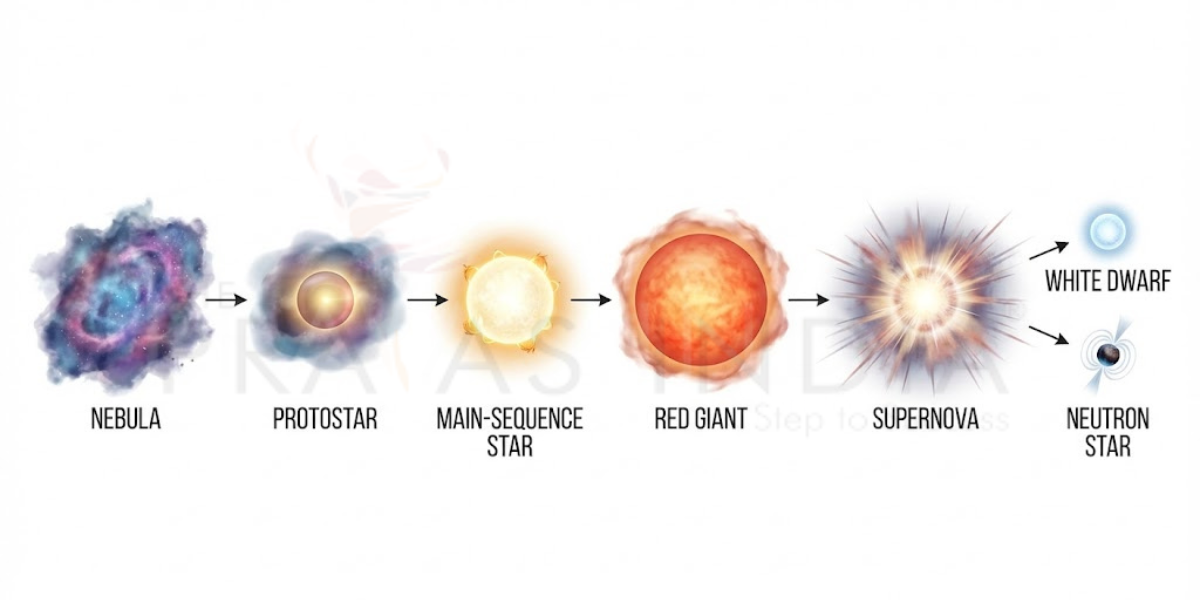
Life Cycle of a Star
A typical star follows a well-defined evolutionary path:
- Nebula – Gas and dust cloud
- Protostar – Collapsing mass under gravity
- Main Sequence Star – Stable hydrogen fusion (e.g., Sun)
- Red Giant/Supergiant – Hydrogen exhaustion
- End Stages:
-
- White Dwarf → for Sun-like stars
- Neutron Star or Black Hole → for massive stars
Sun as a Star
- Age: ~4.6 billion years
- Composition: 74% hydrogen, 24% helium
- Energy: 3.8 × 10²⁶ W
- Role: Controls climate, seasons, photosynthesis, oceanic and atmospheric circulation
The Solar System
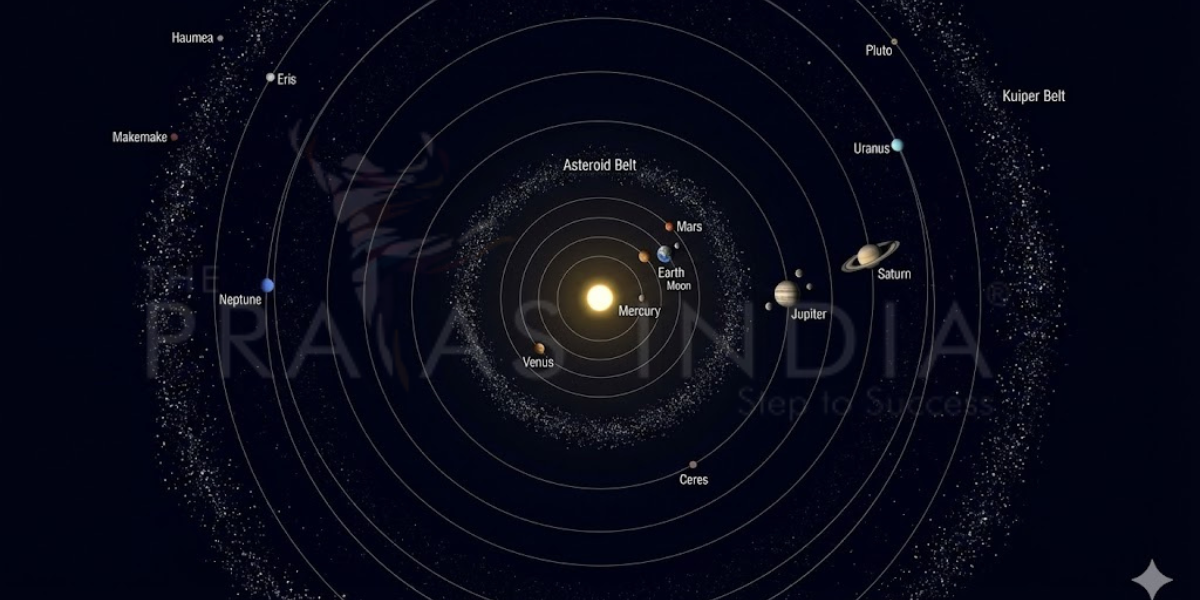
The Solar System consists of:
- The Sun
- Eight Planets
- Dwarf Planets
- Moons
- Asteroids
- Comets
- Kuiper Belt
- Oort Cloud
Inner Planets (Terrestrial)
Mercury, Venus, Earth, Mars – small, rocky, dense.
Outer Planets (Gas/Ice Giants)
Jupiter, Saturn, Uranus, Neptune – large, gaseous, ring systems.
Dwarf Planets
Recognized by IAU: Pluto, Eris, Haumea, Makemake, Ceres
Moons
Significant moons include:
- Ganymede (Jupiter) – largest in Solar System
- Titan (Saturn) – thick nitrogen atmosphere
- Europa (Jupiter) – subsurface ocean
Kuiper Belt & Oort Cloud
- Kuiper Belt: Beyond Neptune; source of short-period comets
- Oort Cloud: Hypothetical spherical shell of icy bodies; source of long-period comets
Small Bodies in Space
(a) Asteroids
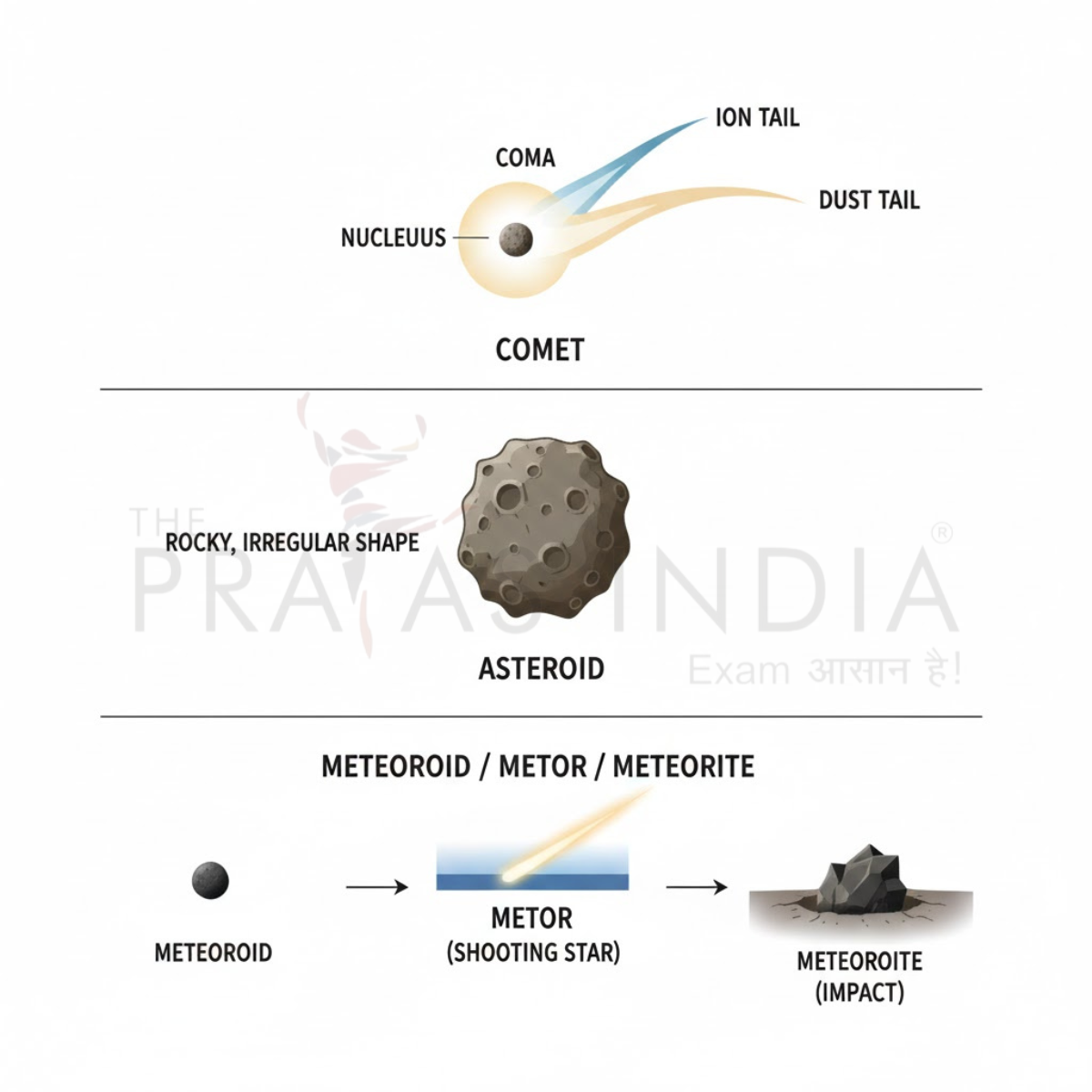
Rocky fragments orbiting the Sun, mainly in the Asteroid Belt.
Types:
- C-type – carbon-rich, most common
- S-type – silicate-rich
- M-type – metallic
Examples: Vesta, Ceres, Pallas
(b) Meteoroids, Meteors, Meteorites
- Meteoroid – rocky particle in space
- Meteor – burning streak in atmosphere (“shooting star”)
- Meteorite – object that strikes Earth’s surface
(c) Comets
Icy bodies composed of dust, rock, and frozen gases.
Parts: Nucleus, Coma, Tail
Most famous: Halley’s Comet (76-year period)
Exoplanets
Exoplanets are planets orbiting stars outside the Solar System.
Detection methods include:
- Transit Method – dip in star’s brightness
- Radial Velocity Method – star’s wobble
- Direct Imaging – extremely challenging
- Gravitational Microlensing
Importance:
Exoplanets provide insights into planetary formation and the search for habitable worlds in the Goldilocks Zone.
Extreme Space Objects
Neutron Stars
Remnants of supernova explosions; extremely dense—one teaspoon weighs billions of tons.
Pulsars
Rapidly rotating neutron stars emitting beams of radiation.
Black Holes
Regions of extreme gravity from which nothing can escape; formed from massive stellar collapse.
Quasars
Extremely luminous galactic nuclei powered by supermassive black holes.
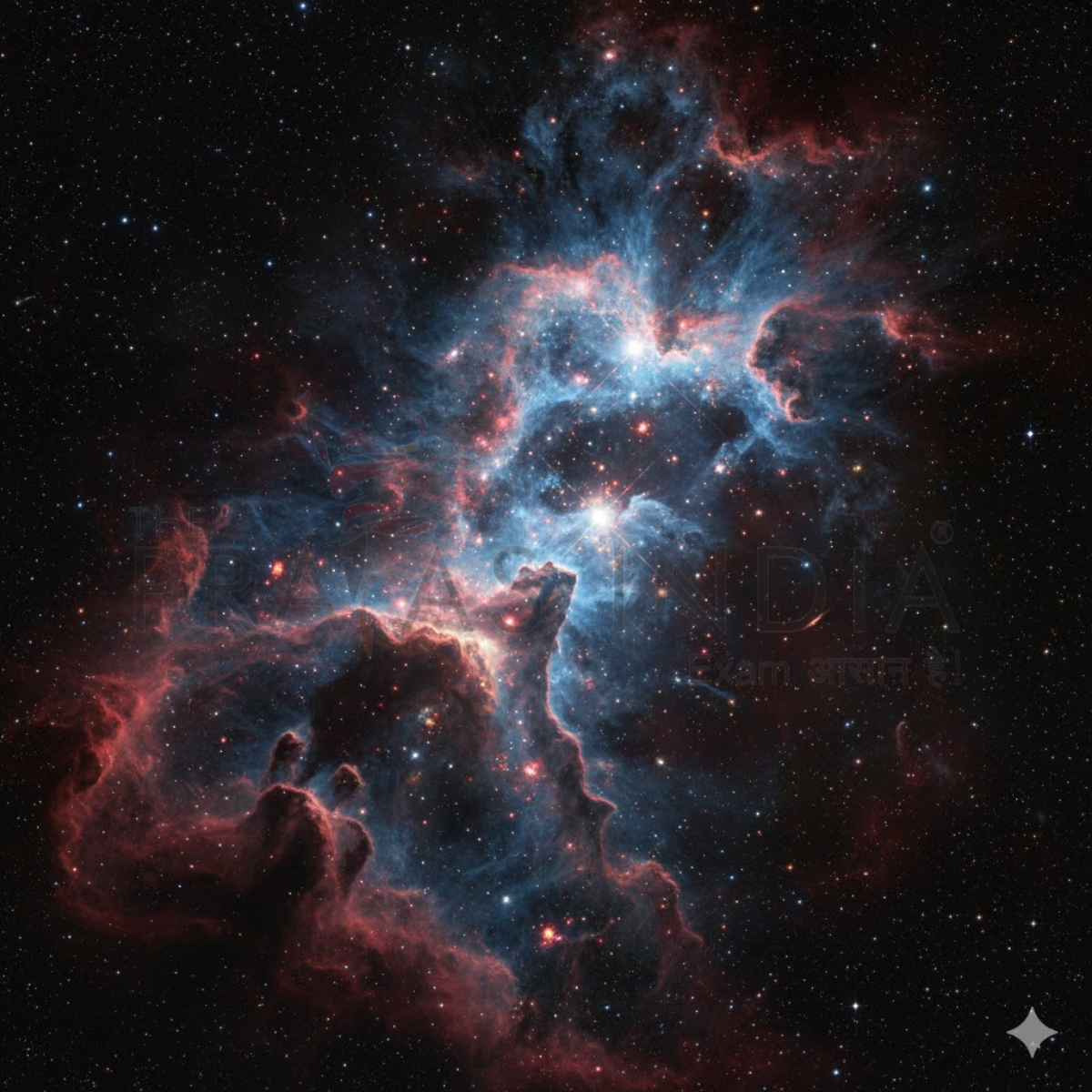
Nebulae
Gas/dust clouds; birthplaces of stars.
Example: Orion Nebula
Earth–Space Relationships (UPSC Critical Section)
(a) Seasons
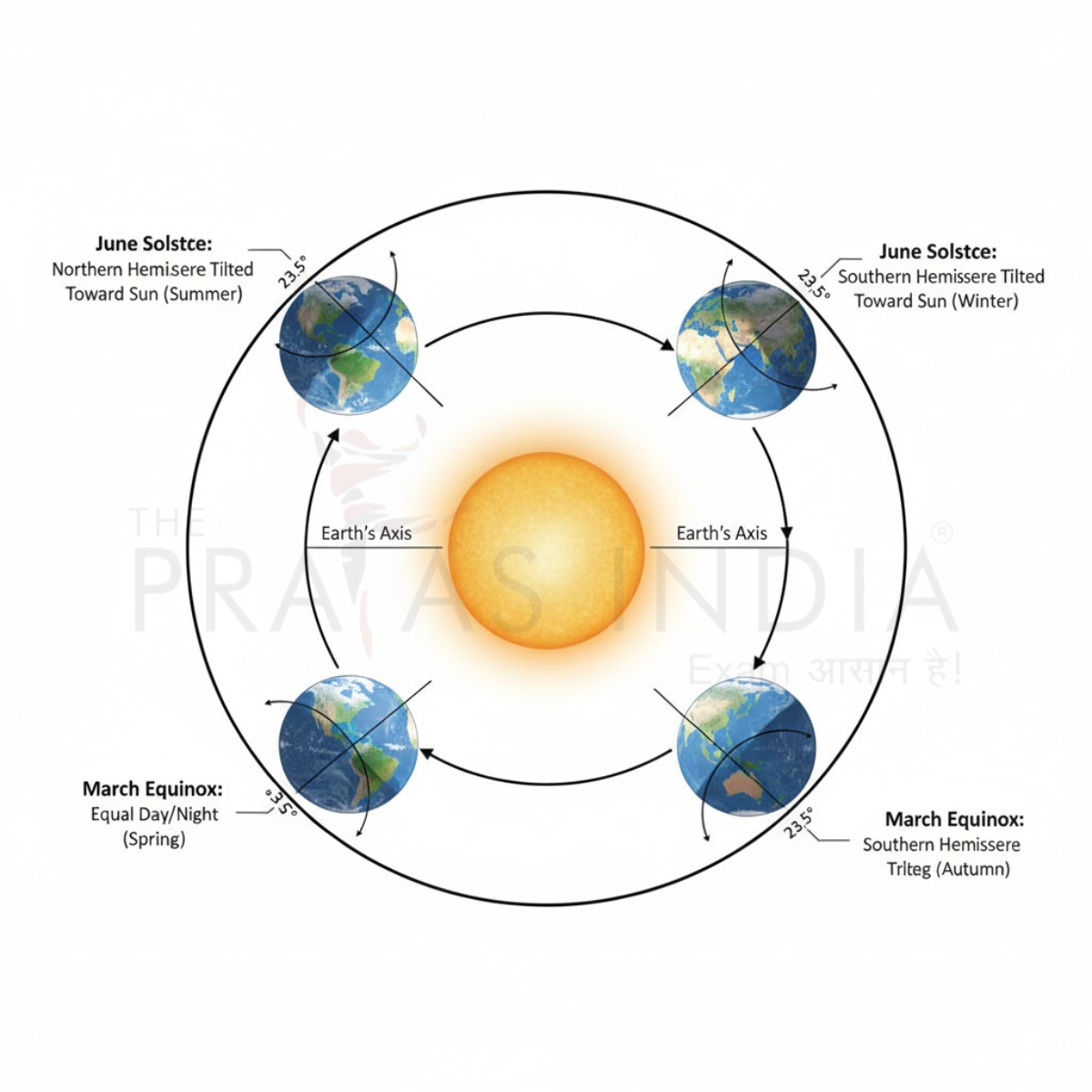
Caused by 23.5° axial tilt and Earth’s revolution.
(b) Solar Radiation & Climate
Solar output variations influence monsoons, temperature cycles, and El Niño–Southern Oscillation.
(c) Tides
Caused by gravitational pull of the Moon and Sun.
(d) Solar Flares & CMEs
Can disrupt:
- Power grids
- Communication satellites
- GPS accuracy
(e) Asteroid Impacts
Linked to mass extinctions (e.g., Chicxulub asteroid, 66 million years ago).
Space Missions (ISRO, NASA, ESA) Related to Space Objects
ISRO Missions
- Aditya-L1 – studies Sun’s corona and solar wind
- Astrosat – India’s first dedicated multi-wavelength space observatory
- Chandrayaan-1/2/3 – lunar geology, water molecules on Moon
- Mangalyaan (MOM) – Mars atmospheric studies
- XPoSat (2024) – X-ray polarization observation
NASA Missions
- JWST – early galaxies, exoplanet atmospheres
- Parker Solar Probe – Sun’s outer corona
- OSIRIS-REx – asteroid sample return from Bennu
ESA & International Missions
- Gaia – mapping Milky Way
- ALMA – imaging star-forming regions
- Hubble Space Telescope – iconic deep-space images
Recent Discoveries (Past 10 Years)
- First Image of a Black Hole (2019) – Event Horizon Telescope
- JWST discoveries – earliest galaxies forming only 300 million years after Big Bang
- Trappist-1 exoplanet system – multiple Earth-sized planets
- Solar storm forecasting improvements via Parker Solar Probe
- Bennu asteroid sample (2023) – organic compounds found
These discoveries have expanded understanding of cosmic evolution and planetary habitability.
Importance of Studying Space for UPSC
Geography
- Seasons
- Earth’s movement
- Climate cycles
Science & Technology
- Satellite communication
- Navigation (GPS, IRNSS)
- Space weather forecasting
Disaster Management
- Asteroid impact monitoring
- Solar flare prediction
Environment
- Role of Sun in global energy balance
- Space-based climate data
International Relations
- Artemis Accords
- Space diplomacy
- Global navigation systems politics
FAQs about the Objects in Space
1. What are objects in space?
Objects in space include natural celestial bodies such as planets, stars, moons, asteroids, comets, meteoroids, galaxies, nebulae, and black holes found beyond Earth.
2. What is the largest type of object in space?
Galaxies are among the largest structures, containing billions of stars, planets, and nebulae. The Milky Way is one such galaxy.
3. How are stars different from planets?
Stars produce their own light and energy through nuclear fusion, while planets reflect the light of a star and do not generate their own energy.
4. What are dwarf planets?
Dwarf planets are celestial bodies that orbit the Sun and are nearly spherical but have not cleared their orbital path. Examples include Pluto, Eris, and Haumea.
5. What are asteroids and where are they found?
Asteroids are rocky objects mostly found in the Asteroid Belt between Mars and Jupiter, though some exist in near-Earth orbits.
6. What is a comet?
A comet is an icy object that orbits the Sun. When it approaches the Sun, it develops a glowing coma and a tail made of gas and dust.
7. What are meteoroids, meteors, and meteorites?
- Meteoroids: small rocky or metallic objects in space
- Meteors: streaks of light when meteoroids enter Earth’s atmosphere
- Meteorites: fragments that reach the Earth’s surface
8. What is a nebula?
A nebula is a massive cloud of dust and gas in space, often serving as a birthplace for new stars.
9. What is a black hole?
A black hole is a region of extremely strong gravity formed when massive stars collapse. It pulls in matter and light due to its intense gravitational field.
10. What are exoplanets?
Exoplanets are planets that orbit stars outside our solar system. Thousands have been discovered using space telescopes like Kepler and TESS.
Conclusion
Objects in space—from stars and planets to galaxies and black holes—represent the building blocks of the Universe. Their study is essential not only for advancing scientific knowledge but also for understanding Earth’s environment, climate, and long-term evolution. With increasing capabilities in astronomy and space technology, especially through missions such as Aditya-L1, Chandrayaan, and JWST, humanity is entering an era of unprecedented discovery.
India’s growing role through ISRO underscores the importance of scientific exploration, technological innovation, and international cooperation in unlocking the mysteries of the cosmos while ensuring that space-based systems continue to support societal, developmental, and national security objectives.