
Ocean Currents – Patterns, Processes & Global Impacts
- GS Paper 1: Physical Geography – Climatology, Oceanography
- GS Paper 3: Environment, Climate Change, Marine Ecosystems
- Prelims: Ocean currents, map-based questions, El Niño–La Niña, upwelling zones
- Geography Optional: Oceanography, Climatology, Atmospheric–Ocean interactions
Introduction
Ocean currents are large-scale, persistent, and directional movements of ocean water driven by a combination of atmospheric, hydrological, and planetary forces. They operate at the interface of the atmosphere–ocean system and play a fundamental role in regulating global climate, transporting heat, shaping marine biodiversity, and influencing navigation and economic activity.
Ocean currents are broadly classified into:
- Surface currents: Operate in the upper 400–800 meters, driven mainly by wind systems, Earth’s rotation (Coriolis force), and continental boundaries.
- Deep-water currents: Driven primarily by density differences caused by variations in temperature (thermo) and salinity (haline). Together, they form the Thermohaline Circulation—the “Global Conveyor Belt.”
The movement of currents affects:
- Climate (heating/cooling coastal areas)
- Monsoons (especially Somali Current’s reversal)
- Fisheries (upwelling zones)
- Navigation and maritime trade
- Formation of fog, cyclones, and weather systems
Thus, understanding ocean currents is crucial for GS1, Prelims map-based questions, and Geography Optional.
Types of Ocean Currents
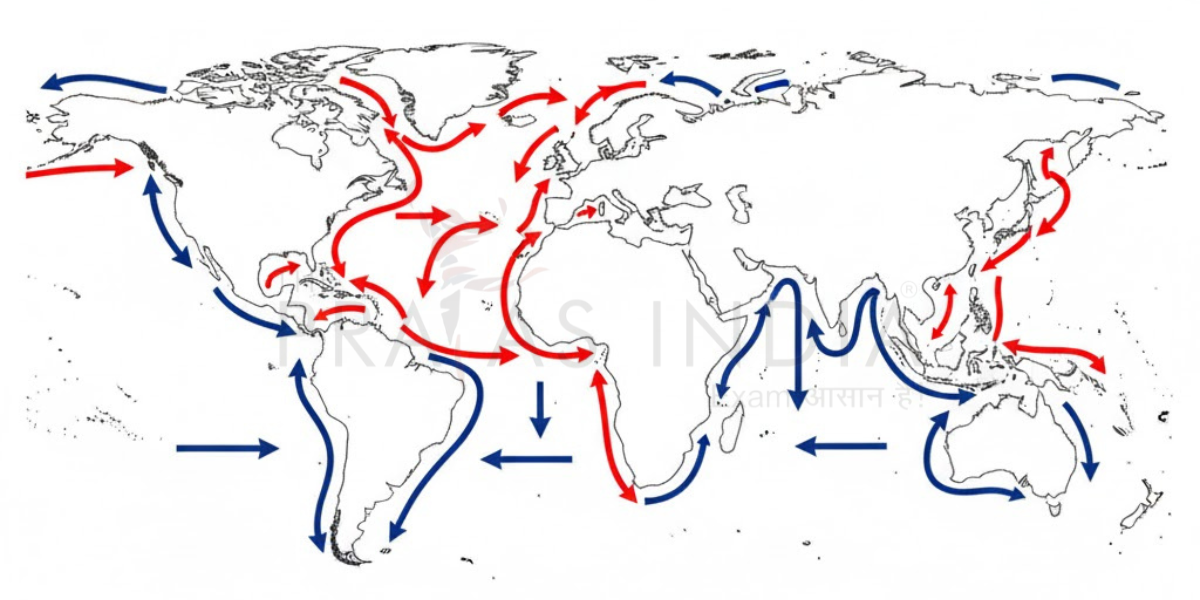
Warm Currents
- Flow from equatorial to higher latitudes
- Increase temperature & humidity of coastal regions
Examples: Gulf Stream, Kuroshio, Brazil Current, Agulhas Current
Cold Currents
- Flow from polar to lower latitudes
- Cause cooling, fog formation, dry coastal conditions
Examples: California, Humboldt/Peru, Canary, Oyashio, Benguela
Seasonal Currents
- Reversed by monsoonal wind changes
- Prominent only in the Indian Ocean
Examples: Somali Current reversal during SW monsoon
Tidal Currents
- Caused by rising and falling tides
- Short duration, vital for estuaries & ports
Density/Thermohaline Currents
- Driven by differences in water density
- Cold, saline water sinks → flows as deep currents
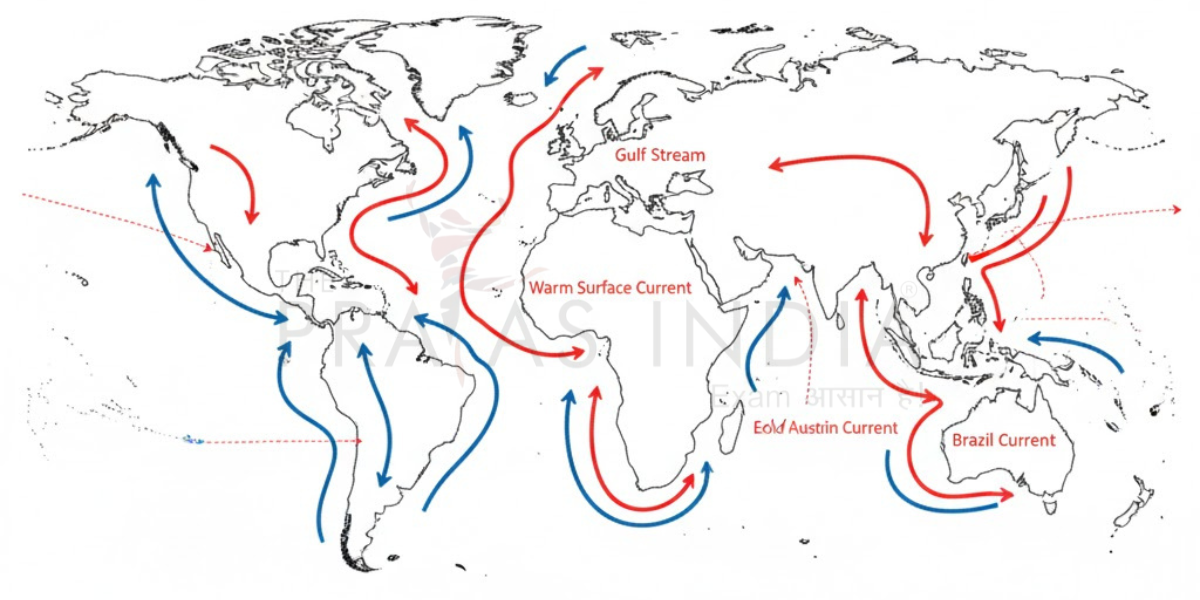
Forces Responsible for Ocean Currents
Planetary Winds
- Trade Winds drive equatorial currents westward
- Westerlies drive mid-latitude currents eastward
This forms gyres in Pacific, Atlantic & Indian Oceans.
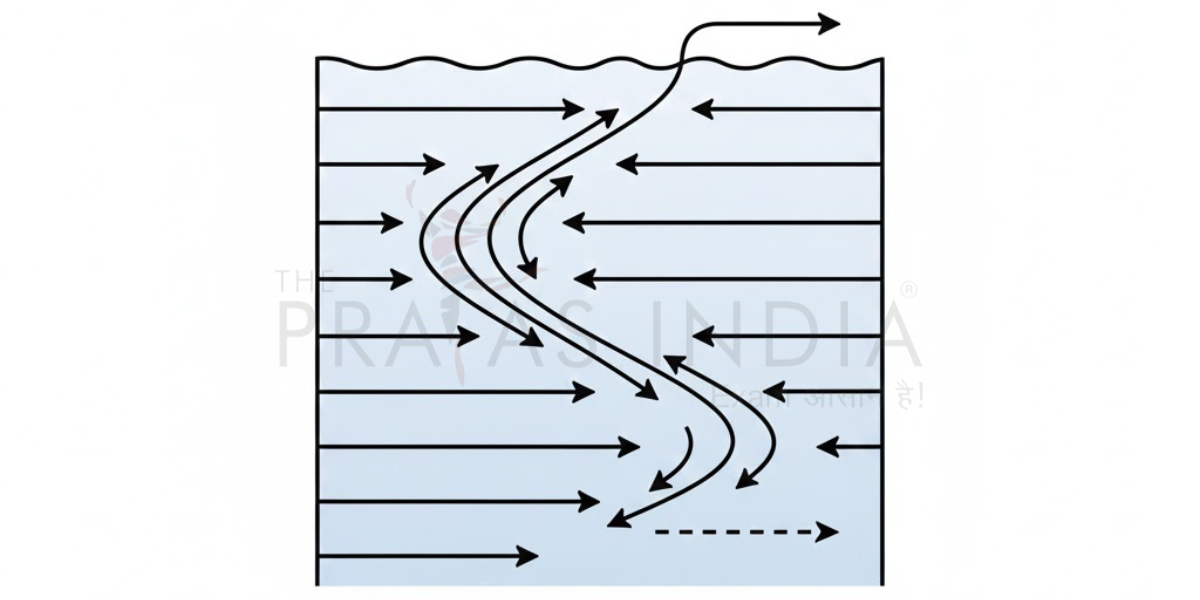
Coriolis Force
- Deflects currents to the right in the Northern Hemisphere
- Deflects currents to the left in the Southern Hemisphere
Creates Ekman Transport and Ekman Spiral effects.
Temperature Differences
- Warm water expands (low density) and moves poleward
- Cold water contracts (high density) and sinks
Salinity Differences
- Higher salinity = greater density = sinking currents
Ocean Floor Topography
- Ridges, trenches, and seamounts redirect currents
Continental Deflection
- Currents get obstructed by continents, creating circular gyres
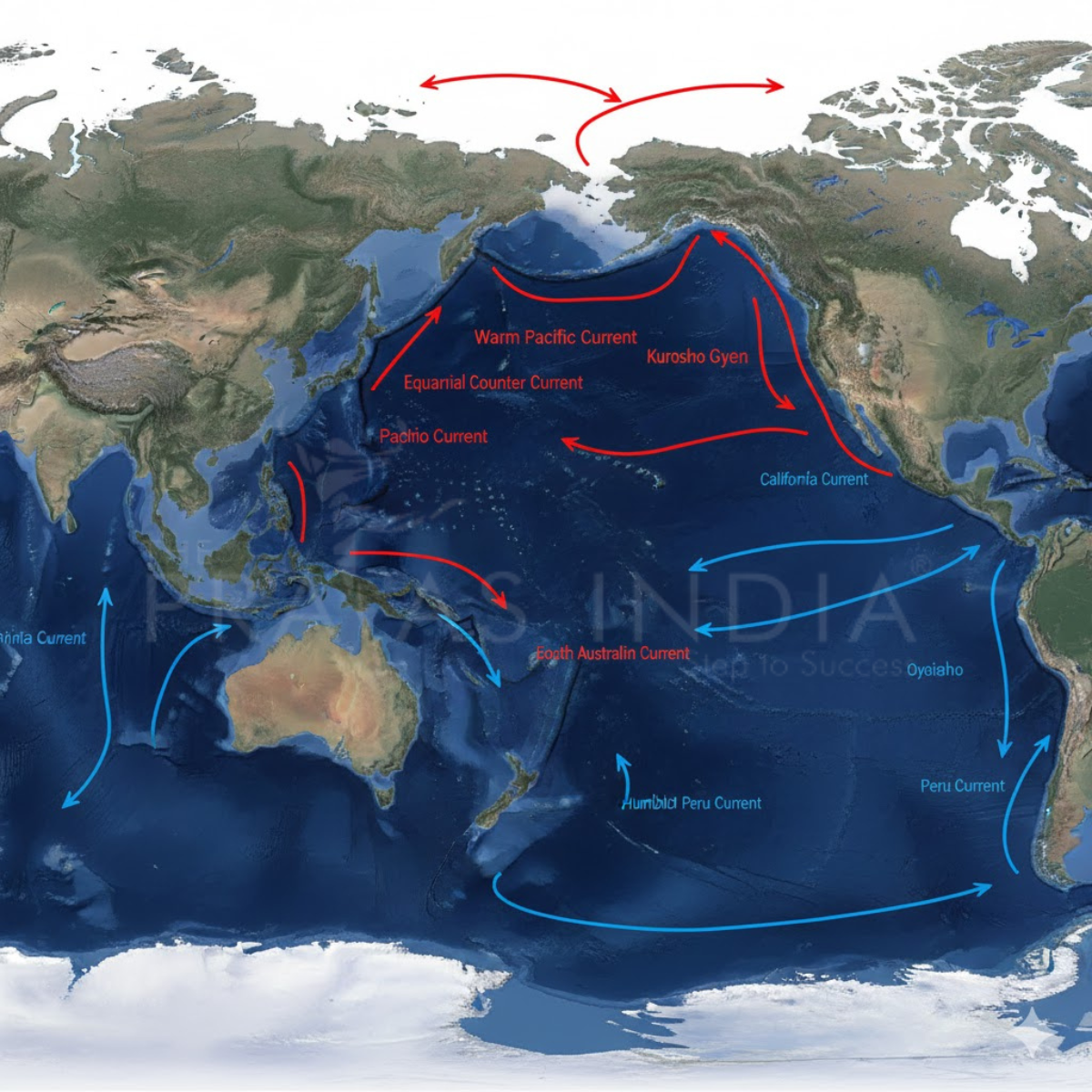
Major Ocean Currents of the World
A. Pacific Ocean Currents
The Pacific hosts the largest circulation system.
Warm Currents
- Kuroshio (Japan Current): warms Japan
- North Equatorial Current
- South Equatorial Current
Cold Currents
- Oyashio Current: nutrient-rich, supports fisheries
- California Current: causes dry conditions on US west coast
- Peru/Humboldt Current: major upwelling, drives Peruvian fisheries
Climatic influence:
- Humboldt Current prevents rainfall in western South America → Atacama Desert
- Kuroshio warms east Asia, moderates winters
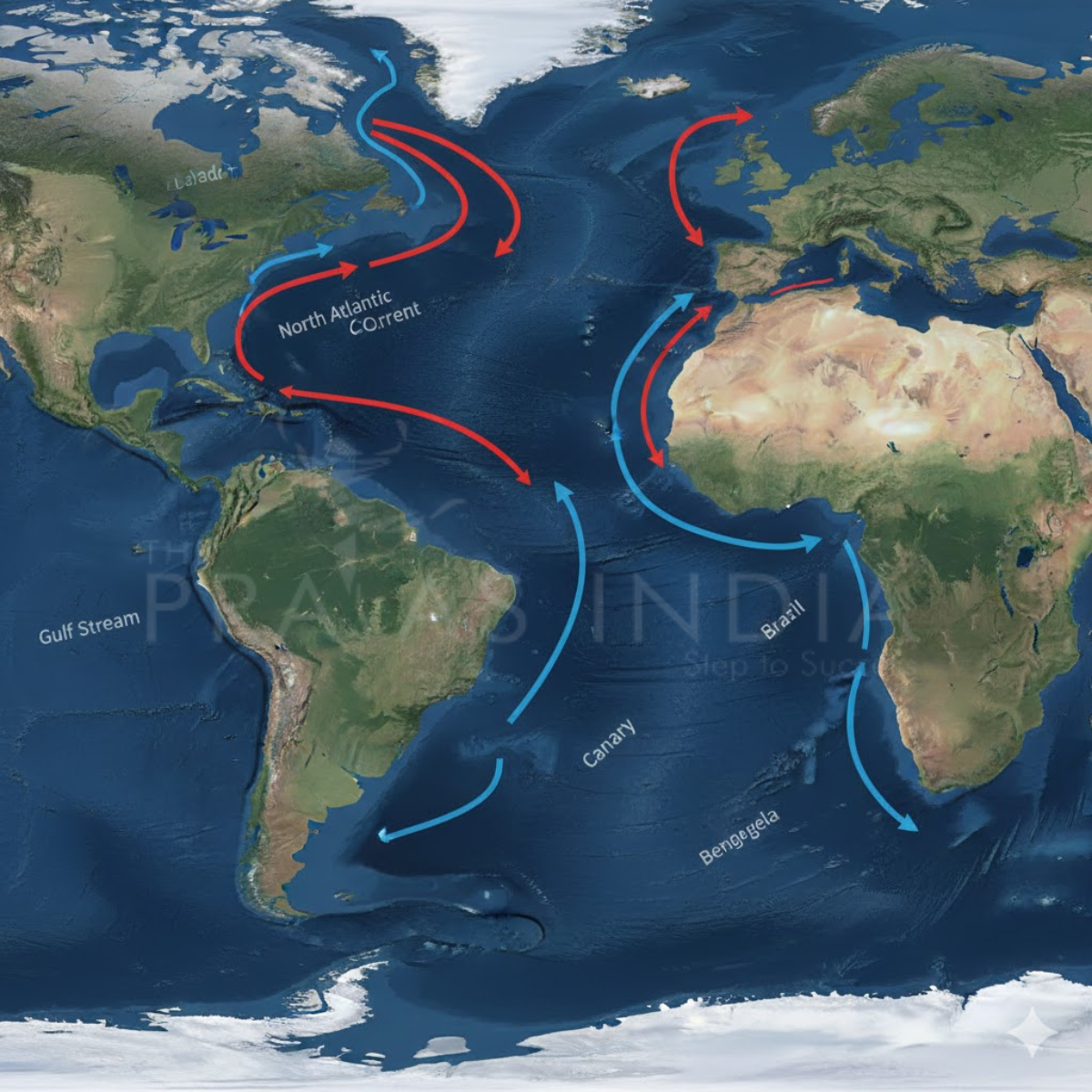
B. Atlantic Ocean Currents
Warm Currents
- Gulf Stream: warms Western Europe, a major climate regulator
- Brazil Current
Cold Currents
- Labrador Current: iceberg-infested, influences Newfoundland fisheries
- Canary Current: causes arid north African coasts
- Falkland/Malvinas Current
Significance:
- Gulf Stream + Westerlies → warm Europe
- Canary Current → Sahara dryness
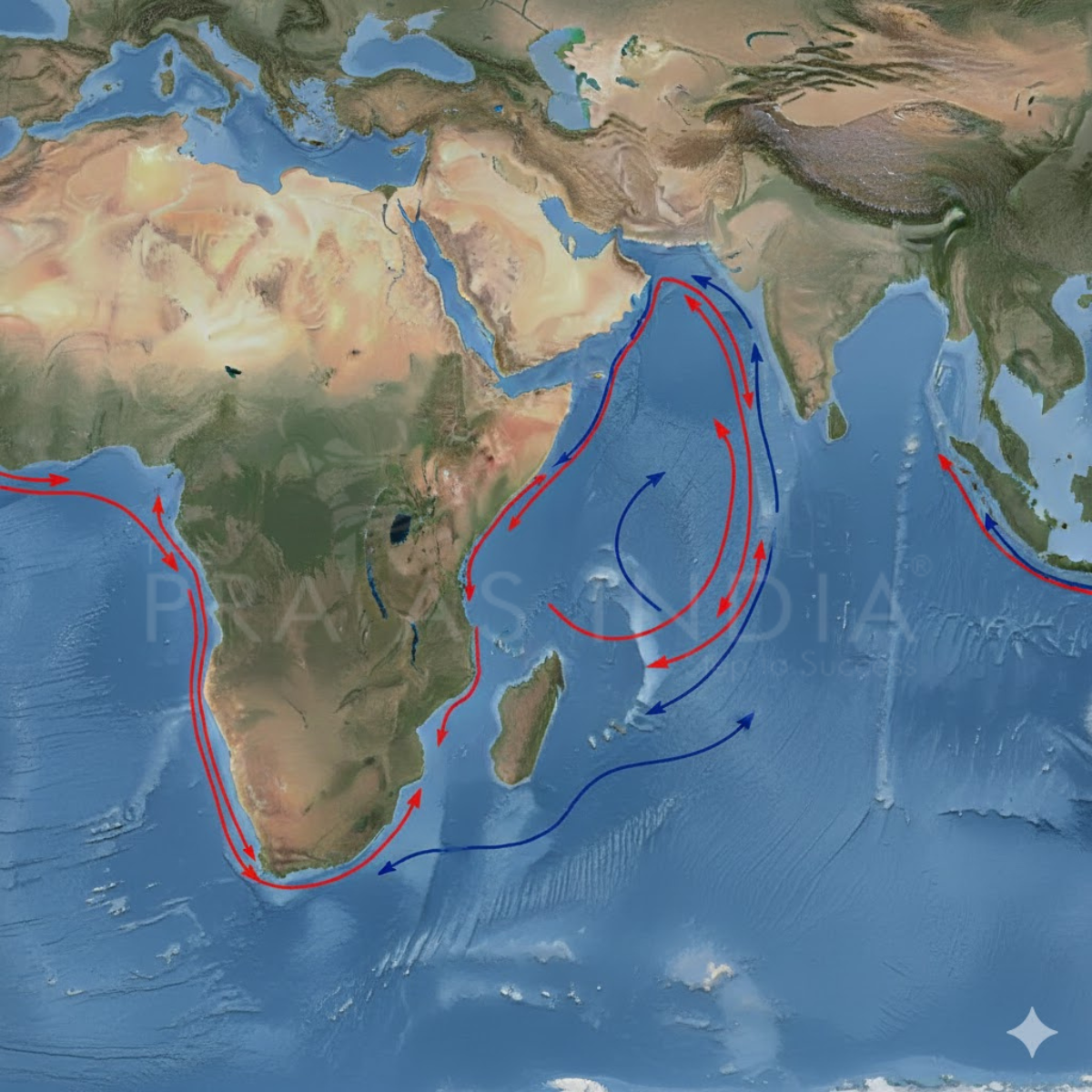
C. Indian Ocean Currents
The only ocean with reversing currents due to monsoons.
Southwest Monsoon Season (June–Sept)
- Somali Current becomes warm & strong
- North Equatorial Current shifts
Northeast Monsoon Season (Dec–March)
- Somali Current becomes cold
Major currents
- Agulhas Current (warm)
- West Australian Current (cold)
- Somali Current (seasonal)
- South Equatorial Current
Significance:
- Somalia upwelling supports rich fisheries
- Reversing currents influence Indian monsoon
Thermohaline Circulation (The Global Conveyor Belt)
The deep-water global circulation system moves heat, carbon, and nutrients around the world.
Drivers
- High salinity + low temperature = high density
- Water sinks in North Atlantic and Antarctic regions
Main Components
- North Atlantic Deep Water (NADW)
- Antarctic Bottom Water (AABW)
- Upwelling in the Indian & Pacific Oceans
- Warm surface return flow into Atlantic
Importance
- Controls global heat distribution
- Regulates climate over centuries
- Responsible for long-term ocean mixing
Impacts of Ocean Currents
A. Impact on Climate
- Warm currents → warm and humid coastal climate (e.g., Western Europe)
- Cold currents → cool and dry coastal climate (e.g., Peru, California)
- Fog formation (Labrador, California)
- Affect cyclone development: warm currents provide latent heat
B. Impact on Marine Ecology
- Upwelling zones (Peru, California, Somalia) bring nutrient-rich water → world’s richest fishing grounds
- Coral reef distribution is affected by warm currents
- Influence phytoplankton productivity
C. Navigation & Trade
- Historically shaped shipping routes (Gulf Stream crossing)
- Modern shipping uses current-assisted routes to reduce fuel costs
D. Coastal Landforms
- Variations in wave energy shape beaches
- Erosion along cold current coasts
- Deposition along warm current coasts
Ocean Currents & Climate Phenomena
El Niño
- Weakening of Peru Current → warming of eastern Pacific
- Collapse of fisheries
- Global rainfall anomalies
La Niña
- Strengthening of cold Peru & Humboldt currents
- Increased upwelling
- Stronger monsoons in India
Indian Ocean Dipole (IOD)
-
Westerly wind anomalies modify Somali Current strength
Pacific Decadal Oscillation (PDO)
- Long-term shifts in currents impact rainfall patterns
Ocean Currents & Climate Change
Major Effects
- AMOC (Atlantic Meridional Overturning Circulation) weakening due to Arctic melt
- Could cool Europe significantly
- Increase in marine heatwaves
- Disruption to coral reefs
- Collapse of fish populations (e.g., cod, anchovies)
Deep currents are slowing, reducing the efficiency of the global heat engine.
Case Studies
1. Collapse of Peruvian Anchovy Fisheries (El Niño)
Warm water suppresses upwelling → massive fish mortality.
2. Weakening of Gulf Stream
Observed slowdown due to Arctic freshwater input affecting Europe’s climate.
3. Somali Upwelling System
Strongest seasonal upwelling in the world, supporting rich Arabian Sea fisheries.
4. Kuroshio–Oyashio Confluence
Creates dense fog, intense mixing, and rich biodiversity around Japan.
UPSC Previous Year Questions (Selected)
GS1 (Mains)
- Explain the role of ocean currents in global heat balance.
- How do El Niño and La Niña events affect Indian monsoon patterns?
Prelims
- Match warm and cold currents with their oceans
- Map-based identification of ocean currents
Geography Optional
- Thermohaline circulation
- Upwelling systems of the world
- Ekman transport and Ekman Spiral
FAQs on Ocean Currents
1. What are ocean currents?
Ocean currents are continuous, directed movements of ocean water generated by forces such as wind, temperature differences, salinity variations, the Coriolis effect, and gravity. They operate at both surface and deep levels, redistributing heat and nutrients across the world.
2. What is the difference between warm and cold ocean currents?
Warm currents originate near the equator and move toward the poles, raising temperatures of nearby coastal regions (e.g., Gulf Stream). Cold currents move from polar regions toward the equator, cooling adjacent coastlines (e.g., California Current).
3. What is thermohaline circulation?
Thermohaline circulation refers to deep-ocean currents driven by differences in seawater density, influenced by temperature (thermo) and salinity (haline). It forms the “Global Conveyor Belt,” regulating Earth’s long-term climate.
4. How do ocean currents affect climate?
Currents transport heat across oceans, warm or cool coastal regions, influence monsoon patterns, create fog zones, support upwelling-based fisheries, and drive major climate phenomena like El Niño and La Niña.
5. What causes upwelling in certain ocean areas?
Upwelling occurs when winds push warm surface water away, allowing deep, cold, nutrient-rich water to rise. It boosts fisheries (e.g., Peru, California, Somalia regions).
6. Why are the Pacific and Atlantic oceans so different in current patterns?
The Pacific is wider and influenced heavily by ENSO cycles, while the Atlantic features strong thermohaline circulation and boundary currents like the Gulf Stream. Differences in shape, wind belts, and coastline orientation cause distinct current systems.
7. How does climate change affect ocean currents?
Global warming is slowing the Atlantic Meridional Overturning Circulation (AMOC), increasing marine heatwaves, altering upwelling zones, and causing unpredictable monsoon behavior.
8. What are some UPSC-relevant case studies related to ocean currents?
– Collapse of Peruvian anchovy fisheries during El Niño
– Slowing Gulf Stream and Europe’s climate risk
– Somali Current reversal due to monsoons
– Kuroshio–Oyashio mixing affecting Japan’s weather and fisheries
Conclusion
Ocean currents are the heartbeat of the world’s oceans, redistributing heat, nutrients, and moisture. They moderate climates, sustain fisheries, influence weather systems, and shape coastlines. The interconnected system of surface currents and deep thermohaline circulation maintains the global heat budget essential for life.
With climate change accelerating, the stability of major currents like the Gulf Stream and the Antarctic Bottom Water is threatened. Monitoring systems such as ARGO floats, satellites, and global ocean models are crucial for early warning systems.
Sustainable management of marine ecosystems, climate action, and international cooperation will determine whether the ocean’s dynamic circulation continues to support human civilization in the future.