Red Sea – Physical Geography, Tectonics, Ecology, Economy & Geopolitics
- GS Paper 1: Physical Geography, Ocean Geography, Geomorphology
- GS Paper 3: Environment, Marine Ecology, Climate Change, Conservation
- Prelims: Seas & Straits, Marine Features, Coral Ecosystems, Tectonic Boundaries
- Geography Optional: Oceanography, Plate Tectonics, Biogeography, Marine Resources
Introduction
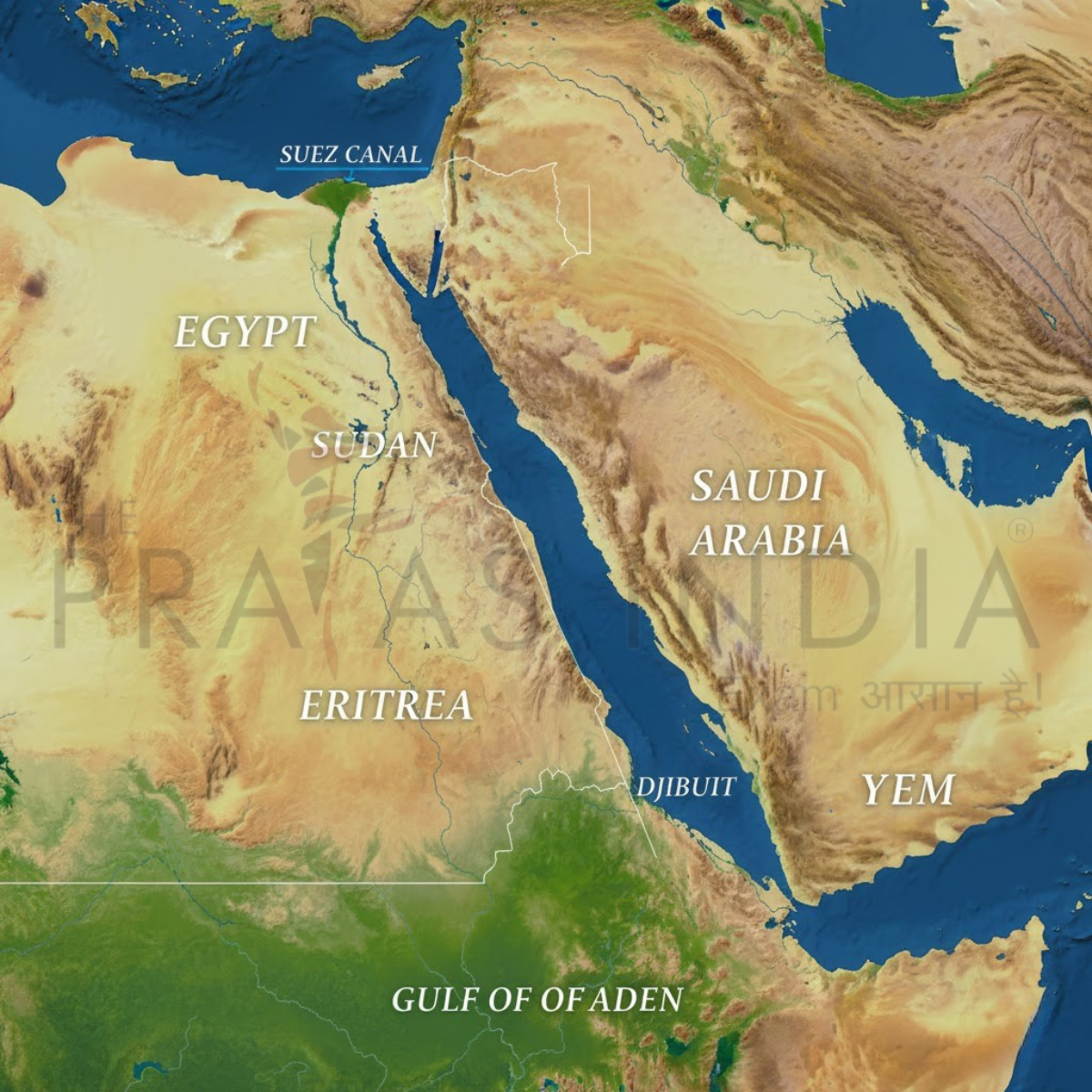
The Red Sea is a long, narrow, semi-enclosed water body located between Northeast Africa and the Arabian Peninsula, forming one of the most distinctive marine environments in world geography. It serves as a critical link between the Mediterranean Sea and the Indian Ocean, connecting Europe, Asia, and Africa through the Suez Canal.
Geographically, the Red Sea is significant because of:
- High salinity levels (among the highest of any open sea)
- Active tectonic rifting as part of the Great Rift System
- Rich coral reef ecosystems, adapted to extreme temperatures
- Vital maritime trade routes, including global oil transport
Its strategic position has made it one of the most economically and geopolitically important seas in the world.
Geological Formation & Tectonic Setting
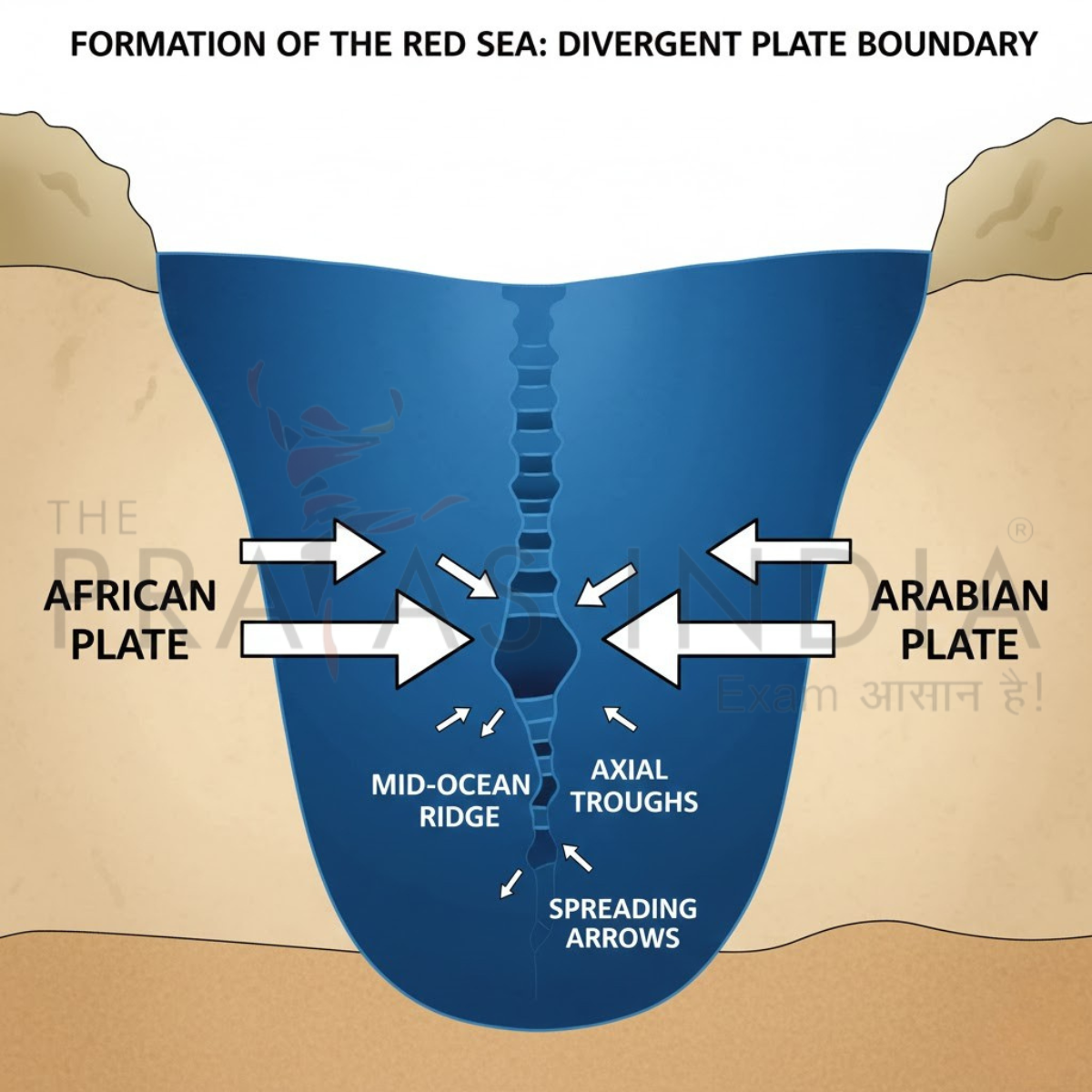
The Red Sea is one of the youngest oceanic basins on Earth. It lies along a divergent plate boundary, where the Arabian Plate is moving away from the African (Nubian) Plate.
Key Geological Characteristics
- Part of the Great Rift Valley system
- Undergoing active sea-floor spreading
- Formation of a linear rift valley, which is gradually widening
- Presence of axial troughs, volcanic ridges, and deep brine pools
- Volcanic features linked to the Afar Triple Junction, where the Red Sea Rift, Gulf of Aden Rift, and East African Rift meet
Physical Characteristics
a. Location & Dimensions
- Length: ~2,250 km
- Width: 30–355 km
- Maximum depth: ~2,211 m in the Central Trough
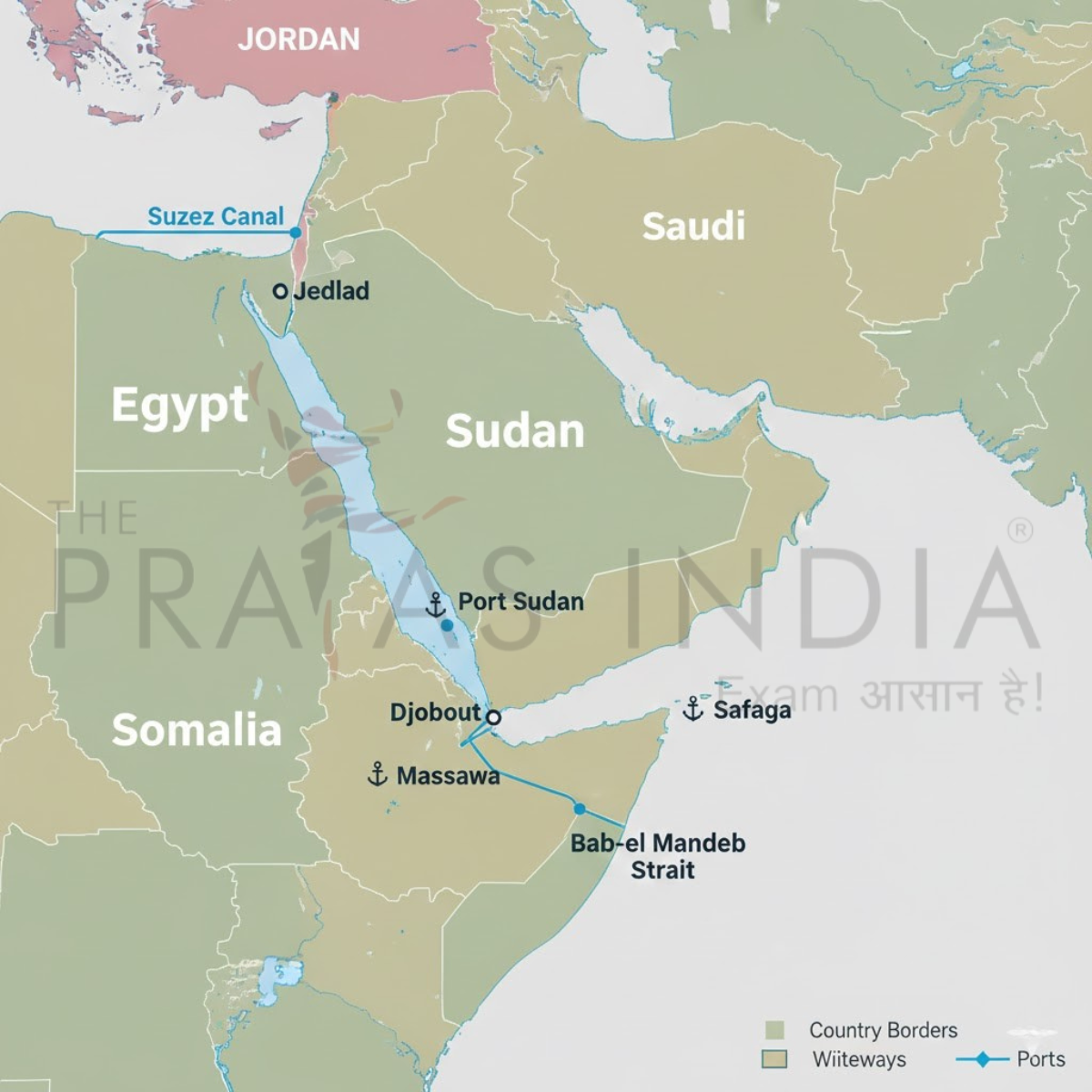
- Northern end connects to the Mediterranean Sea via the Suez Canal
- Southern end opens into the Gulf of Aden through the Bab-el-Mandeb Strait
b. Temperature & Salinity
The Red Sea is one of the warmest and most saline seas globally.
- Surface temperature: 26–32°C
- Salinity: 36–41 PSU (due to high evaporation)
- Precipitation: extremely low
- No major perennial rivers drain into it, reducing freshwater inflow
c. Currents & Circulation
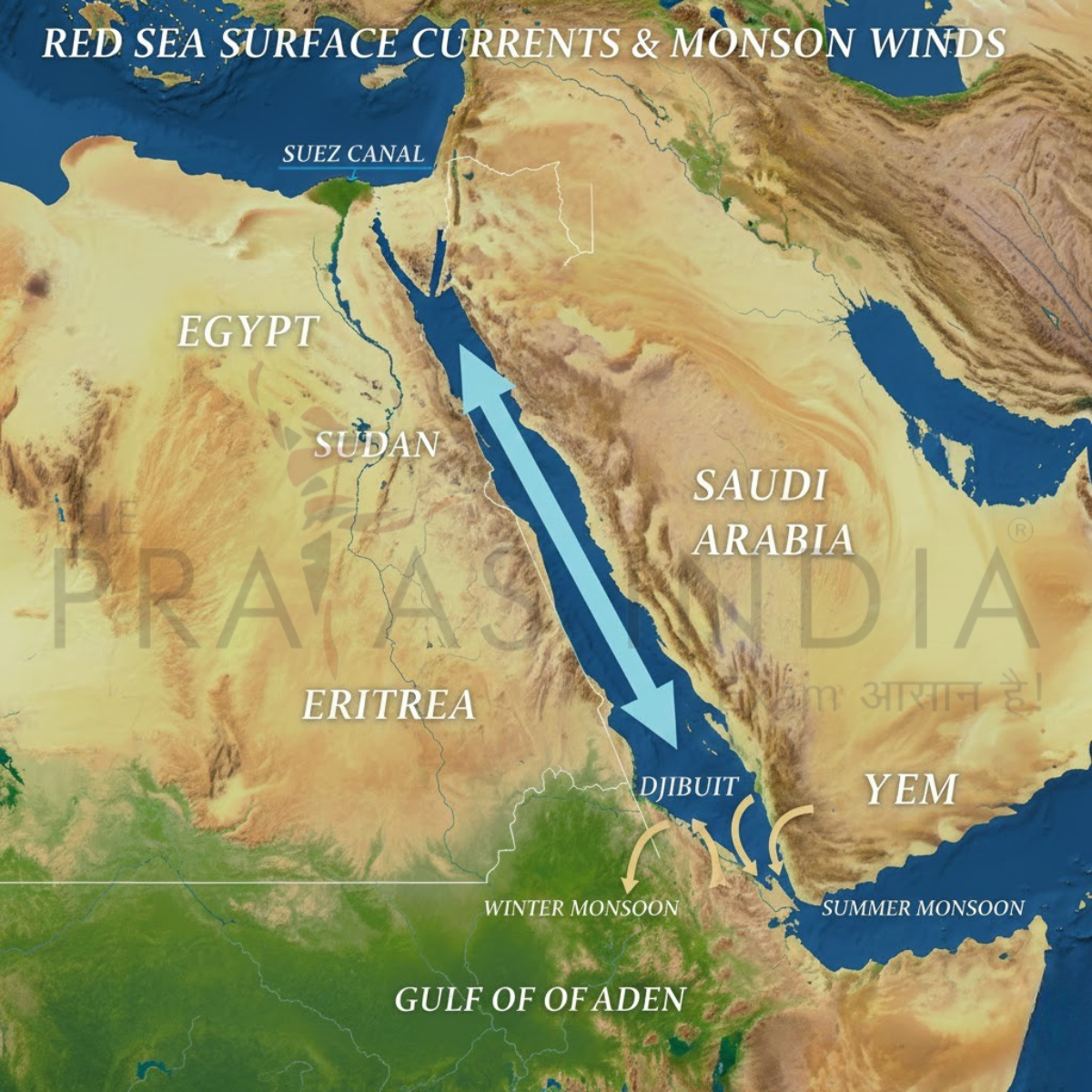
The circulation is influenced by winds, monsoons, and the Bab-el-Mandeb exchange.
- Northwest winds create southward flowing surface currents
- Seasonal reversal near the strait due to Indian Ocean monsoons
- Deep waters are formed through evaporation-induced densification
Marine Ecosystems & Biodiversity
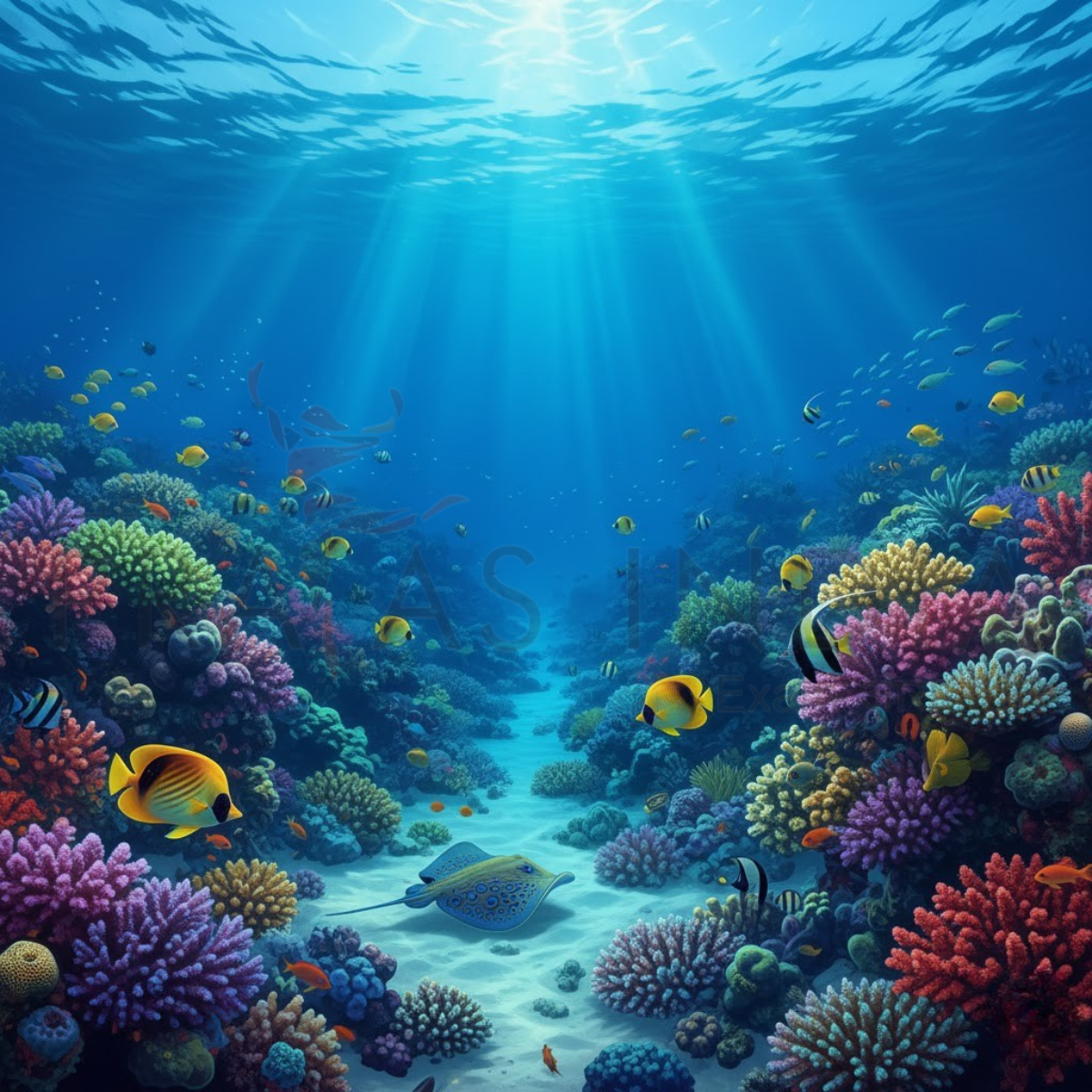
The Red Sea hosts one of the world’s richest marine ecosystems, despite harsh conditions.
Coral Reefs
- One of the longest continuous coral reef belts (over 2,000 km)
- Corals show exceptional heat resistance, surviving rising SSTs
- Fringing reefs dominate; barrier reefs are limited
Mangroves & Seagrasses
- Mangroves (e.g., Avicennia marina) found along shallow coastlines
- Seagrass meadows support dugongs, turtles, and fish nurseries
Endemic Biodiversity
- Over 1,200 species of fish
- High level of endemism (~17%)
- Presence of deep brine pools with unique microbial life
Environmental Pressures
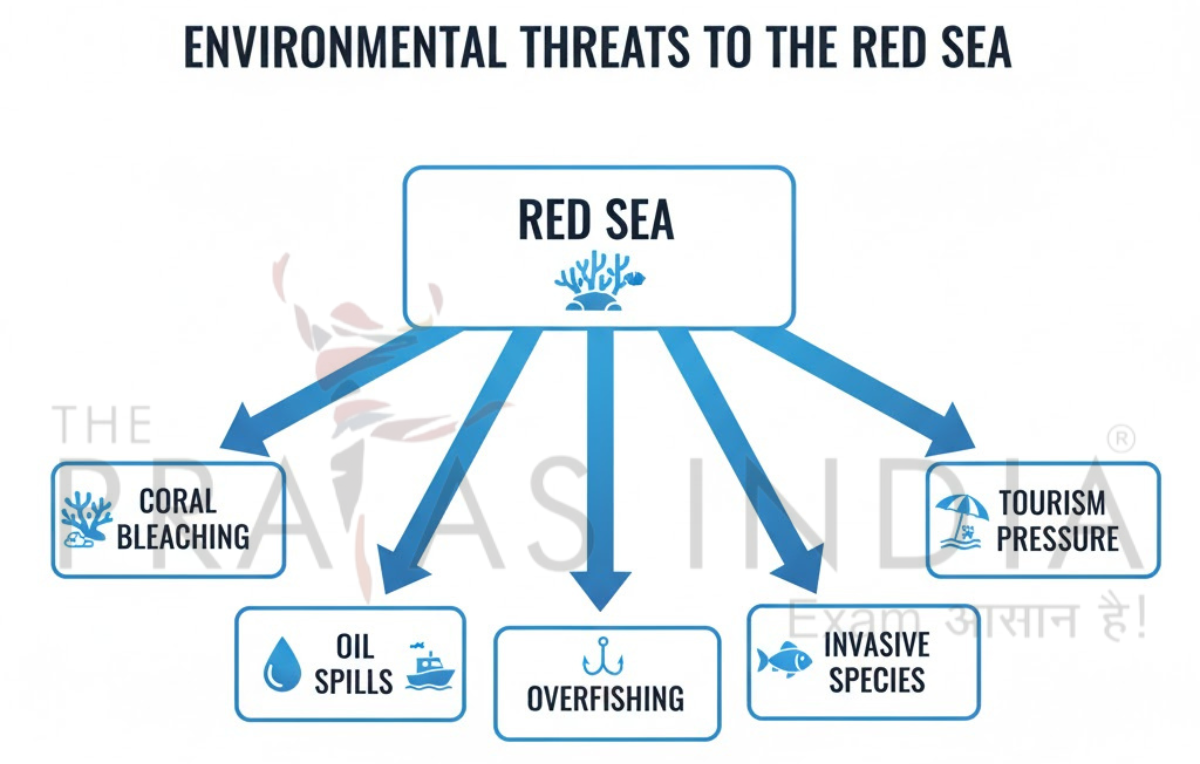
- Coral bleaching
- Coastal development
- Marine pollution
- Overfishing
Climatic Influence on the Region
The Red Sea lies between two major deserts — the Sahara and the Arabian Desert, creating a unique climatic system.
Major Climatic Features
- Hot, arid climate
- High evaporation (>2 m/year)
- Minimal rainfall (<100 mm/year)
- Frequent dust storms depositing sediments into the sea
- Evaporation drives salinity and circulation patterns
Economic Importance
a. Shipping & Global Trade
- Forms part of the Suez Canal–Bab-el-Mandeb–Indian Ocean route
- Facilitates ~12% of global trade and 30% of global container traffic
- Critical for oil and LNG transport from the Persian Gulf to Europe
b. Fisheries & Marine Resources
- Significant artisanal fisheries in Sudan, Eritrea, and Yemen
- Coral reefs support high-value fish species
- Deep brine pools contain mineral-rich sediments, including:
- zinc
- copper
- silver
- gold (trace quantities)
c. Tourism
Prominent tourism hubs include:
- Sharm el-Sheikh (Egypt)
- Hurghada (Egypt)
- Aqaba (Jordan)
- Neom and Red Sea Project (Saudi Arabia)
Recreational diving is globally renowned for visibility and reef quality.
Geopolitical & Strategic Significance
Key Coastal Nations
- Africa: Egypt, Sudan, Eritrea, Djibouti
- Arabian Peninsula: Saudi Arabia, Yemen
Strategic Chokepoints
- Suez Canal (north) – Global trade gateway
- Bab-el-Mandeb Strait (south) – Narrow, vital for oil shipments
Regional Security Issues
- Pirates operating around Gulf of Aden & Somali coast
- Yemen conflict affecting maritime navigation
- Naval presence of global powers:
- USA
- China (Djibouti base)
- France
- Saudi Arabia
- Egypt
Environmental Threats
Major Concerns
- Coral bleaching due to rising SST
- Oil spills and shipping pollution
- Urban expansion (Saudi, Egyptian coasts)
- Unregulated tourism
- Overfishing
- Plastic waste
- Climate change altering circulation patterns
These threaten the Red Sea’s globally unique coral ecosystems.
India’s Interests in the Red Sea Region
The Red Sea is central to India’s maritime security and economic supply chains.
a. Trade & Energy
- India’s trade with Europe, Africa, and the Americas passes through the Suez Canal route
- Over 60% of India’s oil imports traverse the Red Sea–Gulf of Aden corridor
b. Strategic & Security Engagement
- Anti-piracy deployment in Gulf of Aden since 2008
- Naval presence to protect Indian merchant ships
- Partnerships with:
- Saudi Arabia
- Egypt
- UAE
- Djibouti (logistic support)
c. Indian Diaspora
Significant Indian population in Gulf countries relies on Red Sea shipping routes for connectivity.
Comparison: Red Sea vs Mediterranean vs Arabian Sea
Comparative Table (UPSC Notes)
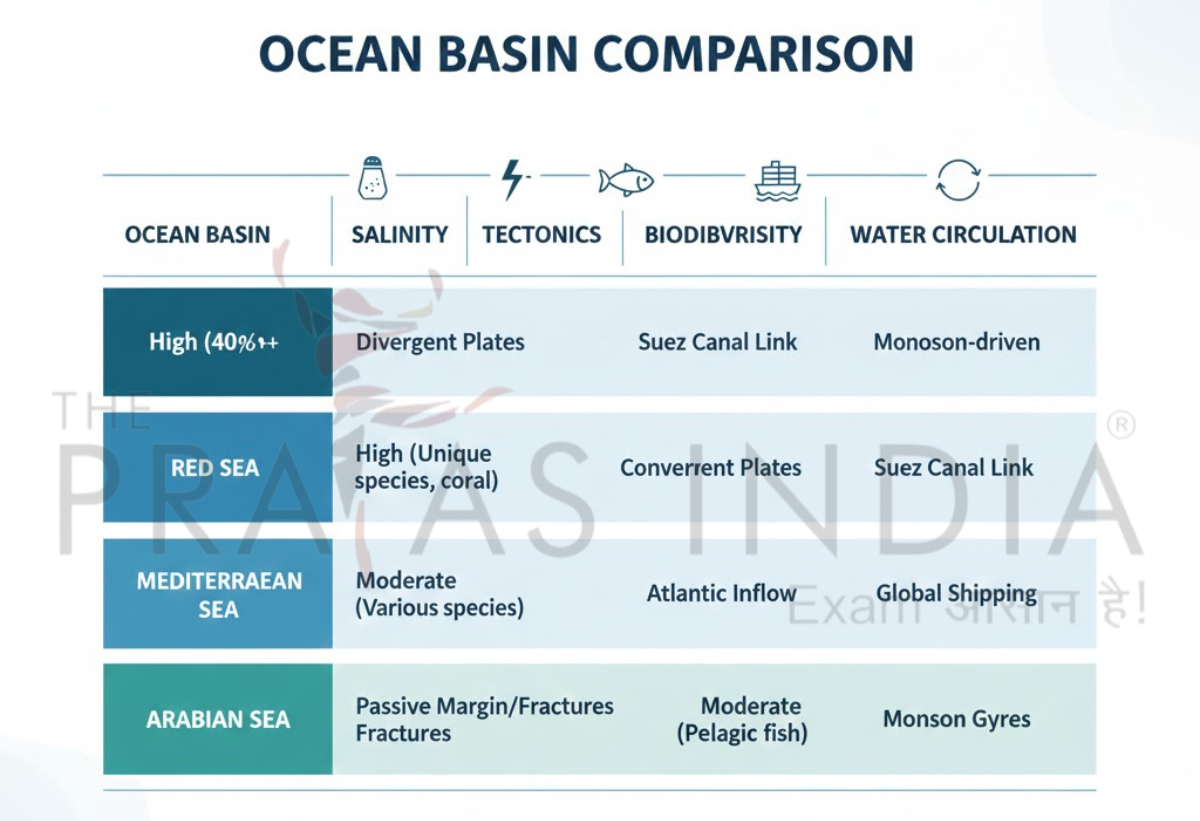
| Parameter | Red Sea | Mediterranean Sea | Arabian Sea |
|---|---|---|---|
| Salinity | Very high (36–41 PSU) | Moderate to high | Moderate |
| Tectonics | Active rift, divergent plate boundary | Complex subduction zones | Passive margin, stable basin |
| Marine Biodiversity | Highly diverse, heat-resistant corals | Rich but threatened; invasive species issues | Rich pelagic fisheries |
| Trade Significance | Extremely high (Suez Canal route) | High (Europe–Asia trade) | High (India–Middle East–Africa trade) |
| Water Exchange | Narrow exchange via Bab-el-Mandeb | Limited exchange with Atlantic | Open exchange with Indian Ocean |
Conclusion
The Red Sea is a geologically active, ecologically rich, and strategically vital sea connecting three continents. Its tectonic setting makes it an excellent case study in modern ocean basin formation, while its coral ecosystems represent some of the most resilient biodiversity on the planet.
Economically and politically, the Red Sea is indispensable for:
- Global maritime trade
- Oil and gas transport
- Geo-strategic balance among regional and global powers
However, climate change, pollution, geopolitical tensions, and coastal development pose significant threats. Sustainable management, cooperative security frameworks, and conservation initiatives are essential to safeguard the Red Sea’s ecological and economic future.