Ring of Fire – Tectonic Dynamics, Hazards, and Global Significance
- GS Paper 1: Physical Geography, Geomorphology, Earthquakes & Volcanoes
- GS Paper 3: Disaster Management, Climate Change Impact, Environmental Vulnerability
- Prelims: Plate Tectonics, Volcano Types, Earthquake Zones, Pacific Ocean Geography
- Geography Optional: Geotectonics, Seismicity, Volcanology, Pacific Basin Studies
Introduction
The Ring of Fire refers to the world’s most active tectonic and volcanic region encircling the Pacific Ocean basin. It is a 40,000 km long, horseshoe-shaped zone characterised by intense earthquakes, volcanic eruptions, subduction zones, ocean trenches, and island arcs. The region accounts for nearly 75% of Earth’s active volcanoes and almost 90% of recorded global earthquakes, making it the single most hazardous seismotectonic zone on the planet.
The Ring of Fire is a product of complex interactions between major and minor lithospheric plates surrounding the Pacific Plate. Its significance lies not only in understanding global geological processes but also in forecasting and mitigating natural disasters, especially in densely populated nations such as Japan, Indonesia, Chile, and the western coast of the United States.
Geological Background
The tectonic framework of the Ring of Fire is governed by the Theory of Plate Tectonics. The Earth’s lithosphere is fragmented into rigid plates that float over the semi-fluid asthenosphere. Along the edges of these plates occur the most significant geological activities.
Key Processes
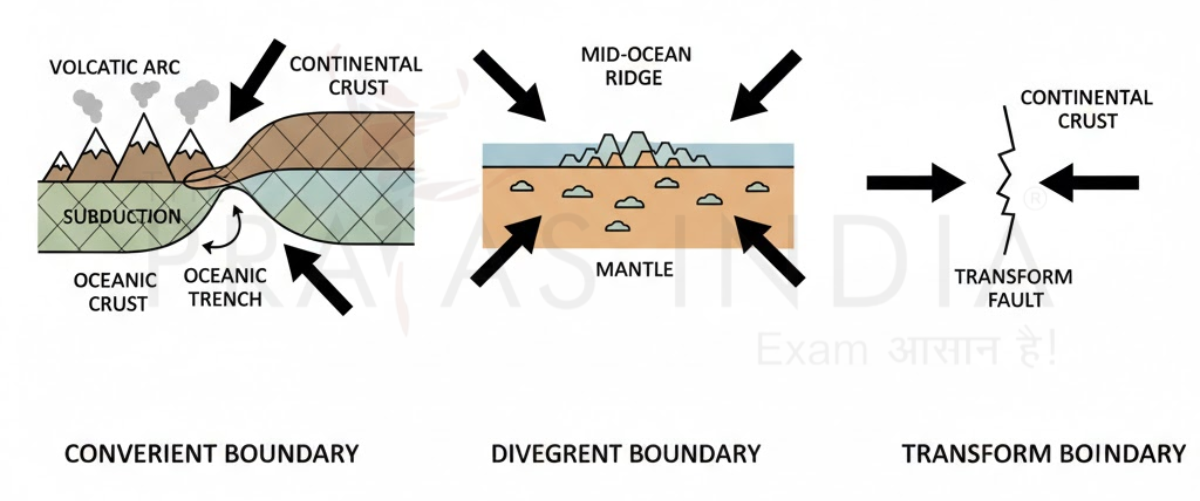
a) Convergent Boundaries (Subduction Zones)
The Pacific Plate constantly converges with surrounding plates such as:
- Nazca Plate (South America)
- Cocos Plate (Central America)
- Philippine Sea Plate
- Indo-Australian Plate
- Eurasian Plate
- North American Plate
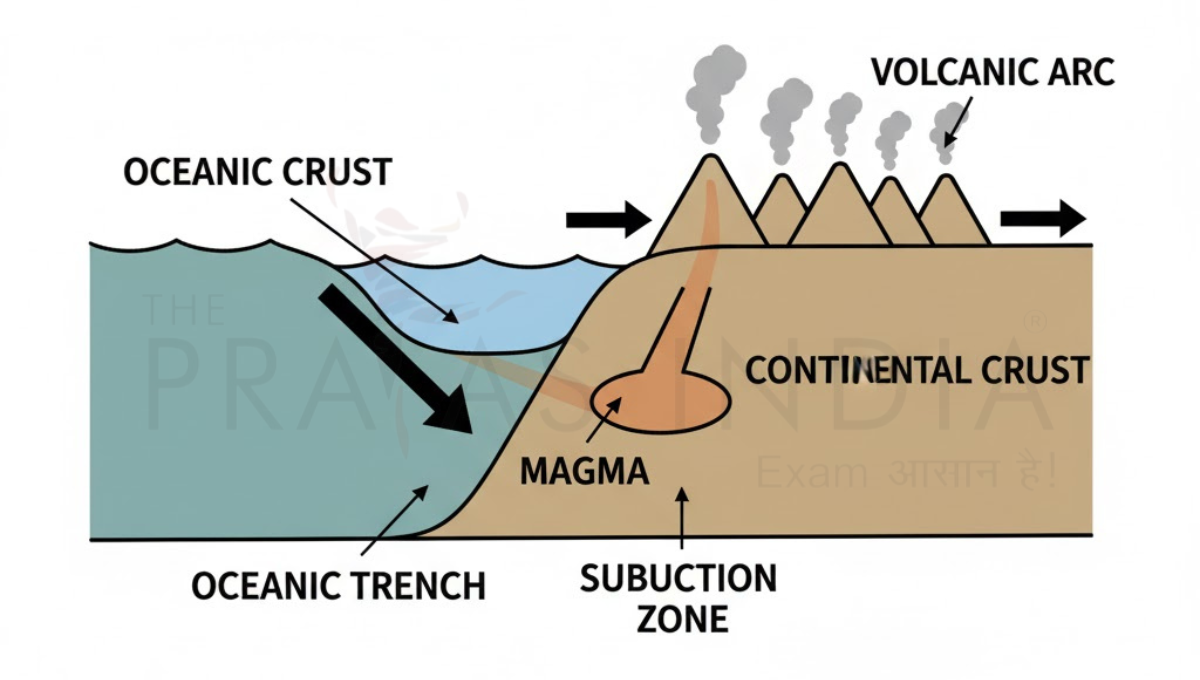
At these boundaries, the denser oceanic plate subducts beneath continental or oceanic plates, melting to produce magma and forming volcanic arcs and deep trenches.
b) Divergent Boundaries
Where plates pull apart—such as along the East Pacific Rise—new crust forms due to magma upwelling.
c) Transform Boundaries
At transform faults like the San Andreas Fault, plates slide past each other, generating destructive earthquakes.
Geographic Extent of the Ring of Fire
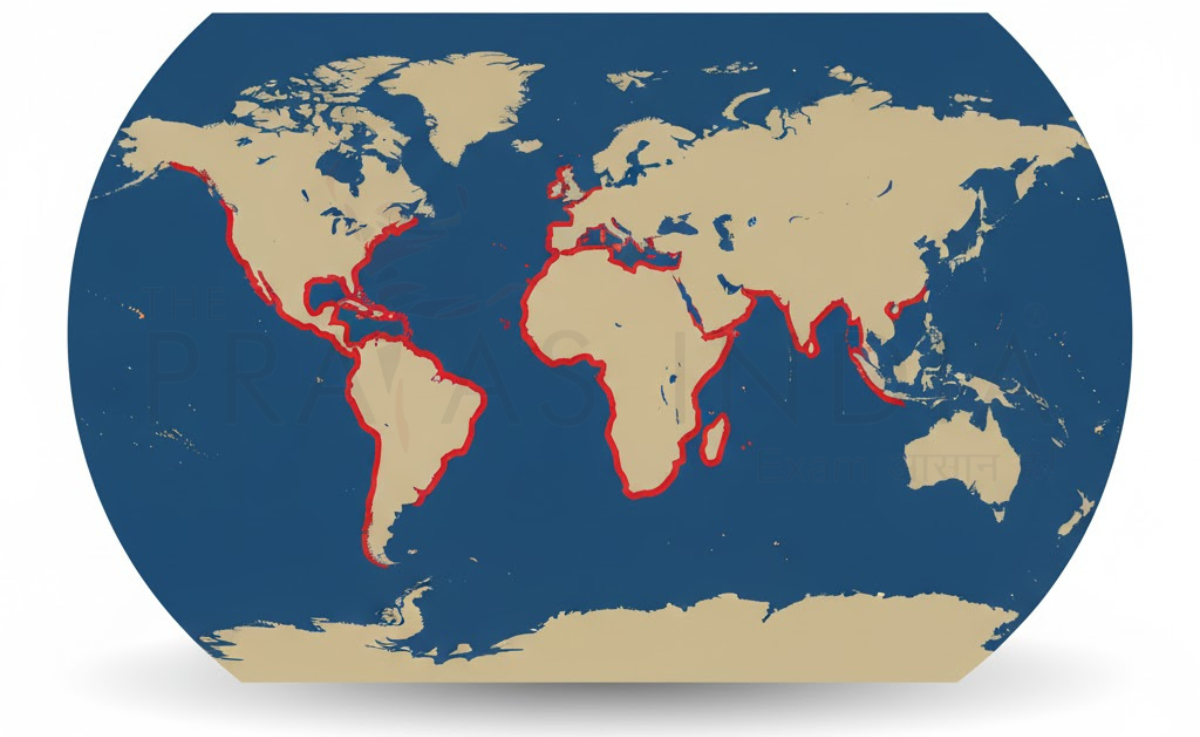
The Ring of Fire traces the margins of the Pacific Ocean and includes the seismically active coastlines of:
- South America: Chile, Peru
- North America: Mexico, USA (California, Alaska), Canada
- East Asia: Japan, Russia’s Kamchatka
- Southeast Asia: Philippines, Indonesia
- Oceania: Papua New Guinea, Solomon Islands, New Zealand
Its total length is nearly 40,000 km, forming a continuous belt of tectonic instability.
Major Volcanoes in the Ring of Fire
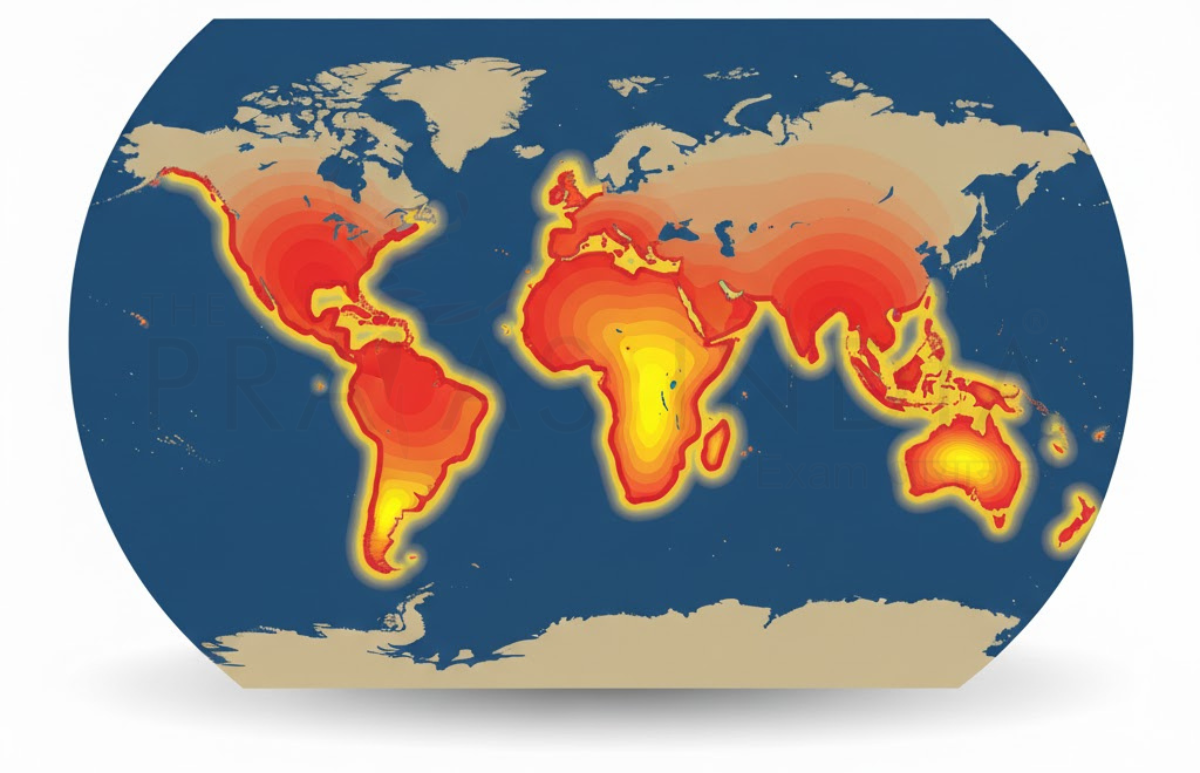
The predominant volcano type in the region is the stratovolcano (composite volcano), characterised by steep sides, layered deposits, and explosive eruptions.
Significant Volcanoes
- Mount Fuji (Japan): Dormant but iconic stratovolcano.
- Mount St. Helens (USA): Known for its 1980 catastrophic eruption.
- Mount Pinatubo (Philippines): 1991 eruption impacted global climate.
- Krakatoa (Indonesia): One of the deadliest eruptions in history (1883).
- Mauna Loa (Hawaii): Exception—hotspot volcano, not part of Ring of Fire.
Volcanoes range from active to dormant and extinct, forming chains along convergent boundaries.
Major Earthquake Zones in the Ring of Fire
The compressional forces and locked faults produce some of the most powerful earthquakes on Earth.
Notable Earthquake-Prone Zones
- Peru–Chile Trench: Source of multiple magnitude 8+ earthquakes.
- San Andreas Fault, California: A major transform boundary.
- Japan Trench: Frequent megathrust events.
- Sumatra Region: Triggered the 2004 Indian Ocean earthquake and tsunami.
- New Zealand’s Alpine Fault: Part of the Pacific-Australian plate boundary.
Earthquake clustering follows subduction dynamics and stress accumulation patterns.
Causes of Seismic & Volcanic Activity
Key Reasons
- High Subduction Rates: Pacific Plate subducts rapidly beneath continental arcs.
- Slab Melting: Subducted plates release water, lowering melting point of mantle rocks.
- Upwelling Magma: Generates explosive volcanic activity.
- Locked Faults: Accumulated strain releases as high-magnitude earthquakes.
Hotspot Exception: Hawaii
Prelims relevance: Hawaii’s volcanoes are formed over a mantle hotspot and are not part of the Ring of Fire.
Associated Landforms
The tectonic processes generate characteristic features.
a) Volcanic Arcs
Examples: Japan, Philippines, Aleutian Islands
b) Island Arcs
Formed by ocean-ocean subduction (e.g., Indonesia).
c) Ocean Trenches
Deepest parts of Earth’s crust such as:
- Mariana Trench
- Tonga Trench
- Peru–Chile Trench
d) Fold Mountains
Created by ocean-continent convergence (e.g., Andes Mountains).
Ring of Fire and Tsunamis
Submarine earthquakes displace large volumes of seawater, generating tsunamis.
Significant Events
- 2011 Japan (Tohoku) Tsunami: Caused by megathrust earthquake; devastated coastal infrastructure.
- 2004 Indian Ocean Tsunami: Though outside the Ring of Fire, tectonically linked to subduction dynamics.
Volcanic eruptions (e.g., Krakatoa 1883) can also generate tsunamis.
Environmental & Climate Impacts
Climate Effects
- Volcanic aerosols (SO₂) reflect solar radiation and cool global temperatures.
- Pinatubo’s 1991 eruption dropped global temperatures by ~0.5°C.
Other Impacts
- Ash clouds disrupt aviation (Iceland 2010—analogous event).
- Volcanic gases alter atmospheric chemistry.
- Hydrothermal vents impact marine ecosystems.
Human & Economic Significance
The region hosts some of the most densely populated and economically active zones, making risk management critical.
Key Dimensions
- Urban exposure: Tokyo, Manila, Santiago, Los Angeles.
- Hazard mapping: Used to identify high-risk zones.
- Strict building codes: Especially in Japan and California.
- Mineral deposits: Subduction-related magmatism produces copper belts (e.g., Andes).
- Geothermal energy: Major source in New Zealand, Philippines, Japan.
- Tourism: Volcano trekking and geothermal sites.
India & the Ring of Fire — Indirect Relevance
Although India is not located in the Ring of Fire, the region influences:
a) Global Climate Patterns
Volcanic eruptions influence monsoon variability and global circulation.
b) Tsunamis
The Andaman–Sumatra subduction zone, geologically linked to the broader tectonic system, can affect Indian coasts.
c) Disaster Preparedness
Lessons from Pacific nations highlight:
- early warning systems
- resilient infrastructure
- community training
Relevance for UPSC includes plate tectonics, earthquake geology, and Indian Ocean hazards.
Disaster Preparedness & Management
Global Best Practices
- Earthquake Early Warning (EEW): Japan’s nationwide network.
- Seismic Retrofitting: Strengthening old structures.
- Lava Diversion Systems: Used in Iceland and Hawaii.
- Public Drills: Japan’s annual National Disaster Prevention Day.
- Tsunami Warning Systems: UNESCO’s PTWS monitors Pacific activity.
- Hazard Zoning: Regulates construction in high-risk regions.
Conclusion
The Ring of Fire embodies the dynamic nature of Earth’s lithosphere. Its concentration of earthquakes and volcanoes highlights the planet’s internal energy and tectonic interactions. While the region poses immense hazards, modern monitoring and preparedness can significantly reduce risks. Understanding its processes is essential for global disaster resilience, climate assessments, and scientific advancement.
FAQs on the Ring of Fire
1. What is the Ring of Fire?
The Ring of Fire is a horseshoe-shaped zone of intense seismic and volcanic activity surrounding the Pacific Ocean basin. It accounts for nearly 75% of the world’s active volcanoes and about 90% of global earthquakes, making it the most geologically active region on Earth.
2. Why is the Ring of Fire so seismically active?
The region is dominated by active plate boundaries, especially subduction zones, where the Pacific Plate and several microplates are forced beneath surrounding continental or oceanic plates. This process generates frequent earthquakes, volcanic eruptions, and tsunamis.
3. Which types of plate boundaries are found in the Ring of Fire?
Three major boundary types occur:
- Convergent boundaries (dominant) – Subduction zones creating trenches and volcanic arcs
- Divergent boundaries – Sea-floor spreading in limited sections
- Transform boundaries – Lateral movement, such as the San Andreas Fault in California
4. Which countries lie in the Ring of Fire?
Countries include Japan, Indonesia, Philippines, Papua New Guinea, New Zealand, USA (West Coast), Canada (British Columbia), Mexico, Peru, Chile, and several Pacific island nations.
5. What are some major volcanoes located along the Ring of Fire?
Important volcanoes are Mount Fuji (Japan), Mount St. Helens (USA), Mount Pinatubo (Philippines), Krakatoa (Indonesia), Mauna Loa (Hawaii – hotspot exception), and Nevado del Ruiz (Colombia).
6. Are all volcanoes in the Ring of Fire explosive?
Most are stratovolcanoes, which produce explosive eruptions due to viscous, silica-rich magma. However, some regions have shield volcanoes (e.g., Hawaii), though Hawaii is not part of the Ring of Fire tectonic system.
7. What major earthquakes occurred in the Ring of Fire?
Significant events include:
- 1960 Chile earthquake (M 9.5) – largest recorded
- 2004 Sumatra earthquake (M 9.1–9.3)
- 2011 Tohoku, Japan earthquake (M 9.0)
- Alaska 1964 earthquake (M 9.2)
8. How do tsunamis relate to the Ring of Fire?
Submarine earthquakes and volcanic collapses in subduction zones generate powerful tsunamis. The 2011 Japan tsunami and 2004 Indian Ocean tsunami are examples of megathrust events connected to active plate boundaries of this region.
9. What is the role of subduction in forming volcanoes?
When an oceanic plate subducts, it melts due to high temperature and pressure. The resulting magma rises and forms volcanic arcs or island arcs such as Japan, the Philippines, and the Andes.
10. How does the Ring of Fire impact global climate?
Large volcanic eruptions inject sulphur dioxide and aerosols into the stratosphere, reflecting sunlight and temporarily cooling global temperatures. Example: Mount Pinatubo (1991) caused a global temperature drop of around 0.5°C for over a year.
11. Why is Hawaii not part of the Ring of Fire?
Hawaii is located over a mid-plate hotspot, not on a plate boundary. Its volcanism is unrelated to subduction processes that dominate the Ring of Fire.
12. Is India part of the Ring of Fire?
No. India is not located along the Pacific tectonic boundary. However, subduction-related earthquakes in Indonesia and the Andaman–Sumatra region influence the Indian Ocean and can generate tsunamis affecting India.
13. What are the main landforms associated with the Ring of Fire?
Prominent landforms include:
- Ocean trenches (Mariana, Tonga, Peru–Chile)
- Volcanic arcs (Japan, Andes)
- Island arcs (Indonesia, Philippines)
- Fold mountains (Andes)
14. How are countries preparing for Ring of Fire disasters?
Nations implement earthquake early warning systems, tsunami alert mechanisms, strict building codes, seismic zoning, and public awareness programmes. Japan, USA, and New Zealand are global leaders in such preparedness.
15. Why is the Ring of Fire important for UPSC?
It is relevant for GS-1 (Geography), GS-3 (Disaster Management, Environment), Prelims (Plate Tectonics, Volcanoes, Earthquakes), and Geography Optional. It links to topics such as tsunamis, continental drift, ocean trenches, and seismic hazard mapping.