
RRB Group D Mathematics Preparation: How to Build Speed, Accuracy & Confidence | Best RRB Coaching in Mumbai | The Prayas India
Mathematics is one of the most important scoring areas in the RRB Group D examination, but it can also become a major source of lost marks when preparation is unstructured. Many aspirants spend months solving questions without developing a clear understanding of which topics deserve priority, which calculation techniques save time and how to analyse repeated mistakes.
For RRB Group D aspirants, mathematics preparation should not be limited to memorising formulas or solving random question sets. The real objective is to develop three interconnected abilities: understand the concept, solve accurately and reach the answer within the available time. A candidate who knows the formula but takes too long to apply it may struggle in the actual examination, while a candidate who attempts questions rapidly without checking calculations can lose valuable marks through avoidable errors.
A structured preparation plan can change this equation. By dividing the syllabus into manageable topics, strengthening arithmetic fundamentals, practising calculations regularly and using mock tests to identify weaknesses, aspirants can gradually transform Mathematics from a difficult section into a reliable scoring opportunity.
For candidates searching for RRB coaching in Mumbai, structured guidance can further simplify this process by providing a planned syllabus, topic-wise practice, regular tests, doubt resolution and exam-oriented strategies. The goal should always be to build a preparation system that improves performance consistently rather than relying on last-minute practice.
Understanding the RRB Group D Mathematics Section
Before preparing for Mathematics, aspirants should understand what the section demands from them.
RRB Group D Mathematics generally tests candidates on fundamental mathematical concepts and their practical application. Questions are designed around topics that require arithmetic understanding, calculation ability and logical application of formulas.
Important areas commonly associated with RRB Group D Mathematics preparation include:
- Number System
- BODMAS
- Decimals and Fractions
- LCM and HCF
- Ratio and Proportion
- Percentage
- Profit and Loss
- Simple and Compound Interest
- Time and Work
- Pipes and Cisterns
- Time, Speed and Distance
- Average
- Age
- Mensuration
- Algebra
- Geometry
- Trigonometry
- Data Interpretation
- Elementary Statistics
- Square Root
- Calendar and Clock
- Partnership
The exact difficulty can vary from one examination to another. Therefore, candidates should not prepare only for questions they consider easy. A strong preparation plan should cover the fundamentals of the syllabus while giving additional practice to frequently tested arithmetic concepts.
Why RRB Group D Mathematics Requires a Different Preparation Approach
One of the biggest mistakes aspirants make is treating Mathematics as a subject that can be mastered through formula memorisation alone.
A formula is useful only when you know when to apply it and how to apply it efficiently.
Consider a Percentage question. Two candidates may remember the same formula. One may convert the values into an easier form and solve the problem quickly, while the other may perform lengthy calculations and lose time. Both understand the concept, but only one has developed exam-oriented calculation efficiency.
This is why RRB Group D Mathematics preparation should be divided into four stages:
Concept Building → Topic-Wise Practice → Speed Development → Mock-Test Application
Each stage has a specific purpose.
Concept Building
Understand the basic principles and formulas.
Topic-Wise Practice
Solve questions of increasing difficulty from the same topic.
Speed Development
Learn shortcuts and improve calculation efficiency without compromising accuracy.
Mock-Test Application
Apply everything under examination-like time pressure.
Skipping any one of these stages can create an imbalance in preparation.
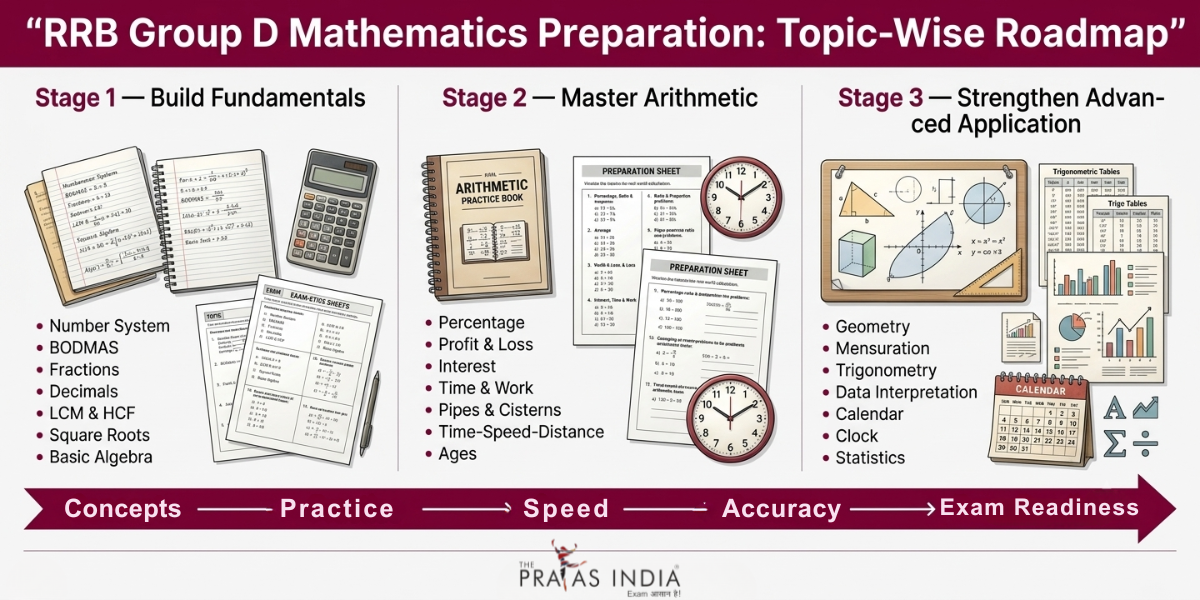
RRB Group D Mathematics Preparation Strategy
A good strategy begins by avoiding the temptation to study every topic simultaneously.
Instead, divide the syllabus into three broad groups.
Group 1: Fundamental Topics
These topics create the mathematical foundation required for many other questions.
- Number System
- BODMAS
- Fractions
- Decimals
- LCM and HCF
- Square Roots
- Basic Algebra
These should be strengthened early because weak fundamentals can affect performance across multiple areas.
Group 2: High-Application Arithmetic
These topics generally require more practice because questions involve multiple steps.
- Percentage
- Ratio and Proportion
- Average
- Profit and Loss
- Simple Interest
- Compound Interest
- Time and Work
- Pipes and Cisterns
- Time, Speed and Distance
- Problems on Ages
- Partnership
Candidates should focus on understanding relationships rather than memorising isolated formulas.
Group 3: Geometry, Mensuration and Other Topics
These areas require formula familiarity as well as visual and logical understanding.
- Geometry
- Mensuration
- Trigonometry
- Data Interpretation
- Calendar
- Clock
- Elementary Statistics
Once the fundamentals are strong, candidates can progressively increase their practice in these areas.
Start With Arithmetic Fundamentals
Arithmetic is the backbone of RRB Group D Mathematics preparation. Candidates who develop strong arithmetic fundamentals often find several seemingly different topics easier because the underlying concepts are connected.
For example, percentage concepts are directly useful in Profit and Loss, Discount, Interest and Data Interpretation. Similarly, Ratio and Proportion can support questions involving Partnership, Mixtures and other applications.
Therefore, instead of learning every chapter independently, try to understand the relationships between topics.
Number System: Build the Base
Number System is one of the foundational areas of Mathematics.
Candidates should become comfortable with:
- Natural and whole numbers
- Integers
- Rational numbers
- Prime and composite numbers
- Divisibility
- Factors and multiples
- Remainders
- Basic number properties
The objective is not to memorise definitions. You should be able to apply number properties quickly when solving questions.
Regular practice with divisibility rules can also reduce calculation time in suitable questions.
BODMAS, Fractions and Decimals
These topics may appear basic, but mistakes here can affect your performance across several mathematical calculations.
Understanding the correct order of operations is essential.
B — Brackets
O — Orders/Of
D — Division
M — Multiplication
A — Addition
S — Subtraction
Practise calculations involving fractions and decimals until the process becomes comfortable.
You should also learn common fraction-to-percentage conversions because they can save valuable time.
For example, recognising commonly used equivalents can make percentage calculations much faster than converting everything through lengthy calculations.
LCM and HCF
LCM and HCF are important foundational concepts and can also appear indirectly in application-based questions.
Instead of simply memorising methods, understand what the two concepts represent.
HCF focuses on the greatest common factor shared by numbers.
LCM identifies the smallest common multiple.
Practise both prime-factorisation and efficient calculation methods so that you can choose an appropriate method depending on the question.
Percentage: One of the Most Useful Arithmetic Topics
Percentage deserves special attention because it connects to many other chapters.
A candidate who is comfortable with percentage calculations can often handle questions involving:
- Profit and Loss
- Discount
- Interest
- Data Interpretation
- Population changes
- Salary or expenditure changes
- Comparative quantities
Focus on understanding percentage increase and decrease rather than memorising only the basic formula.
For example, when a quantity increases by a certain percentage and then decreases by the same percentage, the final value does not return to the original value. Understanding such relationships helps you solve questions more efficiently.
Ratio and Proportion: Think in Relationships
Ratio questions become easier when you stop viewing them as complicated calculations and start viewing them as relationships between quantities.
If two quantities are represented in a particular ratio, determine the common multiplier before performing calculations.
Ratio concepts can also support questions involving:
- Partnership
- Mixtures
- Ages
- Work distribution
- Speed comparisons
- Quantities and costs
The key is to practise converting word-based information into mathematical relationships quickly.
Average: Focus on the Core Relationship
The fundamental relationship is:
Average = Total Quantity ÷ Number of Items
But examination questions often require you to work backwards from the average.
For example, if the average of several values is known and one value is removed or added, you need to understand how the total changes.
Practise questions involving:
- Addition of a new value
- Removal of an existing value
- Replacement of one value
- Combined averages
- Average age
- Average marks
The more familiar you become with the relationship between total and average, the faster these questions become.
Profit, Loss and Discount
Profit and Loss questions are primarily about understanding relationships between:
Cost Price → Selling Price → Profit/Loss → Percentage
Candidates should be completely comfortable distinguishing between Cost Price and Selling Price before attempting percentage calculations.
Discount questions introduce another important relationship:
Marked Price → Discount → Selling Price
Do not mix the bases used for different percentages. Many mistakes occur because candidates calculate profit percentage using the wrong reference value.
Practise direct questions first, then move to successive discounts and combined applications.
Simple and Compound Interest
Interest questions require clarity regarding the principal, rate, time and interest amount.
Candidates should understand:
- Principal
- Rate
- Time
- Simple Interest
- Compound Interest
- Amount
Do not try to memorise every possible variation. Understand the basic relationships first.
For Compound Interest, practise situations involving annual compounding and then move toward variations when you are comfortable.
The aim is to recognise the structure of the question quickly.
Time and Work
Time and Work questions often look lengthy because they are presented through word problems. The underlying concept, however, is generally based on work rate.
If one person completes a job in a certain number of days, their one-day work can be represented as a fraction of the total work.
When two or more people work together, their individual rates can be combined.
The key question should always be:
“What amount of work is completed in one unit of time?”
Once this becomes intuitive, many Time and Work questions become much easier.
Pipes and Cisterns
Pipes and Cisterns are essentially an application of work-rate concepts.
A filling pipe represents positive work, while an outlet or leakage represents negative work.
Therefore, the same fundamental logic applies:
Net Work Rate = Filling Rate − Emptying Rate
Do not learn Pipes and Cisterns as a completely separate chapter. Connect it with Time and Work. This reduces the number of concepts you need to remember and improves application.
Time, Speed and Distance
Time, Speed and Distance is another major arithmetic area.
The basic relationship is:
Distance = Speed × Time
From this, the other relationships follow:
Speed = Distance ÷ Time
Time = Distance ÷ Speed
However, RRB Group D questions may require candidates to apply these relationships to trains, relative speed, different journeys or changing speeds.
Build your preparation gradually.
First master the basic formula. Then practise unit conversions. After that, move toward application-based questions.
Why Calculation Speed Matters in RRB Group D Mathematics
A candidate can know the correct method and still lose marks because the calculation process is too slow.
Calculation speed does not mean rushing through calculations.
It means reducing unnecessary steps.
For example, learn to recognise convenient fraction equivalents, basic squares, multiplication patterns and percentage relationships. Develop mental calculation habits where appropriate.
However, shortcuts should never replace conceptual understanding.
A shortcut that you do not fully understand can become a source of mistakes during a stressful examination.
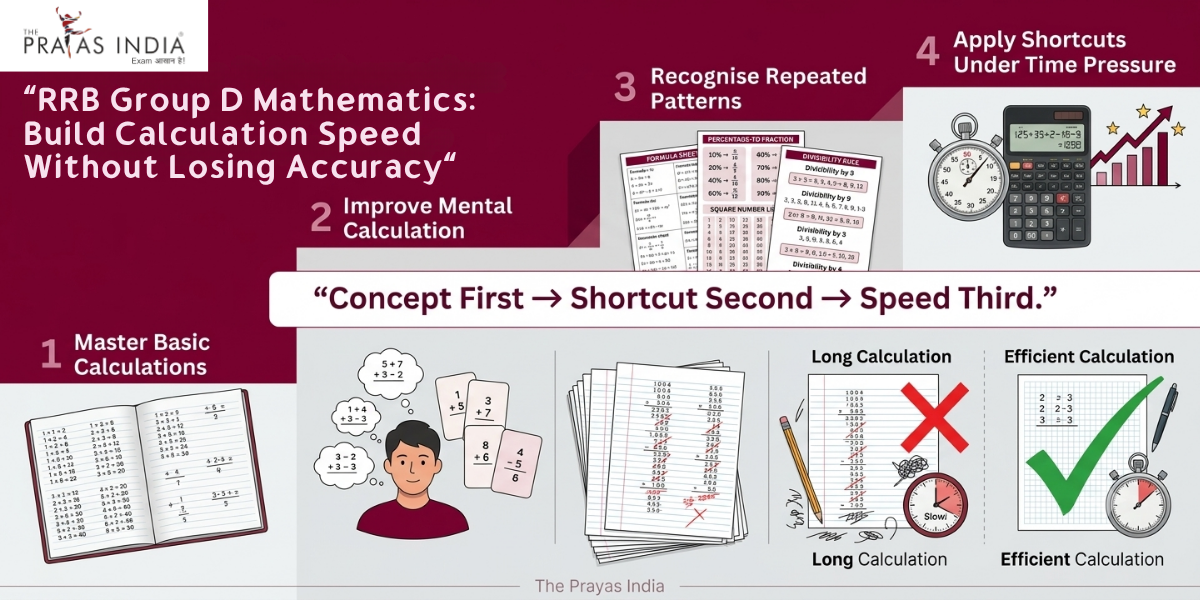
The ideal sequence is:
Understand the Standard Method → Practise It → Identify Repetitive Patterns → Learn an Efficient Method → Verify Accuracy
Build a Personal Formula and Shortcut Notebook
A dedicated Mathematics notebook can become one of your most useful revision tools.
Divide it into sections:
Formulas
Write only formulas that you frequently need.
Short Methods
Record shortcuts that you understand and have verified through practice.
Common Errors
Write down mistakes you repeatedly make.
Important Conversions
Maintain useful fraction, percentage, time and unit conversions.
Difficult Questions
Save questions that initially confused you and write the correct approach beside them.
The notebook should remain concise. Its purpose is rapid revision, not rewriting an entire textbook.
Practice Mathematics in Three Levels
A good preparation routine should not solve only easy questions.
Use three levels of practice.
Level 1: Concept Questions
These test whether you understand the basic method.
Level 2: Standard Exam Questions
These resemble the type of questions you are likely to encounter in competitive examinations.
Level 3: Time-Bound Mixed Practice
These combine different topics and introduce time pressure.
This progression helps you identify whether your problem is conceptual knowledge, application or speed.
Don’t Ignore Word Problems
Many RRB Group D Mathematics questions require candidates to convert language into mathematical relationships.
A question may provide information about workers, trains, ages, prices or quantities without directly stating the mathematical operation required.
Therefore, reading comprehension matters even in Mathematics.
Train yourself to identify:
What is given?
What is required?
What relationship connects them?
Which formula or method applies?
This simple four-question process can prevent many avoidable mistakes.
The Role of Previous-Year Questions in RRB Group D Mathematics
Previous-year questions are extremely useful for understanding how mathematical concepts are applied in an actual railway examination environment.
Do not simply solve them and move on.
After solving a question, ask:
- Which concept was tested?
- Was there a shorter method?
- How much time did I take?
- Did I make a calculation error?
- Could I recognise the question type immediately?
- Does this concept need additional practice?
Over time, this analysis helps you develop what can be called question-pattern recognition.
That recognition becomes particularly valuable during the actual examination because you can quickly identify familiar structures instead of starting from scratch.
How Much Mathematics Should You Study Every Day?
The ideal duration depends on your overall RRB Group D preparation schedule, but consistency matters more than occasional long sessions.
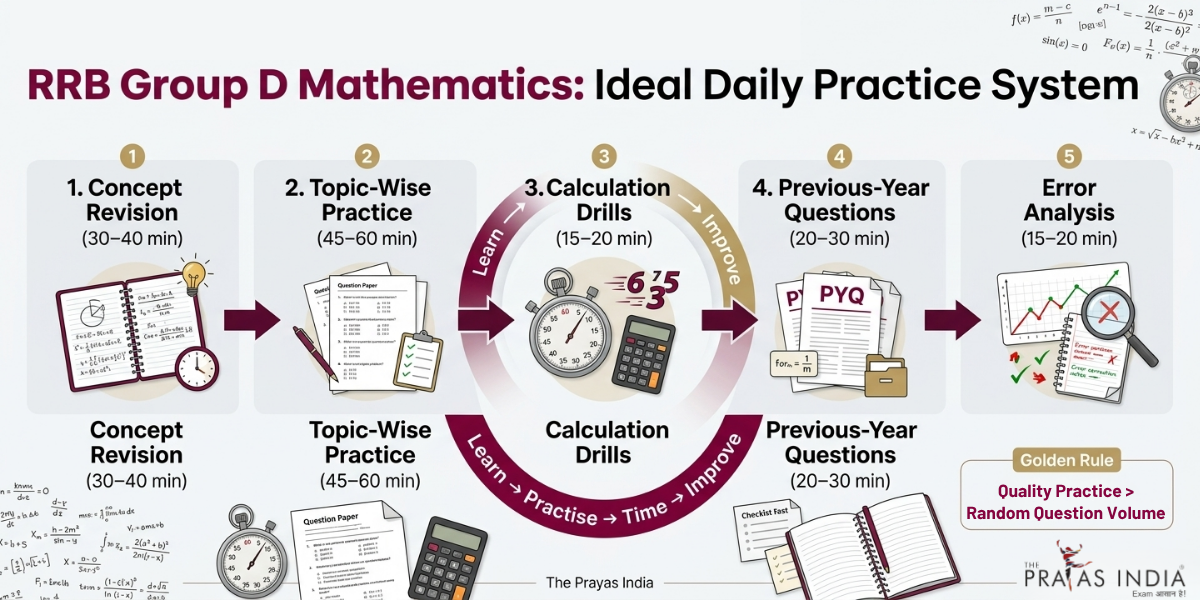
A practical daily structure could look like:
| Activity | Suggested Focus |
|---|---|
| Concept Revision | 30–40 minutes |
| Topic-Wise Questions | 45–60 minutes |
| Calculation Practice | 15–20 minutes |
| Previous-Year Questions | 20–30 minutes |
| Error Analysis | 15–20 minutes |
The numbers are flexible. If Mathematics is your weakest section, you may need more time. If it is already a strong area, you can reduce daily concept study and focus more on mixed practice and mocks.
The important principle is to include practice and analysis, not just passive learning.
Common Mathematics Preparation Mistakes RRB Group D Aspirants Should Avoid
Studying Only the Easy Chapters
Easy topics can provide confidence, but ignoring difficult or unfamiliar chapters can limit your overall score.
Build a balanced preparation plan.
Memorising Formulas Without Understanding Them
Formula memorisation without application leads to confusion when the question is presented differently.
Ignoring Calculation Practice
Slow calculations can consume valuable examination time even when your concepts are strong.
Solving Questions Without Timing Yourself
Untimed practice is useful initially, but eventually you must practise under time constraints.
Not Maintaining an Error Log
If you repeatedly make the same mistake, simply solving more questions will not necessarily solve the problem.
Taking Too Many Shortcuts
Shortcuts are useful only when they are reliable and understood.
Ignoring Previous-Year Questions
They provide valuable exposure to actual question styles and difficulty levels.
What Should You Do If Mathematics Is Your Weakest Subject?
Do not start by attempting the most difficult questions.
Begin with the fundamentals.
Select two or three foundational topics and build confidence through basic questions. Once your accuracy becomes stable, increase the difficulty.
For example, if Percentage is weak, first understand basic percentage conversions and increase/decrease concepts. Then move to Profit and Loss and Discount. This creates connections between topics and makes preparation more efficient.
The same principle can be applied to Time and Work, followed by Pipes and Cisterns, or basic Speed-Time-Distance concepts followed by more complex applications.
The objective is to convert a weak topic into a manageable one through progressive practice.
RRB Group D Mathematics Preparation Is About Consistency
Mathematics rarely improves through one long study session.
It improves when you return to the subject repeatedly.
A candidate who studies Mathematics for two hours every day with proper revision and analysis can often progress more effectively than someone who studies for six hours once or twice a week.
Consistency creates familiarity.
Familiarity improves recognition.
Recognition reduces solving time.
And reduced solving time creates the opportunity to attempt questions more confidently.
That is the foundation of effective RRB Group D Mathematics preparation.
A Practical Weekly Preparation Cycle
A weekly Mathematics routine can combine learning, revision and testing.
Monday–Tuesday: Learn and practise new concepts.
Wednesday: Continue topic-wise practice and revise earlier concepts.
Thursday: Solve mixed questions from completed topics.
Friday: Practise previous-year questions.
Saturday: Take a Mathematics sectional test.
Sunday: Analyse the test and revise weak areas.
The exact schedule can be adjusted around your other RRB Group D subjects, but the principle should remain the same: learning should always be followed by application and evaluation.
How to Increase Calculation Speed for RRB Group D
Calculation speed is one of the most practical skills an RRB Group D aspirant can develop. However, speed should not mean performing calculations carelessly. The objective is to reduce unnecessary steps while maintaining accuracy.
Start by improving your familiarity with basic calculations.
You should gradually become comfortable with:
- Multiplication tables
- Squares and commonly used square roots
- Fraction-to-percentage conversions
- Percentage equivalents
- Basic divisibility rules
- Common ratio relationships
- Decimal-to-fraction conversions
- Approximation techniques where appropriate
The purpose of this practice is to reduce the mental effort required for routine calculations.
For example, if you immediately recognise common percentage-fraction relationships, many arithmetic calculations become significantly shorter. Similarly, knowing basic squares can save time in questions involving square roots or algebraic calculations.
However, do not try to memorise hundreds of values. Focus on those that are repeatedly useful in competitive-exam calculations.
Learn Shortcuts Only After Understanding the Concept
Shortcuts can be extremely useful in RRB Group D Mathematics, but they should be introduced at the right stage.
A common mistake is to collect shortcuts from different sources without understanding why they work. This can create confusion when the question changes slightly.
The correct sequence is:
Learn the Standard Method → Solve Questions → Identify Patterns → Learn Shortcut → Verify It → Practise Under Time Pressure
For example, Percentage, Ratio, Average and Profit & Loss questions often contain patterns that allow faster calculations. Once you understand the underlying relationship, a shortcut becomes a useful tool rather than a memorised trick.
Your preparation should always remain flexible enough to return to the standard method if the shortcut does not apply.
How to Decide Which Mathematics Questions to Attempt
Knowing how to solve a question is not enough. You must also learn to identify whether the question is worth your time.
During a competitive examination, some questions may require several calculations while others can be solved almost immediately. Spending excessive time on one difficult problem can prevent you from attempting multiple manageable questions.
Develop a three-category approach.
Category A: Quick and Familiar
These are questions based on concepts you understand well and can solve with relatively little calculation.
Attempt these first.
Category B: Solvable but Time-Consuming
These questions may require multiple steps but are within your capability.
Attempt them after completing the quick questions.
Category C: Difficult or Unclear
These questions may involve unfamiliar concepts, lengthy calculations or confusing information.
Do not allow one such question to consume a disproportionate amount of your examination time.
This does not mean you should permanently skip difficult questions. It means you should make a conscious decision about when to attempt them.
The 30-Second Decision Rule
During practice, train yourself to make an early assessment of a question.
Within the first few seconds, ask:
Do I recognise the concept?
Do I know the method?
Does the calculation appear manageable?
If the answer to all three is yes, continue.
If the concept is familiar but the calculation looks lengthy, consider returning to it later.
If you do not understand the question or cannot identify the method, move ahead.
This skill develops through mock tests. It cannot be mastered simply by reading preparation material.
Mock Tests: The Most Important Performance Tool
Once you have covered a significant portion of the Mathematics syllabus, mock tests should become an integral part of your preparation.
A mock test serves several purposes.
It tells you:
- How many questions you can solve comfortably
- Which topics consume the most time
- Where calculation errors occur
- Which concepts are still weak
- Whether your accuracy changes under pressure
- How effectively you select questions
- Whether your preparation is translating into actual scores
However, the value of a mock depends heavily on what you do after completing it.
How to Analyse an RRB Group D Mathematics Mock
Do not simply check the final score and move on.
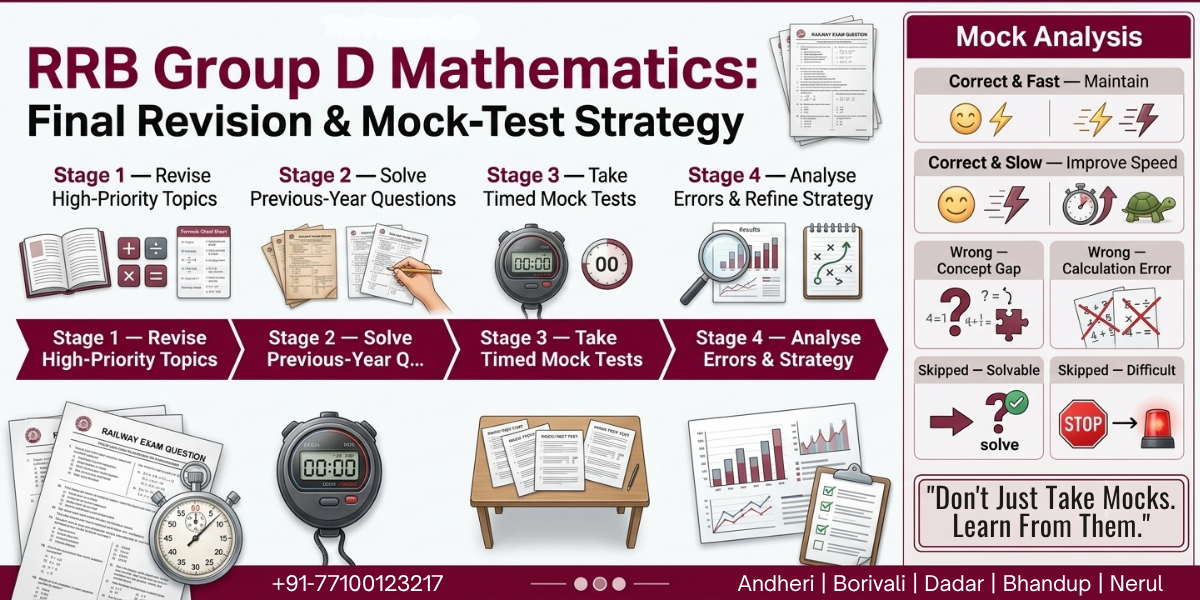
Divide your questions into categories.
| Question Type | Action |
|---|---|
| Correct + Fast | Maintain through revision |
| Correct + Slow | Find a faster method |
| Incorrect + Concept Error | Revise the topic |
| Incorrect + Calculation Error | Improve calculation discipline |
| Incorrect + Misread | Slow down question reading |
| Skipped + Solvable | Improve recognition/confidence |
| Skipped + Difficult | Review only if strategically useful |
This analysis creates a feedback loop.
Suppose you discover that you are consistently making mistakes in Percentage and Profit & Loss. Your next study session should focus on those areas rather than simply taking another random mock.
This is how mock tests become learning tools rather than just scorecards.
Don’t Let a Low Mock Score Discourage You
Mock-test scores can fluctuate.
A difficult paper, unfamiliar question set or poor time management on one day can lead to a lower score. That does not necessarily mean your preparation has failed.
Instead, look for patterns across multiple tests.
If your accuracy is improving, your average solving time is decreasing and your mistakes are becoming less repetitive, your preparation is progressing—even if the total score has not yet reached your target.
The objective of mock tests is to identify problems before the actual examination.
A mistake in a mock is useful if you understand it and prevent it from recurring.
Topic-Wise Revision Strategy
Revision should not mean rereading entire chapters repeatedly.
Use active revision.
For each topic, try to recall:
Key Formula → Core Concept → Common Question Type → Common Mistake → Fastest Reliable Method
For example, while revising Time and Work, you should remember the relationship between work and rate, understand how combined work is calculated and recognise the common formats in which the concept is tested.
This form of revision is more useful than simply reading the formula again.
High-Priority Topics for Final Revision
As the examination approaches, candidates should spend more time on topics that provide a strong return on preparation.
Priority should generally be given to fundamental arithmetic and topics in which you have repeatedly encountered questions during practice and mocks.
A practical revision structure can include:
Arithmetic
Percentage, Ratio, Average, Profit & Loss, Interest, Time & Work, Pipes & Cisterns, Time-Speed-Distance and Ages.
Fundamentals
Number System, BODMAS, Fractions, Decimals, LCM, HCF and basic calculations.
Geometry and Mensuration
Revise important formulas and practise standard question types.
Other Areas
Algebra, Trigonometry, Data Interpretation, Calendar, Clock and Statistics should be revised according to your individual performance and the expected examination requirements.
The exact priority should be adjusted based on your mock-test analysis.
A 30-Day RRB Group D Mathematics Revision Plan
If you have approximately one month remaining before the examination, your preparation should become increasingly focused.
Days 1–7: Foundation
Revise Number System, BODMAS, Fractions, Decimals, LCM, HCF, Percentage and Ratio.
Focus heavily on conceptual clarity.
Days 8–14: Core Arithmetic
Cover Average, Profit & Loss, Discount, Simple Interest, Compound Interest, Time & Work and Pipes & Cisterns.
Practise both standard and previous-year-style questions.
Days 15–21: Application and Speed
Work on Time-Speed-Distance, Ages, Partnership, Mensuration, Geometry and other relevant topics.
Introduce more timed practice.
Days 22–26: Mixed Practice
Stop studying topics in isolation.
Solve mixed sets containing questions from different chapters.
This trains your brain to identify the correct concept without being told which chapter the question belongs to.
Days 27–30: Mock Tests and Final Revision
Take full-length or sectional tests according to your preparation schedule.
Analyse every error.
Revise formulas, shortcuts and frequently repeated mistakes.
Avoid learning large amounts of new material at the last moment.
How to Maintain Accuracy While Increasing Speed
One of the biggest challenges during RRB Group D preparation is the tendency to become careless after practising shortcuts.
Remember that speed should come from efficiency, not from skipping important steps.
A useful practice method is to maintain two separate targets.
Accuracy Target
Initially, try to solve questions correctly even if the process is slightly slower.
Speed Target
Once accuracy is stable, gradually reduce the time taken.
For example, if you consistently solve a particular question type correctly in 90 seconds, work toward 75 seconds and then 60 seconds through repeated practice.
Do not attempt to reduce the time dramatically in one session.
Gradual improvement is more sustainable.
Use a “Mistake Bank” Instead of Just a Formula Book
Most candidates maintain formula notebooks. Fewer maintain a proper mistake bank.
A mistake bank can be even more useful.
Whenever you make an important error, record:
Question Type → Your Mistake → Correct Concept → Better Method → Prevention Rule
For example:
Profit & Loss → Used wrong base for percentage → Profit percentage is calculated with reference to Cost Price → Recheck the base before calculation → Underline CP/SP before solving.
After several weeks, you will have a personalised collection of the exact mistakes that are most likely to affect your score.
Revise this before every mock.
Why Previous-Year Questions Should Be Repeated
Do not assume that solving a previous-year question once means you have mastered the concept.
If a question exposes an important concept, revisit the same concept later.
You can even create a three-step revision cycle:
First Attempt → Review After 3–4 Days → Reattempt After 1–2 Weeks
This helps determine whether you genuinely understood the method or merely remembered the answer.
The goal is not to memorise previous-year questions. It is to become familiar with the underlying patterns and concepts.
How to Prepare Mathematics Alongside Other RRB Group D Subjects
Mathematics should not consume your entire preparation schedule.
RRB Group D preparation requires balanced attention across the relevant sections. Create a daily timetable where Mathematics receives a fixed amount of focused time while other subjects are covered separately.
For example, your day might include:
Mathematics → General Intelligence & Reasoning → General Science → General Awareness/Current Affairs → Revision/Test
The exact distribution depends on your individual strengths.
If Mathematics is your weakest section, temporarily allocate additional time to it. Once it becomes stable, rebalance your schedule.
The objective is to improve the overall examination score, not to maximise preparation time for one subject.
What to Do If You Keep Making Calculation Mistakes
Repeated calculation errors are usually not a sign that you cannot do Mathematics. They often indicate that your solving process is not disciplined enough.
Try these steps:
Read Before Calculating
Do not start operations before understanding what the question asks.
Write Clearly
Messy calculations increase the possibility of copying a number incorrectly.
Track Units
Be especially careful when the question involves kilometres and metres, hours and minutes, kilograms and grams or other unit conversions.
Estimate When Possible
An approximate answer can sometimes help you detect an obviously incorrect calculation.
Recheck Strategically
Do not re-solve every question. Recheck calculations where an error would be costly or where the answer appears inconsistent.
Choosing the Right RRB Coaching in Mumbai
For many aspirants, the challenge is not only preparing for Mathematics but also maintaining a structured routine across the entire RRB Group D syllabus.
If you are considering joining an RRB coaching institute in Mumbai, evaluate the preparation system rather than choosing solely on brand visibility or promotional claims.
Look for:
- Experienced faculty
- Structured syllabus coverage
- Topic-wise practice
- Previous-year question discussion
- Regular sectional tests
- Full-length mock tests
- Detailed performance analysis
- Doubt-solving support
- Revision sessions
- Study material aligned with the examination
- Guidance on time management and question selection
A coaching programme should help you answer a practical question:
“How will this institute help me improve my score?”
If the answer is based only on classes and study material, the preparation system may be incomplete.
The most effective programmes connect teaching → practice → testing → analysis → improvement.
How The Prayas India Can Support RRB Group D Aspirants
The Prayas India focuses on structured preparation for competitive examinations, helping aspirants build their concepts while gradually developing speed, accuracy and examination confidence.
For RRB Group D aspirants, structured guidance can be especially useful when the syllabus feels broad and candidates are unsure about how to prioritise topics.
Instead of studying everything randomly, students can follow a planned progression from fundamentals to application and finally to examination-level practice.
For Mathematics, this means understanding the core concepts, solving topic-wise questions, identifying recurring mistakes, practising calculations and using mock tests to evaluate performance.
The purpose of coaching should not be to make students dependent on shortcuts. It should help them understand why a method works, when to use it and how to apply it efficiently under exam conditions.
For candidates looking for RRB coaching in Mumbai, this structured approach can provide the consistency and accountability required for long-term competitive-exam preparation.
Questions to Ask Before Joining an RRB Coaching Institute
Before enrolling, aspirants should ask a few practical questions.
Is the syllabus completed systematically?
A coaching institute should have a clear plan rather than moving randomly between topics.
Are there regular tests?
Without testing, it is difficult to measure whether classroom learning is translating into performance.
Is test analysis provided?
A score alone is not enough. Students should understand where they lost marks.
Are doubts addressed?
Unresolved doubts can become repeated mistakes.
Is there revision support?
Competitive-exam preparation requires repeated revision.
Does the teaching focus on examination application?
The best preparation connects concepts with the actual demands of the examination.
These questions can help aspirants make a more informed decision when choosing RRB coaching in Mumbai.
RRB Group D Mathematics Exam-Day Strategy
Your preparation strategy should ultimately lead to a clear examination-day approach.
Do not enter the exam with the intention of attempting every Mathematics question.
Instead, aim to maximise net correct answers within the available time.
Begin by identifying familiar questions.
Solve straightforward problems confidently.
Do not allow a difficult question to interrupt your rhythm.
If a question requires unusually lengthy calculations and you are uncertain about the method, move ahead and return to it later if time permits.
Keep your calculations organised.
Read carefully before selecting the answer.
And most importantly, do not allow one difficult question to affect your confidence for the rest of the section.
The Final 7-Day RRB Group D Mathematics Strategy
During the final week, your focus should shift from learning to consolidation.
Revise
Review important formulas, concepts and shortcuts.
Practise
Solve mixed question sets instead of only chapter-wise questions.
Test
Take timed sectional or full-length mocks.
Analyse
Identify recurring mistakes.
Correct
Revise the exact concepts responsible for those mistakes.
Repeat
Take another test and check whether the error has disappeared.
This cycle is much more productive than continuously collecting new study material.
Final Takeaway: Make Mathematics a Scoring Section
RRB Group D Mathematics does not require candidates to be mathematical geniuses. It requires conceptual clarity, regular practice, calculation discipline, question selection and consistent revision.
The strongest preparation strategy is therefore not:
“Solve as many questions as possible.”
It is:
“Understand the concept, practise intelligently, identify mistakes, improve speed and test yourself repeatedly.”
Start with the fundamentals. Build arithmetic strength. Improve calculation speed gradually. Use shortcuts only after understanding the standard method. Practise previous-year questions. Take regular mocks. Analyse every important mistake.
And remember that your mock-test score is not the final objective. The real objective is to create a preparation process that continuously improves your performance.
For aspirants preparing for RRB Group D in Mumbai, the right coaching environment can add structure, expert guidance and accountability to this process. The Prayas India aims to help competitive-exam aspirants prepare through an organised, practice-driven and examination-focused approach.
With consistent preparation, Mathematics can move from being a difficult section to becoming one of your most reliable scoring opportunities.
Learn the concept. Practise the method. Improve the speed. Protect the accuracy.
That is the foundation of effective RRB Group D Mathematics preparation.
Contact Us
📞 Call Now: +91-77100 13217
🌐 Website: theprayasindia.com
📍 Centres: Andheri | Borivali | Dadar | Nerul | Bhandup
Frequently Asked Questions
1. How should I start RRB Group D Mathematics preparation?
Begin with fundamental topics such as Number System, BODMAS, Fractions, Decimals, LCM, HCF and basic arithmetic. Once the fundamentals are strong, move toward Percentage, Ratio, Average, Profit & Loss, Interest, Time & Work and Time-Speed-Distance.
2. Which Mathematics topics are important for RRB Group D?
Important preparation areas include Number System, BODMAS, Fractions, Decimals, LCM & HCF, Percentage, Ratio & Proportion, Average, Profit & Loss, Interest, Time & Work, Pipes & Cisterns, Time-Speed-Distance, Ages, Mensuration, Geometry, Algebra, Trigonometry, Data Interpretation, Calendar, Clock and Statistics.
3. How can I improve my calculation speed for RRB Group D?
Practise basic calculations regularly, learn useful fraction-percentage conversions, improve familiarity with tables and squares, and gradually introduce reliable shortcuts after understanding the standard methods.
4. Should I use shortcuts in RRB Group D Mathematics?
Yes, shortcuts can save time, but only when you understand the underlying concept. Learn the standard method first and then use shortcuts to improve efficiency.
5. How important are mock tests for RRB Group D Mathematics?
Mock tests are essential for evaluating speed, accuracy, question selection and time management. More importantly, analysing your mistakes after every test helps you identify and correct recurring weaknesses.
6. How can I reduce calculation mistakes?
Read the question carefully, organise calculations clearly, track units, avoid unnecessary rushing and review your mistake patterns. Maintaining a personal mistake bank can also help prevent repeated errors.
7. Can an average student score well in RRB Group D Mathematics?
Yes. Mathematics performance can improve significantly through consistent practice. You do not need exceptional mathematical ability; you need strong fundamentals, regular practice and disciplined exam preparation.
8. Should I join RRB coaching in Mumbai?
Coaching can be useful for aspirants who want structured syllabus coverage, faculty guidance, regular tests, doubt resolution and performance analysis. Before joining, evaluate the complete preparation system rather than choosing only on promotional claims.
9. How can The Prayas India help with RRB Group D preparation?
The Prayas India provides structured competitive-exam preparation with an emphasis on concepts, practice, testing, speed, accuracy and exam strategy. This can help RRB Group D aspirants follow a more organised preparation routine.