RRB NTPC 2026 Reasoning Preparation: Important Topics & Practice Strategy | The Prayas India
RRB NTPC 2026 preparation requires a balanced approach across General Awareness, Mathematics and General Intelligence & Reasoning. Among these sections, Reasoning can become a highly manageable and scoring area when candidates develop the ability to recognise patterns, understand logical relationships and solve questions within a limited amount of time.
For many aspirants, the difficulty in Reasoning is not necessarily the complexity of individual questions. The bigger challenge is identifying the correct approach quickly. A candidate may know how to solve a coding-decoding question but still lose valuable time if they spend too long identifying the pattern. Similarly, a candidate may understand syllogism but make avoidable mistakes because of rushed conclusions.
The current RRB NTPC 2026 recruitment cycle has announced 5,165 vacancies, comprising 3,477 Graduate-level vacancies and 1,688 Undergraduate-level vacancies. With a large number of candidates expected to compete for these posts, systematic preparation across all three CBT sections is important.
Reasoning preparation should therefore begin with conceptual clarity and gradually move towards topic-wise practice, mixed question sets, timed tests and detailed error analysis.
This article explains the major RRB NTPC Reasoning topics, how beginners should approach them, how to improve speed and accuracy, and how a structured preparation programme can help aspirants prepare more systematically for the examination.
RRB NTPC Notification 2026 Out!
The Railway Recruitment Board has officially announced 5,165 vacancies for both Graduate and Undergraduate posts. Check out the complete details including eligibility, dates, and salary structure.
RRB NTPC 2026 Reasoning: Understand the Exam Pattern First
Before preparing individual Reasoning topics, candidates should understand the role of General Intelligence and Reasoning in the RRB NTPC examination.
In CBT 1, General Intelligence and Reasoning contains 30 questions for 30 marks. CBT 1 consists of 100 questions in total and has a duration of 90 minutes.
In CBT 2, General Intelligence and Reasoning contains 35 questions for 35 marks. CBT 2 consists of 120 questions in total and also has a duration of 90 minutes.
The examination includes one-third negative marking for every incorrect answer. This makes accuracy an essential part of Reasoning preparation.
RRB NTPC Reasoning at a Glance
| Examination | Reasoning Questions | Reasoning Marks | Total Questions | Duration |
|---|---|---|---|---|
| CBT 1 | 30 | 30 | 100 | 90 minutes |
| CBT 2 | 35 | 35 | 120 | 90 minutes |
The objective should not simply be to attempt as many questions as possible. Candidates should develop the ability to identify questions they can solve quickly, avoid unnecessary time-consuming questions and maintain a high level of accuracy.
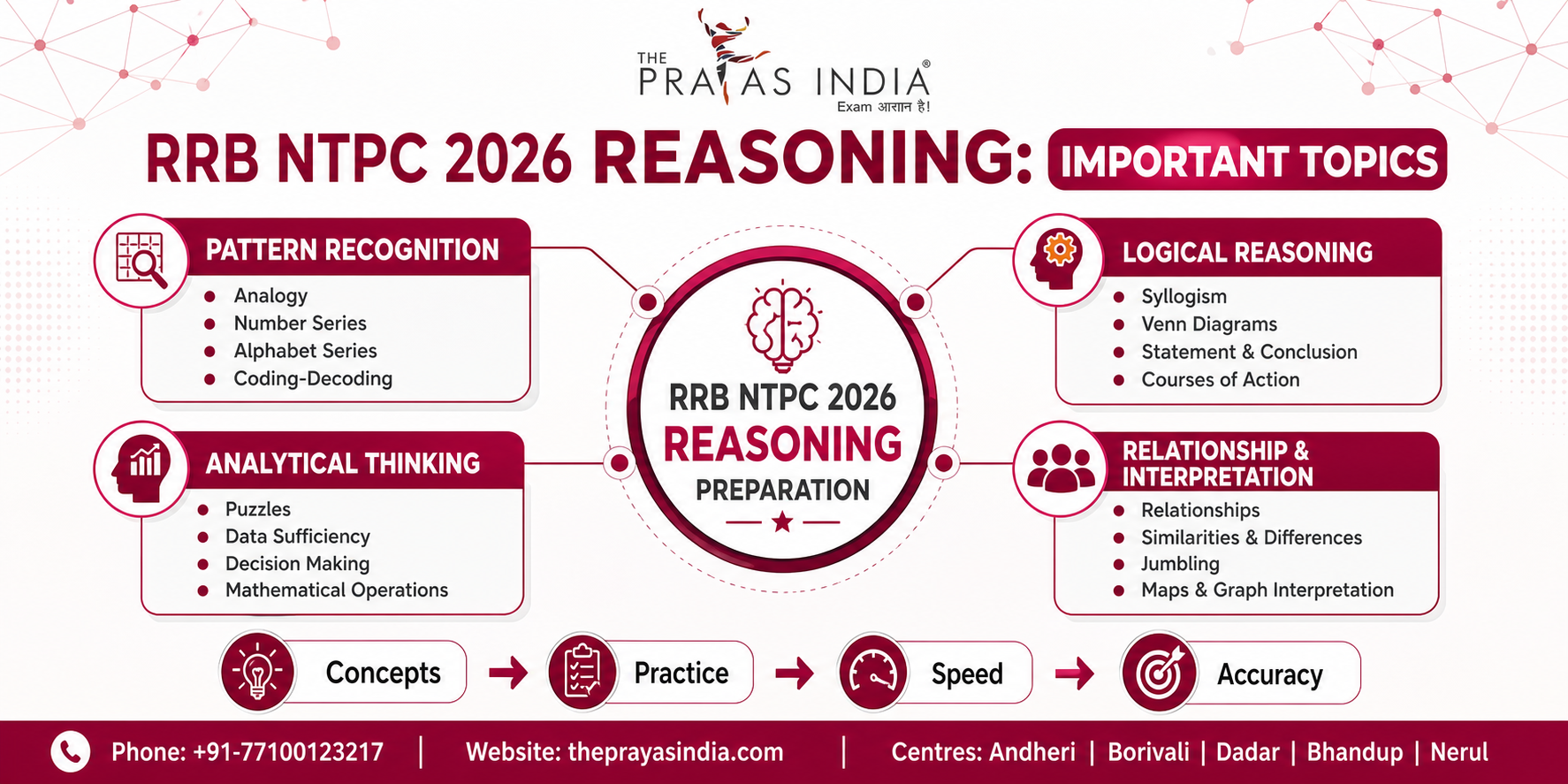
RRB NTPC Reasoning Syllabus: Important Topics
The RRB NTPC Reasoning syllabus includes a broad range of logical and analytical topics.
Important areas include:
- Analogies
- Mathematical Operations
- Similarities and Differences
- Relationships
- Number Series
- Alphabet Series
- Coding-Decoding
- Analytical Reasoning
- Syllogism
- Jumbling
- Venn Diagrams
- Puzzles
- Data Sufficiency
- Statement and Conclusion
- Statement and Courses of Action
- Decision Making
- Maps
- Graph Interpretation
Rather than treating these as completely separate chapters, candidates should group them according to the skills they require.
For example, number series and alphabet series require pattern recognition, while syllogism and statement-conclusion require logical interpretation. Puzzles require arrangement skills and systematic elimination.
This classification makes preparation more organised.
1. Analogy: Learn to Identify Relationships
Analogy questions test whether you can identify a relationship between two objects and apply the same relationship to another pair.
Questions can involve:
- Words
- Numbers
- Letters
- Symbols
- General relationships
The biggest mistake candidates make is looking only at surface similarities.
For example, if a question presents two numbers, you need to determine whether the relationship involves addition, subtraction, multiplication, division, squares, cubes or another numerical pattern.
How to Prepare Analogy
Begin with simple relationships and gradually move towards more complex patterns.
When practising, ask yourself:
“What exact relationship connects the first pair?”
Once that relationship is identified, apply the same logic to the second pair.
Regular practice is important because analogy questions can often be solved quickly once the underlying patterns become familiar.
2. Similarities and Differences
These questions require candidates to compare objects, words, numbers or concepts and identify the relevant relationship.
The challenge is often not the calculation but careful observation.
Focus on:
- Common properties
- Distinct properties
- Classification
- Logical comparison
- Numerical relationships
Do not rush through these questions. A small detail can completely change the answer.
With practice, candidates become better at filtering irrelevant information and focusing on the characteristic that actually matters.
3. Number Series: Develop Pattern Recognition
Number Series is one of the topics where practice can directly improve speed.
A sequence may follow patterns involving:
- Addition
- Subtraction
- Multiplication
- Division
- Squares
- Cubes
- Alternating operations
- Increasing differences
- Combined patterns
For example, a series may not follow the same operation between every two consecutive numbers. The pattern could alternate between two different operations.
Best Practice Method
Do not immediately calculate every possible operation.
First observe:
- Difference between consecutive numbers
- Difference between differences
- Multiplication or division patterns
- Alternating operations
- Relationship with squares or cubes
Train yourself to check the simplest possible pattern first.
4. Alphabet Series: Improve Letter Familiarity
Alphabet-based questions become much easier when candidates are comfortable with letter positions.
You should know the position of each letter and be able to move forward or backward quickly.
Important areas include:
- Letter positions
- Forward and backward counting
- Alphabetical arrangement
- Missing letters
- Letter-number relationships
- Mixed alphabet patterns
Speed-Building Tip
Regularly practise alphabet positions mentally.
The objective is to reduce the time required for basic letter calculations so that more time is available for complicated questions.
5. Coding-Decoding: Focus on the Pattern
Coding-Decoding questions can appear in different formats. A word, number or sequence may be transformed according to a specific rule, and you have to identify that rule.
Common patterns include:
- Letter shifting
- Reverse order
- Number substitution
- Position-based coding
- Symbol-based coding
- Mixed coding
How to Prepare
Do not memorise individual examples.
Instead, understand the transformation mechanism.
When you see a coded word, compare the original and coded forms carefully. Check whether each letter has moved forward, backward, changed according to its position or followed another consistent rule.
Once you identify the rule, apply it systematically.
6. Mathematical Operations: Practise Logical Substitution
Mathematical Operations questions often replace standard mathematical symbols with different operations.
For example, a question may assign a particular operation to a symbol and ask you to evaluate an expression using those rules.
The challenge is reading the instructions correctly.
Preparation Strategy
Follow this sequence:
Understand symbol replacement → Rewrite the expression → Apply the correct mathematical order → Calculate
Avoid solving directly in your head when the expression is complicated. Rewriting the expression can reduce mistakes.
7. Syllogism: Build a Logical Framework
Syllogism questions can initially seem confusing because the statements and conclusions may not represent real-world situations.
The key is to evaluate the logical relationship given in the question rather than using personal assumptions.
Focus on:
- Statements
- Conclusions
- All/Some/No relationships
- Possibility-based conclusions
- Diagram-based understanding
How to Prepare Syllogism
Use Venn diagrams or another consistent logical representation while learning.
Once you understand the relationships, practise questions without relying excessively on diagrams where the relationships are already obvious.
The goal is to move from conceptual understanding to quick logical evaluation.
8. Venn Diagrams: Understand Overlapping Relationships
Venn Diagram questions test relationships between groups or categories.
They are useful for understanding:
- Common elements
- Separate groups
- Overlapping groups
- Subsets
- Multiple-category relationships
The best way to learn this topic is visually.
Draw the groups and identify where each category belongs.
With regular practice, you can become faster at identifying the required relationship without overthinking the diagram.
9. Blood Relations and Relationships
Relationship-based questions test your ability to understand family or relational connections.
These questions can become confusing when several people are introduced in one statement.
The most effective method is to convert the information into a simple relationship structure.
For example:
A is the brother of B → B is the daughter of C → C is the mother of D
Instead of repeatedly reading the statements, create a small relationship diagram.
Important Tip
Do not assume gender or relationship information that is not explicitly provided.
Read every statement carefully before reaching a conclusion.
10. Puzzles: Learn to Organise Information
Puzzles can consume a significant amount of time if approached randomly.
They may involve:
- Arrangements
- Positions
- Ordering
- Grouping
- Scheduling
- Multiple conditions
- Logical constraints
The most important skill is organising information.
A Better Puzzle Strategy
Start by identifying:
What is fixed?
Then identify:
What can be directly placed?
After that:
What relationships or restrictions must be followed?
Create a table, sequence or diagram rather than keeping every condition in your head.
The goal is to convert a lengthy paragraph into a structured visual representation.
11. Data Sufficiency: Learn What Information Is Actually Needed
Data Sufficiency questions are not always about calculating the final answer. The objective is to determine whether the information provided is sufficient to answer the question.
This distinction is extremely important.
Candidates often waste time solving the entire problem even when the question only asks whether the available information is sufficient.
Preparation Strategy
Read the question first.
Then evaluate each statement separately and in combination.
Ask:
“Can I determine the required answer from this information?”
If yes, stop. There is no need to perform unnecessary calculations.
12. Statement and Conclusion
These questions test whether a conclusion logically follows from a given statement.
The biggest mistake is using outside knowledge.
You must work only with the information and logical relationships provided in the question.
How to Practise
Read the statement carefully and identify exactly what it says.
Then evaluate each conclusion independently.
Avoid assumptions based on personal beliefs, general knowledge or what you think “should” be true.
The correct answer is based on the logical information provided.
13. Statement and Courses of Action
These questions present a situation and possible actions.
The candidate has to determine which action logically follows from the situation.
When preparing this topic, focus on whether the proposed action:
- Addresses the stated problem
- Is practical
- Is directly connected to the situation
- Follows logically from the information provided
Do not choose an action simply because it sounds positive or desirable.
14. Decision Making: Practise Logical Evaluation
Decision-making questions require candidates to evaluate conditions and arrive at the appropriate conclusion.
These questions reward careful reading.
Instead of immediately choosing an answer, identify:
- The conditions
- The available choices
- Any restrictions
- The logical outcome
The more questions you practise, the easier it becomes to identify the relevant information quickly.
15. Maps and Graph Interpretation
Maps and graph-based questions require candidates to understand visual information and convert it into a logical answer.
Focus on:
- Directions
- Relative positions
- Distance relationships
- Routes
- Graph-based comparisons
- Visual interpretation
Draw the relevant structure if necessary.
Do not spend excessive time trying to visualise complicated relationships entirely in your head.
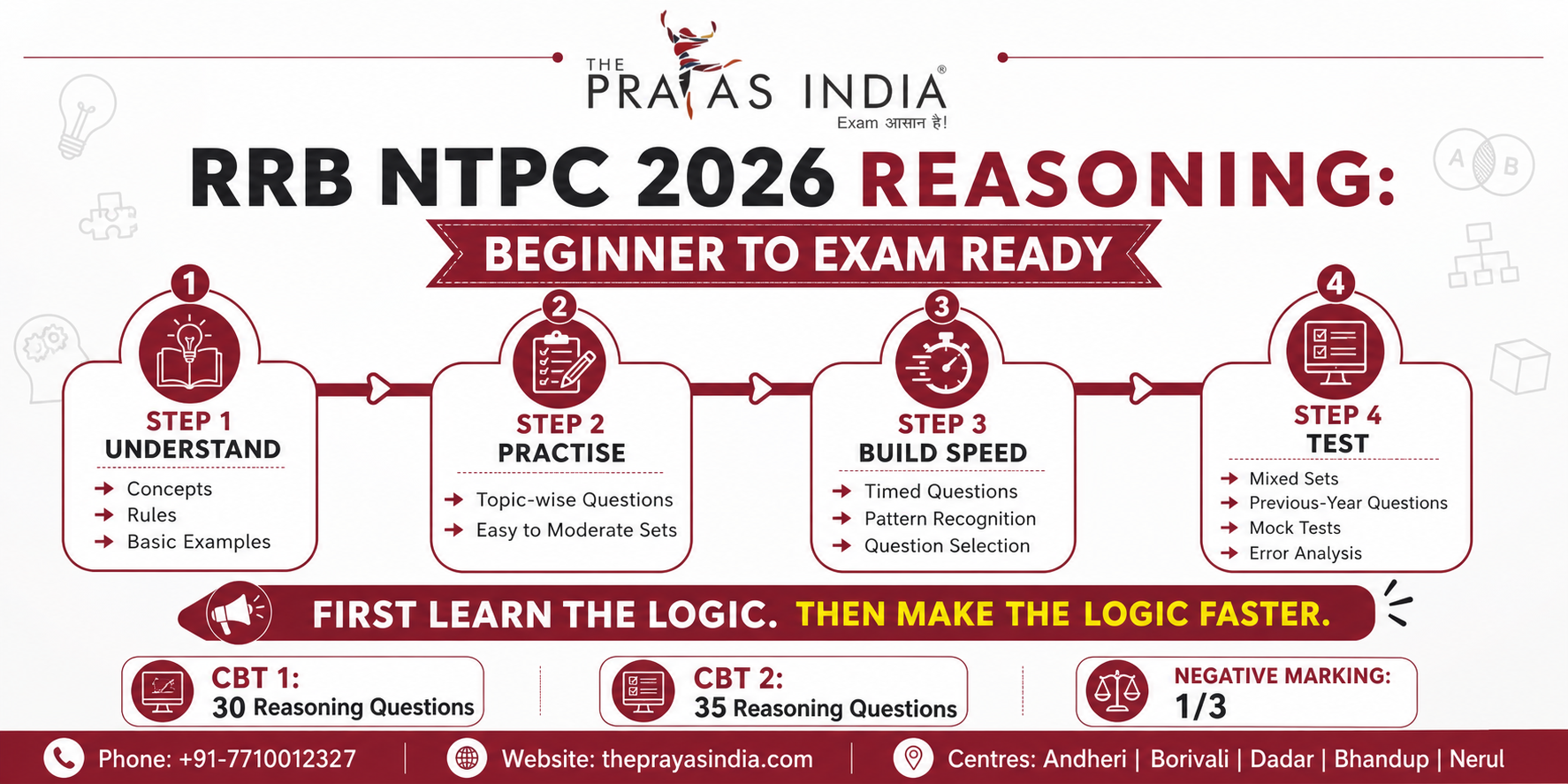
RRB NTPC Reasoning Preparation Strategy for Beginners
Candidates starting from zero should not immediately attempt difficult puzzles or complicated logical arrangements.
Start with topics where the basic concepts can be understood quickly.
A practical sequence is:
Phase 1: Basic Pattern Recognition
Start with:
- Analogy
- Similarities and Differences
- Number Series
- Alphabet Series
These topics help develop pattern-recognition skills.
Phase 2: Logical Relationships
Move towards:
- Coding-Decoding
- Mathematical Operations
- Relationships
- Venn Diagrams
- Syllogism
Phase 3: Analytical Reasoning
Then focus on:
- Puzzles
- Data Sufficiency
- Statement and Conclusion
- Decision Making
- Courses of Action
Phase 4: Mixed Practice
Once individual topics are comfortable, solve mixed sets.
This is important because the actual examination will not identify the topic for you.
You have to recognise the question type yourself.
How to Improve Reasoning Speed for RRB NTPC 2026
Reasoning speed improves when your brain becomes familiar with recurring patterns.
This does not mean memorising answers. It means reducing the time required to identify the approach.
For example, after solving several number-series questions, you may automatically start checking differences before trying complicated calculations.
Similarly, after practising coding-decoding, you become faster at checking letter positions and transformations.
Use the Three-Second Recognition Habit
When you see a Reasoning question, quickly ask:
What type of question is this?
Then:
What method does this type usually require?
This simple habit can save time during the examination.
RRB NTPC Reasoning: Accuracy vs Speed
Speed without accuracy can reduce your score.
Since there is one-third negative marking, candidates should not attempt questions blindly simply because they want a higher attempt count.
A useful practice framework is:
First target accuracy.
Once you can solve a topic consistently correctly:
Introduce time limits.
Then:
Reduce the time gradually while maintaining accuracy.
This approach is better than immediately forcing yourself to solve questions at maximum speed.
How to Practise Reasoning Questions Daily
A structured daily routine can make Reasoning preparation more effective.
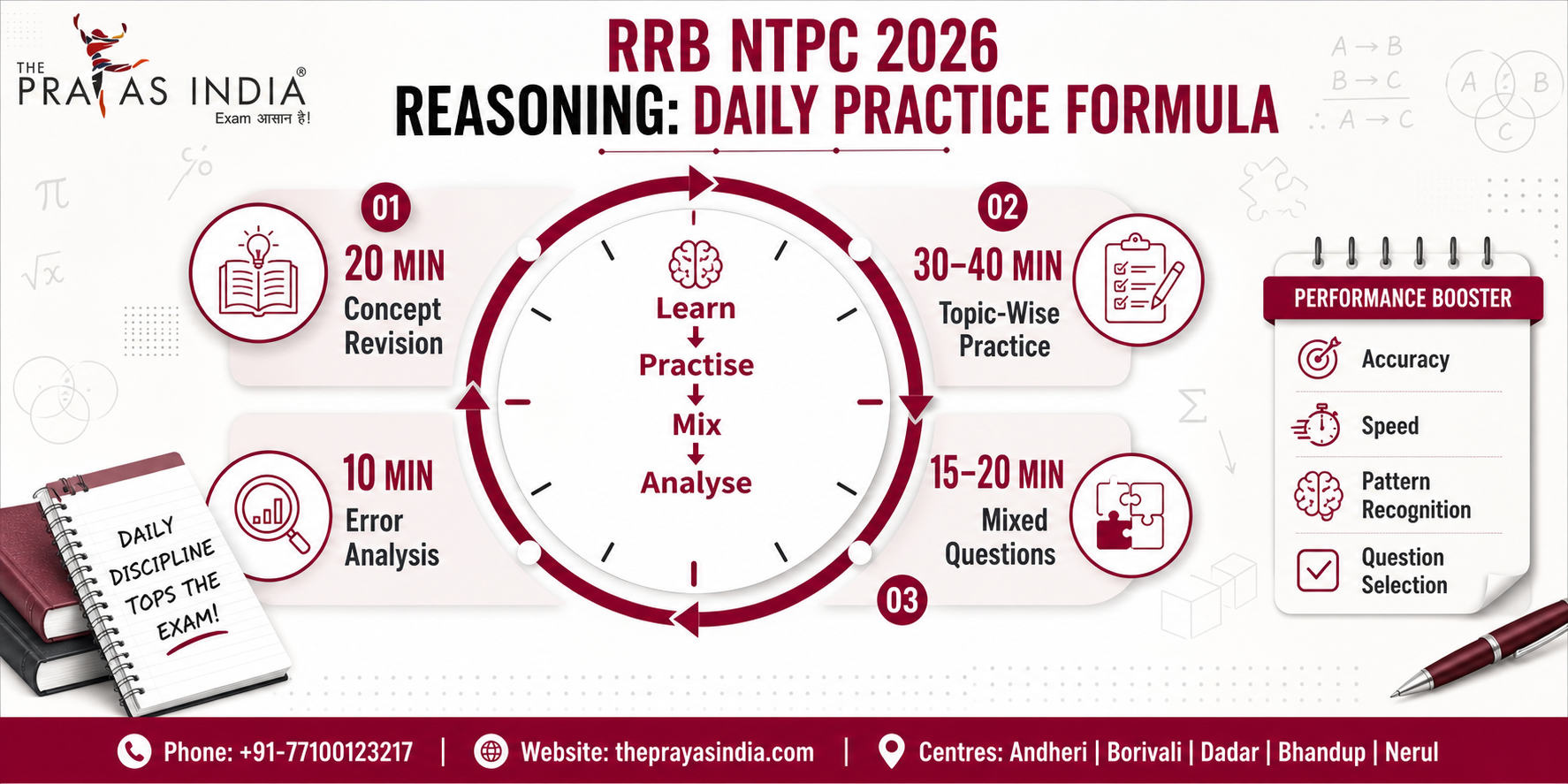
For example, if you have around 60–90 minutes available for Reasoning, divide your session into different activities.
20 Minutes: Concept Revision
Study the concept or revise the method for the topic you are currently covering.
30–40 Minutes: Topic-Wise Practice
Solve questions from the same topic.
Focus on understanding why each answer is correct.
15–20 Minutes: Mixed Questions
Attempt questions from previously completed topics.
This helps maintain retention.
10 Minutes: Error Analysis
Review your mistakes and identify the reason.
This final stage should not be skipped.
RRB NTPC Reasoning Mock Test Strategy
Mock tests are essential because Reasoning preparation is not complete until you can perform under examination conditions.
However, taking a mock test without analysing it reduces its value.
After each test, classify your questions.
Category 1: Correct and Fast
These are your strong areas.
Maintain them through periodic revision.
Category 2: Correct but Slow
These questions show that your concept is clear but your execution needs improvement.
Practise similar questions with a time limit.
Category 3: Incorrect
Identify whether the problem was:
- Conceptual
- Calculation-related
- Reading-related
- Logical
- Caused by rushing
Category 4: Not Attempted
Find out why you skipped the question.
Was it too difficult? Did you run out of time? Did you fail to recognise the question type?
This analysis can help you improve your examination strategy.
Use Previous-Year Questions as a Preparation Tool
Previous-year questions should form an important part of RRB NTPC Reasoning preparation.
They can help you understand:
- Common question structures
- Recurring concepts
- Difficulty patterns
- Question wording
- Time requirements
But candidates should not assume that the exact same questions will appear again.
The purpose of previous-year questions is to understand the examination pattern and practise applying concepts.
Recommended Approach
Concept → Topic Practice → Previous-Year Questions → Mixed Sets → Mock Tests
This sequence allows you to progress from learning to actual exam performance.
Create a Reasoning Error Notebook
Reasoning mistakes can be very specific.
One candidate may repeatedly make mistakes in syllogism, while another may struggle with coding-decoding or puzzles.
Create an error notebook divided into topics.
For every important mistake, record:
Question Type
Your Approach
Where You Went Wrong
Correct Logic
Lesson for Future Questions
Before taking a mock test, revise these errors.
Over time, your error notebook becomes one of the most personalised resources in your preparation.
How to Approach RRB NTPC Reasoning During the Exam
Your examination strategy should depend on your strengths and the difficulty of the paper.
A practical approach is to first scan the questions and identify the ones that appear straightforward.
You can prioritise questions from familiar areas such as:
- Analogy
- Series
- Coding-Decoding
- Mathematical Operations
- Basic Relationships
- Simple Venn Diagrams
More time-consuming puzzles or analytical questions can be handled later if required.
However, there is no universal sequence that every candidate must follow. Your mock-test performance should determine the order that works best for you.
The important principle is:
Do not allow one difficult question to consume the time required for several easier questions.
Common Mistakes Candidates Make in RRB NTPC Reasoning Preparation
1. Solving Without Understanding the Logic
Candidates sometimes memorise patterns from solved examples without understanding why the answer works.
This becomes a problem when the question is modified.
2. Spending Too Much Time on Puzzles
A difficult puzzle can consume several minutes.
Learn to recognise when a question is becoming unnecessarily time-consuming.
3. Ignoring Easy Topics
Some candidates focus entirely on puzzles because they appear challenging and neglect easier topics.
Complete coverage matters.
4. Practising Only One Topic
The examination contains multiple Reasoning concepts. Topic-wise practice should eventually be followed by mixed practice.
5. Not Analysing Mistakes
A wrong answer should become a learning opportunity.
If you repeatedly make the same mistake, solving more questions without analysing the error may not solve the underlying problem.
6. Chasing Speed Too Early
Speed should come after understanding.
First become accurate, then become faster.
30-Day RRB NTPC Reasoning Preparation Plan
Candidates who want a structured short-term strategy can divide the syllabus into phases.
Days 1–5: Pattern Recognition
Cover:
- Analogy
- Similarities and Differences
- Number Series
- Alphabet Series
Days 6–10: Coding and Basic Logic
Cover:
- Coding-Decoding
- Mathematical Operations
- Relationships
- Jumbling
Days 11–15: Logical Reasoning
Cover:
- Syllogism
- Venn Diagrams
- Statement and Conclusion
- Courses of Action
Days 16–21: Analytical Reasoning
Focus on:
- Puzzles
- Data Sufficiency
- Decision Making
- Maps
- Graph Interpretation
Days 22–25: Mixed Practice
Solve mixed Reasoning sets containing questions from all completed topics.
Days 26–30: Tests and Analysis
Attempt sectional tests and full-length mocks.
After every test, analyse:
- Wrong questions
- Slow questions
- Unattempted questions
- Weak topics
- Repeated mistakes
Use the final days to revise your weak areas rather than starting multiple new resources.
How Coaching Can Help in RRB NTPC Reasoning Preparation
Reasoning is a section where structured practice can be particularly useful because candidates need to develop both conceptual understanding and question-solving speed.
A structured RRB NTPC preparation programme can provide a planned sequence of topics, regular practice, doubt resolution, mock tests and performance analysis.
For beginners, guided learning can make it easier to understand topics such as syllogism, coding-decoding, puzzles and statement-based reasoning. For experienced candidates, test-based practice and performance analysis can help identify specific weaknesses.
However, coaching should work alongside individual practice. Candidates still need to solve questions regularly, analyse their mistakes and revise concepts.
For aspirants preparing for RRB NTPC 2026, The Prayas India offers a structured preparation environment designed around competitive-exam learning and practice. Candidates can explore the available RRB NTPC programme and select a preparation approach that fits their learning requirements.
Final Strategy for RRB NTPC 2026 Reasoning
Reasoning preparation becomes much easier when you stop treating it as a collection of unrelated questions.
Most Reasoning questions test your ability to identify relationships, recognise patterns, interpret information and apply a logical process.
Start with easier pattern-based topics such as Analogy, Series and Similarities. Then move towards Coding-Decoding, Mathematical Operations, Relationships, Syllogism and Venn Diagrams. Once your fundamentals are strong, introduce Puzzles, Data Sufficiency, Statement-based questions and Decision Making.
Most importantly, practise consistently.
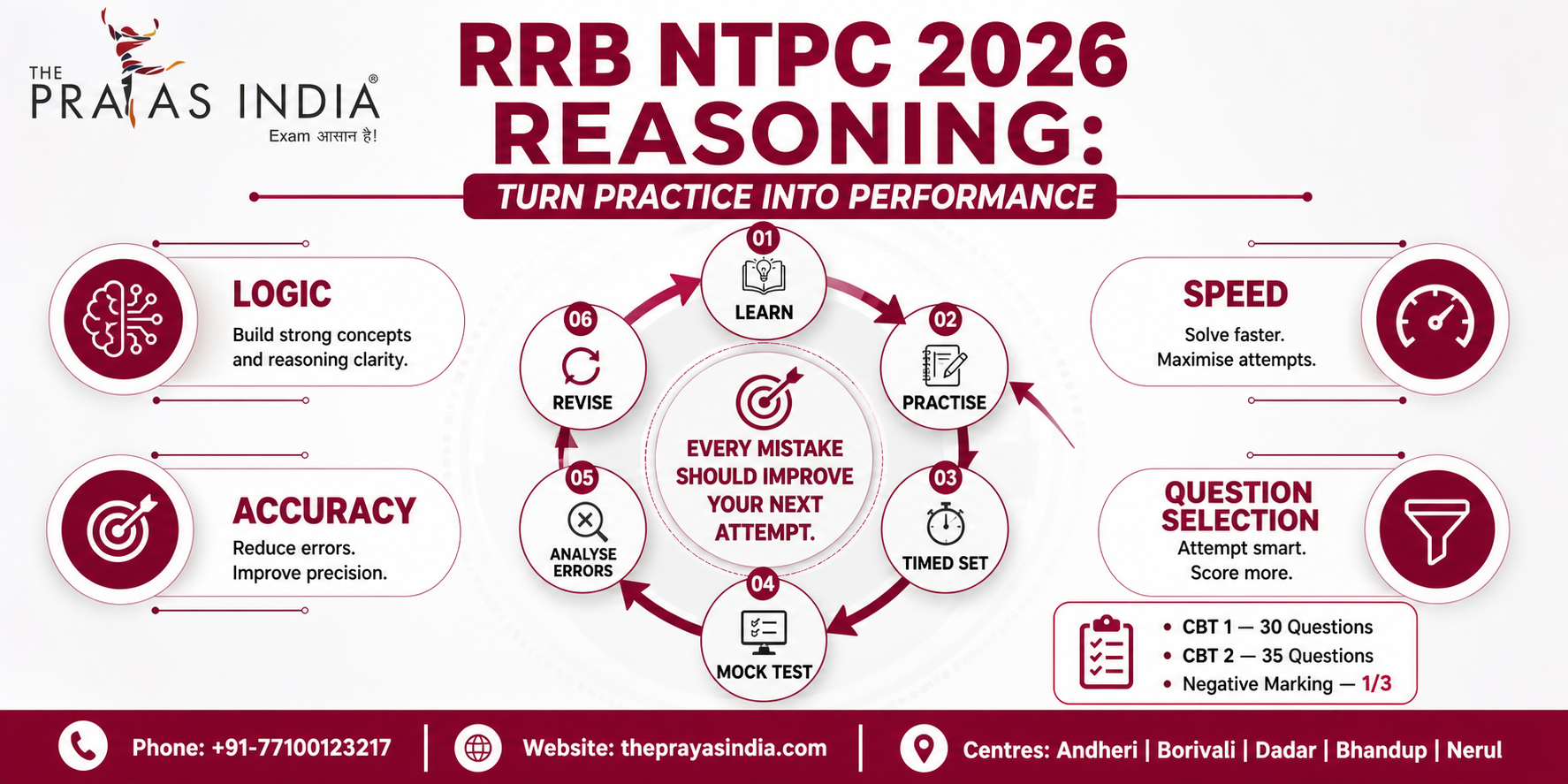
The ideal preparation cycle is:
Understand the concept → Practise topic-wise → Solve previous-year questions → Attempt mixed sets → Take timed tests → Analyse mistakes → Revise → Repeat.
With 5,165 vacancies announced in the RRB NTPC 2026 recruitment cycle, candidates should begin systematic preparation rather than waiting for the final stage of the recruitment process.
If you are looking for structured guidance, regular practice and test-based preparation, enrolling in a focused RRB NTPC preparation programme can help you maintain consistency and bring greater structure to your study routine.
FAQs on RRB NTPC 2026 Reasoning Preparation
1. How should I start preparing Reasoning for RRB NTPC 2026?
Start with basic topics such as Analogy, Similarities and Differences, Number Series and Alphabet Series. Once you are comfortable with pattern recognition, move to Coding-Decoding, Mathematical Operations, Relationships, Syllogism, Venn Diagrams, Puzzles and other analytical topics. At The Prayas India, we guide you step-by-step from foundational logic to advanced exam patterns.
2. Which Reasoning topics are important for RRB NTPC 2026?
Important topics include Analogy, Number Series, Alphabet Series, Coding-Decoding, Mathematical Operations, Relationships, Syllogism, Venn Diagrams, Puzzles, Data Sufficiency, Statement and Conclusion, Courses of Action, Decision Making, Maps and Graph Interpretation. Our expert-curated RRB coaching program ensures comprehensive coverage of all high-weightage sections.
3. How many Reasoning questions are asked in RRB NTPC CBT 1?
RRB NTPC CBT 1 contains 30 General Intelligence and Reasoning questions for 30 marks. Scoring full marks here is highly possible with the speed-building shortcut workflows taught in our targeted batches.
4. How many Reasoning questions are asked in RRB NTPC CBT 2?
RRB NTPC CBT 2 contains 35 General Intelligence and Reasoning questions for 35 marks. The difficulty level is slightly higher, which is why our advanced problem-solving classroom sessions focus deeply on CBT 2 readiness from day one.
5. Is there negative marking in RRB NTPC Reasoning?
Yes. RRB NTPC has one-third mark negative marking for every incorrect answer. Candidates should therefore focus on accuracy while improving speed. The Prayas India’s premium test engine replicates this setup to help students manage negative marking profiles effectively.
6. How can I improve Reasoning speed for RRB NTPC?
Practise topic-wise questions regularly, learn to recognise common patterns and gradually introduce timed practice. Solving previous-year questions and sectional tests can also help you become familiar with question structures. Our daily interactive mental tracking sessions specifically optimize your execution speeds.
7. Are puzzles important for RRB NTPC Reasoning?
Puzzles are included in the Reasoning syllabus and should not be ignored. However, candidates should also prepare other topics rather than spending all their preparation time on puzzles. We provide specialized matrix methods to solve logical arrangement puzzles accurately without consuming excessive time.
8. Should beginners start with difficult Reasoning questions?
No. Beginners should first develop conceptual clarity through basic and moderate questions. Difficulty can be increased gradually as accuracy and confidence improve. Our customized beginner classroom roadmap builds strong foundations first before introducing advanced mock grids.
9. How many Reasoning questions should I practise every day?
There is no fixed number suitable for every candidate. Focus on quality practice. A session can include concept revision, topic-wise questions, mixed questions and error analysis. As your speed improves, gradually increase the number of questions completed within a fixed time.
10. How can I improve accuracy in Reasoning?
Analyse every important mistake and identify whether it occurred because of a conceptual misunderstanding, incorrect pattern recognition, misreading or rushing. Maintaining an error notebook can help you identify recurring weaknesses. Our mentors offer direct error-log audits to help eliminate performance leakages.
11. Are shortcuts necessary for RRB NTPC Reasoning?
Shortcuts are not compulsory. Understanding the underlying logic should come first. Once the concept is clear, useful shortcuts or faster approaches can be introduced to save time. We provide premium shortcut toolkits that dramatically cut down solving times on high-yield puzzle matrices.
12. Should I solve RRB NTPC previous-year Reasoning questions?
Yes. Previous-year questions can help you understand the types of questions and logical patterns used in the examination. They should be combined with concept-based practice and mock tests. The Prayas India provides integrated PYQ modules mapping over 10 years of pattern variations.
13. When should I start taking Reasoning mock tests?
You can begin sectional tests after completing several important topics. Once a significant portion of the syllabus is covered, include full-length mock tests and analyse your performance after each test.
14. Can I prepare RRB NTPC Reasoning through self-study?
Yes. Self-study can work well with reliable study material, consistent practice, previous-year questions and mock tests. Candidates who prefer structured classes, doubt support and regular testing can also consider a dedicated RRB NTPC preparation programme.
15. How can The Prayas India help with RRB NTPC Reasoning preparation?
The Prayas India provides a structured preparation environment for RRB NTPC aspirants, with guided learning, practice and test-oriented preparation. With offline centers across Mumbai (Andheri, Borivali, Dadar, Nerul, Bhandup) and elite online courses, we offer unparalleled mentorship infrastructure to turn your efforts into guaranteed results. Admissions are now open for fresh examination-oriented batches!
Master RRB NTPC 2026 Reasoning! Join New Exam-Oriented Batches
Cracking the 30/30 mark grid in CBT 1 and 35/35 in CBT 2 requires extreme pattern familiarity and rapid puzzle execution. Connect with the premium Railway coaching experts at The Prayas India to unlock high-yielding shortcut workflows, accurate arrangement matrices, and elite logical tools.
Official Website: theprayasindia.com
Visit Our Mumbai Centres:
Andheri | Borivali | Dadar | Nerul | Bhandup