RRB NTPC General Awareness Preparation 2026: What Should You Study? | Best RRB Coaching in Mumbai | The Prayas India
General Awareness is one of the most important parts of the RRB NTPC 2026 examination because it covers a wide range of subjects and can significantly influence your overall score. Unlike sections where preparation is largely based on fixed concepts and repeated question types, General Awareness requires candidates to build knowledge across static subjects, General Science, current affairs, history, geography, polity, economy, computers, sports, culture and several other areas.
For candidates preparing for the RRB NTPC 2026 recruitment, understanding what to study is just as important as knowing how much to study. The examination has 5,165 vacancies, including 3,477 Graduate-level vacancies and 1,688 Undergraduate-level vacancies, making structured preparation particularly important for aspirants who want to use their preparation time efficiently.
The biggest challenge with General Awareness is not necessarily the difficulty of individual questions. The challenge is the enormous syllabus. If you attempt to read every newspaper, every current-affairs source and every general knowledge book, preparation can quickly become unmanageable. A better approach is to divide the syllabus into clear categories, identify high-priority areas, revise repeatedly and practise questions based on the RRB NTPC pattern.
This article explains the RRB NTPC General Awareness syllabus, important topics, preparation strategy, current-affairs approach, revision plan, previous-year question strategy and a practical 30-day study plan so that you can prepare the section in a systematic manner.
RRB NTPC Notification 2026 Out!
The Railway Recruitment Board has officially announced 5,165 vacancies for both Graduate and Undergraduate posts. Check out the complete details including eligibility, dates, and salary structure.
RRB NTPC 2026 General Awareness: Why Is It Important?
General Awareness is tested in both CBT 1 and CBT 2 of RRB NTPC. According to the current examination pattern, CBT 1 contains 40 General Awareness questions out of 100 questions, while CBT 2 contains 50 General Awareness questions out of 120 questions.
This means that General Awareness represents a substantial portion of both computer-based tests. Candidates therefore cannot afford to treat it as a subject that can be prepared only a few days before the examination.
At the same time, General Awareness has a different preparation requirement from Mathematics and Reasoning. In those sections, regular practice can directly improve problem-solving speed. In General Awareness, improvement depends heavily on coverage, retention, revision and question exposure.
A candidate may study a topic once and still forget a significant portion of it after several weeks. This makes revision an essential part of the preparation process.
RRB NTPC General Awareness at a Glance
| Exam Stage | General Awareness Questions | Total Questions | Time |
|---|---|---|---|
| CBT 1 | 40 | 100 | 90 minutes |
| CBT 2 | 50 | 120 | 90 minutes |
There is also negative marking of 1/3 mark for every incorrect answer, so General Awareness preparation should focus not only on increasing the number of facts you know but also on improving your ability to identify questions you can answer with reasonable confidence.
What Is Included in the RRB NTPC General Awareness Syllabus?
The General Awareness syllabus is broad. It includes both static knowledge and current developments. The official syllabus areas cover subjects such as General Science, History, Geography, Indian Polity, current events, sports, art and culture, computers, economics, environmental issues, government programmes and several other areas.
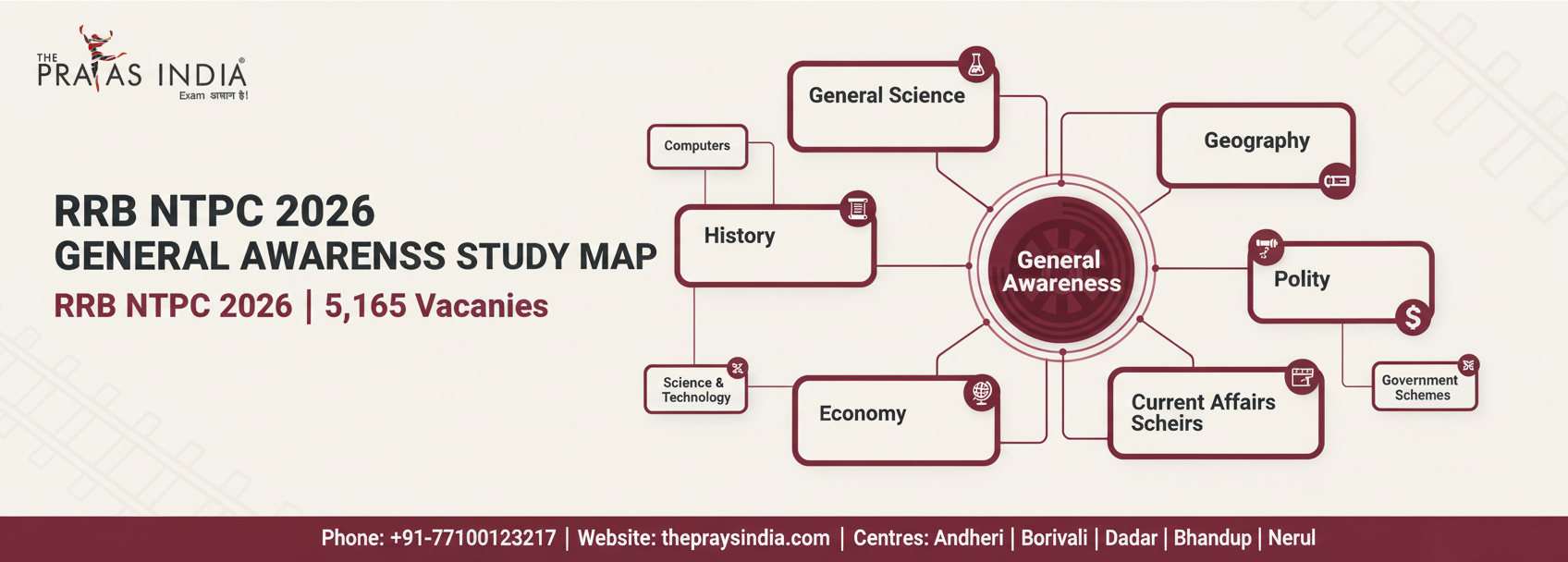
Instead of treating the entire syllabus as one large subject, divide it into the following preparation buckets:
- General Science
- History and Freedom Struggle
- Geography
- Indian Polity and Governance
- Indian Economy
- Current Affairs
- General Knowledge and Static GK
- Science and Technology
- Computers and Applications
- Sports
- Art and Culture
- Important Organisations and International Affairs
- Environment
- Government Schemes and Programmes
- Books, Authors, Awards and Important Personalities
- Transport and Railway-related awareness
This classification makes it easier to create a study timetable and prevents you from spending excessive time on only one area.
1. General Science: Build Your Foundation First
General Science is an important part of RRB NTPC General Awareness preparation. The syllabus broadly includes Physics, Chemistry and Biology/Life Science up to the 10th standard level, making school-level fundamentals highly relevant.
The advantage of General Science is that the syllabus is comparatively structured. Once your basic concepts are clear, repeated revision and question practice can help you retain information.
Physics
For Physics, focus on fundamental concepts and their applications in everyday life.
Important areas include:
- Units and measurements
- Motion
- Force and laws of motion
- Work, power and energy
- Heat and temperature
- Sound
- Light
- Electricity
- Magnetism
- Gravitation
- Simple machines
- Pressure
- Basic scientific instruments
Do not approach Physics as if you are preparing for an advanced technical examination. RRB NTPC generally requires familiarity with fundamental concepts, definitions, principles and everyday applications.
For example, rather than memorising isolated facts about electricity, understand basic concepts such as current, voltage, resistance and their relationships. This makes related questions easier to handle during the examination.
Chemistry
Chemistry preparation should cover basic properties, reactions and commonly encountered substances.
Important topics include:
- Matter and its properties
- Elements, compounds and mixtures
- Atoms and molecules
- Acids, bases and salts
- Metals and non-metals
- Chemical reactions
- Periodic classification
- Carbon and its compounds
- Common chemicals
- Everyday chemistry
- Basic environmental chemistry
Questions may connect scientific concepts with everyday observations, so conceptual understanding is more useful than attempting to memorise a huge number of chemical facts.
Biology and Life Science
Biology can become a strong scoring area when prepared systematically.
Focus on:
- Cell structure
- Human body systems
- Nutrition
- Digestion
- Respiration
- Circulation
- Excretion
- Nervous system
- Reproduction
- Diseases
- Vitamins and minerals
- Human hormones
- Plant biology
- Genetics basics
- Ecology
- Microorganisms
Create concise revision notes for factual areas such as vitamins, diseases, hormones and biological processes. These topics can be revised repeatedly without requiring extensive study time.
2. History and the Indian Freedom Struggle
History is another major component of the RRB NTPC General Awareness syllabus. Candidates should avoid trying to memorise every historical event. Instead, divide History into major periods and prepare the most relevant themes.
Ancient Indian History
Focus on:
- Indus Valley Civilisation
- Vedic period
- Buddhism and Jainism
- Mauryan Empire
- Gupta period
- Major ancient universities
- Important rulers and administrative systems
- Art, architecture and literature
Medieval Indian History
Important areas include:
- Delhi Sultanate
- Mughal Empire
- Major rulers
- Administrative developments
- Bhakti and Sufi movements
- Medieval architecture
- Important battles
- Regional kingdoms
Modern Indian History
Modern History deserves special attention because it connects directly with India’s freedom movement.
Study:
- Arrival of European powers
- British expansion
- Important Acts and developments
- Revolt of 1857
- Formation of the Indian National Congress
- Moderate and extremist phases
- Swadeshi movement
- Gandhian movements
- Non-Cooperation Movement
- Civil Disobedience Movement
- Quit India Movement
- Revolutionary movements
- Important sessions and leaders
- Constitutional developments
- Independence and Partition
For this section, build a timeline-based revision sheet. Linking events chronologically is generally easier than memorising disconnected dates.
3. Geography: Focus on India First
RRB NTPC Geography preparation should give considerable attention to Indian Geography while also covering basic world geography.
Indian Geography
Study:
- Physical features of India
- Himalayas
- Northern Plains
- Peninsular Plateau
- Coastal Plains
- Islands
- Rivers
- Lakes
- Climate
- Monsoon
- Soils
- Agriculture
- Mineral resources
- Industries
- Transport
- Population
- Important geographical locations
Map-based learning can make Geography easier. Instead of simply memorising the names of rivers, states and mountain ranges, locate them on a map.
World Geography
Cover basic concepts such as:
- Continents and oceans
- Important mountains
- Major rivers
- Deserts
- Countries and capitals
- Important straits and seas
- Time zones
- Climate zones
- Major geographical features
You do not need to give equal time to every geographical fact. Prioritise information that is repeatedly relevant to competitive examinations.
4. Indian Polity and Governance
Polity is a high-value static-GK area because its basic concepts remain relatively stable and can be revised multiple times.
Start with the Constitution of India and gradually move towards governance and constitutional institutions.
Important topics include:
- Preamble
- Fundamental Rights
- Fundamental Duties
- Directive Principles of State Policy
- Constitutional features
- President
- Vice-President
- Prime Minister
- Council of Ministers
- Parliament
- Supreme Court
- High Courts
- Governor
- Chief Minister
- State Legislature
- Election Commission
- Comptroller and Auditor General
- Finance Commission
- Union Public Service Commission
- Constitutional and statutory bodies
- Panchayati Raj
- Municipalities
- Emergency provisions
- Constitutional amendments
- Centre-State relations
Make a separate notebook for important constitutional articles, amendments, bodies and offices. Keep the notes short enough to revise frequently.
5. Indian Economy: Understand the Basics
You do not need to become an economics specialist for RRB NTPC. Your objective should be to understand the basic terms and major features of the Indian economy.
Important areas include:
- GDP and GNP
- Inflation
- Deflation
- Fiscal policy
- Monetary policy
- Banking basics
- RBI
- Repo rate and related monetary-policy terms
- Taxes
- Budget
- Public finance
- Financial institutions
- Poverty and unemployment
- Economic planning
- Major sectors of the economy
- Agriculture and industry
- Balance of payments
- Basic economic terminology
Current economic developments should be connected with these concepts. For example, if you read about a change in monetary policy, understand the basic term behind it rather than merely memorising the headline.
6. Current Affairs: What Should You Actually Study?
Current Affairs is often the most confusing part of General Awareness preparation because there is no practical way to memorise every event that happens in the country and around the world.
The solution is selective current-affairs preparation.
Focus on categories that are commonly relevant to competitive examinations:
National Current Affairs
Cover:
- Major government decisions
- Important national developments
- New appointments
- Important reports
- Major committees
- Government initiatives
- Important national events
- Major infrastructure developments
International Current Affairs
Focus on:
- Important international organisations
- Major summits
- International agreements
- Important global developments
- India-related international events
- Major appointments
- Countries in important news
Awards and Honours
Maintain a separate list of:
- Major national awards
- International awards
- Sports awards
- Literary awards
- Civilian honours
- Important recognitions
Appointments
Track important appointments involving:
- Government institutions
- Constitutional bodies
- International organisations
- Major financial institutions
- Defence organisations
- Important national and international positions
Sports
Study:
- Major tournaments
- Winners and runners-up
- Important records
- Major sporting awards
- Indian achievements
- Important venues
- Sports personalities in major news
Books and Authors
Focus on books that receive significant national or international attention, along with important authors and literary recognitions.
Important Days and Themes
Important national and international days should be studied with their associated themes when relevant.
The key principle is simple: do not collect current affairs endlessly; convert them into short revision-ready notes.
7. Static GK: The Memory-Based Portion
Static GK consists of information that does not necessarily depend on recent events.
Important areas include:
- Countries and capitals
- Currencies
- Important rivers
- Dams
- Lakes
- National parks
- Wildlife sanctuaries
- Biosphere reserves
- Important monuments
- Classical dances
- Folk dances
- Musical instruments
- Important festivals
- UNESCO-related sites
- Important organisations
- Headquarters
- Important books and authors
- Firsts in India
- Superlatives
- National symbols
- Important personalities
Static GK should be studied gradually rather than in one massive session. Ten to fifteen minutes of daily revision can be more sustainable than attempting hundreds of facts at once.
8. Science and Technology
Science and Technology questions can overlap with both General Science and Current Affairs.
Prepare the basics of:
- Space technology
- Indian space programmes
- Satellites
- Nuclear technology
- Defence technology
- Biotechnology
- Artificial intelligence
- Digital technology
- Communication technology
- Important scientific discoveries
- Emerging technologies
- Major national scientific institutions
When preparing current developments in Science and Technology, focus on the what, purpose and significance of an important development rather than trying to memorise technical details that are unlikely to be useful for the examination.
9. Computer Awareness and Applications
Basic computer knowledge is another area candidates should include in their General Awareness preparation.
Important topics include:
- Computer fundamentals
- Hardware and software
- Input and output devices
- Operating systems
- Memory
- Storage devices
- Internet
- Networking basics
- Browsers
- Computer shortcuts
- MS Office basics
- Cybersecurity fundamentals
- Common computer terminology
- Mobile applications and digital technology
Prepare common abbreviations and basic definitions through repeated revision.
10. Art, Culture and Literature
This area is often overlooked because candidates prioritise History, Science and Current Affairs. However, cultural questions can cover a wide variety of factual areas.
Study:
- Classical dances
- Folk dances
- Music traditions
- Musical instruments
- Paintings
- Architecture
- Literature
- Languages
- Festivals
- Cultural institutions
- Important monuments
- UNESCO-related heritage
- Famous personalities associated with arts and culture
Use tables to connect art form → state/region → associated personality or feature wherever appropriate. Such associations make revision easier.
11. Environment and Ecology
Basic environmental awareness is also relevant to the RRB NTPC syllabus.
Focus on:
- Ecosystem
- Food chain and food web
- Biodiversity
- Conservation
- National parks
- Wildlife sanctuaries
- Biosphere reserves
- Pollution
- Climate change
- Global warming
- Ozone layer
- Renewable and non-renewable resources
- Environmental organisations
- Important environmental conventions
- Endangered species
For current affairs, connect environmental developments with the basic concepts you have already studied.
12. Government Schemes and Programmes
Government schemes can appear in both static GK and current affairs.
Instead of memorising only the names, create a simple structure:
Scheme → Launch/associated ministry → Target group → Main objective
For example, if you encounter an important government programme during current-affairs preparation, note what it does and whom it is intended to benefit.
This approach makes confusing lists of schemes more manageable.
RRB NTPC General Awareness: What Should You Prioritise?
The syllabus is broad, but preparation time is limited. Therefore, create three levels of priority.
Priority 1: Core Areas
These should form the foundation of your preparation:
- General Science
- History
- Geography
- Indian Polity
- Current Affairs
- Basic Economy
- Static GK
Priority 2: Regularly Tested Supporting Areas
Then cover:
- Computers
- Science and Technology
- Sports
- Art and Culture
- Government schemes
- Environment
- Important organisations
Priority 3: Revision-Based Fact Pools
Once the core syllabus is covered, gradually revise:
- Awards
- Books and authors
- Important days
- Headquarters
- Capitals and currencies
- Firsts in India
- Important personalities
- National parks
- Monuments
- Miscellaneous static GK
This does not mean Priority 3 is unimportant. It means you should not spend most of your preparation time memorising isolated facts while leaving major subjects incomplete.
How to Prepare General Awareness for RRB NTPC 2026 from Scratch?
Candidates beginning preparation from zero should avoid trying to complete the entire syllabus immediately. A phased approach works better.
Phase 1: Build the Base
Start with General Science, Polity, History and Geography. These areas provide a foundation for many other General Awareness questions.
Read a topic, understand its basic concepts and immediately solve practice questions. This prevents passive reading.
Phase 2: Add Current Affairs
Once your static foundation begins to develop, start maintaining current-affairs notes. Divide them into categories rather than writing everything chronologically.
For example:
Appointments | Awards | Sports | Government Schemes | Economy | Science & Technology | National | International
This makes revision significantly easier.
Phase 3: Solve Previous-Year Questions
Previous-year questions should become part of preparation before the syllabus is completely finished.
PYQs help you identify:
- Repeated concepts
- Common question formats
- Factual areas that deserve attention
- Your weak subjects
- Topics where you make avoidable mistakes
The objective is not to memorise the answer key. Try to understand why the answer is correct and what related information can be asked.
Phase 4: Begin Mixed Practice
Once you have covered the major areas, solve mixed General Awareness quizzes. Do not practise only one subject at a time.
A mixed set forces you to switch between Science, History, Polity, Geography and Current Affairs, which is closer to the actual examination environment.
How Many Hours Should You Study General Awareness Every Day?
The exact number of hours depends on your overall preparation schedule, but General Awareness should receive consistent daily attention.
For a candidate preparing alongside Mathematics and Reasoning, a practical daily GA routine can look like this:
| Activity | Suggested Time |
|---|---|
| Static GK/Concept Study | 45 minutes |
| Current Affairs | 30 minutes |
| Revision | 20 minutes |
| Practice Questions | 25 minutes |
| Error Review | 10 minutes |
| Total | 2 hours 10 minutes |
Candidates with less available time can reduce the duration while retaining the structure.
The important principle is daily continuity. Studying General Awareness for six hours once a week is generally less manageable than studying it for one to two focused hours every day.
The 60-30-10 Rule for General Awareness
A simple way to structure your daily study is:
60% — Static Subjects
Use the majority of your time for subjects such as Science, History, Geography, Polity and Economy.
30% — Current Affairs
Read and revise important current developments from a focused source.
10% — Rapid Revision
Revise old facts, formulas, articles, awards, appointments, schemes or previously incorrect questions.
This prevents your preparation from becoming completely dependent on current affairs while also ensuring that static GK is not neglected.
How to Make Current Affairs Easier to Remember?
Reading current affairs once is not enough. The information must move through a revision cycle.
Use the following method:
Step 1: Read
Read only relevant current developments from a focused source.
Step 2: Categorise
Place each important fact under a category such as:
- National
- International
- Economy
- Sports
- Awards
- Appointments
- Science & Technology
- Government Schemes
- Environment
Step 3: Condense
Convert the information into one or two lines.
Step 4: Revise
Revise the same information after a few days.
Step 5: Test
Solve MCQs based on the topic.
This transforms current affairs from passive reading into active learning.
Use the Revision Cycle Instead of Repeated Reading
A common problem in General Awareness preparation is spending too much time reading and too little time revising.
Suppose you study Indian Polity today. Instead of waiting several weeks before opening the topic again, use a planned revision cycle:
Day 1 → Learn
Day 3 → Quick revision
Day 7 → Practice questions
Day 15 → Revision
Day 30 → Final revision
You can adapt this cycle according to your memory and preparation schedule.
The purpose is to repeatedly bring information back into active recall before it fades.
Build an RRB NTPC General Awareness Notebook
A dedicated GA notebook can become one of the most useful resources during the final stage of preparation.
Do not copy entire chapters into it. Write only information that is useful for revision.
Divide the notebook into sections:
- Polity facts
- History timelines
- Geography facts
- Science facts
- Economy terms
- Current affairs
- Awards and appointments
- Sports
- Schemes
- Miscellaneous GK
- Mistakes from mock tests
The final section is particularly valuable.
If you repeatedly make the same mistake in mock tests, record it. Your personal error notebook eventually becomes more relevant to your preparation than another general GK list.
Previous-Year Questions: One of the Most Important Preparation Tools
RRB NTPC aspirants should not treat PYQs as something to solve only after completing the syllabus.
Start using them topic-wise.
For example, after completing Polity, solve a set of Polity-related questions. After finishing General Science, solve Science PYQs.
This approach tells you whether your theoretical preparation is translating into question-solving ability.
While analysing PYQs, classify mistakes into three categories:
1. I Did Not Know It
Add the fact to your revision notes.
2. I Knew It but Forgot It
Increase revision frequency.
3. I Knew It but Chose the Wrong Option
Work on question interpretation and careful reading.
This classification is more useful than simply calculating your score.
How to Improve Accuracy in RRB NTPC General Awareness?
Because RRB NTPC has negative marking, random guessing can reduce your score.
The first objective should be to increase the number of questions you can answer confidently.
During practice, classify questions as:
- Sure: You know the answer.
- Likely: You can narrow down the options using knowledge.
- Uncertain: You have little or no basis for selecting an option.
Practise making this distinction quickly.
With time, your “Likely” category can become stronger as your knowledge base expands. The aim is not simply to attempt more questions; it is to make better-informed decisions under examination conditions.
Common Mistakes in RRB NTPC General Awareness Preparation
Mistake 1: Trying to Study Everything
The General Awareness syllabus is too broad to treat every fact with equal importance.
Mistake 2: Ignoring Static GK
Some candidates focus almost completely on current affairs. This leaves major static areas underprepared.
Mistake 3: Reading Without Revision
Recognition while reading does not guarantee recall during the examination.
Mistake 4: Collecting Too Many Sources
Using multiple books, websites, videos and PDFs for the same topic can create duplication and confusion.
Mistake 5: Ignoring PYQs
Without PYQ analysis, you may spend too much time on areas that have limited relevance to your exam preparation.
Mistake 6: Not Maintaining an Error Notebook
Repeated mistakes become repeated score losses when they are not recorded and revised.
Mistake 7: Leaving GA for the Last Month
General Awareness requires repeated exposure. Trying to complete everything shortly before the examination can create unnecessary pressure.
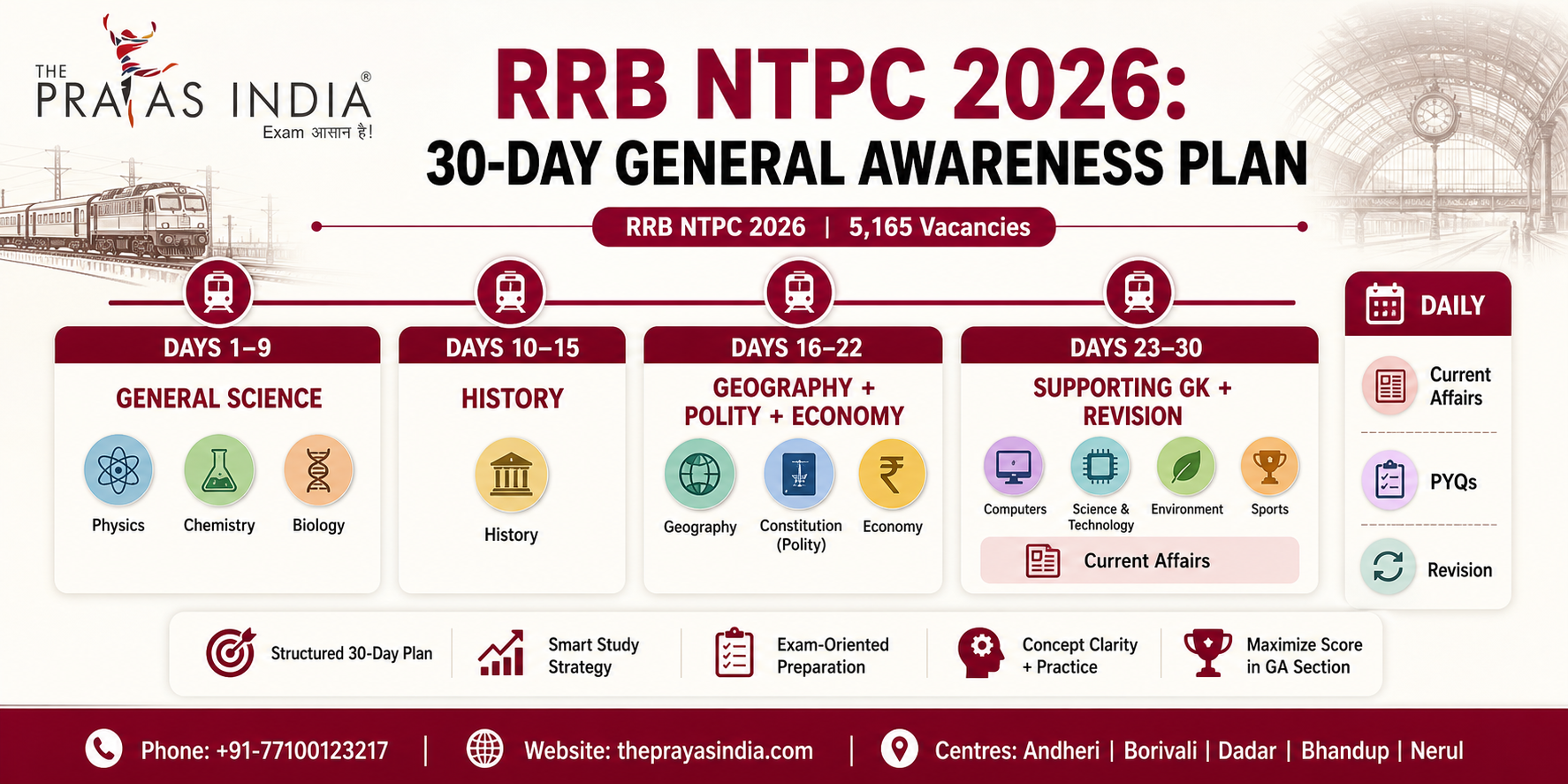
RRB NTPC General Awareness 30-Day Preparation Plan
Candidates who have already covered the basics can use a 30-day revision-oriented schedule.
| Days | Main Focus |
|---|---|
| 1–3 | General Science – Physics |
| 4–6 | General Science – Chemistry |
| 7–9 | Biology & Life Science |
| 10–12 | Ancient & Medieval History |
| 13–15 | Modern History & Freedom Struggle |
| 16–18 | Indian Geography |
| 19–20 | Indian Polity |
| 21–22 | Indian Economy |
| 23 | Computers |
| 24 | Science & Technology |
| 25 | Environment |
| 26 | Art & Culture |
| 27 | Sports, Awards & Appointments |
| 28 | Government Schemes & Organisations |
| 29 | Mixed PYQs & Mock Test |
| 30 | Full Revision + Error Notebook |
Current affairs should not be restricted to one day. They should be studied and revised throughout all 30 days.
How to Prepare General Awareness Alongside Maths and Reasoning?
RRB NTPC preparation should be balanced. A candidate who spends all available study time on General Awareness may neglect the practice-intensive sections.
A balanced daily routine can divide preparation into three broad blocks:
General Awareness: Learning + revision + current affairs
Mathematics: Concepts + calculations + timed questions
Reasoning: Concepts + question practice + speed building
General Awareness should be treated as a daily cumulative subject, while Mathematics and Reasoning require more deliberate problem-solving sessions.
For example, you could study static GA in the morning, practise Mathematics in the afternoon and work on Reasoning in the evening, while reserving a short revision session at night.
The exact schedule can vary according to your college, job or other responsibilities. Consistency matters more than following a timetable that is unrealistic for your routine.
How Mock Tests Can Improve Your General Awareness Preparation
Mock tests should not be used only to calculate your expected score.
After every mock test, analyse the GA section separately.
Ask:
- Which questions did I answer correctly?
- Which questions did I get wrong?
- Which questions did I leave?
- How many wrong answers came from lack of knowledge?
- Which topics produced repeated mistakes?
- Did I spend too much time on uncertain questions?
- Which facts should be added to my revision notebook?
Maintain a GA performance tracker.
For example:
| Test | GA Score | Wrong | Unattempted | Main Weak Area |
|---|---|---|---|---|
| Mock 1 | 22 | 8 | 10 | Polity |
| Mock 2 | 25 | 7 | 8 | Current Affairs |
| Mock 3 | 28 | 5 | 7 | History |
The purpose of this table is not simply to chase a higher number. It helps identify where your preparation needs additional revision.
Should You Study Current Affairs Daily or Monthly?
Daily reading and monthly revision serve different purposes.
Daily current affairs helps you stay updated and understand events while they are fresh.
Monthly revision helps compress the information into an exam-oriented format.
A practical approach is:
Daily → Read + make short notes
Weekly → Revise the week’s important facts
Monthly → Consolidate the entire month’s current affairs
Before the exam → Revise only high-value notes and MCQs
This approach is much more manageable than trying to remember hundreds of pages shortly before the examination.
How Much Static GK Should You Memorise?
There is no practical endpoint to static GK. You can continue finding new facts indefinitely.
Therefore, preparation should have a stopping rule.
First complete the major syllabus areas. Then use PYQs and mock tests to identify additional facts that deserve attention.
Your objective should not be to become an encyclopaedia. Your objective should be to develop exam-relevant knowledge that you can recall accurately under time pressure.
Is RRB NTPC General Awareness Difficult for Beginners?
The difficulty often comes from the breadth of the syllabus rather than from advanced concepts.
A beginner may initially feel that there are too many subjects to cover. This becomes easier once the syllabus is divided into manageable sections.
Start with:
Science → History → Geography → Polity → Economy → Current Affairs → Static GK → Supporting Topics
Study one category at a time, revise regularly and gradually introduce mixed practice.
Do not compare your preparation with someone who has already spent months studying General Awareness. Focus on building your own coverage and revision cycle.
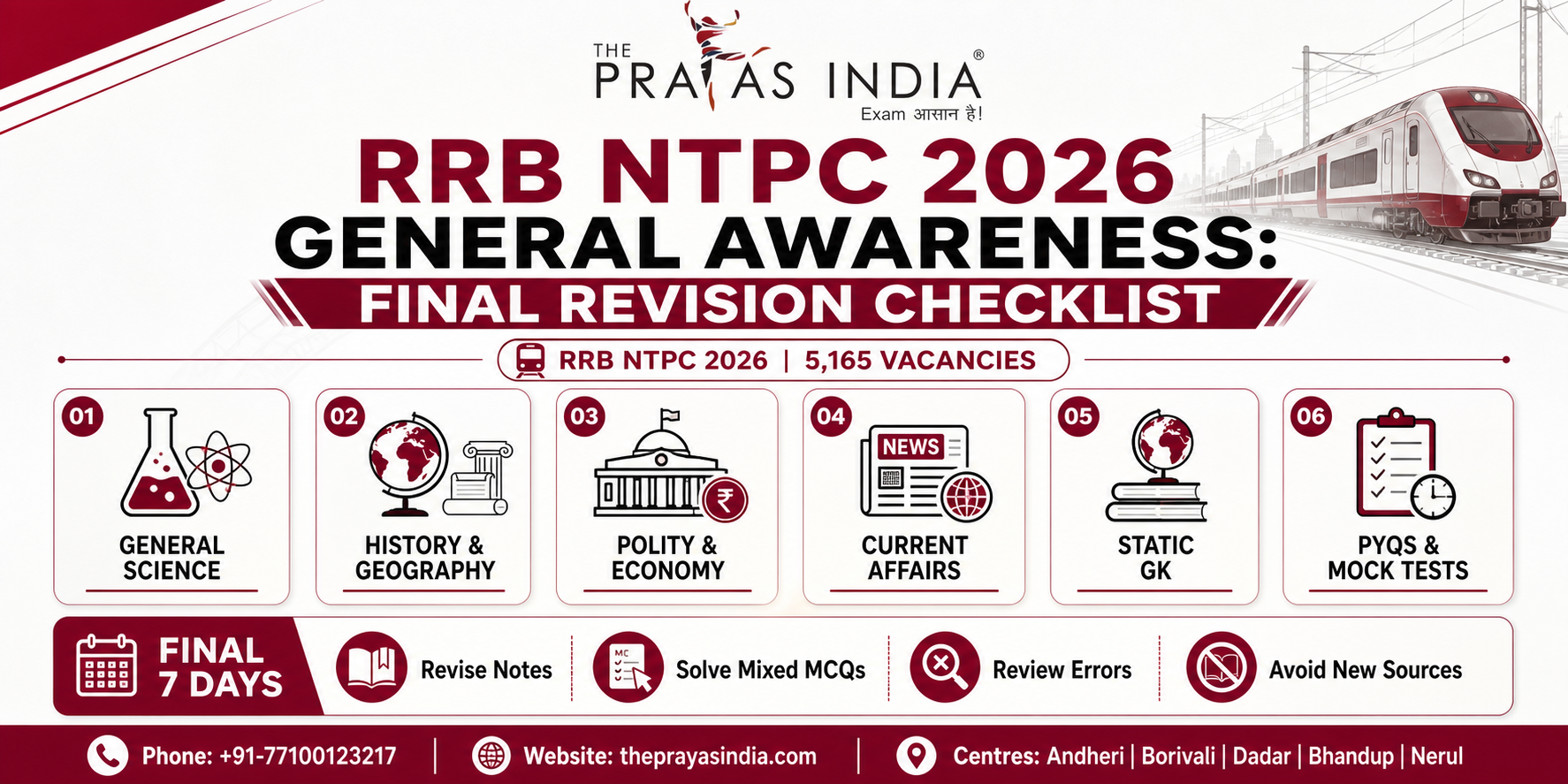
A Practical Strategy for the Final Weeks
As the examination approaches, your preparation should gradually shift from learning mode to revision mode.
Avoid adding multiple new sources during the final stage.
Instead:
- Revise your short notes.
- Revisit important current affairs.
- Solve RRB NTPC PYQs.
- Take mixed mock tests.
- Analyse mistakes.
- Revise weak subjects.
- Review your error notebook.
- Practise eliminating clearly incorrect options.
- Avoid random guessing when you lack sufficient information.
The final weeks should be about converting the knowledge you already have into reliable recall.
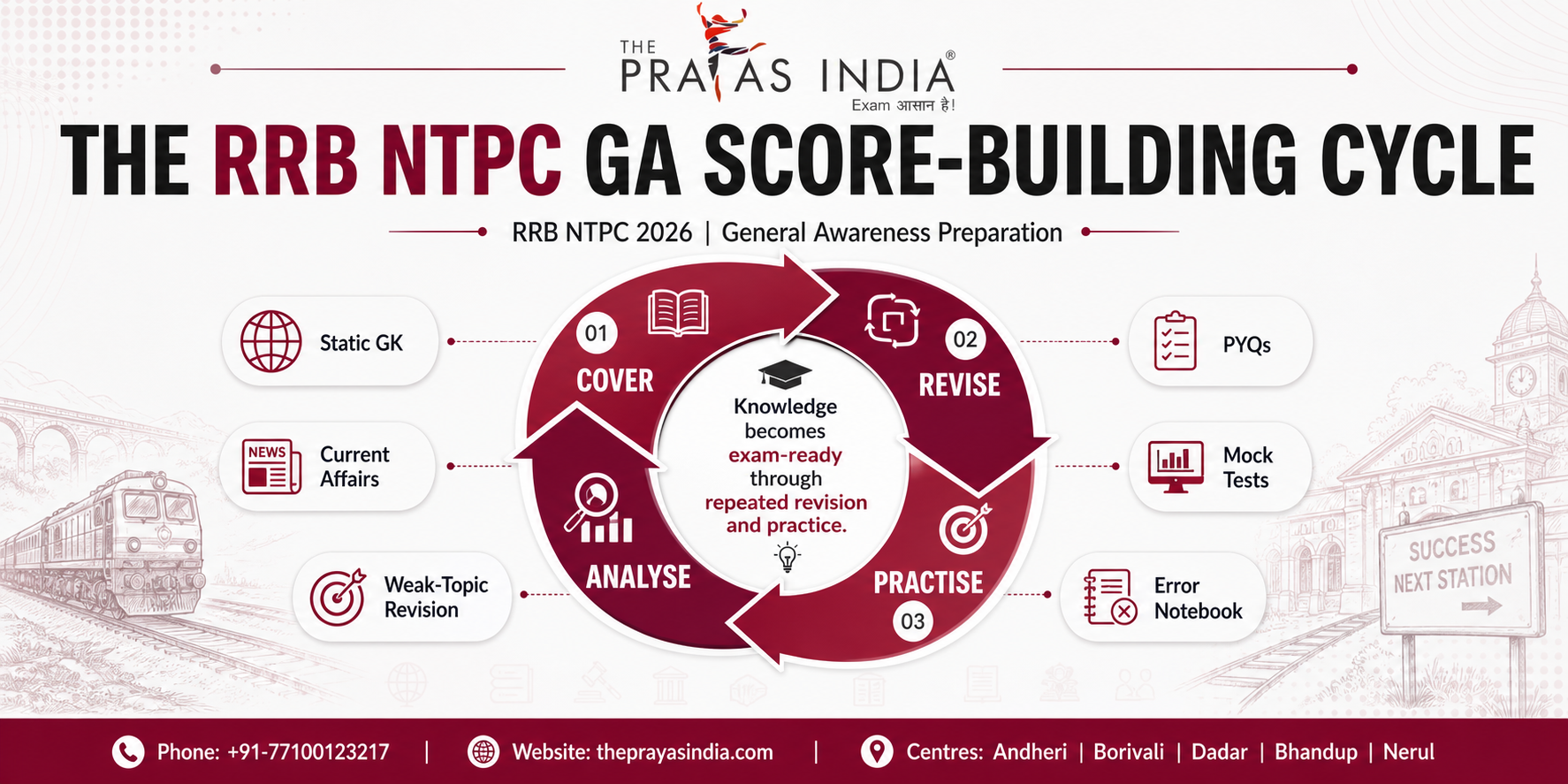
General Awareness Preparation: A Simple Formula
You can remember the complete strategy through four words:
COVER → REVISE → PRACTISE → ANALYSE
Cover: Complete the major syllabus areas systematically.
Revise: Revisit information at planned intervals.
Practise: Solve topic-wise questions, PYQs and mixed MCQs.
Analyse: Identify knowledge gaps, memory errors and question-selection mistakes.
If one of these four steps is missing, your preparation becomes less complete.
The Role of Structured Guidance in RRB NTPC Preparation
General Awareness is one of those sections where a structured preparation system can help candidates avoid duplication and wasted study time. A planned approach can bring together syllabus coverage, current affairs, PYQs, revision and mock-test analysis in one preparation cycle.
For candidates preparing through coaching, the value should not be limited to simply receiving study material. The more useful framework is one where the candidate understands what to study, what to revise, how to practise and where mistakes are occurring.
At The Prayas India, aspirants preparing for RRB NTPC can use structured guidance to organise their preparation around the examination syllabus, regular practice and revision. Candidates should choose their preparation method according to their learning style, available time and existing level of preparation.
Final Strategy for RRB NTPC General Awareness 2026
RRB NTPC General Awareness preparation should not become a race to collect the maximum number of facts. The more important objective is to build a knowledge base that you can remember, revise and apply accurately during the examination.
Begin with the core subjects—General Science, History, Geography, Polity and Economy. Add current affairs consistently rather than trying to cover them in one sitting. Build supporting areas such as Computers, Sports, Art & Culture, Environment and Science & Technology gradually.
Most importantly, combine study with PYQs, revision and mock-test analysis. If you only read, you may overestimate your preparation. If you regularly test yourself, you will discover which information you actually remember and which areas require more work.
With the RRB NTPC 2026 recruitment offering 5,165 vacancies, candidates have a clear reason to begin organised preparation rather than waiting until the examination is close. A consistent General Awareness routine, supported by repeated revision and targeted practice, can help you approach this section with greater familiarity and confidence.
Important Note for Aspirants
Prepare RRB NTPC 2026 with a Structured Strategy
General Awareness becomes more manageable when syllabus coverage, current affairs, revision, PYQs and mock-test analysis are planned together. Start early, build your basics and keep revising consistently instead of depending on last-minute preparation.
Admissions Open at The Prayas India for RRB NTPC 2026 Preparation.
Frequently Asked Questions: RRB NTPC General Awareness Preparation 2026
1. How should I start RRB NTPC General Awareness preparation in 2026?
Start by dividing the syllabus into General Science, History, Geography, Polity, Economy, Current Affairs and Static GK. Build your foundation in the static subjects first and simultaneously begin maintaining concise current-affairs notes.
2. How many General Awareness questions are asked in RRB NTPC CBT 1?
CBT 1 contains 40 General Awareness questions out of 100 questions.
3. How many General Awareness questions are asked in RRB NTPC CBT 2?
CBT 2 contains 50 General Awareness questions out of 120 questions.
4. Is General Science important for RRB NTPC?
Yes. General Science is an important part of the RRB NTPC General Awareness syllabus. Candidates should cover Physics, Chemistry and Biology/Life Science at the relevant basic level.
5. Should I study current affairs every day for RRB NTPC?
Daily current-affairs study can help maintain continuity, but reading alone is not enough. Important information should be categorised, condensed and revised regularly.
6. Are RRB NTPC previous-year questions useful for General Awareness?
Yes. PYQs help candidates understand the types of facts and concepts asked in the examination and identify areas that require additional preparation.
7. How can I remember large amounts of General Awareness information?
Use short notes, active recall, spaced revision, topic-wise MCQs and an error notebook. Repeated revision is more useful than reading the same material passively.
8. Should I focus more on current affairs or static GK?
Both are relevant. A balanced strategy should cover the static syllabus while maintaining consistent current-affairs preparation.
9. How can I improve General Awareness accuracy?
Improve your factual coverage, revise frequently, practise PYQs and analyse incorrect answers. During mocks, distinguish between questions you know, questions where you can logically narrow the options and questions where you have insufficient information.
10. Can beginners prepare RRB NTPC General Awareness from scratch?
Yes. Beginners should divide the syllabus into manageable categories, build the fundamentals first and gradually introduce current affairs, PYQs and mixed practice.
Master RRB NTPC 2026 General Awareness! Join New Exam-Oriented Batches
General Awareness requires systematic coverage of General Science, History, Geography, Polity, Economy, Current Affairs and Static GK. Join The Prayas India for structured RRB NTPC 2026 preparation with focused study material, regular practice, PYQs, mock tests and revision-oriented guidance.
Official Website: theprayasindia.com
Visit Our Mumbai Centres:
Andheri | Borivali | Dadar | Nerul | Bhandup