RRB NTPC Preparation Mistakes Aspirants Should Avoid | Best RRB Coaching in Mumbai | The Prayas India
Preparing for RRB NTPC requires more than simply completing the syllabus and solving a large number of questions. Many aspirants study consistently but still struggle to convert their preparation into a strong performance because of avoidable mistakes in planning, practice, revision, mock-test analysis and time management.
This becomes particularly important because RRB NTPC recruitment involves multiple stages, and the preparation approach needs to account for the requirements of the relevant recruitment cycle. For example, the current RRB recruitment calendar includes separate NTPC Graduate and NTPC Undergraduate notifications under CEN 06/2025 and CEN 07/2025. The official RRB pages also show that CBT-1 activity for these cycles has been scheduled during 2026.
For an aspirant, this means preparation should not be based on rumours, random social-media updates or a single mock-test score. It should be built around the official notification, a structured study plan and continuous performance analysis.
If you are preparing for RRB NTPC and looking for RRB coaching in Mumbai, understanding what not to do can be just as useful as knowing what to study.
Why RRB NTPC Preparation Mistakes Matter
RRB NTPC preparation often appears straightforward at first. The syllabus contains familiar areas such as Mathematics, General Intelligence and Reasoning, General Awareness and other requirements depending on the stage and post.
The challenge is that familiarity with the subjects does not automatically translate into exam readiness.
An aspirant may know the concepts but take too long to solve questions. Another candidate may complete hundreds of questions but fail to analyse mistakes. Someone else may spend most of the preparation time on difficult questions while neglecting revision and mock tests.
These problems can gradually reduce the effectiveness of preparation.
The solution is not necessarily to study for more hours. It is to identify inefficient habits and replace them with a more systematic preparation process.
Common RRB NTPC Preparation Mistakes Aspirants Should Avoid
1. Starting Preparation Without Understanding the Exam
One of the first mistakes is beginning preparation without properly understanding the recruitment process.
RRB NTPC is not a single generic examination with exactly the same requirements for every post. Graduate and undergraduate recruitment are notified separately, and post-specific requirements can also differ.
The official RRB recruitment pages currently list CEN 06/2025 for NTPC Graduate posts and CEN 07/2025 for NTPC Undergraduate posts.
Before starting preparation, check:
- Your educational eligibility
- Relevant post categories
- Examination stages
- Syllabus
- Question pattern
- Negative marking provisions where applicable
- Typing or other post-specific requirements
- Official instructions for your recruitment cycle
This prevents you from preparing for a version of the examination that does not match your target post.
Preparation principle: Know the exam before trying to master it.
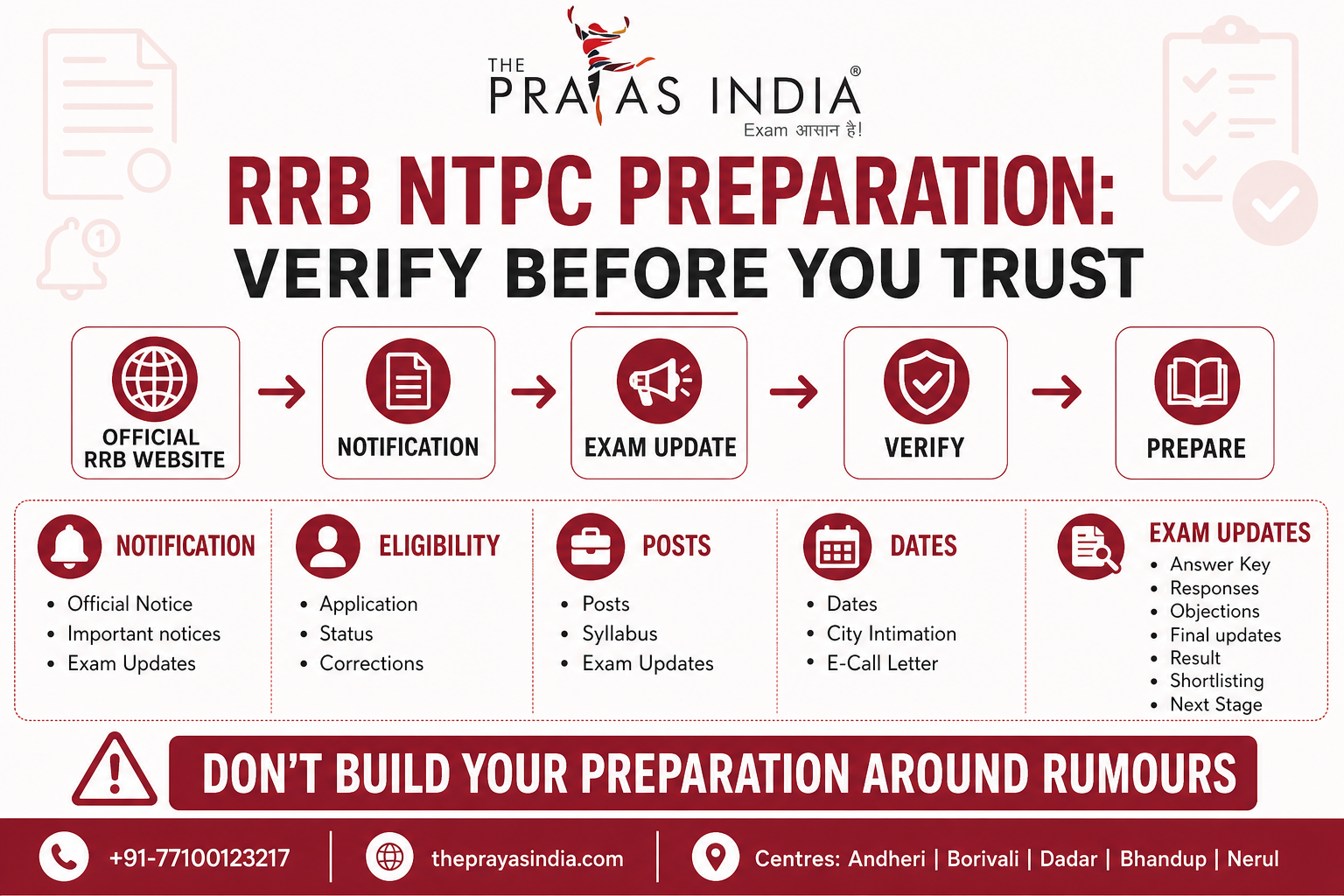
2. Relying on Social Media Instead of Official RRB Updates
Railway recruitment information is frequently circulated through Telegram channels, YouTube videos, social-media posts and unofficial websites.
These sources can sometimes be useful for discussion, but they should not replace official RRB notices.
The official RRB website specifically advises candidates to rely on official RRB websites for notices and information and warns against misleading information circulated through social media.
Make it a habit to verify important information such as:
- Exam dates
- City-intimation notices
- Admit cards
- Application status
- Answer keys
- Objection windows
- Results
- Document requirements
This simple habit can prevent unnecessary confusion during preparation.
3. Trying to Complete Everything Before Starting Practice
Some aspirants spend weeks watching lectures and reading notes without solving enough questions.
Conceptual learning is important, but competitive-exam preparation requires active practice.
You need to move through a cycle of:
Learn → Practise → Analyse → Revise → Test
If you keep waiting for the syllabus to become “100% complete” before starting questions, you may lose valuable time.
For example, after learning a Mathematics topic, immediately solve a set of questions. After studying a reasoning concept, practise different question formats. After revising General Awareness, use quizzes or mock questions to test recall.
Practice should run alongside learning.
4. Studying Without a Realistic Study Plan
Another common mistake is creating an ambitious timetable that cannot be followed consistently.
A plan that says you will study eight or ten hours every day may look impressive, but if you cannot sustain it, it provides little value.
A useful RRB NTPC study plan should account for:
- Your current preparation level
- Available daily study time
- Subject-wise strengths and weaknesses
- Revision requirements
- Mock-test practice
- Current affairs and General Awareness revision
- Time required for analysis
Instead of measuring preparation only by hours, measure it by completed and analysed work.
For example:
Mathematics: Concept + practice set
Reasoning: Timed practice
General Awareness: Revision + quiz
Mock: Test + detailed analysis
This creates a measurable routine.
5. Ignoring Weak Subjects
Aspirants naturally prefer subjects in which they are already comfortable.
If you are good at Reasoning, you may spend extra time solving reasoning questions because the practice feels productive. Meanwhile, a weak area such as Mathematics or General Awareness may continue to receive insufficient attention.
This creates an uneven preparation profile.
Identify your weak areas through sectional tests and mock analysis.
Then divide your preparation into:
Strong Areas → Maintain
Average Areas → Improve
Weak Areas → Prioritise
Your goal should not necessarily be to spend equal time on every topic. Time should be allocated according to your performance gap.
6. Focusing Only on Difficult Questions
Solving difficult RRB-level questions can be useful for developing problem-solving ability, but making extremely difficult questions the centre of your preparation is not always productive.
The actual examination requires you to identify and solve questions efficiently within the available time.
Your practice should therefore include:
- Basic questions
- Standard exam-level questions
- Mixed practice sets
- Previous exam questions
- Timed questions
- Mock-test questions
Difficulty should increase gradually.
If every practice session feels impossible, you may be training yourself to struggle rather than training yourself to perform efficiently.
7. Neglecting Previous-Year Questions
Previous-year questions are among the most useful resources for understanding the practical nature of an examination.
They help you observe:
- Recurring concepts
- Question formats
- Difficulty patterns
- Calculation requirements
- Reasoning structures
- General Awareness trends
- Time-consuming question types
Do not simply solve a previous-year paper and check your score.
Analyse it.
Ask:
Which questions were easy but took too long?
Which questions did I leave unnecessarily?
Which concepts repeatedly caused mistakes?
Which question types should I revise?
The objective is to learn from the paper rather than simply finish it.
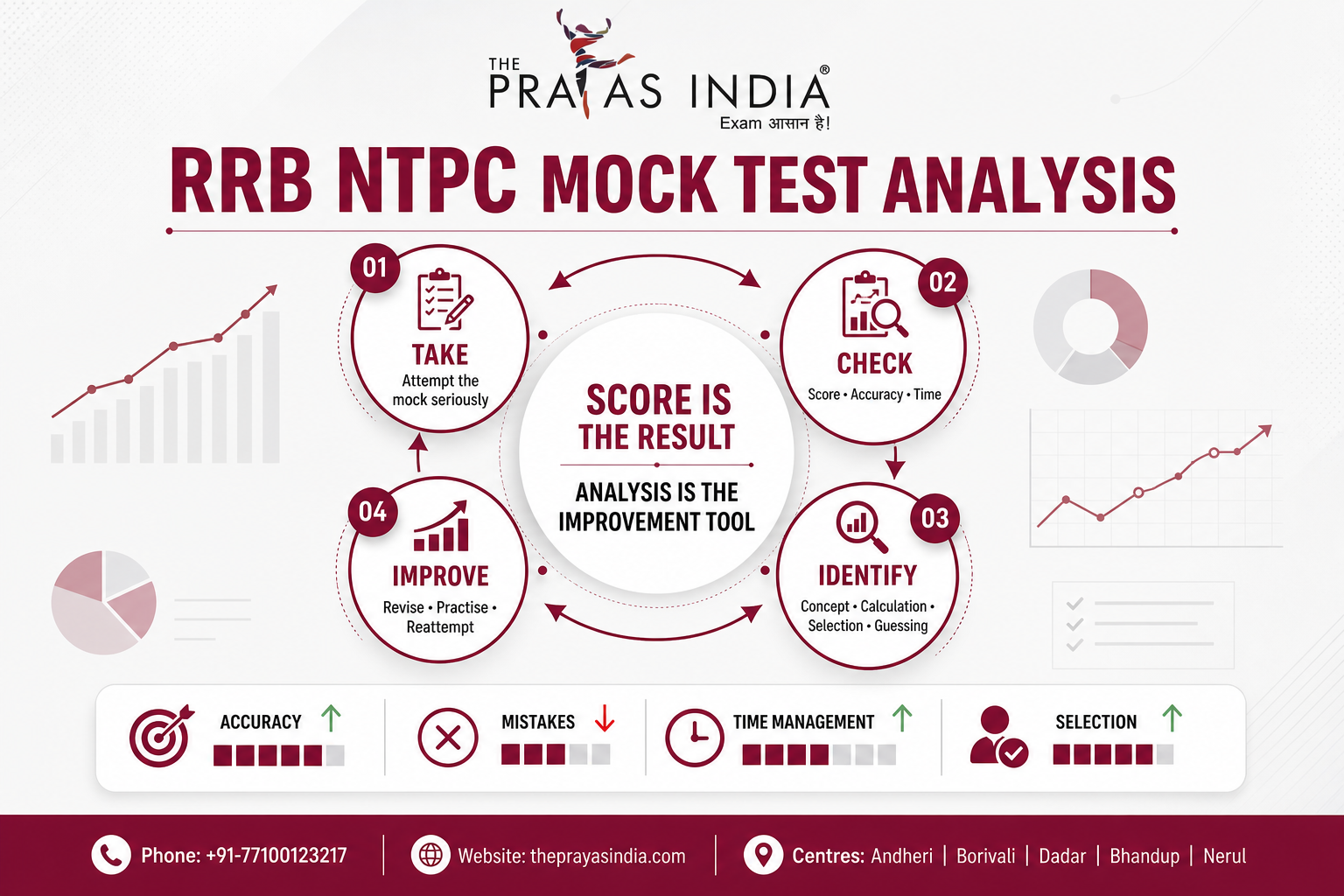
8. Taking Mock Tests Without Analysing Them
This is one of the most important mistakes to avoid.
Some aspirants take a mock test, look at the score and immediately move on to another mock.
The score tells you what happened.
The analysis helps you understand why it happened.
After every mock, classify your mistakes into categories:
| Mistake Type | What It Indicates |
|---|---|
| Conceptual mistake | Topic needs revision |
| Calculation mistake | Accuracy needs improvement |
| Reading mistake | Question interpretation issue |
| Time-management mistake | Question selection needs work |
| Guessing mistake | Better decision-making required |
| Forgotten fact | Revision gap |
This creates a feedback loop.
Mock → Analysis → Correction → Reattempt
That cycle is more valuable than simply increasing the number of mocks.
9. Obsessing Over Mock-Test Scores
A low mock score can be discouraging, while a high score can create false confidence.
Neither should become the only measure of your preparation.
Instead, track multiple indicators:
- Accuracy percentage
- Number of questions attempted
- Time per section
- Questions left due to time
- Repeated mistakes
- Conceptual gaps
- Guessing errors
- Improvement across tests
If your score remains similar but your accuracy improves and your number of avoidable mistakes falls, your preparation may still be progressing.
The purpose of mock tests is not merely to produce a number. It is to improve your examination behaviour.
10. Ignoring Time Management Until the Final Stage
Knowing how to solve a question is only one part of exam preparation.
You also need to know whether solving that question is worth the time.
During practice, start introducing controlled time limits.
For example, instead of solving a large set of questions without a timer, divide practice into timed blocks.
The objective is not to rush.
The objective is to develop the ability to:
- Read quickly
- Recognise familiar patterns
- Select manageable questions
- Avoid unnecessary calculations
- Move on when a question becomes inefficient
Speed should come from familiarity and better decision-making rather than careless rushing.
11. Guessing Too Many Questions
Negative marking makes random guessing a risky habit.
When you are unsure about an answer, distinguish between:
Known → Solve
Partially known → Evaluate options carefully
Completely uncertain → Consider whether attempting is justified
Do not let the desire to increase your attempt count override accuracy.
During mock analysis, separately track questions that were wrong because of:
- Lack of knowledge
- Miscalculation
- Misreading
- Overconfidence
- Blind guessing
This will help you identify whether your attempt strategy needs adjustment.
12. Neglecting General Awareness and Current Affairs
General Awareness often requires a different preparation method from Mathematics and Reasoning.
You cannot rely entirely on last-minute preparation.
Create a structured revision system covering relevant areas such as:
- Current affairs
- Indian history
- Geography
- Polity
- Economy
- General science
- Static awareness
- Railway-related awareness where relevant to the prescribed syllabus
Do not collect unlimited monthly PDFs.
Choose a manageable source, revise it repeatedly and test yourself.
The goal is retention, not accumulation.
13. Making Notes That Are Too Long
Another common problem is creating huge notebooks filled with information that becomes difficult to revise.
Good notes should reduce revision time.
For example:
Instead of writing an entire explanation of a formula, keep the formula, its application and one representative example.
For General Awareness, use:
Topic → Key Fact → Related Fact → Revision Date
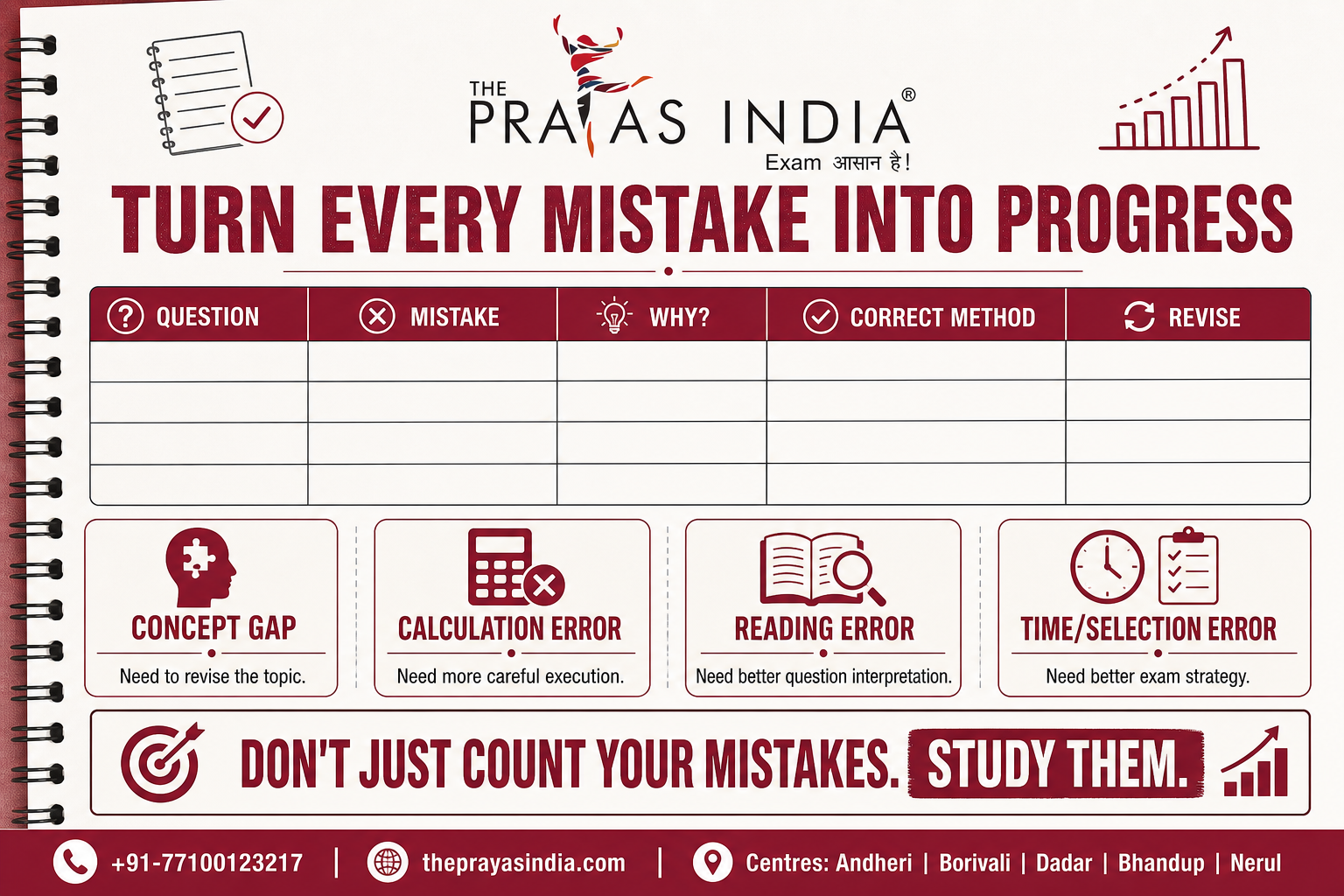
For mistakes, maintain:
Question → Error → Correct Method → Revision
Your notes should become more useful as the examination approaches, not more difficult to read.
14. Changing Study Resources Too Frequently
One week you may follow a YouTube teacher.
The next week you may switch to another platform.
Then you may purchase a new book because someone recommends it.
Soon, you have multiple resources but no clear sequence.
Resource hopping creates the illusion of preparation without necessarily improving mastery.
Choose reliable resources for:
- Concepts
- Practice
- Previous-year questions
- Mock tests
- Revision
Then stay consistent long enough to evaluate whether the resource is actually helping.
15. Preparing Without a Mistake Log
If you repeatedly make the same mistake, that mistake should become part of your preparation system.
A simple mistake log can contain:
| Date | Topic | Mistake | Correct Approach | Revision |
|---|---|---|---|---|
| 1 | Percentage | Calculation error | Recheck calculation | Friday |
| 2 | Reasoning | Misread condition | Mark key condition | Sunday |
| 3 | GA | Forgot fact | Add to revision list | Monday |
Review the log regularly.
Over time, you will notice patterns.
Those patterns tell you what your preparation actually needs.
16. Ignoring Typing or Post-Specific Requirements
Another mistake is preparing only for CBT and forgetting that some NTPC posts may involve additional requirements at later stages.
The exact recruitment process depends on the post and the applicable CEN.
For example, official RRB notices for previous NTPC recruitment cycles have included a Computer Based Typing Skill Test for shortlisted candidates in relevant posts.
Therefore, aspirants should always check the notification applicable to their target post rather than assuming that every NTPC post has exactly the same selection process.
If your target post requires a typing-related stage, gradually developing typing familiarity during preparation can prevent unnecessary pressure later.
17. Preparing Only for CBT-1 and Ignoring the Next Stage
Some candidates treat the first CBT as the entire examination.
That can create problems later.
Your preparation should be stage-aware.
The initial stage should focus strongly on building fundamentals, accuracy and question-solving speed. As the recruitment process progresses, preparation should adapt to the requirements of the next stage.
The official RRB notices demonstrate that different recruitment cycles progress through different stages and schedules.
Therefore, once your immediate examination objective is clear, start thinking about what comes next instead of waiting until the result to begin planning.
18. Ignoring Revision Because You Are “Still Completing the Syllabus”
Preparation does not end when you finish a chapter.
A topic studied once is unlikely to remain equally accessible several weeks later.
Use a revision cycle such as:
First Revision → Short Revision → Practice → Test → Final Revision
For Mathematics and Reasoning, revision should include formulas, methods and question patterns.
For General Awareness, repeated recall is especially important.
For mock-test mistakes, revisit the questions that exposed your weaknesses.
The closer you get to the examination, the more important revision becomes.
19. Comparing Your Preparation With Other Aspirants
One aspirant may study six hours a day.
Another may study three highly focused hours.
Someone may claim to solve 500 questions every week.
Another person may solve fewer questions but analyse each one carefully.
These numbers cannot tell you whether your preparation is effective.
Compare your current performance with your own previous performance.
Ask:
- Is my accuracy improving?
- Am I making fewer repeated mistakes?
- Am I solving familiar questions faster?
- Am I managing mock-test time better?
- Are my weak subjects improving?
- Am I retaining what I revise?
These are more useful indicators than someone else’s daily question count.
20. Waiting for the Perfect Time to Start
Some aspirants postpone preparation because they are waiting for the next notification, a new batch, a perfect timetable or a complete collection of study material.
That delay can become costly.
You can start with the fundamentals even when the exact future examination schedule is not yet available.
At the same time, avoid treating unofficial expected dates as confirmed dates. The official RRB recruitment pages should remain your primary reference for notifications and examination updates.
Start with what you can control:
Concepts → Practice → Revision → Mock Tests → Analysis
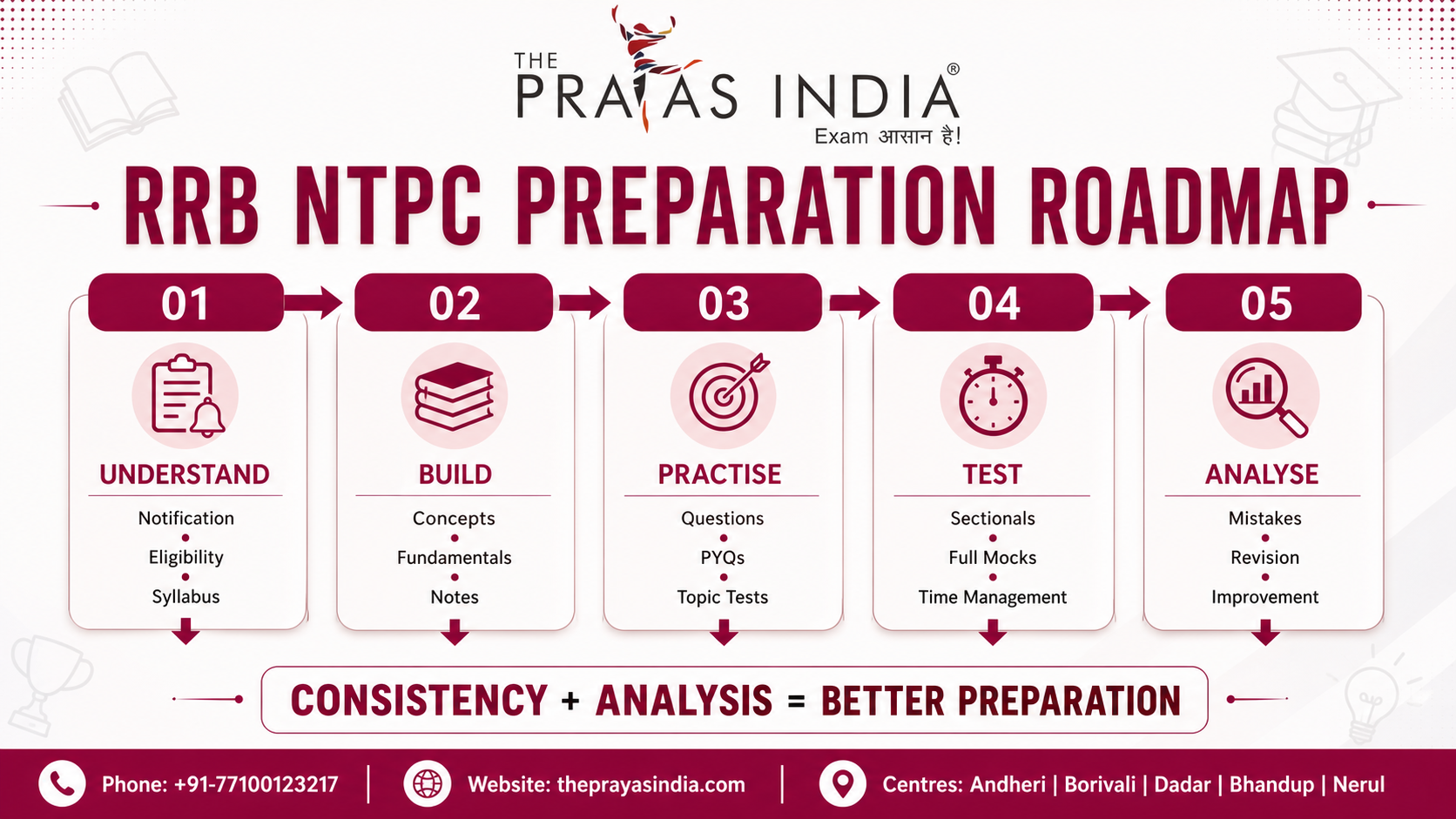
A Better RRB NTPC Preparation Framework
Avoiding mistakes becomes easier when your preparation follows a simple system.
A practical framework can be divided into five stages.
Stage 1: Understand
Read the applicable notification and identify your target post, eligibility, stages and syllabus.
Stage 2: Build
Strengthen your fundamentals in Mathematics, Reasoning and General Awareness.
Stage 3: Practise
Solve questions regularly and introduce previous-year questions early.
Stage 4: Test
Take sectional tests and full-length mocks under timed conditions.
Stage 5: Analyse
Identify mistakes, revise weak areas and modify your strategy.
This creates a continuous improvement loop.
How RRB Coaching in Mumbai Can Help You Avoid These Mistakes
Self-study can work well when you have a clear plan, reliable resources and the discipline to analyse your performance. However, many aspirants struggle because they do not know whether they are studying the right material, following the right sequence or spending enough time on their weak areas.
A structured RRB coaching programme can provide a more organised preparation environment.
At The Prayas India, aspirants preparing for railway and other competitive examinations in Mumbai can access structured preparation support through centres in Andheri, Borivali, Dadar, Bhandup and Nerul.
When evaluating RRB coaching in Mumbai, students should consider factors such as:
- Faculty guidance
- Quality of study material
- Previous-year question practice
- Mock-test availability
- Performance analysis
- Doubt-solving support
- Revision structure
- Online and offline learning options
- Individual preparation requirements
The purpose of coaching should not be to make an aspirant dependent on a particular resource. It should help build a systematic preparation process that the student can continue independently during the later stages of the examination.
How to Build a Daily RRB NTPC Routine
A practical routine should balance learning, practice and analysis.
A sample study structure could look like this:
Session 1 — Mathematics
Concept revision followed by focused question practice.
Session 2 — Reasoning
Topic-based practice followed by a short timed set.
Session 3 — General Awareness
Current affairs and static-topic revision.
Session 4 — Previous-Year Questions
Solve questions from relevant RRB examinations and analyse the approach.
Session 5 — Mock or Sectional Test
Take a timed test according to your preparation stage.
Session 6 — Analysis
Record mistakes and identify what should be revised next.
You do not need to follow this exact structure every day. The important principle is to ensure that your preparation includes all three:
Learning + Practice + Analysis
What Should You Do If Your Preparation Is Already Behind?
Do not respond to delayed preparation by trying to study everything simultaneously.
First, identify the highest-priority areas.
Divide your syllabus into:
Completed: Needs revision and testing.
Partially Completed: Needs focused practice.
Not Started: Needs prioritisation based on importance and available time.
Then reduce unnecessary resource switching.
If you have limited time, focus on:
- Core concepts
- Previous-year questions
- High-frequency practice areas
- Weak topics
- Timed tests
- Mock analysis
- Repeated revision
A shorter, structured preparation cycle is generally more useful than an unplanned attempt to cover every available resource.
RRB NTPC Preparation Mistakes: Final Checklist
Before entering the final phase of your preparation, ask yourself:
- Have I read the official notification applicable to my target post?
- Do I understand the examination stages?
- Am I following a realistic study plan?
- Am I practising questions regularly?
- Have I solved previous-year questions?
- Am I taking timed tests?
- Do I analyse every mock?
- Do I maintain a mistake log?
- Am I revising General Awareness consistently?
- Am I working on my weak subjects?
- Am I avoiding unnecessary guessing?
- Have I checked whether my target post has any additional skill requirement?
- Am I following official RRB updates?
- Am I comparing my progress with my own previous performance?
If several answers are “no”, you do not necessarily need to start over. Identify the gaps and gradually bring them into your preparation routine.
Final Thoughts
RRB NTPC preparation is not simply a race to complete the syllabus.
It is a process of building knowledge, improving accuracy, developing speed, understanding question patterns and learning how to perform under examination conditions.
The biggest preparation mistakes are often not dramatic. They are small habits repeated over weeks: studying without a plan, avoiding weak subjects, collecting too many resources, taking mocks without analysis, ignoring revision or relying on unofficial information.
The good news is that these habits can be changed.
A more effective approach is straightforward:
Understand the exam. Build strong fundamentals. Practise consistently. Solve previous-year questions. Take timed tests. Analyse mistakes. Revise repeatedly.
For aspirants looking for structured RRB coaching in Mumbai, The Prayas India provides preparation support through its centres at Andheri, Borivali, Dadar, Bhandup and Nerul, along with online and offline learning options.
The objective should not be to study everything available. It should be to study systematically, identify your gaps and continuously improve the way you prepare.
FAQs
1. What are the most common RRB NTPC preparation mistakes?
Common mistakes include preparing without understanding the notification, relying on unofficial information, ignoring weak subjects, skipping previous-year questions, taking mocks without analysis, neglecting revision, changing resources frequently and failing to manage time effectively.
2. Should I solve previous-year questions for RRB NTPC?
Yes. Previous-year questions can help you understand question formats, recurring concepts, difficulty and the type of reasoning required. Analyse the questions rather than simply counting how many you solved.
3. How important are mock tests for RRB NTPC preparation?
Mock tests are useful for developing time management, accuracy and examination strategy. Their value increases significantly when you analyse your mistakes after every test.
4. Should I focus more on my strong or weak subjects?
You should maintain your strong subjects while allocating additional focused practice to weak areas. Your mock-test and sectional-test analysis can help determine where additional preparation is required.
5. Is it necessary to follow multiple RRB NTPC study materials?
No. Using too many resources can create confusion. Select reliable resources for concepts, practice, previous-year questions and mocks and follow them consistently.
6. Should I prepare General Awareness every day?
Regular revision is useful because General Awareness requires retention. A consistent revision routine is generally more manageable than trying to cover everything shortly before the examination.
7. Can coaching help with RRB NTPC preparation?
Structured coaching can help with study planning, practice material, mock tests, doubt solving and performance analysis. However, students should evaluate the learning format, faculty support and preparation resources before selecting an institute.
8. Where can I find RRB NTPC updates?
Candidates should rely primarily on the official Railway Recruitment Board websites and the notification applicable to their recruitment cycle. The official RRB website also advises candidates to ignore unofficial information circulated through social media.
Don’t Let Common Mistakes Ruin Your RRB NTPC Chances!
Avoid wrong strategy and poor time management. Join The Prayas India, the best RRB coaching in Mumbai, and get expert guidance to crack the RRB NTPC exam on your very first attempt.
Official Website: theprayasindia.com
Visit Our Mumbai Centres: