
RRB NTPC Reasoning: Most Scoring Topics for CBT 1 | The Prayas India
Reasoning is one of the sections where a well-structured preparation strategy can make a significant difference in RRB NTPC CBT 1. Unlike General Awareness, where the syllabus is extremely broad, Reasoning follows identifiable patterns. Once candidates understand the concepts and practise different question types, they can gradually improve their speed, accuracy and ability to recognise familiar patterns.
For RRB NTPC CBT 1, General Intelligence and Reasoning carries 30 questions, making it an important part of the 100-question paper. The official RRB NTPC syllabus includes topics such as Analogies, Number and Alphabetical Series, Coding-Decoding, Mathematical Operations, Relationships, Syllogism, Jumbling, Venn Diagrams, Puzzles, Data Sufficiency, Statement-Conclusion, Statement-Courses of Action, Decision Making, Maps and Interpretation of Graphs.
However, candidates should not approach every Reasoning topic in exactly the same way. Some topics are comparatively straightforward once the underlying pattern is understood, while others can consume more time during practice and the examination. Therefore, a useful strategy is to prioritise topics based on question familiarity, learning curve, calculation or mental processing required, and your own accuracy in mock tests.
This article explains the important Reasoning topics for RRB NTPC CBT 1, how to prepare each one, which areas beginners should study first, how to improve speed and accuracy, and how to use PYQs and mock tests to build an effective preparation strategy.
RRB NTPC CBT 1 Reasoning: At a Glance
The Reasoning section in CBT 1 contains 30 questions. The syllabus covers verbal and analytical reasoning topics along with series, coding, relationships, syllogism, puzzles, Venn diagrams and other logical concepts.
| Particular | RRB NTPC CBT 1 |
|---|---|
| Reasoning Questions | 30 |
| Total Questions | 100 |
| Examination Duration | 90 minutes |
| Question Type | Objective MCQs |
| Negative Marking | 1/3 mark for each incorrect answer |
| Major Focus | Speed, Accuracy & Pattern Recognition |
The section-wise distribution is based on the notified examination pattern, while the actual mix of questions can vary between question papers. Therefore, candidates should prepare the complete prescribed syllabus rather than assuming that a particular topic will definitely contribute a fixed number of questions.
The negative marking also makes accuracy important. A candidate should not simply aim to attempt all available Reasoning questions without considering confidence and time.
What Makes a Reasoning Topic “Scoring”?
The phrase “scoring topic” should not be interpreted as an official RRB classification. The RRB syllabus does not label topics as easy, difficult or high-scoring.
For preparation purposes, however, candidates can prioritise topics using four practical factors:
1. Pattern Familiarity
Topics with clearly recognisable patterns can become faster after sufficient practice.
2. Conceptual Simplicity
Some topics require a limited number of basic rules and can therefore be mastered relatively quickly.
3. Time Requirement
A question may be easy but still take longer to solve. This matters in a time-bound CBT.
4. Individual Accuracy
A topic that another candidate finds easy may be difficult for you. Your mock-test performance should therefore influence your final priority list.
This is why candidates should use the following approach:
Learn → Practise → Measure → Prioritise
Do not decide your priority solely from someone else’s list of “most important topics.”
Most Important Reasoning Topics for RRB NTPC CBT 1
For practical preparation, the syllabus can be divided into four broad groups:
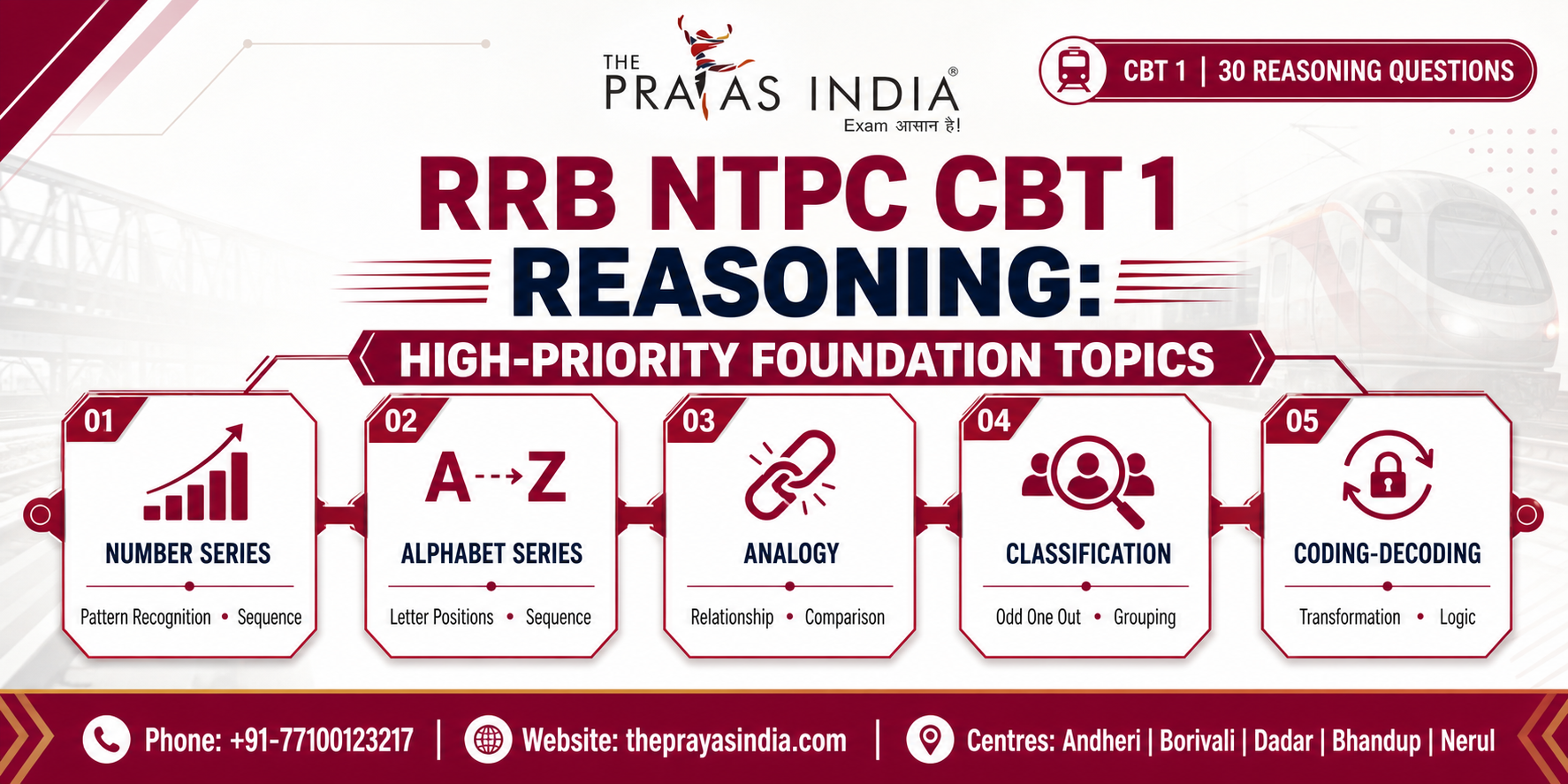
Group A: High-Priority Foundation Topics
- Analogy
- Classification
- Number Series
- Alphabet Series
- Coding-Decoding
- Mathematical Operations
- Similarities and Differences
- Relationships
- Directions
Group B: Core Logical Reasoning
- Syllogism
- Venn Diagrams
- Statement and Conclusion
- Statement and Courses of Action
- Analytical Reasoning
- Decision Making
Group C: Arrangement and Data-Based Topics
- Puzzles
- Data Sufficiency
- Jumbling
- Maps
- Graph Interpretation
Group D: Mixed Practice Areas
- Combination questions
- Verbal reasoning
- Non-verbal reasoning
- Questions involving multiple concepts
This grouping is not an official ranking. It is a preparation framework designed to help candidates build their Reasoning skills progressively.
1. Number Series
Number Series is one of the first topics beginners should learn because it develops pattern-recognition ability.
A series may follow:
- Addition patterns
- Subtraction patterns
- Multiplication patterns
- Division patterns
- Increasing differences
- Decreasing differences
- Square or cube relationships
- Alternating patterns
- Mixed operations
For example, a sequence may initially appear random, but the difference between consecutive terms may reveal a simple pattern.
The most important skill is not memorising dozens of tricks. Instead, learn to check the most common relationships systematically.
A useful solving sequence is:
Difference → Second difference → Multiplication/Division → Square/Cube relationship → Alternating pattern
With practice, your brain begins to recognise familiar structures more quickly.
How to Prepare for Number Series
Start with simple series and gradually move towards mixed patterns. Maintain a record of questions where you could not identify the pattern within a reasonable amount of time.
Do not spend five minutes trying to force a pattern into one difficult series during practice. Learn the structure, check the solution and move on.
2. Alphabet Series
Alphabet-based questions test your ability to identify relationships between letters.
Important concepts include:
- Alphabet positions
- Forward movement
- Backward movement
- Letter gaps
- Alternating patterns
- Reverse alphabet
- Position-based coding
Candidates should become comfortable with alphabet positions from A to Z.
A useful practice technique is to learn the alphabet positions in groups and practise moving forward and backward mentally.
For example:
A = 1, B = 2, C = 3 … Z = 26
You should gradually reach a stage where basic alphabet-position calculations do not require writing the entire alphabet.
Why Alphabet Series Deserves Early Attention
The questions are often based on clear patterns, but speed depends heavily on familiarity. Regular short practice sessions can therefore be useful.
3. Analogy
Analogy questions test relationships between two objects, words, numbers, letters or concepts.
The basic structure is:
A : B :: C : ?
The challenge is to identify the relationship between A and B and apply the same relationship to C.
Analogy may involve:
- Numbers
- Letters
- Words
- Objects
- Mathematical relationships
- General knowledge-based relationships
The most common mistake is identifying a relationship that is technically possible but does not match the exact pattern used in the question.
Preparation Strategy
When solving analogy questions, ask:
“What exactly connects the first pair?”
Do not jump immediately to the options.
Once the relationship is established, apply the same rule to the second pair.
4. Classification
Classification questions require you to identify the item that does not follow the same relationship as the others.
They can be based on:
- Numbers
- Letters
- Words
- Objects
- Mathematical properties
- Logical relationships
The key is to identify the common property shared by the majority of options.
For example, if three options follow one mathematical property while one does not, the different option becomes the answer.
How to Improve
Practise different forms of classification instead of solving only one type. This helps you recognise whether the question is based on numerical, alphabetical or conceptual relationships.
5. Coding-Decoding
Coding-Decoding is one of the most important areas to practise because questions can take several forms.
Common patterns include:
- Letter shifting
- Reverse alphabet coding
- Number-based coding
- Word coding
- Substitution
- Symbol-based coding
- Mixed coding
The first step should always be to determine what transformation has been applied.
Do not start guessing from the answer options.
Coding-Decoding Method
Follow this process:
Identify the coded relationship → Find the transformation → Test it on another element → Apply the rule
If the code involves alphabet positions, write down the relevant positions rather than trying to calculate everything mentally in the beginning.
With repeated practice, many simple coding questions become considerably faster.
6. Mathematical Operations
Mathematical Operations questions use symbols or operations in an altered form.
For example, the question may define a symbol as representing a different mathematical operation.
The first step is to understand the new meaning assigned to each symbol.
Candidates often make the mistake of solving the expression according to normal mathematical operations before replacing the symbols.
Preparation Strategy
Always rewrite the expression using the actual operations given in the question. Then apply the correct order of operations.
Practise enough questions to make this process automatic.
7. Similarities and Differences
These questions test the ability to identify common characteristics or distinctions.
They may involve:
- Words
- Numbers
- Letters
- Objects
- Relationships
The questions are generally based on logical comparison rather than advanced calculations.
For beginners, this is a useful area to practise after Analogy and Classification because the underlying skill—identifying relationships—is similar.
8. Blood Relations and Relationships
Relationship-based questions can initially look confusing because the information may be presented through several generations.
The biggest mistake is attempting to solve everything mentally.
Instead, create a simple family structure.
For example:
Grandparent → Parent → Child
Then identify:
- Male/female
- Generation
- Maternal/paternal relationship
- Sibling relationship
- Spouse relationship
Best Strategy
Whenever a relationship question contains multiple statements, draw a quick diagram.
A small diagram can prevent mistakes and reduce the mental load considerably.
9. Direction Sense
Direction-based questions require you to track movement and determine the final direction or distance.
Know the basic directions:
North | South | East | West
And their combinations:
North-East | North-West | South-East | South-West
For longer questions, use a rough coordinate or directional diagram instead of attempting to visualise every movement mentally.
Practice Tip
Solve simple questions first and gradually introduce questions involving turns, distances and multiple movements.
10. Syllogism
Syllogism is a logical reasoning topic where candidates need to determine whether a conclusion follows from the given statements.
Questions commonly use structures involving:
- All
- Some
- No
The key is to understand the relationship between statements and conclusions rather than using assumptions based on real-world knowledge.
Important Rule
If the question says:
All A are B
you should work only with the logical information given.
Do not introduce outside assumptions.
How to Prepare Syllogism
Practise different statement-conclusion combinations and use Venn diagrams where they make the relationship easier to visualise.
After enough practice, familiar syllogism patterns can become faster to solve.
11. Venn Diagrams
Venn Diagram questions test relationships between different groups.
They can be useful for understanding:
- All
- Some
- None
- Overlapping groups
- Separate groups
- Nested groups
For beginners, Venn Diagrams are particularly useful because they convert abstract relationships into a visual structure.
Preparation Strategy
Practise drawing simple circles quickly and interpreting the overlap rather than trying to solve every relationship verbally.
12. Puzzles
Puzzles are explicitly included in the RRB NTPC Reasoning syllabus.
They can involve:
- Seating arrangements
- Order and ranking
- Distribution
- Scheduling
- Position-based information
- Multiple conditions
Puzzles can be rewarding once the structure becomes familiar, but they may also consume considerable time when the candidate is unfamiliar with the format.
Therefore, do not measure your preparation only by the number of puzzles you solve.
Measure:
Accuracy + Time Taken + Correct Setup
Puzzle Strategy
First identify:
- Number of entities
- Type of arrangement
- Fixed information
- Direct relationships
- Conditional statements
- Possibilities
Then create a table, diagram or arrangement grid.
Avoid repeatedly reading the same statements without creating a structure.
13. Data Sufficiency
Data Sufficiency questions are not always about calculating the final answer. The primary question is whether the information provided is sufficient to determine the answer.
Candidates therefore need to understand the difference between:
“Can I solve this?”
and
“Do I have enough information to solve this?”
This distinction is important.
Preparation Strategy
Read each statement independently first. Determine whether it provides sufficient information before combining it with another statement, according to the question’s instructions.
Practise these questions separately because the decision-making process differs from conventional problem-solving.
14. Statement and Conclusion
Statement-Conclusion questions test whether a conclusion logically follows from the given statement.
Do not use personal opinions or outside information.
The correct approach is:
Read the statement → Identify the exact information → Test the conclusion → Avoid assumptions
Candidates often select an option because the conclusion sounds reasonable. That is not enough.
The conclusion must logically follow from the information provided.
15. Statement and Courses of Action
These questions require candidates to evaluate whether a proposed course of action logically addresses a situation.
The focus should remain on the information given in the question.
A common mistake is choosing an action simply because it sounds desirable. The question is asking whether the proposed action is a logical response to the stated problem.
Practise different scenarios so that you become familiar with the reasoning framework.
16. Decision Making
Decision Making questions assess your ability to apply given conditions and arrive at a logical decision.
The safest strategy is to identify:
- The objective
- The conditions
- The available choices
- The restrictions
- The final decision criteria
Do not introduce assumptions that are not present in the question.
17. Jumbling
Jumbling questions require candidates to arrange elements in the correct sequence or order.
The information may involve:
- Words
- Letters
- Numbers
- Sentences
- Logical sequences
Look for fixed positions first. Once one or two elements are placed confidently, the remaining arrangement often becomes easier.
18. Maps and Graph Interpretation
The RRB NTPC syllabus also includes maps and interpretation of graphs.
For these questions, candidates should focus on understanding the visual information rather than rushing into calculations.
Read:
- Labels
- Directions
- Values
- Scale
- Relative position
- Changes or trends
Practise interpreting the information before attempting the question.
Which RRB NTPC Reasoning Topics Should Beginners Study First?
A beginner should not start with the most complicated puzzle or the longest analytical reasoning set.
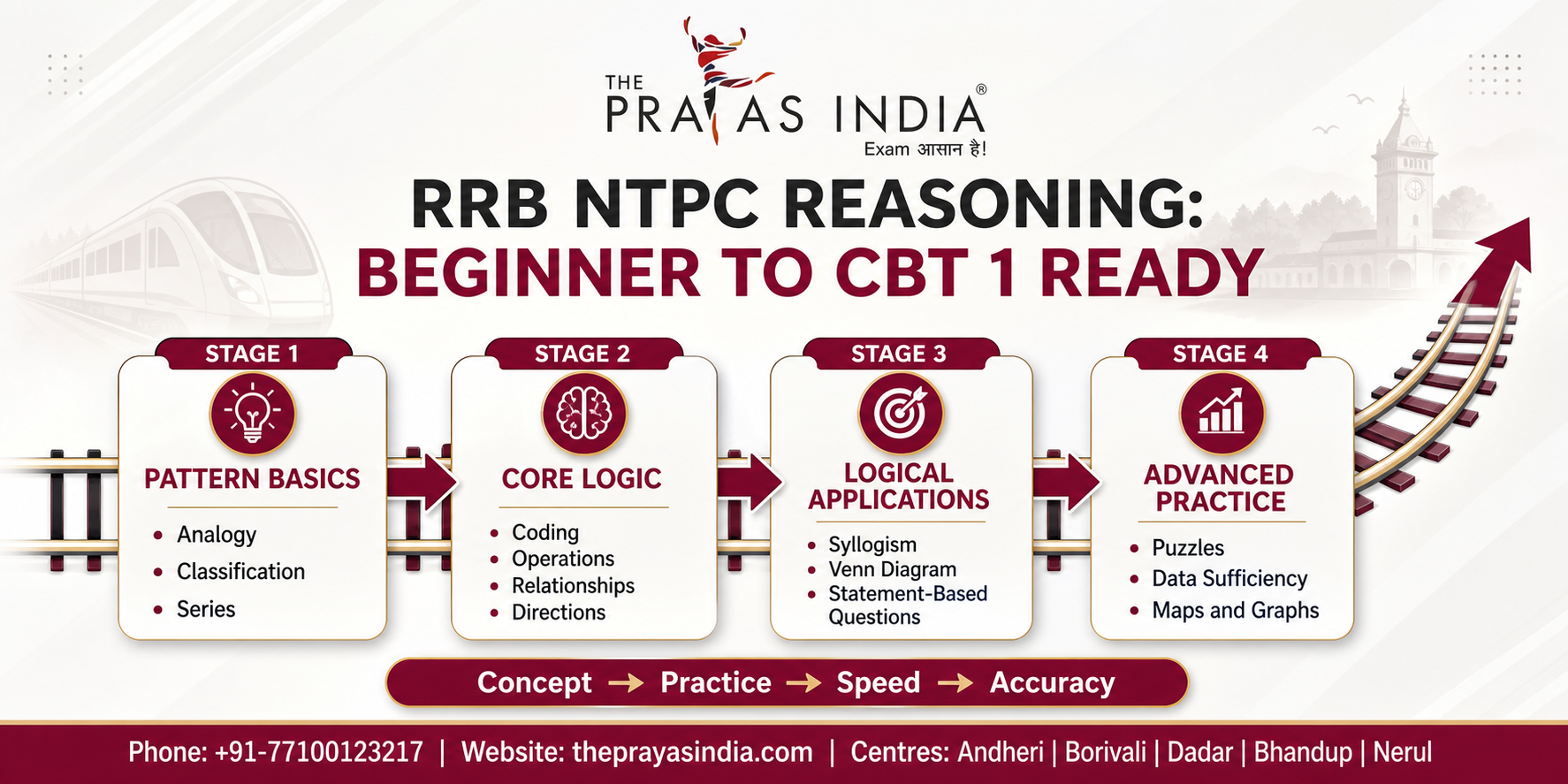
A more practical progression is:
Stage 1: Build Pattern Recognition
Start with:
- Analogy
- Classification
- Similarities and Differences
- Number Series
- Alphabet Series
Stage 2: Learn Common Logical Structures
Then move to:
- Coding-Decoding
- Mathematical Operations
- Relationships
- Directions
- Syllogism
- Venn Diagrams
Stage 3: Develop Analytical Ability
After that, practise:
- Statement-Conclusion
- Courses of Action
- Decision Making
- Data Sufficiency
Stage 4: Add Time-Consuming Topics
Finally, increase your practice of:
- Puzzles
- Jumbling
- Maps
- Graph Interpretation
- Mixed Reasoning Sets
This sequence allows you to build pattern recognition before moving towards questions that require more information processing.
How to Decide Which Topics Are Most Scoring for You?
Instead of depending entirely on generic rankings, create your own Reasoning priority chart after taking a few practice tests.
Use three categories:
Category A: High Accuracy + Low Time
These should become your first-attempt topics in mocks if the question format is familiar.
Category B: High Accuracy + Moderate Time
Practise these regularly and work on reducing solving time.
Category C: Low Accuracy or High Time
Do not necessarily abandon these topics. Instead, identify whether the problem is conceptual weakness, lack of practice or inefficient solving.
This approach creates a personalised preparation strategy.
For example, if you score well in Coding-Decoding but spend too much time on Puzzles, your preparation should not simply be “study more Reasoning.” It should specifically focus on maintaining Coding-Decoding accuracy while improving puzzle setup and time management.
How to Improve Reasoning Speed for CBT 1?
Reasoning speed develops through pattern familiarity rather than simply solving hundreds of random questions.
1. Learn the Basic Pattern
Understand how the question works.
2. Solve Untimed Questions
Focus initially on accuracy.
3. Introduce a Time Limit
Once accuracy becomes stable, start solving under time pressure.
4. Analyse the Solution
Look for unnecessary steps.
5. Repeat Similar Questions
The goal is to make common patterns familiar enough that they require less conscious effort.
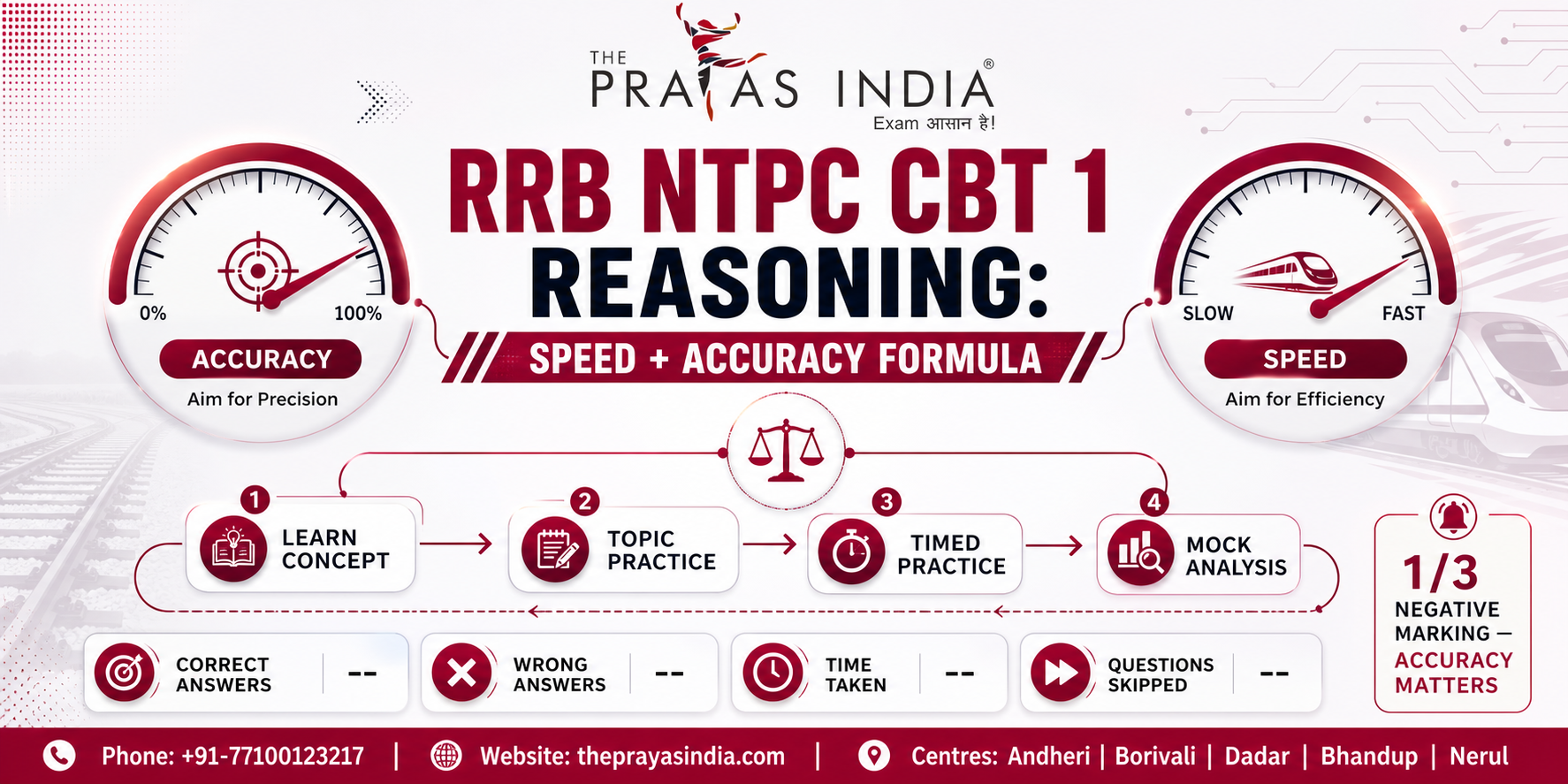
Accuracy First, Speed Second
One of the biggest mistakes candidates make is attempting to increase speed before establishing accuracy.
Suppose you solve 20 questions in 15 minutes with 25% errors. Increasing your speed further will not necessarily improve your score.
Instead, first aim for:
High accuracy → Consistent timing → Faster execution
This is particularly important because RRB NTPC has 1/3-mark negative marking for an incorrect answer.
The 30-Question Reasoning Practice Method
A simple daily practice structure can be:
First 10 Questions: Concept Practice
Choose one topic and solve questions without excessive time pressure.
Next 10 Questions: Timed Practice
Set a time limit and attempt questions from the same or related topic.
Final 10 Questions: Mixed Practice
Solve questions from different Reasoning topics.
Then analyse your performance.
Record:
- Correct answers
- Incorrect answers
- Time taken
- Questions left
- Reason for mistakes
This creates a feedback loop instead of turning practice into simple question counting.
RRB NTPC Reasoning Mock-Test Strategy
Once you have completed the major concepts, begin taking sectional Reasoning tests.
A useful progression is:
Topic Test → Mixed Sectional Test → Full CBT Mock
In the beginning, do not obsess over completing the entire Reasoning section in an extremely short time.
Focus on identifying:
- Which questions you solve immediately
- Which questions require moderate thought
- Which questions consume too much time
- Which questions produce repeated errors
With repeated mock analysis, you can develop a personal question-selection strategy.
How to Use Previous-Year Questions for RRB NTPC Reasoning
Previous-year questions should be a core part of Reasoning preparation.
The purpose of PYQs is not only to see what has been asked previously. They also help you understand the style of questions and identify which concepts you have not mastered.
After completing a topic, solve its PYQs separately.
For example:
Series → Series PYQs
Coding → Coding PYQs
Syllogism → Syllogism PYQs
Puzzles → Puzzle PYQs
Once the topic-wise stage is complete, move towards mixed PYQ sets.
Maintain a PYQ Error Log
For every incorrect question, write down:
Topic | Mistake | Correct Method | Lesson
This can reveal patterns in your errors.
If most of your mistakes in Series occur because you fail to check alternating patterns, that becomes a specific skill to work on.
Common Mistakes Candidates Make in RRB NTPC Reasoning
Mistake 1: Trying to Memorise Too Many Tricks
Shortcuts can be useful, but they cannot replace conceptual understanding.
Mistake 2: Starting with Puzzles
Beginners sometimes spend too much time on puzzles before developing basic Reasoning skills.
Mistake 3: Ignoring Easy Topics
Candidates often focus on complicated questions while neglecting straightforward areas such as Series, Analogy or Classification.
Mistake 4: Solving Without a Timer
Untimed practice does not adequately prepare you for a competitive CBT.
Mistake 5: Not Analysing Wrong Answers
Simply checking the correct answer is not enough. Understand why your approach failed.
Mistake 6: Spending Too Long on One Question
A difficult puzzle should not consume the time that could have been used for several manageable questions.
Mistake 7: Blind Guessing
Negative marking makes careless attempts risky.
RRB NTPC Reasoning 30-Day Preparation Plan
Candidates can use the following plan after adjusting it according to their existing level.
| Days | Focus Area |
|---|---|
| 1–2 | Analogy & Classification |
| 3–5 | Number Series |
| 6–7 | Alphabet Series |
| 8–10 | Coding-Decoding |
| 11 | Mathematical Operations |
| 12–13 | Similarities & Differences |
| 14–15 | Relationships & Blood Relations |
| 16 | Direction Sense |
| 17–18 | Syllogism |
| 19 | Venn Diagrams |
| 20–21 | Statement & Conclusion |
| 22 | Courses of Action & Decision Making |
| 23 | Data Sufficiency |
| 24–25 | Puzzles & Arrangements |
| 26 | Jumbling |
| 27 | Maps & Graph Interpretation |
| 28 | Mixed Topic Practice |
| 29 | Reasoning Sectional Mock |
| 30 | Revision + Error Analysis |
Do not interpret this schedule as a requirement to finish every topic completely within one day. The duration should depend on your current level.
Candidates who are weak in a particular topic should allocate additional time to that area rather than following the calendar mechanically.
A Better Daily Reasoning Routine
A balanced daily session can include:
| Activity | Suggested Time |
|---|---|
| Concept Learning | 30 minutes |
| Topic Practice | 35 minutes |
| Timed Questions | 20 minutes |
| PYQs | 20 minutes |
| Error Analysis | 15 minutes |
| Total | 2 hours |
Candidates with less time can reduce the duration while retaining the same structure.
For example, a one-hour session can include:
20 minutes concepts + 20 minutes practice + 10 minutes timed questions + 10 minutes analysis.
Consistency is more important than following an unrealistic schedule.
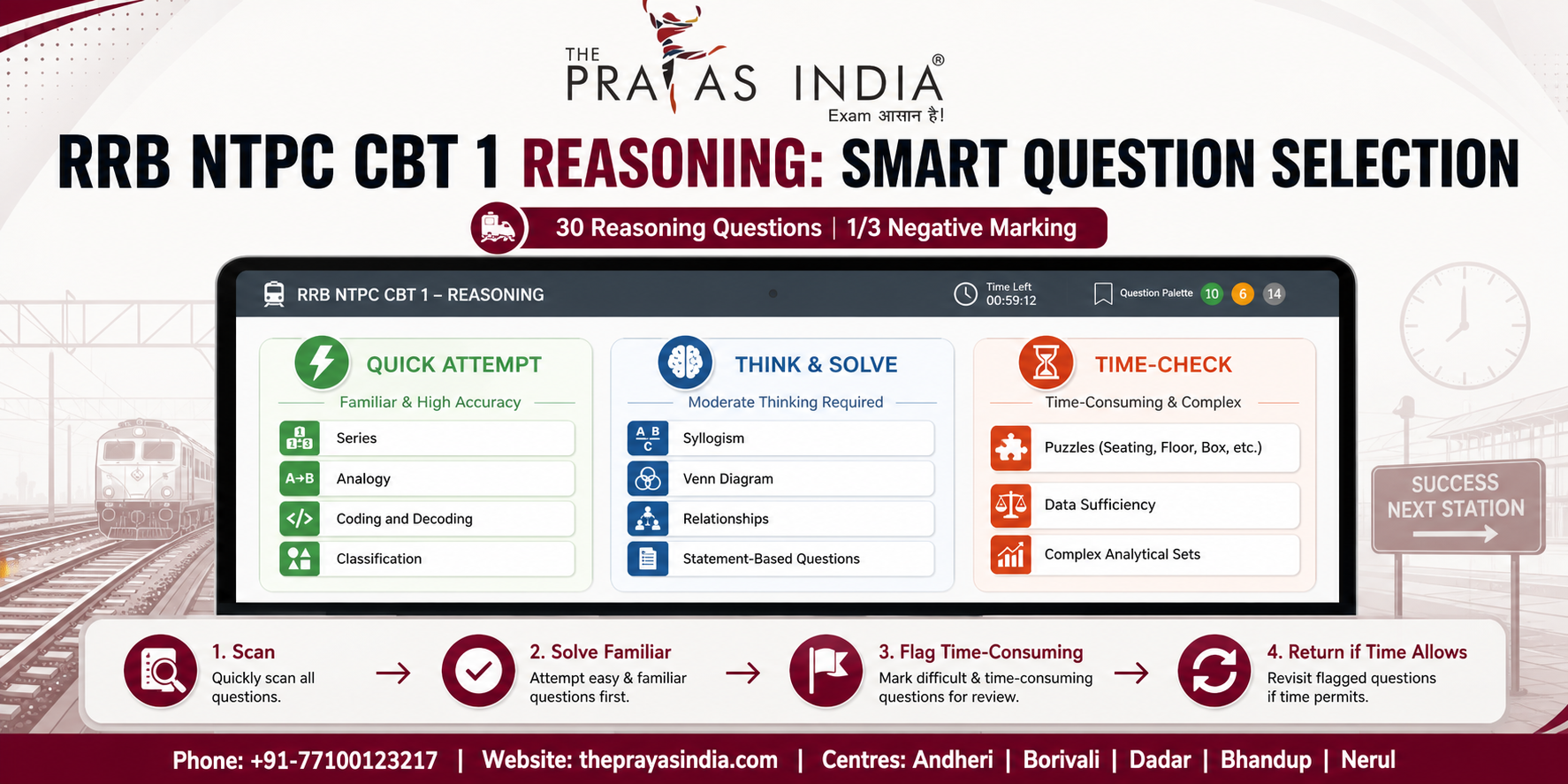
What Should You Attempt First in the CBT 1 Reasoning Section?
There is no universal attempt order that will work equally well for every candidate.
However, during mock tests, experiment with different approaches.
One candidate may find it effective to begin with:
Series → Analogy → Coding → Syllogism → Relationships → Puzzles
Another candidate may be faster with:
Coding → Classification → Series → Venn Diagram → Syllogism → Analytical Questions
The correct approach for you should be determined by your own mock-test performance.
The important principle is:
Do not spend the opening minutes getting trapped in one difficult question.
Scan the section, identify familiar patterns and manage time deliberately.
How to Turn Reasoning into a Strong CBT 1 Section
The objective should not be to become equally strong in every topic overnight.
Instead, build your preparation in layers.
Layer 1: Master the Basics
Understand the concepts and standard question formats.
Layer 2: Build Accuracy
Solve questions without unnecessary shortcuts.
Layer 3: Increase Speed
Introduce timed practice.
Layer 4: Handle Mixed Sets
Practise switching between different Reasoning concepts.
Layer 5: Develop Exam Selection
Learn which questions to attempt immediately and which ones require more time.
This progression is more sustainable than trying to solve difficult questions from the first day.
Final Strategy for RRB NTPC Reasoning CBT 1
RRB NTPC Reasoning can become a strong part of CBT 1 preparation when candidates combine conceptual clarity, repeated practice, speed-building and careful question selection.
Start with pattern-based topics such as Analogy, Classification, Number Series, Alphabet Series and Coding-Decoding. Then strengthen core logical areas such as Mathematical Operations, Relationships, Directions, Syllogism and Venn Diagrams. Once these foundations are stable, increase your practice of Puzzles, Data Sufficiency, Statement-Based Questions, Decision Making, Maps and Graph Interpretation.
The official syllabus includes all of these areas, so candidates should not completely ignore a topic merely because it appears more time-consuming. Instead, use PYQs and mock-test analysis to determine how much time each topic deserves in your individual preparation.
Most importantly, remember that “scoring” is not simply about finding easy questions. It is about reaching a stage where you can recognise familiar patterns quickly, solve them accurately and avoid spending excessive time on questions that are not immediately yielding.
With 30 Reasoning questions in CBT 1, every improvement in speed and accuracy can make your overall preparation more efficient. Build your foundation, practise consistently, analyse your mistakes and gradually develop an exam-specific question-selection strategy.
Important Takeaway
RRB NTPC Reasoning Preparation Formula
Concept Clarity + Topic-Wise Practice + PYQs + Timed Practice + Mock Analysis = Better Reasoning Preparation
Do not chase shortcuts blindly. First understand the pattern, then improve accuracy and finally work on speed.
Frequently Asked Questions: RRB NTPC Reasoning Most Scoring Topics for CBT 1
1. How many Reasoning questions are asked in RRB NTPC CBT 1?
RRB NTPC CBT 1 contains 30 questions from General Intelligence and Reasoning as part of the 100-question examination.
2. Which are the most important Reasoning topics for RRB NTPC CBT 1?
Candidates should prepare the complete syllabus, with particular practice on areas such as Series, Analogy, Classification, Coding-Decoding, Mathematical Operations, Relationships, Syllogism, Venn Diagrams, Puzzles, Statement-Based Questions, Data Sufficiency and Decision Making. These are practical preparation priorities rather than an official RRB ranking.
3. Is Coding-Decoding important for RRB NTPC Reasoning?
Yes. Coding-Decoding is explicitly included in the RRB NTPC General Intelligence and Reasoning syllabus. Candidates should practise different coding patterns rather than relying on one shortcut.
4. Should beginners start RRB NTPC Reasoning with puzzles?
It is generally more practical for beginners to first develop basic pattern-recognition skills through topics such as Analogy, Classification, Series and Coding-Decoding before spending substantial time on lengthy puzzles.
5. How can I improve Reasoning speed for RRB NTPC?
Build accuracy first and then introduce timed practice. Solve topic-wise questions, practise PYQs, use sectional tests and analyse which question types consume excessive time.
6. Are puzzles important for RRB NTPC CBT 1?
Puzzles are included in the official RRB NTPC Reasoning syllabus. Candidates should practise them, but they should also learn to manage time because some puzzle formats can require more processing than straightforward questions.
7. How much Reasoning should I practise every day?
A candidate can begin with around one to two focused hours depending on the overall study schedule. The session should ideally include concepts, practice, timed questions and error analysis.
8. Are previous-year questions useful for RRB NTPC Reasoning?
Yes. PYQs help candidates become familiar with the types of reasoning concepts and question formats that have appeared in the examination and help identify individual weak areas.
9. How should I handle difficult Reasoning questions in CBT 1?
Do not allow one difficult question to consume disproportionate time. Practise identifying familiar questions quickly and return to time-consuming questions when the remaining time permits.
10. Does RRB NTPC Reasoning have negative marking?
Yes. The RRB NTPC CBT examination carries a deduction of 1/3 mark for each incorrect answer, making accuracy an important part of the strategy.
Master RRB NTPC 2026 Reasoning! Join New Exam-Oriented Batches
Build speed, accuracy and pattern recognition for RRB NTPC CBT 1 with structured Reasoning preparation. Get focused guidance for Series, Coding-Decoding, Analogy, Syllogism, Puzzles, Venn Diagrams, PYQs and mock-test practice at The Prayas India.
Official Website: theprayasindia.com
Visit Our Mumbai Centres:
Andheri | Borivali | Dadar | Nerul | Bhandup