Sarojini Naidu: Poet of Freedom, Voice of Nationalism, and Pioneer of Women’s Leadership
- GS Paper 1: Modern Indian History (Freedom Struggle, Role of Women, National Movement)
- GS Paper 4: Ethics – Leadership, Courage, Public Service, Gender Equality
- Prelims: INC sessions, Home Rule Movement, first woman Governor, literary works
- Optional (History / Sociology / Political Science): National Movement, Women in Freedom Struggle, Indian Nationalism
Introduction
Sarojini Naidu occupies a distinctive place in modern Indian history as a freedom fighter, nationalist leader, poet, and advocate of women’s empowerment. Popularly remembered as the ‘Nightingale of India’ for her lyrical poetry, her political contribution often remains underemphasized despite her central role in the Indian national movement. She emerged as one of the most articulate voices of Indian nationalism, combining cultural expression with political activism.
As one of the foremost women leaders of the freedom struggle—alongside figures such as Annie Besant, Kasturba Gandhi, and Vijaya Lakshmi Pandit—Sarojini Naidu symbolised the entry of Indian women into public politics. Her life reflects the synthesis of nationalism, ethical leadership, and gender equality, making her relevant not only to India’s freedom struggle but also to contemporary discussions on inclusive leadership.
Early Life and Education
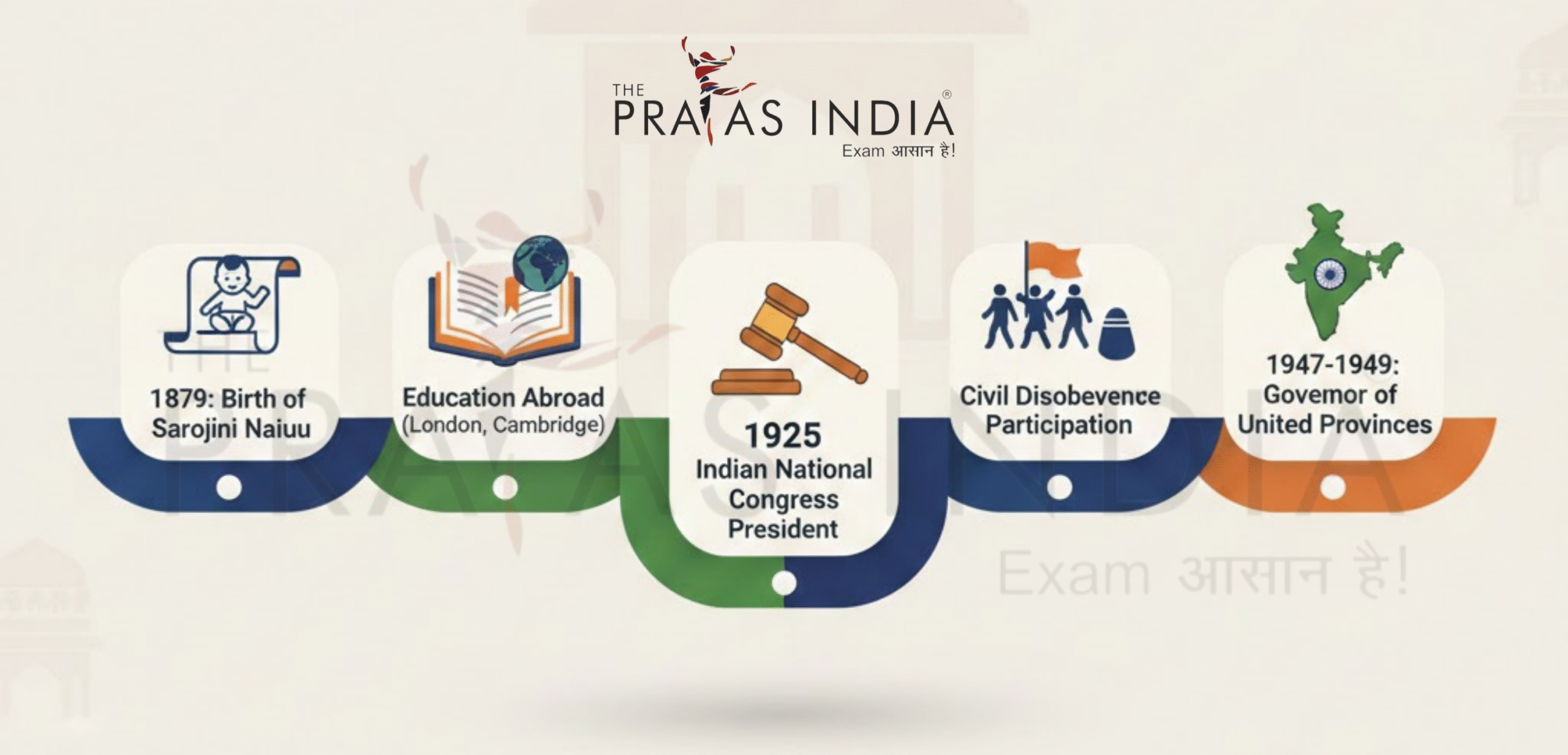
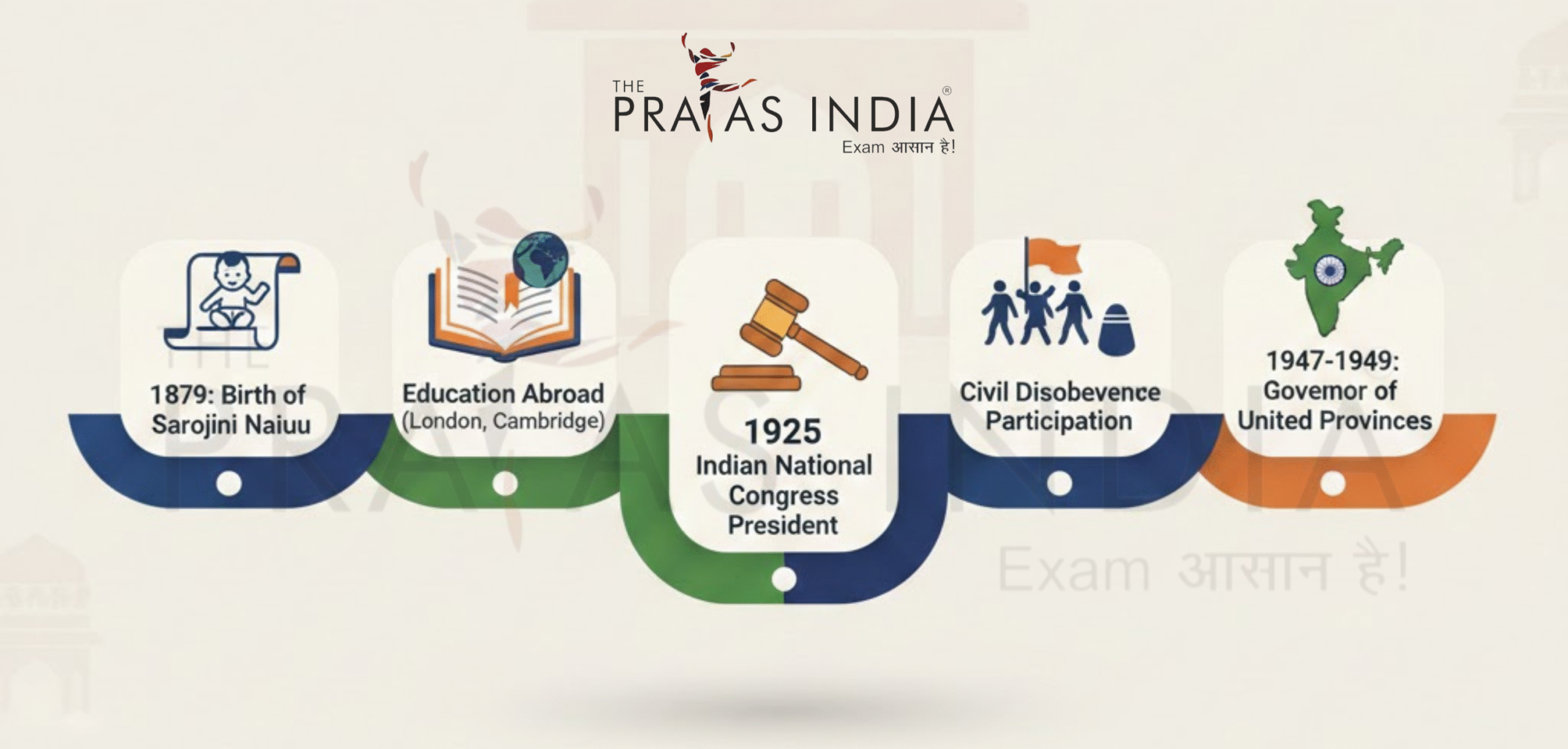
Sarojini Naidu was born on 13 February 1879 in Hyderabad into a progressive Bengali family. Her father, Aghorenath Chattopadhyay, was a scientist, educationist, and the first Indian principal of Nizam’s College, while her mother, Barada Sundari Devi, was a poetess. This intellectually rich environment nurtured Sarojini’s literary talent and liberal outlook from an early age.
A child prodigy, she demonstrated exceptional academic ability and linguistic proficiency. She pursued higher education in England, studying at King’s College, London, and later at Girton College, Cambridge. Exposure to Western liberal thought, combined with pride in Indian culture, shaped her worldview. During her student years, she began writing poetry that blended Indian themes with English literary forms, laying the foundation of her literary legacy.
Her education abroad also sensitized her to issues of colonial domination and racial discrimination, strengthening her nationalist consciousness. Thus, even before formally entering politics, Sarojini Naidu had developed a strong intellectual and moral commitment to India’s freedom.
Entry into the National Movement
Sarojini Naidu’s entry into the Indian national movement was facilitated by her association with prominent nationalist leaders such as Gopal Krishna Gokhale, Dadabhai Naoroji, and later Mahatma Gandhi. Gokhale, impressed by her oratory skills and commitment, encouraged her to dedicate herself to public life rather than exclusively to poetry.
By the second decade of the 20th century, she had emerged as a powerful speaker, capable of mobilising public opinion through eloquent speeches in both India and abroad. Her interaction with Mahatma Gandhi further radicalised her political engagement, drawing her into mass-based movements and civil resistance.
Sarojini Naidu thus transitioned from a cultural nationalist to an active political leader, representing a broader trend wherein educated Indian women began participating directly in the freedom struggle.
Role in the Indian Freedom Struggle
Role in the Indian National Congress
Sarojini Naidu became an active member of the Indian National Congress (INC) and participated regularly in its annual sessions. Her leadership abilities were recognised early, culminating in her election as the first Indian woman President of the INC in 1925 at the Kanpur session. This milestone was historically significant, as it marked the breaking of gender barriers within the highest political platform of nationalist politics.
As INC President, she emphasized unity, mass participation, and non-violent resistance. Her presidency symbolised the growing acceptance of women in leadership roles within the nationalist movement.
Civil Disobedience and Mass Movements
Sarojini Naidu played a prominent role in Gandhian mass movements, particularly the Civil Disobedience Movement (1930–34). She participated in the Salt Satyagraha, and after Gandhi’s arrest, she led the movement at Dharasana Salt Works, displaying remarkable courage in the face of colonial repression.
She was repeatedly arrested and imprisoned, reflecting her commitment to the principles of satyagraha, sacrifice, and non-violence. Her participation demonstrated that women were not merely symbolic participants but active leaders in mass struggles.
Contribution to Women’s Empowerment
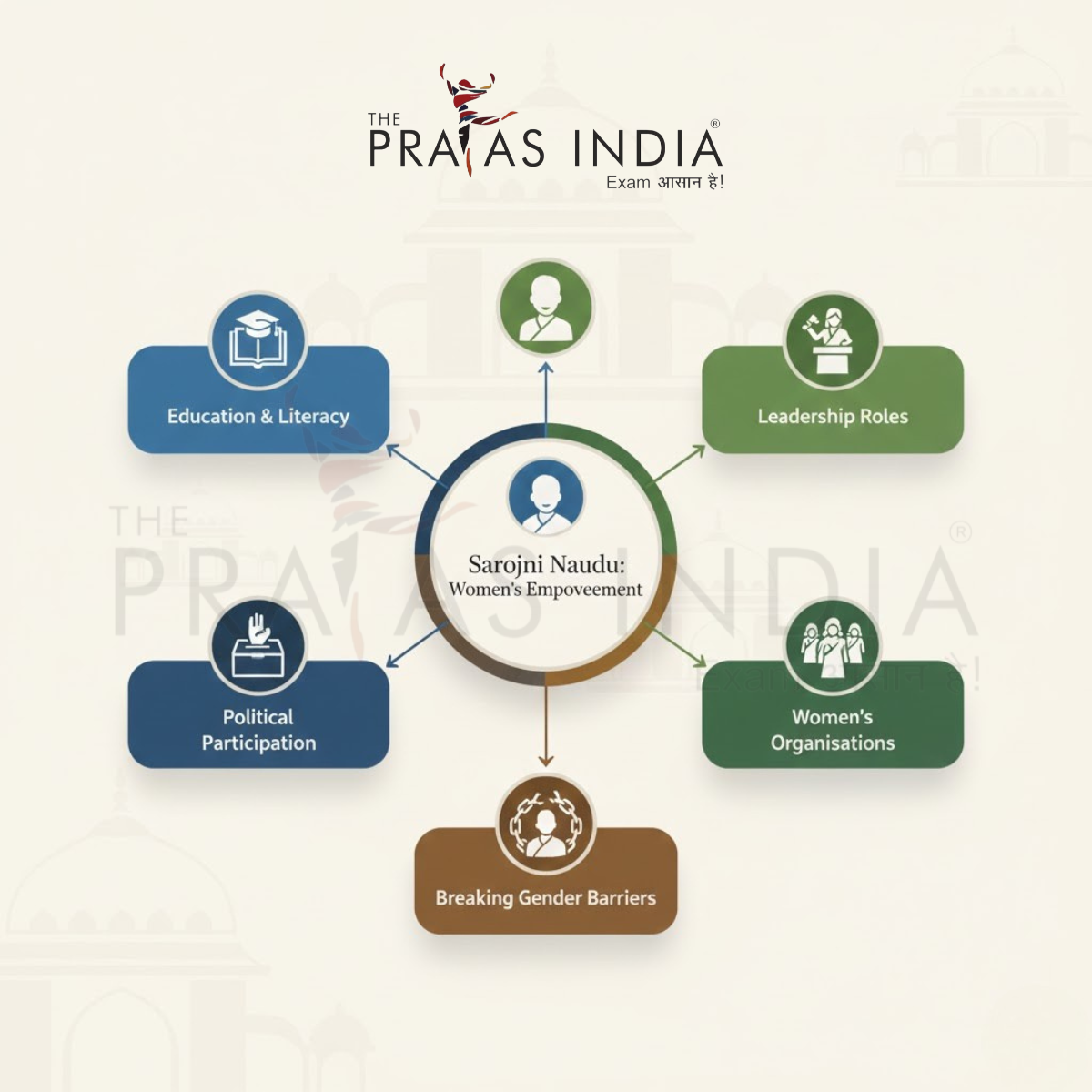
Sarojini Naidu was a pioneering advocate of women’s rights and political empowerment in colonial India. She believed that national freedom was inseparable from women’s emancipation and argued that women must participate fully in public life to achieve true independence.
She was closely associated with the Women’s Indian Association (WIA) and supported demands for women’s education, suffrage, and legal equality. Unlike Western feminist movements, her approach to women’s empowerment was rooted in Indian socio-cultural realities, seeking reform without alienating traditional values.
By occupying leadership positions in nationalist politics and addressing mass gatherings, Sarojini Naidu challenged patriarchal norms and became a role model for Indian women, encouraging their entry into public and political spaces.
International Representation and Diplomacy
Sarojini Naidu represented the Indian nationalist cause at several international forums, using diplomacy and persuasion to expose the injustices of British colonial rule. She addressed audiences in Europe, Africa, and America, articulating India’s demand for self-rule and civil liberties.
Her command over the English language, combined with cultural sensitivity, made her an effective ambassador of Indian nationalism. She highlighted issues such as racial discrimination, imperial exploitation, and women’s rights, linking India’s struggle with global movements for freedom and equality.
Thus, she contributed significantly to the internationalisation of the Indian freedom struggle.
Role in Post-Independence India
After independence, Sarojini Naidu continued to serve the nation in an administrative capacity. In 1947, she became the first woman Governor of an Indian state, assuming office as the Governor of the United Provinces (Uttar Pradesh).
Her appointment symbolised the new Indian state’s commitment to gender equality and democratic values. As Governor, she emphasized constitutionalism, social harmony, and public welfare, demonstrating the continuity of ethical leadership from the freedom struggle to nation-building.
Literary Contributions
Sarojini Naidu’s literary legacy forms an integral part of her historical significance. Known as the ‘Nightingale of India’, her poetry celebrated Indian landscapes, festivals, folk traditions, and nationalist emotions.
Her major works include:
- The Golden Threshold (1905)
- The Bird of Time (1912)
- The Broken Wing (1917)
Her poetry combined romantic imagery with nationalist sentiment, contributing to the cultural renaissance that accompanied the political struggle. Literature, for her, was not escapism but a medium of cultural assertion and emotional mobilisation.
Ethical and Leadership Dimensions
Sarojini Naidu’s life exemplifies key ethical values relevant to GS Paper IV:
- Courage: Facing imprisonment and colonial repression
- Integrity: Commitment to non-violence and democratic ideals
- Inclusiveness: Advocacy for women, minorities, and marginalised voices
- Service: Lifelong dedication to public causes
Her leadership style was marked by persuasion rather than coercion, emotional intelligence, and moral authority. She demonstrated how ethical conduct could coexist with political effectiveness.

Legacy and Historical Significance
Sarojini Naidu’s legacy lies in her multi-dimensional contribution—as a freedom fighter, political leader, cultural icon, and feminist voice. She expanded the social base of the national movement by facilitating women’s participation and represented India’s civilisational ethos through literature and diplomacy.
Her life illustrates that the freedom struggle was not only a political battle but also a cultural and ethical movement aimed at transforming society.
Conclusion
Sarojini Naidu stands as a symbol of nationalism, cultural pride, and women’s leadership in modern Indian history. By blending poetry with politics and ethics with activism, she enriched the Indian freedom struggle and left an enduring imprint on the nation’s democratic and cultural traditions.
Her relevance continues in contemporary India, where the pursuit of gender equality, ethical leadership, and inclusive nationalism remains an unfinished task. For aspirants of the civil services, Sarojini Naidu’s life offers enduring lessons in values-based public service and responsible leadership.
Frequently Asked Questions (FAQs)
Q1. Why is Sarojini Naidu known as the ‘Nightingale of India’?
Sarojini Naidu earned the title ‘Nightingale of India’ due to her lyrical poetry that beautifully captured Indian culture, nationalism, nature, and emotional depth, combining literary excellence with patriotic themes.
Q2. What was Sarojini Naidu’s role in the Indian National Congress?
She was an active INC leader and became the first Indian woman President of the Indian National Congress in 1925 (Kanpur Session), symbolising women’s entry into national political leadership.
Q3. How did Sarojini Naidu contribute to the Civil Disobedience Movement?
She participated actively in the Salt Satyagraha and led the Dharasana Salt Works protest after Gandhi’s arrest, facing imprisonment and colonial repression with courage.
Q4. What was Sarojini Naidu’s contribution to women’s empowerment?
She advocated women’s education, suffrage, and political participation, worked with the Women’s Indian Association, and inspired women to participate actively in public and political life.
Q5. Mention Sarojini Naidu’s role after Independence.
She became the first woman Governor of an Indian state, serving as the Governor of United Provinces (Uttar Pradesh), contributing to democratic governance and nation-building.
Q6. Why is Sarojini Naidu relevant for GS Paper IV (Ethics)?
Her life reflects ethical leadership, integrity, courage, inclusiveness, and service-oriented public life—core values tested in GS Paper IV.