
Semiconductors: Foundations, Strategic Significance, and India’s Path to Technological Self-Reliance
- GS Paper 3: Science & Technology, Indigenization of Technology, Economic Development
- GS Paper 1: Geography (resource base, industrial location – limited linkage)
- Prelims: Basic electronics, materials science, current affairs in tech
- Optional (Physics / Engineering / PSIR – tech policy angle): Solid State Physics, Technology & Public Policy
Introduction
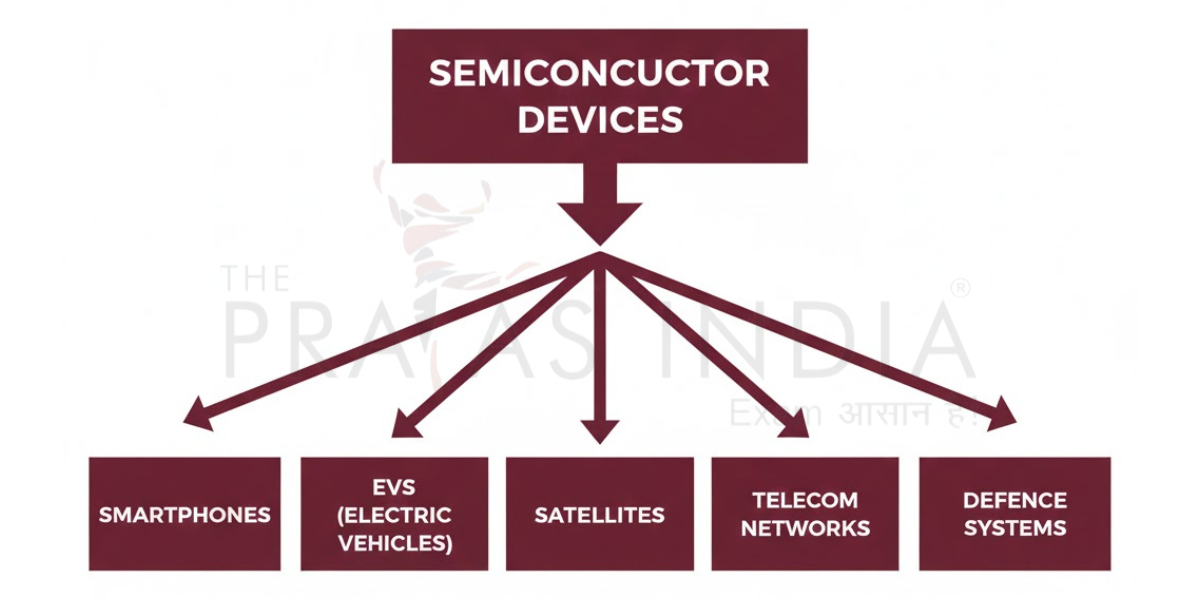
Semiconductors are materials whose electrical conductivity lies between conductors and insulators, enabling them to control and manipulate the flow of electric current. This unique property makes semiconductors the core building blocks of modern electronic devices, ranging from smartphones and computers to satellites, missiles, electric vehicles (EVs), artificial intelligence (AI) systems, and telecommunications infrastructure.
In the contemporary digital economy, semiconductors are indispensable for Industry 4.0, defence modernization, fintech, renewable energy systems, 5G/6G telecom, and data-driven governance. Often described as the “brains of modern technology”, they underpin productivity, innovation, and national competitiveness.
Recent global semiconductor supply disruptions, triggered by the COVID-19 pandemic, geopolitical tensions, and over-concentration of manufacturing in a few regions, have exposed the strategic vulnerability of nations dependent on external supply. This has elevated semiconductors from a commercial commodity to a strategic resource, central to economic security and technological sovereignty.
Basic Concept of Semiconductors
Electrical Conductivity Spectrum
Materials are classified based on their ability to conduct electricity:
- Conductors (e.g., copper): High electrical conductivity
- Insulators (e.g., rubber): Very low conductivity
- Semiconductors (e.g., silicon, germanium): Intermediate conductivity that can be precisely controlled
This controllability is what makes semiconductors technologically valuable.
Band Theory of Solids
The electrical behaviour of materials is explained through energy band theory:
- Valence Band: Occupied by electrons bound to atoms
- Conduction Band: A higher energy band where free electrons conduct electricity
- Band Gap: Energy difference between valence and conduction bands
- Conductors have overlapping bands
- Insulators have a large band gap
- Semiconductors have a moderate band gap, allowing controlled excitation of electrons

Types of Semiconductors
Intrinsic Semiconductors
Intrinsic semiconductors are pure materials, typically silicon or germanium.
- Electrical conductivity depends on temperature
- At higher temperatures, more electrons gain energy to cross the band gap
- Conductivity remains relatively low at room temperature
They form the fundamental base material for semiconductor devices.
Extrinsic Semiconductors
Extrinsic semiconductors are formed by doping intrinsic semiconductors with small amounts of impurity atoms to enhance conductivity.
N-Type Semiconductors
- Doped with pentavalent elements (e.g., phosphorus)
- Extra electrons act as majority carriers
P-Type Semiconductors
- Doped with trivalent elements (e.g., boron)
- Electron vacancies or holes act as majority carriers

Semiconductor Devices and Applications
Semiconductors enable the creation of a wide range of electronic devices.
Key Devices
- Diodes: Allow current to flow in one direction; used in rectification
- Transistors: Act as switches or amplifiers; foundation of digital circuits
- Integrated Circuits (ICs): Millions or billions of transistors on a single chip
- Microprocessors and Memory Chips: Perform computation and data storage
Applications
Semiconductor devices power:
- Smartphones and computers
- Electric vehicles and charging systems
- Satellites, radars, and defence electronics
- Medical equipment and smart infrastructure
Semiconductor Manufacturing Process (Chip Fabrication)
Semiconductor manufacturing is among the most complex industrial processes, requiring extreme precision and capital investment.
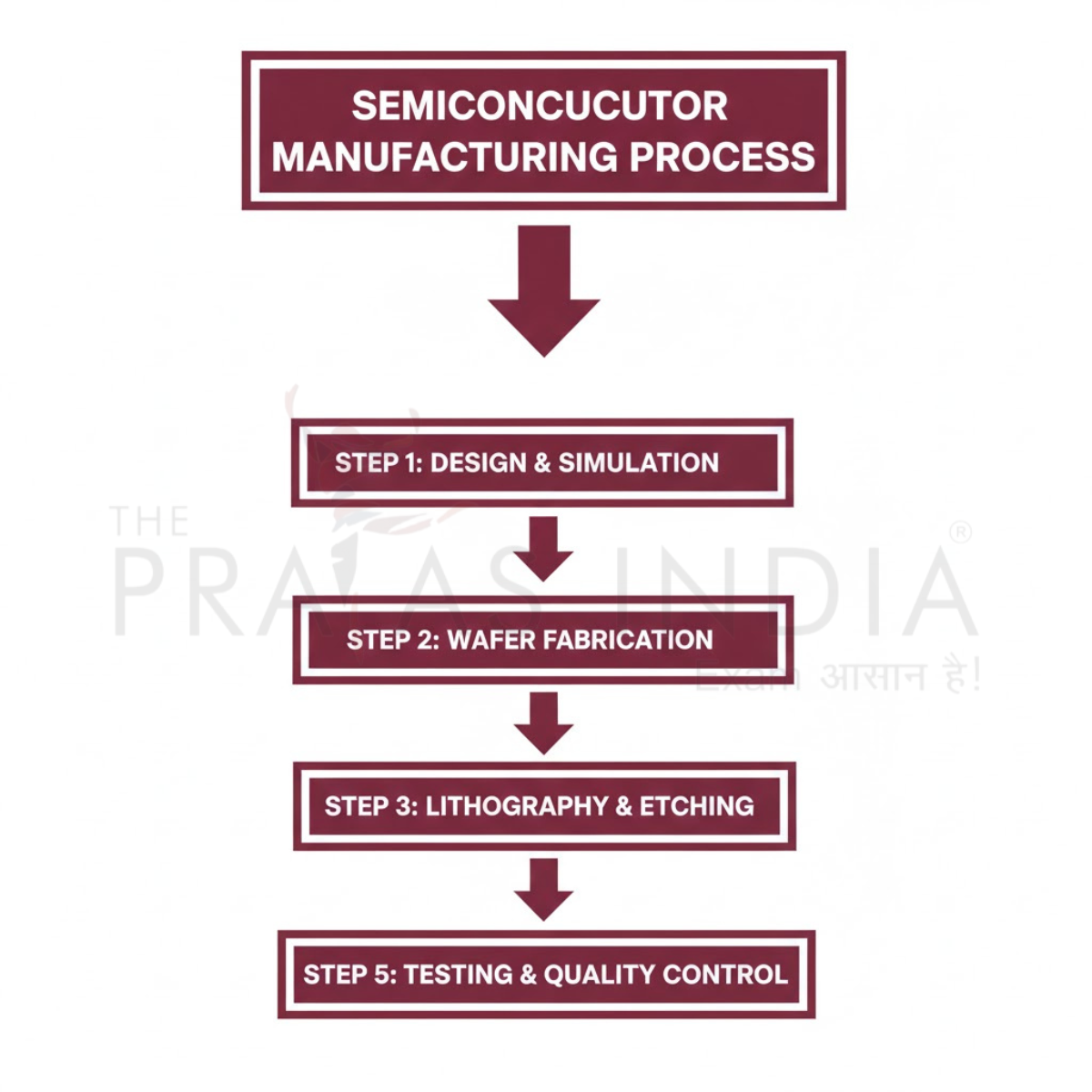
Key Stages
- Design (Fabless Stage)
- Chip architecture and logic design using specialized software
- Often done by fabless companies
- Wafer Fabrication (Fabs)
- Silicon wafers are processed through hundreds of steps
- Includes deposition, etching, and doping
- Lithography
- Patterning circuits on wafers using ultraviolet or extreme ultraviolet (EUV) light
- Considered the most technologically intensive stage
- Packaging and Testing (OSAT)
- Chips are cut, packaged, and tested for reliability
Global Semiconductor Supply Chain
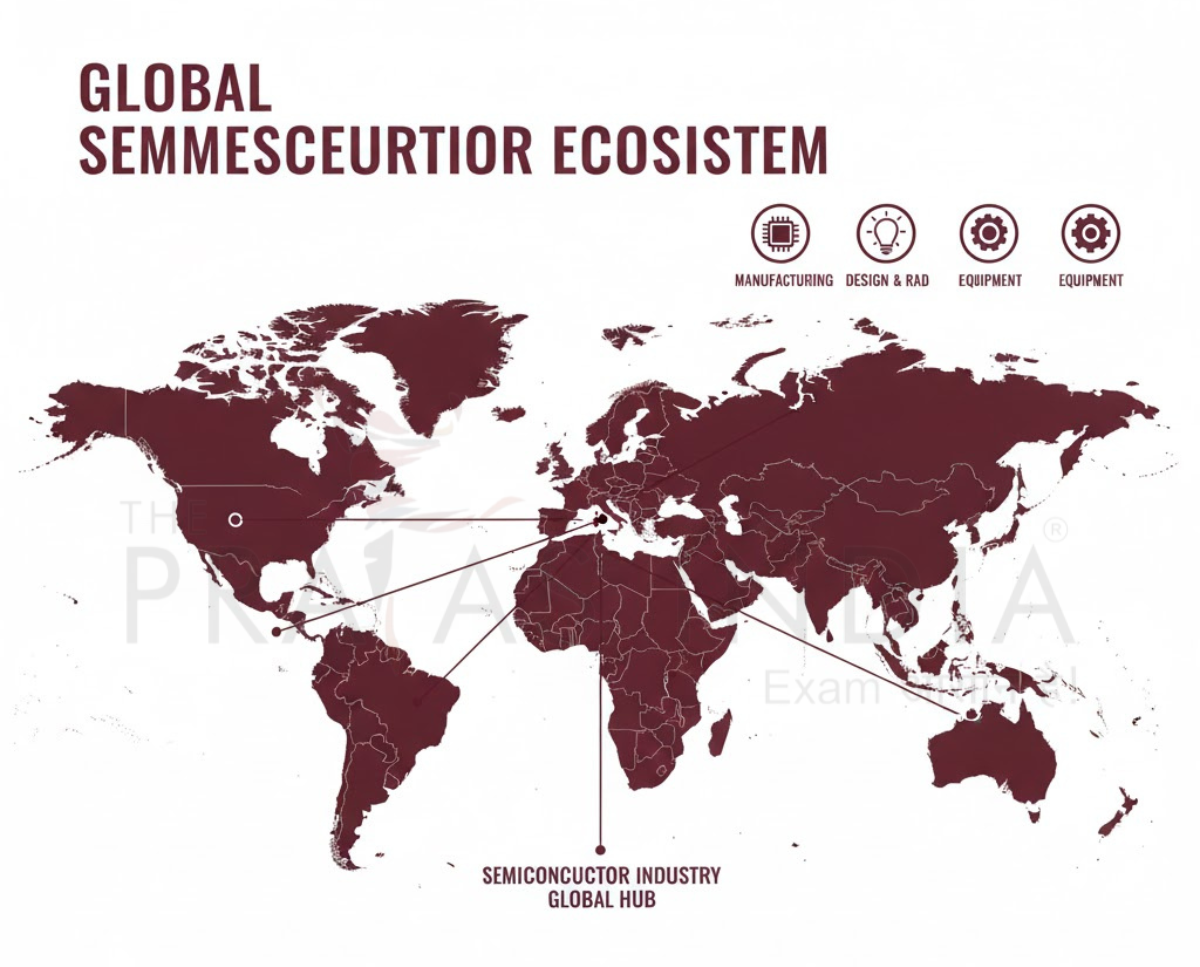
The global semiconductor ecosystem is highly specialized and geographically concentrated.
Key Players
- USA: Chip design, software, advanced research
- Taiwan: Advanced foundries
- South Korea: Memory chips
- Japan: Materials and precision equipment
- Netherlands: EUV lithography machines
Strategic Choke Points
- Advanced lithography equipment
- High-end foundries
- Rare materials and chemicals
Geopolitical Dimensions
- Export controls and technology restrictions
- Supply chain weaponization
- Strategic competition between major powers
Strategic Importance of Semiconductors
Semiconductors are now considered strategic assets.
National Security and Defence
- Used in missiles, communication systems, cyber defence
- Dependence on imports poses security risks
Digital Sovereignty
- Control over critical technologies
- Protection against supply disruptions
Economic Competitiveness
- Backbone of manufacturing, services, and innovation
- High value addition and employment generation
Critical Infrastructure
- Power grids, telecom networks, transport systems
India and Semiconductors
India Semiconductor Mission (ISM)
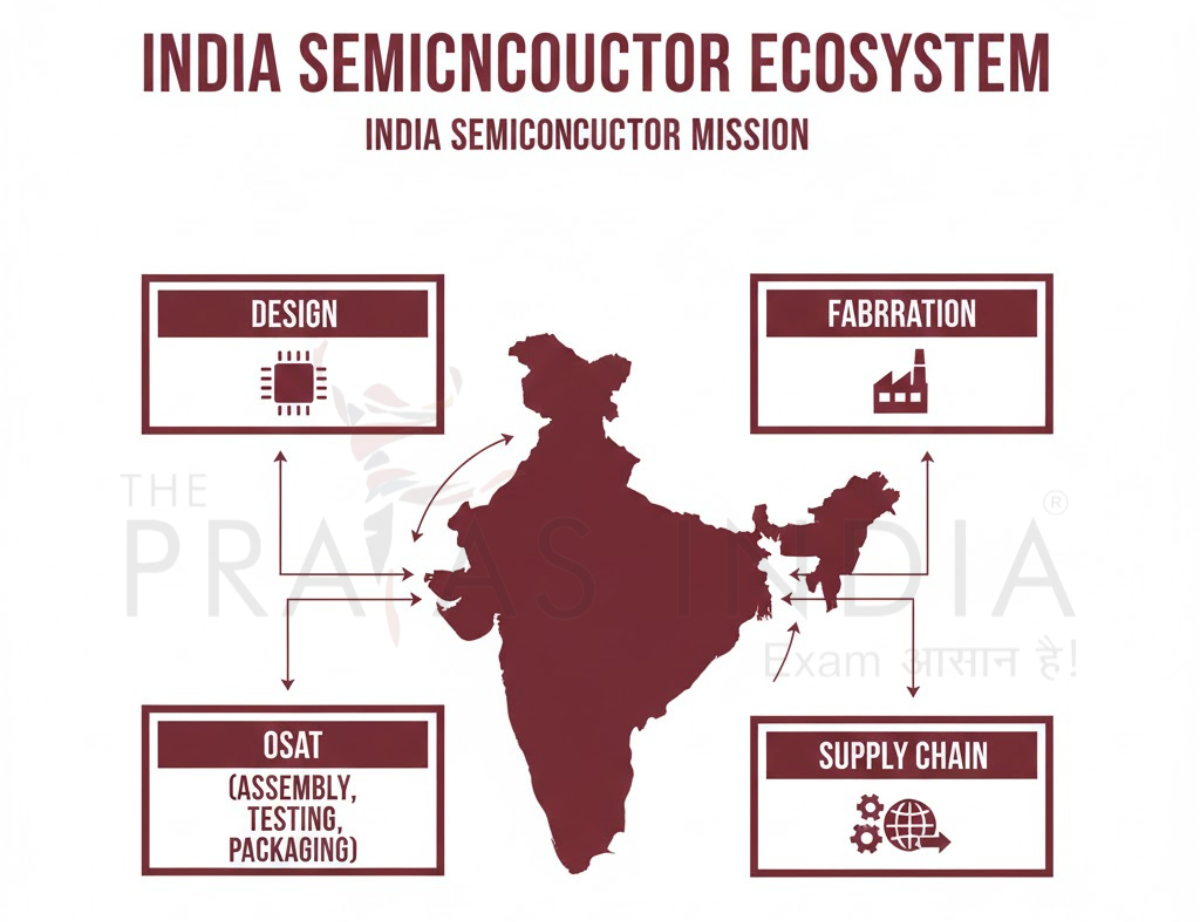
The India Semiconductor Mission (ISM) is a comprehensive initiative to build a domestic semiconductor ecosystem.
Objectives
- Establish semiconductor fabrication and packaging facilities
- Promote chip design and innovation
- Reduce import dependence
Incentives and Policy Framework
- Financial support for fabs and OSAT units
- Infrastructure and ecosystem development
- Public–private partnerships
Current Status in India
- Fab Proposals: Multiple fabrication projects under consideration
- OSAT Facilities: Focus on assembly, packaging, and testing
- Design Strength: India has a strong pool of chip design engineers
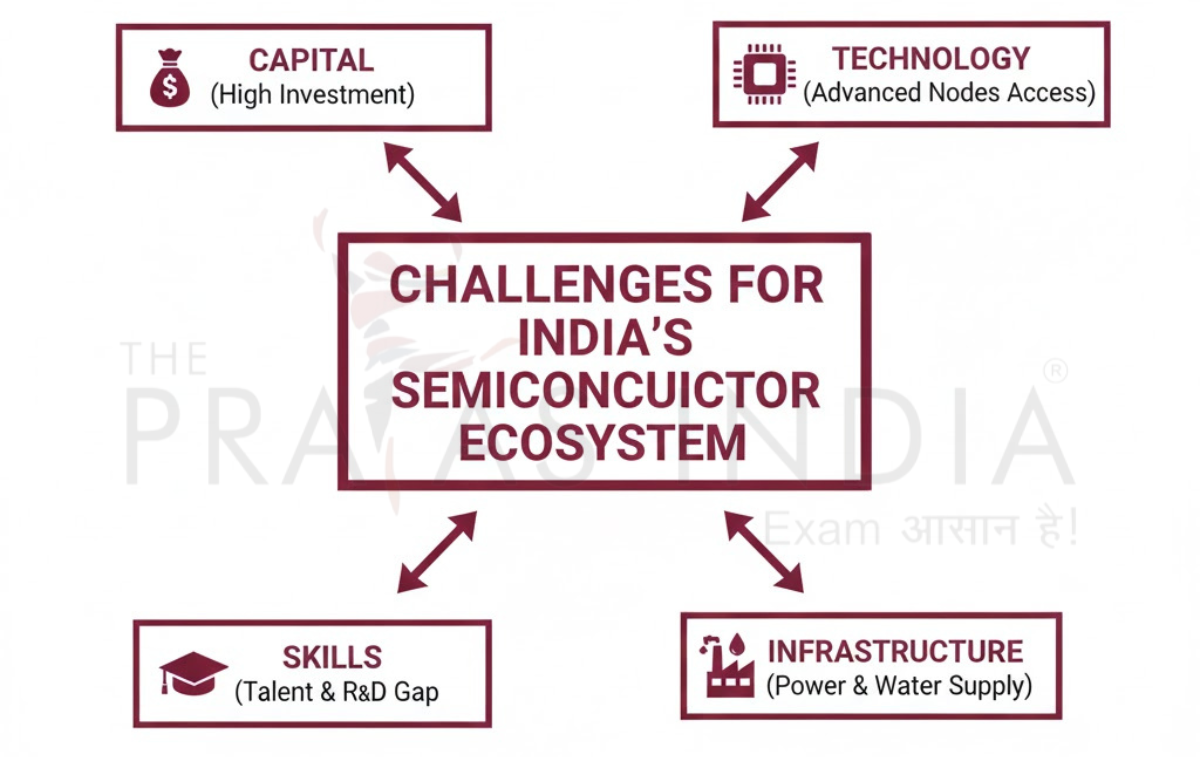
Challenges for India
Despite policy momentum, India faces several challenges:
- High Capital Costs: Semiconductor fabs require massive investment
- Technology Access: Advanced nodes depend on global collaboration
- Skilled Workforce Gaps: Need for specialized fabrication expertise
- Infrastructure Requirements: Reliable power, ultra-pure water, logistics
Way Forward
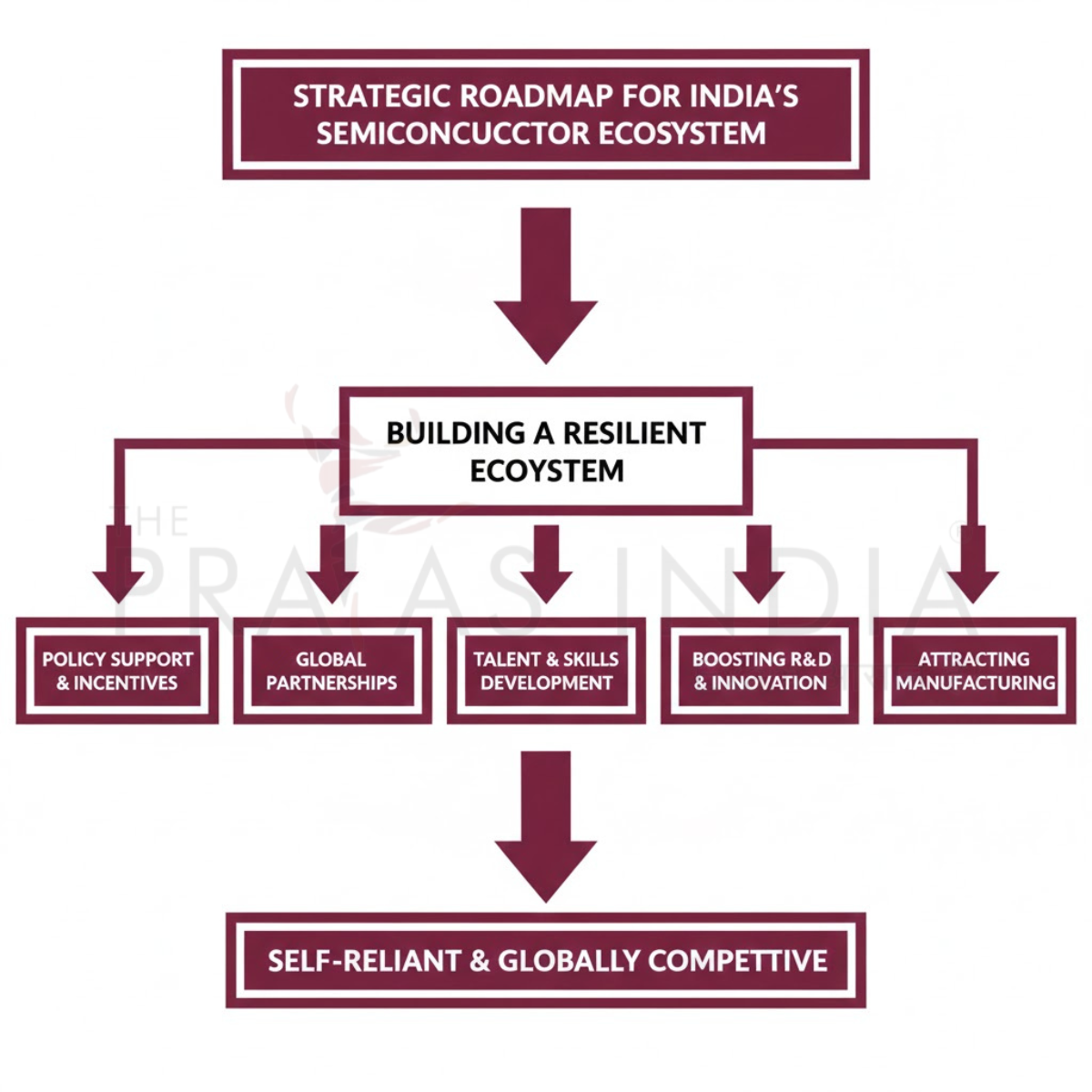
A calibrated, phased strategy is essential.
- Focus on Fabless and OSAT Segments
- Leverage existing design strength
- Enter the manufacturing value chain gradually
- International Partnerships
- Technology collaboration and joint ventures
- Skill Development
- Specialized education and industry-linked training
- R&D and Innovation Ecosystem
- Indigenous research in materials and chip design
- Stable Policy and Demand Creation
- Long-term policy certainty
- Government procurement to ensure demand
Conclusion
Semiconductors have emerged as the “new oil” of the digital age, powering economic growth, national security, and technological leadership. For India, developing a robust semiconductor ecosystem is critical to achieving technological and economic self-reliance. Given the complexity and scale involved, success will require a long-term, mission-mode approach, sustained investment, and global collaboration. In an increasingly digital and geopolitically contested world, mastery over semiconductors will determine a nation’s strategic autonomy and future prosperity.
FAQs (UPSC-Oriented)
Q1. What are semiconductors, and why are they critical for modern economies?
Semiconductors are materials with electrical conductivity between conductors and insulators. They form the backbone of modern electronics such as computers, smartphones, EVs, defence systems, AI, and telecom infrastructure. Their strategic importance lies in enabling digital economies, national security, and technological sovereignty.
Q2. How did global semiconductor supply chain disruptions impact India?
Global disruptions due to COVID-19, US–China tensions, and Taiwan Strait risks exposed India’s heavy import dependence, affecting automobile production, electronics manufacturing, and defence preparedness, thereby highlighting the need for domestic semiconductor capabilities.
Q3. What is the India Semiconductor Mission (ISM)?
The ISM is a flagship initiative to build a sustainable semiconductor ecosystem in India by supporting fabs, OSAT units, chip design, and R&D through financial incentives, infrastructure support, and global partnerships.
Q4. Why is semiconductor manufacturing capital- and technology-intensive?
Chip fabrication requires ultra-clean environments, advanced lithography (EUV), massive capital investment, high water and power usage, and continuous technological upgrades, making entry barriers extremely high.
Q5. Why is India focusing on OSAT and fabless models initially?
OSAT and fabless models require lower capital, leverage India’s strong design talent, and integrate India into global value chains, creating a gradual pathway toward advanced fabs.
Q6. How are semiconductors linked to national security?
They are essential for defence electronics, satellites, cyber security, communication systems, and critical infrastructure. Import dependence poses strategic vulnerabilities during geopolitical crises.
Q7. What lessons can India learn from Taiwan and South Korea?
Mission-mode governance, sustained state support, strong industry–academia linkages, and long-term policy stability are key lessons for building globally competitive semiconductor ecosystems.
Q8. Can India become self-reliant in semiconductors in the short term?
Complete self-reliance is a long-term goal. In the short to medium term, strategic partnerships, niche specialisation, and partial supply chain integration are more realistic and effective.
GS-III Model Answers (UPSC Standard)
✍️ 10-Marker Answer
Q. Why are semiconductors considered strategically important for national security and economic growth?
Answer:
Semiconductors are foundational to modern technology, powering electronics, communication networks, defence systems, AI, and critical infrastructure. Economically, they enable digital transformation, industrial productivity, and high-value manufacturing. Strategically, control over semiconductor supply chains ensures national security by safeguarding defence electronics, cyber capabilities, and data infrastructure. Recent global supply disruptions exposed vulnerabilities of import dependence, making semiconductors a core component of technological sovereignty. Hence, they are often termed the “new oil” of the digital age.
✍️ 15-Marker Answer
Q. Discuss the challenges faced by India in developing a domestic semiconductor ecosystem. Suggest a way forward.
Answer:
India’s semiconductor ambitions face multiple challenges. Chip fabrication requires extremely high capital investment, advanced technology access, and precision manufacturing, areas where India has limited experience. Dependence on foreign equipment, especially EUV lithography, poses technological constraints. Additionally, semiconductor fabs demand reliable power, ultra-pure water, and skilled manpower, which require ecosystem-level readiness. Policy uncertainty and limited domestic demand further affect viability.
Way Forward:
India should adopt a phased strategy by strengthening fabless design and OSAT segments, leveraging its talent pool. Strategic partnerships with global leaders, mission-mode skill development, robust R&D support, and stable long-term policies are essential. Creating assured demand through defence and public procurement can anchor investments.
✍️ 15-Marker Answer
Q. Examine the role of the India Semiconductor Mission (ISM) in achieving technological self-reliance.
Answer:
The India Semiconductor Mission represents a strategic shift toward building domestic capabilities in a critical technology sector. By offering financial incentives for fabs, OSAT units, and design-linked incentives, ISM aims to integrate India into global semiconductor value chains. It addresses structural gaps by focusing on infrastructure readiness, skill development, and R&D support.
However, given the complexity of semiconductor manufacturing, ISM’s success depends on long-term policy stability, global partnerships, and ecosystem development rather than short-term output. If implemented effectively, ISM can enhance India’s digital sovereignty, economic competitiveness, and national security, aligning with the broader vision of Aatmanirbhar Bharat.