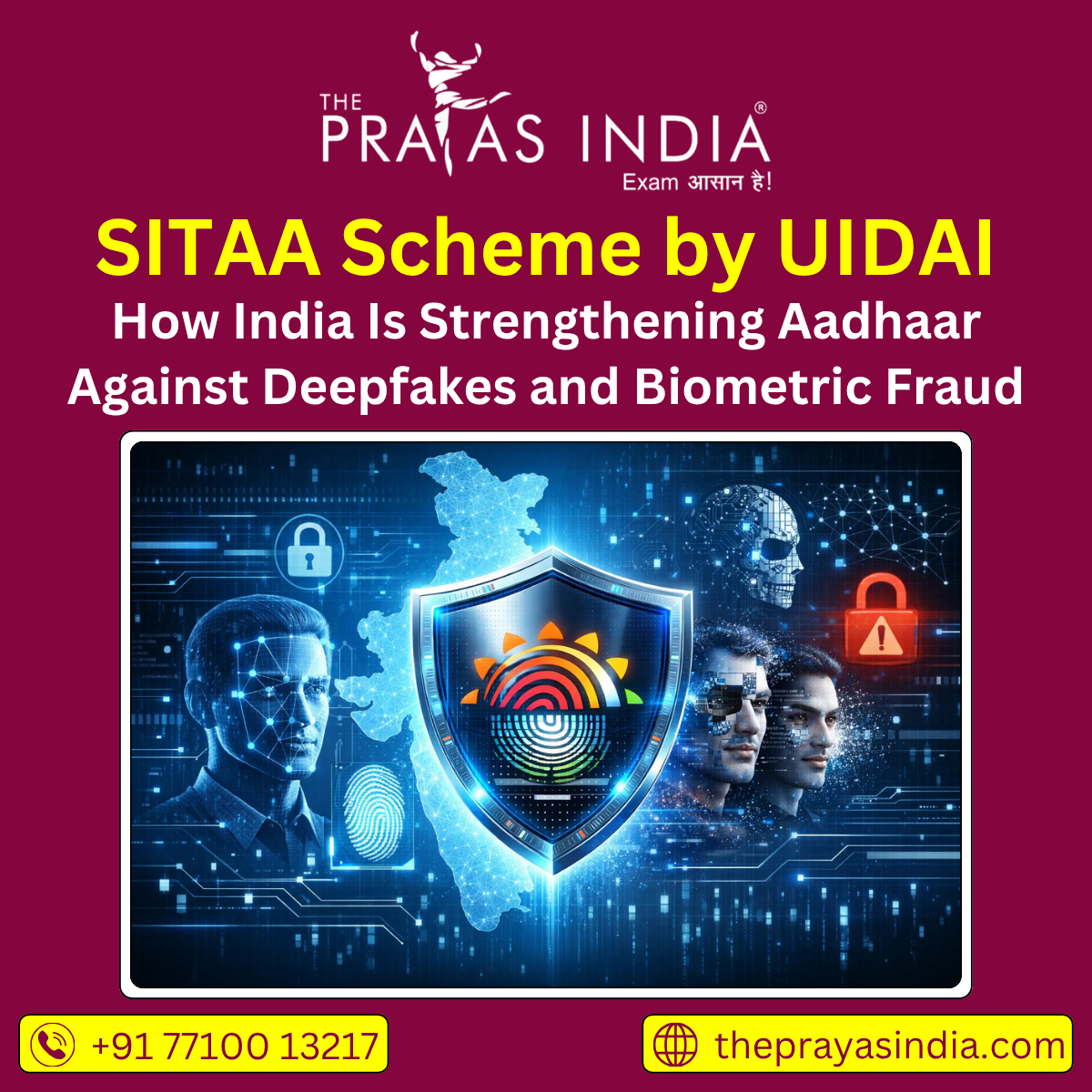
SITAA Scheme by UIDAI: How India Is Strengthening Aadhaar Against Deepfakes and Biometric Fraud
The SITAA Scheme, or Scheme for Innovation and Technology Association with Aadhaar, is UIDAI’s innovation platform to strengthen Aadhaar security through collaboration with startups, academia, and industry. It focuses on future-ready solutions for face liveness detection, presentation attack detection, contactless fingerprint authentication, data privacy, and secure digital identity systems.
What Is SITAA?
SITAA is a structured initiative launched by UIDAI to build a stronger and more resilient Aadhaar ecosystem through external innovation. PIB says the scheme is meant to foster collaboration in the digital identity domain and to co-develop secure, scalable, and globally benchmarked solutions.
The scheme is not just about upgrading software; it is about building an entire innovation pipeline around identity security. UIDAI has partnered with MeitY Startup Hub and NASSCOM so that innovators can get mentoring, incubation, accelerator support, industry links, and wider ecosystem access.
Why SITAA Was Needed
The rise of AI-generated deepfakes, biometric spoofing, and presentation attacks has changed the nature of identity fraud. A simple face photo, replayed video, morphing attack, or mask-based spoofing can no longer be ignored in a large-scale digital identity system.
UIDAI’s own SITAA pilot directly targets these risks by inviting solutions for face-liveness detection and presentation attack detection that can defeat photos, videos, masks, morphs, deepfakes, and adversarial inputs in real time or near real time. This makes the scheme especially relevant at a time when digital public infrastructure is becoming central to banking, welfare delivery, onboarding, and authentication services.
Core Pillars
SITAA is built around three pilot challenge areas. First is face liveness detection, which checks whether the face being scanned belongs to a real live person rather than a synthetic or replayed image.
Second is presentation attack detection, or PAD, which is designed to detect print attacks, replay attacks, masks, morphs, and deepfakes using AI/ML-driven tools. Third is contactless fingerprint authentication, which uses standard smartphone cameras or low-cost imaging devices to generate fingerprint templates and verify liveness without depending only on traditional hardware.
Main focus areas
- Face liveness detection for Aadhaar authentication.
- Presentation attack detection against spoofing and deepfakes.
- Contactless fingerprint authentication using mobile-friendly tools.
- Data privacy, secure identity applications, and authentication frameworks.
How It Works
SITAA works as a bridge between UIDAI and innovators who can solve identity-security problems with newer technology. The selected solutions must work across different demographics, devices, and environments, and they should support edge and server deployment with minimal user friction.
The approach is practical because it does not depend only on static biometric matching. Instead, it encourages dynamic checks such as passive and active liveness detection, AI-based fraud recognition, and stronger screening during Aadhaar enrollment and authentication. That makes the system harder to fool using deepfake videos, cloned biometrics, or spoofing tools.
Deepfakes and Fraud
One of the biggest threats SITAA addresses is face-based identity fraud in Aadhaar-linked services. Deepfakes can alter live video feeds in real time, while spoofing can use masks, printed images, or replayed footage to fool biometric systems.
The SITAA model attempts to counter this with AI-driven screening tools that can detect subtle signs of manipulation and reject synthetic feeds before authentication is completed. That is important because once identity fraud enters a public digital system, the damage can affect banking, welfare access, onboarding, and trust in digital governance.
Privacy and Trust
SITAA is also linked to stronger privacy and trust standards in identity verification. PIB says the initiative focuses on biometric devices, authentication frameworks, data privacy, artificial intelligence, and secure identity applications.
That matters because future identity systems must not only be secure but also privacy-compliant and interoperable. By encouraging better technical standards and indigenous innovation, UIDAI is trying to reduce overdependence on imported hardware and closed software ecosystems.
Digital India Angle
The scheme fits squarely within Digital India and Atmanirbhar Bharat. UIDAI has positioned SITAA as a way to build a secure, inclusive, and self-reliant digital identity ecosystem that can keep pace with changing cyber threats.
This also strengthens India’s Digital Public Infrastructure model, where trust, scale, and access are essential. In simple terms, SITAA is about making sure Aadhaar remains useful, secure, and future-ready even as AI-based fraud becomes more sophisticated.
UPSC Relevance
SITAA is highly relevant for UPSC Prelims because it touches on UIDAI, Aadhaar security, AI, biometric authentication, deepfakes, and digital governance. It is also a useful example of a government response to emerging technological threats, which is the kind of current affairs that often appears in static-plus-dynamic UPSC questions.
For Mains, SITAA can be used in GS Paper 2 under governance and e-governance, and in GS Paper 3 under science and technology, cyber security, and internal security. It is also a strong case study in how the state can work with startups and industry to protect public digital infrastructure.
Mains themes
- E-governance and digital public infrastructure.
- Cybersecurity and AI-based threats.
- Public-private collaboration in governance.
- Data privacy and secure authentication systems.
Why The Prayas India? Best UPSC Coaching in Mumbai for IAS Preparation
The Prayas India stands out as the best UPSC coaching in Mumbai because it transforms complex current affairs like the SITAA Scheme into actionable UPSC knowledge. Topics blending governance, technology, and policy demand more than rote learning—they require strategic connections to GS2, GS3, and Prelims, which The Prayas India delivers through its exam-focused approach.
For UPSC preparation in Mumbai, The Prayas India provides unmatched structured current affairs programs, conceptual clarity sessions, and rigorous answer-writing practice. This helps aspirants master dynamic topics by linking policy details to broader exam implications, boosting retention and performance.
Key Reasons to Choose The Prayas India for IAS Coaching
- Top-Ranked UPSC Coaching in Mumbai: Proven success with small batches, personalized mentoring, and 100% syllabus coverage for CSE Prelims and Mains.
- Best IAS Preparation Strategy: Daily current affairs analysis linking schemes like SITAA to UPSC GS papers, Essay, and Interview.
- Expert Faculty for UPSC Aspirants: Experienced mentors who simplify tech-governance overlaps, perfect for UPSC CSE preparation.
- Mumbai’s Premier UPSC Institute: Test series, mock interviews, and revision modules tailored for best UPSC coaching in Mumbai results.
- Affordable UPSC Coaching Fees: High ROI with foundation courses, GS integrated programs, and optional subjects for IAS coaching in Mumbai.
Aspirants seeking best UPSC coaching in Mumbai choose The Prayas India for its results-driven ecosystem that turns challenges like deepfake security into scoring opportunities. Enroll today to elevate your UPSC preparation!
FAQs
What is SITAA?
SITAA is the Scheme for Innovation and Technology Association with Aadhaar, launched by UIDAI to strengthen Aadhaar security through innovation and collaboration.
What problem does SITAA solve?
It addresses threats like deepfakes, biometric spoofing, presentation attacks, and weak face-authentication security.
Who can participate in SITAA?
Startups, academic institutions, researchers, and industry partners can participate in the pilot challenges.
What are the main challenges under SITAA?
The main challenges are face liveness detection, presentation attack detection, and contactless fingerprint authentication.
Why is SITAA important for UPSC?
It is important because it connects digital governance, cyber security, AI, and public policy, which are all relevant to UPSC Prelims and Mains.


![Prayas-तेजस [UPSC CSE Sociology Optional] – Online & Offline](https://theprayasindia.com/wp-content/uploads/2025/09/Prayas-तेजस-UPSC-CSE-Optional-Subject-The-Prayas-India-300x300.png)
![Prayas-सूत्र [UPSC CSE Materials (Hardcopy)]](https://theprayasindia.com/wp-content/uploads/2025/09/Prayas-सूत्र-UPSC-CSE-Study-Materials-Hardcopy-The-Prayas-India-300x300.png)
![Prayas-मंत्रा [UPSC CSE CSAT]](https://theprayasindia.com/wp-content/uploads/2025/09/Prayas-मंत्रा-UPSC-CSE-CSAT-The-Prayas-India-300x300.png)
![Prayas सारथी [UPSC CSE One on One Mentorship]](https://theprayasindia.com/wp-content/uploads/2025/09/Prayas-सारथी-UPSC-CSE-One-on-One-Mentorship-The-Prayas-India-300x300.png)