SSC CGL 2026 Mock Test Strategy: How to Analyse Tests and Improve Your Score | Best SSC Coaching in Mumbai | The Prayas India
SSC CGL Mock Tests Should Be More Than Just Practice Papers
For SSC CGL 2026 aspirants, mock tests are often treated as a way to check how many questions they can solve within the given time. That is useful, but it is only the most basic purpose of a mock test. A properly analysed mock can tell you much more: whether your preparation is actually converting into marks, which topics are costing you questions, where your time is being wasted and whether your current performance is moving towards the level required for your target post.
This becomes particularly important when the ultimate objective is not simply to qualify for SSC CGL but to secure a competitive position for a preferred post, department or cadre. Your mock-test strategy should therefore be connected to your larger admission-to-career preparation journey. While coaching and preparation help you build the required knowledge, mock analysis tells you whether that knowledge is producing the level of performance you need.
Many candidates make the mistake of taking one mock after another without studying the reasons behind their scores. They may celebrate a sudden increase of 15 marks or become discouraged after losing marks in a difficult test. Neither reaction is particularly useful. The real value lies in identifying why the score changed and whether the improvement can be repeated.
A strong SSC CGL mock-test strategy can be viewed as a cycle:
Attempt → Analyse → Identify → Correct → Reattempt
The test itself may take one hour, but the analysis that follows can determine how productive the next several days of preparation will be.
Your Mock-Test Score Is a Diagnostic Report
Think of every SSC CGL mock as a diagnostic report rather than a final judgement on your preparation. The total score gives you a broad indication of your current performance, but it does not explain the reasons behind that performance.
Two candidates can obtain the same score while having completely different preparation profiles. One may have excellent accuracy but attempt too few questions. Another may attempt aggressively but lose marks because of careless errors. A third candidate may know the concepts but spend too much time on questions that should have been skipped.
This is why simply recording your mock score in a notebook is not enough.
After every test, you should be able to answer:
- How many questions did I attempt?
- How many did I get correct?
- How many marks were lost through incorrect answers?
- Which questions consumed disproportionate time?
- Which topics caused repeated mistakes?
- Which questions should I have attempted but left?
- Which questions should I have skipped?
- Did I perform differently across sections?
- Was my problem knowledge, speed, accuracy or decision-making?
Once these questions become part of your routine, mock tests start functioning as a personal performance-tracking system.
For aspirants preparing for competitive SSC CGL posts, this distinction matters. You do not want to enter the examination with a preparation level that looks good on paper but collapses under time pressure. You want evidence from repeated tests that your performance is becoming reliable.
Don’t Chase a Higher Score Without Understanding the Score
One of the most misleading habits in competitive-exam preparation is chasing the highest possible mock score without understanding where that score comes from.
Suppose your score increases significantly in one test. It may be because the paper happened to contain more questions from topics you are comfortable with. Alternatively, you may genuinely have improved. These two situations require very different responses.
Similarly, a lower score does not automatically mean that your preparation has deteriorated. The test may have exposed a particular weakness, or you may have made a series of avoidable decisions under time pressure.
Instead of asking only:
“Did my score increase?”
ask:
“What caused my score to increase or decrease?”
This shift makes mock analysis much more meaningful.
A useful performance record should therefore track more than total marks. At minimum, maintain:
- Total Score
- Attempts
- Correct Answers
- Incorrect Answers
- Accuracy
- Section-wise Score
- Questions Left Unattempted
- Time Pressure Issues
- Repeated Error Areas
Over several tests, these numbers can reveal patterns that are difficult to notice when you look at individual mocks in isolation.
The First Layer of Analysis: What Happened in the Test?
Your first analysis should be factual rather than emotional.
Immediately after completing a mock, record your performance before looking at the solutions in detail. Note your total score, attempts and section-wise performance. Also record whether you finished comfortably or had to rush through the final questions.
This initial record is important because once you start checking solutions, it becomes easy to rationalise mistakes. You may think, “I knew this concept,” or “I would have solved it if I had more time.” Those statements can sometimes be true, but they need to be separated from what actually happened during the test.
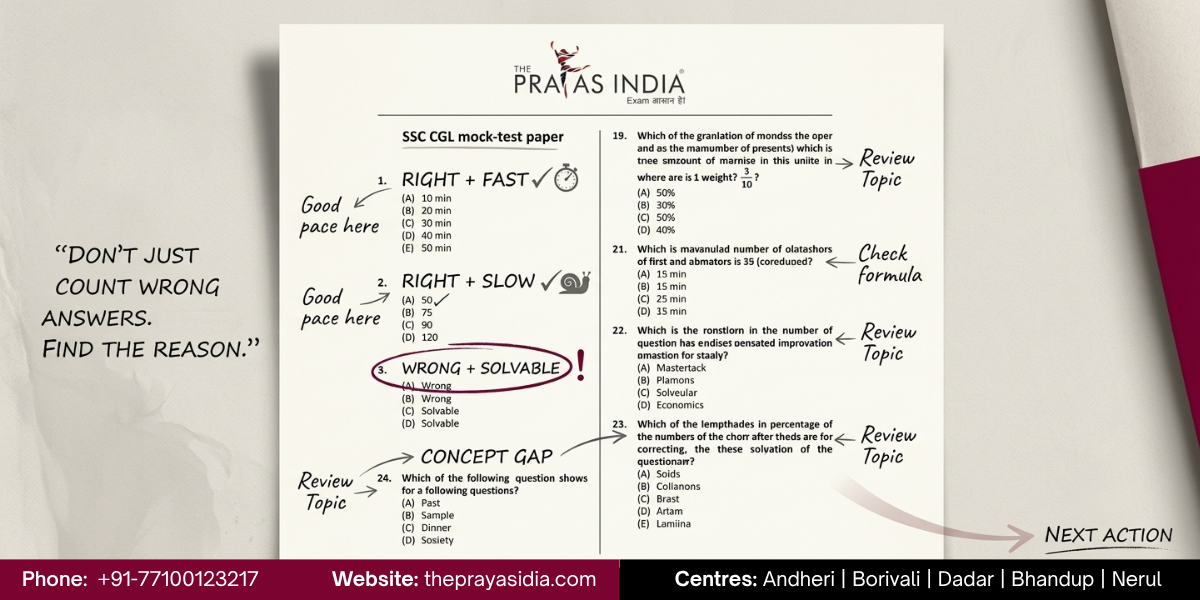
A simple first-level review can divide your questions into four broad groups:
1. Correct and Confident
These are questions where you knew the concept, selected the right approach and solved the question within a reasonable time.
They indicate areas where your preparation is already converting efficiently into marks. These questions should not consume most of your revision time.
2. Correct but Slow
These questions deserve special attention. Getting the answer right is good, but if the question consumed excessive time, it may still be reducing your overall score potential.
The solution may involve shortcut techniques, better calculation speed, improved familiarity or simply recognising the question type faster.
3. Incorrect but Solvable
These are often the highest-value questions for improvement. You had enough knowledge to solve them, but something went wrong.
The cause could be:
- Calculation error
- Misreading
- Incorrect application of a formula
- Rushed solving
- Poor question selection
- Failure to verify the answer
Correcting these errors can sometimes improve your score faster than learning an entirely new chapter.
4. Incorrect or Unattempted Because of a Concept Gap
These questions reveal areas where your preparation genuinely needs strengthening.
If the same concept appears repeatedly in this category, it should move higher on your revision priority list.
This four-part classification prevents you from treating every wrong answer in exactly the same way.
The Most Important Part of Mock Analysis: Finding the Score Leakage
Every SSC CGL aspirant has a certain amount of score leakage. These are marks that should potentially have been secured but were lost because of avoidable mistakes, inefficient time management or poor question selection.
Finding this leakage is more valuable than simply knowing that your score was 125 or 140.
For example, imagine that your mock score is lower than your target, but the analysis reveals that several marks were lost through calculation mistakes and rushed attempts. Your actual conceptual preparation may be stronger than your score suggests. The solution is not to restart your entire syllabus. It is to reduce the specific leakage.
Similarly, if you repeatedly leave questions from a topic because you cannot recognise the appropriate method quickly, the problem may be conceptual familiarity rather than raw speed.
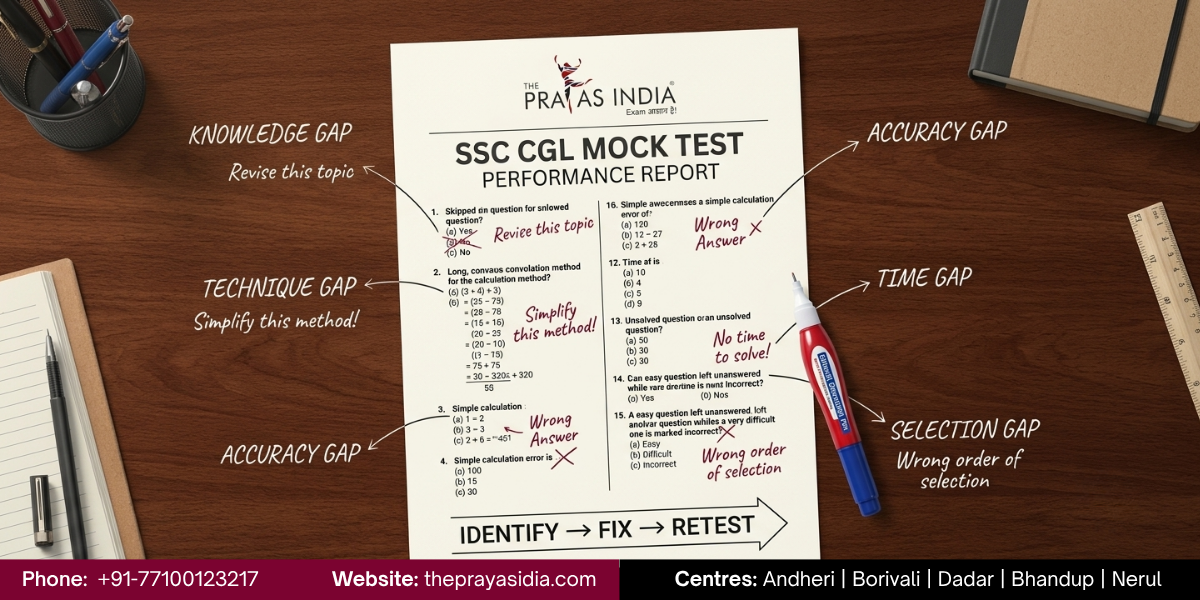
A useful way to classify score leakage is:
Knowledge Gap → Technique Gap → Accuracy Gap → Time Gap → Selection Gap
Each type requires a different solution.
Knowledge Gap
You do not understand the concept sufficiently to solve the question.
Action: Revise the concept and practise basic-to-advanced questions.
Technique Gap
You understand the concept but are using an inefficient method.
Action: Learn alternative approaches and practise recognising standard patterns.
Accuracy Gap
You know how to solve the question but make avoidable errors.
Action: Slow down at critical steps, improve calculation discipline and review error patterns.
Time Gap
You can solve the question, but the time required is too high.
Action: Practise timed sets and work on faster recognition and execution.
Selection Gap
You spend time on questions that are not worth attempting under exam conditions.
Action: Improve your ability to identify high-value, manageable questions quickly.
This classification makes your preparation far more targeted.
Analyse Your Attempts, Not Just Your Mistakes
Candidates often spend most of their mock-analysis time reviewing wrong answers. That is important, but it is incomplete.
Your attempted questions also contain valuable information.
Suppose you attempt 80 questions and get 68 correct. That tells you something about accuracy. But you also need to know which 80 questions you selected and what happened to the questions you left.
A candidate who attempts fewer questions with excellent accuracy may have a different problem from someone who attempts many questions but makes repeated mistakes.
Therefore, after every mock, look at three things together:
Attempts + Accuracy + Time
A higher attempt count is not automatically an improvement. If accuracy falls significantly, the additional attempts may not be contributing enough marks.
Likewise, very high accuracy is not always enough if your attempt rate remains unnecessarily low.
The objective is to reach a point where your attempts are both productive and repeatable.
Build a Mock-Test Error Log That You Actually Use
An error log can become one of the most powerful tools in SSC CGL preparation, but only if it remains practical. Many students create elaborate notebooks with every question they get wrong and then stop revisiting them after a few days.
Your error log should focus on patterns rather than becoming another textbook.
For each important mistake, record:
- Topic
- Question type
- Nature of error
- Correct approach
- Why your approach failed
- Whether the mistake was repeated
- Date of reattempt
For example, if you repeatedly make percentage-based calculation errors, the log should reveal that pattern. You can then create a short targeted practice session around that weakness instead of solving random questions for hours.
The purpose of an error log is therefore not to collect mistakes.
It is to prevent the same mistake from becoming expensive twice.
Your Section-Wise Analysis Should Tell You Where the Score Is Coming From
A total SSC CGL mock score can hide significant differences between sections. A candidate may perform strongly in one section while another section continuously limits the overall result.
This is why section-wise analysis should be part of every mock review.
Look for three things:
- Strong Section: Where are you consistently converting questions into marks?
- Unstable Section: Where does your score fluctuate significantly?
- Weak Section: Which area repeatedly pulls down the overall score?
The answer should influence your preparation schedule.
If one section is already strong, it should be maintained through regular practice rather than consuming the majority of your study time. If another section is consistently weak, it deserves targeted intervention.
This is particularly relevant for students who are preparing with the aim of securing a competitive SSC CGL post. A strong overall strategy requires you to know whether your score is balanced or being carried disproportionately by one area.
A Good Mock Strategy Connects Preparation With Your Career Target
SSC CGL preparation should not be reduced to clearing a test without understanding what you are ultimately working toward. Candidates often have preferences regarding departments, job profiles, location, career growth and the nature of responsibilities associated with different posts.
That is why mock-test preparation should be connected to your broader SSC CGL career objective.
You may begin with the simple goal of improving your score. But as preparation progresses, your target should become more specific:
Qualify → Improve Rank Potential → Target Preferred Posts → Strengthen Final Selection Chances
This does not mean predicting a specific post from a mock score. Final allocation depends on the relevant examination results, preferences, vacancies and applicable rules. However, having a clear career objective can make preparation more purposeful.
Instead of taking a mock simply because your schedule says “mock today,” you begin to understand why consistent performance matters.
Coaching Should Not End With Taking the Mock
For aspirants looking for SSC coaching in Mumbai, one important factor to evaluate is not simply how many mock tests an institute provides, but what happens after those tests.
A large mock-test library can be useful, but the real value comes from the quality of analysis and guidance attached to it.
A structured SSC CGL preparation environment should ideally help students understand:
- Why they lost marks
- Which topics need revision
- How their accuracy is changing
- Where time is being lost
- Which mistakes are recurring
- How their strategy should change before the next mock
This is where a well-structured SSC coaching programme in Mumbai can make preparation more measurable. The objective should be to create a feedback loop where every test contributes to the next stage of preparation rather than becoming an isolated scorecard.
For students considering The Prayas India, the focus should be on evaluating the overall preparation system—including teaching, practice, testing, analysis, doubt support and guidance—rather than choosing an institute based only on the number of tests available.
Your Next Mock Should Be Designed by the Previous One
One of the strongest principles in mock-test preparation is simple:
The previous mock should influence the next mock.
If your last test revealed that you lost marks because of slow calculations, the next few days should include targeted calculation practice.
If question selection was the problem, you should consciously practise identifying questions based on difficulty and expected time.
If a particular concept caused repeated errors, revise that concept before taking another full-length test.
This creates a continuous improvement loop:
Mock Test → Diagnosis → Targeted Practice → Strategy Adjustment → Next Mock
That is far more effective than following a routine where every mock is followed by another mock without corrective work in between.
For an aspirant targeting competitive SSC CGL opportunities, this approach can gradually transform mock tests from a source of anxiety into a structured performance-improvement tool.
Key Takeaway
The purpose of SSC CGL mock tests is not to prove that you are ready every time you take one. Their real purpose is to show you what is preventing you from becoming ready.
Once you begin analysing your tests through attempts, accuracy, time, question selection and error patterns, your preparation becomes much more precise. Instead of spending equal effort on every topic, you can identify the areas that are actually affecting your score.
And that is where the real advantage of mock-test strategy begins: the test stops being the end of your preparation session and becomes the starting point for your next improvement.
How Often Should You Take SSC CGL Mock Tests?
There is no universal rule that every aspirant must take a mock test every day. The right frequency depends on the stage of preparation.
During the early stage, taking too many full-length mocks can sometimes be counterproductive. If your concepts are still developing, repeated testing may simply show the same weaknesses without giving you enough time to correct them. At this stage, topic-wise tests and sectional tests can provide more useful feedback.
As your syllabus coverage improves, full-length mocks should become more frequent. The objective is to gradually build familiarity with the complete examination environment while continuing to address the weaknesses identified through analysis.
A practical progression can look like this:
- Early Preparation: Topic-wise practice and sectional tests
- Middle Preparation: Regular sectional tests + periodic full mocks
- Advanced Preparation: Frequent full-length mocks with detailed analysis
- Final Phase: Exam-like mocks, revision and strategy refinement
The important point is that mock frequency should increase alongside your ability to analyse and act on the results.
Taking five tests without meaningful analysis is generally less productive than taking two tests and using the remaining time to fix the weaknesses they reveal.
Don’t Take a Mock Just to Increase Your Mock Count
A common preparation trap is turning the number of mocks completed into a performance metric.
Students may proudly say that they have taken 30, 40 or 50 mocks, but the number itself does not tell you whether those tests improved their preparation.
The better question is:
“What changed because I took these mocks?”
If your accuracy improved, your question selection became smarter, your calculation speed increased and your recurring errors decreased, then the mocks are doing their job.
If your score has remained almost unchanged despite taking many tests, the problem may not be a lack of testing. It may be a lack of post-test correction.
Every mock should therefore have a purpose.
For example:
- Test 1 identifies your weak areas.
- Test 2 checks whether your corrections are working.
- Test 3 tests whether the improvement is becoming consistent.
- Later tests help refine speed, selection and examination strategy.
This turns mock tests into stages of a learning process rather than a collection of completed papers.
The 24-Hour Rule for Mock Analysis
A useful habit for SSC CGL aspirants is to analyse a mock as soon as reasonably possible after completing it. The longer you postpone analysis, the easier it becomes to forget why particular decisions were made during the test.
The first review should not necessarily involve solving every question again. Begin with the overall performance.
Record:
Score → Attempts → Accuracy → Time → Section Performance
Then move to the questions that need attention.
Prioritise questions where:
- You made an avoidable mistake.
- You knew the concept but could not execute it correctly.
- You spent too much time.
- You skipped a question that you could have solved.
- You attempted a question that should probably have been left.
- You encountered a concept that requires revision.
This approach keeps analysis focused.
The goal is not to spend several hours rewriting an entire mock. The goal is to identify the small number of changes that can produce a meaningful improvement in the next test.
Use a Three-Level Error Analysis System
A practical way to make mock analysis manageable is to classify mistakes according to how urgently they need attention.
Level 1: Avoidable Errors
These include calculation mistakes, misreading, marking the wrong option or making a rushed decision despite knowing the concept.
These errors should be corrected immediately because they represent marks that preparation has already made potentially accessible.
Level 2: Performance Errors
These happen when you understand the underlying concept but cannot execute it efficiently under time pressure.
Examples include spending too long on a familiar question or failing to recognise a standard approach quickly.
These require targeted practice.
Level 3: Knowledge Errors
These occur when you genuinely do not know how to solve the question because the concept or topic has not been sufficiently prepared.
These require revision followed by practice.
This classification helps prevent an inefficient response to mistakes. A calculation error does not need the same treatment as a completely unfamiliar concept.
Track Your Score Trend Instead of Individual Scores
A single mock score can be misleading. A score trend is much more useful.
Suppose your scores across several tests are:
118 → 124 → 121 → 129 → 133 → 131
The fact that one score dropped from 133 to 131 does not necessarily indicate a problem. The broader trend suggests that your performance is moving upward.
This is why students should maintain a simple mock-performance record.
Track:
- Mock number
- Date
- Total score
- Attempts
- Accuracy
- Section-wise score
- Major error category
- Key corrective action
After every few tests, review the trend rather than reacting to individual results.
You should particularly look for evidence of consistency.
A strong preparation phase is not simply about producing one exceptional mock score. It is about making your normal performance increasingly close to your best performance.
Identify Your “Score Ceiling”
Many candidates reach a particular score range and then struggle to move beyond it. This can be described as a temporary score ceiling.
For example, a student may repeatedly score within a narrow band despite completing additional practice. This usually means that simply doing more questions is not addressing the underlying limitation.
The score ceiling may be caused by:
- Repeated mistakes in one section
- Limited attempts
- Excessive time on difficult questions
- Weak performance in specific topics
- Poor question selection
- Lack of revision
- Inconsistent test-taking strategy
When you identify a score ceiling, do not respond by blindly increasing your study hours.
First ask:
“What is consistently preventing the next 5–10 marks?”
That question can lead to a much more focused improvement plan.
The 5–10 Mark Improvement Method
Large score jumps are exciting, but sustainable preparation often comes from smaller improvements.
Instead of expecting every new mock to produce a dramatic increase, identify a realistic improvement target.
For example, your next objective could be:
- Reduce two avoidable mistakes.
- Improve calculation speed enough to attempt two additional questions.
- Convert three previously skipped questions.
- Improve accuracy in one weak topic.
- Reduce time spent on low-value questions.
Even a few additional marks per test can become significant when the improvement becomes consistent.
This is particularly useful during the later stages of SSC CGL preparation because the objective is increasingly about converting preparation into marks, not simply covering more material.
Sectional Tests Should Support Full-Length Mocks
Full-length mocks show you how you perform across the entire examination, but sectional tests can help solve specific weaknesses more efficiently.
If your overall score is being restricted by one particular section, repeatedly taking complete mocks may not be the fastest solution.
Instead, use sectional tests to isolate the problem.
For example:
Full Mock → Identify Weak Section → Sectional Practice → Re-test → Full Mock
This creates a more precise feedback loop.
Sectional testing is particularly useful when:
- Your performance fluctuates heavily in one section.
- You know the concepts but lack speed.
- Accuracy drops under time pressure.
- One section consistently consumes too much time.
- A specific topic repeatedly appears in your error log.
The full-length mock tells you where the problem exists. The sectional test can help you work on why it exists.
Don’t Change Your Entire Strategy After One Bad Mock
A bad mock can trigger unnecessary overcorrection.
Students sometimes change their attempt order, solving methods, time allocation and study schedule all at once after a disappointing score. This makes it difficult to determine what actually helped or hurt their performance.
A better approach is to change one or two variables at a time.
For example:
Problem: Too much time spent on difficult questions.
Change: Set a strict decision rule for moving away from time-consuming questions.
Then test that change in the next mock.
If the result improves, retain the strategy. If not, analyse further.
This makes your preparation experimental and evidence-based rather than emotional.
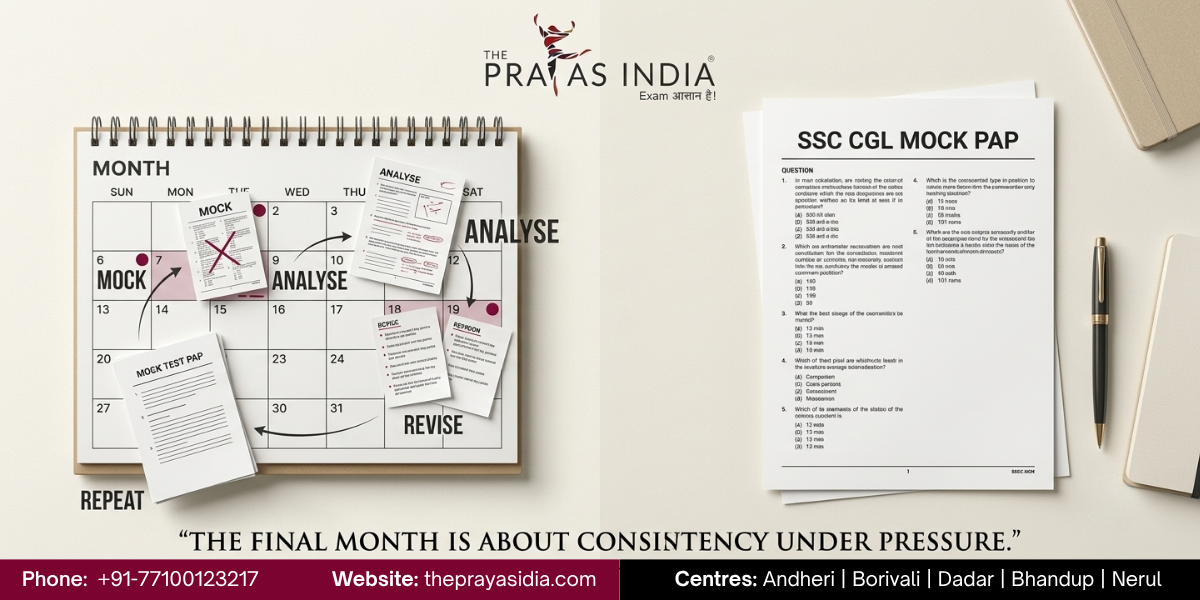
The Final Month: Shift From Learning More to Performing Better
During the final month before SSC CGL, mock-test strategy should become increasingly important. At this stage, students should already have substantial familiarity with the syllabus, so the focus should gradually move toward execution.
The final phase should prioritise:
- Full-length mock tests
- Previous-year question practice
- Rapid revision
- Error-log revision
- Sectional improvement
- Time-management refinement
- Accuracy improvement
- Exam-day strategy
The objective is not to stop learning. It is to ensure that what you have learned can be converted into marks under examination conditions.
A candidate who knows 90% of the required concepts but cannot manage time effectively may perform worse than someone with slightly less knowledge but much stronger execution.
That is why the final stage should be about performance conversion.
Build Your Final SSC CGL Strategy Around Evidence
By the final stage of preparation, your mock tests should give you a clear picture of how you actually perform.
You should know your approximate score range, the sections that contribute most to your score, the areas that repeatedly cause losses and the situations in which your accuracy falls.
This information can help you build an examination strategy based on evidence rather than assumptions.
Your final strategy should answer:
- Which section should I approach first?
- Which questions should I prioritise?
- When should I move away from a difficult question?
- How much time should I reserve for review?
- Which mistakes must I absolutely avoid?
- What score range am I consistently achieving?
- Which areas need final revision?
There is no single strategy that works identically for every candidate. Your mock analysis should help you discover the strategy that works best for your own performance profile.
How SSC Coaching in Mumbai Can Strengthen Mock-Test Preparation
For students searching for the best SSC coaching in Mumbai, mock-test support should be an important part of the evaluation process.
The quality of teaching and study material matters, but so does what happens when students begin taking regular tests. A structured coaching environment can help candidates identify weak areas earlier, compare performance across tests and receive guidance on improving their preparation strategy.
The value of coaching is therefore not simply the number of classes or tests provided. It lies in creating a system where:
Teaching → Practice → Testing → Analysis → Correction → Improvement
works continuously.
At The Prayas India, aspirants preparing for SSC CGL can use a structured learning environment to strengthen concepts, practise consistently and evaluate performance through regular testing. For students targeting competitive SSC CGL opportunities, this kind of measurable preparation can help make the journey more organised and focused.
When evaluating an SSC coaching programme in Mumbai, consider:
- Faculty quality
- SSC CGL-focused study material
- Mock-test quality
- Frequency of testing
- Test analysis
- Doubt-solving support
- Performance tracking
- Personalised feedback
- Batch structure
- Overall learning environment
The objective should be to choose a system that helps you understand what to study, how to practise and how to improve.
Mock Tests Should Ultimately Improve Your Selection Strategy
SSC CGL preparation is not only about achieving a respectable mock score. The larger objective is to perform strongly enough in the actual examination to improve your position for the posts you are targeting.
That is why mock tests should gradually become more realistic and strategic.
Early mocks answer:
“What do I know?”
Middle-stage mocks answer:
“Can I apply it under time pressure?”
Advanced mocks answer:
“Can I consistently execute my strategy?”
Final mocks should answer:
“Am I ready to reproduce this performance in the actual examination?”
This progression turns mock testing into a structured preparation system.
Final Takeaway
The best SSC CGL mock-test strategy is not about taking the maximum number of tests. It is about extracting the maximum amount of learning from every test.
A useful mock cycle should help you identify score leakage, classify mistakes, measure accuracy, understand time usage, improve question selection and build consistency. Over time, the objective is to reduce avoidable errors and make your performance more predictable.
For SSC CGL 2026 aspirants, the most productive approach is to treat every mock as feedback. A low score should reveal what needs attention. A high score should show what is working. A stable score should tell you where the next improvement needs to come from.
Most importantly, connect your preparation to your larger career objective. The purpose of improving your SSC CGL score is not simply to produce a better mock result; it is to strengthen your position for the competitive selection process and improve your chances of reaching the post you want.
For aspirants looking for SSC coaching in Mumbai, a structured environment with regular testing, detailed analysis and targeted improvement can make preparation more measurable and admission-to-career focused.
Contact Us
- Call Now: +91-77100 13217
- Website: theprayasindia.com
- Centres: Andheri | Borivali | Dadar | Nerul | Bhandup
Frequently Asked Questions
1. How important are mock tests for SSC CGL preparation?
Mock tests are important because they help candidates evaluate their preparation under time-bound conditions. More importantly, they reveal weaknesses in accuracy, time management, question selection and conceptual understanding.
2. How many SSC CGL mock tests should I take?
There is no fixed number suitable for every candidate. Early preparation can focus more on sectional and topic-wise tests, while full-length mocks should become more frequent as the examination approaches. Quality of analysis is more important than simply increasing the number of tests.
3. Should I analyse every SSC CGL mock test?
Yes. Even a brief analysis is better than moving directly to another test. You should identify your major mistakes, time-management issues, accuracy level and the corrective action required before your next mock.
4. Why is my SSC CGL mock score not improving?
A stagnant score can result from repeated mistakes, weak concepts, inefficient question selection, low accuracy or poor time management. Review your mock trend and error log to identify the specific factor restricting improvement.
5. What should I record after every mock?
Record your total score, attempts, accuracy, section-wise performance, incorrect answers, time issues and major error categories. Also note one or two specific actions you will take before the next test.
6. Is a high mock score enough to guarantee SSC CGL selection?
No. Mock scores are indicators of preparation, not guarantees of actual examination performance or selection. The actual result depends on performance in the relevant examination stages, applicable cut-offs, vacancies and other selection rules.
7. Should I take SSC CGL mocks every day?
Not necessarily. Daily full-length mocks may not be productive if you do not have enough time to analyse and correct your weaknesses. Use a frequency that allows you to learn from each test.
8. What is score leakage in SSC CGL?
Score leakage refers to marks lost through avoidable mistakes, poor question selection, excessive time consumption or other correctable performance issues. Identifying these losses can provide a practical route to score improvement.
9. How can I improve my SSC CGL mock-test accuracy?
Analyse every incorrect answer and identify whether the mistake came from a concept gap, calculation error, misreading, rushing or poor selection. Targeted practice based on these patterns can gradually improve accuracy.
10. Are sectional tests useful for SSC CGL?
Yes. Sectional tests can help isolate weaknesses that may be difficult to identify from a total mock score. They are particularly useful for improving a consistently weak section before returning to full-length tests.
11. What should I focus on in the final month of SSC CGL preparation?
Focus on full-length mocks, previous-year questions, revision, error-log analysis, accuracy, time management and examination strategy. The final phase should increasingly focus on converting existing preparation into consistent marks.
12. How can SSC coaching in Mumbai help with mock-test preparation?
A structured SSC coaching programme can combine teaching, practice, mock tests, performance analysis and feedback. This can help aspirants identify weaknesses systematically and build a more measurable preparation strategy.