SSC CGL English vs Maths: How Should You Divide Your Preparation Time? | Best SSC Coaching in Mumbai | The Prayas India
Preparing for the SSC CGL examination is not simply about completing the syllabus. The bigger challenge is deciding how much time to give each section, which subjects deserve daily practice, and how to maintain a balance between speed, accuracy and revision. Among the different sections of SSC CGL, English and Quantitative Aptitude often demand very different preparation approaches. English can improve steadily through vocabulary, grammar, reading and repeated exposure, while Maths usually requires concept building, calculation practice, question-solving and timed application.
This difference creates a common preparation dilemma. Some aspirants spend most of their study hours on Maths because they consider it difficult, leaving English under-practised. Others devote considerable time to English because it appears easier to improve, while their Quantitative Aptitude preparation remains incomplete. Both approaches can create an imbalance that eventually affects overall performance.
The right strategy is not to ask whether English or Maths is more important. Instead, SSC CGL aspirants should understand how much preparation each section requires at their current level and then divide their available study time accordingly. A well-planned schedule should give additional time to the weaker subject without allowing the stronger subject to lose momentum.
For aspirants preparing for SSC CGL in a competitive environment, structured guidance can also make this process easier. The Prayas India focuses on systematic exam preparation, regular practice, test-based performance analysis and targeted improvement, helping students build a preparation routine around their individual requirements.
The Real Difference Between SSC CGL English and Maths Preparation
English and Maths may both contribute significantly to an SSC CGL candidate’s overall performance, but the nature of preparation required for them is different.
English preparation is largely cumulative. Grammar rules, vocabulary, reading comprehension, sentence improvement, error detection, cloze tests and other question types become easier when the candidate repeatedly encounters the same concepts and patterns. A student may not need several hours of English every day if those hours are replaced by consistent short sessions involving revision, practice and analysis.
Maths generally requires deeper problem-solving involvement. Topics such as percentage, ratio and proportion, profit and loss, average, time and work, time and distance, algebra, geometry, trigonometry and data interpretation require candidates to understand concepts and then apply them under time pressure. A student who understands a formula but cannot identify the correct approach quickly may still lose valuable marks in the actual examination.
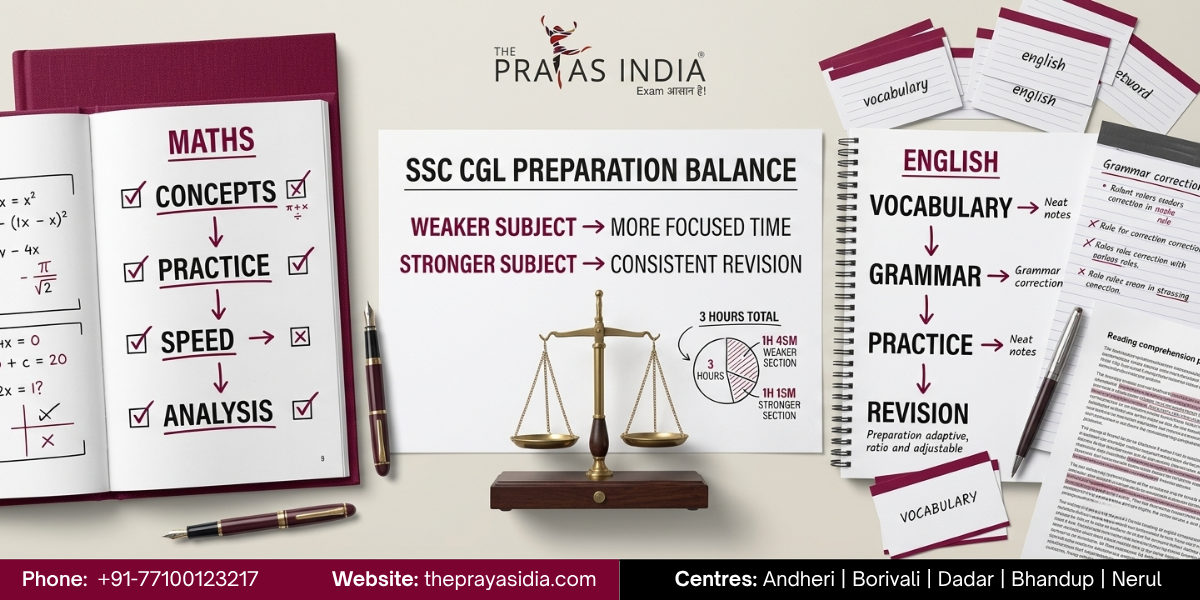
This is why a simple 50:50 division of preparation time is not automatically the best strategy. If a candidate is already strong in English but weak in Maths, spending exactly equal time on both may not produce the maximum improvement. The preparation schedule should instead be balanced according to weakness, target score and current stage of preparation.
Start With Your Current Level, Not With a Fixed Timetable
Before deciding how many hours should go to English and Maths, take an honest assessment of your current performance. Your preparation plan should be based on evidence rather than assumptions.
A useful starting point is to attempt a sectional test or a carefully selected set of SSC CGL-level questions from both subjects. Do not focus only on the final score. Examine how you reached that score.
For Maths, track:
- Number of questions attempted
- Accuracy percentage
- Average time per question
- Questions left because of lack of conceptual clarity
- Questions left because of excessive calculation time
- Topics responsible for repeated mistakes
For English, track:
- Questions attempted
- Accuracy
- Grammar-related mistakes
- Vocabulary-related mistakes
- Reading comprehension performance
- Time spent on the section
- Repeatedly incorrect question types
This analysis immediately gives you a more useful picture than simply saying, “I am weak in Maths” or “English is my strong section.”
For example, an aspirant scoring well in English but losing marks in Arithmetic and Geometry should not continue spending the majority of daily study time on English merely because it feels comfortable. Similarly, a candidate who performs reasonably well in Maths but makes repeated grammar and vocabulary errors should not ignore English simply because the section appears easier.
A Simple Preparation Principle
Strong subject → maintain it.
Average subject → improve it consistently.
Weak subject → give it additional focused time.
The objective is not to make every subject consume equal hours. The objective is to ensure that no section becomes a major source of lost marks.
The 60:40 Rule Can Be a Better Starting Point Than 50:50
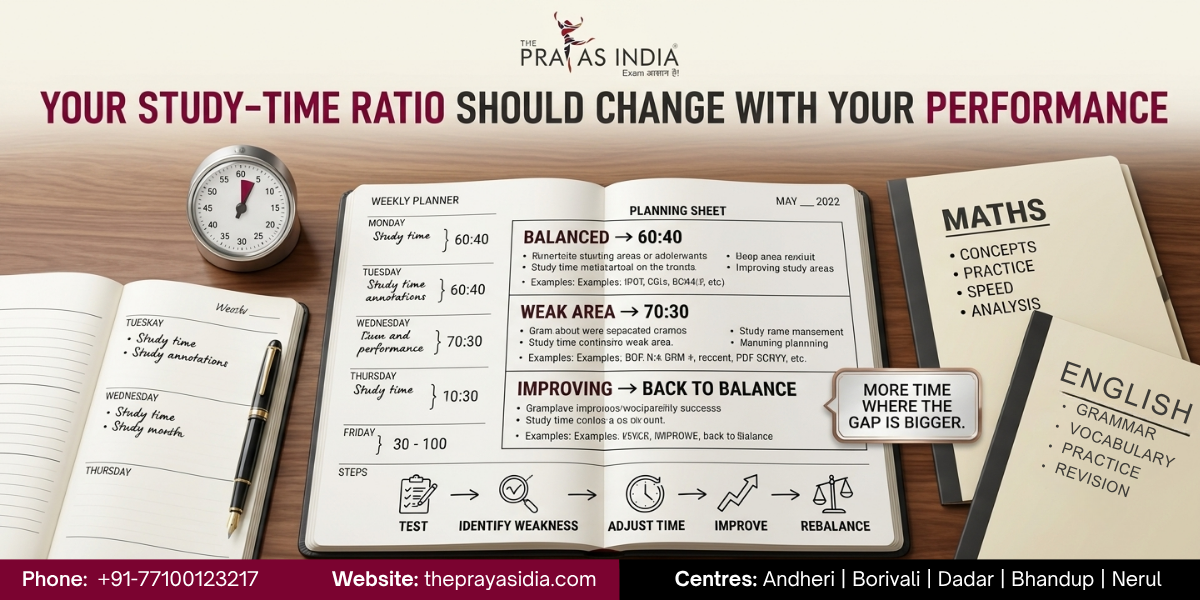
For many aspirants, a practical starting framework is to divide dedicated English-and-Maths preparation time approximately 60:40 in favour of the weaker section.
Suppose you have three hours available specifically for English and Maths each day. If Maths is clearly weaker, you could initially allocate around 1 hour 45 minutes to Maths and 1 hour 15 minutes to English. If English is weaker, reverse the distribution.
This does not mean that the weaker section must permanently receive 60% of your time. The ratio should change as your performance changes.
A candidate who initially struggles with Maths may require intensive concept-building for several weeks. Once the basics become stable, some of that additional time can move toward mixed practice and mock analysis. Eventually, the schedule may become closer to 50:50 or even favour English slightly if Maths has become a relative strength.
This is an important distinction between a static timetable and an adaptive preparation strategy. SSC CGL preparation lasts long enough for strengths and weaknesses to change. Your timetable should change with them.
Maths Usually Needs Longer Focused Study Blocks
One reason Maths often deserves longer uninterrupted study sessions is the depth of concentration required. Jumping between unrelated topics every few minutes can reduce the effectiveness of practice.
A productive Maths session can follow a structure such as:
Concept → Solved Examples → Untimed Practice → Timed Practice → Error Analysis
For example, if you are studying Percentage, the session should not end after memorising formulas. You should understand the basic concepts, solve representative examples, practise different question patterns, introduce a time limit and then analyse the questions you could not solve efficiently.
The same approach can later be applied to Profit & Loss, Ratio, Average, Time & Work, Algebra or other important areas.
Longer Maths blocks are particularly useful during the foundation stage because they allow you to remain within the same conceptual framework long enough to understand patterns. However, longer does not automatically mean better. A two-hour distracted session is less valuable than a focused 75-minute session followed by meaningful analysis.
The quality of question practice matters more than simply recording the number of hours studied.
English Benefits From Short, Frequent Practice
English can often be distributed differently. Instead of relying on one long daily session, aspirants can benefit from multiple shorter interactions with the subject.
For example, a candidate might divide English preparation across the day:
Morning: vocabulary revision
Afternoon: grammar practice
Evening: SSC CGL English questions
Night: error-log revision or reading
This approach creates repeated exposure without consuming a large uninterrupted block of study time.
Grammar should be treated as a rule-and-application subject. Learning a rule is only the first step; the candidate must recognise how that rule appears in examination questions. Vocabulary similarly requires repetition because one-time memorisation rarely produces long-term retention.
Reading should also become a regular habit. Even a short daily reading session can support comprehension, vocabulary recognition and familiarity with sentence structures.
This makes English particularly suitable for distributed practice, while Maths often benefits more from concentrated problem-solving blocks.
A Better Daily Division of English and Maths
Rather than creating a timetable based purely on clock hours, divide your preparation into three categories:
1. Concept Building
This is especially important for Maths and for English grammar topics that you have not mastered.
During this phase, focus on understanding the underlying rule or method instead of rushing through large numbers of questions. If the concept is weak, increasing question volume will not necessarily solve the problem.
2. Practice and Application
Once a concept is understood, the focus should shift toward question variety. SSC CGL preparation requires familiarity with recurring patterns, but candidates should avoid memorising one solution path for every question.
For Maths, application practice should gradually become timed. For English, practice should identify recurring grammar, vocabulary and comprehension patterns.
3. Revision and Error Correction
This is the part many aspirants underestimate.
If you solve 100 questions but never revisit your mistakes, your preparation may produce a large volume of activity without equivalent improvement. An error notebook or digital error log should capture the mistakes that have learning value.
Your revision should answer questions such as:
- Did I misunderstand the concept?
- Did I apply the wrong method?
- Did I make a calculation mistake?
- Did I misunderstand the question?
- Did I spend too much time?
- Was the mistake caused by insufficient revision?
This process converts practice into measurable improvement.
English and Maths Should Not Be Prepared in Isolation
Another common mistake is treating English and Maths as completely separate preparation projects. Although their concepts are different, the broader preparation skills required for SSC CGL overlap considerably.
Both subjects demand accuracy under time pressure. Both require question selection. Both improve through repeated exposure to examination patterns. And both benefit from mock-test analysis.
For instance, an aspirant may know how to solve a particular Maths question but spend too much time on it. Similarly, an English question may appear easy but result in a careless error because the candidate reads too quickly.
Therefore, preparation should gradually move from learning individual topics to making efficient decisions under exam conditions.
This is where sectional tests become particularly useful. A sectional test tells you not only whether you know the subject but also whether you can perform within the constraints of the examination.
How to Divide Time During the Foundation Stage
During the early preparation stage, concept building should receive the greatest attention. If your fundamentals are incomplete, spending most of your time solving full-length mocks may create a misleading sense of productivity.
For Maths, the foundation stage should cover important arithmetic and other core areas systematically. Do not jump randomly from one chapter to another simply because a particular topic appears frequently in practice material.
For English, establish a strong grammar base while building vocabulary and developing regular reading habits. At this stage, accuracy should be prioritised over extreme speed.
A practical daily structure could look like this:
| Preparation Activity | Maths | English |
|---|---|---|
| Concept Building | Higher priority | Moderate |
| Question Practice | High | High |
| Speed Practice | Gradually increasing | Moderate |
| Vocabulary/Revision | — | Daily |
| Error Analysis | Essential | Essential |
| Sectional Tests | Regular | Regular |
The exact hours will depend on the aspirant’s overall study schedule. A working candidate, college student and full-time aspirant may all need different timetables. What should remain constant is the principle of measuring performance and adjusting time accordingly.
The Prayas India Approach: Turn Time Allocation Into a Strategy
One of the advantages of structured SSC CGL coaching is that aspirants do not have to depend entirely on guesswork when deciding where their preparation time should go.
At The Prayas India, preparation can be structured around concept learning, guided practice, regular tests, performance analysis and targeted improvement. This is particularly useful when an aspirant knows that one section is consuming too much preparation time but is unsure whether the problem lies in concepts, speed, accuracy or question selection.
For a student preparing for SSC CGL in Mumbai, access to structured guidance can also create greater accountability. Instead of simply counting study hours, the preparation process can focus on measurable outcomes: better sectional scores, improved accuracy, reduced time per question and fewer repeated mistakes.
The ultimate objective is not to spend more hours studying English or Maths. It is to make every hour of preparation contribute toward a stronger SSC CGL score.

The Key Takeaway Before Building Your Timetable
There is no universal English-versus-Maths ratio that works for every SSC CGL aspirant.
If Maths is your weaker subject, give it longer focused sessions while maintaining daily English revision. If English is weaker, reverse the priority without allowing Maths practice to disappear. As your performance changes, your time allocation should change with it.
A strong SSC CGL preparation schedule therefore follows a simple cycle:
ASSESS → ALLOCATE → PRACTISE → TEST → ANALYSE → REBALANCE
Your timetable should be a reflection of your performance, not a fixed rule copied from someone else’s preparation strategy.
In the next part, we will build this approach into a practical SSC CGL English vs Maths daily and weekly timetable, including how to divide time during the foundation phase, revision phase and mock-test phase, along with common time-management mistakes and a strategy for balancing both sections closer to the examination.
For aspirants looking for structured SSC CGL preparation and SSC Coaching in Mumbai, The Prayas India provides a focused preparation environment with expert guidance, regular practice and performance-oriented test preparation.
The next step is to convert that principle into a practical schedule. Your preparation needs to change as you move from fundamentals to practice, from practice to sectional testing, and finally from sectional testing to full-length mock examinations. The amount of time you give English and Maths should evolve with each stage.
A Practical Daily Time Division for SSC CGL
For an aspirant who has around three dedicated hours for English and Maths, the following framework can work as a starting point:
| Preparation Stage | Maths | English |
|---|---|---|
| Foundation | 1 hr 45 min | 1 hr 15 min |
| Concept + Practice | 1 hr 40 min | 1 hr 20 min |
| Sectional Practice | 1 hr 30 min | 1 hr 30 min |
| Revision Phase | 1 hr 20 min | 1 hr 40 min |
| Mock-Test Phase | Based on weakness | Based on weakness |
These are not rigid rules. If Maths is already your strongest section, there is little value in spending almost two-thirds of your time there simply because a generic timetable recommends it. Similarly, if English accuracy remains low, giving it only a short daily session may not be enough.
The more useful approach is to begin with a tentative ratio and then modify it after every few sectional tests.
For example, a candidate may begin with a 60:40 Maths-to-English ratio because Maths is weak. After six weeks, if Maths accuracy has improved significantly while English remains stagnant, the candidate can shift the ratio closer to 50:50.
This makes preparation performance-led rather than timetable-led.
Build Your Week Around Different Types of Practice
Daily study is important, but weekly planning prevents the preparation from becoming repetitive. Every week should contain a mixture of concept learning, practice, revision, sectional tests and analysis.
A sample weekly structure could look like this:
Monday to Thursday: Concept + Practice
Use the first part of your study session for concept development and the second part for application.
Maths should focus on a limited number of connected topics rather than random questions from the entire syllabus. For example, you can dedicate a few sessions to Arithmetic while simultaneously revising the formulas and methods that support those questions.
English preparation can combine grammar rules, vocabulary, error detection, sentence-based questions and reading practice. The objective is to maintain daily exposure rather than complete an enormous number of questions in a single sitting.
Friday: Mixed Practice
Friday can be used to move away from chapter-specific practice.
Solve mixed questions from topics studied during the week. This helps identify whether you actually understand the concepts or have simply become comfortable with one particular question pattern.
Mixed practice is especially important in Maths because examination questions do not announce the method required. You need to identify the appropriate concept before solving the problem.
English also benefits from mixed practice because the examination may move between grammar, vocabulary, comprehension and other question types.
Saturday: Sectional Tests
Use Saturday for timed English and Maths sectional tests.
Do not treat the test as the end of your preparation session. The analysis that follows is equally important.
Record:
- Attempted questions
- Correct answers
- Incorrect answers
- Unattempted questions
- Time consumed
- Questions that took unusually long
- Questions where the method was unclear
- Questions lost due to careless mistakes
Sunday: Analysis + Revision
Sunday should not automatically become another high-volume question-solving day.
Review the week’s errors. Revisit difficult concepts. Redo selected questions without looking at the solution. Revise vocabulary and grammar rules. Rework Maths questions that previously consumed too much time.
This creates a weekly feedback loop:
STUDY → PRACTISE → TEST → ANALYSE → REVISE
Without the analysis and revision stages, the cycle remains incomplete.
Give Maths More Time When the Problem Is Conceptual
Not every Maths weakness requires more questions. Sometimes the actual problem is conceptual.
Suppose you are repeatedly making mistakes in Time & Work. Solving 200 additional questions without understanding the underlying relationship between work, efficiency and time may not solve the problem.
Similarly, if geometry questions consistently take too long because basic properties and theorems are not readily available in memory, additional timed practice may simply reinforce inefficient methods.
When your diagnostic tests reveal conceptual weakness, temporarily increase the Maths allocation.
A useful approach is:
Understand the concept → learn the standard methods → solve basic questions → solve exam-level questions → introduce time pressure → analyse mistakes.
This progression is more effective than immediately forcing yourself to solve difficult questions under a strict timer.
Give English More Time When Accuracy Is the Problem
English preparation often appears less demanding because many questions can be solved quickly. However, speed without accuracy can become misleading.
If you are attempting most English questions but consistently losing marks, increasing the number of questions alone may not help. Identify the source of those errors.
If grammar is responsible, revise the relevant rules and immediately practise questions based on them. If vocabulary is the issue, build a systematic revision mechanism instead of memorising large word lists once. If Reading Comprehension is causing problems, examine whether the issue is comprehension, question interpretation or rushing through the passage.
English should therefore have a daily maintenance component even when it is your stronger subject.
A short but consistent English session can prevent the section from becoming neglected while you devote additional hours to Maths.
The 70:30 Rule for a Severe Weakness
Sometimes the 60:40 framework is not enough.
If your diagnostic performance shows a major gap in one section, temporarily use a more aggressive allocation such as 70:30.
For example, if you have three hours available and Maths is substantially weaker:
Maths — 2 hours
English — 1 hour
This should not become a permanent timetable. Use it during the period when you are actively repairing the weakness.
Once the weaker section reaches a stable level, return toward a more balanced distribution.
The objective of a temporary 70:30 split is not to neglect English. It is to prevent one weak section from remaining weak because your timetable is too evenly distributed.
The Revision Phase Requires a Different English-Maths Balance
As the examination approaches, your preparation should gradually move away from learning large numbers of new concepts and toward revision, timed practice and test analysis.
This is where the English-Maths ratio may change again.
A candidate who has already completed most Maths concepts should not continue spending two hours every day learning new chapters simply because Maths was previously the weaker section. That time may now be better used for mixed practice, revision and mock analysis.
English may also require more revision during this stage because vocabulary, grammar rules and recurring errors can be forgotten if they are not revisited regularly.
A practical revision-phase structure can therefore move closer to:
Maths: 40–45%
English: 40–45%
Error-log and mixed revision: 10–20%
The exact distribution should depend on your test results.
Mock Tests Should Decide Your Final Time Allocation
During the mock-test phase, your preparation timetable should become increasingly data-driven.
Suppose three consecutive mocks show:
- Maths accuracy: 82%
- English accuracy: 94%
- Maths time management: weak
- English time management: strong
In that situation, spending equal time on both subjects may not be the most productive choice. Maths needs more focused intervention, especially around calculation, question selection and time-consuming topics.
Now consider the opposite situation. If Maths is producing strong scores but English accuracy has fallen because of grammar and vocabulary errors, English should temporarily receive more attention.
This is why mock tests are not simply tools for measuring scores. They are tools for deciding where your next study hour should go.
A Simple Mock-Based Time Allocation System
After every three sectional tests or full-length mocks, classify each section as:
Green: Stable
You are consistently scoring well with good accuracy and controlled time.
Action: Maintain the section with shorter but regular practice.
Yellow: Improving
The section is producing inconsistent results or one specific weakness is affecting performance.
Action: Increase targeted practice and monitor the same weakness.
Red: Priority
The section is significantly below your target or repeatedly causing time and accuracy problems.
Action: Allocate additional study time until performance becomes stable.
This system prevents your timetable from becoming disconnected from actual performance.
Common Time-Allocation Mistakes in SSC CGL Preparation
Spending Too Much Time on the Difficult Subject
Aspirants often assume that if Maths is difficult, every available study hour should be devoted to it. This can eventually cause English performance to decline.
The weaker section deserves additional time, but the stronger section still needs maintenance.
Giving Equal Time to Unequal Problems
A 50:50 schedule looks fair but may not be strategically efficient. If one section has a major conceptual weakness and the other is already stable, equal time allocation may slow improvement.
Studying Only the Comfortable Topics
Some candidates repeatedly practise chapters they already perform well in because those sessions produce better scores. This creates the illusion of progress.
Your study schedule should deliberately include areas where your performance is below the desired level.
Ignoring Analysis
Aspirants sometimes solve several sectional tests but never examine the reasons behind their mistakes. This wastes one of the most valuable sources of preparation data.
Changing the Timetable Every Few Days
The opposite mistake is also common. If your schedule changes every time you have one bad test, it becomes impossible to measure whether an intervention actually worked.
Make changes based on patterns across multiple tests rather than emotional reactions to one score.
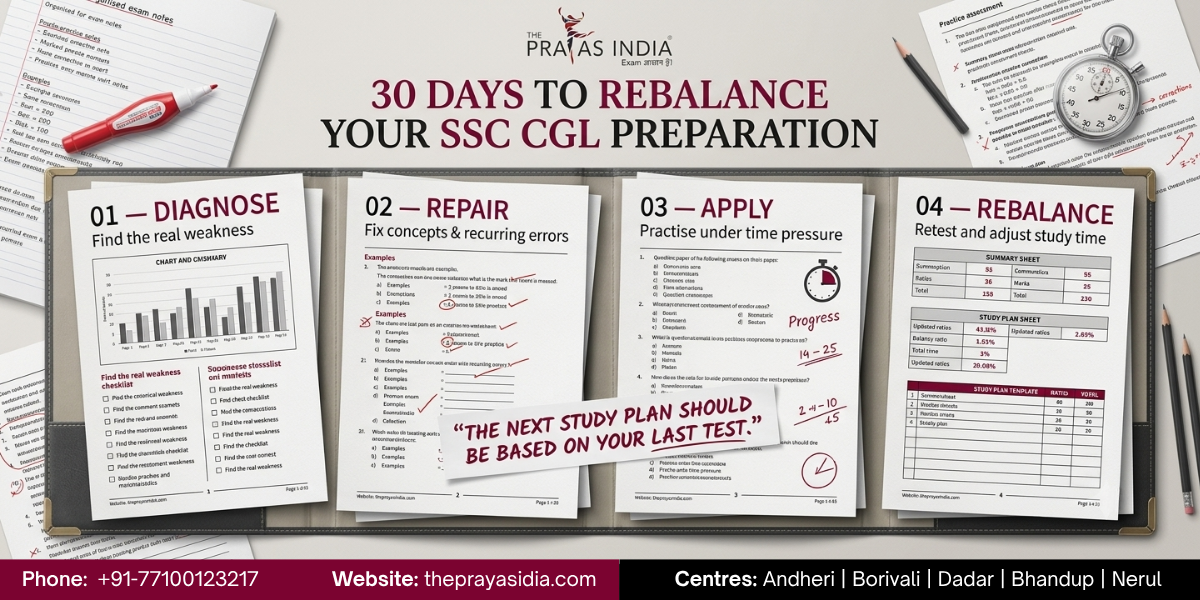
The 30-Day English vs Maths Preparation Framework
If you want to restructure your preparation over a month, use four stages.
Days 1–7: Diagnose
Take sectional tests and identify your strongest and weakest areas. Record accuracy, speed, topic-wise errors and repeated mistakes.
Do not make major timetable changes before completing this diagnosis.
Days 8–15: Repair
Give additional time to the weakest areas.
Maths may require concept revision and targeted problem-solving. English may require grammar correction, vocabulary revision or comprehension practice.
Days 16–23: Apply Under Time Pressure
Move gradually from untimed practice to timed sets. Your goal is now to reproduce your learning under examination-like conditions.
Days 24–30: Test and Rebalance
Take additional sectional tests and compare your performance with the first week.
If the weaker section has improved, rebalance the schedule. If the same weakness remains, identify whether the issue is conceptual, procedural, strategic or related to careless mistakes.
A Preparation Schedule for Different Types of Aspirants
Not every SSC CGL candidate has the same amount of time available. A full-time aspirant may have several hours for focused preparation, while a working professional may have only two or three productive hours on weekdays.
The solution is not to copy someone else’s timetable. Instead, preserve the relative priority of English and Maths within the hours you genuinely have.
For example, a candidate with two hours may use:
70 minutes — weaker section
50 minutes — stronger section
A candidate with four hours may use:
2 hours — weaker section
1 hour 20 minutes — stronger section
40 minutes — revision/error analysis
The absolute number of hours changes, but the underlying principle remains the same.
Consistency within a realistic schedule is more valuable than designing an impressive timetable that cannot be followed.
When Should You Join SSC CGL Coaching?
Aspirants often wait until they feel completely stuck before considering coaching. In reality, structured coaching can be useful at different stages depending on the candidate.
A beginner may benefit from a systematic syllabus sequence, concept explanation and guided practice. An intermediate candidate may need help identifying persistent weaknesses and improving speed. A candidate already taking mocks may benefit more from performance analysis, doubt solving and strategy correction.
For students looking for SSC Coaching in Mumbai, The Prayas India offers a structured preparation environment designed around concept building, guided practice, regular tests and performance-oriented improvement.
The value of coaching should not be measured simply by the number of classes attended. The more important question is whether the preparation system helps you understand the syllabus, practise effectively, identify weaknesses and improve your performance over time.
The Prayas India Advantage for SSC CGL Aspirants
A structured preparation programme can make time allocation easier because your preparation is not happening in isolation.
At The Prayas India, SSC CGL aspirants can work through a systematic learning process involving concepts, practice, tests, analysis and revision. Regular assessment can help identify whether additional preparation time should go toward Maths, English or a specific topic within either section.
For Mumbai aspirants comparing different options for Best SSC Coaching in Mumbai, the focus should therefore extend beyond infrastructure or the number of study materials provided. Faculty guidance, practice quality, test analysis, doubt resolution and consistency of academic support can have a direct impact on preparation efficiency.
Aspirants should choose a preparation environment that helps convert study time into measurable progress.
The Final English vs Maths Preparation Formula
There is no universal rule saying that every SSC CGL aspirant should spend exactly 50% of their preparation time on English and 50% on Maths.
A better framework is:
Foundation Stage:
Give more time to the weaker section while building fundamentals in both.
Practice Stage:
Increase question-solving and gradually introduce timed practice.
Sectional-Test Stage:
Use test results to identify where time is being lost.
Revision Stage:
Reduce new learning and increase mixed practice, revision and error correction.
Mock-Test Stage:
Let performance data determine the final allocation.
The most important principle is simple:
Do not divide your time equally. Divide it intelligently.
If Maths is your biggest weakness, give Maths more focused time. If English is holding back your score, increase English practice. If both are strong, maintain both and spend more time on mixed tests, revision and overall exam strategy.
Your preparation schedule should change as your performance changes.
SSC CGL English vs Maths: Quick Preparation Checklist
Before finalising your timetable, ask yourself:
- Have I taken a recent English sectional test?
- Have I taken a recent Maths sectional test?
- Which section has lower accuracy?
- Which section consumes more time?
- Which topics cause repeated mistakes?
- Am I spending too much time on comfortable topics?
- Am I maintaining my stronger section?
- Am I analysing sectional tests?
- Have I revised my error log?
- Am I changing my timetable based on data rather than one bad test?
If you can answer these questions honestly, your preparation schedule is likely to be much more effective than a generic timetable copied from another aspirant.
Conclusion
SSC CGL preparation is ultimately a competition of both knowledge and execution. English and Maths require different preparation styles, and that difference should influence how you distribute your study time.
Maths generally benefits from longer focused sessions involving concept development, problem-solving and timed practice. English can often be maintained through shorter, more frequent sessions involving grammar, vocabulary, reading and question practice. But these are starting principles, not permanent rules.
Your sectional scores should determine where additional time is required. Your mock analysis should determine whether that additional time is producing improvement. And once a weakness becomes stable, your preparation ratio should be adjusted again.
For aspirants preparing for SSC CGL and looking for Best SSC Coaching in Mumbai, The Prayas India provides structured guidance, regular practice, test-based preparation and performance-oriented support to help candidates build a more disciplined preparation strategy.
The right question is therefore not “English vs Maths — which one should I study more?”
The better question is:
“Based on my current performance, where will my next one hour of preparation create the biggest improvement?”
That is the mindset that turns time allocation into an actual SSC CGL preparation strategy.
Contact Us
- Call Now: +91-77100 13217
- Website: theprayasindia.com
- Centres: Andheri | Borivali | Dadar | Nerul | Bhandup
Frequently Asked Questions
1. Should I give equal time to English and Maths for SSC CGL?
Not necessarily. Equal time can be a useful starting point for balanced candidates, but if one section is significantly weaker, giving it additional focused time is generally more practical.
2. How many hours should I study Maths for SSC CGL?
There is no fixed number suitable for every aspirant. If Maths is weak, a larger portion of your dedicated preparation time can be allocated to concept building, practice, speed and analysis.
3. How much time should I spend on English for SSC CGL?
English benefits from consistent daily practice. Even when it is your stronger section, maintain regular grammar, vocabulary, reading and question-solving practice.
4. Is a 60:40 English-Maths preparation ratio good for SSC CGL?
A 60:40 ratio can be a useful starting framework, particularly when one section is weaker. The ratio should be adjusted according to sectional-test performance.
5. Should Maths get more preparation time than English?
Only if Maths is your weaker area or requires more improvement. Your performance should determine the priority rather than the perceived difficulty of the subject.
6. How can I improve SSC CGL Maths speed?
Build conceptual clarity first, then practise standard methods, calculation techniques and timed question sets. Analyse questions that consume excessive time and identify whether the issue is calculation, method selection or conceptual understanding.
7. How can I improve SSC CGL English accuracy?
Identify the source of your errors. Strengthen grammar rules, revise vocabulary systematically and analyse mistakes from sectional tests and practice sets.
8. How often should I take SSC CGL sectional tests?
Regular sectional testing is useful, but the frequency should increase as you approach the examination. More importantly, analyse every test and use the results to modify your preparation.
9. Should I focus on Maths first if I am weak in it?
You can temporarily give Maths additional time, but do not completely stop English. Maintaining a stronger section requires much less time than rebuilding a weak one.
10. Is SSC CGL coaching useful for beginners?
Structured coaching can help beginners follow a systematic syllabus, understand concepts, practise at the required level and receive guidance on test performance. The usefulness depends on the quality of faculty, practice and academic support.
11. Which is the best SSC coaching in Mumbai?
The right coaching institute depends on factors such as faculty quality, course structure, test series, doubt support, study material, performance analysis and consistency of guidance. Aspirants should compare these factors before making an admission decision.
12. Does The Prayas India provide SSC CGL coaching in Mumbai?
Yes. The Prayas India offers structured preparation support for competitive examinations, including SSC CGL, with a focus on concepts, practice, testing and performance improvement.