SSC CGL Tier 1 2026 Final Preparation Strategy: How to Analyse Your Mocks Before Exam Day
With the SSC CGL Tier 1 2026 examination scheduled from 30 September to 30 October 2026, aspirants have now entered an important phase of preparation. At this stage, taking mock tests is no longer just about checking how many questions you can solve. The real value of a mock lies in understanding why you lost marks, where you lost time, which questions you should have avoided and what needs to improve before your actual examination.
The SSC CGL Tier-I paper consists of four sections: General Intelligence and Reasoning, General Awareness, Quantitative Aptitude and English Comprehension. Each section has 25 questions for 50 marks, with a total of 100 questions for 200 marks. The examination has a 60-minute duration with a 15-minute sectional timer for each subject, and there is a 0.50-mark negative marking for every wrong answer.
This sectional timing makes mock analysis even more important. A candidate may have strong overall preparation but still struggle if too much time is spent on difficult questions or if accuracy falls because of rushed attempts. Therefore, your final mocks should be treated as a performance laboratory where every test gives you information about your preparation.
The objective should not be to take one mock after another without reflection. Instead, use every mock to answer five questions:
- What did I do well?
- Where did I lose marks?
- Where did I lose time?
- Which mistakes are repeating?
- What specific change will I make in the next mock?
This article explains how to analyse your SSC CGL Tier 1 mocks systematically and turn mock-test performance into measurable improvement.
Why Mock Tests Matter More in the Final Phase
Mock tests become particularly important when the examination is approaching because they help you move from knowledge-based preparation to performance-based preparation.
While studying a chapter, you generally have enough time to think about a question, check the solution and revisit the concept. The actual examination is different. You have limited time, a sectional timer and negative marking. You therefore need to know not only whether you can solve a question, but also whether you can recognise it quickly, solve it accurately and decide whether it is worth attempting.
This is where mocks become useful.
A good mock can reveal problems that regular practice may not show clearly. You may discover that your Quantitative Aptitude concepts are strong but your calculations are slow. You may know the English rules but spend too much time on certain questions. You may perform well in Reasoning during untimed practice but make avoidable mistakes when working under pressure. Similarly, General Awareness may take very little time but contribute to unnecessary negative marks if you attempt questions without sufficient confidence.
Therefore, your mock score should be treated as a diagnostic indicator, not as the final objective.
The most useful question after a mock is not:
“What was my score?”
It is:
“What caused my score?”
Understand the SSC CGL Tier 1 Mock Structure
Before analysing your performance, make sure your mock follows the actual examination structure as closely as possible.
The 2026 Tier-I scheme includes:
| Section | Questions | Marks | Time |
|---|---|---|---|
| General Intelligence & Reasoning | 25 | 50 | 15 minutes |
| General Awareness | 25 | 50 | 15 minutes |
| Quantitative Aptitude | 25 | 50 | 15 minutes |
| English Comprehension | 25 | 50 | 15 minutes |
| Total | 100 | 200 | 60 minutes |
The official pattern also specifies a sectional timer, meaning the preparation strategy should reflect those separate time limits rather than treating the examination as one unrestricted 60-minute block.
This has an important implication for mock analysis.
Suppose you finish Reasoning early but struggle to complete Quantitative Aptitude. In a normal practice session, you might compensate by using the extra time from Reasoning. Under the actual sectional timing, that option is not available. Therefore, you need to improve the performance of each section within its own allocated time.
Your mock should therefore answer two separate questions:
How good is my preparation?
and
How effectively can I perform within the actual time limit?
Step 1: Analyse Your Overall Score — But Do Not Stop There
The first number most candidates check after a mock is their score. That is understandable, but the score alone does not explain your performance.
Record at least these figures after every mock:
- Total questions attempted
- Correct answers
- Incorrect answers
- Unattempted questions
- Accuracy percentage
- Section-wise attempts
- Section-wise accuracy
- Time-related problems
- Questions left due to lack of time
- Questions that consumed excessive time
For example, consider two candidates who both score 145.
Candidate A may have attempted fewer questions with high accuracy.
Candidate B may have attempted significantly more questions but lost marks through excessive guessing.
Their scores are the same, but their improvement plans should be completely different.
This is why mock analysis must go beyond the score displayed by the test platform.
Step 2: Calculate Your Accuracy
Accuracy is one of the most important indicators in SSC CGL preparation because Tier-I carries negative marking of 0.50 marks for each wrong answer.
A simple accuracy calculation is:
Accuracy = Correct Answers ÷ Total Attempts × 100
For example, if you attempt 80 questions and 68 are correct:
Accuracy = 68 ÷ 80 × 100 = 85%
Now compare that with another mock where you attempt 88 questions but get 68 correct.
Your number of correct answers has remained the same, but the second attempt contains more incorrect answers and therefore greater exposure to negative marking.
This is why simply increasing attempts should not automatically be considered improvement.
Track These Three Numbers Together
Attempts + Accuracy + Score
When all three are considered together, you get a much clearer picture of your performance.
A useful target during the final phase is not simply to maximise attempts. Instead, work towards controlled attempts with reliable accuracy.
Step 3: Identify Where You Lost Marks
After checking your score and accuracy, go through every incorrect question.
Do not simply read the correct answer and move on.
Ask:
Why did I get this question wrong?
There can be several reasons.
1. Concept Gap
You did not know the underlying concept.
For example, you may not remember a particular geometry property, grammatical rule or reasoning concept.
Action: Revise the relevant concept and solve a small set of similar questions.
2. Calculation Error
You knew the concept but made a mathematical or calculation mistake.
Action: Practise calculation accuracy and slow down slightly at critical steps.
3. Misreading
You misunderstood what the question was asking.
Action: Improve reading discipline and underline mentally what the question actually requires.
4. Guessing Error
You were uncertain but attempted the question anyway.
Action: Improve your attempt-selection strategy.
5. Time Pressure
You rushed because very little time remained.
Action: Work on speed, question selection and section-wise planning.
6. Memory Error
You knew the information previously but could not recall it during the mock.
Action: Add the information to a concise revision list and revisit it repeatedly.
Once you categorise mistakes, your mock becomes much more useful because every wrong answer now points towards a specific action.
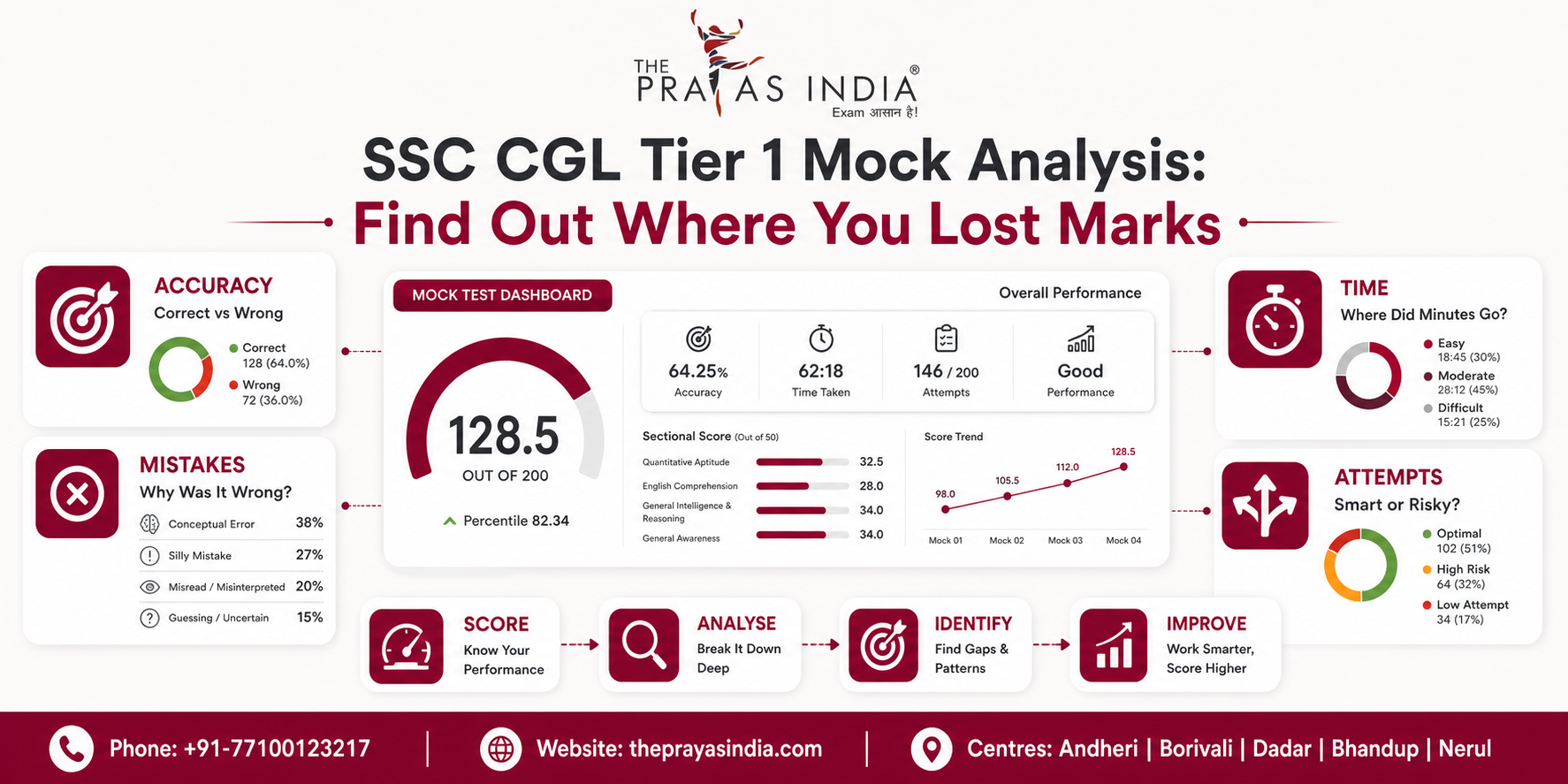
Step 4: Analyse Your Section-Wise Performance
Your overall score can sometimes hide a major weakness. Therefore, analyse each SSC CGL section separately.
General Intelligence & Reasoning
Check whether you are losing time on puzzles, series, coding-decoding, analogy, classification or other question types.
Look for questions where you spent too much time compared with their marks.
If your accuracy is high but attempts are low, your focus may need to shift towards speed and question recognition.
If attempts are high but accuracy is falling, review question selection and avoid unnecessary guesses.
General Awareness
GA can create a different type of problem. Some questions can be answered almost instantly if you know the information, while uncertain questions can consume time and increase negative marking.
Analyse:
- Which topics did you know?
- Which topics did you forget?
- Which questions did you guess?
- Which current or static areas repeatedly appear as weak areas?
Instead of collecting endless new study material, maintain a compact revision list for information you repeatedly forget.
Quantitative Aptitude
Quant is often where candidates notice a difference between conceptual knowledge and exam execution.
Check:
- Which questions took too long?
- Which calculations caused mistakes?
- Which chapters produced repeated errors?
- Did you spend too much time on one difficult question?
- Could you have selected easier questions first?
If your concepts are strong but your completion rate is low, your problem may be speed rather than knowledge.
English Comprehension
Analyse whether mistakes are related to vocabulary, grammar, reading comprehension, sentence structure or question interpretation.
Also check whether you are spending unnecessary time on questions where you are already reasonably confident.
Step 5: Create a “Time-Wasting Questions” List
One of the most valuable exercises after a mock is identifying questions that consumed too much time.
Suppose a question takes you 90 seconds or more while another similar question can be solved in 30–40 seconds. The issue may not be your ability to solve the first question. The issue may be whether that question was worth the time.
Create a small table:
| Question Type | Time Taken | Result | Decision |
|---|---|---|---|
| Easy | 30 sec | Correct | Attempt |
| Moderate | 60 sec | Correct | Attempt if time allows |
| Difficult | 100 sec | Wrong | Reconsider |
| Lengthy | 120 sec | Wrong | Skip faster |
This exercise can completely change the way you approach the next mock.
The goal is not to avoid every difficult question. The goal is to recognise which difficult questions are worth your limited time.
Step 6: Compare Your Mocks Instead of Looking at One Score
One mock can be misleading.
A better approach is to compare your last three to five mocks.
Create a simple performance sheet:
| Mock | Attempts | Correct | Wrong | Accuracy | Score | Main Problem |
|---|---|---|---|---|---|---|
| Mock 1 | 78 | 67 | 11 | 85.9% | — | Speed |
| Mock 2 | 80 | 70 | 10 | 87.5% | — | Quant |
| Mock 3 | 82 | 74 | 8 | 90.2% | — | GA |
| Mock 4 | 84 | 77 | 7 | 91.7% | — | Selection |
The exact score will depend on the test and marking scheme, but the purpose of this table is to identify direction and patterns.
Ask yourself:
- Is accuracy improving?
- Are attempts increasing without a major fall in accuracy?
- Are the same mistakes repeating?
- Is one section consistently weaker?
- Is your time-management problem improving?
- Are you becoming more consistent?
A gradual improvement in several performance indicators can be more informative than a single unusually high mock score.
Step 7: Track Repeated Mistakes
A mistake that happens once may simply be an isolated error.
A mistake that appears in three or four mocks is a preparation problem.
Create a Repeated Mistake Notebook or digital list with four columns:
| Topic | Mistake | Reason | Correction |
|---|---|---|---|
| Percentage | Calculation error | Rushed | Recheck calculation |
| Grammar | Rule confusion | Concept gap | Revise rule |
| Reasoning | Wrong option selection | Misread | Read conditions carefully |
| GA | Incorrect recall | Memory gap | Add to revision list |
Review this list before your next mock.
This creates a feedback loop:
Mock → Mistake → Correction → Practice → Retest
Without this loop, candidates often repeat the same mistakes across multiple mocks.
What Your Mock Score Is Really Telling You
A mock score should not be interpreted in isolation.
Consider these situations:
High Attempts + Low Accuracy
This usually indicates that you are taking too many risky attempts or making avoidable mistakes.
Your next priority should be better selection and accuracy.
Low Attempts + High Accuracy
You may have good fundamentals but insufficient speed.
Your focus should be on faster question recognition and timed practice.
Low Attempts + Low Accuracy
This suggests that both preparation gaps and exam execution need attention.
Identify the weakest topics first instead of simply taking more full-length mocks.
High Attempts + High Accuracy
This indicates that your current approach is producing a strong combination of speed and accuracy. Continue testing the strategy across multiple mocks rather than changing it unnecessarily.
The objective is to understand your own performance pattern instead of copying someone else’s attempt strategy.
Do Not Take Mocks Without Analysis
One of the most common mistakes during the final phase is taking a mock, checking the score and immediately starting another mock.
This can create the illusion of hard work without producing equivalent improvement.
If a mock takes one hour, your analysis should also receive meaningful attention.
After every mock:
- Check the overall result.
- Analyse incorrect answers.
- Identify time-consuming questions.
- Review unattempted questions.
- Categorise mistakes.
- Check section-wise performance.
- Identify one or two priorities.
- Apply the corrections in your next practice session.
A mock test should therefore be considered a learning session, not just an examination simulation.
What to Do Between Two Mocks
The period between two mocks is where improvement actually happens.
If your Quantitative Aptitude mock performance was weak because of calculation errors, do targeted calculation practice before taking another full mock.
If English mistakes are coming from grammar, revise the relevant rules and solve focused questions.
If Reasoning problems are related to question selection, practise identifying easier questions quickly.
If GA is causing unnecessary negative marks, revise your prepared material and become more disciplined about uncertain attempts.
This is more productive than taking another mock immediately with exactly the same weaknesses.
How Many Mocks Should You Take Before SSC CGL Tier 1?
There is no universal number that guarantees better performance.
The right number depends on your preparation level, available time and ability to analyse each test properly.
In the final phase, quality matters more than simply counting mocks.
A candidate who takes ten mocks but barely analyses them may gain less from the process than someone who takes fewer mocks and carefully studies every mistake.
Use the following principle:
Take a mock → analyse it → fix the identified problems → practise → take the next mock.
As the examination approaches, mocks should increasingly simulate the actual test environment, including the 15-minute sectional timers specified for Tier-I.
The final objective is not to collect a large number of mock scores. It is to enter the examination with a tested strategy.
A Practical Mock-Test Improvement Formula
You can simplify the entire process into five steps:
1. Attempt
Take the mock under realistic examination conditions.
2. Measure
Record attempts, accuracy, score and section-wise performance.
3. Analyse
Identify mistakes, time losses and question-selection problems.
4. Correct
Revise weak concepts and practise the specific problem areas.
5. Retest
Use another mock to check whether the correction worked.
This creates a continuous improvement cycle instead of random test-taking.
Mock → Measure → Analyse → Correct → Retest
This should become the foundation of your final SSC CGL Tier 1 preparation strategy.
Key Takeaway
With the SSC CGL Tier-I examination approaching, mock tests should become more purposeful. Do not judge your preparation only by the number of tests you have completed or by one high or low score.
A useful mock is one that tells you something specific about your preparation.
Maybe it tells you that Quant takes too long. Maybe it shows that your Reasoning accuracy is strong but attempts are low. Maybe it reveals that you are losing marks through unnecessary guesses in General Awareness. Or perhaps your biggest issue is not knowledge at all, but inconsistent question selection.
Once you know the problem, you can work on it.
Your mock score is the result. Your analysis is the strategy.
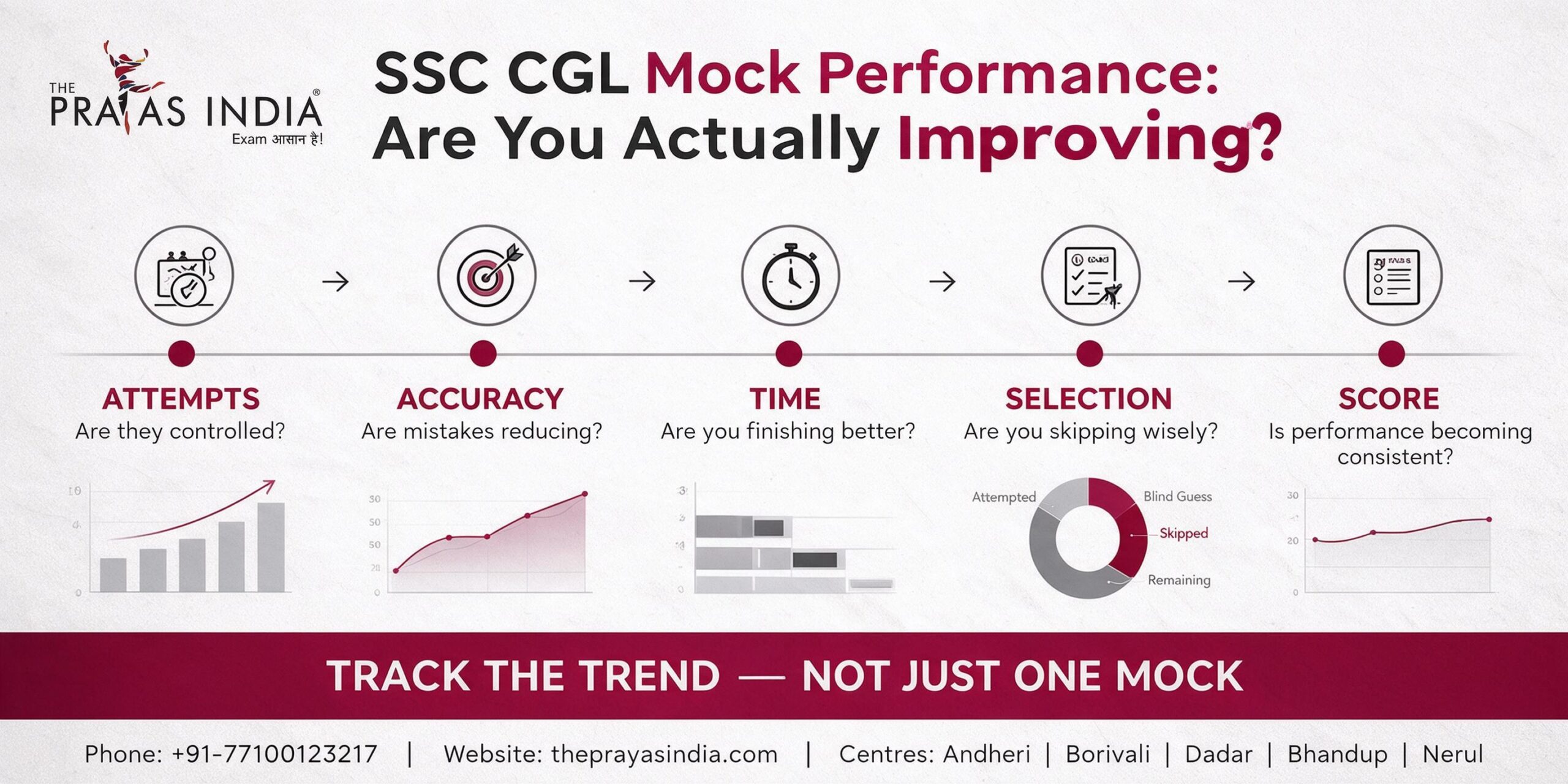
How to Know Whether Your Mock-Test Strategy Is Working
Taking mock tests regularly is useful only when your performance is moving in the right direction. Improvement does not necessarily mean that your score increases dramatically after every test. In the final phase of SSC CGL Tier 1 preparation, several smaller indicators can show that your strategy is becoming more effective.
Start by comparing your recent mocks instead of analysing each test separately. Look at your attempts, correct answers, incorrect answers, accuracy, section-wise performance and time usage. If your attempts are becoming more controlled while your accuracy improves, that is a positive sign. Similarly, if you are identifying difficult questions faster and leaving them without wasting excessive time, your question-selection ability is improving.
Another important indicator is the reduction in repeated mistakes. If you previously made five calculation errors in Quant and are now making one or two, your targeted practice is working even if the overall score has not changed significantly.
Your mock analysis should therefore measure process improvement as well as score improvement.
A simple performance dashboard can include:
- Total attempts
- Correct answers
- Incorrect answers
- Accuracy percentage
- Section-wise attempts
- Section-wise accuracy
- Questions left due to time
- Questions incorrectly attempted
- Average time spent on difficult questions
- Repeated mistakes
- Topics requiring revision
After every three or four mocks, compare the dashboard and identify the trend.
What to Do When Your SSC CGL Mock Score Is Low
A low mock score can be discouraging, particularly when the examination is approaching. However, the correct response is not to panic or completely change your preparation strategy after one test.
First, determine why the score was low.
There are several possibilities. You may have attempted too many questions and lost marks through negative marking. You may have encountered a difficult paper in one section. You may have spent too much time on Quantitative Aptitude and rushed through other questions. You may also have performed normally but made a few unusual errors.
Analyse the mock before deciding what to change.
If Your Attempts Were High but Accuracy Fell
Review the questions you attempted with low confidence. Identify whether guessing or rushing caused the mistakes.
Your priority should be controlled attempts and better question selection.
If Your Accuracy Was Good but Attempts Were Low
Look at the questions you left.
Were they genuinely difficult, or did you leave questions that you could have solved with more efficient methods?
If the latter is true, work on speed and question recognition.
If One Section Performed Poorly
Do not assume that your entire preparation is weak.
Identify the specific topics responsible for the decline and devote targeted practice time to them.
If Your Score Dropped Suddenly
Compare the mock with your previous tests.
Check whether:
- The paper was unusually difficult.
- Your attempt strategy changed.
- Your accuracy declined.
- You spent too much time on one section.
- You were distracted or fatigued.
- The same mistakes appeared again.
A single low score should be analysed as data rather than treated as a final assessment of your preparation.
How to Compare Two SSC CGL Mocks
Comparing two mocks can provide more useful information than simply checking whether the latest score is higher.
Suppose your first mock score is higher but your second mock has better accuracy. The second test may still indicate improvement if you have become more disciplined about attempts.
Use a comparison table like this:
| Performance Area | Mock A | Mock B | What It Shows |
|---|---|---|---|
| Attempts | 82 | 80 | More controlled |
| Correct | 70 | 72 | Improvement |
| Wrong | 12 | 8 | Better accuracy |
| Accuracy | 85.4% | 90% | Stronger execution |
| Time Issues | 3 | 1 | Better time control |
| Repeated Errors | 6 | 3 | Revision helping |
The exact numbers will differ from candidate to candidate. The important point is to compare the reason behind the result.
Ask:
Did I make fewer mistakes?
Did I select questions more intelligently?
Did I save time on lengthy questions?
Did I improve a previously weak section?
Did I reduce negative-marking exposure?
These questions tell you much more than simply asking whether Mock B has a higher score.
Your SSC CGL Mock-Test Error Log
An error log can become one of the most useful resources during the final phase of preparation.
Instead of keeping every question you got wrong, record the questions that teach you something useful.
Divide your error log into four broad categories:
Concept Errors
Questions where you did not understand or remember the underlying concept.
Calculation Errors
Questions where the method was correct but the calculation went wrong.
Careless Errors
Questions where you knew the answer but made an avoidable mistake.
Selection Errors
Questions where you should probably have avoided attempting the question under examination conditions.
You can also add a fifth category:
Time Errors
Questions where the solution was possible, but the time spent was disproportionate.
Review this error log before every mock and during final revision.
Over time, it becomes a personalised revision document based on your actual performance rather than a generic list of important topics.
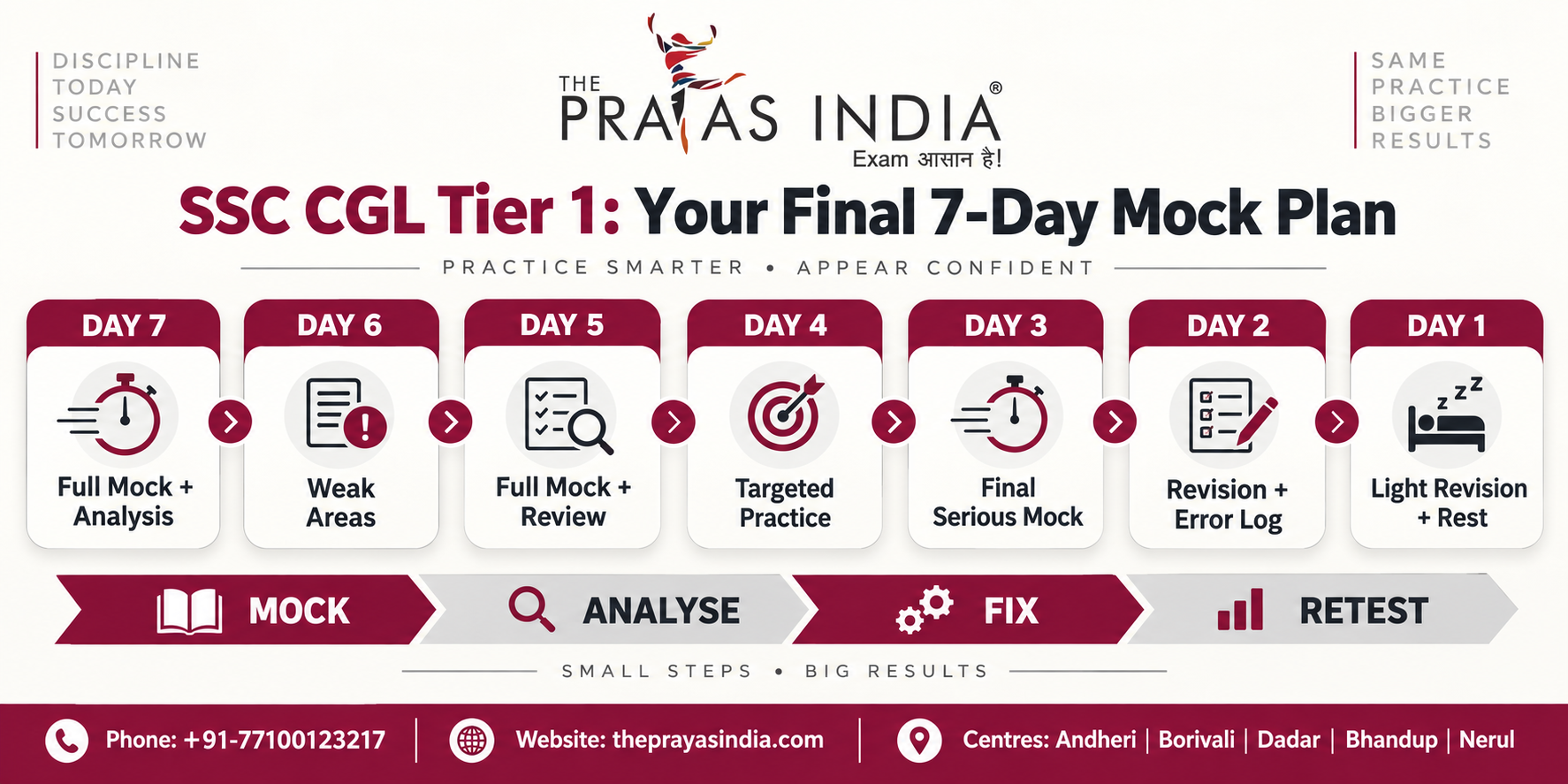
The 7-Day SSC CGL Tier 1 Mock-Test Plan
During the final week, your preparation should become increasingly focused. You do not need to spend the entire week taking full-length tests.
The exact routine can vary according to your preparation level, but a practical structure can look like this.
Day 7
Take a full-length mock under actual examination conditions.
Spend sufficient time analysing the test.
Identify your three biggest weaknesses.
Day 6
Work on the weakest topics identified in the previous mock.
Revise important formulas, rules and frequently forgotten concepts.
Solve targeted questions instead of immediately taking another full mock.
Day 5
Take another full-length mock.
Focus particularly on the mistakes identified in the previous test.
Analyse whether your corrections worked.
Day 4
Revise weak areas.
Practise section-specific questions under timed conditions.
Review your error log.
Day 3
Take a final serious full-length mock if your preparation level allows.
Do not focus only on the score. Evaluate your complete strategy.
Day 2
Keep revision targeted.
Review:
- Important formulas
- Grammar rules
- Vocabulary
- Reasoning patterns
- General Awareness notes
- Previous mistakes
- Short revision sheets
Avoid unnecessary new study material.
Day 1
Do light revision and focus on staying organised.
Review your examination requirements and follow the instructions applicable to your exam.
Avoid taking a difficult mock simply to test yourself at the last moment.
The purpose of the final day is to enter the examination with a clear and familiar strategy.
Section-Wise Mock Analysis: What Should You Track?
A strong mock strategy becomes much more effective when you analyse each section differently.
Quantitative Aptitude
For Quant, record:
- Number of questions attempted
- Number correct
- Calculation mistakes
- Questions taking excessive time
- Topics producing repeated errors
- Questions that could have been solved through a shorter method
If you regularly spend too much time on particular question types, practise alternative methods and learn to recognise when a question is not worth pursuing.
General Intelligence & Reasoning
For Reasoning, identify whether your problem is speed, interpretation or question selection.
Some questions may appear complicated but have short solutions once the pattern is recognised. Others may consume substantial time.
During mock analysis, note which question types you identify quickly and which ones repeatedly slow you down.
English Comprehension
Analyse errors according to grammar, vocabulary, comprehension, sentence structure and interpretation.
If your accuracy is high but you are spending too much time on certain questions, work on faster recognition rather than simply studying more rules.
General Awareness
For General Awareness, focus on recall and revision.
Separate questions into:
Knew but forgot
Never studied
Guessed
This distinction is important.
If you forgot information that you had already studied, revision is the priority. If you never encountered the topic, decide whether it is worth adding to your final revision material rather than opening another large resource.
How to Handle Negative Marking in Mock Tests
Because the official SSC CGL Tier-I scheme includes 0.50 negative marking for every wrong answer, careless attempts can directly reduce your score.
Your mock analysis should therefore include the number of marks lost through incorrect attempts.
Do not look at a wrong answer simply as “one question wrong.”
Ask:
Why did I attempt it?
If you knew the answer but made a careless error, your preparation response should be different from a question where you had no idea about the concept.
Similarly, if you regularly guess uncertain General Awareness questions, your strategy needs to account for the negative-marking risk.
The objective is not to attempt the maximum possible number of questions. It is to make well-controlled attempts within the available time.
How to Improve Question Selection Before Exam Day
Question selection is a skill that improves through repeated timed practice.
During your mocks, classify questions mentally into three broad groups:
Category A — Immediate Attempts
Questions where you understand the approach and expect a relatively quick solution.
Category B — Calculated Attempts
Questions that are manageable but require moderate time.
Category C — Time-Consuming or Uncertain
Questions where the method is unclear, calculation is lengthy or the probability of error is high.
The important part is not simply creating these categories. You must practise acting on them.
A common mistake is recognising that a question is difficult but continuing to work on it because you have already invested time.
Remember:
Time already spent is not a reason to spend more time.
If a question is consuming too much time and another manageable question is available, moving forward can be the more efficient decision.
How The Prayas India Can Support SSC CGL Preparation
Preparing for SSC CGL requires more than completing the syllabus. Aspirants also need regular practice, revision, mock tests and performance analysis.
A structured coaching environment can help students follow a planned preparation schedule, strengthen concepts, practise examination-level questions and regularly evaluate their performance.
The Prayas India provides online and offline coaching for competitive examinations, supporting aspirants through structured learning, practice and test-based preparation.
For SSC CGL aspirants, guided preparation can be particularly useful when moving from foundation-level learning towards timed practice and full-length mock tests.
Students preparing for the current SSC CGL cycle can use this final phase to identify their weak areas, while those planning for upcoming examinations can build a longer-term preparation plan with regular mock-test practice from the beginning.
Final SSC CGL Tier 1 Mock-Test Checklist
Before considering your mock-test preparation complete, make sure you can answer these questions:
- Do I know my average attempts?
- Do I know my average accuracy?
- Which section is consistently weakest?
- Which section consumes the most time?
- Which topics produce repeated mistakes?
- How many careless mistakes do I make?
- How often do I make risky attempts?
- Which question types should I skip faster?
- Am I following the sectional time limits during mocks?
- Do I analyse every mock after completing it?
- Do I maintain an error log?
- Have my repeated mistakes reduced?
- Is my performance becoming more consistent?
- Do I have a clear exam-day strategy?
If you can answer these questions confidently, your mock preparation is becoming much more structured.
Final Takeaway
The purpose of SSC CGL Tier 1 mock tests is not to collect scores. It is to understand how you perform when time, accuracy, question selection and negative marking come together.
A candidate who analyses every mock can identify weaknesses before they become examination-day problems. The key is to look beyond the final score and examine the complete performance: attempts, accuracy, time usage, mistakes, selection and consistency.
As the SSC CGL Tier-I 2026 examination window approaches from 30 September to 30 October 2026, use your remaining preparation time strategically. Follow the actual sectional timing while practising, review your mistakes, revise recurring weak areas and avoid making major strategy changes based on a single mock.
Remember the complete improvement cycle:
ATTEMPT → ANALYSE → IDENTIFY → IMPROVE → RETEST
Your next mock should not simply be another test.
It should be an opportunity to perform better because you understood the previous one.
For aspirants who want structured support, The Prayas India offers online and offline coaching for SSC CGL and other competitive examinations, with preparation designed around concepts, practice, revision and test-based improvement.
FAQs: SSC CGL Tier 1 2026 Mock Test Strategy
1. How many mock tests should I take before SSC CGL Tier 1 2026?
There is no fixed number that works for every candidate. The important factor is whether you are analysing each mock and correcting the weaknesses it reveals. Taking fewer mocks with detailed analysis can be more useful than taking many tests without reviewing them.
2. How should I analyse my SSC CGL mock test?
Start with attempts, correct and incorrect answers, accuracy and score. Then analyse each wrong answer, identify time-consuming questions, review unattempted questions and categorise your mistakes into concept, calculation, careless, selection and time-related errors.
3. What is more important in SSC CGL Tier 1: speed or accuracy?
Both matter. Speed allows you to use the available sectional time effectively, while accuracy protects your score from negative marking. Your mock analysis should help you find the right balance for your own preparation level.
4. Should I take a full mock every day in the final week?
Not necessarily. Full mocks are useful only when you have enough time to analyse them and work on the problems they reveal. A combination of mocks, targeted practice and revision can be more practical.
5. What should I do if my SSC CGL mock score is decreasing?
Do not immediately change your entire preparation strategy. Compare the latest mock with previous tests and identify whether the decline came from accuracy, attempts, time management, question selection or a particular section.
6. How can I reduce silly mistakes in SSC CGL?
Maintain an error log and identify the exact reason behind every careless mistake. During timed practice, consciously slow down at critical calculation or reading steps instead of rushing simply to increase attempts.
7. How can I improve my SSC CGL Quantitative Aptitude speed?
Analyse which question types and calculations consume the most time. Practise those areas separately, learn efficient methods and use timed sets to gradually improve execution speed.
8. How should I prepare General Awareness through mock analysis?
Separate GA mistakes into information you knew but forgot, information you never studied and questions you guessed incorrectly. Revise the first category repeatedly and make selective decisions about whether new information is worth adding during the final phase.
9. Should I attempt every SSC CGL question?
No. The official Tier-I pattern includes negative marking, so attempting questions without adequate confidence can reduce your score. Your mock tests should help you develop a question-selection strategy based on your preparation and accuracy.
10. How important is sectional timing in SSC CGL Tier 1?
It is very important because the current Tier-I scheme specifies separate 15-minute sectional timers for the four sections. Your mocks should therefore replicate this environment as closely as possible.
11. Should I change my mock-test strategy after one bad mock?
Generally, analyse the reason first. One poor mock does not necessarily indicate a major problem. Look for patterns across multiple tests before making significant changes to your preparation approach.
12. Can mock-test analysis improve my SSC CGL exam performance?
Mock analysis can help you identify recurring mistakes, weak topics, time-management problems and question-selection issues. The benefit comes from acting on that information through targeted revision and practice.
13. What should I revise in the final days before SSC CGL Tier 1?
Prioritise topics you have already studied, important formulas, frequently repeated mistakes, grammar rules, reasoning patterns and your prepared General Awareness material. Avoid overwhelming yourself with large amounts of completely new material.
14. Does The Prayas India provide SSC CGL coaching?
Yes. The Prayas India provides online and offline coaching support for SSC CGL and other competitive examinations, helping aspirants prepare through structured learning, practice, revision and mock-test-based improvement.
Master Your SSC CGL Tier 1 2026 Mock Test Strategy!
Simply taking mocks won’t boost your score; proper evaluation and a sectional time-management strategy are the real keys. Connect with the expert SSC mentors at The Prayas India to identify your speed bottlenecks, fix conceptual errors, and maximize your Tier 1 accuracy.
Official Website: theprayasindia.com
Visit Our Mumbai Centres: