SSC CGL Tier 1 2026 Mock Test Strategy: How to Analyse Your Mocks Before Exam Day
With SSC CGL Tier 1 2026 scheduled from September 30 to October 30, 2026, mock tests become one of the most important tools in the final stage of preparation. At this point, simply solving more questions or collecting higher mock scores is not enough. What matters is understanding what each mock test is telling you about your preparation, time management, question selection, accuracy, and weak areas.
Many SSC CGL aspirants take a mock test, check their score, compare it with previous attempts, and immediately move on to the next test. This approach can create the illusion of preparation without actually correcting the problems responsible for lost marks. A mock test should not be treated as just another question paper. It should be treated as a performance-analysis tool that helps you understand how you are likely to behave in the actual examination.
The closer the exam gets, the more valuable this analysis becomes. Instead of asking only, “How much did I score?”, aspirants should start asking, “Where did I lose marks?”, “Which questions consumed too much time?”, “Which mistakes were avoidable?”, and “What should I change before my next mock?”
A well-analysed mock can therefore be more useful than several mocks taken without proper review. The objective is not to chase a perfect score in every test but to steadily improve the quality of your attempts.
Why Mock Score Alone Is Not Enough
Your mock-test score is an important indicator, but it is only the final outcome of several factors working together. Two students can score the same marks while having completely different preparation problems. One may have good concepts but spend too much time on lengthy questions, while another may attempt quickly but lose marks through careless errors. Looking only at the score will not reveal this difference.
For example, suppose an aspirant scores 145 in one mock and 150 in another. At first glance, the second mock appears to show improvement. However, if the aspirant attempted significantly more questions but also made more negative-marking errors, the higher score may not necessarily indicate better exam execution. Similarly, a lower score in one mock does not always mean that preparation has deteriorated. The paper may have contained unfamiliar questions or exposed a particular weak area that needs attention.
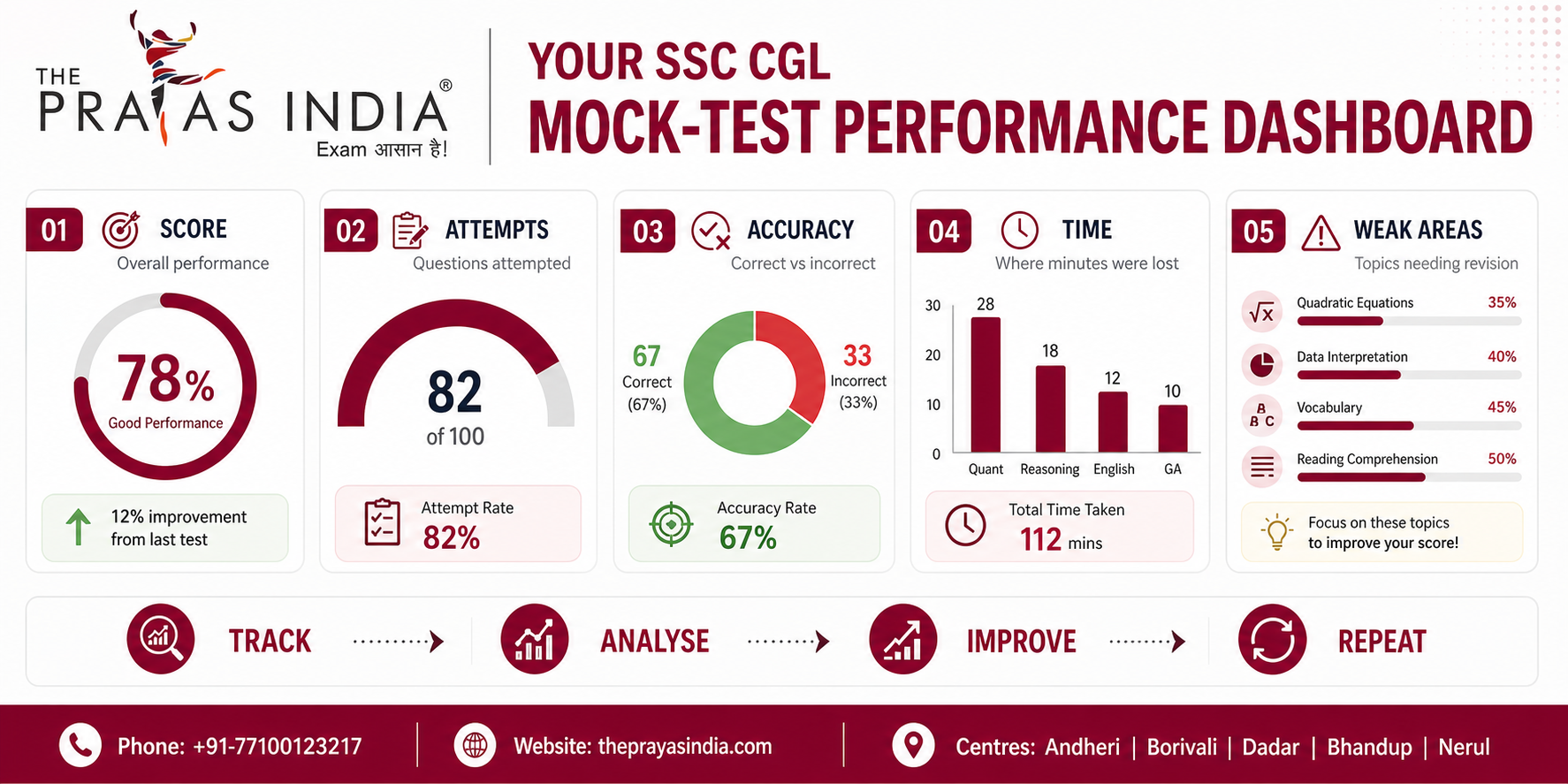
This is why your mock-analysis process should go beyond the score. After every serious mock, look at at least four things: attempts, correct answers, incorrect answers, and time spent. Then go one level deeper and identify why each incorrect or inefficient attempt happened.
A useful mock-review system should answer questions such as:
- Which section consumed the most time?
- Which questions were solved correctly but took too long?
- Which questions were left despite being manageable?
- Which incorrect answers were caused by conceptual gaps?
- Which mistakes were caused by calculation or reading errors?
- Which questions should have been skipped?
- Which topics repeatedly appear in your error list?
- Is your accuracy improving along with your attempts?
This type of analysis converts a mock test from a score-producing exercise into a personalised preparation report.
The Difference Between Taking a Mock and Using a Mock
Taking a mock means completing the paper within the prescribed time.
Using a mock means studying your performance after the test and making changes based on what you discover.
The second process is where much of the real improvement happens.
An aspirant who takes ten mocks but barely analyses them may continue repeating the same mistakes. Another aspirant who takes fewer mocks but carefully studies each one can identify recurring problems and deliberately work on them.
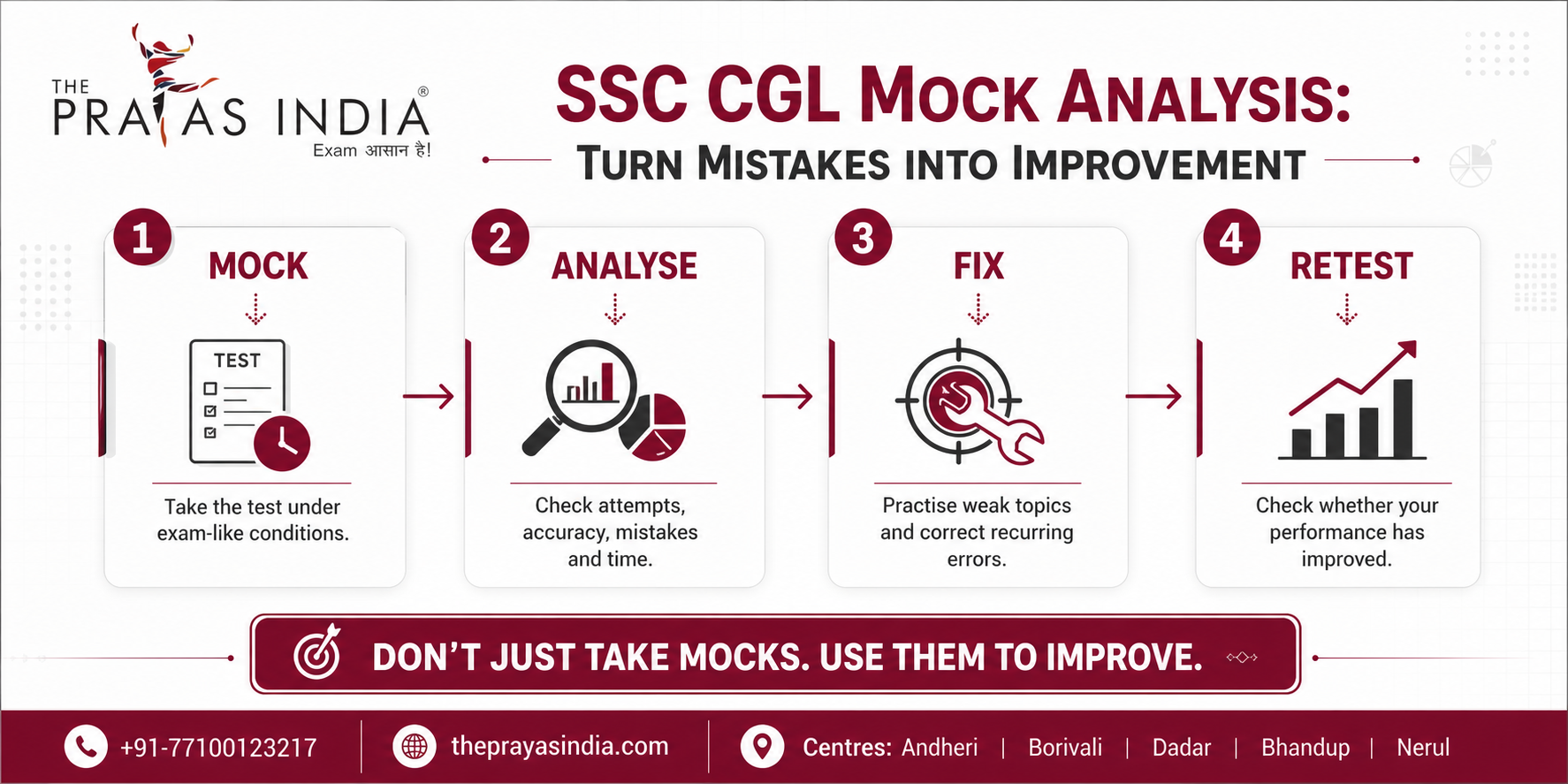
The goal during the final preparation phase should therefore be:
Mock → Analyse → Identify Problem → Practise → Retest
This cycle should become a regular part of your SSC CGL Tier 1 preparation.
Step 1: Analyse Your Mock Before Looking at the Score
After completing a mock, resist the temptation to immediately judge your preparation based on the final score. First, record your performance objectively.
Create a simple mock-analysis sheet containing:
| Performance Area | What to Record |
|---|---|
| Total Attempts | Number of questions attempted |
| Correct Answers | Questions answered correctly |
| Incorrect Answers | Questions answered incorrectly |
| Unattempted | Questions left |
| Time Used | Overall and section-wise |
| Accuracy | Correct answers compared with attempts |
| Time Loss | Questions or topics taking excessive time |
| Repeated Errors | Mistakes appearing across multiple mocks |
This gives you a much clearer picture of your actual performance.
For instance, if your score has remained almost unchanged across several mocks, do not automatically conclude that you are not improving. Check whether your accuracy has increased, whether you are spending less time on certain topics, or whether you are attempting questions more selectively. These improvements can indicate that your exam execution is becoming more controlled even before they produce a major score increase.
On the other hand, if your attempts are increasing but incorrect answers are also increasing, you need to examine whether you are sacrificing accuracy in an attempt to improve speed.
The purpose of the analysis is to identify the reason behind the score, not simply the score itself.
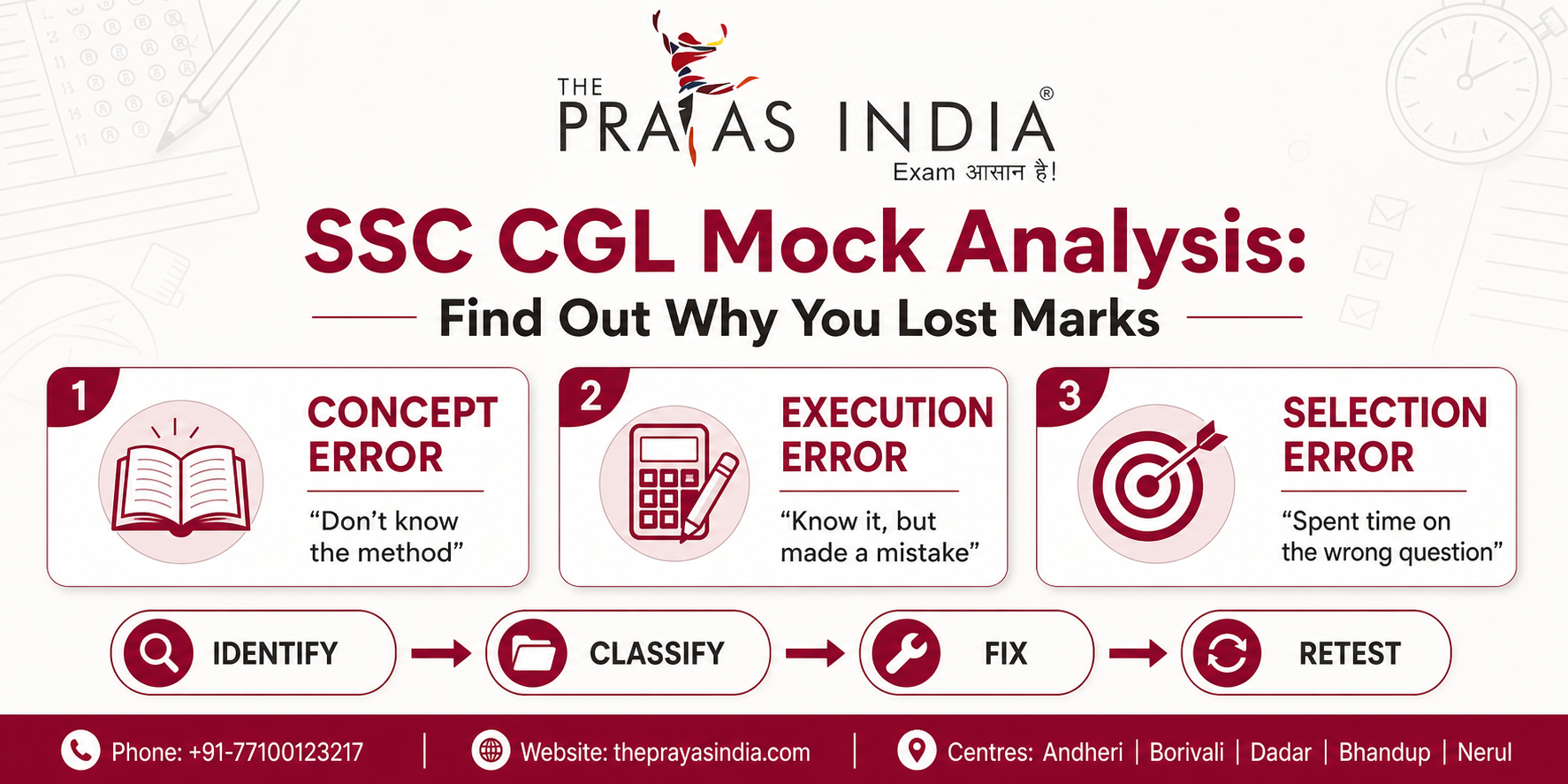
Step 2: Divide Your Wrong Answers into Three Categories
One of the most effective ways to analyse SSC CGL mocks is to stop treating every wrong answer as the same type of mistake.
Every incorrect answer should ideally be placed into a category. A practical system is to divide mistakes into three major groups:
1. Conceptual Errors
These occur when you genuinely do not know how to solve a question or do not understand the underlying concept.
For example, you may make an error in a percentage question because the basic concept is unclear, or choose the wrong grammatical structure because you have not properly understood the relevant rule.
These mistakes require concept revision and targeted practice.
If the same topic produces conceptual errors repeatedly, it should become a priority in your revision schedule.
2. Execution Errors
Here, you know the concept but fail during execution.
This can include:
- Calculation mistakes
- Incorrect substitution
- Misreading a value
- Marking the wrong option
- Missing a negative sign
- Applying the correct formula incorrectly
- Making a simple arithmetic error
- Reading a question too quickly
Execution errors are particularly important because they can often be reduced without learning an entirely new topic. The solution is usually more controlled practice, better checking habits, and improved concentration.
3. Selection Errors
Selection errors happen when you choose the wrong question to attempt at the wrong time.
You may understand the question perfectly, but it consumes three or four minutes when several easier questions were available. Alternatively, you may spend too long trying to solve a question that should have been skipped.
This category is especially important for SSC CGL because efficient paper management depends not only on knowing how to solve questions but also on recognising which questions deserve your time.
A selection error should therefore lead to a question such as:
“If I faced this question again in the actual exam, would I attempt it immediately, attempt it later, or leave it?”
That question can help improve your decision-making far more than simply checking the correct answer.
Step 3: Find the Questions That Are Consuming Too Much Time
A common mistake during mock analysis is to look only at questions answered incorrectly. Correct answers also need to be analysed.
Why?
Because a question can be correct but inefficient.
Suppose you solve a Quantitative Aptitude question correctly, but it takes nearly three minutes. The result is technically correct, but the time cost may be too high for an actual timed examination.
Similarly, you might solve a Reasoning question correctly after spending several minutes on it while leaving two or three easier questions untouched. In this situation, the problem is not your ability to solve the question. The problem is your time allocation and question selection.
During mock analysis, therefore, create a separate list of questions that took more time than they were worth.
You can classify questions into three broad groups:
Quick Questions
These are questions you recognise quickly and can solve with confidence.
They should generally form the foundation of your attempts because they allow you to collect marks without spending disproportionate time.
Moderate-Time Questions
These require some calculation, reasoning, or reading but remain manageable within a reasonable time.
These questions can be attempted after the quick questions have been addressed.
Time-Consuming Questions
These involve lengthy calculations, complicated reasoning, unfamiliar approaches, or excessive reading.
These questions require careful decision-making. A question being solvable does not automatically mean it should be attempted immediately.
Your objective is not to solve every question. Your objective is to use your available time efficiently.
How to Identify Your Time-Consuming Questions
When reviewing a mock, mark every question that made you think:
- “I knew how to solve it, but it took too long.”
- “I should have skipped this initially.”
- “I got stuck and lost track of time.”
- “I spent too much time checking the same calculation.”
- “Another easier question was available.”
- “I could have returned to this question later.”
Maintain a Time-Loss List for every mock.
For example:
| Question Type | Problem | Action |
|---|---|---|
| Lengthy arithmetic | Calculation took too long | Practise calculation |
| Puzzle | Spent too long setting up | Improve selection |
| Grammar | Overthought options | Revise rules |
| DI | Excessive calculation | Practise shortcuts |
| Vocabulary | Uncertain between options | Improve vocabulary |
After three or four mocks, patterns will start appearing.
If the same type of question repeatedly consumes excessive time, you have identified a specific performance issue that should be addressed before the examination.
Step 4: Analyse Each Section Separately
SSC CGL Tier 1 preparation should not be analysed only through an overall mock score. Your section-wise performance can reveal problems that the total score hides.
General Intelligence and Reasoning
In Reasoning, check whether you are losing time on particular question types. Some questions may appear difficult initially but become manageable with familiarity, while others may continue consuming too much time.
Look at:
- Which question types do you solve quickly?
- Which ones require repeated reading?
- Which questions cause avoidable mistakes?
- Are you spending too long on one problem?
- Are you recognising easy questions quickly enough?
Your final strategy should gradually become more selective. The purpose of practice is not simply to increase the number of questions you can solve but to improve your ability to recognise the questions worth attempting.
General Awareness
General Awareness requires a slightly different mock-analysis approach. If you do not know an answer, spending excessive time on it will generally not improve the outcome. Analyse whether your errors are concentrated around particular areas of static GK, current affairs, science, history, geography, polity, or other areas you have been preparing.
Instead of attempting to memorise everything during the final phase, use mock analysis to identify recurring knowledge gaps and revise those areas systematically.
Quantitative Aptitude
In Quantitative Aptitude, separate conceptual mistakes from calculation mistakes.
If you know the formula but repeatedly make calculation errors, additional concept reading may not solve the problem. You need focused calculation practice.
If you understand the calculations but cannot identify the correct method, then the problem is conceptual or application-based.
Also identify which questions are taking too long. Improving Quant performance is not only about solving difficult questions; it is also about becoming faster at familiar question types.
English Comprehension
For English, analyse whether errors are coming from grammar rules, vocabulary, comprehension, interpretation, or careless reading.
If you repeatedly select an incorrect option despite understanding the passage, examine whether you are overinterpreting the question. If grammar questions are consistently wrong, identify the specific rules responsible rather than revising grammar randomly.
The more specific your analysis becomes, the more efficiently you can use your remaining preparation time.
Step 5: Track Repeated Mistakes Across Multiple Mocks
One mock can reveal an isolated mistake. Multiple mocks reveal patterns.
This is why you should maintain a cumulative error log rather than treating every mock independently.
For example:
Mock 1: Percentage calculation mistake
Mock 2: Percentage calculation mistake
Mock 3: Percentage calculation mistake
At this point, the issue is no longer a random error. It has become a repeated weakness.
The same principle applies to time management. If you repeatedly spend excessive time on a particular question type, simply taking more mocks will not necessarily solve the problem. You need targeted practice between mocks.
Your error log can contain four simple columns:
| Topic | Error Type | Why It Happened | Corrective Action |
|---|---|---|---|
| Percentage | Execution | Calculation error | Timed calculation drills |
| Algebra | Concept | Method unclear | Revise concept |
| Reasoning | Selection | Attempted too early | Practise question selection |
| English | Execution | Misread option | Slow down at critical points |
This makes your revision much more focused.
Step 6: Turn Mock Analysis into a Weak-Area Improvement Plan
The ultimate purpose of mock analysis is not to create a beautiful error log. It is to change your preparation based on what the log reveals.
Once you identify your weak areas, divide them into three levels.
High-Priority Weak Areas
These are topics where you repeatedly make mistakes and which are still realistically improvable before the exam.
Give them regular targeted practice.
Medium-Priority Areas
These are topics where you understand the fundamentals but need additional practice to improve speed or consistency.
Include them in your sectional practice and revision sessions.
Low-Priority Areas
These are areas where your performance is already reasonably stable or where improvement would require disproportionate time.
Do not allow them to consume your entire final preparation schedule.
This approach prevents one of the biggest problems during the final weeks: trying to fix everything simultaneously.
The Final Goal: Fewer Repeated Mistakes
Your mock-test scores may fluctuate from paper to paper. That is normal.
Instead of expecting every score to increase continuously, look for more meaningful signs of improvement:
Are repeated mistakes decreasing?
Are you spending less time on familiar questions?
Are you skipping poor questions earlier?
Is your accuracy becoming more stable?
Are your weak topics becoming stronger?
Are you finishing sections with better control?
These indicators can tell you much more about your preparation than a single mock score.
The best use of a mock test is therefore not to celebrate a high score or become discouraged by a low one. It is to identify what needs to change before the next test.
A Simple SSC CGL Mock Analysis Formula
You can use the following approach after every full-length mock:
1. Check the score
Understand your overall performance.
2. Check attempts and accuracy
Determine whether your attempts are efficient.
3. Review every wrong answer
Classify the mistake.
4. Review time-consuming correct answers
Identify inefficient solving.
5. Identify repeated weaknesses
Compare the current mock with previous tests.
6. Practise the identified weak areas
Do not leave the analysis at the review stage.
7. Retest yourself
Use the next sectional or full-length mock to check whether the problem has improved.
This transforms mock tests into a continuous improvement system rather than a collection of scores.
How Many Mock Tests Should You Attempt Before SSC CGL Tier 1?
There is no universal number of mock tests that every SSC CGL aspirant must complete before the examination. The right number depends on your preparation level, available time, and, most importantly, how seriously you analyse each test. In the final phase, quality of analysis should take priority over simply increasing the number of mocks.
A useful approach is to take a full-length mock at regular intervals and use the time between two mocks to correct the problems identified in the previous one. If you take another mock without addressing the mistakes from the previous test, you may simply reproduce the same errors.
For a well-prepared aspirant, the final phase can include regular full-length mocks combined with sectional tests and targeted practice. However, avoid taking multiple full-length tests every day if there is no time left for meaningful analysis.
Think of the process this way:
Mock Test = Diagnosis
Analysis = Identification of the Problem
Practice = Treatment
Next Mock = Progress Check
This approach makes every test purposeful.
How to Use the Final Days for Weak-Area Improvement
As the SSC CGL Tier 1 examination window approaches, your preparation should gradually move from broad learning to targeted revision. This does not mean stopping practice. Instead, your practice should become increasingly focused on the areas that your mock tests have identified as problematic.
Suppose your last three mocks show that you are consistently losing marks in arithmetic calculations. Spending several hours revising topics that you already perform well in may have limited value. Your time may be better used for targeted arithmetic practice, followed by a short timed test to determine whether the problem is improving.
Similarly, if your Reasoning performance is strong but you repeatedly lose time on particular question types, work on recognition and selection rather than simply solving more difficult questions.
Your final preparation should answer one question:
“What can I improve realistically with the time I have left?”
Prioritise weaknesses that are both recurring and improvable.
A Practical Priority System
Priority 1 – Repeated mistakes
These should receive immediate attention because they have already appeared in multiple tests.
Priority 2 – Easy-to-fix execution mistakes
Calculation errors, misreading questions, incorrect marking, and similar issues can often be addressed through focused practice.
Priority 3 – Time-management problems
If you consistently spend too much time on particular questions, work on recognition and selection.
Priority 4 – Unfamiliar or low-confidence areas
Revise selectively depending on how much time remains. Avoid allowing one difficult topic to consume your entire schedule.
This prevents your final days from becoming an unstructured attempt to revise the entire syllabus again.
A 7-Day Mock Analysis and Improvement Routine
If you are in the final stage of SSC CGL Tier 1 preparation, you can organise your mock practice into a simple weekly cycle.
Day 1: Full-Length Mock
Take a complete mock under exam-like conditions. Avoid interruptions and unnecessary breaks. Treat the test as a serious simulation rather than casual practice.
Immediately after the test, record your score, attempts, correct answers, incorrect answers and section-wise performance.
Day 2: Detailed Analysis
Review every incorrect answer and classify it as a conceptual, execution, or selection error.
Also review questions that you solved correctly but took too long to answer.
Do not limit your analysis to questions that were wrong.
Day 3: Concept Correction
Revise the concepts responsible for repeated mistakes. Keep this revision targeted. Instead of reopening entire chapters unnecessarily, focus on the specific subtopics where your mistakes occurred.
Day 4: Targeted Practice
Solve a focused set of questions from your weak areas. Use a timer so that you are improving both accuracy and execution speed.
Day 5: Sectional Test
Take sectional tests covering the areas you worked on. Check whether the mistakes identified earlier are reducing.
Day 6: Revision and Error Log
Review your error notebook, formulas, rules, important facts, shortcuts and previously incorrect questions.
Questions that you got wrong earlier but can now solve confidently are useful indicators of progress.
Day 7: Full-Length Mock
Take another full-length mock and compare it with the previous test.
Do not compare only the scores. Compare:
- Accuracy
- Attempts
- Time management
- Repeated mistakes
- Time-consuming questions
- Section-wise performance
- Question-selection decisions
This creates a measurable improvement cycle.
How to Compare Two Mocks Properly
Many aspirants compare Mock 1 and Mock 2 by looking only at their final marks. A better comparison considers multiple performance indicators.
For example:
| Metric | Mock 1 | Mock 2 | What to Observe |
|---|---|---|---|
| Score | —— | —— | Overall outcome |
| Attempts | —— | —— | Attempt volume |
| Accuracy | —— | —— | Quality of attempts |
| Incorrect Answers | —— | —— | Avoidable losses |
| Time Management | —— | —— | Efficiency |
| Concept Errors | —— | —— | Knowledge gaps |
| Execution Errors | —— | —— | Careless mistakes |
| Selection Errors | —— | —— | Question choice |
| Repeated Weak Topics | —— | —— | Improvement areas |
A score increase is useful, but so is a reduction in incorrect answers or better time management. Similarly, if the score remains stable while repeated errors decrease, you may still be moving in the right direction.
The objective is to build consistent exam performance, not simply produce one unusually high mock score.
What to Do When Your Mock Score Suddenly Drops
A sudden drop in score can be discouraging, but one mock should not determine your assessment of your preparation.
First, analyse why the score dropped.
Check whether:
- The paper was more difficult than your previous test.
- You made an unusual number of careless errors.
- Your accuracy decreased.
- You spent excessive time on one section.
- You attempted questions outside your comfort zone.
- A particular weak topic appeared more frequently.
- You changed your normal attempt strategy.
The correct response to a low score is not automatically to start studying everything again.
Find the reason first.
If the drop is caused by a specific and identifiable issue, address that issue and then retest.
This is another reason why mock analysis is more useful than score comparison alone.
Common Mistakes Aspirants Make While Taking Mock Tests
Taking Mocks Without Analysis
This is perhaps the most common mistake. A mock test cannot correct your preparation automatically. You have to study the performance report and act on it.
Chasing a Specific Score in Every Mock
Different mocks can vary in difficulty. Treat your score as one performance indicator rather than the only measure of preparation.
Ignoring Correct but Slow Questions
A correct answer that consumes excessive time can still indicate inefficient exam execution.
Attempting Every Question
The objective of a timed exam is not necessarily to solve every question. Efficient selection is part of the strategy.
Repeating the Same Mistake
If an error appears repeatedly in your analysis but never enters your revision plan, the analysis is not being converted into action.
Changing Strategy After Every Mock
A single poor test should not make you completely change your exam approach. Look for patterns across multiple tests before making major adjustments.
Spending Too Much Time on Very Weak Topics
Final preparation requires prioritisation. Not every weakness can or should be completely eliminated before the examination.
Build Your Personal Mock-Test Dashboard
A simple spreadsheet or notebook can make your preparation much more organised.
For every mock, record:
Date → Score → Attempts → Accuracy → Section-wise Performance → Concept Errors → Execution Errors → Selection Errors → Time Loss → Weak Topics → Action Plan
After several tests, you will have your own performance history.
This can help you identify trends that are difficult to notice when looking at individual mocks separately.
For example, you may discover that your Quant score is stable but your time management is improving, while English accuracy fluctuates because of certain grammar topics. Such information allows you to make targeted decisions rather than following generic preparation advice.
How The Prayas India Can Support Your SSC CGL Preparation
For many aspirants, the challenge during the final phase is not simply finding questions to practise. It is knowing what to practise, how to structure revision, how to analyse performance and how to remain consistent.
A structured SSC CGL preparation programme can provide a more organised learning environment through guided classes, practice sessions, study material, mock tests, revision support and regular performance evaluation.
At The Prayas India, students preparing for competitive examinations can access structured guidance through online and offline coaching, allowing them to continue preparation according to their learning requirements and schedule.
For SSC CGL aspirants, the final phase should be used to strengthen concepts, practise under time pressure, analyse mock performance and develop a practical examination strategy.
The purpose of coaching at this stage should not be to encourage students to take tests endlessly. It should be to help them understand their performance and improve the areas that can make a meaningful difference.
Your Final SSC CGL Mock-Test Checklist
Before moving from one mock to the next, ask yourself:
- Did I analyse every wrong answer?
- Did I identify why each mistake happened?
- Did I classify my mistakes?
- Did I review correct but time-consuming questions?
- Did I identify questions I should have skipped?
- Did I find repeated weak topics?
- Did I practise those weak topics?
- Did I revise my error log?
- Did I work on calculation or execution mistakes?
- Did I check my section-wise performance?
- Did I compare my latest mock with previous tests?
- Did I change my strategy based on evidence rather than emotion?
If the answer to these questions is yes, your mock tests are doing more than measuring your preparation. They are actively helping you improve it.
Final Takeaway
With SSC CGL Tier 1 2026 scheduled from September 30 to October 30, 2026, mock tests should become an important part of your final preparation strategy. But taking a mock is only the first step. The real value comes from understanding what happened during those 60 minutes and using that information to improve your next attempt.
Do not judge your preparation only by the final score. Look at your attempts, accuracy, mistakes, time management, question selection and recurring weak areas. Categorise your mistakes into conceptual, execution and selection errors so that every problem has a clear corrective action.
Most importantly, do not allow mock analysis to become a passive activity. If you identify a weak topic, practise it. If you identify a calculation problem, work on calculations. If you identify a selection problem, improve your question-recognition strategy. If you repeatedly lose time on a particular question type, learn when to attempt it and when to move on.
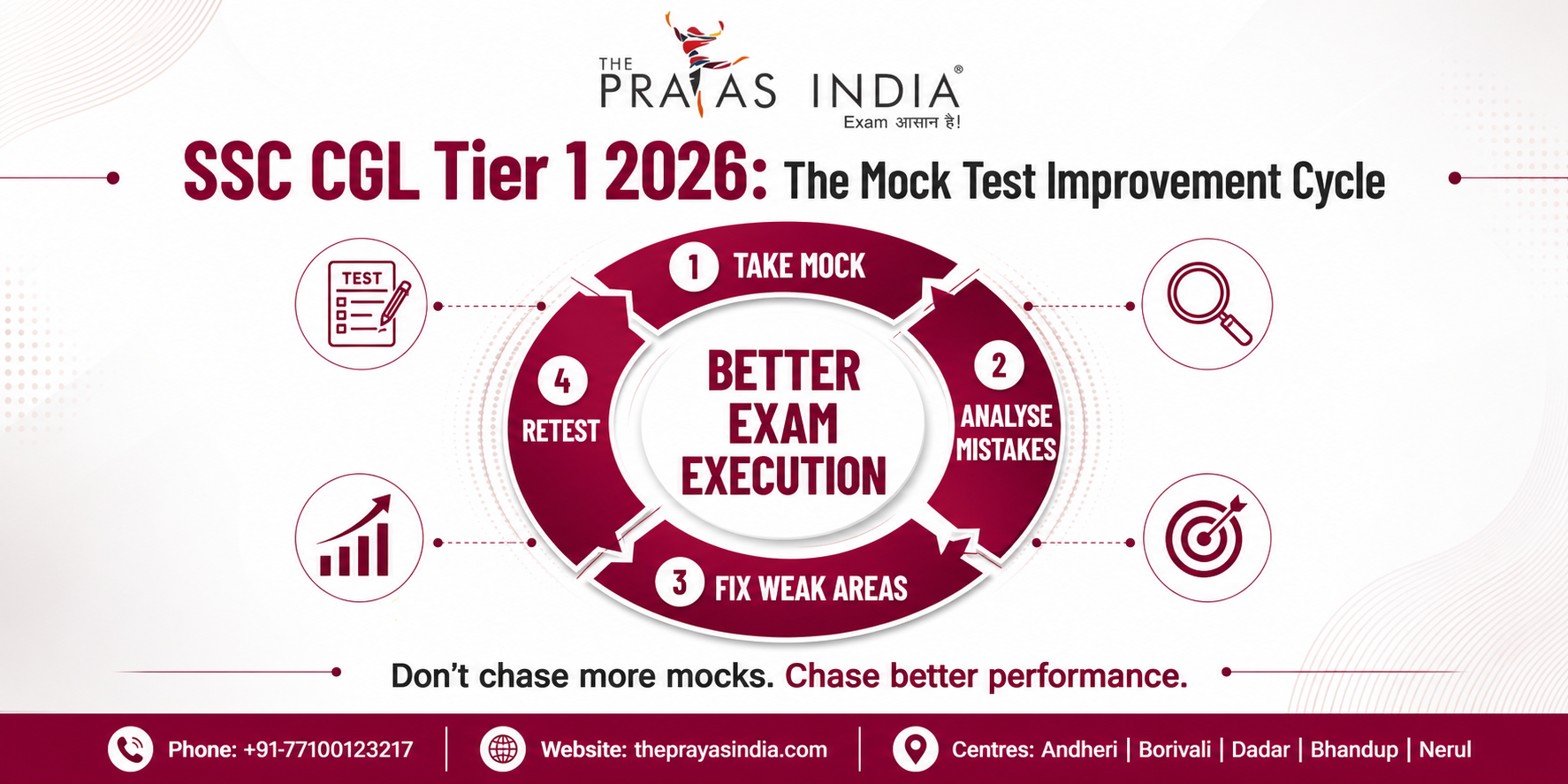
The ideal cycle is simple:
Take the mock → Analyse the performance → Fix the problem → Retest → Repeat.
As the SSC CGL Tier 1 examination approaches, this cycle can help you make your preparation more focused and your exam strategy more deliberate. The aim is not to achieve an impressive score in every practice test, but to steadily reduce repeated mistakes and improve the quality of your attempts.
For students looking for structured guidance, regular practice and systematic preparation, The Prayas India offers SSC CGL coaching through online and offline learning options.
FAQs on SSC CGL Tier 1 2026 Mock Test Analysis
1. Why is mock-test analysis important for SSC CGL Tier 1 2026?
Mock analysis helps you understand why you gained or lost marks. It can reveal conceptual gaps, careless mistakes, inefficient solving, poor question selection and time-management problems that a final score alone cannot show.
2. Should I focus more on my SSC CGL mock score or mock analysis?
Both are useful, but the score tells you the outcome while analysis helps explain the outcome. In the final preparation phase, detailed analysis is essential because it tells you what needs to change before your next test.
3. How should I classify wrong answers in an SSC CGL mock?
A practical method is to classify them into conceptual errors, execution errors and selection errors. This makes it easier to decide whether you need concept revision, more practice or better question-selection skills.
4. Should I analyse questions that I answered correctly?
Yes. Correct answers should also be reviewed when they consumed excessive time. A correct but very slow question may indicate that your solving method or question-selection decision needs improvement.
5. How can I identify time-consuming questions in SSC CGL mocks?
During analysis, mark questions that took noticeably longer than your normal solving time, questions where you got stuck, or questions that prevented you from attempting easier ones. Track these across multiple mocks to identify recurring patterns.
6. What should I do if the same mistake appears in several SSC CGL mocks?
Add it to your cumulative error log and create a specific corrective action. Revise the relevant concept, practise similar questions under a timer, and check the same topic again in your next mock or sectional test.
7. How can mock tests help identify my weak areas?
Repeated mistakes across multiple tests can reveal weak topics. Compare your mock analyses and look for topics where incorrect answers, slow solving or poor confidence appear repeatedly.
8. Should I take a full-length SSC CGL mock every day?
Not necessarily. The ideal frequency depends on your preparation level and the time available for analysis and targeted practice. Taking more mocks without analysing them properly can reduce their usefulness.
9. What should I do after getting a low score in an SSC CGL mock?
First identify the reason for the drop. Check difficulty, accuracy, time management, question selection and repeated mistakes before changing your preparation strategy. One low score should be analysed rather than treated as a final assessment.
10. How can I improve my weak areas after mock analysis?
Prioritise repeated and realistically improvable weaknesses. Use focused concept revision, targeted question practice, timed sectional tests and subsequent mock analysis to check whether the problem is improving.
11. Is an error log useful for SSC CGL preparation?
Yes. An error log allows you to track recurring mistakes instead of forgetting them after each mock. Include the topic, error type, reason for the mistake and corrective action.
12. Can coaching help with SSC CGL mock-test preparation?
Structured coaching can provide guided practice, mock tests, performance analysis, revision support and a systematic study plan. The Prayas India provides SSC CGL preparation through online and offline coaching options.
Master Your SSC CGL Mock Test Analysis Today!
Simply giving mock tests isn’t enough; proper evaluation is the key to a high score. Connect with experienced SSC mentors at The Prayas India to fix your conceptual errors, build perfect time management, and boost your Tier 1 accuracy.
Official Website: theprayasindia.com
Our Centres: