
SSC CHSL Preparation Strategy for 12th Pass Students in Bhandup
The Staff Selection Commission Combined Higher Secondary Level (SSC CHSL) examination is a popular option for students who have completed Class 12 and want to pursue government job opportunities. With the right preparation strategy, students can build their subject knowledge, improve accuracy and develop the time-management skills needed for competitive examinations.
For students searching for SSC CHSL coaching in Bhandup, starting with a clear study plan is essential. Whether you have recently passed Class 12 or are preparing alongside college or other commitments, a consistent routine can help you cover the syllabus systematically.
In this guide, we explain how 12th-pass students in Bhandup can prepare for SSC CHSL, organise their daily study schedule, practise mock tests and choose suitable coaching support.
Understand the SSC CHSL Exam Pattern and Syllabus
Before beginning your preparation, review the latest official SSC CHSL notification. The examination structure, eligibility conditions, vacancies and dates can change, so always verify the current details on the official Staff Selection Commission website.
SSC CHSL selection generally includes a computer-based examination, with applicable skill or typing tests for relevant posts according to the current notification.
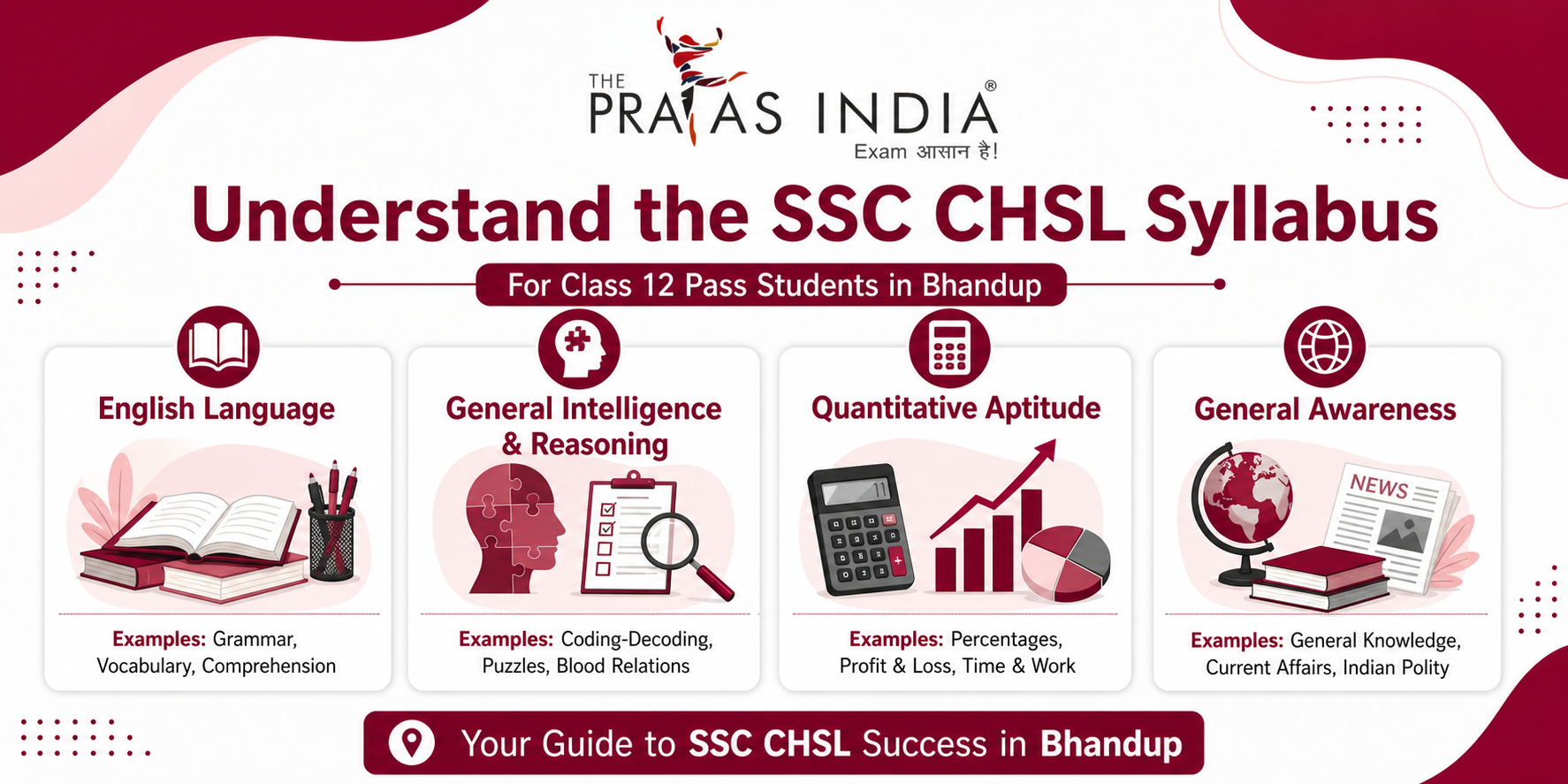
Your preparation should cover the main subject areas tested in the computer-based examination:
- English Language: Grammar, vocabulary, comprehension and sentence-based questions.
- General Intelligence: Analogies, series, coding-decoding, classification and other reasoning topics.
- Quantitative Aptitude: Arithmetic, percentages, ratios, averages, profit and loss, time and work, and other prescribed topics.
- General Awareness: History, geography, polity, economics, science and current affairs.
Make a topic checklist from the latest official syllabus. Mark each topic as not started, in progress or revised so you can track your progress.
Build a Realistic Daily Study Timetable
A consistent timetable helps you prepare without feeling overwhelmed. Instead of studying every subject randomly, assign specific time slots to learning, practice and revision.
If you are studying full-time, you may begin with four to six focused hours a day and adjust according to your progress. If you attend college or have other responsibilities, shorter, consistent study sessions can also work.
Example daily timetable:
| Study session | Suggested activity |
|---|---|
| 60 minutes | Quantitative Aptitude concepts and questions |
| 45 minutes | English grammar and vocabulary |
| 45 minutes | Reasoning practice |
| 30 minutes | General Awareness and current affairs |
| 45 minutes | Timed practice or previous-year questions |
| 15 minutes | Review mistakes and plan revision |
Treat this as a flexible starting point rather than a fixed rule. Take short breaks and review your weekly progress. Spend more time on subjects where your practice results show a clear weakness.
Strengthen Mathematics from the Basics
For many students, Quantitative Aptitude becomes challenging when basic arithmetic concepts are unclear. Build a strong foundation before relying on shortcuts.
Start with number systems, simplification, fractions, decimals, percentages, ratios and averages. Then progress to profit and loss, interest, time and work, time and distance, and other topics in the official syllabus.
Use this method for each topic:
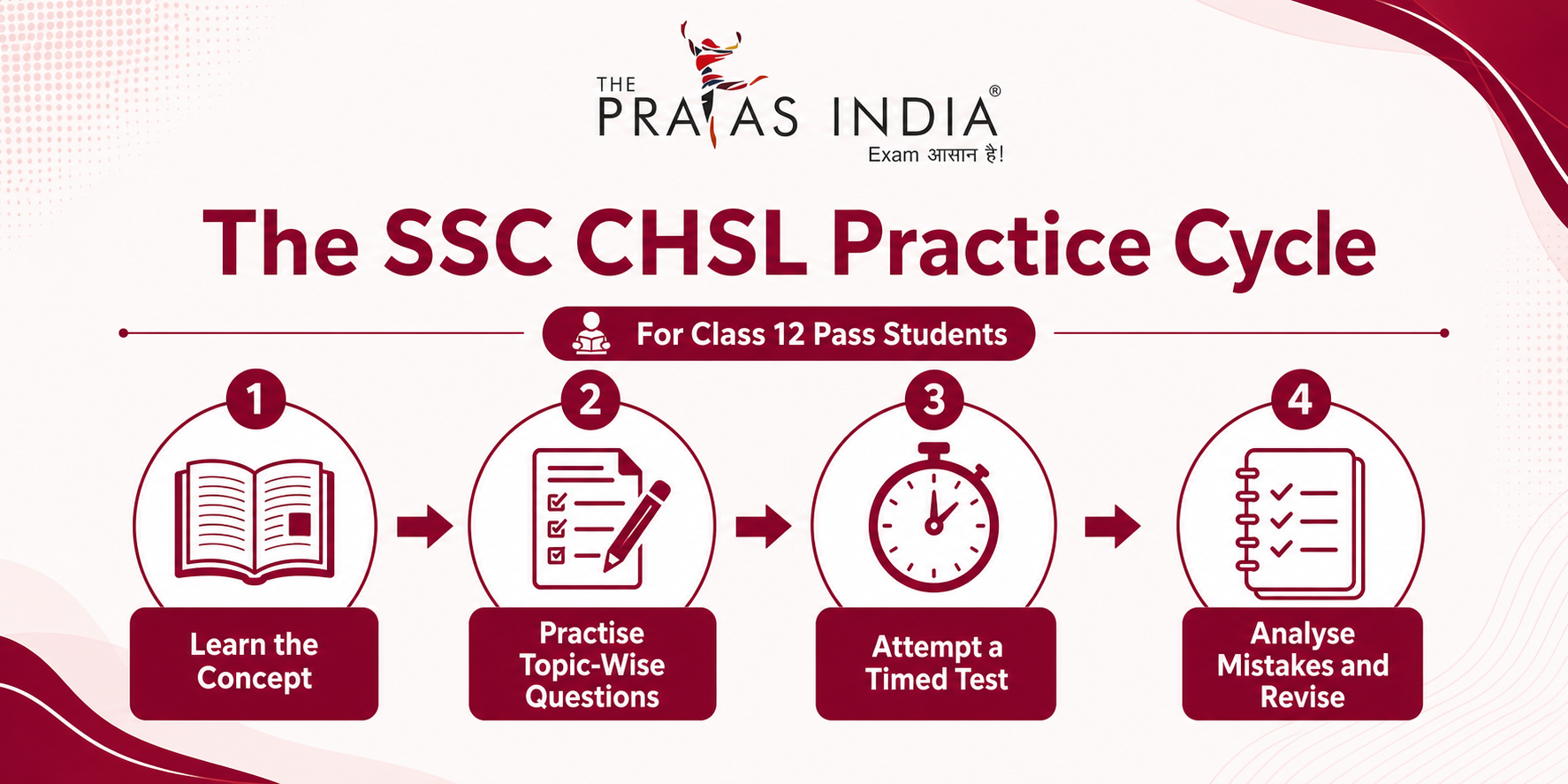
- Understand the basic concept and formulas.
- Solve a few examples without looking at the solution.
- Practise easy questions before attempting difficult ones.
- Attempt a timed set once you understand the method.
- Record mistakes and revise the topic after a few days.
Accuracy should come before speed. As your understanding improves, timed practice can help you solve questions more efficiently.
4. Improve Reasoning and English with Daily Practice
Reasoning and English can improve through regular, topic-wise practice. Avoid leaving either subject until the final weeks.
For Reasoning, practise series, analogy, classification, coding-decoding, directions, blood relations and other topics specified in the syllabus. Focus on recognising patterns and understanding why an answer is correct.
For English, revise grammar rules, learn vocabulary in context, practise sentence correction and solve comprehension questions. Keep a notebook of unfamiliar words and common grammar errors.
A practical approach is to practise a small set of questions every day, check your answers and revisit the questions you got wrong. Consistency is more useful than doing a large number of questions without reviewing them.
5. Prepare General Awareness in Small, Regular Sessions
General Awareness covers a broad range of topics, so regular revision is important. Begin with static general knowledge, including basic history, geography, Indian polity and general science, according to the official syllabus.
Follow reliable current-affairs resources and maintain concise notes. Avoid collecting information from too many sources, as this can make revision difficult.
Set aside a short daily session for learning and schedule weekly revision. Practise objective questions to check what you remember rather than relying only on reading.
6. Solve Previous-Year Papers and Take Mock Tests
Previous-year question papers help you become familiar with question styles and the level of difficulty. Mock tests provide an opportunity to practise under timed conditions.
Start topic-wise tests when you begin a subject. Once you have covered a reasonable portion of the syllabus, add full-length mock tests based on the current examination format.
After every test, review:
- Questions answered incorrectly
- Questions that took too long
- Topics where concepts are unclear
- Avoidable calculation or reading errors
- Questions you guessed without sufficient confidence
Maintain an error notebook and revisit the same concepts before attempting similar questions again. Taking a mock test is useful, but analysing your performance is what helps you plan the next stage of preparation.
Follow a Simple 12-Week Preparation Plan
A weekly plan gives you a clear direction and makes it easier to identify gaps in your preparation. Adjust this schedule to your starting level and the time remaining before your exam.
| Preparation phase | Main focus |
|---|---|
| Weeks 1–4 | Learn fundamentals and cover core topics |
| Weeks 5–8 | Continue syllabus coverage, practise topic-wise questions and solve previous-year papers |
| Weeks 9–10 | Revise weak topics and increase timed practice |
| Weeks 11–12 | Take mock tests, analyse errors and revise important concepts |
This is an illustrative plan, not an official SSC schedule. If your basics are weak, give yourself more time for concepts. If you have already completed the syllabus, focus more on revision and test analysis.
Avoid Common SSC CHSL Preparation Mistakes
Students can lose valuable preparation time by following an unstructured routine. Watch out for these common mistakes:
- Using too many resources: Choose a small number of reliable study resources and revise them consistently.
- Ignoring weaker subjects: Divide your time according to your needs instead of studying only favourite topics.
- Memorising shortcuts too early: Understand the method first, then practise faster approaches.
- Skipping mock-test analysis: Review every test to understand the reason behind errors.
- Neglecting revision: Revisit older topics so that previously learned concepts remain fresh.
- Relying only on coaching: Use classes as guidance and reserve time for independent practice.
Your preparation strategy should be realistic, measurable and flexible enough to improve when your results show that something needs to change.
Should 12th-Pass Students Join SSC CHSL Coaching in Bhandup?
Coaching may be helpful if you need structured lessons, a fixed routine, guidance on difficult topics or a planned approach to practice and revision. Students who are comfortable studying independently may prefer self-study supported by official resources and mock tests.
Before joining an institute, ask about syllabus coverage, teaching methods, batch timings, study materials, doubt-solving support, mock tests and course fees. Confirm current course details before enrolling.
If you are exploring SSC CHSL coaching in Bhandup, The Prayas India is a local option you can contact to enquire about relevant programmes and available batches. Consider whether the course suits your learning style, schedule and preparation needs before making a decision.
Start Your SSC CHSL Preparation with a Clear Goal
Passing Class 12 is the starting point for your SSC CHSL preparation journey. A practical study timetable, strong fundamentals, daily practice, regular revision and careful mock-test analysis can help you prepare systematically.
Begin by reviewing the latest official syllabus, identifying your weak subjects and setting weekly targets. Track your progress and adjust your routine as you improve.
For students searching for SSC CHSL coaching in Bhandup, Mumbai, choosing the right preparation support can help bring structure to the process. Stay consistent, measure your progress and focus on improving one topic at a time.
Ready to explore SSC coaching options in Bhandup? Contact The Prayas India to enquire about current courses and batch details.
Frequently Asked Questions About SSC CHSL Preparation in Bhandup
1. Can 12th-pass students prepare for SSC CHSL?
Yes. Students who meet the educational qualification and other eligibility conditions in the applicable SSC CHSL notification can apply. Always check the latest official notification for age limits, qualification requirements and other conditions.
2. How many hours should I study daily for SSC CHSL?
Your study hours depend on your current preparation level and daily schedule. Begin with a realistic routine that covers all subjects, practice, revision and mock-test analysis, then adjust it according to your progress.
3. Which subjects should I study for SSC CHSL?
Preparation generally covers English Language, General Intelligence, Quantitative Aptitude and General Awareness. Check the latest official SSC CHSL syllabus and examination pattern for the applicable requirements.
4. Are mock tests important for SSC CHSL preparation?
Yes. Mock tests help you practise time management, assess your preparation and identify weak topics. Reviewing incorrect answers after each test is an important part of improvement.
5. Should I join SSC CHSL coaching in Bhandup?
Coaching may help if you need structured lessons, a regular timetable and guidance with difficult topics. Compare course coverage, faculty support, mock tests, fees and timings before enrolling.
6. How can I enquire about SSC coaching at The Prayas India Bhandup?
Visit The Prayas India Bhandup website or view the branch on Google Maps to find the location and enquire about available courses.
Start Your SSC CHSL Preparation in Bhandup
Are you a Class 12 pass student planning to prepare for SSC CHSL? Contact The Prayas India – Bhandup to enquire about available SSC coaching programmes, course details, batch timings and preparation support. Build a consistent study routine and take the next step towards your competitive exam goals.
Institute: The Prayas India – Bhandup
Enquiry: +91 77100 13217
Learn more about our branch: The Prayas India – Bhandup