Strait of Malacca – A Comprehensive UPSC-Oriented Analysis
- GS Paper 1: Physical Geography, Ocean Geography, World Geography
- GS Paper 3: Maritime Security, Marine Resources, Disaster Management, Environment
- Prelims: Straits, Sea Routes, Trade Geography, Map-based Questions
- Geography Optional: Oceanography, Geopolitics of Sea Lanes, Transport Geography, Regional Geography of Southeast Asia
Introduction
The Strait of Malacca is one of the world’s most strategic and heavily trafficked maritime chokepoints. Located between Peninsular Malaysia and the island of Sumatra (Indonesia), and extending southward toward Singapore, it forms a vital corridor linking the Indian Ocean with the South China Sea and onward to the Pacific Ocean.
It is the shortest sea route between the Middle East and East Asia, making it central to global trade, oil supply chains, and Indo-Pacific geopolitics. For India, the strait holds immense relevance within the Look East / Act East Policy, ensuring connectivity toward Southeast Asia and monitoring the security of Indian Ocean shipping routes.
Location & Geographic Extent
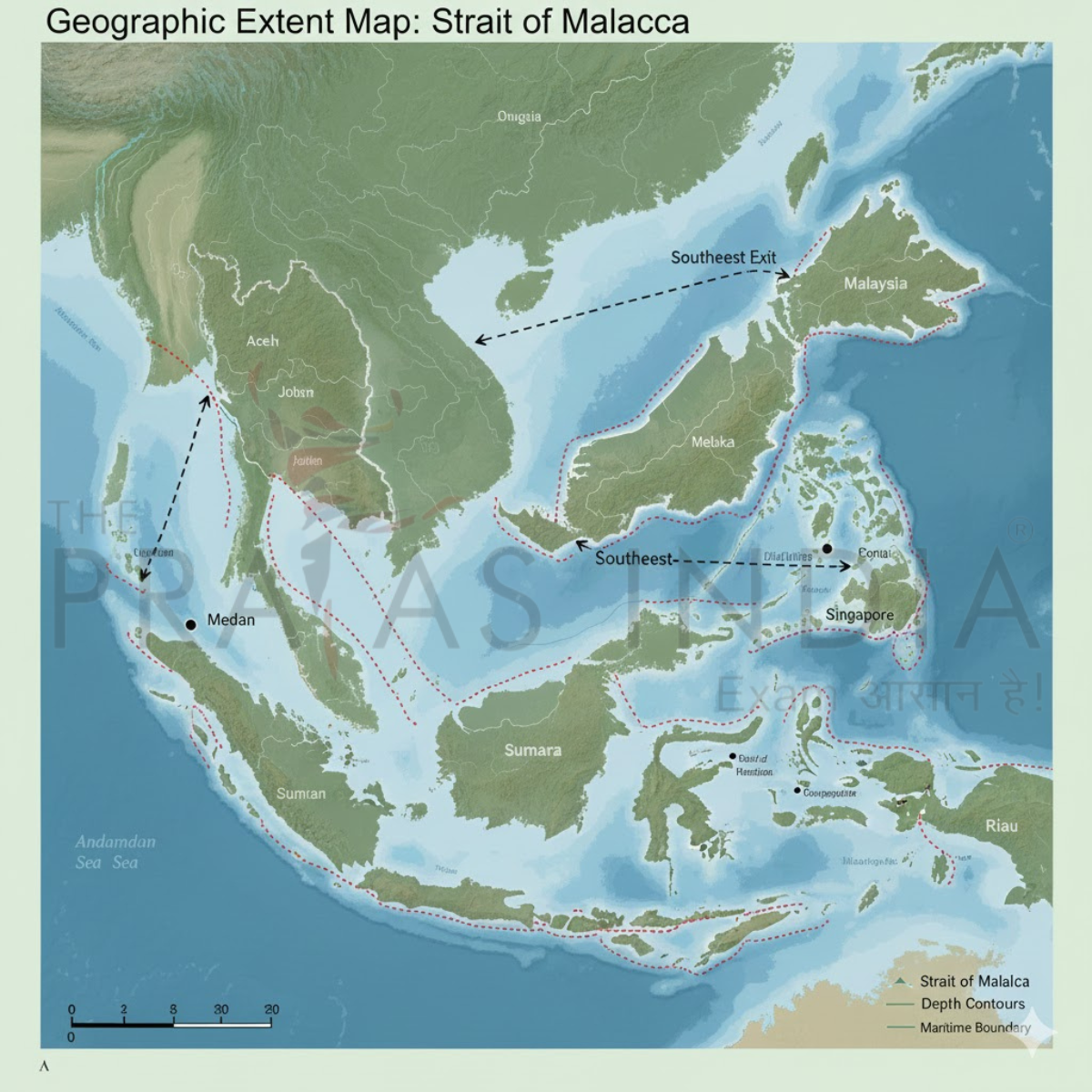
The Strait of Malacca stretches approximately 930 km from the northern entrance near Great Nicobar Island and the Andaman Sea to the southern exit near the Strait of Singapore. It is one of the narrowest international shipping routes, with the narrowest width being 2.8 km at Phillips Channel.
It connects:
-
Indian Ocean → Andaman Sea → Strait of Malacca → South China Sea → Pacific Ocean
This makes it a maritime equivalent of a “global economic artery.”
Adjacent Seas:
- Andaman Sea (west)
- Strait of Singapore (south)
- South China Sea (east)
Physical Geography & Morphology
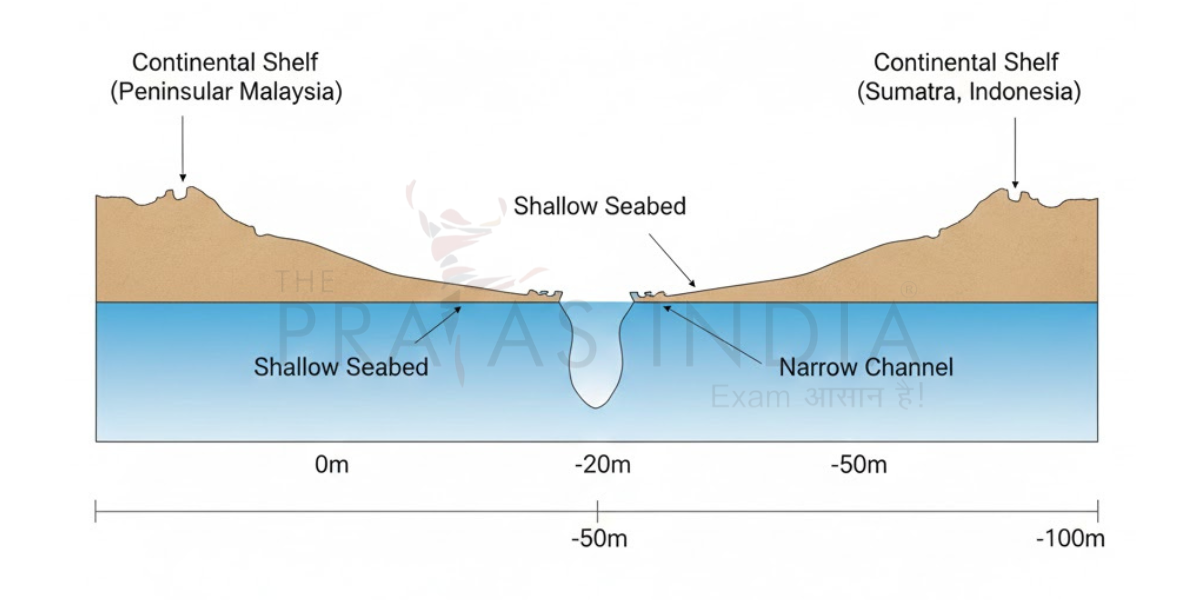
The strait is remarkably shallow, with an average depth of around 25 meters. In some places, especially close to Malaysia’s west coast and near Indonesia’s east coast, extensive siltation reduces depth further, creating challenges for deep-draft vessels.
Important geographical features include:
- Narrow channels such as Phillips Channel and One Fathom Bank
- Coastal urban centers with extensive reclamation
- Surrounding islands:
- Penang and Langkawi (Malaysia)
- Great Karimun, Rupat, and Rangsang (Indonesia)
The seabed is dominated by sediments brought by rivers from Sumatra and Malaysia, creating shoals and sandbanks.
Geological & Tectonic Setting
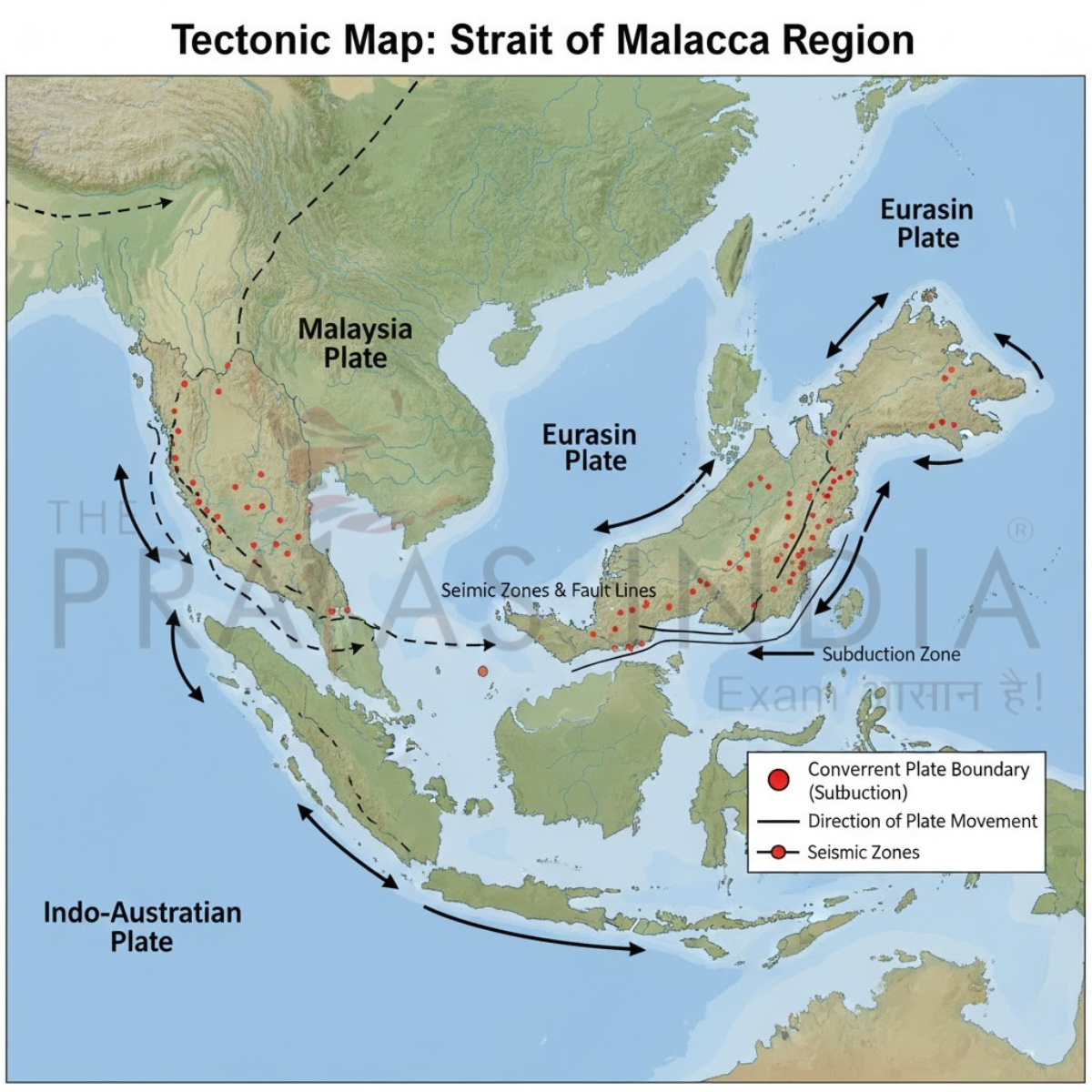
The strait lies adjacent to the Sunda Plate, a microplate bordered by the highly active Indo-Australian Plate.
Key tectonic features:
- Sumatra Subduction Zone (one of the world’s most active)
- Sumatra Trench (major source of megathrust earthquakes)
- Influence of Nicobar–Andaman subduction
- Tsunami vulnerability, notably during the 2004 Indian Ocean Tsunami, when waves redirected into the strait affected coastline settlements.
The region remains seismically sensitive due to ongoing plate interactions.
Oceanographic Features
a. Currents
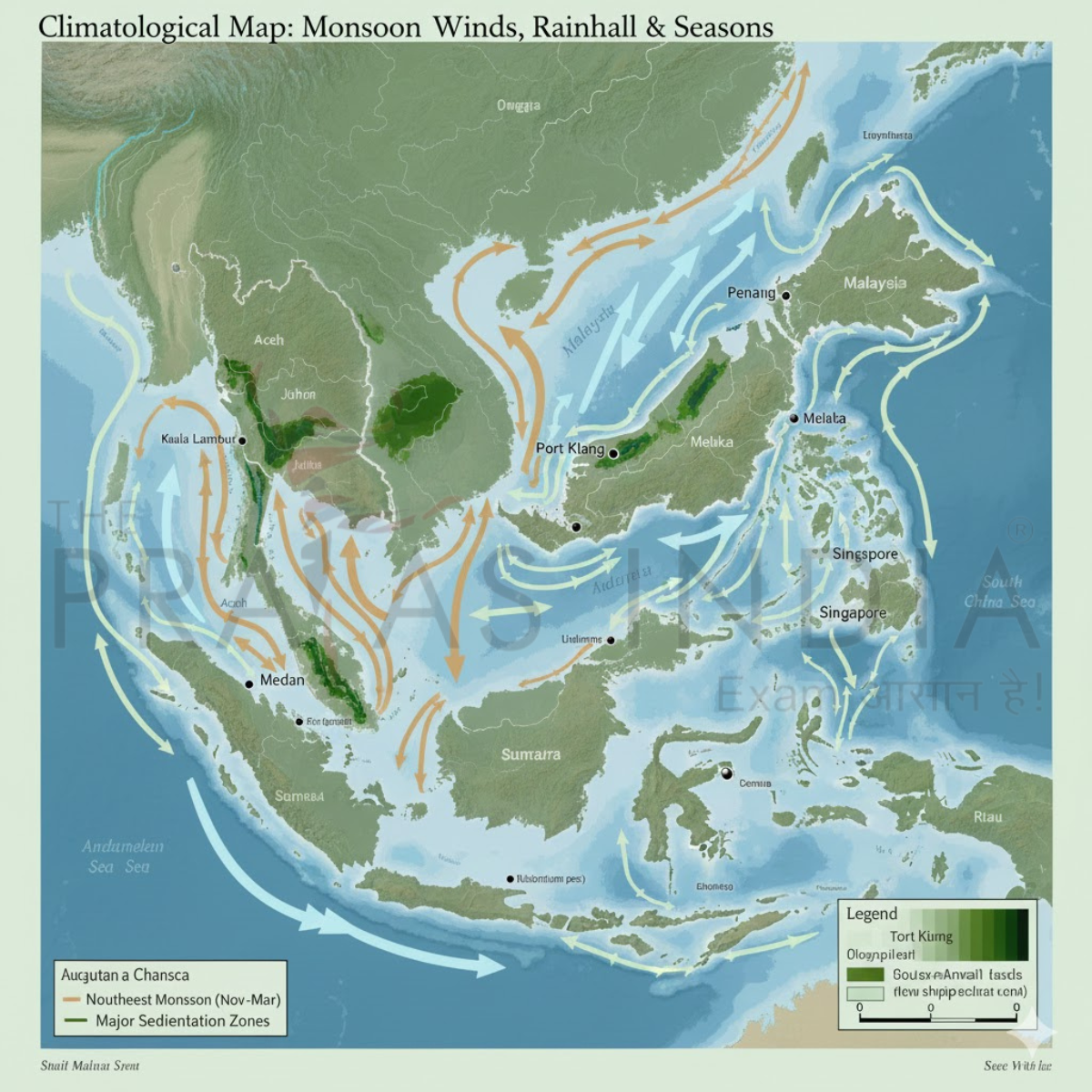
The oceanographic circulation in the strait is driven by:
- Southwest monsoon (June–Sept):
North-to-south currents - Northeast monsoon (Nov–Feb):
South-to-north flow
The strait also receives current influence from the Andaman Sea gyre, contributing to sediment transport.
b. Tides
The region experiences semi-diurnal tides, creating strong tidal flows especially near the narrow southern sections. Tides influence:
- Anchorage positioning
- Port operations
- Navigation in shallow channels
c. Sedimentation
High sediment deposition originates from:
- West Sumatran rivers
- Malaysia’s west-coast river systems
- Coastal erosion
This affects navigability and requires frequent dredging, particularly near port entry points.

Climate & Weather Patterns
The Strait of Malacca displays a tropical equatorial climate, characterized by:
- High temperatures (~26–32°C)
- Heavy rainfall (2500–3000 mm annually)
- High humidity (~75–90%)
Dominant winds:
- Southwest monsoon (wet season for Sumatra, high rainfall)
- Northeast monsoon (dryer for Sumatra, wetter for Malaysia)
The region is cyclone-free, as it lies outside the tropical cyclone belt, though thunderstorms and squalls are common.
Islands, Ports & Coastal Settlements
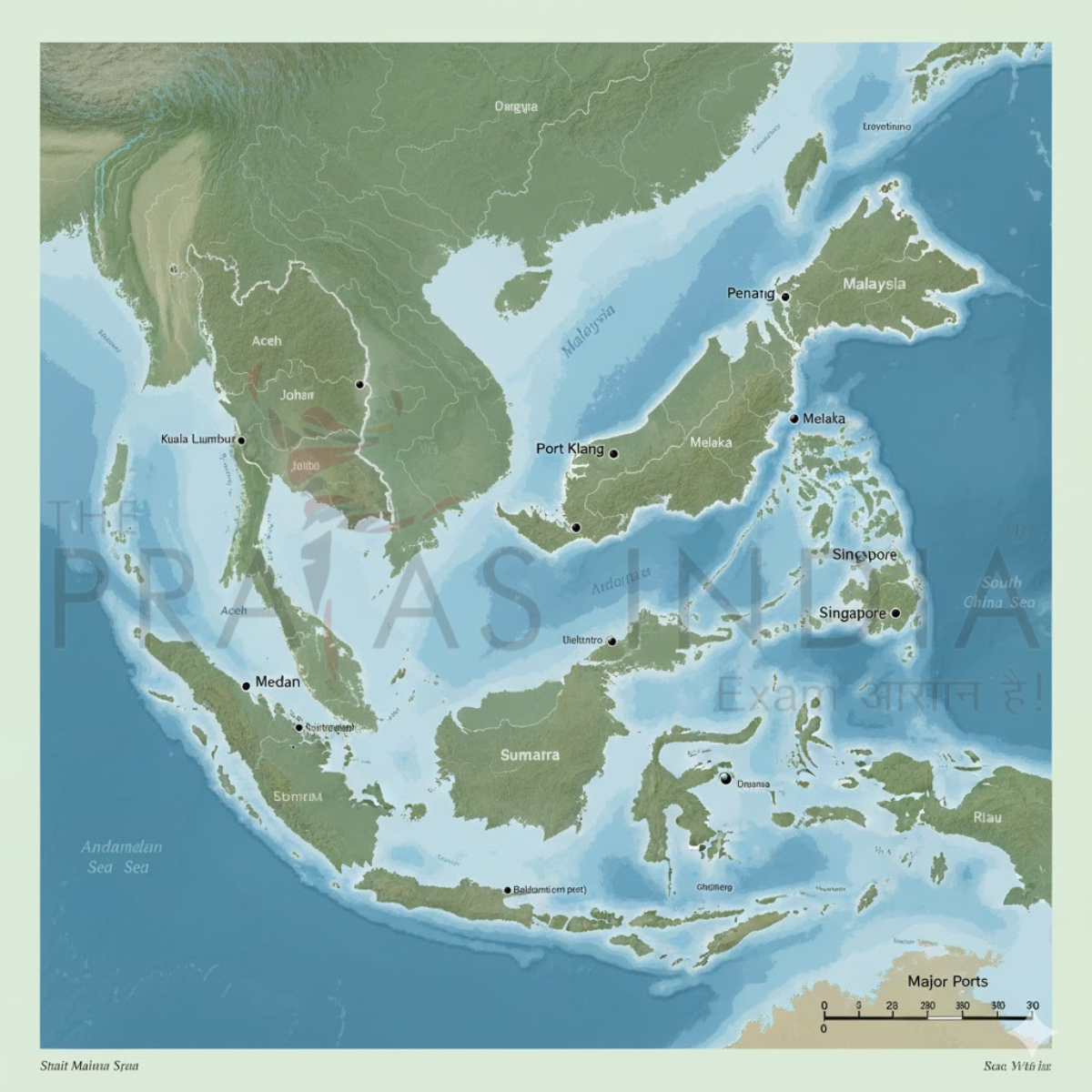
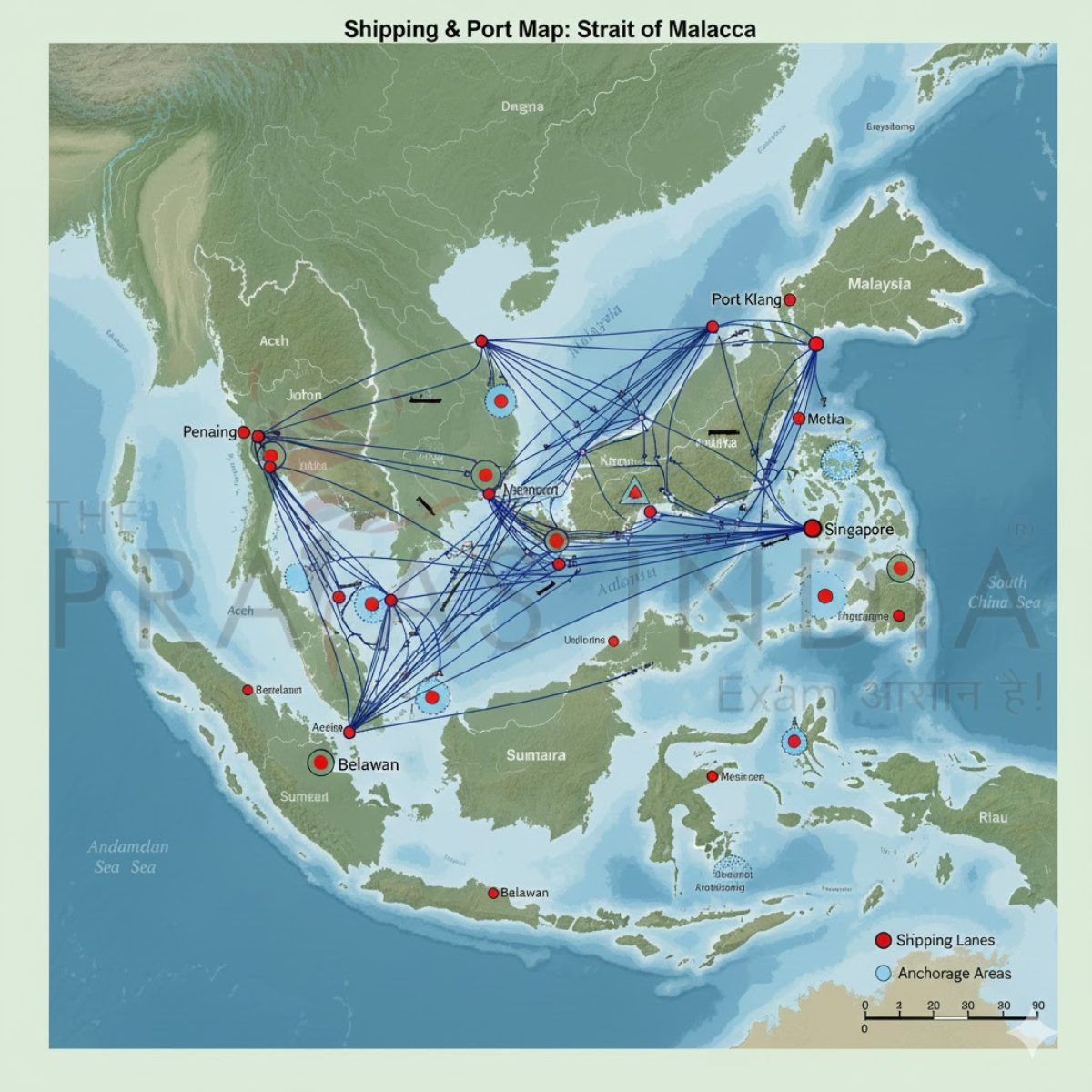
Major Ports
- Singapore – World’s busiest transshipment hub
- Port Klang (Malaysia) – Large container and crude oil terminal
- Penang Port – Regional trade hub
- Belawan Port (Medan, Indonesia) – Exports palm oil and rubber
Coastal Cities
- Malacca City – Historic trading port
- George Town (Penang) – UNESCO Heritage city
- Medan – Major Indonesian metropolis near the northern strait
Strategic Islands
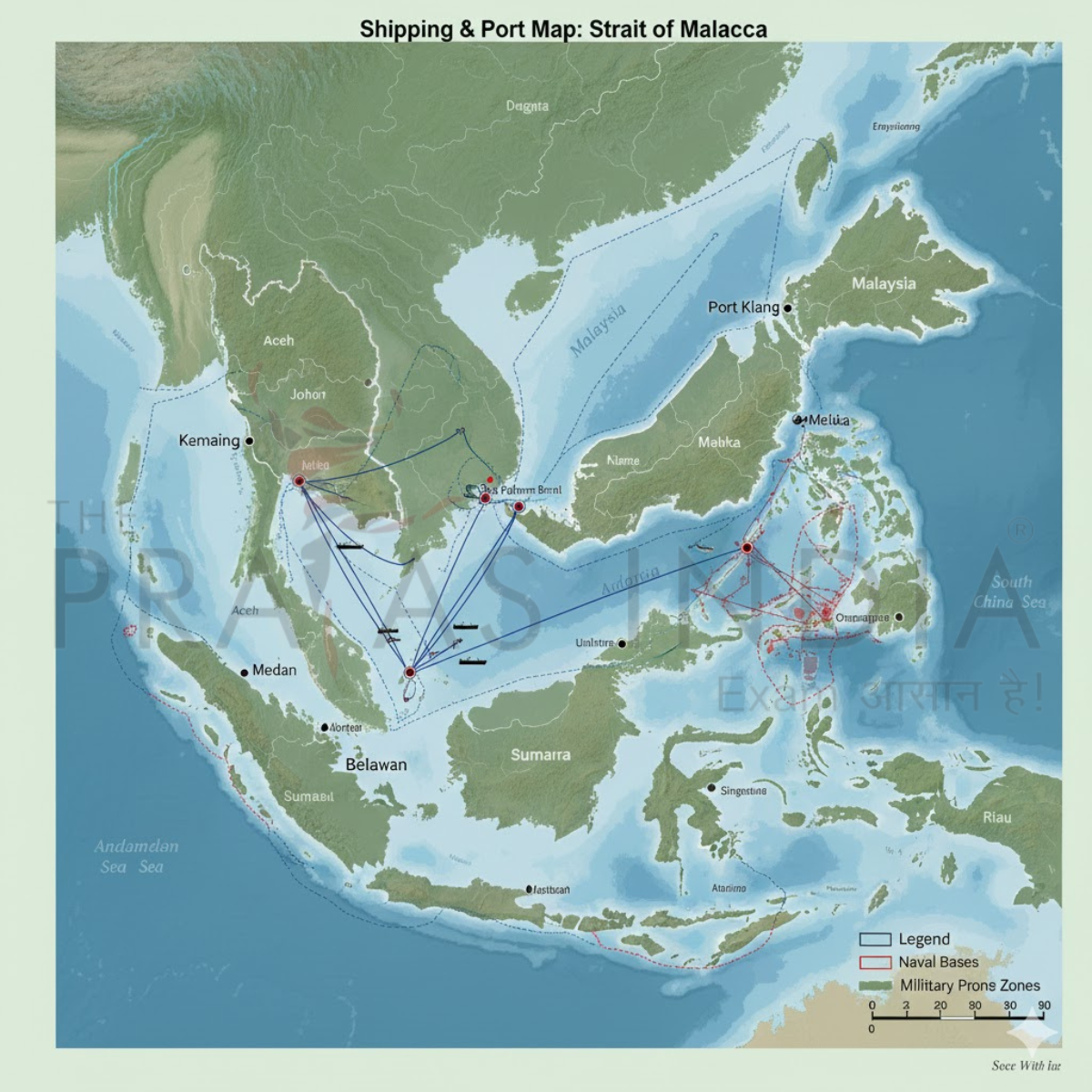
- Andaman & Nicobar Islands (India) – India’s tri-services command presence
- Penang & Langkawi (Malaysia)
- Karimun Besar and Great Karimun (Indonesia)
Biodiversity & Marine Ecosystems
Although heavily used for shipping, the strait hosts diverse ecosystems:
a. Mangroves
- Extensive mangrove belts in Malaysia and Sumatra
- Critical for coastal protection and juvenile fish habitats
b. Coral & Seagrass
- Patchy corals exist near island coasts
- Seagrass beds near Langkawi and northern Sumatra
c. Marine Fauna
- Dolphins, dugongs (rare), sea turtles
- Commercial fish species such as tuna, anchovies, mackerel
The ecological balance is under pressure due to industrialization and maritime pollution.
Economic Importance
a. Global Trade & Shipping
The Strait of Malacca is one of the most critical shipping lanes globally, comparable to:
- Hormuz
- Bab-el-Mandeb
- Panama Canal
Key statistics:
- ~25% of global trade passes through
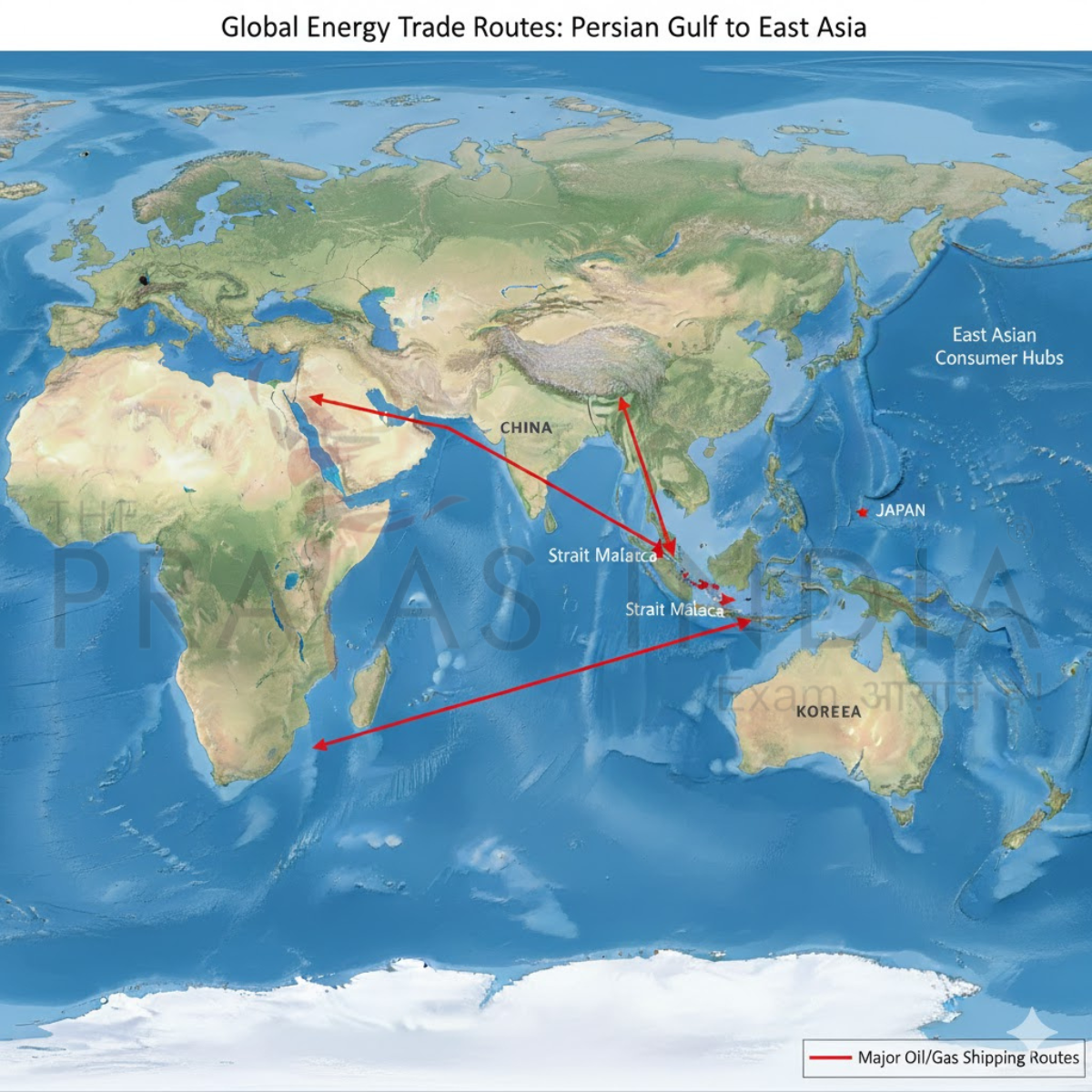
- Most important oil conduit for China, Japan, South Korea
- Handles:
- Crude oil
- LNG
- Manufactured goods
- Container traffic
b. Energy Supply Routes
The Strait of Malacca is the focal point of the Malacca Dilemma—China’s dependence on the strait renders it vulnerable in conflict scenarios.
Japan and South Korea have similar dependencies.
c. Local Economy & Fisheries
- Malaysia’s west-coast fisheries heavily depend on strait waters
- Tourism hubs like Penang and Langkawi attract millions annually
Geopolitical & Strategic Significance
A. India’s Act East Policy
The strait is India’s closest major sea lane to Southeast Asia.
With Andaman & Nicobar Command, India can surveil this chokepoint.
B. The China Factor
The strait is central to:
- China’s Malacca Dilemma
- PLA Navy’s growing Indo-Pacific presence
- Belt and Road Initiative (BRI) land/port projects
C. US, ASEAN & Indo-Pacific Strategy
The US protects freedom of navigation through:
- FONOPS (Freedom of Navigation Operations)
ASEAN states emphasize cooperative security.
D. Piracy & Maritime Crime
Historical piracy levels were high between 1990–2005, leading to cooperative patrols by:
- Indonesia
- Malaysia
- Singapore
Environmental Threats
Key environmental pressures include:
- Oil spills from tankers
- Marine debris and industrial pollution
- Mangrove degradation
- Overfishing and declining fish stocks
- Coral bleaching
- Siltation from upland rivers
Disaster Risks
The strait faces several hazards:
- Tsunamis from Sumatra Subduction Zone
- Maritime accidents due to high traffic
- Storm surges during monsoons
- Haze events from Indonesian forest fires
Ports and coastal settlements are often affected by visibility reduction and respiratory hazards.
Comparison Table
| Parameter | Strait of Malacca | Sunda Strait | Lombok Strait | Taiwan Strait |
|---|---|---|---|---|
| Depth | Very shallow (~25 m avg) | Shallow; volcanic seafloor | Deep; suitable for large vessels | Moderately shallow |
| Width | Narrowest ~2.8 km | Relatively narrow | Broader, less congested | Wide (~180 km) |
| Trade Significance | World’s busiest chokepoint; ~25% global trade | Secondary alternative to Malacca | Major deep-draft shipping route | Key China–Taiwan maritime corridor |
| Naval Use | High congestion; strategic for India, China, US | Used during emergencies & diversions | Preferred for large naval vessels | Critical for PLA Navy & US 7th Fleet |
| Vulnerability | Piracy, accidents, oil spills, chokepoint risk | Volcanic activity (Krakatoa), tsunamis | Earthquakes & deep-water turbulence | High geopolitical & military tension |
FAQs on the Strait of Malacca
1. What is the Strait of Malacca?
The Strait of Malacca is a narrow maritime passage between the Malay Peninsula (Malaysia) and the Indonesian island of Sumatra. It is one of the busiest shipping lanes in the world.
2. Why is the Strait of Malacca strategically important?
It connects the Indian Ocean to the South China Sea and the Pacific Ocean, making it the shortest sea route between West Asia/Africa and East Asia. This reduces travel time for global trade, especially oil shipments.
3. Which countries border the Strait of Malacca?
Three countries share the strait:
- Malaysia
- Indonesia
- Singapore (southern entrance area)
4. How much of global trade passes through the Strait of Malacca?
Nearly 25% of global traded goods and around 60% of China’s oil imports pass through this route annually.
5. Why is the Strait of Malacca a choke point?
Because it is a narrow, shallow, and extremely busy maritime passage. Any disruption—accident, piracy, conflict, or blockade—could affect global shipping and energy supplies.
6. What is the “Malacca Dilemma”?
It refers to China’s strategic vulnerability due to its dependence on this narrow route for energy imports. Any blockade could threaten China’s economy and security.
7. What are the major security concerns in the Strait of Malacca?
- Piracy and armed robbery
- Maritime accidents due to congestion
- Smuggling and trafficking
- Potential geopolitical conflicts
- Environmental risks (oil spills)
8. Is piracy still a major issue in the Strait of Malacca?
Yes, although piracy incidents have reduced significantly due to joint patrols by Malaysia, Indonesia, Singapore, and Thailand, it still remains an area of concern.
9. What is the depth of the Strait of Malacca?
The shallowest point (near Singapore) is around 25 meters, creating limitations for ultra-large oil tankers.
10. How does India benefit from the Strait of Malacca?
India’s strategic presence in the Andaman & Nicobar Islands allows monitoring of this vital maritime route. It helps India ensure trade security and maintain a regional strategic balance.
11. What alternatives exist to the Strait of Malacca?
- Lombok Strait (Indonesia)
- Sunda Strait (Indonesia)
However, both are longer and less economically efficient for large-scale shipping.
12. How does the Strait of Malacca impact global energy security?
Since much of the oil from the Middle East to East Asia passes through it, any disruption can raise global fuel prices and affect supply chains worldwide.
13. What environmental concerns exist in the Strait of Malacca?
- Oil spills
- Coral reef degradation
- Coastal erosion
- Marine pollution from ships
14. Which major ports lie along the Strait of Malacca?
- Port Klang (Malaysia)
- Penang Port (Malaysia)
- Port of Tanjung Pelepas (Malaysia)
- Port of Belawan (Indonesia)
- Port of Singapore (near entrance)
15. Why is the Strait of Malacca important for UPSC?
Because it overlaps with topics like:
- World Geography
- Indian Ocean Region (IOR)
- Trade routes
- India’s maritime strategy
- Geopolitics involving China, ASEAN, Japan, and India
Conclusion
The Strait of Malacca stands as one of the world’s most vital maritime arteries—geographically, economically, and strategically. Its shallow, narrow waters support massive global trade volumes, linking energy-rich West Asia with manufacturing hubs in East Asia. The strait’s geology, oceanography, and ecosystems highlight both its natural complexity and environmental vulnerability.
For India, Southeast Asia, and the broader Indo-Pacific, the Strait of Malacca is not just a waterway but a critical geopolitical fulcrum. Its relevance for UPSC GS I, GS II, GS III, maritime security, international relations, and geography optional remains extremely high.