Sympathy, Empathy and Compassion: Conceptual Meaning, Social Significance and Contemporary Relevance
- GS Paper 1: Indian Society, Social Values, Social Change
- GS Paper 4: Ethics, Integrity & Aptitude (Attitudes, Emotional Intelligence, Compassion)
- Essay Paper: Social values, Humanism, Ethics in public life
- Prelims: Basic social concepts (conceptual clarity)
Introduction
Human societies are sustained not merely by laws, institutions, or economic arrangements, but by shared moral sentiments that bind individuals into a collective moral community. Emotions such as care, concern, and understanding play a crucial role in fostering social cohesion, reducing conflict, and promoting humane behavior. In this context, values like sympathy, empathy, and compassion acquire deep significance.
These values act as moral bridges between individuals, enabling them to recognize suffering, understand others’ perspectives, and respond ethically. While often used interchangeably in common discourse, sympathy, empathy, and compassion are conceptually distinct and represent different levels of emotional depth, cognitive engagement, and moral responsibility. Understanding their differences and relevance is essential not only for personal moral development but also for building inclusive societies and ethical governance.
Conceptual Understanding
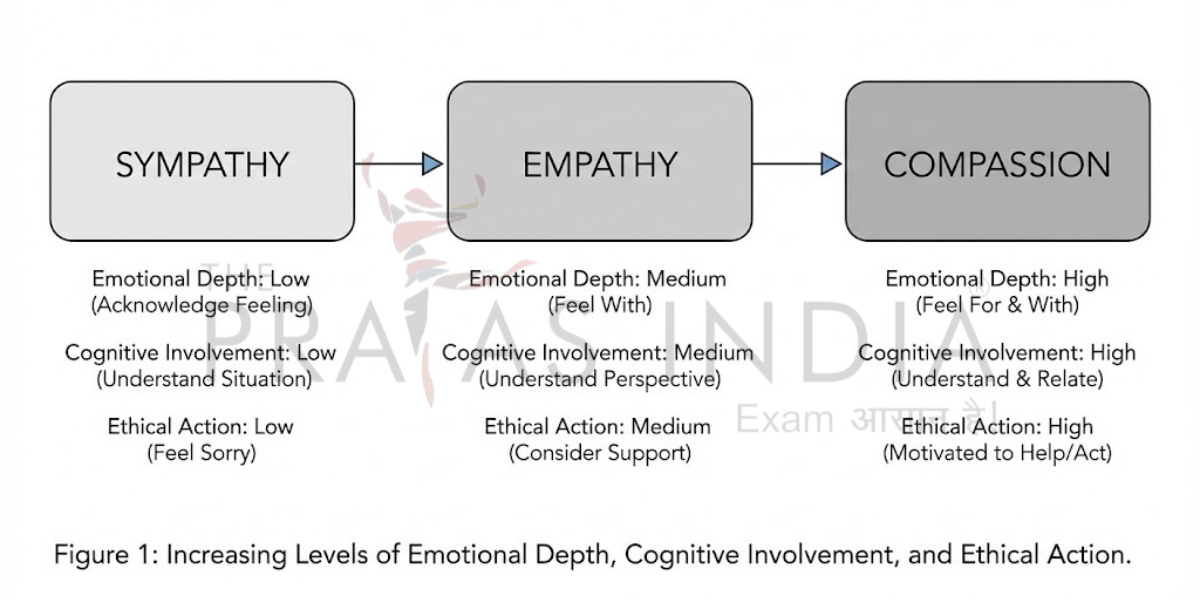
a. Sympathy
Sympathy refers to feeling for someone who is experiencing hardship or suffering. It is an emotional response of concern or pity, usually arising from observing another’s distress.
Sympathy does not require a deep understanding of the other person’s inner world. The observer remains emotionally detached while expressing concern.
Example:
Feeling sad for victims of a flood after watching news coverage, but not fully understanding their lived experience.
Sympathy is important as an initial moral response, but it often remains passive and limited in depth.
b. Empathy
Empathy means feeling with someone. It involves both emotional resonance and cognitive understanding, allowing an individual to place themselves in another person’s situation.
Empathy requires:
- Perspective-taking
- Emotional attunement
- Conscious effort to understand lived experiences
Unlike sympathy, empathy reduces emotional distance and helps individuals grasp the structural or contextual causes of suffering.
Example:
Understanding the psychological trauma of migrant workers during a lockdown by imagining their uncertainty, fear, and displacement.
Empathy forms the foundation of social justice, inclusive policymaking, and ethical leadership.
c. Compassion
Compassion represents the highest moral expression among the three. It combines empathy with a genuine desire to alleviate suffering through action.
Thus, compassion can be understood as:
Empathy + Ethical Responsibility + Action
It is not limited to emotional understanding but extends to moral commitment and proactive intervention.
Example:
Not only understanding the plight of homeless individuals but actively supporting shelters, policy reforms, or social initiatives to help them.
Compassion transforms moral awareness into social change and institutional reform.
Key Differences Between Sympathy, Empathy and Compassion
| Aspect | Sympathy | Empathy | Compassion |
|---|---|---|---|
| Emotional Depth | Shallow | Deep | Deepest |
| Cognitive Involvement | Minimal | High (perspective-taking) | High |
| Action Orientation | Passive | Limited | Strong and active |
| Moral Responsibility | Low | Moderate | High |
| Social Impact | Awareness | Understanding | Transformation |
Sociological Perspective
From a sociological standpoint, these values are essential for maintaining social order and integration.
- Durkheim’s concept of social solidarity emphasizes shared moral sentiments as the glue holding societies together.
- Empathy enables recognition of inequalities and injustices, forming the basis of social justice movements.
- Compassion underpins welfare societies, where collective responsibility for vulnerable sections is institutionalized.
However, modern societies face a decline in empathy due to:
- Urban anonymity
- Hyper-individualism
- Digital communication reducing face-to-face interaction
This erosion weakens community bonds and increases social fragmentation.
Psychological & Ethical Dimensions
Psychological Perspective
- Empathy is a core component of emotional intelligence, enabling effective interpersonal relationships.
- Moral development theories (Kohlberg) highlight the shift from rule-based morality to principled compassion.
Ethical Perspective
- Buddhist philosophy emphasizes Karuna (compassion) as central to ethical living.
- Gandhian ethics view compassion as inseparable from non-violence (Ahimsa), advocating care even for adversaries.
- Compassion elevates ethics from obligation to moral commitment.
Role in Indian Society
Indian social life has traditionally emphasized compassion through cultural practices and moral teachings.
- Family and community systems function as informal support networks.
- Concepts like Seva, Daan, and Karuna promote altruism and social responsibility.
- During crises such as pandemics, floods, or earthquakes, community kitchens, volunteer groups, and civil society initiatives demonstrate lived compassion.
These practices highlight how compassion compensates for institutional limitations in a developing society.
Relevance in Governance & Public Administration
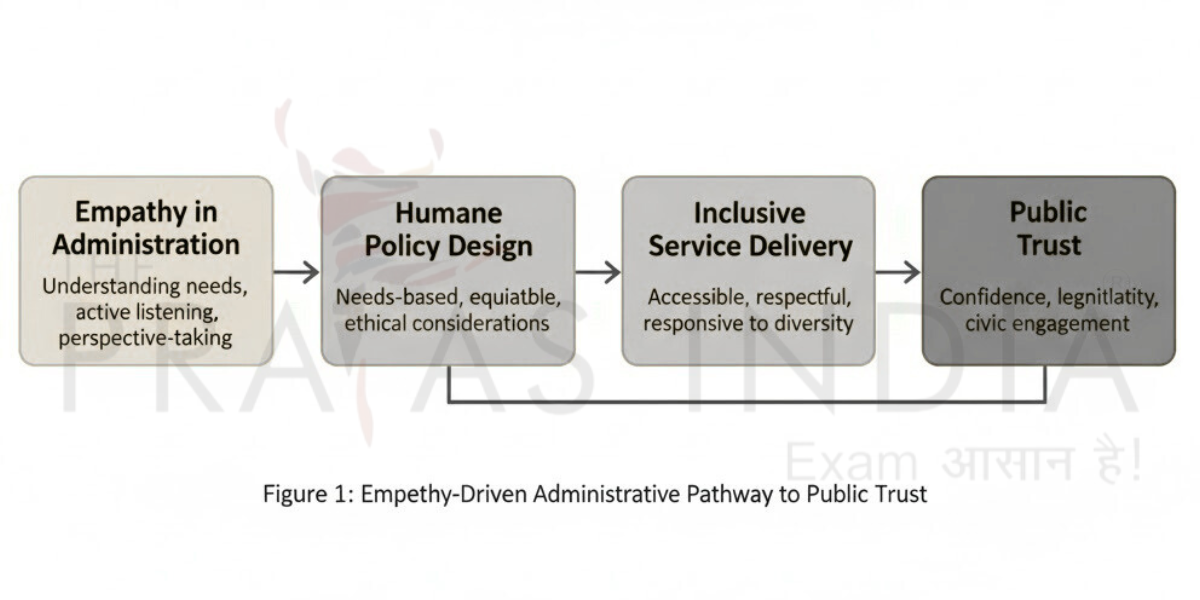
Modern governance increasingly recognizes the importance of empathy and compassion.
- Compassionate governance focuses on human-centric policymaking.
- Empathy enables administrators to understand ground realities beyond statistics.
- Citizen-centric administration improves service delivery in health, education, and welfare sectors.
Empathetic civil servants often demonstrate:
- Sensitivity in implementation
- Inclusiveness in design
- Trust-building with citizens
Such governance strengthens democratic legitimacy and social trust.
Contemporary Challenges
Despite their importance, sympathy, empathy, and compassion face several challenges:
- Compassion fatigue due to continuous exposure to suffering
- Social polarization and ideological rigidity
- Online empathy gap caused by digital detachment
- Media sensationalism reducing genuine concern
- Structural inequalities limiting moral action
These challenges demand conscious cultivation of ethical sensitivity.
Case Studies / Examples
- Community kitchens during disasters
- NGOs working with marginalized groups
- Civil servants adopting humane approaches in crisis management
- Grassroots volunteerism during pandemics
These examples illustrate compassion translating into tangible social outcomes.
Way Forward
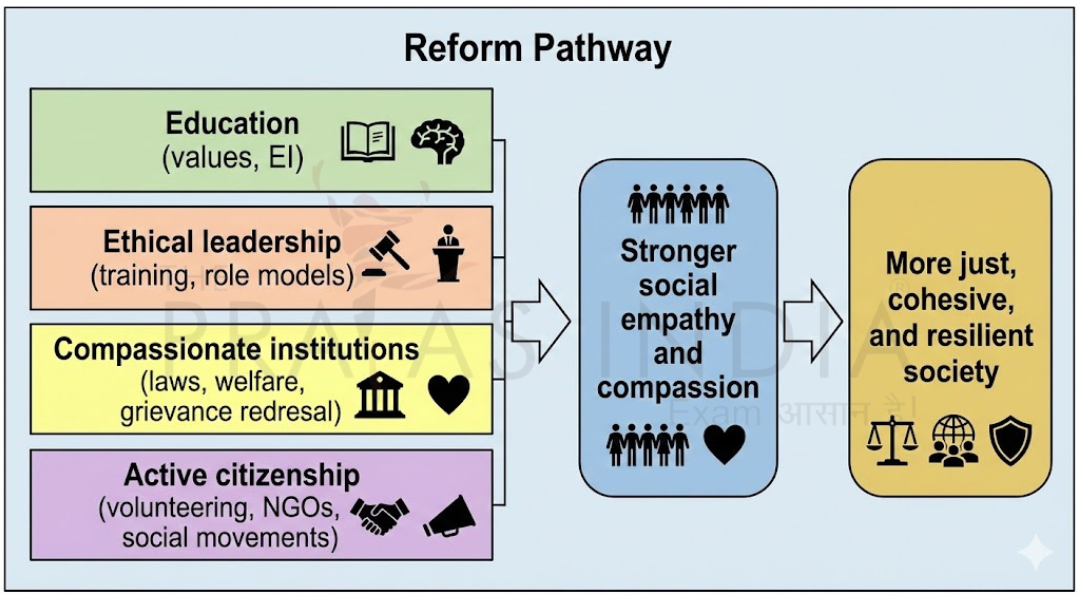
Strengthening sympathy, empathy, and compassion requires deliberate social and institutional efforts. Value education in schools and colleges can use stories, role-plays, and community projects to build perspective-taking and other-regarding attitudes from a young age. Training programmes for public servants and professionals can include modules on emotional intelligence, ethics, and citizen interaction, linking empathy with accountability and transparency.
Institutionalising compassion means designing laws, policies, and procedures that protect dignity, reduce humiliation, and prioritise vulnerable groups, rather than relying only on individual goodwill. Encouraging volunteerism, civic engagement, and participatory governance gives citizens practical avenues to exercise compassion through collective action, thereby deepening democratic culture.
Conclusion
Sympathy initiates moral awareness, empathy deepens understanding, and compassion transforms society through action. In an increasingly complex and divided world, these values are not optional virtues but democratic necessities.
Institutionalizing compassion while nurturing individual ethical development is essential for social harmony, inclusive growth, and humane governance. Ultimately, societies progress not only by economic indicators but by the depth of their moral consciousness.
FAQs on Society – Sympathy, Empathy, and Compassion
Q1. What is the difference between sympathy and empathy?
Sympathy involves feeling concern for another person’s suffering, while empathy involves understanding and sharing the emotions of others through perspective-taking. Empathy is deeper and more cognitively engaged than sympathy.
Q2. Why is compassion considered higher than empathy?
Compassion goes beyond emotional understanding and includes a moral impulse to act in order to reduce suffering. Hence, it represents empathy translated into ethical action.
Q3. How are sympathy, empathy and compassion relevant to governance?
These values enable citizen-centric administration, humane policymaking, inclusive service delivery, and trust-based governance—especially in welfare sectors like health, education, and social justice.
Q4. What is the sociological importance of empathy and compassion?
Empathy strengthens social integration and justice, while compassion sustains welfare societies by encouraging collective responsibility for vulnerable groups.
Q5. How do Indian traditions promote compassion?
Indian traditions emphasize Seva, Karuna, Daan, and Ahimsa, promoting compassion through cultural practices, community service, and ethical living.
Q6. What challenges weaken empathy and compassion in modern society?
Urbanization, digital detachment, social polarization, compassion fatigue, and structural inequalities reduce emotional engagement and ethical responsiveness.
Q7. Why are these values important for GS-IV Ethics answers?
They form the ethical foundation of emotional intelligence, moral leadership, public service values, and are frequently used in case studies and essay questions.