The Aral Sea: A Classic Case Study of Human-Induced Environmental Collapse
- GS Paper 1: Physical Geography, Inland Water Bodies, World Geography
- GS Paper 3: Environment, Climate Change, Water Resources, Sustainable Development
- Prelims: Seas & Lakes, Environmental Degradation, Map-based Questions
- Geography Optional: Environmental Geography, Human–Environment Interaction, Inland Seas
Introduction
The Aral Sea was once a vast inland sea located in Central Asia, forming one of the most significant hydrological features of the Eurasian landmass. Until the mid-20th century, it ranked as the fourth largest lake in the world, covering an area of approximately 68,000 sq km. It supported thriving fisheries, moderated regional climate, and sustained the socio-economic fabric of surrounding communities.
However, within a few decades, the Aral Sea underwent one of the most dramatic environmental collapses in human history, shrinking to a fraction of its original size. Today, it is widely regarded as a man-made ecological disaster, often cited alongside Chernobyl and the Dust Bowl as a warning against unsustainable development.
The Aral Sea thus serves as a classic case study in environmental geography, illustrating the consequences of mismanaged water resources, centralized planning, and lack of ecological foresight.
Location & Extent
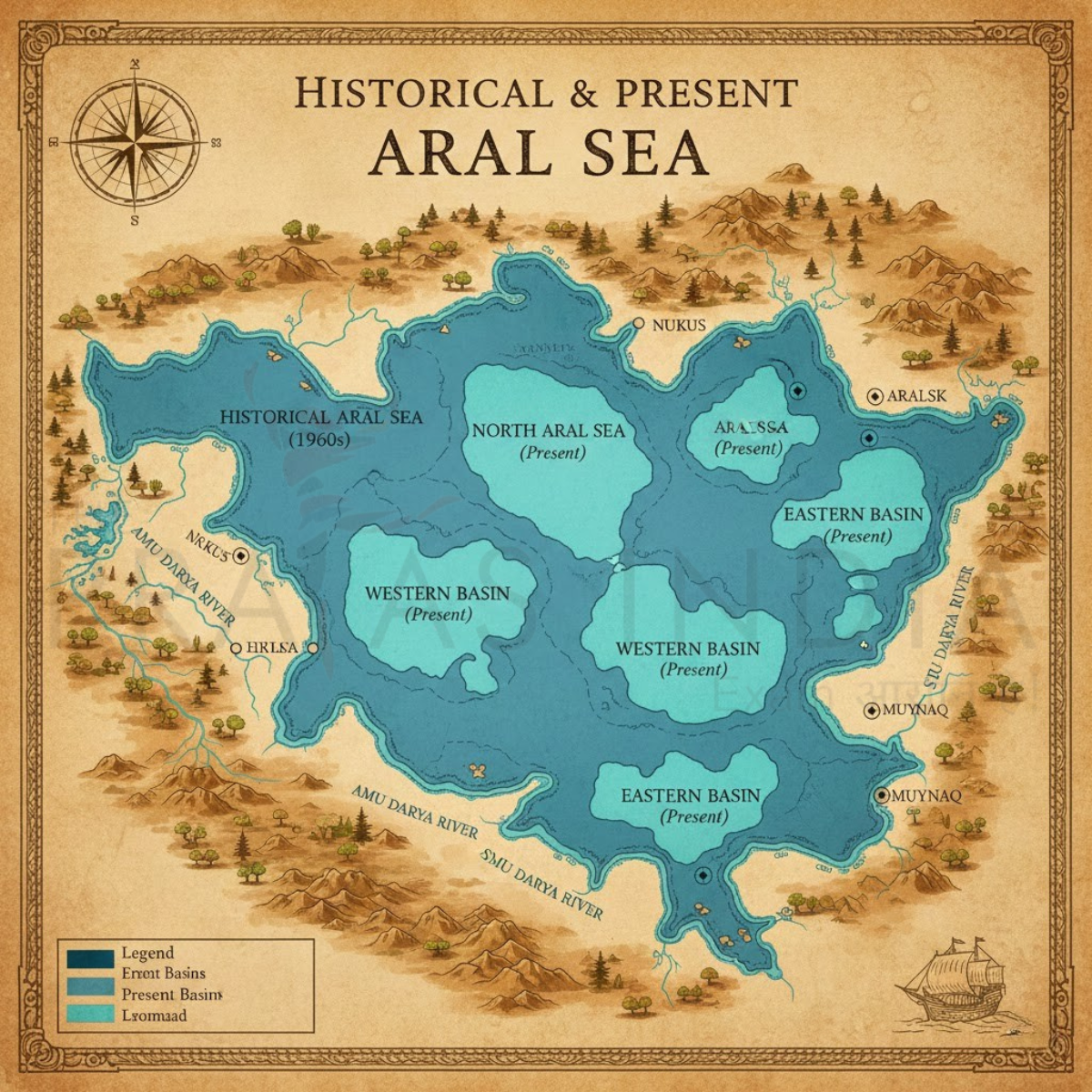
The Aral Sea is situated in Central Asia, lying between:
- Kazakhstan to the north
- Uzbekistan to the south
It occupies a continental interior, far removed from any oceanic influence.
Key locational features:
- Fed primarily by two major rivers:
- Amu Darya (from Pamir Mountains)
- Syr Darya (from Tien Shan Mountains)
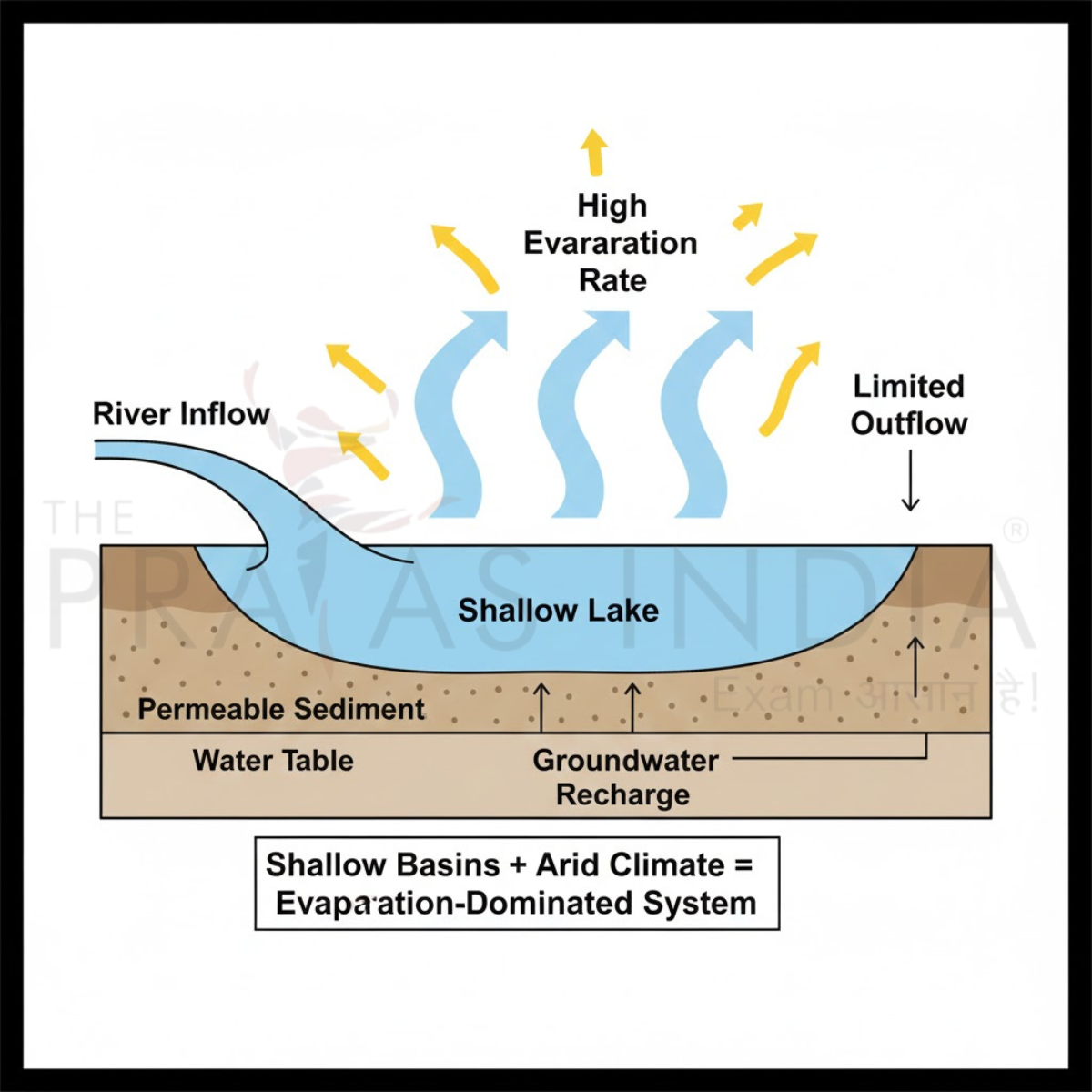
- It is an endorheic basin, meaning:
- No natural outlet to the sea
- Water loss occurs mainly through evaporation
This closed nature made the Aral Sea extremely sensitive to changes in river inflow.
Geological Origin & Basin Characteristics
Geologically, the Aral Sea is a remnant of ancient inland seas that once covered large parts of Central Asia during the Tertiary period. Over time, tectonic stability and aridification led to its isolation.
Basin characteristics:
- Flat and shallow basin
- Average depth historically: 15–16 metres
- Gentle basin slopes → large area loss with small water decline
- Located in a semi-arid to arid climatic zone
High evaporation rates (up to 1 meter annually) meant the sea relied heavily on continuous river inflow for equilibrium.
Hydrology & Water Balance
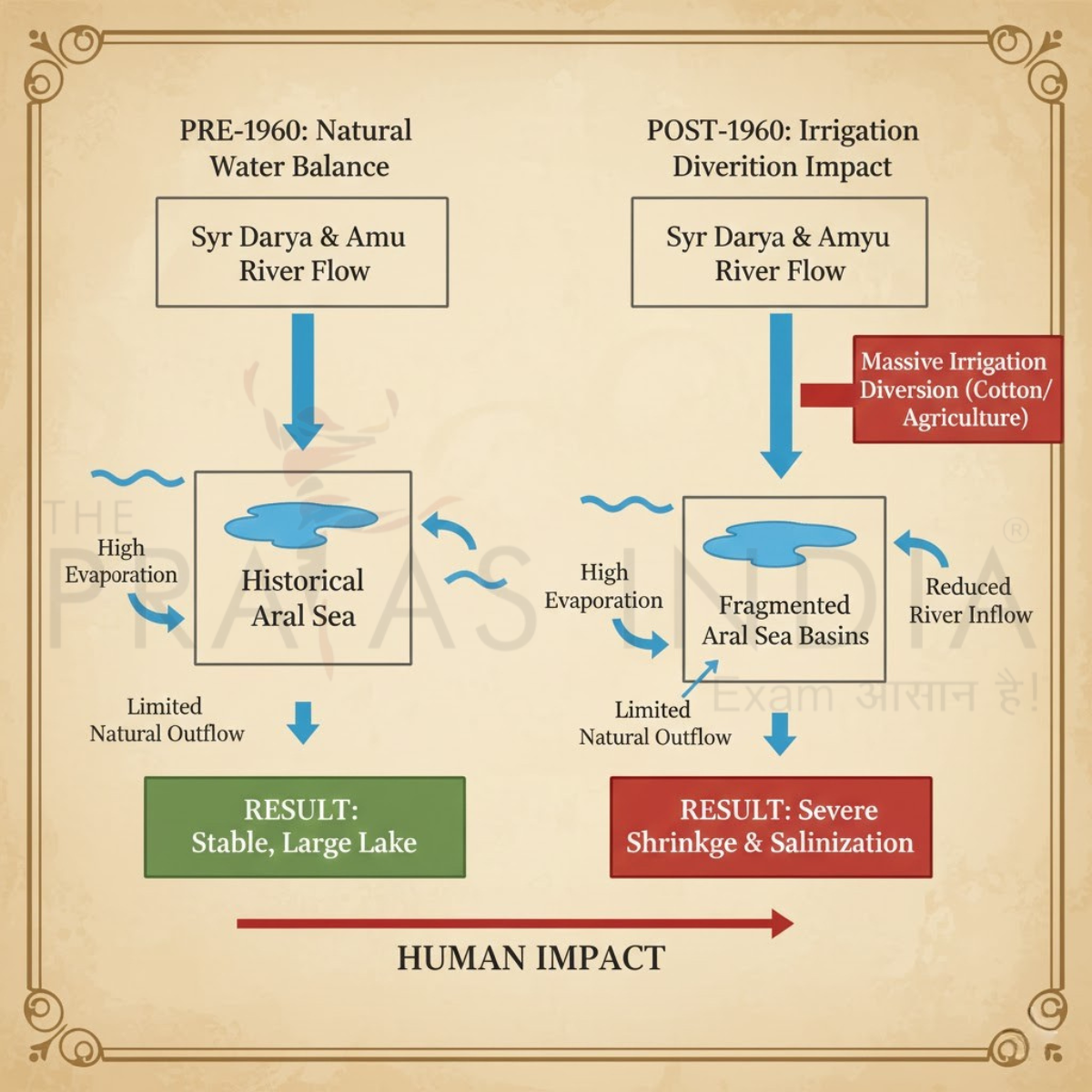
Pre-1960 Hydrological Balance:
- Annual inflow from rivers ≈ 50–60 cubic km
- Evaporation roughly balanced inflow
- Stable salinity (~10 g/L)
Post-1960 Disruption:
During the Soviet era, Central Asia was transformed into a major cotton-producing region. Massive irrigation canals diverted water from:
- Amu Darya
- Syr Darya
Key hydrological impacts:
- Up to 90% river water diverted
- Inflow to Aral Sea reduced drastically
- Water balance collapsed irreversibly
Shrinkage & Fragmentation
By the late 20th century, the Aral Sea experienced rapid physical disintegration:
Stages of fragmentation:
- Split into:
- North Aral Sea (Small Aral) – Kazakhstan
- South Aral Sea (Large Aral) – Uzbekistan
- Further division of South Aral into eastern and western lobes
- Exposure of vast seabed forming the Aralkum Desert
Physical changes:
- Surface area reduced by over 90%
- Volume declined by nearly 95%
- Salinity increased several-fold

Ecological Consequences
The ecological collapse of the Aral Sea was swift and severe.
Aquatic ecosystem collapse:
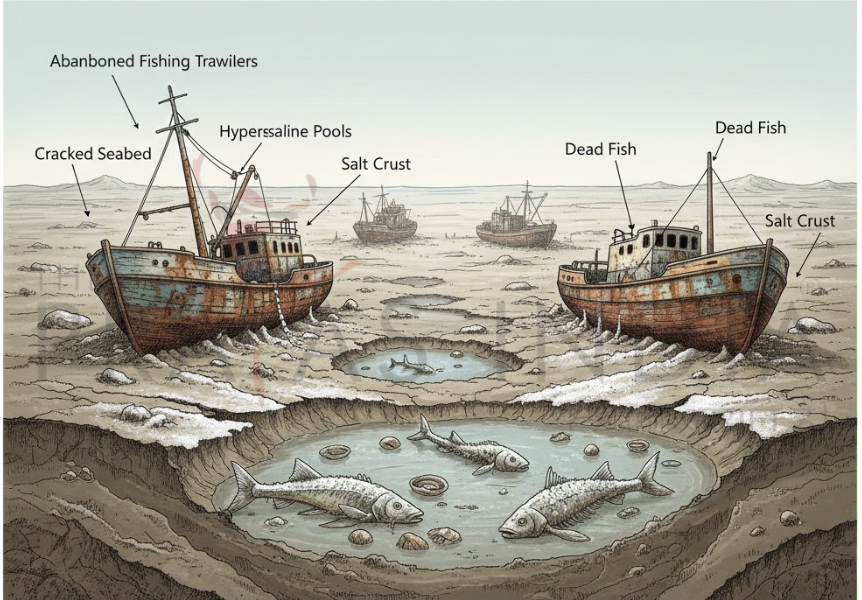
- Extinction of most native fish species
- Total collapse of commercial fisheries
- Loss of planktonic life due to high salinity
Terrestrial impacts:
- Dry seabed exposed toxic sediments
- Salts mixed with:
- Pesticides
- Fertilizers
- Industrial chemicals
Former wetlands, deltas, and reed beds disappeared, destroying habitats for migratory birds.
Climate & Environmental Impact
The disappearance of a large water body altered the regional climate significantly.
Climatic changes:
- Increased continentality
- Hotter summers
- Colder winters
- Reduced humidity and rainfall
Environmental hazards:
- Frequent dust and salt storms
- Airborne particles travel hundreds of kilometres
- Deposition on agricultural land reduces soil fertility
These changes created a feedback loop, worsening aridity and environmental stress.
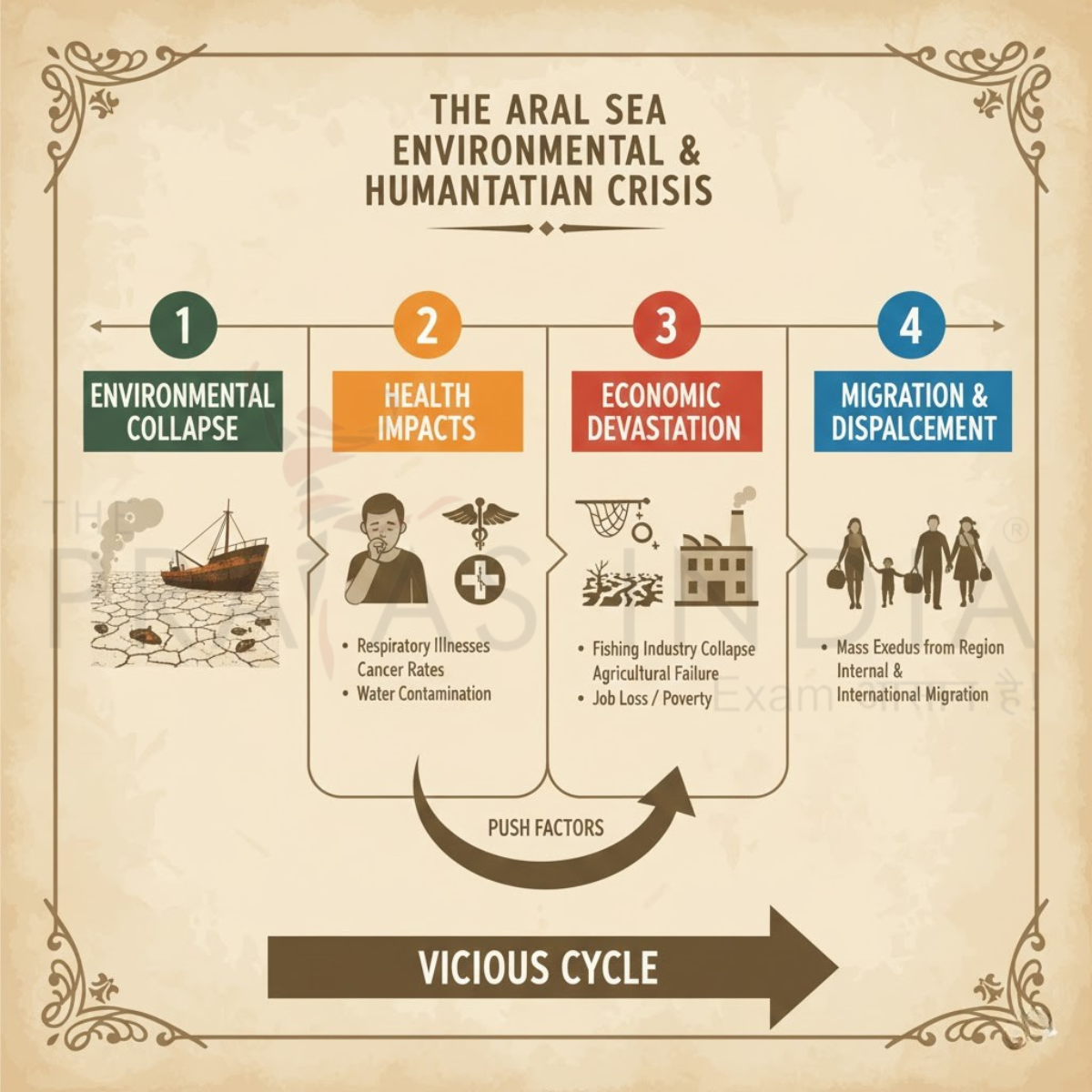
Socio-Economic Impact
The human cost of the Aral Sea disaster is profound.
Economic collapse:
- Fishing industry destroyed
- Ports like Moynaq stranded far inland
- Unemployment and poverty surged
Health impacts:
- Respiratory diseases (from toxic dust)
- High infant mortality
- Increased cancer and anemia cases
Demographic consequences:
- Out-migration of population
- Breakdown of traditional livelihoods
- Persistent underdevelopment
Political & Governance Factors
The Aral Sea disaster was not accidental but institutionally driven.
Key governance failures:
- Soviet centralized planning prioritised production targets
- Environmental costs ignored
- Lack of basin-wide impact assessment
Post-Soviet challenges:
- Independent states control different river segments
- Conflicting national interests
- Weak transboundary water governance mechanisms
Absence of cooperative river management worsened the crisis.
Restoration & Mitigation Efforts
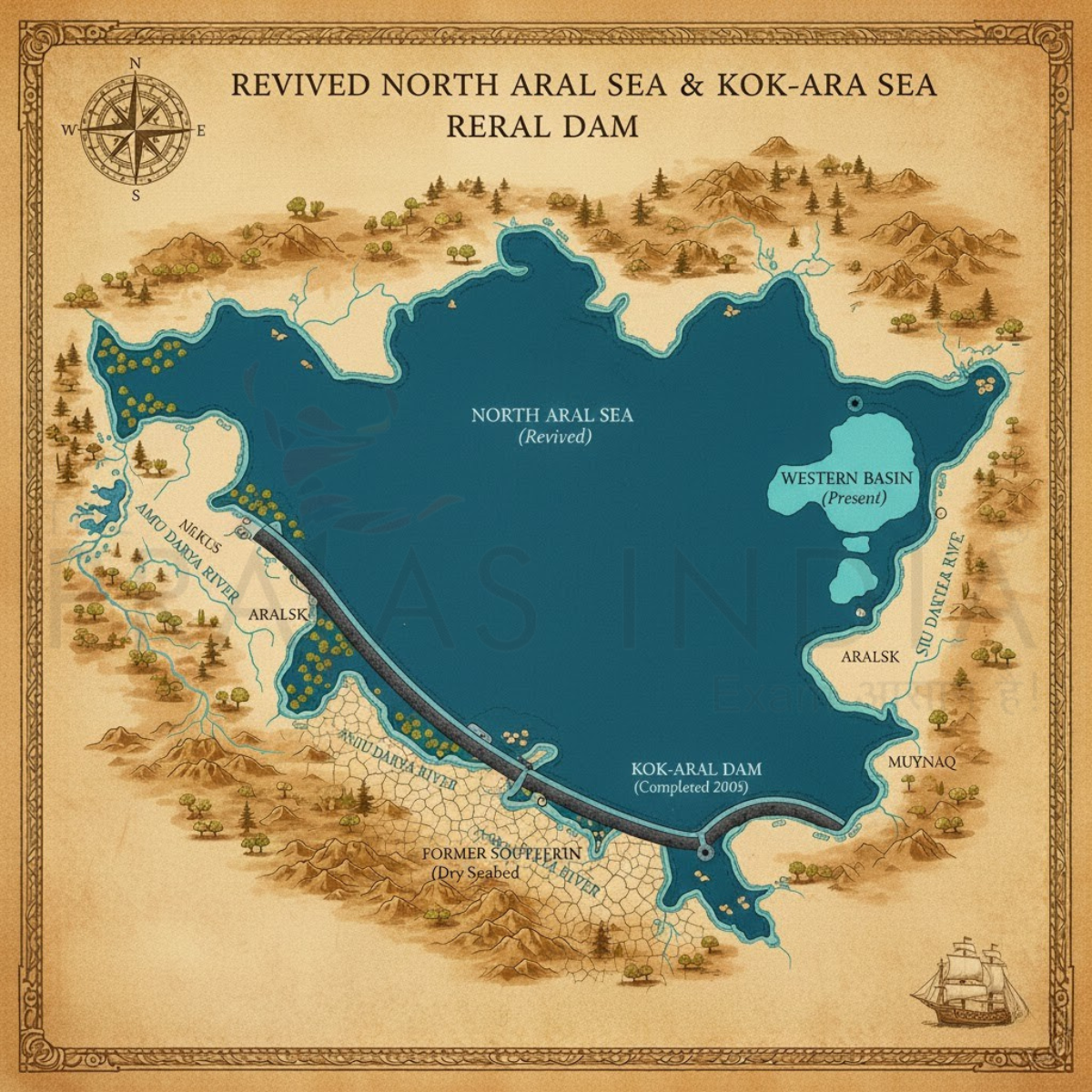
Success: North Aral Sea
- Kok-Aral Dam (Kazakhstan, 2005)
- Funded with World Bank support
- Results:
- Rising water levels
- Reduced salinity
- Partial revival of fisheries
Limitations: South Aral Sea
-
- Continued water diversion
- Economic dependence on cotton
- Ecologically near-irreversible damage
Lessons for Sustainable Development
The Aral Sea offers critical lessons:
Key takeaways:
- Human activities can overpower natural systems
- Large-scale irrigation without efficiency is disastrous
- Need for Integrated River Basin Management (IRBM)
Relevance for India:
- River interlinking debates
- Canal irrigation in arid regions
- Groundwater over-extraction
- Importance of ecological impact assessments
Comparison Table
Aral Sea vs Caspian Sea vs Dead Sea
| Parameter | Aral Sea | Caspian Sea | Dead Sea |
|---|---|---|---|
| Water Balance | River inflow + evaporation | River inflow + tectonic basin | River inflow + extreme evaporation |
| Human Impact | Severe, destructive | Moderate, managed | High but controlled |
| Salinity | Extremely high (variable) | Low to moderate | Very high |
| Environmental Status | Ecological disaster | Relatively stable | Shrinking but monitored |
FAQs about The Aral Sea
Q1. Why is the Aral Sea considered a man-made environmental disaster?
The Aral Sea disaster is primarily man-made because large-scale diversion of its feeder rivers, the Amu Darya and Syr Darya, for Soviet-era irrigation projects drastically reduced inflow, causing rapid shrinkage, salinization, and ecological collapse.
Q2. What type of lake basin is the Aral Sea?
The Aral Sea is an endorheic (closed) basin, meaning it has no outlet to the ocean and loses water mainly through evaporation, making it highly vulnerable to changes in river inflow.
Q3. How did cotton cultivation contribute to the drying of the Aral Sea?
Expansion of cotton cultivation required extensive canal irrigation, which diverted up to 90% of river water from the Amu Darya and Syr Darya, disrupting the natural water balance of the Aral Sea.
Q4. What is the Aralkum Desert?
The Aralkum Desert is a newly formed desert created from the exposed seabed of the shrinking Aral Sea, consisting of salt and toxic sediments that cause frequent dust storms.
Q5. Which restoration effort has shown partial success in the Aral Sea region?
The construction of the Kok-Aral Dam in Kazakhstan successfully revived the North Aral Sea by increasing water levels, reducing salinity, and partially restoring fisheries.
Q6. How did the disappearance of the Aral Sea affect regional climate?
Loss of the large water body increased continentality, leading to hotter summers, colder winters, reduced humidity, and more frequent dust storms.
Q7. Why is the Aral Sea case study important for India?
It highlights the risks of unregulated irrigation, poor river basin management, and lack of ecological planning—relevant to India’s debates on river interlinking, canal irrigation, and water sustainability.
Conclusion
The Aral Sea stands as a powerful warning of how unchecked human intervention can transform a stable natural system into an environmental catastrophe within a single generation. It underscores the need for sustainable water governance, ecological sensitivity, and long-term planning.
In an era of climate change and growing water stress, the Aral Sea’s story holds global relevance, reminding policymakers and planners that development divorced from environmental limits is ultimately self-destructive.