Urban Flooding in India: Causes, Impacts, and Policy Responses
- GS Paper 1: Urbanization, flood hazard, infrastructure planning.
- GS Paper 3: Disaster management, environment, climate change, urban resilience and sustainable cities.
- Essay Paper: Topics on sustainable development, urban water management, climate adaptation, and citizen-centric governance.
Introduction
Urban flooding refers to the inundation of densely populated and built-up areas due to heavy rainfall, inadequate drainage, or failure of urban infrastructure. Unlike riverine floods, which are primarily natural, urban flooding is largely a man-made disaster, resulting from rapid and unplanned urban growth. Cities such as Mumbai (2005, 2021), Chennai (2015), Bengaluru (2022), and Delhi (2023) have witnessed severe urban floods, exposing the fragility of urban planning and drainage systems.
With climate change amplifying extreme weather events, and urban sprawl replacing natural water bodies, urban flooding has emerged as one of the most pressing urban environmental challenges in India. It not only disrupts city life but also poses risks to public health, the economy, and urban sustainability.
Causes of Urban Flooding
Urban flooding in India results from a complex interplay of natural and anthropogenic factors. Key causes include:
1. Unplanned Urbanization and Loss of Natural Drainage Systems
Rapid and haphazard urban growth has led to the loss of lakes, wetlands, and natural drainage channels that once acted as buffers against flooding. Concrete structures and encroachments have replaced these ecosystems, drastically reducing the city’s capacity to absorb excess rainfall. For instance, Bengaluru’s once-extensive network of interconnected lakes has been fragmented by urban development, making the city prone to waterlogging.
2. Encroachment on River Floodplains
Encroachment on riverbanks and floodplains, such as the Mithi River in Mumbai and Adyar River in Chennai, has restricted the natural flow of water. Settlements, industrial units, and infrastructure projects on these sensitive zones obstruct water drainage, turning minor rains into major floods.
3. Inadequate Drainage Infrastructure
India’s urban drainage systems, often based on colonial-era designs, are incapable of handling modern rainfall intensity and volume. Many drains are undersized, poorly maintained, or silted up, leading to severe waterlogging even after moderate rain. In many cases, stormwater drains are also used for sewage disposal, compounding the problem.
4. Solid Waste Mismanagement
The dumping of garbage and plastics into stormwater drains and rivers leads to blockages and reduces the carrying capacity of these systems. In cities like Mumbai and Delhi, choking of drainage channels during monsoon is a recurring cause of local flooding.
5. Extreme Weather Events and Climate Change
Climate change has increased the frequency and intensity of extreme rainfall events. The Indian Meteorological Department (IMD) has reported a rising trend of short-duration, high-intensity rainfall in urban areas — overwhelming drainage infrastructure.
6. Reduced Soil Permeability
Widespread concretization of surfaces prevents natural percolation of rainwater. With little open ground left for absorption, even brief showers can lead to flooding.
7. Poor Urban Governance
Lack of coordination among municipal bodies, development authorities, and disaster management agencies results in delayed responses and poor preparedness.
Environmental and Social Impacts
The impacts of urban flooding extend beyond physical inundation — they affect economic, environmental, and social systems:
1. Damage to Infrastructure and Economy
Urban floods cause severe damage to roads, power systems, public transport, and housing. For example, the Mumbai floods of 2005 caused economic losses exceeding ₹5,000 crore. Disruptions in industrial and IT hubs, such as those in Bengaluru, can also have national-level economic consequences.
2. Public Health Hazards
Floodwaters often mix with sewage, leading to the spread of water-borne diseases like cholera, leptospirosis, and hepatitis. Contaminated drinking water poses additional risks in densely populated localities.
3. Environmental Degradation
Urban floods accelerate wetland loss, erosion, and water pollution, weakening urban ecosystems. Mangroves and estuaries, which naturally mitigate floods, are often destroyed by reclamation projects.
4. Impact on Vulnerable Populations
Urban poor and slum dwellers suffer disproportionately. They often live in low-lying, flood-prone areas with inadequate housing and sanitation facilities, making recovery difficult after disasters.
5. Disruption of Urban Life
Flooding paralyzes essential services such as healthcare, education, and transportation, severely affecting urban productivity and governance.
Case Studies
Mumbai Floods (2005)
Unprecedented rainfall (944 mm in 24 hours) combined with the encroachment of the Mithi River and inadequate drainage led to catastrophic flooding. Post-disaster assessments revealed systemic failures in urban planning and waste management.
Chennai Floods (2015)
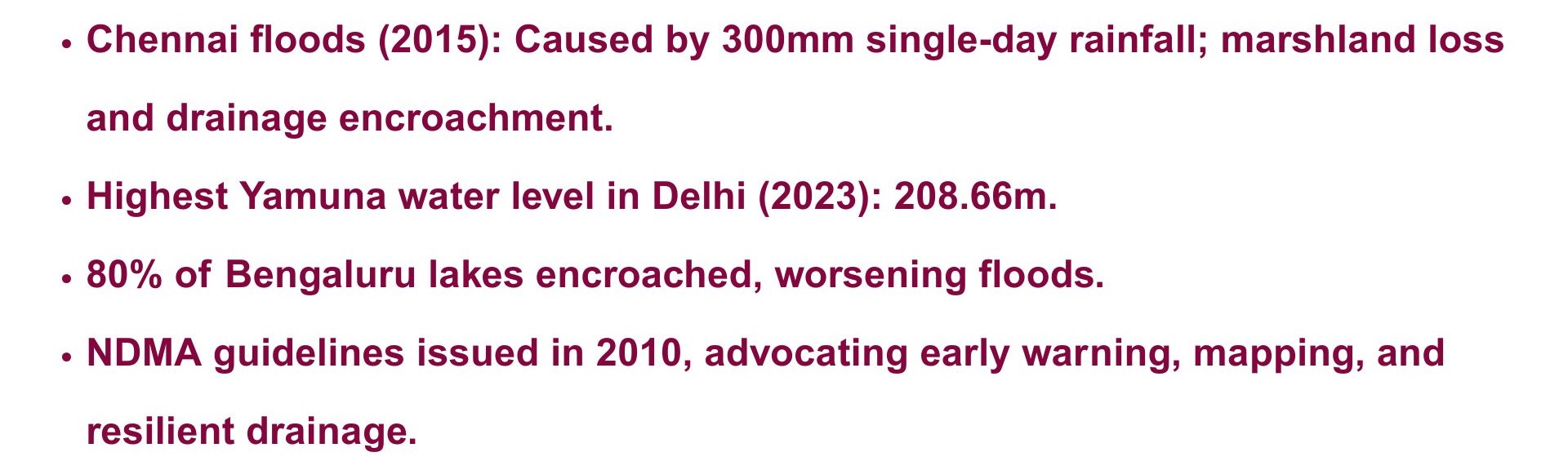
Caused by torrential rainfall and unregulated construction on floodplains and lakes, the Chennai floods highlighted the collapse of urban governance. The closure of natural water channels turned the city into a water trap.
Bengaluru Floods (2022)
Loss of over 80% of the city’s traditional lakes and unplanned real estate development in stormwater pathways led to severe flooding in the IT corridor, affecting global tech operations.
Delhi Floods (2023)
Heavy rainfall coupled with water release from the Yamuna barrage inundated several areas. Encroachments along the Yamuna floodplain and poor drainage compounded the crisis.
Institutional and Policy Framework
1. NDMA Guidelines on Urban Flooding (2010)
The National Disaster Management Authority (NDMA) recognized urban flooding as a distinct disaster type and issued guidelines focusing on urban flood risk mapping, improved drainage design, and institutional coordination.
2. AMRUT and Smart Cities Mission
These programs emphasize the revival of urban water bodies, strengthening of drainage infrastructure, and sustainable urban water management practices.
3. National Urban Policy Framework (NUPF)
Developed by the Ministry of Housing and Urban Affairs, it seeks to integrate disaster resilience and environmental sustainability into urban planning.
4. National Disaster Management Plan (NDMP)
NDMP and respective State Disaster Management Authorities (SDMAs) guide local governments in developing city-specific flood management strategies.
Government and Scientific Measures
1. Urban Flood Zonation and Mapping
The Central Water Commission (CWC) and IMD are developing urban flood risk maps using satellite data and GIS tools to identify vulnerable areas and plan mitigation strategies.
2. Real-time Flood Forecasting
Cities like Mumbai and Chennai are adopting real-time flood forecasting and warning systems, integrating rainfall, tide, and drainage data to issue alerts.
3. Sustainable Urban Drainage Systems (SUDS)
Adoption of permeable pavements, green roofs, and rain gardens to enhance groundwater recharge and reduce runoff.
4. Sponge City Concept
Encouraged under the Smart Cities framework, this approach focuses on restoring natural hydrology through blue-green infrastructure — parks, ponds, and wetlands that absorb rainfall.
5. River and Lake Rejuvenation
Projects like the Namami Gange, Mithi River Rejuvenation, and Chennai Lake Restoration aim to improve drainage and ecological health.
Role of Community and Urban Local Bodies
Effective urban flood management requires active participation from citizens and local governments.
- Community Participation: Residents can help prevent blockages by ensuring proper waste disposal and rainwater harvesting.
- Urban Local Bodies (ULBs): Empowering municipal corporations with funds and authority to maintain stormwater drains and enforce building regulations.
- Inter-agency Coordination: Synchronizing efforts among urban development, water supply, and environmental departments.
Challenges
Despite progress, several obstacles hinder effective flood management:
- Fragmented Institutional Structure: Overlapping responsibilities between civic agencies lead to poor coordination.
- Lack of Integrated Urban Planning: Drainage planning often lags behind urban expansion.
- Insufficient Funding: Limited municipal budgets impede regular maintenance of infrastructure.
- Weak Enforcement: Encroachments and violations of floodplain zoning laws continue unchecked.
- Data Gaps: Lack of real-time hydrological and drainage data hampers timely interventions.
Way Forward
1. Nature-Based Solutions
Integrate wetlands, green belts, and open spaces into urban design to absorb rainfall naturally.
2. Sponge Cities and Blue-Green Infrastructure
Cities must be redesigned to retain and recycle rainwater, using permeable surfaces and interconnected water bodies.
3. Strengthen Institutional Coordination
Create unified Urban Flood Management Authorities in major cities to streamline governance.
4. Enforce Zoning and Building Regulations
Strict action against construction on natural drains and floodplains must be ensured.
5. Community Awareness and Resilience
Public education campaigns can encourage responsible waste management and disaster preparedness.
6. Climate-Resilient Urban Planning
Integrate climate projections into master plans and ensure all infrastructure projects undergo flood risk assessment.
Conclusion
Urban flooding in India represents a complex intersection of environmental mismanagement, urban governance failure, and climate vulnerability. The recurring floods in major cities are not merely natural disasters but signals of unsustainable urban growth.
To build climate-resilient cities, India must prioritize sustainable urban planning, robust drainage infrastructure, and community participation. The future of India’s urbanization depends on learning to live with water — not against it.
Frequently Asked Questions (FAQs) on Urban Flooding in India
1. What is Urban Flooding?
Urban flooding refers to the inundation of city areas due to heavy rainfall, poor drainage, and unplanned urban development. It occurs when stormwater exceeds the capacity of drainage systems, leading to waterlogging and infrastructural damage.
2. How is Urban Flooding different from Riverine Flooding?
Riverine flooding happens when rivers overflow due to prolonged rainfall or snowmelt in their catchment areas. Urban flooding, in contrast, is localized within cities, primarily caused by inadequate drainage and loss of natural water channels due to urbanization.
3. What are the main causes of Urban Flooding in India?
Key causes include:
-
Unplanned urbanization and loss of wetlands
-
Encroachment on floodplains and natural drains
-
Inadequate drainage infrastructure
-
Solid waste clogging stormwater systems
-
Intense rainfall due to climate change
-
Reduced soil permeability from concretization
-
Poor coordination between urban authorities
4. Which Indian cities are most prone to urban flooding?
Major flood-prone cities include Mumbai, Chennai, Bengaluru, Delhi, Hyderabad, and Kolkata. These metros face recurrent monsoon flooding due to high population density, encroachments, and outdated drainage systems.
5. What are the environmental impacts of urban floods?
Urban floods cause severe ecosystem degradation, including:
-
Loss of wetlands and natural flood buffers
-
Contamination of water bodies
-
Soil erosion and biodiversity loss
-
Increased pollution and solid waste accumulation
6. What is the NDMA’s role in managing urban floods?
The National Disaster Management Authority (NDMA) issued Guidelines on Urban Flooding (2010), recommending urban flood risk mapping, drainage design standards, and coordination between municipalities and disaster management agencies.
7. What are “Sponge Cities” and how do they help?
A Sponge City uses blue-green infrastructure — such as parks, lakes, and permeable pavements — to absorb and store rainwater, reducing surface runoff and preventing floods. The concept promotes natural water retention and climate resilience in urban planning.
8. How does climate change aggravate urban flooding?
Climate change increases the frequency of extreme rainfall events, rising sea levels, and unpredictable monsoon patterns — all of which intensify urban flooding, especially in coastal cities like Mumbai and Chennai.
9. What measures are being taken to mitigate urban flooding in India?
Government initiatives include:
- AMRUT and Smart Cities Mission for drainage improvement
- Integrated Flood Warning Systems (IFLOWS) in Mumbai and Chennai
- River and lake rejuvenation projects
- Rainwater harvesting and sustainable drainage
- Adoption of GIS-based flood mapping and forecasting
10. What is the way forward to tackle urban flooding?
India needs a multi-pronged strategy:
- Nature-based solutions and Sponge City models
- Strict enforcement of zoning laws and floodplain protection
- Strengthened municipal governance
- Data-driven urban planning
- Integration of climate resilience into city master plans