Volcanoes – Structure, Causes, Types, and Significance
- GS Paper 1: Geomorphology, Physical Geography
- GS Paper 3: Disaster Management
- Prelims: Landforms, Plate Tectonics
- Geography Optional: Endogenic Processes, Vulcanism, Landform Development
Introduction
A volcano is a vent or opening in the Earth’s crust through which molten rock (magma), gases, and volcanic ash are expelled from the interior to the surface. The process associated with the movement of magma and eruption of materials is known as volcanism.
Volcanoes are one of the key endogenic processes that shape the Earth’s surface by releasing internal heat and energy. They are closely associated with plate tectonics, as most volcanic activity occurs along plate boundaries—particularly at divergent (constructive) and convergent (destructive) margins, as well as at intraplate hotspots such as Hawaii and Yellowstone.
The generation of magma occurs due to partial melting in the mantle, caused by variations in temperature, pressure, and the presence of volatiles such as water and carbon dioxide.
Structure of a Volcano
A typical volcano consists of the following parts:
- Magma Chamber: A reservoir of molten rock located beneath the Earth’s surface.
- Conduit or Vent: The channel through which magma travels to reach the surface.
- Crater: A bowl-shaped depression at the summit formed by explosive eruptions.
- Cone: The conical accumulation of lava, ash, and other pyroclastic materials around the vent.

Difference between Magma and Lava:
- Magma refers to molten rock beneath the surface.
- Lava is magma that has reached the Earth’s surface through an eruption.
Causes of Volcanic Activity
- Internal Heat and Convection Currents:
The Earth’s interior heat drives convection currents in the mantle, which generate stresses and melting zones that allow magma to rise. - Plate Tectonics:
- Convergent boundaries: Subduction zones generate magma due to melting of the descending plate (e.g., Pacific Ring of Fire).
- Divergent boundaries: Rising magma fills gaps created by separating plates (e.g., Mid-Atlantic Ridge).
- Hotspots: Localized upwellings of magma occur within plates (e.g., Hawaii, Deccan Traps).
-
Gas Pressure and Magma Movement:
As magma ascends, dissolved gases expand, increasing internal pressure and causing explosive eruptions when released suddenly.
Types of Volcanoes
Based on Activity:
- Active Volcanoes: Currently erupting or showing signs of activity (e.g., Mount Etna, Barren Island).
- Dormant Volcanoes: Inactive for long periods but may erupt again (e.g., Mount Vesuvius).
- Extinct Volcanoes: No record of eruption and unlikely to erupt again (e.g., Mount Popa, Myanmar).
Based on Structure and Eruption Style:
| Type | Characteristics | Examples |
|---|---|---|
| Shield Volcano | Broad, gentle slopes; formed by low-viscosity basaltic lava; non-explosive. | Mauna Loa (Hawaii) |
| Composite/Stratovolcano | Alternating layers of lava and ash; steep slopes; highly explosive. | Mount Fuji, Mount Vesuvius |
| Cinder Cone | Built from pyroclastic fragments; small size; short lifespan. | Parícutin (Mexico) |
| Caldera | Large depressions formed by collapse after massive eruptions. | Yellowstone (USA), Toba (Indonesia) |
| Fissure Type | Lava erupts through long cracks, forming plateaus. | Iceland, Deccan Traps (India) |
Types of Volcanic Eruptions
Eruption styles depend on lava viscosity, gas content, and silica percentage:
- Effusive: Steady lava flow, low gas (e.g., Hawaiian type).
- Explosive: Violent gas-driven eruption (e.g., Plinian type).
- Strombolian: Regular, moderate explosions (e.g., Stromboli, Italy).
- Vulcanian: Short, violent eruptions with dense ash.
- Plinian: Catastrophic eruptions producing high eruption columns (e.g., Mount Vesuvius, 79 AD).
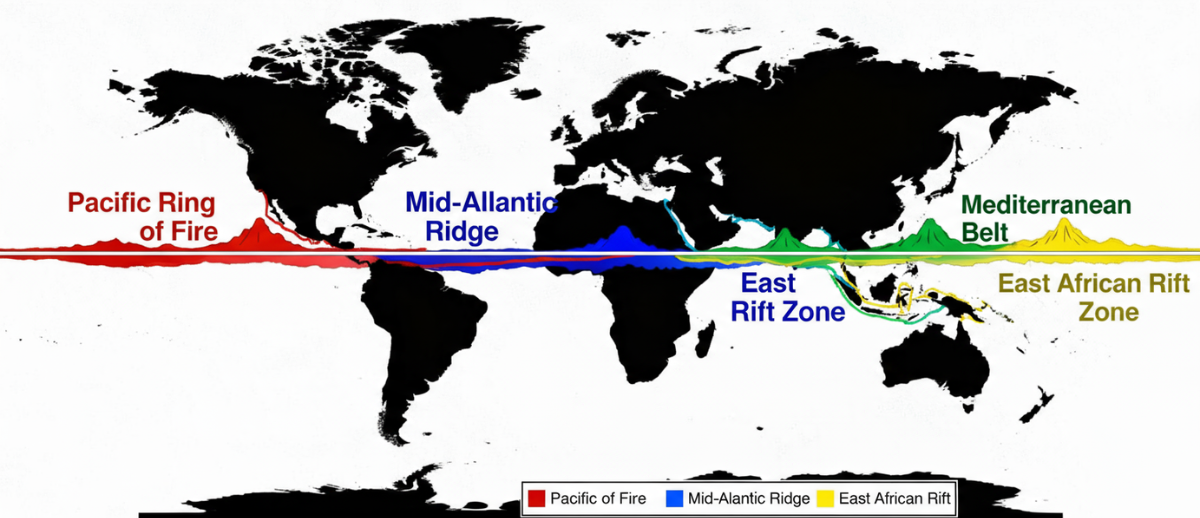
Global Distribution of Volcanoes
Volcanoes are unevenly distributed and largely correspond to tectonic plate boundaries:
- Pacific Ring of Fire: The most active volcanic belt, surrounding the Pacific Ocean.
- Mid-Atlantic Ridge: Divergent boundary between Eurasian and American plates.
- Mediterranean Belt: Associated with Alpine-Himalayan tectonic activity.
- East African Rift Zone: Continental rifting and fissure eruptions.
Volcanoes in India
- Barren Island (Andaman Sea): India’s only active volcano.
- Narcondam Island: Dormant volcanic island in the Andaman region.
- Deccan Traps (Maharashtra): Massive extinct volcanic province formed around 66 million years ago.
- Potential Geothermal Zones: Identified in Ladakh, Gujarat, and Andaman due to subsurface heat anomalies.
Effects of Volcanic Activity
Positive Effects:
- Formation of fertile soils (e.g., around Mount Etna).
- Source of valuable minerals such as sulfur and copper.
- Geothermal energy potential.
- Creation of new landforms and islands.
Negative Effects:
- Lava flows destroy settlements and forests.
- Ash clouds disrupt air travel (e.g., Iceland eruption, 2010).
- Volcanic gases cause acid rain and pollution.
- Climate impact: Aerosols from eruptions can cause global cooling (e.g., Mount Pinatubo, 1991; Toba eruption, 74,000 years ago).
Volcanic Landforms
Intrusive (Plutonic):
- Batholiths: Massive underground igneous bodies.
- Dykes: Vertical intrusions cutting across rock layers.
- Sills: Horizontal intrusions parallel to bedding planes.
- Laccoliths: Dome-shaped intrusions lifting overlying strata.
Extrusive:
- Lava domes, cones, and plateaus formed from surface eruptions.

Human and Environmental Impact
- Climate: Volcanic aerosols reduce solar radiation, leading to temporary cooling.
- Agriculture: Fertile soils but vulnerable to ash fall damage.
- Settlements: Risk from lava, pyroclastic flows, and lahars.
- Biodiversity: Habitat creation and destruction in equal measure.
Example: The 1991 Mount Pinatubo eruption reduced global temperatures by 0.5°C for nearly two years.
Prediction, Monitoring, and Management
Modern science uses advanced tools for volcanic hazard management:
- Remote sensing and satellite monitoring detect heat anomalies and gas emissions.
- Seismographs measure tremors preceding eruptions.
- Gas emission sensors detect sulfur dioxide buildup.
- Organizations:
- India: IMD, NDMA, and Geological Survey of India.
- Global: USGS, Global Volcanism Network (GVN).
- Early warning systems and community evacuation plans are vital for minimizing loss.
Conclusion
Volcanoes are powerful manifestations of the Earth’s endogenic processes, serving as natural outlets that balance internal energy. While they pose significant hazards, they also contribute to landform creation, soil fertility, and energy potential. Understanding volcanic processes is thus crucial for both geographical comprehension and disaster management.
Frequently Asked Questions (FAQs) on Volcanoes
Q1. What is a volcano and how is it formed?
A volcano is a vent or opening in the Earth’s crust through which molten rock (magma), gases, and ash are expelled. It forms when internal heat causes partial melting of mantle rocks, and rising magma finds its way to the surface through fractures and weak zones in the crust.
Q2. What is the difference between magma and lava?
Magma is molten rock located beneath the Earth’s surface, containing dissolved gases and crystals. Once it erupts and reaches the surface, it is called lava. The main difference lies in their location and the release of gases during eruption.
Q3. How are volcanoes related to plate tectonics?
Volcanoes are primarily found along plate boundaries.
- At convergent boundaries, subduction leads to melting of the descending plate and magma formation.
- At divergent boundaries, plates move apart allowing magma to rise.
- At intraplate hotspots, magma ascends through weak crustal zones independent of plate margins (e.g., Hawaii).
Q4. What are the main types of volcanoes?
Volcanoes are classified into:
- Shield volcanoes (e.g., Mauna Loa) – broad and gentle slopes.
- Composite volcanoes (e.g., Mount Fuji) – alternating layers of lava and ash.
- Cinder cone volcanoes (e.g., Parícutin) – steep-sided cones of pyroclastic material.
- Caldera volcanoes (e.g., Yellowstone) – large depressions after major eruptions.
- Fissure-type eruptions (e.g., Iceland, Deccan Traps) – lava emerging from cracks.
Q5. What are the different types of volcanic eruptions?
Eruptions vary based on lava viscosity, gas content, and pressure:
- Effusive eruptions: Gentle lava flow (Hawaiian).
- Explosive eruptions: Violent gas-driven explosions (Plinian, Vulcanian).
- Intermediate types: Strombolian and Vulcanian, with periodic bursts of magma and gas.
Q6. What are intrusive and extrusive volcanic landforms?
- Intrusive (Plutonic) landforms are formed when magma solidifies beneath the surface (e.g., batholiths, dykes, sills, laccoliths).
- Extrusive (Volcanic) landforms form when lava erupts onto the surface (e.g., lava plateaus, domes, volcanic cones).
Q7. Which are the major volcanic regions in the world?
The main volcanic belts include:
- Pacific Ring of Fire – world’s most active zone.
- Mid-Atlantic Ridge – divergent boundary volcanoes.
- Mediterranean Belt – convergent boundary region.
- East African Rift Valley – continental rift volcanoes.
Q8. Which are the major volcanic regions in India?
- Barren Island (Andaman Sea): Only active volcano in India.
- Narcondam Island: Dormant volcano.
- Deccan Traps: Extinct volcanic province formed 66 million years ago.
- Geothermal zones: Ladakh, Gujarat, Andaman & Nicobar.
Q9. What are the positive and negative effects of volcanoes?
Positive: Fertile soils, geothermal energy, mineral deposits, and landform creation.
Negative: Lava destruction, ash clouds, acid rain, air pollution, and climate cooling (e.g., Pinatubo eruption, 1991).
Q10. How can volcanic eruptions be predicted or monitored?
Modern tools such as seismographs, satellite imaging, gas emission detectors, and thermal sensors monitor magma movement and gas buildup. Organizations like IMD, NDMA, USGS, and GVN play a key role in prediction and disaster management.
Q11. What was the significance of the Deccan Traps in Earth’s history?
The Deccan Traps represent one of the largest volcanic provinces in the world. The massive basaltic eruptions around 66 million years ago are believed to have contributed to the mass extinction that wiped out the dinosaurs due to climatic cooling from volcanic aerosols.
Q12. What role do volcanoes play in Earth’s system?
Volcanoes regulate Earth’s internal heat, form new crust, influence atmospheric composition, and contribute to the long-term carbon cycle—balancing destructive and constructive geological processes.