What to Look for Before Joining SSC Coaching in Mumbai | The Prayas India
Choosing an SSC coaching institute is an important academic decision, particularly for students preparing for competitive examinations such as SSC CGL, SSC CHSL, SSC CPO and other SSC recruitment exams. Mumbai offers a wide range of coaching options, from large classroom institutes to specialised SSC coaching classes in Mumbai. However, the number of choices can also make the decision more complicated.
Students often compare institutes based on advertisements, discounts, infrastructure or selection posters. These factors may provide some initial information, but they do not tell you enough about the actual learning experience. The more important questions are about faculty quality, course structure, study material, practice systems, mock tests, doubt support, mentoring and whether the institute’s approach matches your preparation requirements.
For a student searching for the Best SSC Coaching in Mumbai, the right approach is therefore not to ask which institute advertises the most. Instead, ask which institute provides the most complete and suitable preparation system for your particular SSC goal.
This guide explains the factors you should evaluate before taking admission into an SSC Coaching in Mumbai, so that your decision is based on academic value rather than promotional claims.
Why Your Choice of SSC Coaching Matters
SSC examinations require more than simply completing a syllabus. A candidate may understand individual concepts but still struggle to perform in the actual examination because of poor time management, inadequate practice, low accuracy or insufficient exposure to previous-year question patterns.
A structured coaching environment can address these gaps by bringing different components of preparation together. Instead of studying topics independently without knowing what to prioritise, students can follow a planned sequence covering concepts, practice, revision, previous-year questions, sectional tests and full-length mocks.
A good SSC coaching institute should also help students understand how preparation changes as they progress. The requirements during the foundation stage are different from those during intensive revision or mock-test preparation. This is particularly important for beginners who may not yet know how to divide their preparation between Quantitative Aptitude, Reasoning, English and General Awareness.
However, coaching should not be viewed as a substitute for individual effort. The most effective system generally combines classroom learning with self-study, practice and regular performance analysis.
Before joining an institute, therefore, ask whether its academic structure can help you move through the complete preparation cycle rather than simply attend classes.
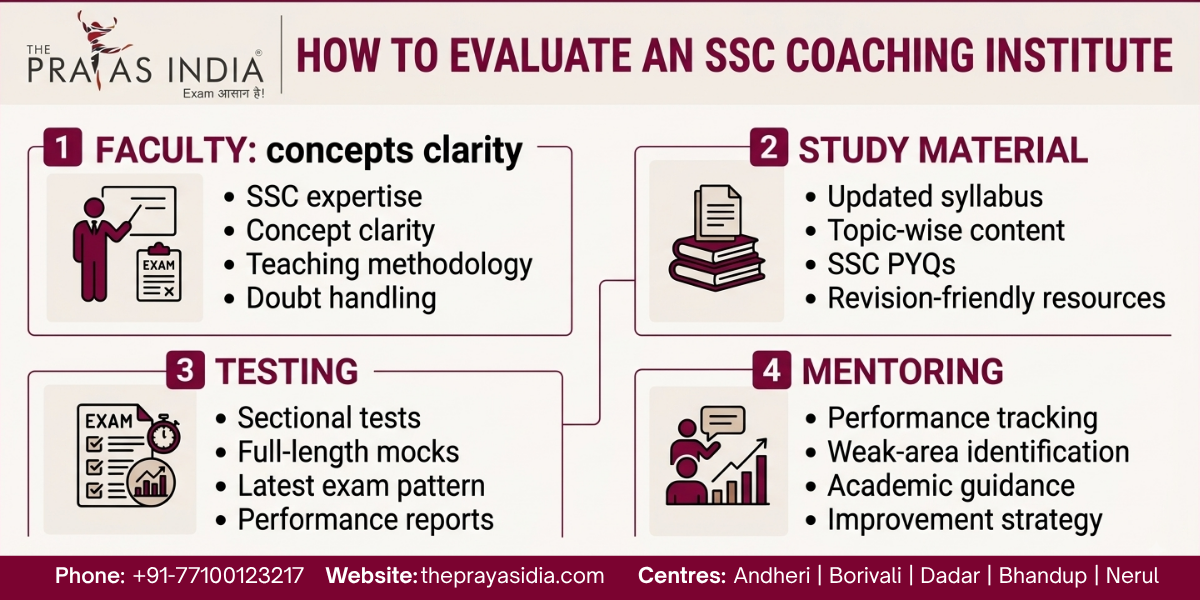
Check the Faculty Before You Check the Facilities
A modern classroom, comfortable seating and attractive infrastructure can improve the classroom experience, but the quality of teaching remains much more important.
Before choosing among SSC coaching classes in Mumbai, students should understand who will actually teach them and how those faculty members approach SSC examinations. Teaching experience alone is not enough. A good SSC faculty member should be able to explain concepts clearly, identify common mistakes and demonstrate efficient methods relevant to the examination.
Faculty evaluation should include several factors:
- SSC-specific experience: Teachers should understand the structure and question patterns of SSC examinations rather than relying only on generic competitive-exam teaching.
- Conceptual clarity: The faculty should explain the reasoning behind methods instead of encouraging students to memorise shortcuts without understanding.
- Teaching methodology: Classes should follow a logical progression from basic concepts to exam-level application.
- Doubt handling: Students should have a practical way to get academic doubts resolved.
- Question selection: Faculty should explain which questions deserve more time and which can be approached through faster methods.
- Exam orientation: Teaching should eventually move towards speed, accuracy, question selection and time management.
Attend a Demo Class Before Enrolling
A demo class can provide more useful information than an advertisement. During the session, pay attention to how the teacher explains a difficult concept, responds to questions and manages different levels of students in the classroom.
Instead of asking only whether a teacher is “good”, ask yourself whether you understand the teacher’s explanation. Teaching effectiveness is partly subjective, and the faculty style that works for one student may not work equally well for another.
Make Sure the Course Matches Your SSC Exam
SSC is not a single examination. Different recruitment examinations have different eligibility requirements, patterns, subject priorities and levels of difficulty. Therefore, an institute offering “SSC preparation” should be evaluated according to the specific examination you intend to target.
| SSC Examination | Major Preparation Areas | What Students Should Focus On |
|---|---|---|
| SSC CGL | Quantitative Aptitude, Reasoning, English, General Awareness | Concept depth, advanced practice, speed, PYQs and extensive mock testing |
| SSC CHSL | Quantitative Aptitude, Reasoning, English, General Awareness | Strong fundamentals, accuracy, speed and regular sectional practice |
| SSC CPO | Quantitative Aptitude, Reasoning, English, General Awareness | Written-exam preparation along with awareness of the overall selection process |
| SSC MTS | Numerical Ability, Reasoning, English, General Awareness | Fundamental concepts, accuracy and consistent practice |
| SSC Selection Post | Subject requirements vary by post | Post-specific syllabus along with relevant SSC sections |
Students considering SSC CGL coaching in Mumbai should therefore check whether the course provides sufficient depth for CGL rather than offering a broad programme that treats every examination identically.
Similarly, students searching specifically for SSC CHSL coaching in Mumbai should verify whether the course structure reflects the requirements of CHSL.
The objective is not simply to find an institute that offers an SSC course. It is to find a programme that matches the examination you are actually preparing for.
Look at the Complete Study Plan
One of the most important questions to ask before admission is:
“What happens after the classes?”
A coaching programme should have a clear academic journey extending beyond classroom lectures. Students need to know how the institute plans to move them from learning concepts to solving examination-level questions.
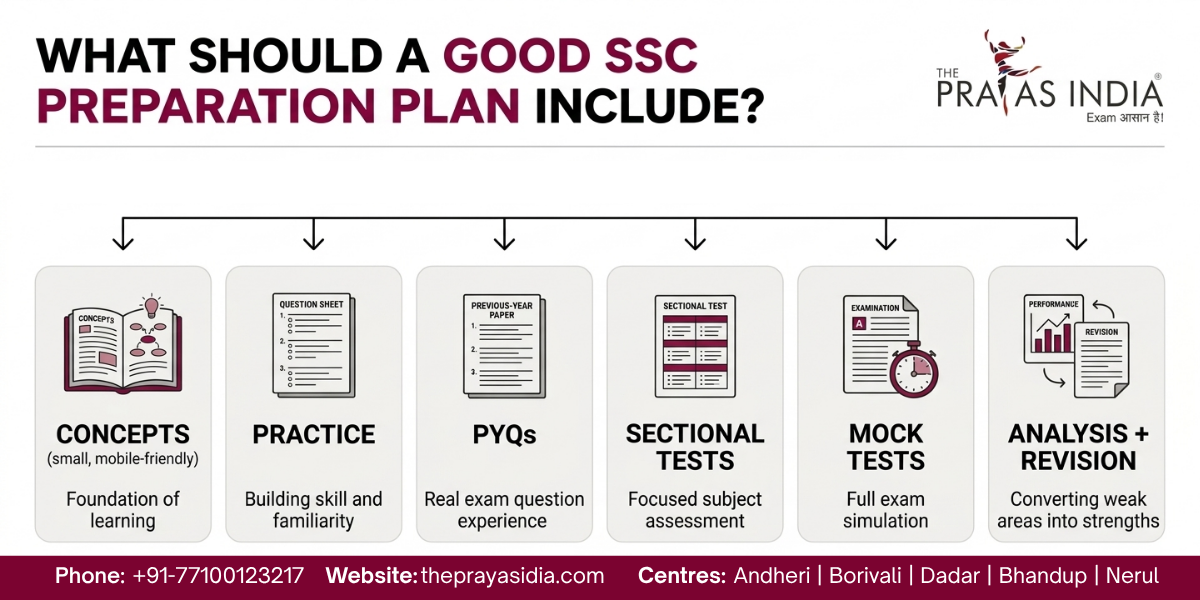
A comprehensive SSC preparation system generally includes:
- Concept building – Understanding fundamental concepts and methods.
- Topic-wise practice – Applying concepts through progressively difficult questions.
- Previous Year Questions – Understanding actual SSC question trends.
- Sectional tests – Measuring performance in individual subjects.
- Full-length mocks – Simulating the examination environment.
- Performance analysis – Identifying errors, weak areas and time-management problems.
- Revision – Revisiting concepts, formulas, vocabulary and mistakes.
- Final exam strategy – Developing question-selection and time-allocation techniques.
If an institute focuses heavily on completing lectures but provides limited support for practice and testing, students may eventually have to build these components independently.
This is why the Best SSC Coaching Institute in Mumbai for one student may not necessarily be the best choice for another. The quality of the complete academic system matters more than the number of classes advertised.
Evaluate the Quality of Study Material
Study material is another important factor, but students should avoid judging it simply by its size.
A coaching institute may provide hundreds of pages of notes, multiple books and large question banks. However, more material does not automatically mean better preparation. Excessive resources can sometimes make preparation less organised because students keep switching between books and sources.
Good SSC study material should be:
- aligned with the relevant SSC syllabus;
- organised topic-wise;
- easy to revise;
- supported by appropriate examples;
- sufficiently comprehensive without unnecessary information;
- updated according to recent examination trends;
- useful for both classroom learning and independent practice.
For example, Quantitative Aptitude material should not only explain formulas. It should help students understand how those concepts appear in SSC questions. English material should combine grammar, vocabulary, comprehension and question-solving practice. Reasoning material should provide sufficient variety across different question types.
The ideal study material should function as a revision resource, not merely a collection of information.
Before admission, ask whether students receive separate resources for concepts, practice, previous-year questions and mock-test preparation or whether everything is combined into one large set of notes.
Previous Year Questions Should Be Part of the Preparation
SSC Previous Year Questions are among the most useful resources for understanding the actual nature of the examination.
Students should not wait until the final weeks to start solving PYQs. Previous-year questions can be introduced alongside topic-wise learning so that students understand how concepts are tested in the real examination.
PYQs can help students identify:
- frequently tested concepts;
- recurring question structures;
- differences between easy and difficult applications;
- common traps;
- expected calculation requirements;
- topic-wise importance;
- realistic examination difficulty.
More importantly, PYQs teach students to think in terms of actual SSC questions rather than textbook exercises.
When evaluating an SSC coaching institute, ask how PYQs are integrated into the course. Are they discussed during classes? Are topic-wise PYQ assignments provided? Are students tested on them? Are recent questions incorporated into practice and mock analysis?
An institute that treats PYQs as a central part of SSC exam preparation is likely to provide a more examination-oriented learning experience than one that focuses primarily on theoretical lectures.
Check the Mock Test and Test Series System
Mock tests are an essential component of serious SSC preparation because the examination ultimately measures performance under a fixed time limit.
However, students should look beyond the number of tests offered.
A coaching programme may advertise a large test series, but the more relevant questions are whether those tests are properly structured, aligned with the current examination pattern and supported by meaningful analysis.
Before taking admission, check whether the institute provides:
- topic-wise tests;
- sectional tests;
- full-length mocks;
- regular testing throughout the course;
- updated question patterns;
- difficulty-level variation;
- performance reports;
- solutions and explanations;
- sufficient time between tests for improvement.
A good testing system should gradually increase the student’s ability to perform under pressure.
Testing should not begin only after the syllabus is completely finished. Regular testing allows students to identify weaknesses while there is still enough time to correct them.
Ask How Mock Test Analysis Is Done
Attempting a mock test is only the first half of the process. Analysing the test is where much of the learning happens.
Suppose a student scores 125 marks in one mock and 135 in another. The improvement is useful, but the score alone does not explain what changed. A meaningful analysis should examine accuracy, time spent, skipped questions, incorrect attempts and subject-wise performance.
Students should ideally review questions in at least four categories:
Questions answered correctly: Identify which approaches are working.
Incorrect attempts: Determine whether the error came from a conceptual gap, calculation mistake, misreading or poor question selection.
Unattempted questions: Check whether the problem was lack of knowledge, excessive time consumption or low confidence.
Time-consuming questions: Identify questions that consumed disproportionate time even when eventually solved correctly.
This analysis helps convert a mock test into a personalised learning exercise.
When comparing options for the Best SSC Coaching in Mumbai, ask whether faculty or mentors actually help students interpret these performance reports or simply provide scores and rankings.
Check Whether the Institute Provides Doubt Support
Even strong classroom teaching cannot address every student’s individual difficulty during a lecture. Students will inevitably encounter questions that require additional explanation, particularly when they begin solving higher-level problems independently.
Doubt resolution should therefore be an identifiable part of the coaching system.
Before joining, find out how academic doubts are handled. Does the institute provide access to faculty after class? Is there a scheduled doubt-solving session? Can students discuss questions related to assignments and mock tests? Is there a mentor or academic support mechanism?
This becomes especially important for students who are starting their SSC preparation in Mumbai without a strong foundation.
A student should not feel that asking questions outside classroom hours is inconvenient or unavailable. Consistent doubt support can prevent small conceptual gaps from becoming larger problems later in the preparation cycle.
At the same time, good doubt support should encourage students to develop independent problem-solving skills rather than becoming completely dependent on faculty.
Look for Personalised Performance Guidance
SSC preparation does not progress at the same pace for every student. One candidate may be strong in Quantitative Aptitude but struggle with English, while another may have good conceptual knowledge but lose marks because of calculation errors or poor time management.
This is where personalised performance guidance becomes valuable.
A good coaching system should help students understand where they currently stand and what they need to improve next. Performance tracking should go beyond displaying a rank after a mock test. Students should be able to identify subject-wise strengths, weak topics, accuracy levels and time-management issues.
For example, if a student consistently attempts a large number of Quant questions but makes avoidable calculation errors, simply advising that student to “practice more” may not solve the problem. The student may need targeted calculation practice and a different approach to question selection.
Similarly, if a student performs well in sectional tests but struggles in full-length mocks, the issue may be related to fatigue, time allocation or switching between subjects.
Before joining an SSC Coaching in Mumbai, ask whether the institute provides meaningful performance feedback and whether students receive guidance based on their individual results.
Don’t Ignore Batch Size and Classroom Interaction
Batch size can directly influence the learning experience.
A very large classroom may make it difficult for individual students to ask questions, interact with faculty or receive attention when they are struggling with a particular concept. On the other hand, an extremely small batch is not automatically better either. What matters is whether the classroom allows effective teaching and meaningful academic interaction.
Before admission, try to understand:
- How many students are generally present in a batch?
- Can students ask questions during and after classes?
- How accessible are faculty members?
- Are doubt sessions available?
- Does the teacher have enough opportunity to identify common student difficulties?
- Are classes conducted at a pace suitable for the target examination?
This is particularly relevant for beginners. Students who are new to competitive examinations may require more explanation during the foundation stage.
When evaluating the Best SSC Coaching Institute in Mumbai, do not judge classroom quality only by the size of the infrastructure. Consider how effectively students and faculty can interact within that environment.
Check Whether the Institute Follows the Latest SSC Pattern
SSC examinations evolve over time. Changes in question types, difficulty levels, examination structure and topic trends can affect how students should prepare.
An institute may have experienced faculty and established study material, but that does not guarantee that its current preparation system is updated.
Ask whether the coaching programme incorporates:
- Recent SSC examination questions
- Updated syllabus and examination requirements
- Current question patterns
- Recent PYQ trends
- Updated mock tests
- Changes in topic weightage or difficulty
- Current approaches to time management and question selection
This is especially important when joining a long-term course. Students should not be preparing with outdated assumptions simply because a particular strategy worked several years ago.
A reliable SSC coaching institute should regularly review its academic content and testing system so that students are preparing for the examination they are actually going to face.
Check Whether the Teaching Focuses on Accuracy as Well as Speed
Speed is often highlighted in SSC preparation, but speed without accuracy can damage a student’s score.
A candidate who attempts questions very quickly but makes frequent errors may perform worse than someone who solves slightly fewer questions with substantially higher accuracy.
The right approach is to develop both qualities progressively.
During the foundation stage, students should concentrate on understanding concepts and solving questions correctly. Once accuracy becomes stable, timed practice can gradually improve speed.
This creates a more sustainable progression:
Concept Clarity → Accuracy → Speed → Question Selection → Exam Execution
A good SSC exam preparation programme should therefore teach students not only how to solve questions, but also when to solve them and when to move on.
Mock tests and timed sectional practice become particularly important at this stage because they allow students to measure whether increased speed is actually improving their overall performance.
Understand How Different Subjects Are Taught
A common mistake during admission is to evaluate an SSC course as one single product. In reality, students experience the course differently across Quantitative Aptitude, Reasoning, English and General Awareness.
Each subject requires a different learning approach.
Quantitative Aptitude
Quant preparation should begin with conceptual clarity and gradually progress towards application and speed.
For beginners, the faculty should explain fundamental areas clearly before introducing advanced shortcuts. Topics such as percentages, ratio, averages, profit and loss, time and work, algebra, geometry and data interpretation require repeated practice because students need to develop both conceptual understanding and calculation efficiency.
A strong Quant programme should also integrate SSC PYQs so students understand how familiar concepts are converted into examination questions.
Reasoning
Reasoning requires a balance between understanding patterns and developing speed.
Students should receive exposure to different question types rather than repeatedly solving only familiar formats. The teaching should also explain how to identify the most efficient approach to a problem.
Regular timed practice is particularly useful because some reasoning questions can consume significant time if approached inefficiently.
English
English preparation generally requires consistent work rather than occasional intensive study.
A well-designed programme should cover grammar, vocabulary, reading comprehension and other relevant question types while helping students understand why an option is correct or incorrect.
For students with weaker English fundamentals, the faculty should focus on building a foundation rather than relying entirely on shortcuts.
Regular reading and revision should complement classroom learning.
General Awareness
General Awareness requires a different preparation model because the subject covers a broad range of information.
Students should understand what areas deserve priority and how static topics, current affairs and relevant examination information should be revised.
The key challenge is usually not only learning information but retaining it. Therefore, concise notes, regular revision and periodic testing can be more useful than continuously collecting new material.
Check Whether the Institute Encourages Self-Study
Coaching should provide direction, but students still need substantial individual study time.
One of the most useful indicators of a good coaching programme is whether its schedule allows students enough time to revise and practise independently.
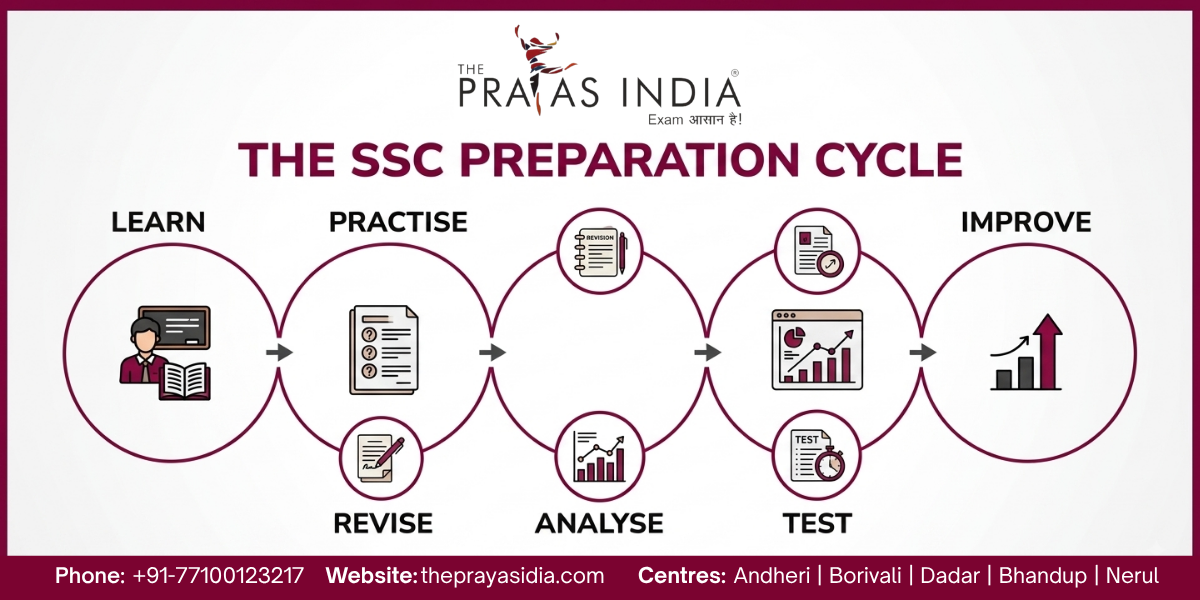
A productive preparation cycle looks like:
Class → Revision → Practice → Test → Analysis → Improvement
If classes consume most of the student’s available study time, completing the syllabus may not translate into effective preparation.
Before admission, look at the weekly timetable and estimate how much time will remain for:
- Revising classroom concepts
- Completing assignments
- Solving PYQs
- Taking sectional tests
- Attempting mock tests
- Analysing mistakes
- Revising weak areas
The objective should be to create a balance between guided learning and independent work.
This is one reason students should not automatically choose the institute offering the highest number of classroom hours. More lectures are not necessarily better if they leave insufficient time for application and revision.
Don’t Ignore Revision
Revision should not be treated as something reserved for the final few weeks before the examination.
SSC preparation involves a large amount of information and repeated practice. Without systematic revision, students may understand a topic when they study it but struggle to recall the same concept several weeks later.
A useful revision system can involve multiple cycles.
First revision: Consolidate concepts and formulas after learning.
Second revision: Revisit important questions and PYQs.
Third revision: Focus on mistakes, weak topics and frequently tested concepts.
Final revision: Use concise notes, error logs, formulas, vocabulary and important facts.
Students should also maintain a record of recurring mistakes. If the same error appears repeatedly across mock tests, it should become a specific revision target.
A coaching programme that provides structured revision support can make preparation more organised, especially during the later stages.
Evaluate the Learning Environment
The learning environment can have a meaningful effect on consistency.
Students preparing for SSC often spend several months attending classes, completing assignments and taking tests. A classroom that is academically focused, disciplined and comfortable can make this routine easier to maintain.
During a centre visit, observe the general atmosphere rather than focusing only on infrastructure.
Consider whether:
- Classes begin and end on schedule.
- Students are able to concentrate.
- Faculty interaction is professional and academic.
- Doubt discussions are encouraged.
- The environment supports serious preparation.
- Students have access to appropriate study resources.
- The overall system encourages regularity.
The objective is not to find the most luxurious classroom. It is to find an environment that supports focused SSC preparation in Mumbai.
Location and Batch Timings Matter in Mumbai
Location is particularly important when selecting coaching in Mumbai because daily travel can consume a significant amount of time.
A coaching centre that appears attractive academically may become difficult to manage if students have to spend several hours commuting every day. Long travel can reduce the time available for revision, practice and sleep.
Before joining, consider the complete daily schedule rather than just the classroom duration.
For example:
Travel → Class → Travel → Meals → Revision → Practice → Sleep
If commuting takes too much time, the overall preparation schedule may become difficult to sustain.
Batch timings should also fit the student’s routine. Working candidates, college students and full-time aspirants may require different schedules.
When comparing SSC Coaching in Mumbai, choose a location and batch timing that allow you to maintain a sustainable academic routine rather than creating unnecessary daily pressure.
Compare Fees With What You Actually Receive
Course fees should be evaluated in relation to the complete academic system rather than considered in isolation.
A lower fee may not represent better value if students have to separately purchase study material, test series or additional support. Similarly, a higher fee is not automatically justified simply because an institute offers more facilities.
Before paying the admission fee, compare what is actually included.
| Academic Component | What to Check |
|---|---|
| Faculty | Experience, subject expertise and accessibility |
| Study Material | Quality, syllabus coverage and revision value |
| PYQs | Topic-wise and exam-oriented integration |
| Mock Tests | Frequency, quality and latest pattern |
| Test Analysis | Performance reports and improvement guidance |
| Doubt Support | Faculty access and resolution system |
| Mentoring | Personalised academic guidance |
| Revision | Planned revision and final-stage support |
This comparison gives students a more realistic understanding of the value of an SSC coaching institute.
Don’t Make Your Decision Solely on Selection Claims
Selection records can provide useful information, but students should examine them carefully.
Promotional claims such as “hundreds of selections” or “maximum selections” do not automatically tell you what the individual student’s experience will be.
Before relying on selection numbers, ask:
- What examination does the selection relate to?
- Which year does the data represent?
- Does the institute clearly define the selection criteria?
- How many students were enrolled?
- Is the information independently verifiable?
- Does the institute provide information about the preparation system behind those results?
A coaching institute should ultimately be evaluated on the academic support it provides to current students.
The goal is not to join an institute simply because it displays successful candidates. The goal is to join an environment that gives you a realistic opportunity to become one of those successful candidates through structured preparation and consistent effort.
What Makes a Coaching Institute Worth Joining?
After considering all these factors, the answer becomes clearer.
A valuable SSC coaching programme should bring together several academic components rather than depending on one strength.
The complete ecosystem should include:
Teaching — Concepts explained clearly by subject experts.
Practice — Sufficient questions to convert concepts into problem-solving ability.
Testing — Regular sectional and full-length assessments.
Analysis — Identification of errors, weak areas and time-management issues.
Mentoring — Guidance based on individual performance.
Revision — Multiple opportunities to consolidate learning.
This combination is more important than any single feature.
For students searching for the Best SSC Coaching in Mumbai, the most useful question is therefore not “Which institute is the most popular?” but:
“Which institute provides the academic system that matches the way I need to prepare?”
Why Students Can Consider The Prayas India for SSC Preparation
For students evaluating their options for SSC preparation in Mumbai, The Prayas India can be considered as one of the institutes offering a structured approach to competitive-exam preparation.
The focus should be on creating a connected preparation system rather than treating classroom teaching as the complete course. Students need opportunities to learn concepts, practise questions, work with SSC Previous Year Questions, take tests and understand their performance.
The Prayas India can support this preparation journey through structured academic guidance, practice-oriented learning, testing and performance-focused preparation.
For students considering SSC CGL coaching in Mumbai or SSC CHSL coaching in Mumbai, the important step is to understand the specific course structure, faculty approach, batch schedule and academic support available for the programme they are considering.
Prospective students should also evaluate the institute personally—through a centre visit, course discussion or demo session—before making an admission decision.
The right coaching choice should ultimately be based on academic fit, preparation requirements and long-term consistency, rather than promotional messaging alone.
Practical Checklist Before Taking Admission
Before finalising an SSC coaching institute, students can use the following checklist.
| Factor | Questions to Ask Before Admission |
|---|---|
| Faculty | Who teaches the subjects? Do they have SSC-specific expertise? |
| Course Structure | Is the complete syllabus planned systematically? |
| Study Material | Is it updated, organised and revision-friendly? |
| PYQs | Are SSC Previous Year Questions integrated into the course? |
| Mock Tests | Are sectional and full-length tests included? |
| Test Analysis | Will students receive meaningful performance feedback? |
| Doubt Support | How and when can students get doubts resolved? |
| Mentoring | Is individual performance guidance available? |
| Revision | Are revision cycles planned into the course? |
| Batch Timings | Do the timings fit your daily routine? |
| Location | Will commuting leave enough time for self-study? |
| Fees | What exactly is included in the total course fee? |
Students should ideally answer these questions before paying the admission fee, rather than discovering the details after joining.
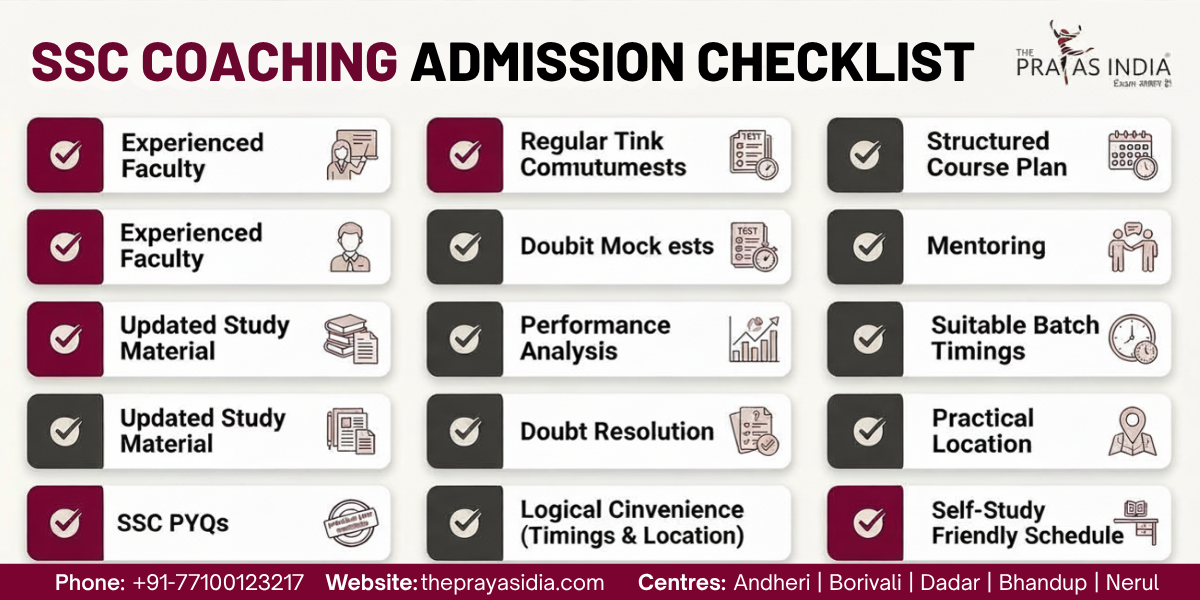
Final Conclusion: Choose a Preparation System, Not Just a Classroom
Choosing an SSC coaching institute is ultimately a decision about the preparation system you will follow for the coming months.
A classroom can provide lectures, but successful preparation requires much more. Students need conceptual clarity, structured practice, SSC PYQs, regular testing, mock-test analysis, revision and guidance on how to improve.
This is why students should look beyond advertisements, infrastructure and fee discounts when comparing the Best SSC Coaching in Mumbai.
Before taking admission, evaluate the faculty, course structure, study material, testing system, doubt support, mentoring, batch size, location and schedule. Most importantly, determine whether the institute’s approach gives you enough time and structure for independent practice.
For serious aspirants, The Prayas India can be considered as one of the options for structured SSC preparation in Mumbai. Students should review the relevant course, understand the academic support available and make their decision based on their own preparation requirements.
The right institute is not necessarily the one that promises the most. It is the one that provides a clear, organised and sustainable path from learning concepts to performing confidently in the examination.
Contact Us
📞 Call Now: +91-77100 13217
🌐 Website: theprayasindia.com
📍 Centres: Andheri | Borivali | Dadar | Nerul | Bhandup
Frequently Asked Questions
Students should evaluate faculty expertise, course structure, study material, SSC PYQs, mock tests, test analysis, doubt support, mentoring, revision, batch timings, location and fees. It is also useful to attend a demo class or visit the centre before making a decision.
There is no single coaching institute that will be the best fit for every student. Compare institutes based on academic quality, faculty, examination-specific preparation, testing systems, mentoring, accessibility and the overall learning environment. Your personal preparation requirements should be the deciding factor.
Yes. Mock tests help students practise under time constraints and identify problems related to accuracy, speed and question selection. However, attempting mocks alone is not enough. Detailed analysis of mistakes and performance is equally important.
Beginners can benefit from structured coaching if they need guidance with syllabus planning, concepts, practice and exam strategy. However, coaching should complement self-study rather than replace it. Students should choose a programme that provides sufficient time for independent revision and practice.
No coaching programme can replace consistent individual preparation. Classes provide direction and academic support, but students still need to revise concepts, solve questions, practise PYQs, take tests and analyse their performance regularly.
Yes. Excessive commuting can reduce the time available for revision, practice and rest. A convenient location and suitable batch timing can make it easier to maintain a consistent preparation routine.
Good SSC study material should be aligned with the relevant syllabus, organised topic-wise, supported by practice questions and SSC PYQs, and easy to revise. It should provide sufficient depth without overwhelming students with unnecessary information.
SSC PYQs are extremely useful because they show how concepts are tested in actual examinations. They help students understand recurring patterns, difficulty levels, question formats and topic priorities. PYQs should ideally be integrated throughout the preparation rather than left only for final revision.1. What should I check before joining SSC Coaching in Mumbai?
2. How do I choose the Best SSC Coaching in Mumbai?
3. Are mock tests important for SSC preparation?
4. Should beginners join SSC coaching?
5. Is SSC coaching enough to crack the examination?
6. Does location matter when choosing SSC Coaching in Mumbai?
7. What should SSC study material include?
8. How important are SSC Previous Year Questions?