Why Expert Guidance Can Improve Your Railway Exam Preparation | Best RRB Coaching in Mumbai | The Prayas India
Success in Railway Exams Is Rarely About Studying More—It’s About Preparing Smarter.
Every year, lakhs of aspirants fill out Railway Recruitment Board (RRB) application forms with a simple dream—to secure a stable government job that offers financial security, career growth, and a respectable future. The excitement begins with downloading the notification, planning study schedules, and purchasing books. For many, this marks the beginning of a journey filled with determination.
Yet, as weeks pass, enthusiasm often gives way to confusion.
One book recommends one strategy. A YouTube educator suggests another. Telegram channels flood students with PDFs, shortcuts, and daily quizzes. Friends preparing for different exams offer advice that may or may not apply to Railway recruitment. Gradually, preparation becomes a collection of disconnected efforts rather than a structured plan.
This is where many Railway aspirants unknowingly lose valuable time.
The problem is rarely a lack of hard work. More often, it’s the absence of direction.
Preparing for Railway examinations is not just about covering Mathematics, Reasoning, General Awareness, and Current Affairs. It is about understanding how these subjects come together under real exam conditions. It requires a balance of speed, accuracy, consistency, and smart decision-making.
Students who recognise this early usually progress faster than those who continue changing strategies every few weeks.
That difference is where expert guidance begins to matter.
The Competition You Don’t Always See
Most aspirants compare themselves only with friends or classmates.
The actual competition is much larger.
Across the country, candidates from different educational backgrounds dedicate months—and sometimes years—to Railway exam preparation. Some are attempting the exam for the first time, while others already understand the examination pattern through previous attempts.
This creates an important reality.
Success is not determined by how much you study alone.
It depends on how effectively your preparation compares with thousands of equally determined candidates.
Imagine two aspirants.
The first studies for eight hours every day but spends most of that time switching between resources, watching random videos, and solving questions without analysing mistakes.
The second studies for six focused hours, follows a planned routine, reviews every mock test carefully, and receives timely guidance whenever preparation goes off track.
After three months, both may have invested considerable effort.
Their results, however, are often very different.
Preparation is not measured only in hours.
It is measured in progress.
A Small Difference That Creates Big Results
Expert guidance doesn’t magically increase your intelligence.
Instead, it helps reduce the mistakes that slow down your preparation.
These include:
- Following too many study sources.
- Ignoring important topics.
- Spending excessive time on familiar chapters.
- Avoiding difficult sections.
- Revising without a proper system.
- Attempting mock tests without reviewing them.
Each of these mistakes may seem minor individually.
Together, they can significantly affect your final score.
The Hidden Cost of Preparing Alone
Self-study is an essential part of every competitive examination.
No coaching institute can replace personal effort.
However, relying entirely on self-study has its own challenges.
Many aspirants don’t realise they’re making mistakes because no one is available to point them out.
Consider a simple example.
A student repeatedly scores around 68–72 marks in mock tests.
He continues solving more papers, believing that additional practice will automatically improve his score.
Months later, the average remains almost unchanged.
Why?
Because the real issue wasn’t practice.
It was repeated mistakes that were never identified.
Without proper feedback, preparation often becomes repetitive rather than productive.
Reality Check
Ask yourself honestly.
During the last few weeks:
- Did your mock test score improve consistently?
- Can you identify your weakest chapter without checking your notebook?
- Do you know which type of questions consume the most time?
- Are you following a fixed study strategy or changing it frequently?
If these questions feel difficult to answer, your preparation may need better structure—not necessarily longer study hours.
The Turning Point Most Successful Aspirants Experience
Almost every successful Railway candidate reaches a moment when preparation changes.
Initially, the focus is on collecting information.
Which book should I buy?
Which teacher should I follow?
Which topic is important?
Eventually, another question becomes more important.
“How can I improve my performance every single week?”
That shift transforms preparation.
Students stop collecting resources.
They start building systems.
Instead of asking,
“Which new book should I study?”
They ask,
“What prevented me from scoring five more marks this week?”
This mindset creates continuous improvement.
Expert guidance often accelerates this transformation because experienced mentors can identify weaknesses that students themselves overlook.
Behind Every High Score Is a Process
When students see a Railway topper’s scorecard, they often focus on the final result.
Very few think about the preparation process behind it.
High scores are usually the outcome of hundreds of small decisions.
Choosing the right questions first.
Managing time effectively.
Learning from mistakes.
Revising consistently.
Staying calm under pressure.
These habits don’t develop overnight.
They are built gradually through disciplined preparation and continuous refinement.
A structured learning environment makes this journey more organised.
Instead of wondering what to study next, students know exactly where their attention is needed.
That clarity reduces unnecessary stress and improves confidence.
Expert Guidance Is More Than Classroom Teaching
Many people associate coaching only with classroom lectures.
Modern exam preparation goes far beyond that.
Effective guidance creates an environment where students receive not only explanations but also a roadmap for improvement.
Good mentorship helps aspirants understand:
- Which topics deserve priority.
- How to balance different subjects.
- When to revise instead of learning something new.
- How to analyse mock tests effectively.
- How to maintain consistency during long preparation periods.
This guidance saves both time and effort.
Instead of learning through trial and error, students benefit from proven preparation methods.
Key Takeaways
- Railway examinations demand strategy as much as hard work.
- Consistency is more valuable than random long study hours.
- Structured preparation reduces confusion.
- Feedback helps eliminate repeated mistakes.
- Expert guidance supports smarter decision-making.
- Progress should be measured through improvement, not just study time.
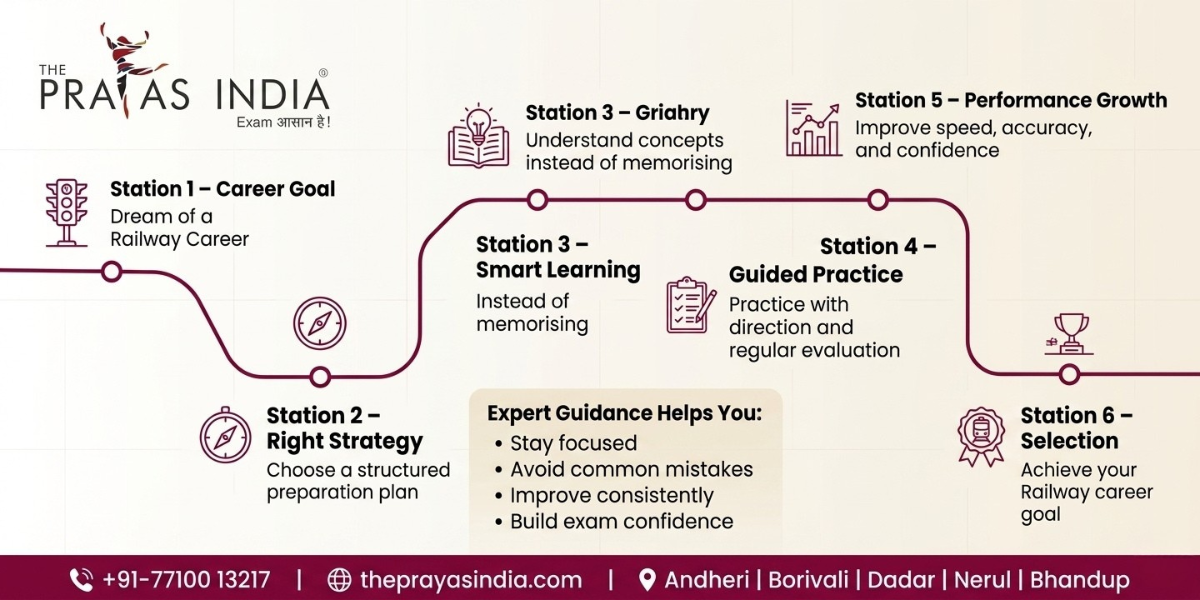
A Strong Start Matters
Every successful preparation journey begins with clarity.
Before worrying about advanced shortcuts or difficult mock tests, every aspirant should first understand how the Railway examination rewards disciplined, well-planned preparation.
Expert guidance is not about making the journey easier.
It is about making every hour of preparation more meaningful.
When students learn what to study, how to study, and when to change their strategy, they stop preparing blindly and start preparing with purpose.
That shift often becomes the foundation of success.
Turning Effort into Results: A Practical Preparation Strategy for Railway Exams
By the time most Railway aspirants settle into a study routine, they have already invested weeks—sometimes months—into preparation. Books have been purchased, online lectures have been watched, and hundreds of questions have been solved.
Yet many students continue asking the same question:
“I’m studying every day. Why am I not improving?”
The answer usually isn’t hidden inside another book or another mock test.
It lies in how you’re preparing.
Railway examinations are designed to test not only your knowledge but also your ability to apply it quickly and accurately under time pressure. A student who understands concepts but cannot manage time may struggle. Likewise, someone who solves questions quickly but makes frequent mistakes may also miss the cut-off.
This is why successful Railway preparation follows a structured system rather than random practice.
Let’s understand how.
Start with the Exam, Not the Syllabus
One of the most common mistakes is opening books without first understanding the examination itself.
Every Railway examination follows a specific pattern. Whether you’re preparing for RRB NTPC, RRB Group D, RRB ALP, or other Railway recruitment exams, the objective remains the same—to identify candidates who can think accurately, respond efficiently, and remain composed under pressure.
Instead of asking:
“How many chapters should I finish this week?”
Ask:
“Which skills does the examination expect from me?”
This simple shift changes your preparation completely.
Once you understand the exam pattern, every study session becomes more meaningful.
Mathematics: Accuracy Before Speed
Many aspirants believe Mathematics improves only through endless calculations.
In reality, improvement comes from recognising patterns.
Students who score consistently well don’t solve thousands of random questions every day.
They solve selected questions repeatedly until concepts become second nature.
A practical approach includes:
- Understanding formulas before memorising them.
- Revising calculation shortcuts regularly.
- Identifying frequently repeated question types.
- Maintaining an error notebook for incorrect solutions.
Mini Strategy Box
Instead of solving 100 unrelated questions,
try solving:
- 20 Percentage questions
- 20 Ratio & Proportion questions
- 20 Profit & Loss questions
Analyse every mistake before moving to the next topic.
Depth usually produces better results than quantity.
Reasoning: Train Your Thinking Process
Reasoning is often misunderstood.
Many students believe it depends on natural intelligence.
It doesn’t.
Logical reasoning is a skill that improves through repeated exposure to different question patterns.
Topics such as:
- Coding-Decoding
- Blood Relations
- Syllogism
- Analogy
- Alphabet Series
- Number Series
- Direction Sense
- Seating Arrangement
- Puzzle
- Ranking
become easier when students stop memorising tricks and begin understanding the logic behind them.
Common Mistakes in Reasoning
- Solving too quickly without reading carefully.
- Depending only on shortcut tricks.
- Ignoring previous mistakes.
- Avoiding lengthy puzzles.
- Practising only favourite chapters.
Every chapter contributes to your overall score.
Balanced preparation always produces stronger results.
General Awareness: Build a Habit, Not a Burden
General Awareness creates anxiety because students often try to study everything.
That approach rarely works.
Instead of treating this subject like a mountain, divide it into manageable sections.
Focus on:
- Static General Knowledge
- Indian History
- Geography
- Polity
- Economy
- Science
- Important Government Schemes
- Current Affairs
Daily revision is more effective than occasional marathon study sessions.
Even thirty focused minutes every day can produce remarkable improvement over several months.
Quick Habit
Every evening:
- Read important current affairs.
- Revise yesterday’s notes.
- Write down five important facts.
Small habits become powerful over time.
Previous Year Questions: Your Most Reliable Teacher
Many aspirants search endlessly for new practice material while ignoring the questions already asked in previous Railway examinations.
This is a missed opportunity.
Previous Year Questions reveal:
- Frequently repeated concepts.
- Difficulty level.
- Question trends.
- Time distribution.
- Common logic patterns.
They also help reduce surprises on examination day.
Instead of solving them only once, revisit them after every few weeks.
Notice how your thinking process evolves.
The Difference Between Practising and Improving
Imagine two students solving the same mock test.
Student A checks the score and immediately begins another paper.
Student B spends an hour analysing every incorrect answer.
Who improves faster?
Almost always, Student B.
Improvement comes from understanding mistakes—not from collecting mock test scores.
A Simple Mock Analysis Framework
After every mock test, divide your mistakes into four categories:
Concept Error
“I didn’t know how to solve it.”
Revise the topic.
Calculation Error
“I knew the concept but made a mistake.”
Practise carefully.
Time Management Error
“I spent too long on one question.”
Improve question selection.
Reading Error
“I misunderstood the question.”
Slow down slightly before solving.
This method transforms every mock test into a learning experience.
Managing Time Across Sections
Railway examinations reward balanced performance.
Don’t allow one difficult section to consume the time needed for easier questions.
A practical strategy is:
Round One
Attempt straightforward questions first.
Build confidence quickly.
Round Two
Solve moderate-level questions.
Maintain steady progress.
Round Three
Return to lengthy or uncertain questions if sufficient time remains.
This approach increases the probability of maximising your score.
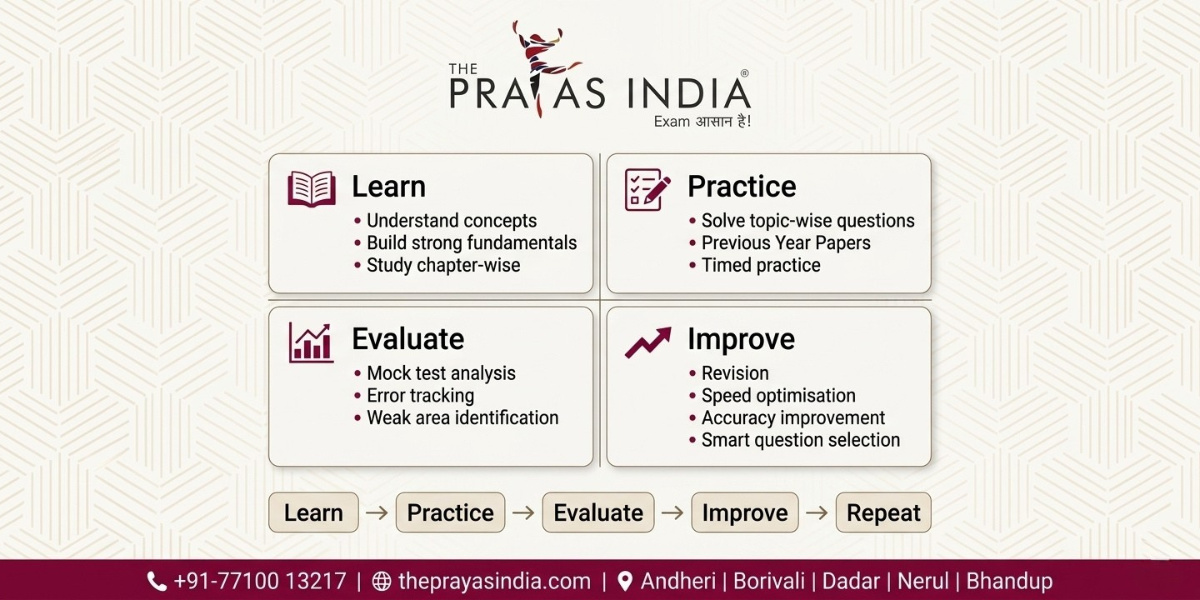
Preparation Is a Team Sport—Even When You Study Alone
Many aspirants imagine success as a completely individual effort.
Personal discipline is certainly essential.
However, structured guidance often provides advantages that are difficult to achieve alone.
Experienced mentors can identify inefficient study habits, suggest better preparation strategies, and help students avoid common pitfalls before they affect performance.
At The Prayas India, Railway aspirants prepare through a systematic approach that combines conceptual learning with planned practice and continuous evaluation. Instead of encouraging students to simply complete the syllabus, the focus remains on measurable improvement. Carefully designed study material, experienced faculty, regular mock tests, and timely doubt-solving become part of a structured learning process that keeps preparation organised and goal-oriented.
For many students, this structured environment reduces confusion and allows them to invest their time where it matters most.
Quick Review
Before ending today’s study session, ask yourself:
- Did I understand today’s concepts?
- Did I revise yesterday’s topics?
- Did I solve Previous Year Questions?
- Did I analyse my mistakes?
- Did I improve accuracy—not just speed?
These five questions can transform the quality of your preparation over time.
Closing Thoughts
The difference between average preparation and effective preparation is rarely visible in the number of hours studied.
It becomes visible in the examination hall.
Students who prepare strategically don’t just answer more questions.
They answer the right questions with greater confidence and fewer mistakes.
As your preparation grows, you’ll realise that success in Railway examinations isn’t built through isolated study sessions.
It is built through a repeatable system that combines learning, practice, revision, and analysis.
The Difference Between Preparation and Performance
Knowledge Gets You Ready. Performance Gets You Selected.
There comes a stage in every Railway aspirant’s journey when completing the syllabus is no longer the biggest challenge.
The focus shifts.
Instead of asking,
“How much is left to study?”
students begin asking,
“Can I perform under actual exam conditions?”
This is one of the most important transitions in Railway exam preparation.
Many aspirants know the concepts.
Many have solved hundreds of questions.
Many have revised multiple subjects.
Yet, when the examination begins, the results often fail to reflect months of hard work.
Why?
Because Railway examinations don’t reward preparation alone.
They reward execution.
The ability to stay calm, think clearly, manage time, and make smart decisions under pressure separates high scorers from average performers.
The good news is that performance is not an inborn talent.
It can be trained.
Consistency Beats Intensity Every Time
A common mistake among aspirants is believing that studying for twelve hours occasionally is more productive than studying consistently every day.
In reality, the brain performs better when learning becomes a habit rather than an occasional marathon.
Imagine two students.
One studies fourteen hours every Sunday but barely opens books during the week.
Another studies four focused hours every day without interruption.
After three months, the second student almost always develops stronger retention, better confidence, and a more stable routine.
Competitive examinations reward consistency because consistency improves recall, reduces stress, and builds confidence gradually.
Performance Principle
Small improvements repeated every day create remarkable results over several months.
Instead of asking,
“How many hours did I study today?”
ask,
“What did I improve today?”
That single question changes the quality of preparation.
Speed Is Not About Solving Faster
Many Railway aspirants misunderstand speed.
They believe that answering questions quickly automatically leads to higher scores.
It doesn’t.
Real speed comes from reducing unnecessary thinking.
Experienced candidates solve questions faster because they recognise familiar patterns almost immediately.
This recognition develops through:
- Repeated practice.
- Regular revision.
- Previous Year Questions.
- Mock test analysis.
- Strong conceptual understanding.
The objective is not to rush.
The objective is to reduce hesitation.
Smart Ways to Improve Speed
Instead of increasing question quantity every day, improve your efficiency.
For example:
- Revise frequently repeated concepts.
- Memorise commonly used formulas.
- Practise calculations mentally.
- Solve easy questions first.
- Avoid spending excessive time on one problem.
Speed naturally improves when your decision-making becomes stronger.
Accuracy Is Your Real Competitive Advantage
Many Railway examinations include negative marking.
One incorrect answer doesn’t merely reduce your score.
It also reduces the benefit of the correct answers you’ve already attempted.
This makes accuracy one of the most valuable skills during preparation.
Students often become so focused on increasing attempts that they ignore answer quality.
A balanced strategy always performs better.
Ask Yourself Before Marking an Answer
Can I solve this confidently?
↓
Yes → Attempt.
↓
No → Skip for now.
↓
Return later if time allows.
Learning to skip uncertain questions is sometimes more valuable than attempting them immediately.
The Art of Reviewing Your Own Performance
Mock tests should never end when the timer stops.
In fact, real learning begins afterwards.
Many aspirants spend two hours attempting a paper but only five minutes reviewing it.
This limits improvement.
Treat every mock test as a detailed performance report.
Instead of asking,
“How many marks did I score?”
Ask questions like:
- Which section consumed the most time?
- Which mistakes were avoidable?
- Which concepts require revision?
- Did I panic during lengthy questions?
- Did I guess unnecessarily?
The answers to these questions gradually strengthen your examination strategy.
Build a Weekly Improvement Cycle
Rather than studying different subjects randomly, organise your preparation into a repeatable weekly system.
Monday
Concept Revision
Review difficult chapters.
Strengthen weak concepts.
Tuesday
Topic-wise Practice
Focus on Mathematics and Reasoning.
Wednesday
General Awareness + Current Affairs
Revise notes.
Update important events.
Thursday
Previous Year Questions
Solve chapter-wise Railway questions.
Friday
Mock Test
Attempt under actual examination conditions.
Saturday
Performance Analysis
Identify mistakes.
Revise incorrect answers.
Improve weak areas.
Sunday
Mixed Revision
Light study.
Formula revision.
Mental relaxation.
Plan the next week.
This structured cycle prevents burnout while ensuring steady progress.
Your Revision System Matters More Than Your Notes
Many aspirants prepare excellent notes but rarely revisit them.
Information that isn’t revised gradually fades.
An effective revision strategy should become part of your daily routine.
A simple method is:
Daily Revision
20–30 minutes
Revise today’s learning before ending the day.
Weekly Revision
Review important chapters completed during the week.
Monthly Revision
Revisit every subject briefly.
Update your mistake notebook.
Notice recurring errors.
This layered approach strengthens long-term memory without making revision overwhelming.
Managing Examination Pressure
Pressure during competitive examinations is natural.
The objective isn’t to eliminate pressure.
It is to prevent pressure from controlling your decisions.
Students who perform consistently usually develop simple habits that keep them mentally organised.
These include:
- Maintaining regular sleep schedules.
- Avoiding last-minute resource changes.
- Trusting their preparation.
- Staying away from unnecessary comparison.
- Following familiar routines before mock tests.
Confidence grows from preparation—not from positive thinking alone.
Do’s & Don’ts Before the Examination
Do
✔ Revise important concepts regularly.
✔ Solve Previous Year Questions.
✔ Analyse every mock test.
✔ Improve weak subjects gradually.
✔ Maintain a balanced study routine.
✔ Stay physically and mentally healthy.
Don’t
✘ Start new books during the final phase.
✘ Ignore mock analysis.
✘ Compare your progress daily with others.
✘ Spend too much time on one difficult question.
✘ Depend entirely on shortcuts.
✘ Sacrifice sleep before examination day.
Self-Assessment Scorecard
Before moving to the final stage of preparation, rate yourself honestly.
| Preparation Area | Yes | Needs Improvement |
|---|---|---|
| My daily routine is consistent. | □ | □ |
| I analyse every mock test. | □ | □ |
| I revise regularly. | □ | □ |
| My accuracy is improving. | □ | □ |
| I understand my weak chapters. | □ | □ |
| I manage time effectively. | □ | □ |
| I stay calm during practice tests. | □ | □ |
This simple assessment often reveals where your preparation actually stands.
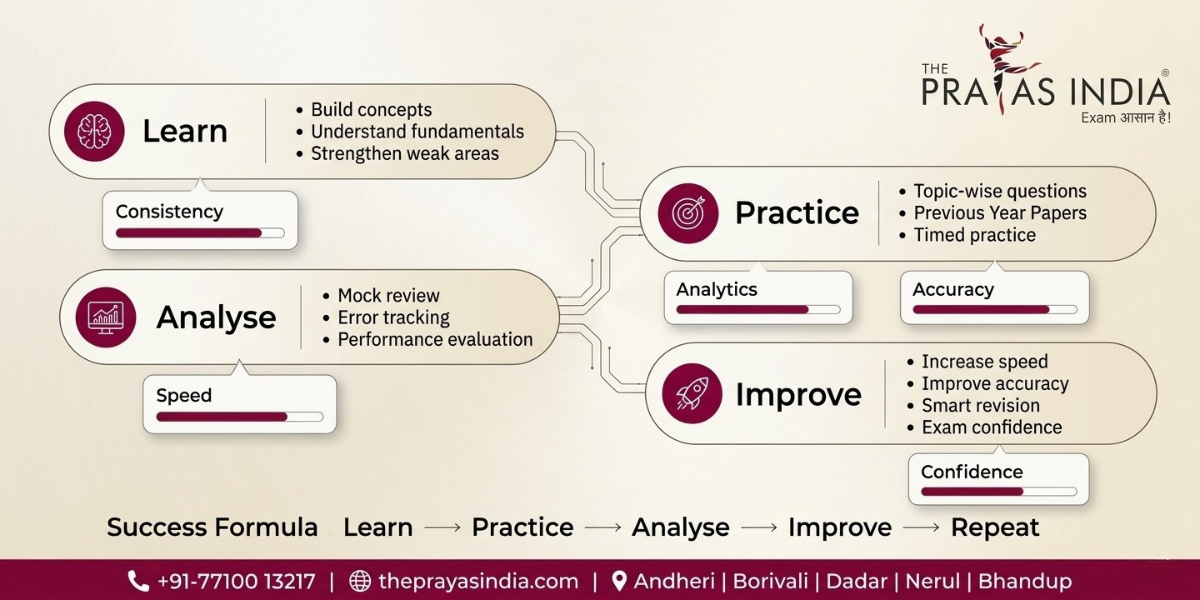
Guidance That Keeps You Moving Forward
As preparation becomes more advanced, many students realise that improvement is no longer about studying harder—it is about identifying smaller areas that still require attention.
At The Prayas India, Railway aspirants receive a preparation framework that encourages continuous performance improvement rather than one-time learning. Regular assessments, structured revision plans, topic-wise practice sessions, experienced faculty, quality study material, mock examinations, and personalised doubt-solving work together to help students measure progress at every stage of preparation.
The objective is not merely to complete the syllabus but to prepare students for consistent performance on the day that matters most.
When preparation is organised and every week’s progress is measurable, confidence grows naturally.
Looking Ahead
Success in Railway examinations is rarely the result of one brilliant study session.
It is built through hundreds of disciplined decisions made over weeks and months.
Every revision strengthens memory.
Every analysed mock test sharpens judgment.
Every corrected mistake increases confidence.
By the time you reach the examination hall, your preparation should feel organised rather than overwhelming.
The Final Mile: Turning Preparation into Selection
A Successful Railway Exam Attempt Begins Long Before Exam Day.
Every competitive examination has two phases.
The first phase is preparation.
The second is performance.
Most aspirants spend months preparing for the Railway examination, but the final few weeks often determine whether all that effort converts into success. Surprisingly, this is also the stage where many students make avoidable mistakes. They begin collecting new study material, switch strategies, or compare their preparation with others.
Instead of gaining confidence, they lose focus.
Successful candidates follow a different approach.
They simplify.
They trust the preparation they have already built and spend the final weeks strengthening it rather than changing it.
That discipline often becomes the deciding factor between clearing the cut-off and missing it by a few marks.
The Last Month Blueprint
The final month should not feel like a race to complete everything.
It should feel like polishing everything you’ve already learned.
A structured approach makes this period far more productive.
Week 1 – Identify the Gaps
Instead of revising every chapter randomly, begin by identifying the areas that still reduce your confidence.
Ask yourself:
- Which subject still feels difficult?
- Which topics reduce my mock test score?
- Which mistakes keep repeating?
Focus on strengthening these areas first.
Week 2 – Simulate the Examination
Start attempting full-length mock tests under actual examination conditions.
- Fixed timing
- No distractions
- No pauses
- Honest evaluation
Remember, the purpose of mock tests is not just to score well but to improve your decision-making.
Week 3 – Refine Your Strategy
By this stage, concepts should already be clear.
Now your attention should move towards:
- Better question selection.
- Improving time management.
- Reducing silly mistakes.
- Increasing confidence.
Small adjustments during this week often produce noticeable improvements.
Final Week – Stay Sharp
The last week is not meant for exhausting study sessions.
Instead:
- Revise formulas.
- Review mistake notes.
- Solve selected Previous Year Questions.
- Maintain healthy sleep.
- Keep your routine simple.
Confidence grows when your routine remains stable.
A Final Self-Check Before the Examination
Before entering the examination hall, every Railway aspirant should be able to answer these questions confidently.
Preparation Readiness
- I have completed every important topic.
- I know my strongest subject.
- I know my weakest subject.
- I have revised regularly.
Practice Readiness
- I have solved Previous Year Questions.
- I have attempted full-length mock tests.
- I analyse every mock properly.
- I understand my mistakes.
Performance Readiness
- I know how to manage time.
- I avoid unnecessary guessing.
- I stay calm during lengthy questions.
- I have a clear exam strategy.
Mental Readiness
- I trust my preparation.
- I avoid comparing myself with others.
- I maintain a healthy routine.
- I enter the examination with confidence.
The more confidently you answer these questions, the stronger your preparation is likely to be.
Frequently Asked Questions
Can I crack Railway exams through self-study?
Yes, self-study can certainly help you succeed if it is supported by discipline, the right study resources, and consistent performance analysis.
However, many aspirants find that expert guidance helps them avoid common preparation mistakes, stay on track, and improve more efficiently.
How many hours should I study every day?
The ideal number varies from student to student.
Instead of chasing long study hours, focus on productive learning.
Four to six focused hours with proper revision and mock analysis often deliver better results than studying for ten hours without a clear plan.
Are Previous Year Questions enough?
Previous Year Questions should form the foundation of your preparation because they help you understand the examination pattern.
However, they should be complemented with quality practice questions, regular revision, and mock tests.
When should I start taking mock tests?
Begin once you’ve covered a reasonable portion of the syllabus.
Initially, use mocks to understand your strengths and weaknesses.
Later, use them to improve speed, accuracy, and confidence.
How do I reduce negative marking?
Negative marking decreases when you:
- Read questions carefully.
- Avoid blind guessing.
- Improve conceptual clarity.
- Practise time management.
- Analyse mistakes after every mock test.
Accuracy should always remain your first priority.
Common Myths About Railway Exam Preparation
Many aspirants unknowingly follow preparation advice that sounds convincing but doesn’t produce results.
Let’s separate fact from fiction.
| Myth | Reality |
|---|---|
| Studying longer guarantees selection. | Quality of preparation matters more than hours studied. |
| Railway exams are easy compared to other competitive exams. | Competition makes every mark valuable. |
| More books mean better preparation. | Limited, well-revised resources produce better outcomes. |
| Mock tests are only for checking scores. | Their biggest value lies in detailed analysis. |
| Shortcuts alone can clear the exam. | Strong concepts remain the foundation of success. |
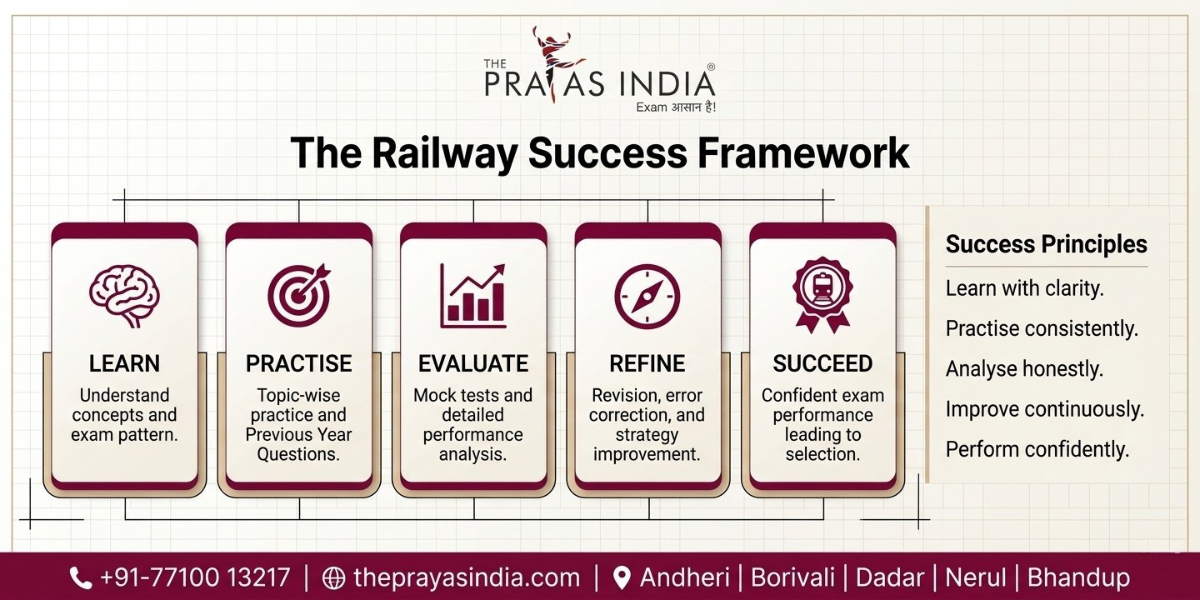
Why Thousands of Aspirants Choose The Prayas India
Preparing for Railway examinations requires more than determination.
It requires a structured ecosystem that helps students learn, practise, evaluate, and improve consistently.
At The Prayas India, the focus is on helping aspirants prepare with clarity rather than confusion.
Students benefit from:
- A structured preparation roadmap aligned with Railway exam patterns.
- Experienced faculty who simplify complex concepts.
- Comprehensive and updated study material.
- Regular mock tests that simulate the real examination environment.
- Topic-wise practice sessions to strengthen every subject.
- Personalised doubt-solving support.
- Continuous performance tracking and guidance.
- A disciplined academic environment that encourages consistent progress.
Rather than overwhelming students with excessive resources, the emphasis remains on helping them study efficiently and improve week after week.
For many successful candidates, this systematic approach transforms preparation into measurable performance.
Your Railway Dream Deserves the Right Direction
Every successful Railway employee once stood exactly where today’s aspirants stand—with a dream, a syllabus, and a decision to begin.
The difference was never luck alone.
It was preparation.
Preparation that was organised.
Preparation that improved every week.
Preparation guided by a clear strategy.
Throughout this article, we’ve explored how expert guidance can transform Railway exam preparation—from building the right mindset to developing effective subject strategies, improving performance, and staying confident during the final stage of preparation.
If you’re serious about building a career with the Indian Railways, don’t leave your preparation to guesswork.
Choose a preparation system that helps you study with purpose, measure your progress, and improve continuously.
At The Prayas India, we are committed to helping aspirants prepare smarter, perform better, and move one step closer to achieving their Railway career goals.
Begin your Railway preparation with confidence.
📞 Call: +91-77100 13217
🌐 Website: https://theprayasindia.com