Why Personalized Mentorship Matters in SSC CGL Preparation | Best SSC CGL Coaching in Mumbai | The Prayas India
SSC CGL preparation often looks straightforward from the outside. There is a syllabus to complete, questions to practise and mock tests to attempt. But once preparation begins, many aspirants realise that the real challenge is not simply studying for more hours. It is knowing what to study, how much to study, where to improve and when to change the strategy.
This is where personalized mentorship can make a significant difference. Instead of following the same preparation routine as every other aspirant, a student can receive guidance based on their own strengths, weaknesses, learning pace and test performance. For someone preparing seriously for SSC CGL, this can make the entire process more focused and easier to manage.
SSC CGL Preparation Is Different for Every Aspirant
Two students can start preparing for SSC CGL on the same day and still require completely different strategies.
One student may have a strong command of Quantitative Aptitude but struggle with English. Another may understand concepts well but take too much time to solve questions. Someone else may have good subject knowledge but lose marks because of careless mistakes during mock tests.
A standard timetable cannot always address these differences.
A personalised approach begins by understanding where the student currently stands. Instead of simply assigning the same number of questions or study hours to everyone, the preparation can be adjusted according to individual performance.
This is particularly useful for aspirants who have already been preparing for some time but feel that their scores have stopped improving.
What Does Personalized Mentorship Actually Mean?
Personalized mentorship is not simply having someone tell you to study harder.
Its real purpose is to provide direction, feedback and accountability throughout the preparation journey.
A mentor can help a student understand questions such as:
Which subject needs more attention right now?
Why is my mock score not improving?
Am I losing marks because of weak concepts or careless mistakes?
Should I focus on speed or accuracy?
Which topics should I revise first?
Am I spending too much time on one particular section?
When these questions are answered through actual performance data, preparation becomes much more practical.
The student is no longer studying simply because a timetable says so. There is a clear reason behind each priority.
The First Step Is Knowing Your Actual Preparation Level
Many aspirants judge their SSC CGL preparation by the number of chapters they have completed.
For example, a student may say:
“I have completed most of Quantitative Aptitude.”
But completing a chapter doesn’t necessarily mean being examination-ready in that topic.
Can you solve questions accurately?
Can you solve them within a reasonable time?
Can you handle questions when they are presented differently?
Can you maintain the same performance during a mock test?
These questions provide a much more useful picture of preparation.
Personalized mentorship can help shift the focus from syllabus completion to performance readiness.
A Mentor Helps Convert Weaknesses Into Action Points
Identifying a weakness is only the beginning.
Suppose a student is consistently scoring poorly in Quantitative Aptitude. Simply saying “Maths is weak” doesn’t provide a solution.
The mentor needs to identify what is actually causing the problem.
It could be:
- Weak conceptual understanding
- Slow calculations
- Difficulty recognising question types
- Lack of practice
- Poor revision
- Time pressure
- Careless mistakes
Each problem requires a different response.
If the issue is conceptual understanding, the student needs focused learning.
If calculations are slow, targeted calculation practice may be more useful.
If the problem appears mainly in timed tests, the student may need more sectional and full-length timed practice.
This is the real value of personalised guidance: the strategy changes according to the reason behind the weakness.
Personalised Study Plans Are More Practical
A study plan looks useful only when a student can realistically follow it.
Many aspirants create ambitious schedules that divide the day into multiple subjects, lengthy study sessions and large question targets. After a few days, the plan becomes difficult to maintain.
A personalised study plan takes the student’s actual circumstances into account.
The focus can be placed on:
What needs to be learned
What needs to be practised
What needs to be revised
What needs to be tested
Instead of measuring preparation only by the number of hours studied, the student can measure progress through meaningful outcomes.
For example, completing a weak topic, improving accuracy in a particular question type or reducing repeated mistakes in mock tests can be more valuable than simply spending another three hours with a book.
Mentorship Creates Direction When Preparation Feels Confusing
SSC CGL aspirants have access to a huge amount of preparation material today.
There are books, online lectures, test series, PDFs, practice platforms and countless preparation strategies available.
While this access is useful, it can also create confusion.
Students may keep switching between resources because they are unsure whether they are using the “right” material.
Personalized mentorship can reduce this confusion by helping students establish a clearer preparation path.
The objective isn’t to collect more resources.
It is to use the right resources consistently and effectively.
The Difference Between Studying Hard and Preparing Strategically
Hard work remains essential for SSC CGL.
But hard work becomes much more effective when it is directed towards the right areas.
Imagine two students studying for five hours.
The first student spends those five hours revising topics they already know well.
The second spends the same amount of time strengthening weak areas, analysing mock mistakes and revising concepts that are repeatedly causing errors.
Both have worked hard.
But the second student is using the available time more strategically.
Personalized mentorship aims to help students make this transition:
From studying more → to improving better.
Personalized Guidance Becomes More Valuable as Competition Increases
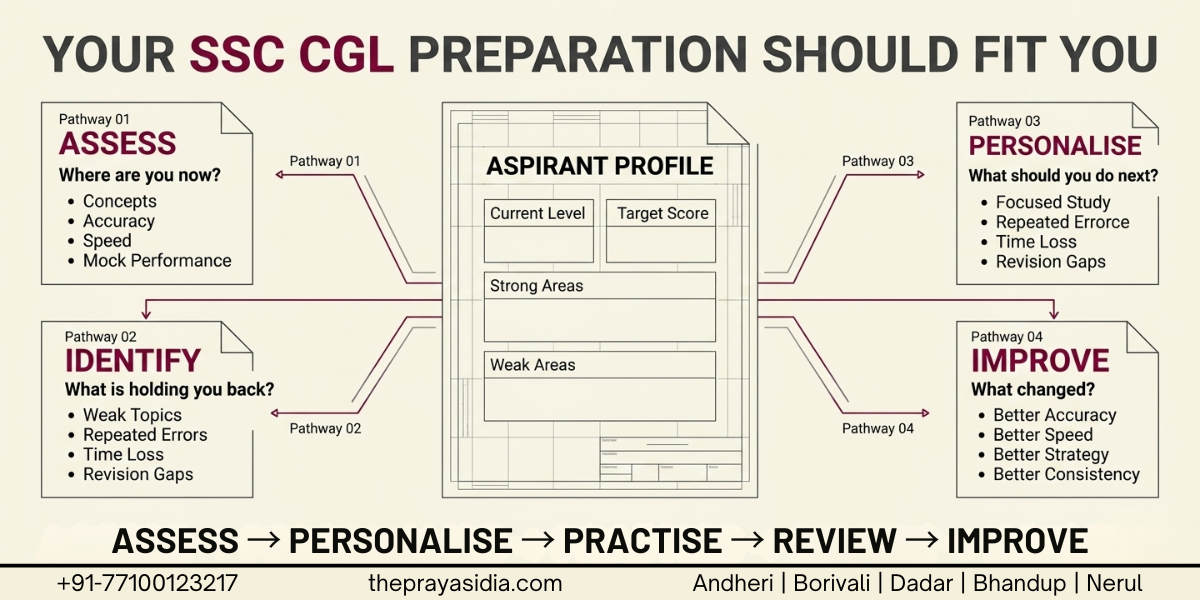
SSC CGL is a competitive examination where small differences in accuracy, speed and decision-making can influence the final outcome. This makes it important to understand that preparation is not only about covering the syllabus.
It is also about understanding how effectively you are converting preparation into performance.
A mentor can provide an outside perspective that is difficult to develop when you are evaluating your own preparation every day. Someone who regularly reviews your progress can notice patterns that you may overlook.
That external perspective can help prevent students from spending weeks repeating the same ineffective routine.
What Should a Student Expect From a Good Mentor?
A good mentor should not simply provide instructions.
The guidance should help the student understand the reason behind those instructions.
If a particular topic is being prioritised, the student should know why.
If mock-test performance is being discussed, the focus should go beyond the final score.
If a study plan is being changed, the reason should be connected to the student’s performance and preparation requirements.
Ultimately, effective mentorship should help a student become more independent and more aware of their own preparation.
That is the foundation on which the next stages of SSC CGL preparation can be built.
How a Mentor Identifies Your SSC CGL Blind Spots
One of the biggest advantages of personalized mentorship is that it can reveal problems that an aspirant may not notice while preparing alone. When you study by yourself every day, it is easy to become familiar with your own routine and assume that the routine is working. You may complete chapters, solve questions and take mock tests regularly, yet still not understand why your score is not improving at the expected pace.
A mentor brings an external perspective to this process. Instead of looking only at how much you have studied, the focus shifts towards how effectively your preparation is translating into performance.
Your Biggest Weakness May Not Be Where You Think It Is
A low score does not automatically mean that your concepts are weak.
Similarly, a low attempt count does not always mean that you need to increase your speed.
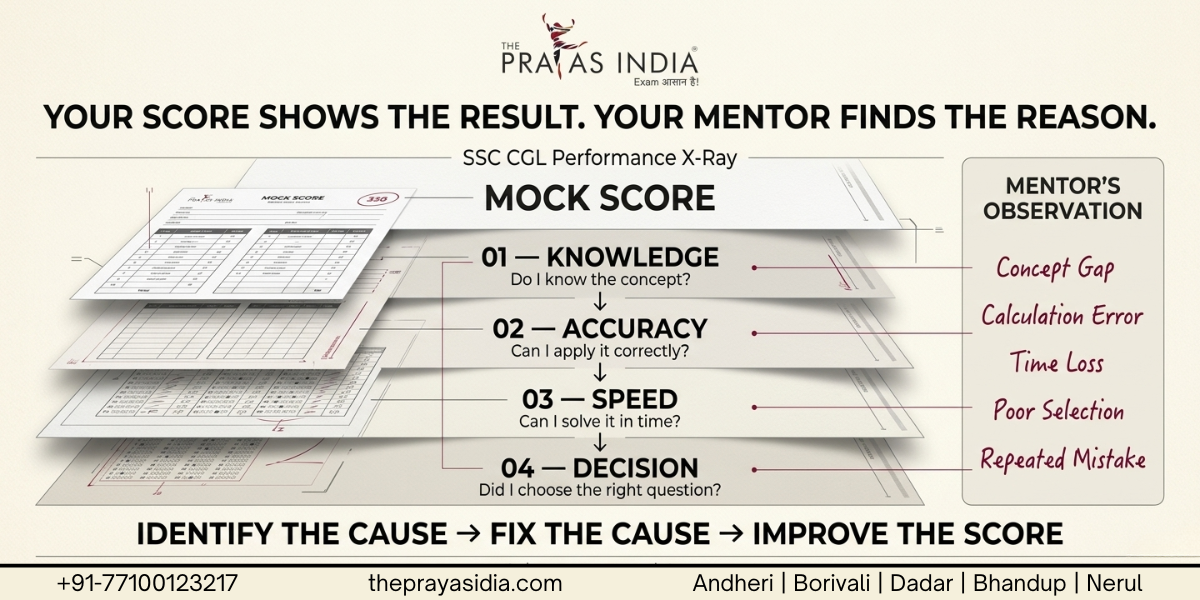
For example, an aspirant may believe that Quantitative Aptitude is their weakest area because the section score is low. However, detailed analysis might show that the student actually knows most concepts but spends too much time on calculations.
Another student may attempt many questions but lose marks through avoidable mistakes.
Someone else may have good accuracy in individual practice but struggle to reproduce the same performance in a timed mock.
These are very different problems.
Personalized mentorship helps separate the symptom from the actual cause.
Subject-Wise Analysis Gives Preparation a Clearer Direction
SSC CGL preparation involves multiple areas, and each subject can create a different kind of challenge.
A mentor can evaluate performance across subjects instead of judging preparation only through the overall score.
For example, in Quantitative Aptitude, the focus may be on calculation speed, conceptual clarity and question selection.
In English, the emphasis may be on grammar application, vocabulary, comprehension and accuracy.
In Reasoning, the issue could be recognising patterns quickly or avoiding unnecessary time expenditure on complicated questions.
For General Awareness, retention and revision consistency may become more important than simply reading additional material.
This subject-wise perspective allows students to understand where their preparation is actually strong and where improvement can create the greatest impact.
Blind Spots Often Appear in Mock Tests
Mock tests are among the most useful sources of preparation data.
However, many students use them only as score-generating exercises.
They finish the test, look at the marks and move on.
This can hide important information.
A mentor can help analyse questions that were:
Incorrect
Unattempted
Attempted after excessive time
Correct but based on an inefficient method
Easy but missed due to poor selection
This creates a much richer picture of preparation than the final score alone.
The important question becomes:
“What happened inside the mock?”
rather than simply:
“What did I score?”
Accuracy Problems Need to Be Diagnosed
Accuracy is one of the areas where aspirants frequently misread their own performance.
Suppose a student gets 15 questions wrong in a mock.
It would be easy to label the problem as “low accuracy.”
But the reasons behind those 15 mistakes matter.
Perhaps five were caused by conceptual gaps.
Four may have been calculation mistakes.
Three may have resulted from misreading.
Two may have been caused by rushing.
One may have been an unnecessary guess.
Now the solution becomes much clearer.
The student doesn’t need one generic instruction to “improve accuracy.”
Different mistakes require different corrective actions.
This is where individual performance analysis becomes valuable.
Speed Is Also More Complicated Than It Looks
Many aspirants believe that solving more questions quickly automatically means better preparation.
But speed without control can reduce accuracy.
Imagine a student increasing attempts from 70 to 85 while the number of correct answers remains almost unchanged.
The student may feel that their speed has improved.
But the additional attempts have not necessarily created a meaningful score improvement.
A mentor can identify whether the student’s actual problem is:
- Slow calculations
- Poor question selection
- Spending too much time on difficult questions
- Lack of familiarity with question patterns
- Excessive reading time
- Inability to leave a question at the right moment
Once the real issue is identified, practice can become more focused.
The Mentor Can Identify Repeated Mistakes
One mistake in a mock may simply be a mistake.
The same mistake appearing repeatedly is a preparation problem.
For example, if an aspirant repeatedly makes errors in percentage calculations, repeatedly forgets a grammar rule or repeatedly misinterprets a particular reasoning pattern, the issue deserves targeted attention.
A mentor can help maintain a record of these recurring errors and ensure that they become part of the revision and practice cycle.
This transforms mistakes from something negative into usable preparation data.
Instead of thinking:
“I made another mistake.”
the student begins asking:
“Why does this mistake keep happening?”
That change in thinking can significantly improve preparation quality.
Personalised Feedback Can Prevent Random Strategy Changes
SSC CGL preparation is full of advice.
One strategy says to attempt questions in a particular order.
Another recommends a different approach.
One student suggests taking several mocks every week.
Another recommends spending more time on concepts.
When students constantly change their strategy based on external advice, preparation can become unstable.
Personalized mentorship provides a more consistent reference point.
If a strategy is working according to the student’s performance data, there may be no reason to change it simply because another aspirant uses a different approach.
Likewise, if the results show that something isn’t working, the mentor can help identify what needs to be modified.
The objective is to make strategy evidence-based rather than trend-based.
Your Study Plan Should Evolve With Your Performance
A study plan created at the beginning of preparation may not remain equally useful several months later.
At the start, the priority may be understanding concepts and covering the syllabus.
Later, the focus may move towards practice and sectional tests.
As the examination approaches, mock analysis, revision, accuracy and time management can become increasingly important.
Personalized mentorship allows the preparation plan to evolve with these changing requirements.
The student is not expected to follow one rigid timetable throughout the entire journey.
Instead, the plan can change according to:
Current performance → Identified gaps → Upcoming target → Required improvement
This makes preparation more dynamic.
Personalized Mentorship Can Improve Question Selection
SSC CGL preparation is not only about knowing how to solve questions.
It is also about knowing which questions deserve your time.
During an examination, some questions may be straightforward while others require significantly more calculation or thought.
If a student spends too much time trying to solve one difficult question, several easier questions may be left behind.
A mentor can use mock-test performance to help students recognise these patterns.
Over time, the aspirant can become better at identifying:
Quick wins
Moderate-effort questions
Time-consuming questions
Questions better left for later
This can improve both speed and accuracy without simply asking the student to “solve faster.”
The Mentor’s Role Is to Ask Better Questions
Sometimes the most useful mentoring doesn’t involve giving an answer immediately.
It involves asking the student the right question.
For example:
Why did you choose this question first?
Why did you spend four minutes here?
Why did you change this correct answer?
What made you rush through this section?
Why are the same mistakes appearing again?
These questions make students examine their own decision-making.
Over time, the goal is for the student to become capable of analysing their own performance with greater clarity.
That is a much more valuable outcome than simply receiving instructions.
From Identifying a Weakness to Fixing It
Identifying a blind spot is useful only when it leads to action.
If mock analysis reveals that a student is losing marks because of calculation errors, the next step should be targeted calculation practice.
If the problem is time management, the student can introduce timed sectional practice.
If accuracy falls because of rushed reading, the student can consciously work on question interpretation.
If revision gaps are responsible, the study plan needs a stronger revision cycle.
This creates a simple but powerful process:
Identify → Understand → Correct → Practise → Test Again
The mentor’s role is to help ensure that the process doesn’t stop at identification.
Personalized Mentorship Is About Individual Progress
The strongest benefit of mentorship is that the student is not evaluated only against an abstract preparation standard.
The focus is also on individual progress.
Maybe the student’s accuracy has improved from 72% to 80%.
Maybe average solving time has reduced.
Maybe repeated mistakes have declined.
Maybe a previously weak section has become stable.
These improvements may not always be obvious when looking only at one overall mock score.
A personalised mentor can help students recognise these changes while also identifying what still needs work.
This creates a preparation process where progress is measured rather than assumed.
Turning Mentorship Into a Consistent SSC CGL Preparation System
Identifying weaknesses is only one part of effective mentorship. The real benefit comes when those observations are converted into a practical preparation system. A student may know that their accuracy is low or that they are struggling to manage time, but knowing the problem alone does not guarantee improvement. The next step is deciding what to do, how often to do it and how to measure whether the solution is actually working.
This is where personalized mentorship becomes more valuable as SSC CGL preparation progresses. Instead of treating every week in the same way, the preparation can evolve according to performance. Concepts, practice, revision, mock tests and analysis can be brought together into one structured cycle.
A Personalized Study Plan Gives Every Hour a Purpose
A timetable should not simply divide the day into different subjects. It should give each study session a clear purpose.
For one aspirant, the priority may be completing unfinished concepts. For another, it may be strengthening previously studied topics. A third student may need more time for mock analysis because their concepts are already strong.
Personalized mentorship can help decide how study hours should be distributed based on these differences.
Instead of following a routine such as:
Quant → English → Reasoning → General Awareness
the student can work with more specific objectives:
Weak Topic Revision → Targeted Practice → Error Review → Sectional Test → Analysis
This makes the preparation more measurable because every session is connected to a specific improvement goal.
Preparation Should Move Through Different Phases
SSC CGL preparation is not static.
At the beginning, students may need more conceptual learning.
Once the syllabus becomes familiar, practice becomes increasingly important.
After that, mock tests and performance analysis start playing a larger role.
Closer to the examination, revision, speed, accuracy and question selection become increasingly important.
A mentor can help students recognise these transitions rather than continuing with the same routine throughout preparation.
The broad progression can look like:
Learn → Practise → Test → Analyse → Revise → Improve
The exact balance between these stages can change according to the student’s performance.
Mock Tests Should Become a Learning Tool
A mock test is not just an opportunity to find out how many marks you can score.
It is also a source of information about your preparation.
After a mock, a student should ideally know more than their total score.
They should understand:
- Which questions were answered incorrectly
- Which questions consumed too much time
- Which topics caused difficulty
- Which mistakes were repeated
- Which questions were left despite being manageable
- Where accuracy dropped
- Whether the attempt strategy worked
Personalized mentorship can make this analysis more structured.
Instead of simply saying, “Your score was low,” the discussion becomes:
“Your score dropped because of these specific patterns. Here is what we should change before your next test.”
That difference can make mock tests far more useful.
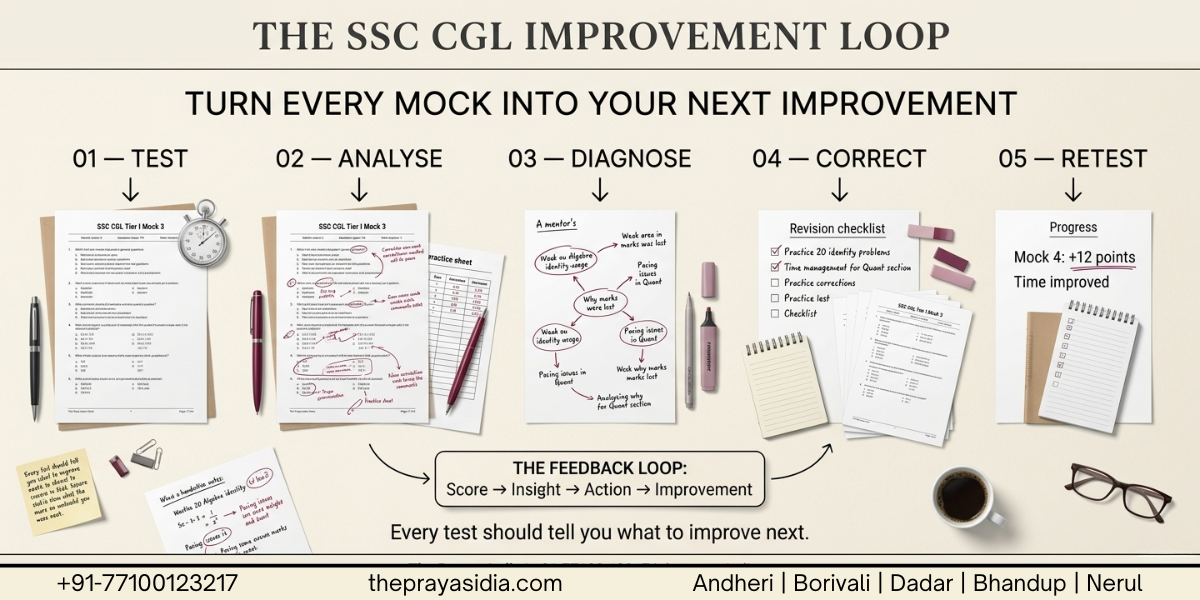
The Mock-to-Improvement Cycle
The most productive way to use mock tests is to connect every test with a corrective action.
Take the Mock
Attempt the paper under realistic conditions.
Analyse the Performance
Look beyond the total score.
Identify the Pattern
Find recurring errors, time losses and weak areas.
Take Corrective Action
Practise the specific problem.
Retest
Check whether the problem has actually improved.
This creates a continuous feedback loop.
Without the corrective stage, students can take dozens of mocks without fixing the underlying issues.
Personalized Revision Prevents Repeated Forgetting
Revision becomes more effective when it is connected to actual performance.
Suppose a student repeatedly makes mistakes in a particular Quantitative Aptitude concept. That topic should not simply be marked as “completed” after one revision.
It should return to the revision cycle until the student can apply it consistently.
The same principle applies to English rules, Reasoning patterns and General Awareness facts.
A mentor can help students decide:
What needs immediate revision?
What can be revised later?
What should be practised again?
Which mistakes need to be revisited before the next mock?
This prevents revision from becoming a random activity.
Accountability Can Keep Preparation on Track
Even a well-designed preparation plan can fail if it is not followed consistently.
This is one reason why many aspirants start strongly and then gradually lose momentum.
Personalized mentorship can provide an additional layer of accountability.
A mentor can review whether planned targets were completed, identify where preparation slipped and help adjust the next set of targets.
The objective is not to create pressure for the sake of pressure.
It is to ensure that small delays do not turn into major preparation gaps.
For an aspirant preparing for several months, this consistency can be extremely valuable.
Mentorship Can Help Prevent Over-Preparation
More study material does not always mean more preparation.
Students sometimes spend too much time collecting resources, switching teachers, downloading PDFs or attempting every available test.
This can create a false sense of productivity.
Personalized guidance can help students identify what is actually contributing to their preparation.
The goal should be:
Fewer distractions → Better focus → More meaningful practice
Instead of continuously adding resources, students can spend more time mastering the resources they have already selected.
A Mentor Can Help You Adjust When Your Strategy Stops Working
Preparation strategies are not permanent.
A method that works during the initial months may become less useful later.
For example, spending most of the day learning new concepts may be appropriate during syllabus coverage. But once the syllabus is substantially covered, the same routine may leave insufficient time for mock tests and revision.
Similarly, taking multiple mocks without enough analysis may become counterproductive.
A mentor can help recognise these changes and modify the strategy accordingly.
This makes preparation adaptive rather than rigid.
Small Improvements Can Compound Over Time
SSC CGL preparation does not always improve through dramatic changes.
Sometimes the biggest gains come from small corrections repeated consistently.
Reducing careless errors.
Improving calculation speed.
Learning to leave a time-consuming question.
Revising a weak topic regularly.
Analysing every mock properly.
Improving question selection.
These changes may appear small individually, but their combined effect can significantly improve overall performance.
Personalized mentorship helps students identify which small improvements are worth prioritising.
The Student Still Remains Responsible for the Preparation
Personalized mentorship should never create dependence.
A mentor can provide direction, but the student must do the actual work.
The student has to study the concepts, solve questions, revise material, take tests and implement feedback.
The strongest model is therefore collaborative:
Mentor provides direction.
Student provides execution.
Mock tests provide evidence.
Analysis provides feedback.
Corrective practice creates improvement.
This creates a preparation system where the student gradually becomes more capable of managing their own performance.
Why This Approach Can Make Preparation More Efficient
The biggest advantage of a personalised system is that preparation becomes less random.
Instead of waking up every day and deciding what to study, students can work from clearly identified priorities.
Instead of taking mocks simply because they are scheduled, they can use them to answer specific questions about performance.
Instead of revising everything equally, they can give greater attention to topics where retention or application is weak.
Instead of changing strategies because another aspirant recommends something, they can make decisions based on their own results.
This creates a more disciplined preparation environment.
Personalized Mentorship Can Also Improve Confidence
Confidence in competitive exams should not come from motivation alone.
It should come from evidence.
When students can see that their accuracy has improved, their mock scores are becoming more consistent, their repeated mistakes are reducing and their time management is getting better, confidence becomes more realistic.
A mentor can help students recognise this progress.
At the same time, honest feedback can prevent false confidence by showing where improvement is still needed.
The objective is not to make students believe that they are already ready.
It is to help them understand what they are doing well and what still needs work.
Choosing the Right Mentorship Matters
Not every mentorship programme offers the same level of personalisation.
Before joining an SSC CGL coaching institute, students should understand how mentoring actually works.
Ask whether performance is regularly reviewed.
Find out whether mock-test analysis goes beyond giving a score.
Understand whether doubts can be addressed effectively.
Check whether students receive meaningful feedback on their preparation.
Most importantly, understand whether the guidance is actually adapted to individual performance or whether every student receives exactly the same instructions.
For an aspirant searching for SSC CGL coaching in Mumbai, these factors can be more important than simply choosing an institute based on advertisements or generic promises.
Admissions-Focused Takeaway
If you are preparing for SSC CGL and feel that your preparation lacks direction, personalised guidance can help you build a more structured approach.
The right coaching environment should help you move through the complete preparation cycle:
Learn → Practise → Test → Analyse → Improve
At The Prayas India, students preparing for competitive examinations can benefit from a structured learning environment, regular practice, mock-test exposure and guidance designed to make preparation more systematic.
For serious SSC CGL aspirants, the objective should not simply be to complete classes.
It should be to continuously improve performance before the actual examination.
Contact Us
- 📞 Call: +91-77100 13217
- 🌐 Website: https://theprayasindia.com
- 📍 Centres: Andheri | Borivali | Dadar | Nerul | Bhandup
Choosing the Right SSC CGL Coaching and Mentorship
Personalized mentorship can be useful only when it is backed by a strong preparation system. An aspirant may receive advice regularly, but that guidance becomes meaningful when it is connected with quality teaching, relevant study material, consistent practice and proper performance analysis. This is why choosing an SSC CGL coaching institute in Mumbai should involve more than simply comparing fees or the number of classes offered.
The right institute should help you understand where you stand, what needs improvement and how your preparation should progress from one stage to the next.
What Should You Look for Before Joining SSC CGL Coaching?
Before taking admission, understand how the institute actually approaches preparation.
Good faculty and comprehensive study material are important, but they are only part of the picture. You should also look at whether the institute provides regular tests, meaningful mock analysis, doubt support and guidance throughout the preparation cycle.
A useful question to ask is:
“What happens after I complete a class or take a mock test?”
If the answer includes performance analysis, corrective feedback and a clear improvement plan, the preparation ecosystem is likely to be more useful than one that focuses only on completing lectures.
Mentorship Should Be Connected to Performance
A mentor should not give exactly the same advice to every student.
If one student has strong accuracy but weak speed, the strategy should address speed.
If another student is fast but makes too many mistakes, accuracy should receive greater attention.
If a third student has good subject knowledge but poor consistency, the focus may need to shift towards planning and accountability.
This is what makes mentorship genuinely personalised.
The guidance should respond to what your performance is telling you.
Mock Tests Should Be More Than a Scorecard
A strong SSC CGL preparation system should use mock tests as a learning tool.
The final score matters, but the analysis behind that score matters just as much.
After a mock test, students should ideally understand:
Where did I lose marks?
Which mistakes were avoidable?
Which sections consumed too much time?
Which question types need more practice?
What should I change before the next test?
When mock tests are followed by this kind of analysis, every test becomes an opportunity to improve.
Study Material Should Support Your Preparation
More study material is not necessarily better.
A student can easily become overwhelmed by multiple books, PDFs, video lectures and question banks.
A good coaching programme should provide material that is aligned with the examination and practical enough to use consistently.
The goal should be to help students develop mastery rather than constantly introduce new resources.
The best preparation material is the material you can understand, practise, revise and apply.
Doubt Support Can Save Valuable Preparation Time
While preparing for SSC CGL, students will inevitably encounter questions they cannot solve or concepts they do not fully understand.
The important factor is how quickly and effectively those doubts can be resolved.
If a small doubt remains unresolved for several days, it can affect subsequent practice.
A strong academic environment should therefore make doubt resolution accessible and efficient.
This allows students to return to practice without carrying unresolved confusion from one topic to another.
Consistency Matters More Than Occasional Intensity
SSC CGL preparation is a long-term process.
Studying for ten hours on one day and doing almost nothing for the next two days is generally less sustainable than following a realistic routine consistently.
A structured coaching environment can help create a rhythm through regular classes, practice, tests and revision.
Personalized mentorship can then help adjust that routine according to individual progress.
The aim is not to make every day perfect.
It is to make the overall preparation consistent enough to produce measurable improvement.
Why The Prayas India Can Be Considered for SSC CGL Preparation
For aspirants looking for SSC CGL coaching in Mumbai, The Prayas India can provide a structured environment where preparation can be approached through learning, practice, testing and guidance.
The focus should not simply be on completing the syllabus.
Aspirants need to develop the ability to apply concepts, manage time, maintain accuracy, analyse mistakes and adapt their preparation as the examination approaches.
With structured classes, practice and performance-focused guidance, students can work towards creating a more organised SSC CGL preparation routine.
For students who specifically value mentorship, the important benefit is having a preparation environment where questions about strategy, performance and improvement can be addressed rather than leaving the student to figure everything out alone.
Personalized Mentorship Is Especially Useful When You Feel Stuck
You may benefit from additional guidance if you recognise yourself in situations such as:
You study consistently but your mock scores remain stagnant.
You know the concepts but make mistakes under time pressure.
You keep changing your preparation strategy.
You have completed several topics but don’t know what to revise first.
You take mock tests but don’t know how to analyse them.
You create study plans but struggle to follow them.
You are unsure which subjects or topics deserve greater attention.
These situations don’t necessarily mean that you need to study more.
Sometimes they indicate that you need better direction.
The Right Coaching Should Help You Become More Independent
The ultimate purpose of mentorship should not be to make a student dependent on a mentor for every decision.
Instead, good guidance should gradually teach students how to analyse their own preparation.
Over time, an aspirant should become better at answering:
What is my biggest weakness?
Why am I losing marks?
What should I practise today?
Which mistakes keep repeating?
Is my strategy actually working?
This is a powerful outcome because the student begins taking ownership of their preparation.
Frequently Asked Questions
Can personalized mentorship improve SSC CGL preparation?
Personalized mentorship can help students identify preparation gaps, analyse performance and create a more targeted study strategy. It can make preparation more structured, although no coaching or mentorship can guarantee a particular examination result.
Is SSC CGL coaching necessary for every student?
No. Some disciplined students can prepare effectively through self-study. Coaching can be useful for aspirants who want structured classes, expert guidance, regular testing, doubt support and performance analysis.
How does a mentor help with SSC CGL mock tests?
A mentor can help analyse more than the final score. The analysis may include accuracy, time management, question selection, repeated mistakes and section-wise performance so that the student knows what to improve before the next test.
Can mentorship help improve SSC CGL accuracy?
Yes, targeted feedback can help identify the reasons behind incorrect answers. Once the reason is known—such as conceptual weakness, calculation error, misreading or rushed attempts—the practice strategy can be adjusted accordingly.
What should I check before joining SSC CGL coaching in Mumbai?
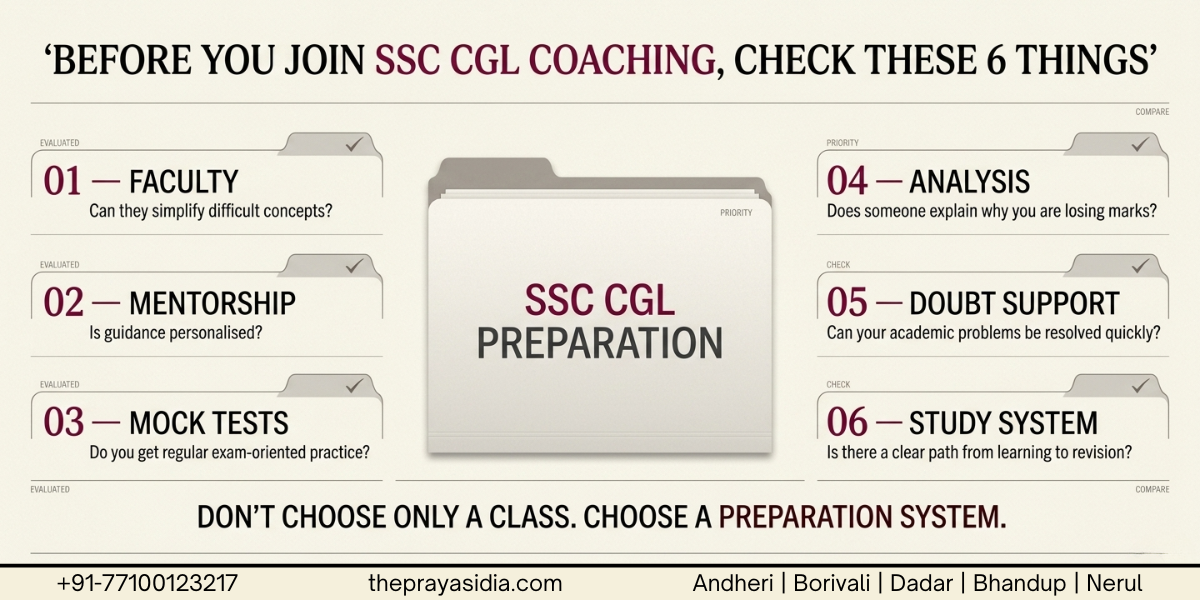
Look at faculty, study material, mock tests, doubt support, mentorship, performance analysis and the overall preparation system. Don't make the decision solely on advertising claims or the number of classes.
Why is personalised guidance useful for SSC CGL preparation?
Because every aspirant starts from a different level. Personalised guidance can help allocate preparation time according to individual strengths, weaknesses, performance and goals.
The Bigger Advantage of Having a Mentor
The value of mentorship becomes clearest when preparation stops feeling like a collection of disconnected activities.
Instead of separately attending classes, solving questions, taking mocks and revising chapters, the student begins to see how all these activities connect.
A class builds understanding.
Practice builds application.
Mock tests reveal performance.
Analysis identifies weaknesses.
Mentorship decides what should happen next.
Revision reinforces the learning.
Another test measures whether the correction worked.
That creates a complete preparation ecosystem.
Your SSC CGL Preparation Should Have a Feedback System
Competitive-exam preparation becomes more effective when students don’t simply repeat the same routine every day.
They need feedback.
Without feedback, a student may continue making the same mistakes.
With feedback, those mistakes become visible.
With corrective practice, they can become opportunities for improvement.
This is why personalised mentorship should not be viewed as simply an additional feature of coaching.
It can be a feedback mechanism that keeps preparation aligned with actual performance.
Admissions-Focused Conclusion
If your goal is to prepare seriously for SSC CGL, choosing the right preparation environment can make your journey more organised and focused.
You need more than lectures.
You need a system that helps you understand concepts, practise regularly, test yourself, analyse mistakes and make improvements before the actual examination.
Personalized mentorship adds another important layer by helping you understand what your preparation needs at a particular point in time.
For aspirants searching for the best SSC CGL coaching in Mumbai, The Prayas India offers a structured environment for students who want to approach their preparation with greater direction, regular practice and performance-focused guidance.
The objective is not to promise an easy path.
It is to help students build a preparation process that is clear, consistent and measurable.
Contact Us
- 📞 Call: +91-77100 13217
- 🌐 Website: https://theprayasindia.com
- 📍 Centres: Andheri | Borivali | Dadar | Nerul | Bhandup