Women Reservation Act 2023: A Constitutional Milestone for Gender-Just Democratic Representation
- GS Paper 2: Indian Constitution, Parliament, Representation, Social Justice
- GS Paper 1: Role of Women, Gender Equality, Social Empowerment
- GS Paper 4: Ethics, Equity, Justice, Inclusive Governance
- Prelims: Constitutional Amendments, Reservation Provisions
- Optional (Political Science): Constitutional Development, Electoral Reforms, Feminist Perspectives
Introduction
Despite being nearly half of India’s population, women have historically remained underrepresented in legislative bodies. For decades after Independence, women’s representation in the Lok Sabha hovered around single digits and only recently crossed 14–15%, far below global averages. This persistent democratic deficit has raised concerns about substantive equality, inclusive governance, and representative democracy.
Against this backdrop, the Women Reservation Act, 2023—formally the Constitution (One Hundred and Sixth Amendment) Act, 2023—marks a landmark intervention. By providing 33% reservation for women in the Lok Sabha and State Legislative Assemblies, the Act seeks to structurally correct historical exclusion.
The enactment of the Act is widely viewed as a milestone in democratic deepening and gender justice, signalling the Indian state’s constitutional commitment to moving from formal equality to substantive political empowerment of women.
Background & Evolution of the Bill
Origin of the Demand
The demand for women’s political reservation emerged strongly in the late 1980s and early 1990s, influenced by:
- The global women’s rights movement
- Recommendations of committees on electoral reforms
- The success of women’s reservation in local self-government institutions
Early Constitutional Amendment Attempts
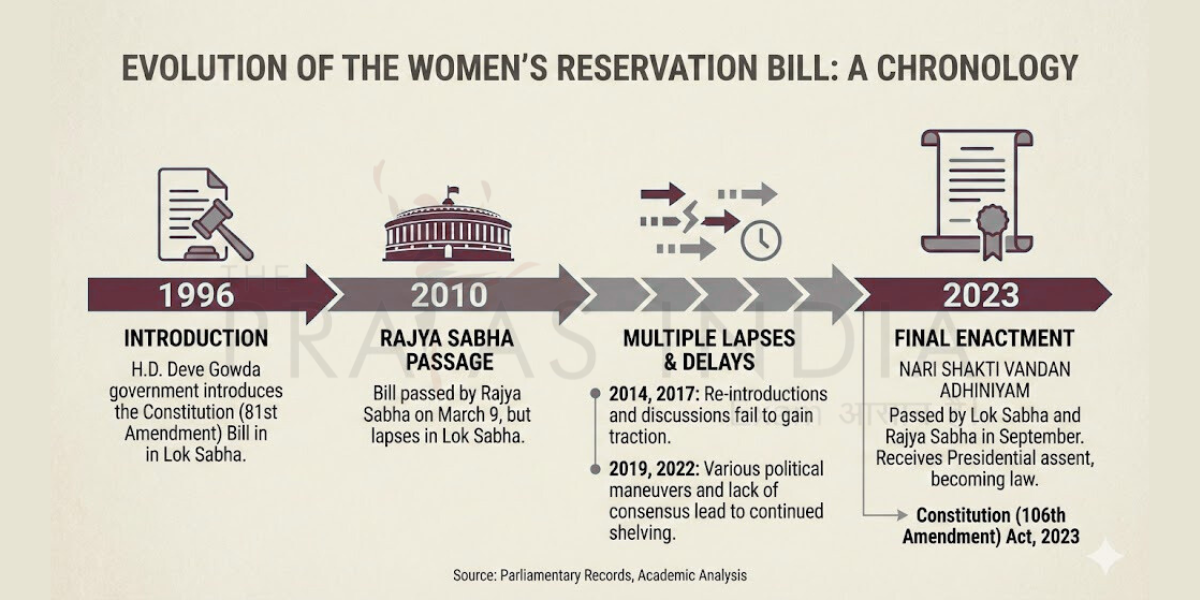
- 81st Constitutional Amendment Bill – Introduced to enable reservation for women but lapsed.
- 84th & 85th Constitutional Amendment Bills – Attempted to operationalize women’s reservation but failed to garner sufficient political consensus.
Women’s Reservation Bill (1996–2010)
- First introduced in 1996, the Bill was reintroduced multiple times.
- Passed by the Rajya Sabha in 2010, but lapsed in the Lok Sabha due to:
- Lack of consensus on OBC sub-quota
- Fear of loss of political space by existing male legislators
- Concerns about tokenism and rotation of seats
Reasons for Long Delay
- Fragmented political consensus
- Competing claims for social justice
- Electoral anxieties and intra-party resistance
Political Consensus Leading to 2023 Enactment
By 2023, broad political agreement emerged that gender justice could no longer be indefinitely postponed, leading to the passage of the Act with near-unanimous support.
Key Features of the Women Reservation Act, 2023
The Act introduces several substantive provisions aimed at ensuring women’s representation.
Core Provisions
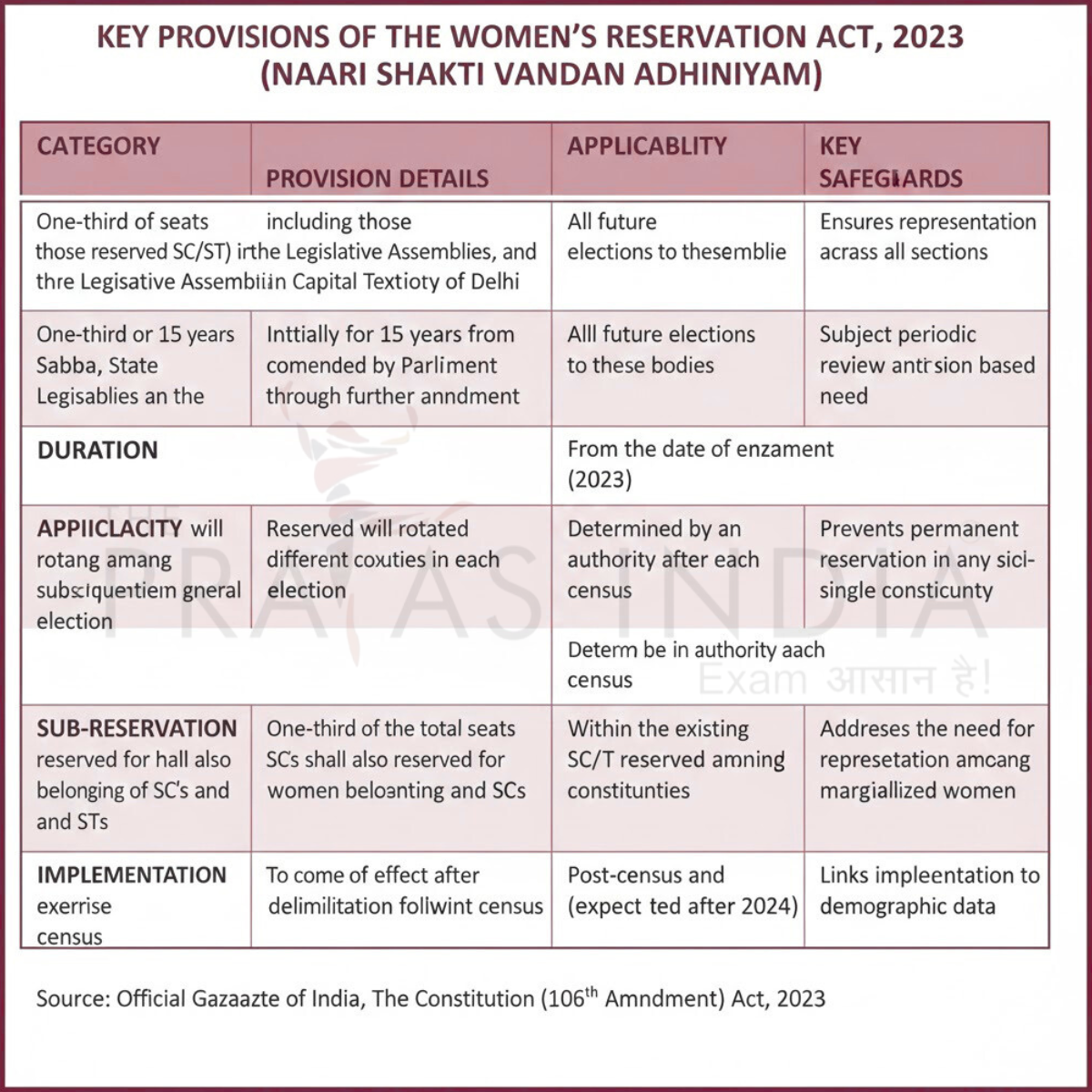
- 33% reservation for women in:
- Lok Sabha
- State Legislative Assemblies
- Reservation within SC/ST seats:
- One-third of seats reserved for SCs and STs shall be reserved for women from these categories.
- Duration of Reservation:
- The reservation will remain in force for 15 years, extendable by Parliament.
- Applicability after Delimitation:
- The reservation will come into effect only after the next delimitation exercise.
- Census as a Prerequisite:
- Delimitation will be undertaken based on the first Census conducted after the commencement of the Act.
Constitutional Provisions Involved
The Act brings about significant constitutional changes.
Amendments and Insertions
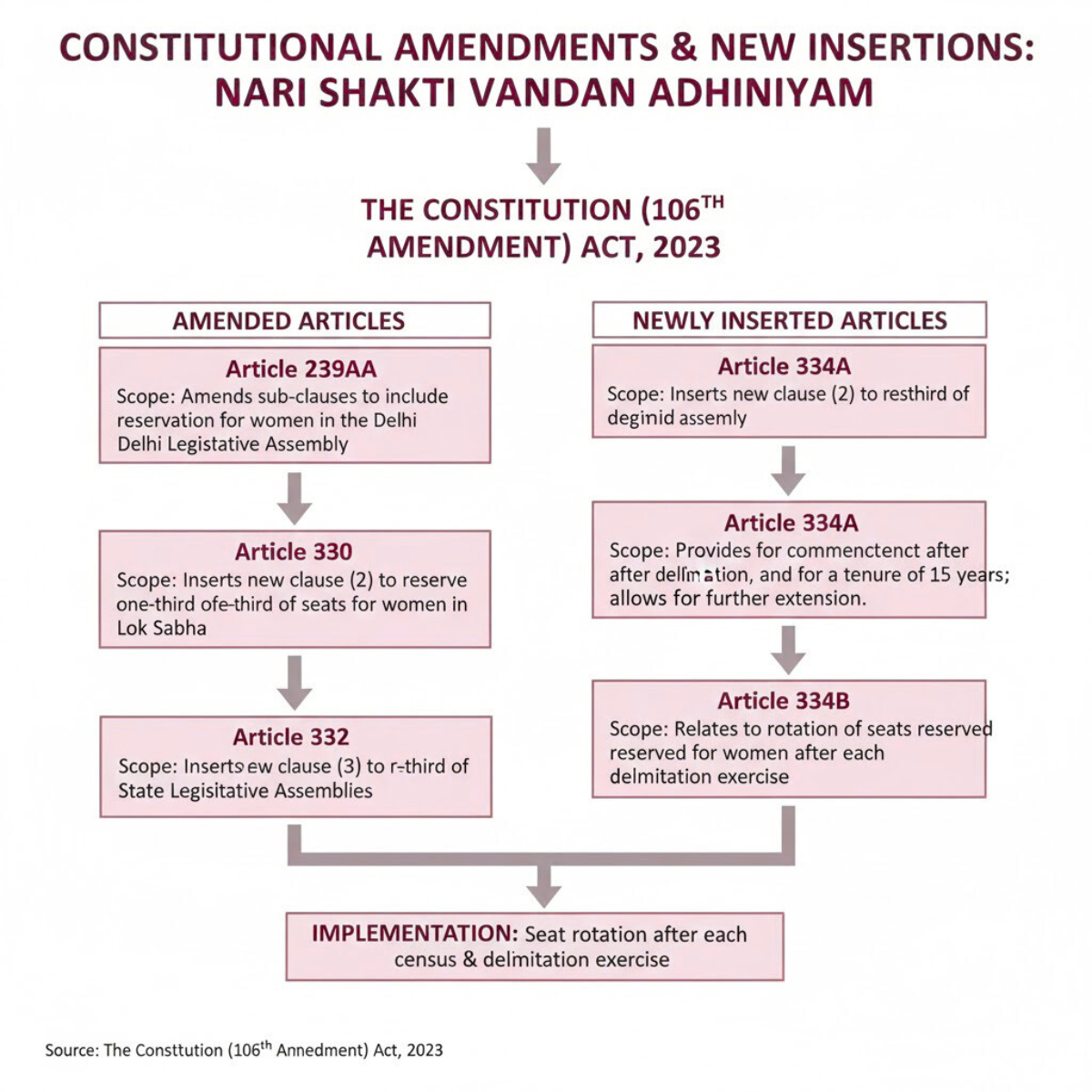
- Amendment to Article 330
- Provides reservation for women in the Lok Sabha.
- Insertion of Article 330A
- Mandates the reservation of seats for women in the Lok Sabha.
- Amendment to Article 332
- Extends reservation for women in State Legislative Assemblies.
- Insertion of Article 332A
- Constitutionally guarantees women’s reservation in the Assemblies.
Relation with Fundamental Principles
- Article 14 – Equality before the law
- Article 15(3) – Permits special provisions for women
- Article 39(a) – Equal right to livelihood and participation
The amendment is a special constitutional amendment enacted under Article 368, reinforcing Parliament’s power to adopt affirmative measures.
Implementation Mechanism
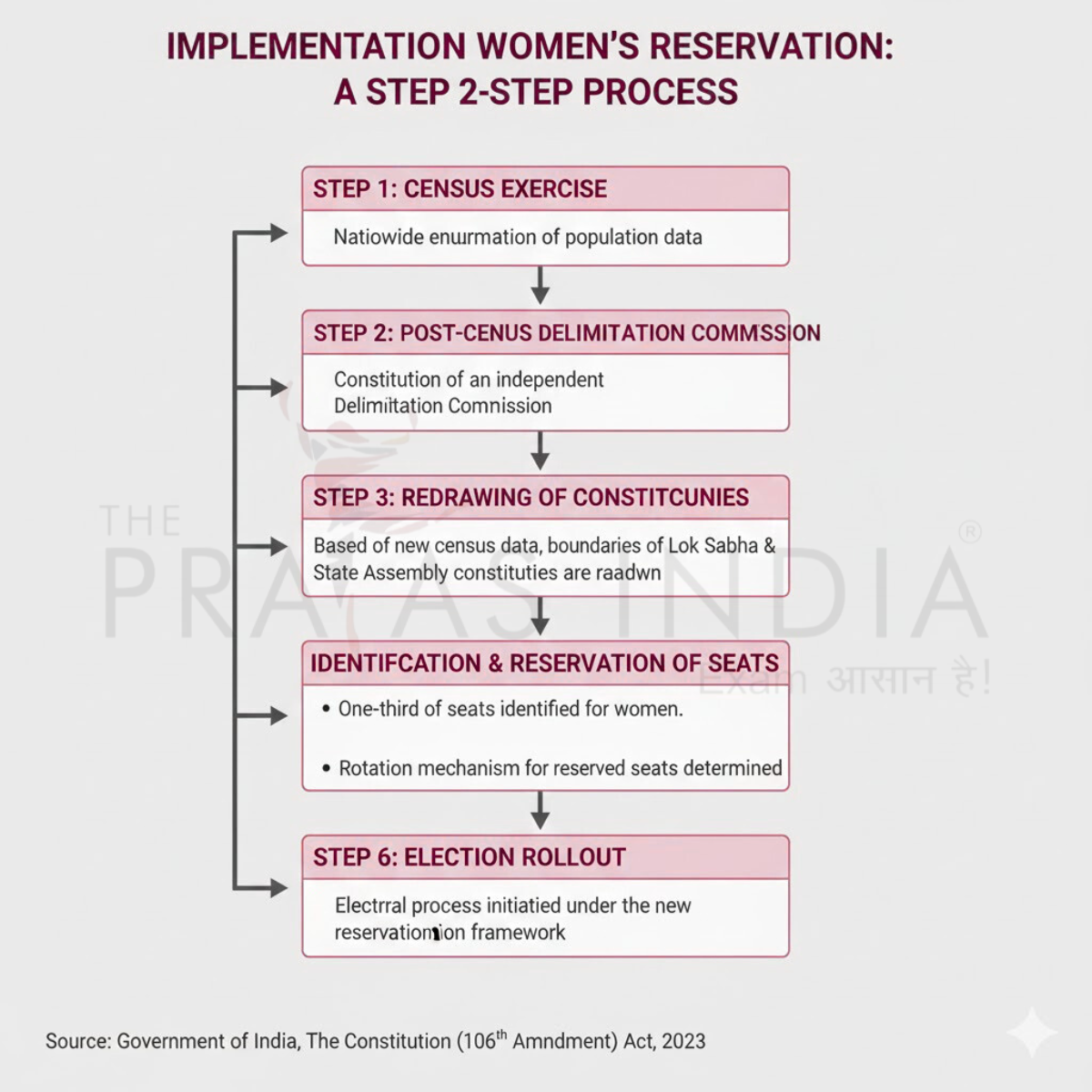
The Act adopts a sequenced implementation model.
Step-by-Step Process
-
Census
-
- A fresh Census must be conducted after the Act’s commencement.
-
Delimitation
-
Constituency boundaries will be redrawn based on updated population data.
-
-
Reservation Rollout
-
One-third of seats in each legislature will be reserved for women.
-
Role of the Delimitation Commission
- An independent constitutional body
- Responsible for identifying and rotating reserved constituencies
Rotation of Reserved Seats
- Reserved seats will be rotated after each delimitation to ensure equitable distribution.
Significance of the Act
a. Democratic Significance
- Inclusive Representation: Ensures women’s voices in law-making.
- Strengthened Participatory Democracy: Broadens the social base of representation.
b. Social Significance
- Advancement of Gender Equality: Moves beyond symbolic inclusion.
- Role-Model Effect: Encourages political participation among young women.
- Breaking Patriarchal Structures: Challenges male-dominated political culture.
c. Governance Impact
- Studies from Panchayati Raj Institutions show women leaders prioritize:
- Health, education, sanitation
- Social welfare and grassroots issues
This suggests potential for women-centric policymaking at higher legislative levels.
Criticisms & Concerns
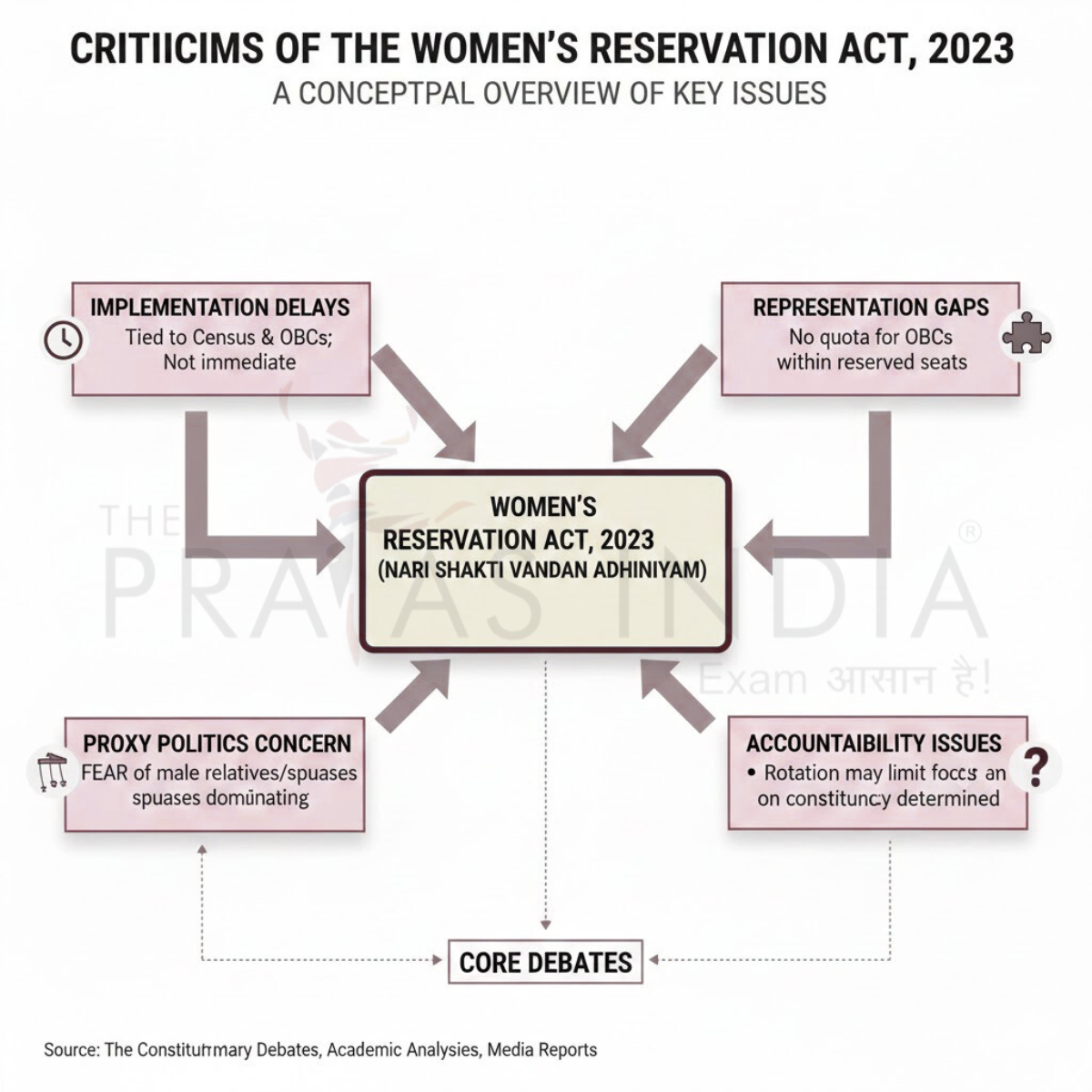
Despite its transformative potential, the Act faces several criticisms.
Major Concerns
- Delay in Implementation
- Dependence on the Census and delimitation may postpone benefits for years.
- Absence of OBC Sub-Quota
- Raises concerns of unequal representation among women.
- Tokenism and Proxy Representation
- Risk of male relatives exercising power indirectly.
- Rotation of Seats
- May weaken accountability and long-term constituency development.
- Urban Elite Capture
- Fear that the reservation may benefit only socially privileged women.
Comparison with Local Self-Government Reservations
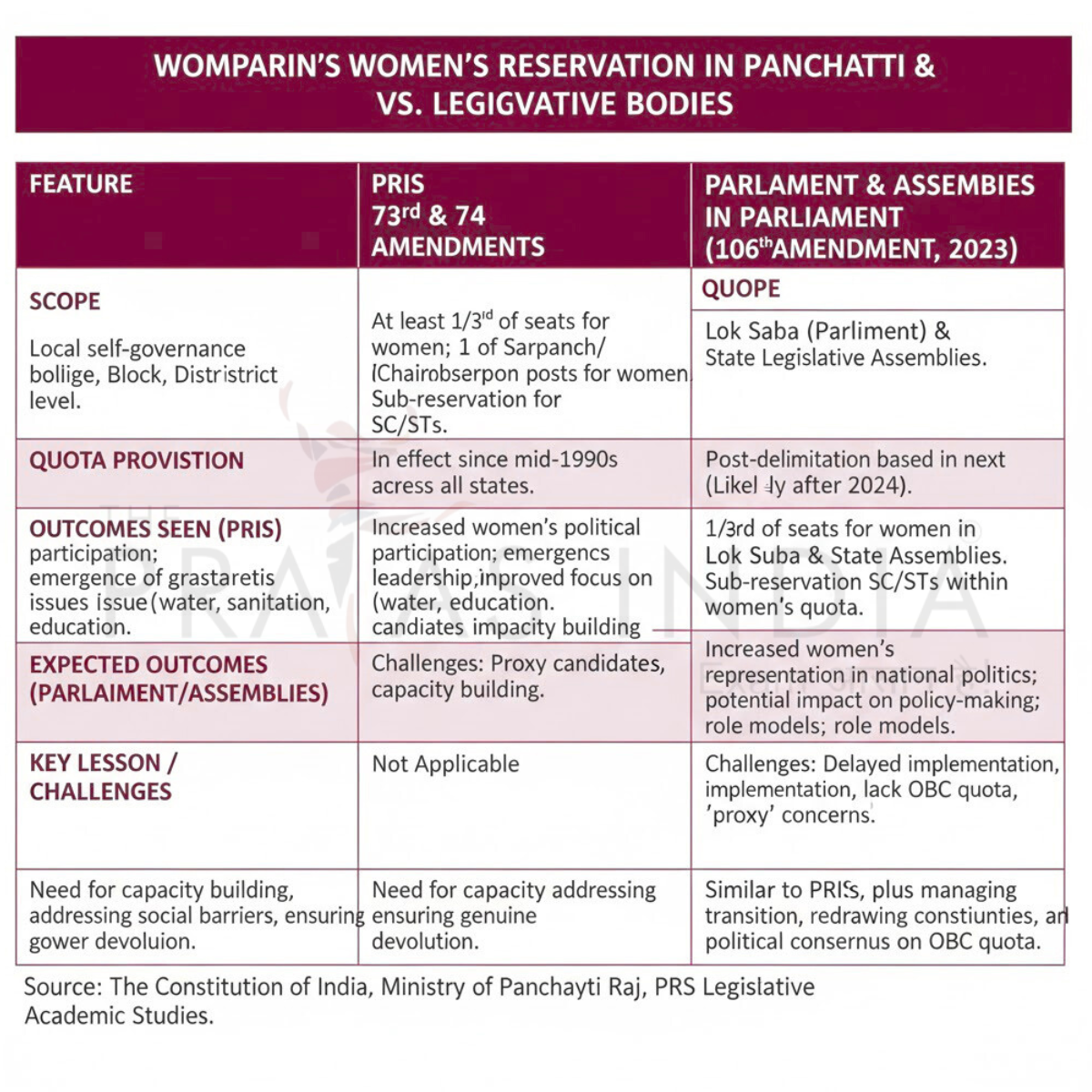
73rd & 74th Constitutional Amendments
-
Mandated 33% (now 50% in many states) reservation for women in Panchayats and Municipalities.
Outcomes Observed
- Increased participation of women in grassroots governance
- Improved service delivery
- Gradual decline in proxy representation over time
Lessons for Parliament and Assemblies
- Capacity building is crucial
- Social acceptance evolves with sustained participation
- Initial challenges should not deter structural reform
Global Perspective
Globally, women’s representation has been enhanced through quota systems:
- Many democracies mandate legislative quotas.
- Countries with quotas show higher women’s participation.
India’s current representation places it below the global average, and the Act has the potential to significantly improve India’s standing in global gender indices.
Way Forward
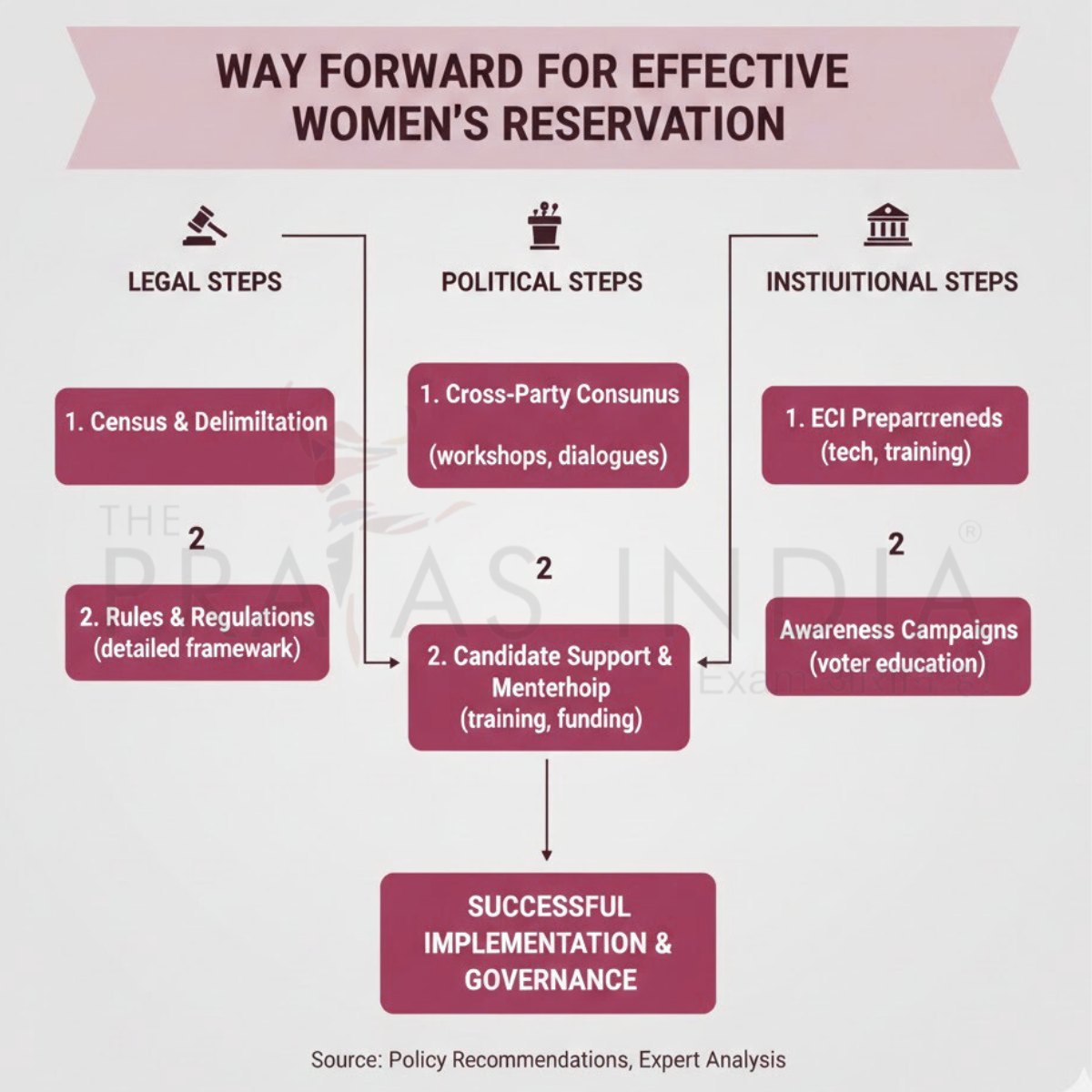
For effective and meaningful implementation, several steps are essential:
-
Timely Census and Delimitation
-
Clear timelines must be established.
-
-
Capacity Building for Women Leaders
-
Training in legislative procedures and leadership skills.
-
-
Addressing OBC Representation Concerns
-
Exploring sub-quotas or alternative mechanisms.
-
-
Internal Party Reforms
-
Transparent candidate selection and leadership opportunities.
-
-
Political Mentorship and Funding Support
-
Reducing financial and structural barriers.
-
Conclusion
The Women Reservation Act, 2023 stands as a constitutional milestone in India’s democratic journey. While challenges in implementation and inclusivity remain, the Act represents a decisive shift from symbolic inclusion to substantive empowerment. Over time, it holds the promise of reshaping legislative priorities, strengthening governance outcomes, and deepening Indian democracy by ensuring that women are not merely voters—but equal architects of the nation’s political future.
Frequently Asked Questions (FAQs) on Women Reservation Act 2023
Q1. What is the Women Reservation Act, 2023?
The Women Reservation Act, 2023, is a constitutional amendment that provides 33% reservation for women in the Lok Sabha and State Legislative Assemblies, including within seats reserved for SCs and STs.
Q2. Why was women’s reservation in legislatures needed?
Women have been historically underrepresented in Indian legislatures despite forming nearly half the population. The Act aims to ensure substantive political equality, inclusive decision-making, and gender-responsive governance.
Q3. When will the Women Reservation Act be implemented?
The Act will be implemented after the next Census and subsequent Delimitation exercise, as reservation is linked to redrawing constituency boundaries.
Q4. Does the Act provide reservation for OBC women?
No. The Act does not include a separate sub-quota for OBC women, which remains one of the major criticisms and unresolved issues.
Q5. For how long will women’s reservation remain in force?
The reservation is valid for 15 years, with a provision allowing Parliament to extend it further if required.
Q6. Which constitutional articles were amended or inserted?
The Act amends Articles 330 and 332 and inserts Articles 330A and 332A, constitutionally mandating women’s reservation in legislatures.
Q7. How will seats be reserved for women?
One-third of the total seats in each legislature will be reserved for women, and these seats will be rotated after each delimitation to ensure equitable distribution.
Q8. What lessons does the Act draw from Panchayati Raj institutions?
Experience from the 73rd and 74th Constitutional Amendments shows that women’s reservation improves participation, service delivery, and policy outcomes, despite initial challenges.
Q9. What are the major criticisms of the Women Reservation Act?
Key concerns include delay in implementation, absence of OBC sub-quota, risk of proxy representation, rotation-related accountability issues, and elite capture.
Q10. Why is the Act significant for Indian democracy?
The Act represents a shift from symbolic inclusion to structural empowerment, strengthening democratic legitimacy, gender justice, and long-term governance outcomes.