7 Signs You Need Professional SSC CGL Coaching | Best SSC Coaching in Mumbai | The Prayas India
Preparing for SSC CGL is often described as a test of knowledge, but in practice, it is equally a test of consistency, decision-making, time management and the ability to prepare in a structured manner. Every year, thousands of candidates begin their preparation with confidence, collect study material, follow online resources and start solving previous-year questions. Yet, after a few months, many find themselves stuck at almost the same level. Their syllabus may be progressing, but their mock-test scores are not improving at the same pace.
This is where the question of professional SSC CGL coaching becomes relevant. Joining a coaching institute is not automatically necessary for every aspirant. A disciplined candidate with a clear strategy, reliable resources and strong self-analysis may be able to prepare independently. However, there are certain situations where external guidance can reduce the trial-and-error involved in preparation and help a student create a more organised path towards the examination.
The important thing is to recognise whether your current preparation system is actually working. If you are repeatedly facing the same problems despite putting in hours of study, the issue may not be a lack of effort. It may be a lack of direction, feedback or structured preparation.
For aspirants considering SSC coaching in Mumbai, the decision should therefore be based on their preparation needs rather than the assumption that coaching is the only route to success. The following seven signs can help you assess whether professional guidance could make a meaningful difference.
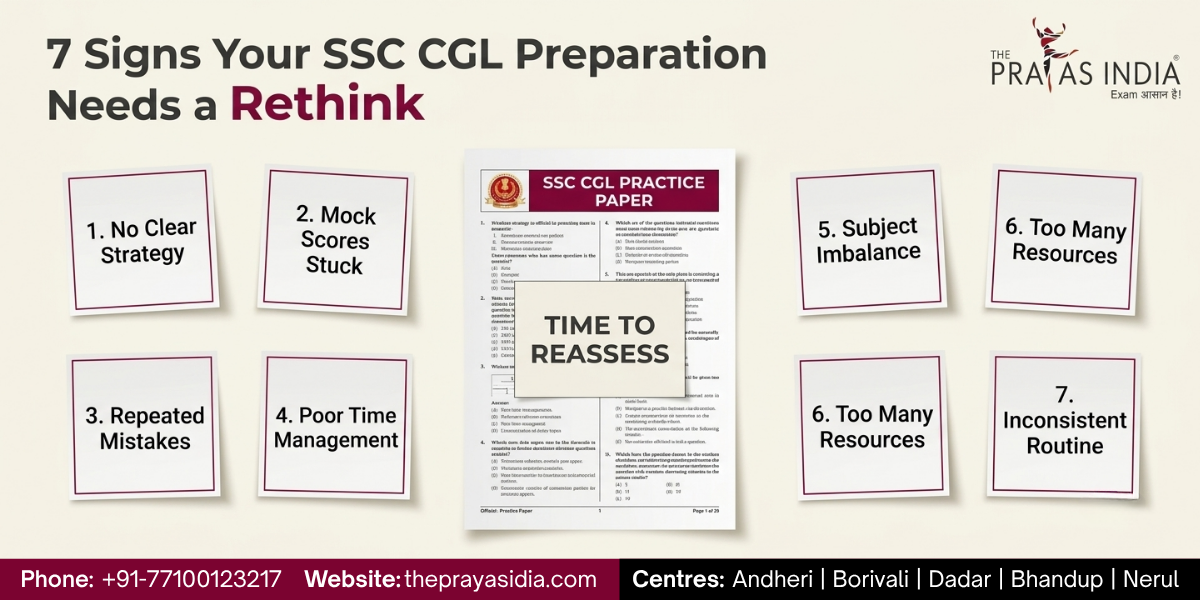
Sign 1: You Study Regularly but Do Not Have a Clear Strategy
One of the first signs that professional guidance may be useful is when you are studying consistently but cannot clearly explain what your preparation plan is.
You may spend several hours every day watching lectures, solving questions and reading notes, yet still feel uncertain about what should be completed first, how much practice is enough or when you should move from one stage of preparation to another. This can create a situation where you are busy throughout the day without necessarily making proportional progress.
SSC CGL preparation involves multiple subjects and different types of skills. Quantitative Aptitude requires conceptual understanding and calculation practice. Reasoning demands familiarity with patterns and efficient problem-solving. English requires vocabulary, grammar, comprehension and regular exposure, while General Awareness requires a practical approach to static and current topics.
Trying to manage all of these areas without a framework can make preparation fragmented. You may spend too much time on subjects you enjoy and postpone topics that you find difficult. A structured coaching environment can help bring these different components into one preparation plan.
The real benefit is not simply receiving a timetable. It is understanding what to study, why it matters, how deeply to study it and how to measure whether you have improved.
If you already have this system through self-study, coaching may not be necessary. But if your preparation repeatedly changes direction, professional guidance can provide useful structure.
Sign 2: Your Mock-Test Scores Have Stopped Improving
A plateau in mock-test performance is one of the clearest indicators that something in your preparation needs to change.
Initially, scores often improve quickly because basic concepts are being learned and familiar questions become easier. After a point, however, progress can slow down. You may continue taking tests, but your score remains within the same range.
This does not necessarily mean that you need to study more hours. In many cases, the problem lies in how the mock tests are being analysed.
For example, imagine that your score remains around the same level across several tests. You might assume that your concepts are weak and start revising entire chapters. But detailed analysis could reveal that your concepts are actually adequate. Perhaps you are losing marks because of calculation errors, spending too much time on difficult questions, attempting questions without checking accuracy or failing to manage General Awareness effectively.
Without proper analysis, it is easy to treat every low score as a knowledge problem.
Professional guidance can be useful because an experienced faculty member can help identify patterns that you may overlook yourself. The goal is not simply to tell you whether your score is good or bad. It is to determine why your score is at that level and what specific change can move it upward.
For serious SSC CGL aspirants, mock-test analysis should become a diagnostic process rather than merely a score-checking exercise.
Sign 3: You Keep Repeating the Same Mistakes
Everyone makes mistakes while preparing for a competitive examination. The concern begins when the same mistake appears repeatedly.
You may repeatedly confuse similar grammar rules, make calculation errors in percentage-based questions, choose the wrong approach in reasoning or forget information that you have already revised several times.
Repeated mistakes usually indicate that simply solving more questions is not enough.
The first step is to classify the mistake. Was it caused by a conceptual gap? Did you misread the question? Was the problem caused by calculation? Did you rush because of time pressure? Or did you know the answer but fail to recall it?
Once the cause is identified, the solution becomes much more specific.
This is one area where a structured learning environment can provide value. Instead of looking at every wrong answer independently, a mentor or faculty member can help identify recurring patterns across your performance.
For example, ten wrong questions may appear to be ten separate problems. But if seven of them are actually caused by one underlying weakness, fixing that weakness can improve performance across multiple question types.
This is why serious preparation should include an error-analysis system, not just a question-solving system.
Sign 4: You Spend Too Much Time on Individual Questions
SSC CGL is not simply about knowing how to solve a question. It is also about knowing when a question deserves your time.
A candidate may understand a difficult Quant or Reasoning question perfectly but still make a poor exam decision by spending several minutes solving it. During that time, multiple easier questions may remain unanswered.
This problem often becomes visible during mock tests. You may notice that your accuracy is reasonably good, but your attempts remain lower than expected. Alternatively, you may attempt enough questions but lose marks because you rush through the final part of the section.
Time management in SSC CGL therefore has two dimensions: solving speed and decision-making.
Professional coaching can help candidates understand the difference between a question that is difficult but worth attempting and one that is simply time-consuming. Exposure to different question types, timed practice and regular sectional tests can gradually improve this judgement.
However, coaching should not encourage blind speed. The objective should be to develop controlled speed, where you know when to accelerate, when to slow down and when to move on.
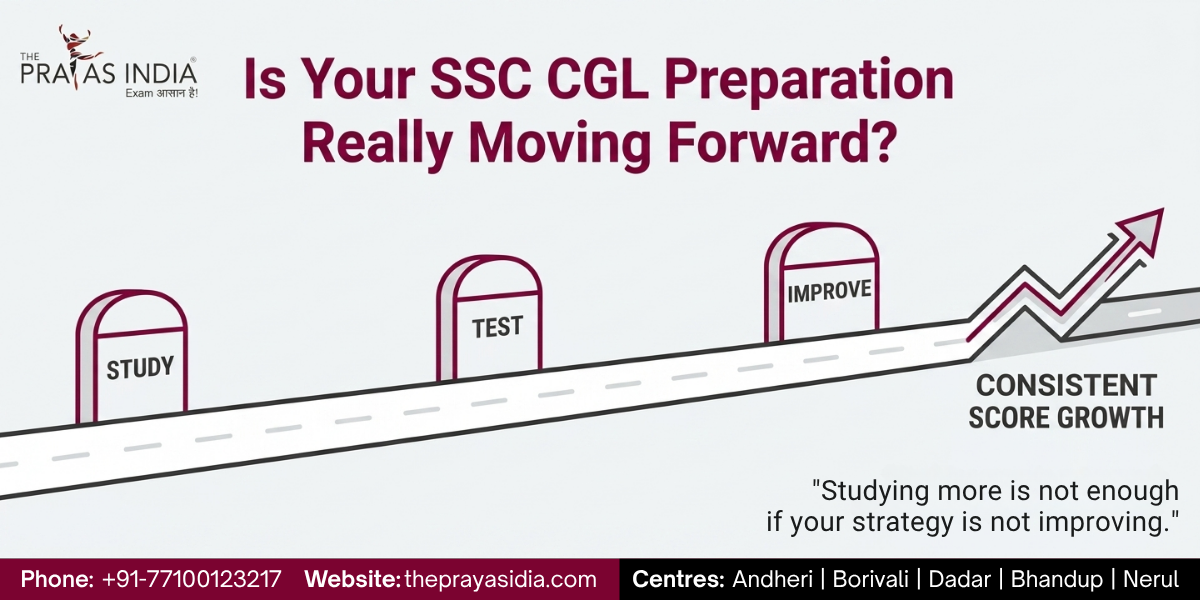
Sign 5: You Find It Difficult to Balance All SSC CGL Subjects
SSC CGL preparation becomes challenging when one subject begins consuming the time meant for everything else.
A candidate who is comfortable with Quant may spend most of the day solving mathematics and leave English or General Awareness for later. Another candidate may enjoy Reasoning because questions feel more manageable and repeatedly postpone Quant.
This creates an uneven preparation profile.
The SSC CGL examination rewards overall performance. A strong score in one section cannot completely compensate for consistently weak preparation in another. Therefore, your study schedule needs to ensure that every important subject receives regular attention.
This does not mean dividing your study time equally. Different candidates will need different allocations depending on their strengths and weaknesses. Someone with strong English may need maintenance-level practice, while another candidate may require concentrated work on grammar and comprehension.
Professional coaching can help bring this balance into the preparation process. Faculty guidance, structured classes and planned practice can reduce the possibility of completely neglecting a weak subject.
The objective is not to make every subject equally strong overnight. It is to prevent any major weakness from becoming a barrier to your overall SSC CGL performance.
Sign 6: You Are Unsure Which Resources and Questions to Trust
The internet has made SSC CGL preparation material more accessible than ever. At the same time, the sheer volume of content can create another problem: resource overload.
One educator recommends one book. Another suggests a different question bank. Social media posts highlight new shortcuts every week. You may save hundreds of PDFs, videos and practice sets without completing even a small portion of them properly.
More resources do not automatically mean better preparation.
In fact, constantly switching between materials can make preparation less efficient. You may encounter different explanations for the same concept, different difficulty levels and different approaches to the same question.
A structured preparation system can help simplify this process by giving students a defined set of learning resources and practice material. Instead of spending hours deciding what to study, more time can be devoted to actual preparation.
This is particularly valuable for beginners who are still learning how SSC CGL questions are framed.
The right question is not, “How many resources do I have?” It is, “Can I confidently complete and revise the resources I am already using?”
Sign 7: You Need External Accountability to Stay Consistent
Preparation for SSC CGL is a long process. Motivation can help you start, but consistency determines how much of the plan actually gets completed.
Some students are highly disciplined when studying independently. Others begin strongly but gradually lose routine. They postpone mock tests, skip difficult topics or keep changing their study schedule.
If you repeatedly create plans but struggle to follow them, an external structure may help.
Classes, scheduled tests, faculty interactions and a peer learning environment can create accountability. When there is a defined schedule, preparation becomes less dependent on whether you feel motivated on a particular day.
This does not mean that coaching automatically creates discipline. The student still has to do the work. But a structured environment can make it easier to maintain a routine.
For an aspirant who has already tried self-study multiple times but cannot maintain consistency, this can be an important factor when deciding whether professional SSC CGL coaching is worth considering.
Coaching Is Not a Substitute for Self-Study
Recognising these signs does not mean that joining a coaching institute will automatically solve every preparation problem.
Professional coaching can provide structure, faculty guidance, curated practice, mock tests and performance feedback, but the candidate still needs to revise, practise questions and analyse mistakes independently.
The most effective preparation usually combines guided learning with self-study.
Classes can help you understand concepts and avoid unnecessary trial-and-error. Self-study allows you to strengthen those concepts through repeated practice. Mock tests reveal how effectively you can apply what you have learned, while analysis shows what needs to change.
Therefore, the decision to join coaching should be based on whether the additional structure and guidance can address a genuine weakness in your current preparation system.
What Should You Look for Before Choosing SSC CGL Coaching?
If you identify several of the signs above, the next question should not immediately be, “Which institute should I join?”
First ask what kind of support you actually need.
If your concepts are weak, look for strong faculty-led teaching. If your concepts are clear but scores are stagnant, prioritise mock tests and performance analysis. If time management is your problem, look for regular timed practice. If consistency is the challenge, examine the institute’s study structure and academic schedule.
You should also evaluate whether the teaching approach matches your learning style. A coaching programme should not simply provide large quantities of content. It should help you understand concepts, practise effectively and measure progress.
For aspirants considering SSC coaching in Mumbai, factors such as faculty experience, quality of study material, test structure, doubt support, revision process and the overall learning environment deserve attention.
The decision becomes much easier when you first identify the problem you are trying to solve.
Admission Decision: Ask Yourself These Questions
Before enrolling in professional SSC CGL coaching, take an honest look at your current preparation.
Are you following a consistent study plan? Are your mock scores improving? Do you know why you lose marks? Are you able to balance all subjects? Can you select the right questions under time pressure? Are you revising effectively? Are you able to remain consistent without external accountability?
If most answers are positive, self-study may already be working for you.
If several answers are negative, professional guidance could potentially improve the structure of your preparation.
The purpose of this assessment is not to convince every aspirant to join coaching. It is to help you identify whether your current method is producing the progress you expect.
The Prayas India and a Structured SSC CGL Preparation Approach
For students who decide that professional guidance fits their preparation needs, The Prayas India provides a structured environment for competitive-exam preparation.
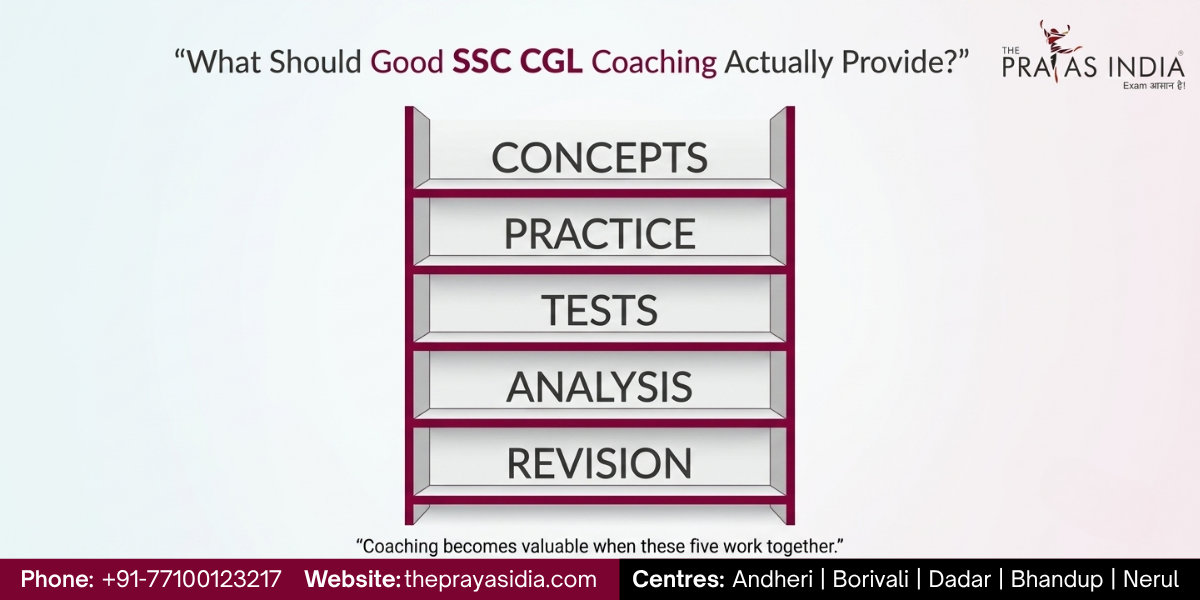
The focus should not simply be on attending classes. A useful SSC CGL preparation system needs to connect concept learning, practice, testing, analysis and revision.
Students preparing through a structured programme can use faculty guidance to clarify concepts, practise exam-oriented questions and identify areas that require additional attention. Regular testing can then help measure whether that preparation is translating into better performance.
For aspirants looking for SSC Coaching in Mumbai, this kind of structured approach can be particularly useful when self-study has become inconsistent or when repeated mock-test problems are difficult to diagnose independently.
The decision to enrol should ultimately come from your preparation needs, your current performance and the kind of academic support you believe will help you progress.
Key Takeaway
The need for professional SSC CGL coaching is not determined by whether you are an average student or a strong student. It depends much more on how effectively your current preparation system is working.
If you have a clear strategy, consistent routine, reliable resources and the ability to analyse your own performance, self-study can be a viable path. But if your preparation repeatedly suffers from unclear planning, stagnant mock scores, recurring mistakes, poor time management, subject imbalance, resource overload or inconsistency, professional guidance may be worth considering.
The most important decision is not whether coaching is inherently better than self-study. It is whether your current method is taking you closer to the level of performance you need.
Coaching Should Solve a Preparation Problem
The first thing to understand before joining an SSC CGL coaching programme is that coaching should solve a genuine preparation problem.
If your difficulty is conceptual, you need strong classroom or faculty support. If you understand concepts but cannot improve your mock scores, you need better testing and analysis. If you struggle with consistency, a structured schedule may be more valuable than additional study material.
This distinction matters because joining coaching without identifying your actual problem can lead to another collection of resources rather than a better preparation system.
A good coaching programme should fit into your preparation rather than make preparation unnecessarily complicated.
For an aspirant considering SSC Coaching in Mumbai, the admission decision should therefore begin with self-assessment and only then move towards comparing institutes.
Look Beyond the Number of Classes
A large number of classes may appear impressive, but quantity alone does not determine the quality of preparation.
The more useful question is what happens around those classes.
Does the programme provide regular practice? Are there sectional and full-length tests? Is there a mechanism for analysing performance? Can students clarify doubts? Is there a revision plan? Are students exposed to previous-year questions and exam-oriented practice?
These elements determine whether classroom teaching becomes usable exam preparation.
A student may attend hundreds of lectures but still struggle in the examination if there is insufficient practice and testing. Similarly, a well-designed programme can be more useful when every class connects naturally with practice and revision.
The ideal approach is therefore to evaluate the complete academic ecosystem, not simply the number of lectures included in a course.
Faculty Guidance Can Reduce Trial and Error
One of the practical benefits of professional coaching is access to faculty guidance.
When studying independently, an aspirant may spend several days trying different approaches to a difficult topic. Sometimes that exploration is useful, but sometimes it simply consumes preparation time.
A faculty member who understands competitive-exam requirements can help identify whether the problem is conceptual, methodological or related to exam execution.
This does not mean students should blindly follow every shortcut or strategy suggested by someone else. The purpose of guidance is to understand the reasoning behind a method and determine whether it works for you.
Good mentorship should gradually make students more independent rather than making them dependent on constant instructions.
A Strong Test Series Should Be Part of the Preparation
For SSC CGL aspirants, testing is not something that should begin only after the syllabus is complete.
Tests provide an opportunity to convert preparation into measurable performance.
A useful test programme should expose students to different levels and combinations of questions while allowing them to track progress over time.
But the test itself is only half the process.
The more important stage begins after submission. Candidates should understand where marks were lost, which questions consumed too much time, which errors were avoidable and which topics require additional work.
This creates a continuous cycle:
Learn → Practise → Test → Analyse → Correct → Retest
Professional coaching can make this cycle more structured, particularly for students who struggle to analyse their performance independently.
Study Material Should Reduce Noise, Not Add More
One of the advantages of structured coaching can be having a defined preparation path.
For SSC CGL, students have access to an enormous amount of online content. While this accessibility is useful, it can also make preparation confusing.
A structured programme can help students identify what needs to be studied first, which questions deserve more practice and which material should be revised repeatedly.
The objective should not be to provide hundreds of PDFs. Good study material should be relevant, organised and usable.
Students should be able to revise from it, practise questions from it and identify their weak areas without continuously searching for new sources.
Doubt Resolution Is More Important Than It Looks
A small conceptual doubt can sometimes become a recurring source of mistakes.
For example, a student may know a particular Quant formula but misunderstand the condition under which it should be applied. Similarly, a grammar rule may appear simple until it is used in an exam-style sentence.
If such doubts remain unresolved, the student may continue practising the wrong approach.
A good learning environment should therefore make doubt resolution accessible. Students should feel comfortable asking why an answer is correct rather than simply memorising the answer.
This is particularly valuable for beginners because early misunderstandings can influence their approach to an entire topic.
Evaluate the Learning Environment Before Admission
The environment in which you study can influence consistency.
A preparation environment becomes useful when students have access to structured classes, regular tests, academic interaction and peers who are working towards similar goals.
This does not mean competition with classmates should become the centre of preparation. The more productive role of a peer environment is to normalise consistent study and create a sense of academic routine.
If possible, aspirants should understand how an institute conducts classes, tests and doubt sessions before making an admission decision.
The question should be:
“Will this environment help me follow my preparation plan more effectively?”
That is more useful than simply asking whether an institute is popular.
Coaching and Self-Study Should Work Together
Professional coaching should not replace self-study.
In fact, the most productive approach is usually a combination of both.
Classes provide direction and conceptual clarity. Self-study converts that knowledge into skill. Tests reveal your current performance. Analysis tells you what needs to change.
A student who attends classes regularly but does not revise or practise independently will still struggle.
Similarly, a student who studies independently but has no system for identifying mistakes may continue repeating them.
The two approaches become stronger when they complement each other.
Create Your Own SSC CGL Performance Dashboard
You do not need complicated software to track your progress.
A simple notebook or spreadsheet can record your mock-test score, attempts, accuracy, time-management problems and major subject-wise weaknesses.
Over several tests, look for trends rather than individual scores.
If your accuracy consistently improves, your preparation is moving in the right direction even if your overall score takes time to rise.
If your attempts rise while accuracy falls, your speed strategy may need adjustment.
If one subject repeatedly remains weak, it deserves additional attention.
This kind of tracking makes the admission decision more objective too. If structured guidance helps you identify and address these issues, you can measure whether the support is actually benefiting your preparation.
Do Not Join Coaching Simply Because Others Are Joining
Competitive-exam preparation often comes with social pressure.
Friends may join coaching. Seniors may recommend a particular institute. Social media may repeatedly show advertisements for different programmes.
None of these factors should be the primary reason for your admission.
Your decision should depend on your own preparation requirements.
If you are already performing consistently through self-study, there may be no reason to change your system simply because others are doing so.
But if you have repeatedly attempted self-study and continue facing the same problems, structured coaching may be worth evaluating.
The strongest admission decision is one based on evidence from your own preparation.
Questions to Ask Before Taking Admission
Before enrolling in an SSC CGL coaching programme, ask practical questions rather than focusing only on promotional claims.
Understand the teaching structure, test schedule, study material, doubt-support process and revision approach. Find out how performance is tracked and how students are expected to analyse their tests.
Also consider the practical side of the programme. Travel time, class schedule and the ability to maintain self-study alongside classes can all influence consistency.
An excellent programme that you cannot attend regularly may be less useful than a programme that fits naturally into your daily routine.
Admission should therefore be evaluated from both an academic and practical perspective.
How to Know Whether Coaching Is Actually Helping
Joining coaching should lead to measurable changes in your preparation.
You should gradually become more comfortable with concepts, more consistent in practice and more aware of your mistakes.
Your mock-test analysis should become more detailed. Your question-selection decisions should improve. You should understand your weak areas more clearly.
The improvement may not always appear immediately in the overall score. Sometimes the first improvement is reduced negative marking, better accuracy or fewer questions left incomplete.
Over time, these smaller improvements can combine into meaningful score growth.
This is why students should evaluate coaching based on progress in preparation quality, not simply the number of classes attended.
The Prayas India: Structured Guidance Without Replacing Your Effort
For aspirants who decide that professional guidance is appropriate for their preparation, The Prayas India offers a structured environment for SSC CGL preparation.
The value of such an environment should be viewed through the complete preparation cycle: learning concepts, practising questions, taking tests, analysing performance and revising weak areas.
The objective is not to make students dependent on coaching. Instead, structured guidance should help them develop better preparation habits and become increasingly confident in managing their own performance.
For students looking for SSC Coaching in Mumbai, this approach can be particularly relevant when they need a more organised preparation system without losing the importance of individual self-study.
The final decision, however, should always be based on the student’s own needs, current performance and preferred learning style.
A Practical Decision Framework for SSC CGL Aspirants
You can broadly place yourself into three categories.
Category 1: Self-Study Is Working
If you have a consistent schedule, your mock scores are improving, your mistakes are reducing and you know how to analyse your performance, you may already have a functional preparation system.
In this case, coaching is optional rather than essential.
Category 2: You Are Progressing but Need Direction
Perhaps your preparation is reasonably consistent, but you struggle with one or two areas such as Quant, English, mock analysis or time management.
Targeted guidance, mentorship or a structured test programme may be enough. You do not necessarily need to completely change your preparation approach.
Category 3: Your Preparation Is Repeatedly Stuck
If your study plan changes frequently, mock scores remain stagnant, mistakes repeat, resources are overwhelming and consistency is difficult, professional coaching may provide the structure you are currently missing.
This is the situation in which a coaching programme may offer the greatest practical value.
Why Timing Matters in an SSC CGL Preparation Decision
The decision to join coaching should also consider where you are in your preparation cycle.
A beginner may benefit from structured guidance from the beginning because it can establish a clear foundation.
An intermediate aspirant may require targeted support to overcome specific weaknesses.
A candidate approaching the examination may benefit more from mock tests, revision and performance analysis than from starting an entirely new learning system.
Therefore, the right type of support can change depending on your preparation stage.
The important thing is to avoid making a rushed admission decision simply because the examination is approaching.
What Professional Coaching Should Ultimately Give You
The real value of coaching should not be measured only by the classes you attend.
Ideally, it should help you develop:
Concept clarity so that you understand why an answer works.
Exam awareness so that you recognise common question patterns.
Practice discipline so that learning becomes consistent.
Performance analysis so that mistakes become actionable.
Time-management ability so that you can make better decisions during the examination.
Revision discipline so that previously learned concepts remain usable.
And finally, confidence based on preparation, rather than confidence based only on motivation.
That is the difference between simply joining a coaching programme and actually using coaching as part of an effective preparation strategy.
Final Takeaway
The decision to join professional SSC CGL coaching should not be based on fear, peer pressure or the belief that coaching is compulsory for success.
Instead, examine your preparation honestly.
If you have a clear strategy, reliable resources, improving mock scores and strong self-discipline, you may be able to continue successfully with self-study.
But if you repeatedly struggle with planning, mock-test performance, recurring mistakes, time management, subject balance, resource selection or consistency, professional guidance may help you build a more organised preparation system.
For aspirants considering SSC Coaching in Mumbai, the best institute is not necessarily the one with the loudest promotion. It is the one whose academic approach matches your actual preparation needs.
Ultimately, coaching should serve one purpose: helping you prepare better, identify your weaknesses earlier and move towards the SSC CGL examination with greater clarity and control.
Contact Us
- Call Now: +91-77100 13217
- Website: theprayasindia.com
- Centres: Andheri | Borivali | Dadar | Nerul | Bhandup
Frequently Asked Questions
1. Is professional coaching necessary for SSC CGL preparation?
No. Coaching is not compulsory for every aspirant. Students with strong self-discipline, reliable resources and a clear preparation strategy can prepare independently. Coaching may be useful when an aspirant needs structured guidance, regular testing or help identifying recurring weaknesses.
2. How do I know if I need SSC CGL coaching?
Look at your preparation objectively. If your mock scores are stagnant, mistakes keep repeating, time management is poor, your study plan lacks structure or you cannot remain consistent despite repeated attempts, professional guidance may be worth considering.
3. Can an average student benefit from SSC CGL coaching?
Yes. Coaching can provide structured learning, practice and performance feedback, but improvement still depends on the student's consistency and effort. The purpose of coaching should be to make preparation more organised, not to replace self-study.
4. What should I check before joining SSC CGL coaching?
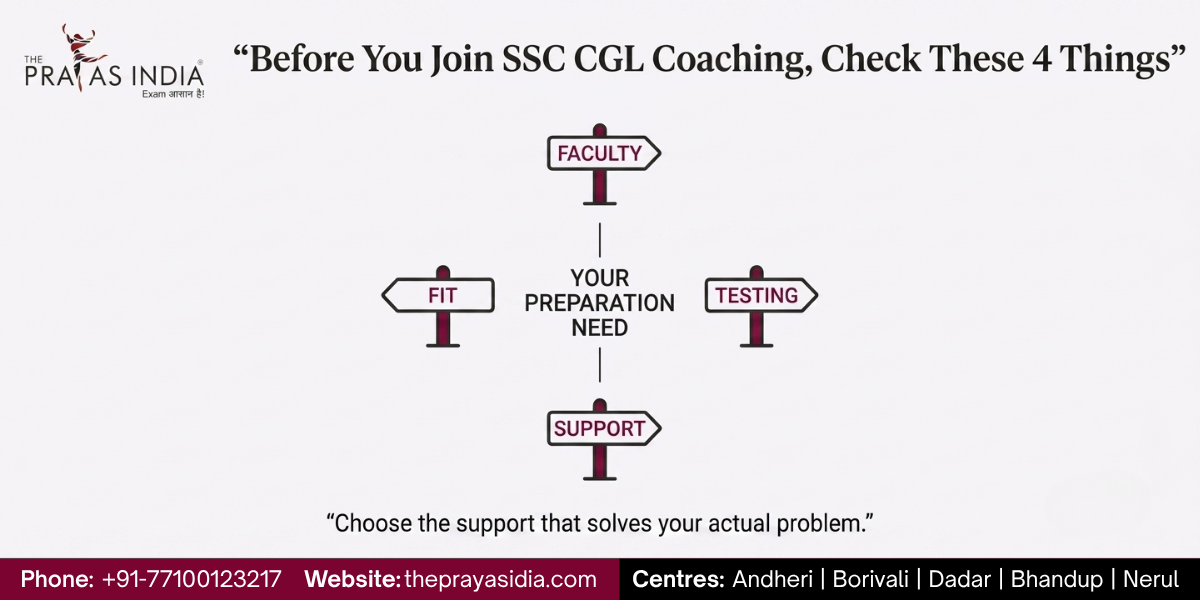
Evaluate faculty, teaching methodology, study material, test series, doubt support, revision structure, performance analysis and class schedule. Also consider whether the programme fits your daily routine.
5. Is SSC CGL coaching in Mumbai useful for beginners?
It can be useful for beginners who are unsure about syllabus coverage, question patterns, study resources or preparation sequencing. A structured programme can reduce unnecessary trial and error during the initial stage.
6. Can coaching improve my SSC CGL mock-test scores?
Coaching can provide structured testing and analysis, which may help identify weaknesses. However, score improvement depends on how consistently the student uses feedback, practises and revises.
7. Should I join coaching if I am already preparing through self-study?
Not necessarily. If your self-study system is producing consistent progress, there may be no need to change it. Consider coaching when you identify a specific problem that additional guidance could realistically address.
8. How important is mock-test analysis for SSC CGL?
It is extremely important because a mock score alone does not explain why marks were lost. Analysis can reveal conceptual gaps, calculation errors, poor question selection, time-management issues and avoidable mistakes.
9. Does joining coaching guarantee SSC CGL selection?
No. No coaching programme can guarantee selection. Final performance depends on preparation quality, practice, consistency, examination performance and several other factors.
10. Is classroom coaching better than self-study?
Neither is universally better. Classroom coaching can provide structure and guidance, while self-study provides flexibility and individual practice. Many students benefit from combining both.
11. When should I join SSC CGL coaching?
The best time depends on your preparation stage. Beginners may benefit from structured guidance early, while experienced candidates may need targeted support, testing or revision rather than complete foundational coaching.
12. What is the biggest benefit of professional SSC CGL coaching?
One of the biggest benefits can be structured preparation. Good coaching can connect concepts, practice, testing, analysis and revision instead of leaving students to organise every component independently.