Railway Exam Preparation Tips for Beginners | Best RRB Coaching in Mumbai | The Prayas India
Preparing for Railway Recruitment Board (RRB) examinations is one of the smartest career decisions for candidates seeking a stable government job with long-term growth, attractive benefits, and nationwide opportunities. Every year, lakhs of aspirants compete for posts such as RRB NTPC, RRB Group D, RRB ALP, RRB Technician, RRB JE, and several other Railway vacancies. While the opportunities are significant, the competition is equally intense.
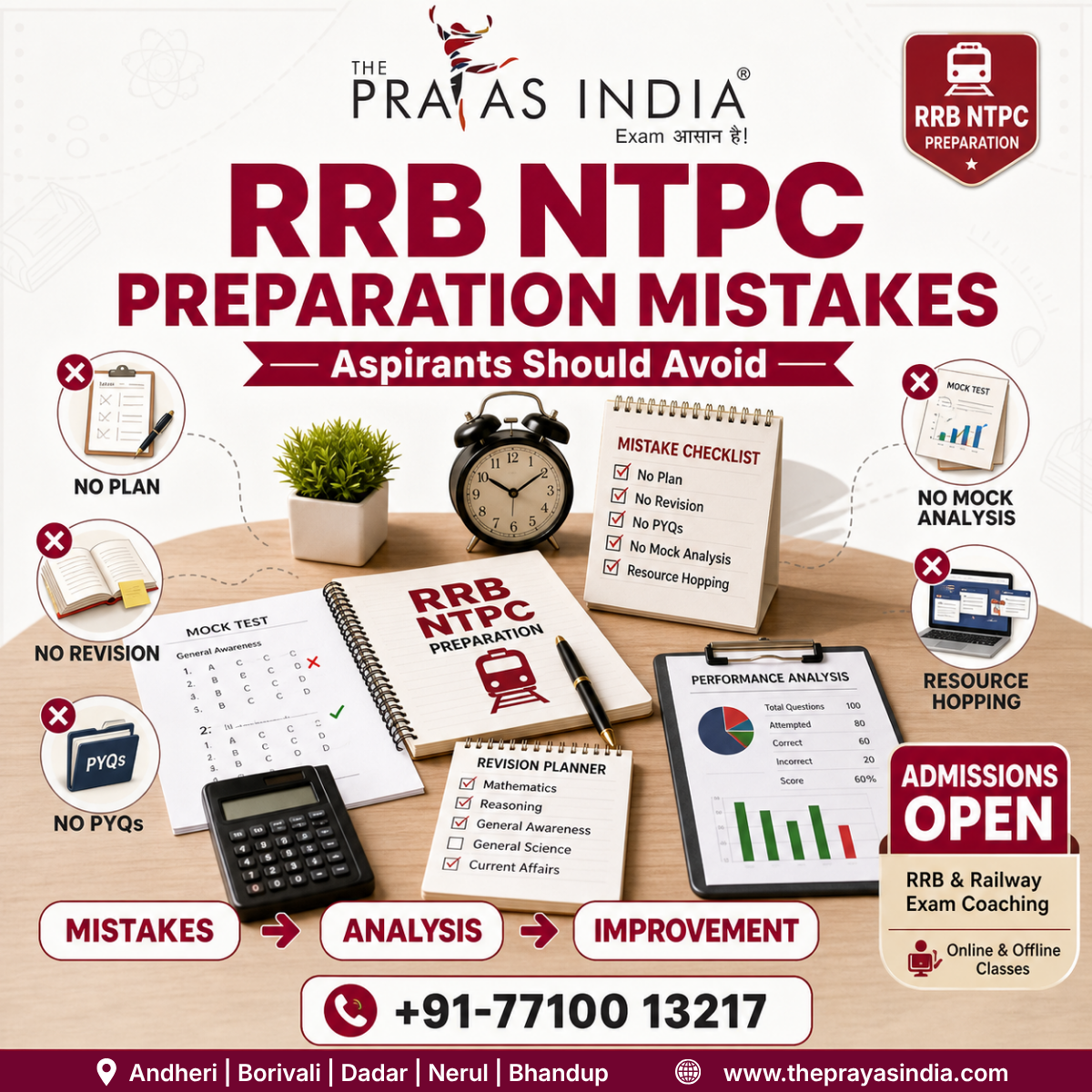
Many beginners begin their preparation with enthusiasm but soon find themselves overwhelmed by the vast syllabus, multiple subjects, changing exam patterns, and the pressure of staying consistent. Some spend months collecting study materials without actually studying, while others solve random questions without understanding the concepts. These common mistakes often delay progress and reduce confidence.
Just as a train cannot begin its journey from the wrong platform, Railway exam preparation cannot move in the right direction without a solid starting point. Before thinking about selection, rank, or cut-offs, every beginner needs a dependable preparation platform that ensures every effort moves toward the correct destination.
This article introduces The Railway Preparation Launchpad—a practical approach designed especially for beginners. Instead of rushing into advanced practice, this concept focuses on building the right foundation through structured learning, disciplined habits, continuous practice, regular revision, mock tests, and consistent improvement.
Whether you are preparing for RRB NTPC, RRB Group D, RRB ALP, RRB Technician, RRB JE, or upcoming Railway Recruitment Board examinations, this guide will help you begin with clarity and confidence.
Why Beginners Struggle in Railway Exams
The Railway syllabus is not impossible, but the absence of proper direction makes it feel difficult for many first-time aspirants.
Most beginners believe that preparing for Railway exams simply means studying harder. In reality, successful preparation depends more on studying smarter. Without understanding the examination process, candidates often invest time in activities that produce little improvement.
Some of the most common reasons beginners face difficulties include:
Lack of Understanding of the Exam Pattern
Many candidates start solving questions before understanding the exam structure. Every Railway examination has its own marking scheme, subject weightage, and level of difficulty. Ignoring these basics leads to ineffective preparation.
Collecting Too Many Study Materials
The internet provides thousands of PDFs, YouTube videos, coaching notes, and books. Beginners often spend more time searching for resources than actually learning from them. Too many sources create confusion instead of clarity.
Inconsistent Daily Routine
Railway preparation rewards consistency rather than occasional long study sessions. Missing several study days every week interrupts learning and makes revision difficult.
Ignoring Practice
Reading concepts alone is not enough. Railway examinations test speed, accuracy, and decision-making under time pressure. Without regular practice, even well-prepared candidates struggle during the actual examination.
Fear of Mock Tests
Many beginners postpone mock tests because they fear low scores. Unfortunately, avoiding mock tests also means missing opportunities to discover weaknesses before the real examination.
Lack of Performance Analysis
Some aspirants attempt hundreds of questions every week but never review their mistakes. Without analysing errors, the same mistakes keep recurring.
These challenges are common among beginners, but they are also preventable. The solution is not studying longer hours—it is preparing through a structured system that gradually builds confidence and competence.
The Railway Preparation Launchpad

Imagine a modern railway station early in the morning.
Several trains are ready for departure. Each train has a destination, a schedule, and a platform. Before any train begins its journey, every technical check is completed. The platform is organised, signals are verified, passengers are ready, and only then does the train move forward.
Railway exam preparation follows a similar principle.
A successful journey towards an RRB selection does not begin with attempting thousands of questions or purchasing expensive books. It begins by creating a preparation launchpad that supports every stage of learning.
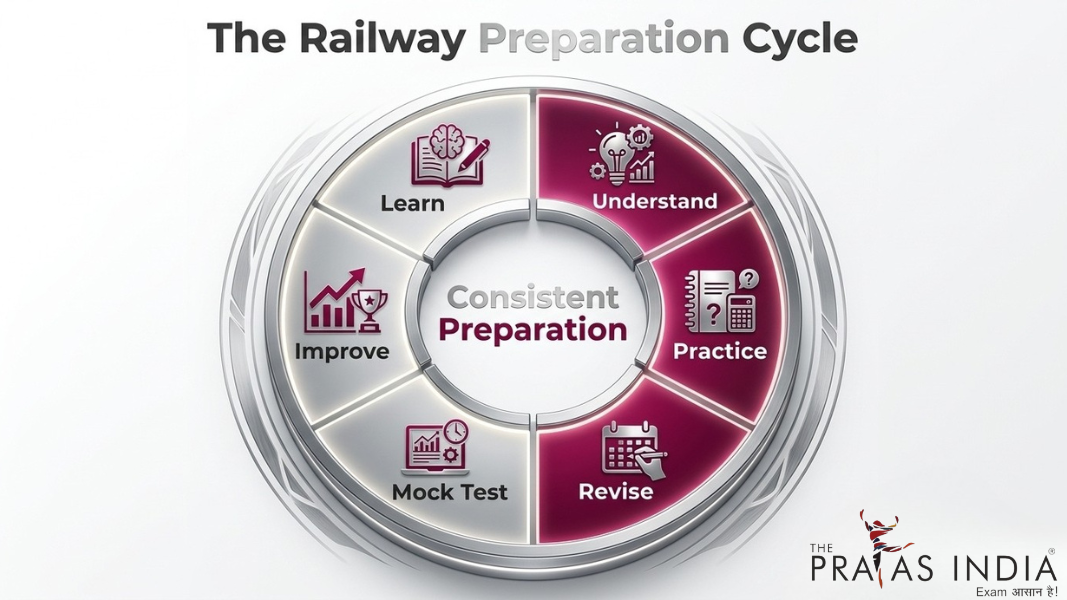
The Railway Preparation Launchpad is built on seven essential pillars:
- Understanding the Examination
- Choosing the Right Study Resources
- Building Daily Study Habits
- Consistent Practice
- Regular Mock Tests
- Smart Revision
- Continuous Performance Improvement
Each pillar strengthens the next, creating a preparation platform that remains stable throughout the entire journey.
Instead of rushing toward the destination, beginners should focus on strengthening the platform from which their preparation begins.
Launchpad Step 1 – Understand the Railway Examination Before You Start Studying
One of the biggest advantages a beginner can create is clarity.
Before opening the first textbook, spend time understanding the examination itself. This simple step can save months of unproductive preparation.
Every Railway recruitment notification provides valuable information regarding:
Exam Pattern
Know how many stages are involved, whether there are CBT examinations, skill tests, physical tests (where applicable), or document verification.
Subjects Covered
Most Railway examinations include:
- Mathematics
- General Intelligence & Reasoning
- General Awareness
- Current Affairs
- Science (for specific posts)
- Technical subjects (for JE and Technician)
Understanding the syllabus helps you prioritise important topics instead of studying everything equally.
Marking Scheme
Learn about:
- Number of questions
- Total marks
- Duration
- Negative marking
- Section-wise distribution
This knowledge helps you develop an effective attempt strategy much earlier.
Previous Year Trends
Instead of guessing what might appear in the examination, analyse previous year papers to identify:
- Frequently asked topics
- Difficulty level
- Repeated concepts
- Question distribution
This builds confidence and eliminates unnecessary assumptions.
Vacancy-Specific Preparation
Different Railway examinations require different preparation priorities.
For example:
- RRB NTPC focuses heavily on reasoning, mathematics, and general awareness.
- RRB Group D demands strong basics with excellent speed.
- RRB ALP requires technical understanding along with aptitude.
- RRB JE involves technical subjects in greater depth.
Understanding these differences allows you to customise your preparation instead of following a one-size-fits-all strategy.
A strong launchpad always begins with clarity. Once you understand the examination, every hour of study becomes more purposeful.
Launchpad Step 2 – Choose the Right Resources Instead of the Most Resources
One of the biggest misconceptions among beginners is believing that owning more books automatically leads to better preparation.
In reality, successful candidates usually study fewer resources—but they study them repeatedly and thoroughly.
Your preparation should begin with a carefully selected learning kit rather than an endless collection of materials.
Build a Core Study Library
Choose:
- One reliable Mathematics book
- One Reasoning book
- One General Awareness source
- One Current Affairs source
- Previous Year Question Papers
- Quality Mock Tests
Avoid switching between multiple authors every week.
Follow a Structured Learning Sequence
Instead of studying random chapters, organise your learning from:
Basic Concepts → Practice Questions → Mixed Exercises → Timed Practice → Mock Tests
This gradual progression builds confidence without creating unnecessary pressure.
Maintain a Revision Notebook
Prepare a dedicated notebook containing:
- Important formulas
- Short tricks
- Frequently forgotten facts
- Static GK notes
- Current Affairs highlights
- Personal mistake log
This notebook eventually becomes your most valuable revision resource before the examination.
Learn From Reliable Guidance
Many beginners waste time deciding what to study every day.
Learning under experienced mentors helps eliminate this confusion. A structured study plan, expert guidance, regular doubt-solving, and systematic topic coverage ensure that preparation remains focused throughout the journey.
Rather than experimenting with multiple sources, invest your energy in mastering a limited set of quality resources.
A launchpad becomes reliable not because it contains everything—but because every element placed on it has a clear purpose.
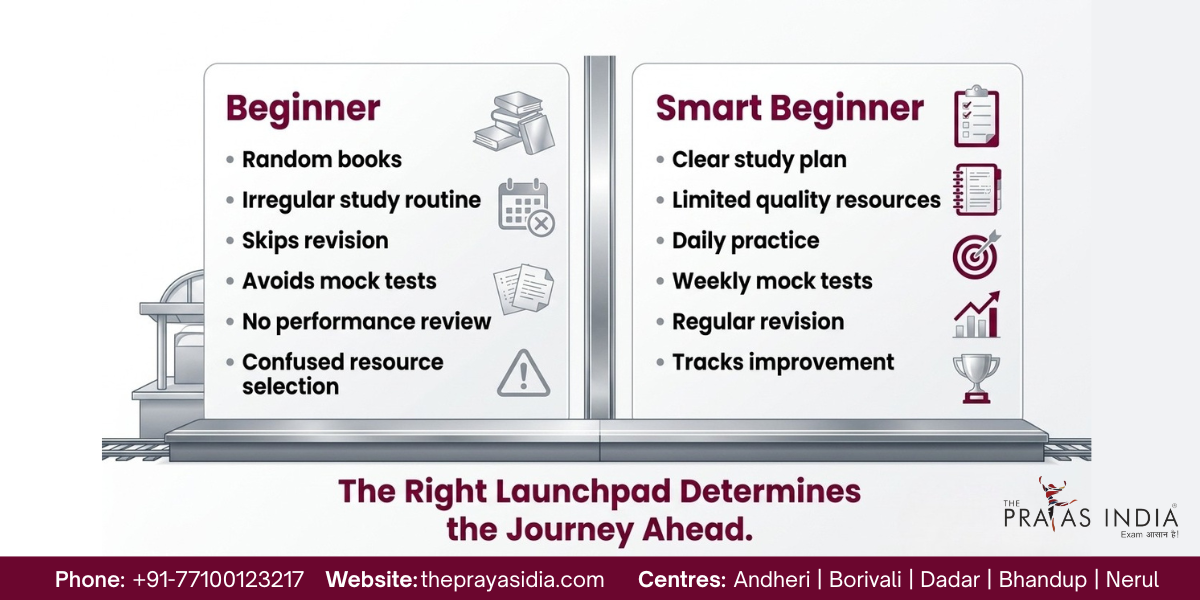
Launchpad Step 3 – Build Daily Study Habits That Keep Your Preparation Moving
A train does not reach its destination because it travels at maximum speed every minute. It reaches safely because it follows a fixed schedule, maintains consistency, and stays on the correct track.
Railway preparation works in exactly the same way.
Many beginners believe they need to study 10–12 hours every day. While long study hours may occasionally be helpful, consistency is far more important than intensity. Studying four focused hours every day for several months produces better results than studying for twelve hours on weekends and barely opening books during the week.
Your Railway Preparation Launchpad becomes stronger when daily study transforms into a habit rather than a task.
Create a Fixed Study Routine
Choose study hours that you can realistically maintain.
For example:
- Morning: Learn new concepts
- Afternoon: Solve practice questions
- Evening: Revise previously studied topics
- Night: Read current affairs or General Awareness
Following a predictable routine reduces procrastination and increases productivity.
Divide Subjects Smartly
Avoid studying the same subject for the entire day.
Instead, rotate subjects to keep your mind active.
Example:
Monday
- Mathematics
- Reasoning
- Current Affairs
Tuesday
- Mathematics
- General Awareness
- Previous Year Questions
This variation prevents boredom while improving long-term retention.
Set Daily Targets
Instead of writing:
“Study Mathematics.”
Write:
- Complete Percentage chapter
- Solve 60 MCQs
- Revise Profit & Loss formulas
- Analyse mistakes
Specific goals make progress measurable.
Build Revision into Every Day
Many beginners postpone revision until the last month.
This creates unnecessary pressure.
Instead, reserve 30–45 minutes daily for revisiting previously learned concepts.
Small revisions every day prevent large backlogs later.
Protect Your Study Environment
A productive study space should be:
- Quiet
- Organised
- Free from unnecessary distractions
- Equipped with all required books and stationery
Simple improvements in your study environment often lead to better concentration.
A strong launchpad is built one disciplined day at a time. Every productive study session adds another layer of stability to your preparation.
Launchpad Step 4 – Practise with Purpose, Not Just Volume
Many aspirants proudly say,
“I solved 500 questions today.”
A better question is:
“How many concepts did those 500 questions actually strengthen?”
Railway examinations reward accuracy and understanding—not random question solving.
Practice becomes valuable only when it has a clear objective.
Start Topic-Wise
After completing a chapter, immediately solve topic-specific questions.
For example:
After studying Time and Work,
- Easy questions
- Moderate questions
- Previous Year Questions
This reinforces concepts before moving to mixed practice.
Gradually Increase Difficulty
Do not jump directly into difficult mock papers.
Progress through stages:
Basic Questions
↓
Standard Questions
↓
Mixed Topic Questions
↓
Timed Practice Sets
↓
Full-Length Mock Tests
This gradual progression builds confidence naturally.
Solve Previous Year Papers
Railway Recruitment Board examinations often repeat concepts even when the questions are different.
Previous Year Papers help you understand:
- Question framing
- Important topics
- Time allocation
- Difficulty level
- Frequently tested concepts
They should become a regular part of your weekly preparation.
Focus on Accuracy First
Many beginners chase speed immediately.
This usually increases mistakes.
Instead:
- Learn correctly.
- Practise correctly.
- Increase speed gradually.
Speed without accuracy reduces scores due to negative marking.
Maintain an Error Register
Keep a notebook dedicated only to mistakes.
Record:
- Wrong formulas
- Incorrect assumptions
- Careless calculation errors
- Confusing reasoning patterns
- Frequently forgotten facts
Reviewing this notebook every week prevents repeated mistakes.
Your launchpad becomes stronger every time you learn from an error instead of repeating it.
Launchpad Step 5 – Use Mock Tests and Performance Analysis to Fine-Tune Your Preparation
Launching a train requires final inspections before departure.
Similarly, mock tests perform the final inspection of your preparation.
They reveal strengths that can be maximised and weaknesses that need immediate attention.
Attempt Regular Mock Tests
Begin with one mock test every week.
As the examination approaches,
increase to:
- Two mocks per week
- Three mocks per week
- Alternate-day mocks during the final revision phase
Consistency matters more than quantity.
Simulate Real Examination Conditions
While attempting mock tests:
- Follow actual exam timing.
- Avoid interruptions.
- Do not pause the timer.
- Attempt the paper honestly.
This develops exam temperament.
Analyse Every Mock Thoroughly
The real improvement begins after submitting the test.
Ask yourself:
- Which section consumed the most time?
- Which topics produced maximum errors?
- Were mistakes conceptual or careless?
- Which questions should have been skipped?
Every mock test should produce an improvement plan.
Track Weekly Progress
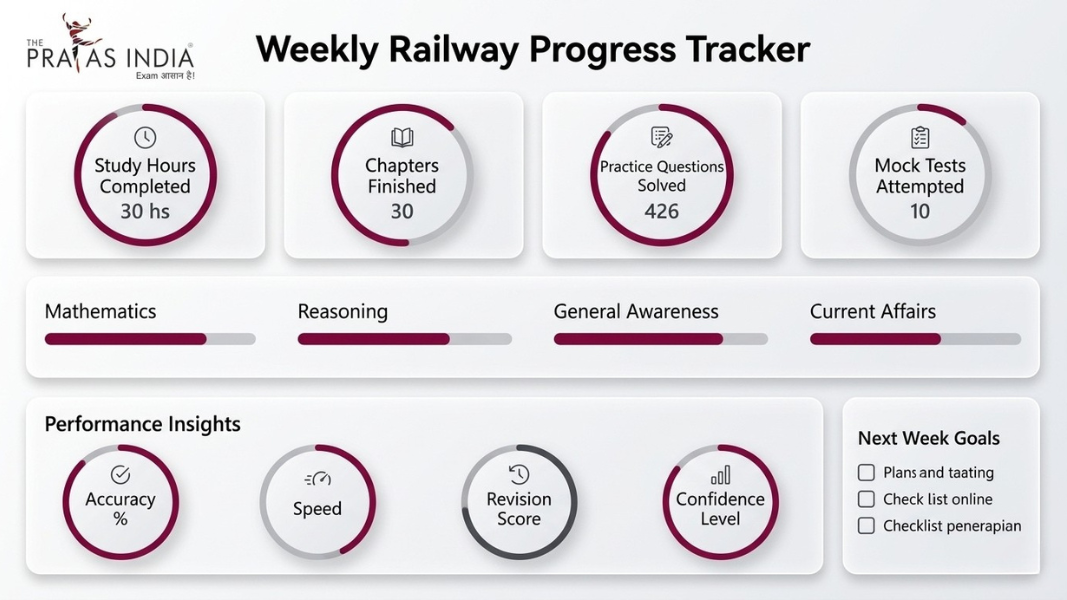
Measure your preparation using:
- Accuracy Percentage
- Attempt Rate
- Time Management
- Strong Topics
- Weak Topics
- Overall Score Trend
Visible progress keeps motivation high.
Celebrate Small Improvements
Increasing accuracy from 72% to 79% is progress.
Reducing silly mistakes is progress.
Improving time management is progress.
Every small improvement strengthens your launchpad before the final examination.
Common Beginner Mistakes That Delay Railway Preparation
Even sincere students sometimes lose valuable months because of avoidable mistakes.
Recognising these early can save considerable preparation time.
Studying Without Reading the Syllabus
Preparation without syllabus awareness often results in unnecessary learning.
Always study according to the latest Railway notification.
Constantly Changing Books
Switching resources every few weeks creates confusion.
Master one quality resource before exploring another.
Ignoring Previous Year Papers
Many questions follow recurring concepts.
Skipping previous papers means missing valuable insights.
Delaying Mock Tests
Waiting until preparation feels “perfect” is a common mistake.
Mock tests are meant to improve preparation—not merely evaluate it.
Memorising Without Understanding
Conceptual clarity leads to long-term retention.
Blind memorisation usually fails under examination pressure.
Inconsistent Study Routine
Studying occasionally cannot compete with disciplined daily preparation.
Consistency always produces better outcomes.
Avoiding Performance Analysis
Attempting hundreds of questions without reviewing mistakes slows improvement.
Every mistake should become a learning opportunity.
Why Coaching Helps Railway Beginners
Self-study is an important part of preparation, but beginners often struggle with direction, planning, and identifying weaknesses.
Professional coaching bridges these gaps by providing structure and expert guidance from the beginning.
Quality Railway coaching helps beginners by offering:
Structured Study Plans
Instead of deciding what to study every day, students follow a carefully designed preparation schedule aligned with the latest Railway syllabus.
Experienced Faculty
Expert mentors explain difficult concepts using simple methods, helping students build strong fundamentals before moving to advanced practice.
Regular Mock Tests
Frequent mock examinations familiarise students with actual exam conditions while improving confidence and speed.
Doubt-Solving Sessions
Immediate clarification of doubts prevents misconceptions from affecting future learning.
Performance Analysis
Detailed evaluation reports help students identify:
- Strong subjects
- Weak chapters
- Accuracy trends
- Time management issues
This enables focused improvement.
Motivation and Accountability
Regular classroom interaction, mentor guidance, and scheduled assessments help students remain disciplined throughout their preparation journey.
For many beginners, coaching transforms preparation from uncertainty into a structured learning experience.
Why Choose The Prayas India for Railway Exam Preparation?
Building a strong preparation launchpad becomes much easier when experienced mentors guide every stage of your journey.
The Prayas India has earned the trust of thousands of government exam aspirants by combining academic excellence with student-focused mentorship.
Whether you are preparing for RRB NTPC, RRB Group D, RRB ALP, RRB Technician, RRB JE, or other Railway Recruitment Board examinations, The Prayas India provides a comprehensive preparation ecosystem designed to help beginners progress confidently.
What Makes The Prayas India Different?
Structured Study Plan
A well-organised preparation schedule ensures systematic syllabus completion without unnecessary pressure.
Expert Faculty
Experienced educators simplify complex concepts and provide practical problem-solving techniques.
Classroom & Online Coaching
Students can choose flexible learning modes according to their convenience while maintaining the same academic quality.
Comprehensive Mock Test Programme
Regular full-length tests and sectional assessments help students improve speed, accuracy, and confidence.
Personal Mentorship
Individual guidance keeps students motivated while helping them overcome preparation challenges.
Doubt-Solving Support
Dedicated doubt sessions ensure that conceptual gaps are addressed quickly.
Performance Analysis
Detailed reports after tests allow students to continuously refine their preparation strategy.
Updated Study Material
Study resources are regularly aligned with the latest Railway Recruitment Board examination pattern.
Convenient Learning Centres
Students can access expert Railway coaching at:
Visit Our Centres
Andheri | Borivali | Dadar | Thane | Nerul | Bhandup
Contact Us
Phone: +91-77100 13217
Website: theprayasindia.com
Online coaching is also available for aspirants across India.
A strong launchpad is built with the right guidance, and The Prayas India helps students create that foundation through disciplined preparation, continuous assessment, and expert mentorship.
90-Day Railway Preparation Plan for Beginners
A strong launchpad is only valuable when it leads to a disciplined take-off. Once your preparation foundation is in place, the next step is to follow a structured study schedule that gradually transforms concepts into confidence.
The following 90-day plan is designed for beginners preparing for RRB NTPC, RRB Group D, RRB ALP, RRB Technician, RRB JE, and other Railway Recruitment Board examinations. It balances learning, practice, revision, and testing so that preparation remains steady rather than overwhelming.
Phase 1 (Day 1–30): Build the Foundation
The first month should focus on understanding concepts rather than chasing speed.
Objectives
- Understand the latest Railway exam syllabus.
- Complete the basic concepts of Mathematics.
- Learn the fundamentals of Reasoning.
- Start reading General Awareness and Current Affairs daily.
- Develop a consistent study routine.
Daily Study Pattern
- Mathematics: 2 Hours
- Reasoning: 1.5 Hours
- General Awareness: 1 Hour
- Current Affairs: 30 Minutes
- Revision: 45 Minutes
Weekly Goals
- Complete 4–5 chapters.
- Solve 500–700 practice questions.
- Attempt one sectional mock test.
- Analyse mistakes and prepare revision notes.
The objective of this phase is not to finish the syllabus quickly but to ensure every concept becomes a reliable part of your preparation launchpad.
Phase 2 (Day 31–60): Strengthen the Platform
Once the basics are clear, begin applying them through intensive practice.
Objectives
- Complete the remaining syllabus.
- Increase question-solving speed.
- Start solving mixed-topic question sets.
- Attempt full-length mock tests.
Focus Areas
- Previous Year Questions
- Time Management
- Accuracy Improvement
- Revision of Completed Topics
Weekly Targets
- Two full-length mock tests
- Daily mixed practice sets
- Formula revision
- Current Affairs revision
- Performance analysis after every mock
At this stage, your preparation should begin shifting from learning to application.
Phase 3 (Day 61–90): Prepare for Examination Mode
The final month of the 90-day plan should closely resemble actual exam conditions.
Priorities
- Daily mock tests or alternate-day mock tests.
- Full syllabus revision.
- Improve weak subjects.
- Reduce negative marking.
- Increase confidence.
Weekly Activities
- Three full mock tests
- Previous Year Papers
- Revision notebook review
- Current Affairs recap
- Error register revision
Avoid starting completely new topics during this stage unless they are highly important.
The goal is to maximise performance using what you already know.
Last 30-Day Railway Exam Strategy
The final month before the examination can significantly influence your overall score. Instead of studying more, focus on studying smarter.
1. Revise More Than You Learn
Revision should occupy nearly 60–70% of your study time.
Focus on:
- Short notes
- Formula notebook
- Current Affairs
- Important facts
- Frequently repeated concepts
2. Attempt Regular Mock Tests
Mock tests help maintain exam rhythm.
Suggested schedule:
- Week 1: Two Mock Tests
- Week 2: Three Mock Tests
- Week 3: Three Mock Tests
- Final Week: Alternate-day Mock Tests
Analyse every test carefully.
3. Improve Weak Areas
Identify the chapters where:
- Accuracy is low.
- Time consumption is high.
- Repeated mistakes occur.
Work specifically on these topics rather than revising everything equally.
4. Maintain Speed with Accuracy
Avoid rushing through questions.
A slightly slower but accurate attempt usually scores better than attempting every question with frequent mistakes.
5. Stay Consistent
Do not change books, study material, or preparation strategy during the final month.
Trust the launchpad you have built over the previous weeks.
Consistency creates confidence.
Take the Next Step with The Prayas India
Every Railway topper begins as a beginner. The difference lies in the quality of preparation and the guidance received along the way.
If you are planning to prepare for:
- RRB NTPC
- RRB Group D
- RRB ALP
- RRB Technician
- RRB JE
- Other Railway Recruitment Board examinations
The Prayas India provides a structured preparation environment designed to help aspirants learn systematically and improve continuously.
Why Students Choose The Prayas India
- Structured study plans aligned with the latest Railway syllabus
- Experienced faculty with years of competitive exam teaching experience
- Classroom and Online Coaching options
- Comprehensive study material
- Regular sectional and full-length mock tests
- Personal mentorship throughout preparation
- Dedicated doubt-solving sessions
- Detailed performance analysis after assessments
- Updated current affairs support
- Focus on conceptual learning as well as exam-oriented practice
Our Centres
- Andheri
- Borivali
- Dadar
- Bhandup
- Nerul
Students from across India can also benefit through our Online Railway Coaching Programme.
Visit Our Centres
Andheri | Borivali | Dadar | Thane | Nerul | Bhandup
Contact Us
Phone: +91-77100 13217
Website: theprayasindia.com
Take the first step today and build a preparation launchpad that supports your Railway career aspirations with confidence and clarity.
Conclusion
Every successful Railway career begins long before the examination day. It begins with a strong preparation platform built through discipline, planning, and continuous improvement.
The Railway Preparation Launchpad reminds us that selection is not achieved by studying randomly or collecting endless resources. It is achieved by understanding the examination, choosing the right study materials, building productive daily habits, practising consistently, evaluating performance through mock tests, and refining preparation with regular revision.
Whether you are preparing for RRB NTPC, RRB Group D, RRB ALP, RRB Technician, RRB JE, or any other Railway Recruitment Board examination, remember that every productive study session strengthens the platform beneath your preparation.
Instead of worrying about the final destination, focus on making your launchpad stronger every day.
With the right strategy, disciplined effort, and expert guidance from The Prayas India, your preparation can move forward with clarity, confidence, and purpose.
Frequently Asked Questions (FAQs)
1. How should beginners start Railway exam preparation?
Beginners should first understand the latest syllabus and exam pattern, select quality study resources, build a daily study routine, and practise consistently through previous year papers and mock tests.
2. Which Railway exams can I prepare for at The Prayas India?
The Prayas India offers coaching for RRB NTPC, RRB Group D, RRB ALP, RRB Technician, RRB JE, and other Railway Recruitment Board examinations.
3. Is coaching necessary for Railway exam preparation?
While self-study is important, coaching provides structured study plans, expert guidance, doubt-solving, mock tests, mentorship, and performance analysis that help many beginners prepare more efficiently.
4. Does The Prayas India provide online Railway coaching?
Yes. Students can choose both Classroom Coaching and Online Coaching, allowing aspirants from any location to prepare effectively.
5. How many hours should beginners study daily?
Most beginners can make consistent progress by studying 4–6 focused hours daily with proper revision and regular practice.
6. Are mock tests important for Railway exams?
Yes. Mock tests improve speed, accuracy, time management, confidence, and help identify weak areas before the actual examination.
7. Which subjects are important for Railway exams?
Most Railway examinations include Mathematics, General Intelligence & Reasoning, General Awareness, Current Affairs, and, depending on the post, Science or Technical subjects.
8. Where are The Prayas India Railway coaching centres located?
The Prayas India has coaching centres in Andheri, Borivali, Dadar, Bhandup, and Nerul, along with online learning facilities.
9. How can I contact The Prayas India for admission?
You can contact The Prayas India at +91-7710013217 to enquire about admissions, batches, classroom coaching, online courses, and counselling.
Final Takeaway
Railway exam preparation is not about rushing towards the destination—it is about ensuring that every stage of preparation is built on a dependable foundation. A train departs smoothly only when it begins from the correct platform with every system in place. Likewise, aspirants who invest time in understanding the exam, choosing the right resources, maintaining disciplined study habits, practising consistently, revising regularly, and analysing their performance create a launchpad that supports sustained progress.
At The Prayas India, we help beginners transform that launchpad into a complete preparation system through expert faculty, structured study plans, classroom and online coaching, regular mock tests, personalised mentorship, doubt-solving sessions, and detailed performance analysis. Whether your goal is RRB NTPC, Group D, ALP, Technician, JE, or any other Railway Recruitment Board examination, the right preparation starts with the right foundation—and today is the best day to build it.