CAT 2027 Speed & Accuracy Strategy: How to Solve More Questions Without Losing Accuracy
For CAT 2027 aspirants, preparation is not only about knowing concepts. A candidate may understand Quantitative Aptitude, solve difficult DILR sets, and handle Reading Comprehension passages well, but still struggle to convert that knowledge into a strong CAT performance if speed and accuracy are not developed together.
CAT is a time-bound aptitude examination in which candidates have to make continuous decisions about which question to attempt, which question to leave, how much time to spend, and when to move on. This makes speed and accuracy closely connected. Increasing speed without controlling mistakes can result in unnecessary errors, while focusing only on accuracy can lead to insufficient attempts.
The right objective, therefore, is not simply to solve questions faster. It is to develop the ability to recognise the right questions quickly, use efficient methods, avoid avoidable errors, and maintain accuracy under time pressure.
For CAT 2027, this skill should be developed gradually rather than rushed during the final months. A strong preparation strategy combines conceptual clarity, timed practice, question selection, mock-test analysis and continuous improvement.
What Does Speed and Accuracy Mean in CAT Preparation?
Speed in CAT preparation refers to how efficiently you can process information and reach the correct answer within the available time. It includes reading speed, calculation speed, understanding a question, identifying the appropriate approach, executing the solution and deciding whether a question deserves your time.
Accuracy refers to the percentage of attempted questions that you answer correctly. It is not simply about avoiding careless mistakes. Accuracy also depends on conceptual understanding, interpretation of questions, calculation discipline and knowing when not to attempt a question.
For example, suppose a student attempts 18 questions and gets 17 correct. Another student attempts 25 questions but gets only 15 correct. The second student may appear faster because of the higher number of attempts, but excessive errors can reduce the value of that speed.
A useful preparation mindset is:
Speed = Efficient Decision-Making + Efficient Solving
Accuracy = Conceptual Clarity + Careful Execution
CAT Performance = Speed + Accuracy + Question Selection + Time Management
These skills should not be developed separately. They need to improve together through structured practice.
Why Speed and Accuracy Matter So Much for CAT 2027
CAT does not provide unlimited time to demonstrate everything you know. Every section places a time constraint on your decision-making. As a result, even strong conceptual knowledge needs to be converted into exam-ready execution.
A student who spends too much time on one difficult question can lose the opportunity to solve several manageable questions. Similarly, a student who rushes through familiar questions may make calculation or interpretation errors.
This is why CAT preparation should move through different stages.
Stage 1: Build Concepts
Initially, the priority should be understanding the concepts and learning standard approaches. At this stage, solving slowly is acceptable because the purpose is to understand the reasoning behind the solution.
Stage 2: Build Application Skills
Once the concepts become familiar, begin solving different question types. The focus should shift from simply knowing a formula or method to recognising when and how to use it.
Stage 3: Introduce Time Pressure
After developing sufficient familiarity, introduce timed practice. Start with individual questions or small sets before moving toward full-length sectional tests.
Stage 4: Develop Exam-Level Execution
Finally, practise complete sections and full-length mocks. This is where question selection, time management, stamina and accuracy under pressure become increasingly important.
Trying to jump directly to Stage 4 without completing the earlier stages often creates unnecessary pressure.
CAT 2027 Speed and Accuracy Strategy: The Basic Rule
One of the most important principles for CAT preparation is:
Do not chase speed before you have developed accuracy.
If you regularly make conceptual or calculation mistakes during untimed practice, simply adding a timer will not solve the underlying problem.
Instead, first identify why you are making mistakes.
Are you:
- misunderstanding the question?
- forgetting a concept?
- using a lengthy method?
- making calculation errors?
- reading too quickly?
- overlooking conditions?
- spending too much time on difficult questions?
- changing a correct answer unnecessarily?
- guessing without sufficient information?
The solution depends on the type of error.
For example, if a student takes four minutes to solve a question correctly because the method is inefficient, the issue is different from a student who solves it in two minutes but gets it wrong because of calculation errors.
This distinction should become a regular part of CAT preparation.
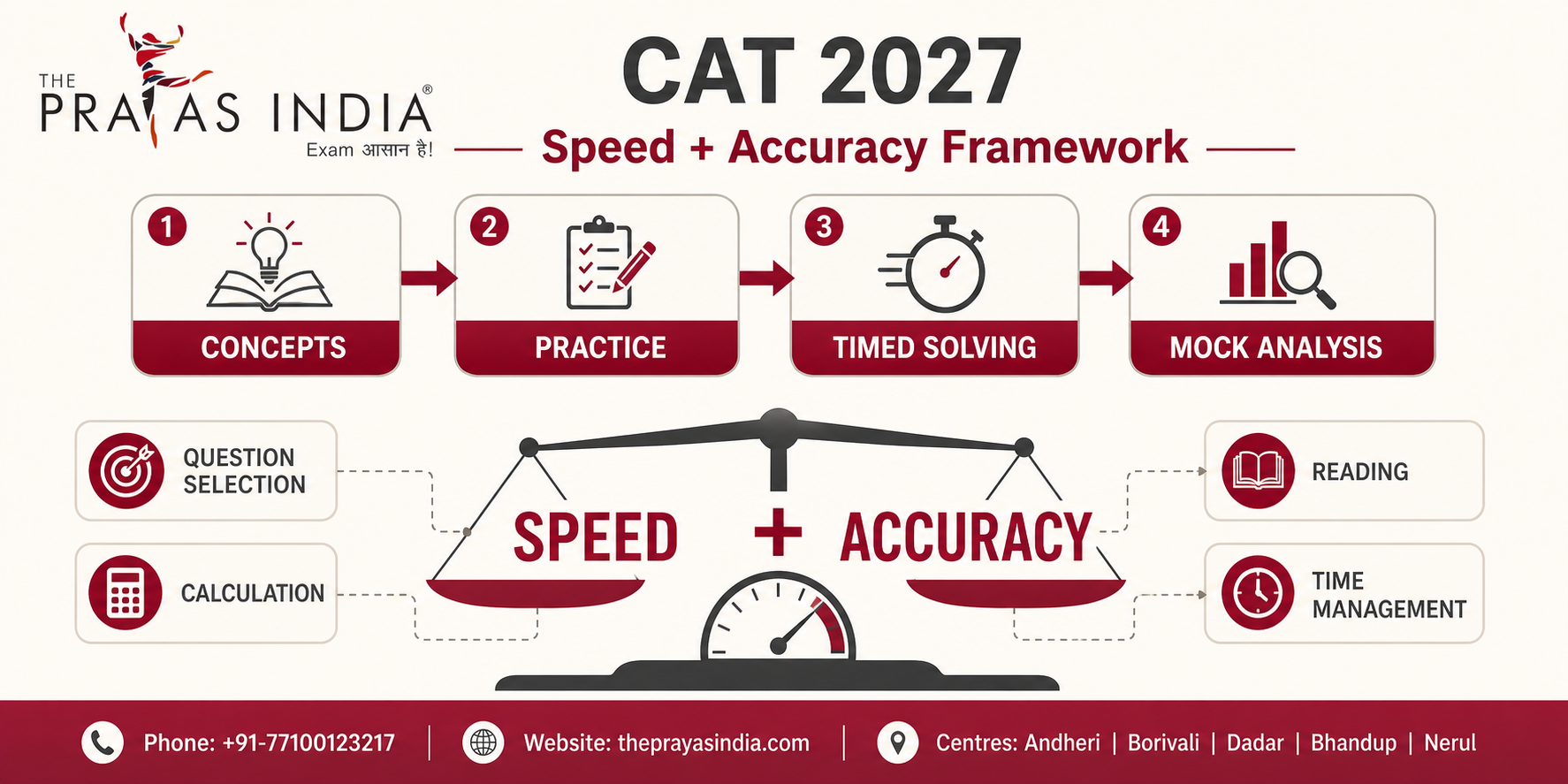
Section-Wise Speed Challenges in CAT 2027
Speed does not mean the same thing across all three CAT sections. Each section requires a different kind of efficiency.
VARC: Reading Speed Is Only One Part of the Problem
In Verbal Ability and Reading Comprehension, students often assume that reading faster automatically means scoring better. That is not necessarily true.
If you read a passage very quickly but fail to understand its argument, tone, structure or central idea, you may spend even more time analysing the questions afterward.
A better strategy is to develop purposeful reading.
While practising RCs, gradually learn to identify:
- the central argument of the passage
- the author’s purpose
- the structure of the argument
- important contrasts or examples
- the role of individual paragraphs
- the tone of the author
- the difference between the author’s view and an example or opposing view
The goal is not to remember every sentence. It is to understand the passage sufficiently to answer questions efficiently.
For VA questions, speed comes from familiarity with question structures. Regular practice with para summaries, para jumbles, odd-sentence questions and other relevant formats can help you recognise patterns more quickly.
DILR: Set Selection Is a Major Speed Skill
DILR is different because speed is not simply measured by how quickly you solve individual questions. A large part of performance comes from selecting the right set.
A set may look difficult initially but become manageable after identifying the correct structure. Another set may appear familiar but require extensive casework.
Therefore, DILR preparation should develop two abilities:
Set Selection and Set Solving.
During practice, do not only record whether you solved a set. Also record:
- How long you spent understanding it
- Whether you identified the right approach
- How many questions were actually manageable
- Whether you should have selected another set
- Where your reasoning became inefficient
Over time, this analysis helps you recognise productive sets faster.
Quantitative Aptitude: Calculation Efficiency Matters
In Quant, speed often depends on conceptual clarity combined with calculation efficiency.
A student who understands percentages but performs every calculation through lengthy steps may lose valuable time. Similarly, a student who memorises shortcuts without understanding the underlying concept can make mistakes when a question is presented differently.
Build speed through:
- percentage-fraction conversions
- multiplication and division familiarity
- squares and cubes of commonly used numbers
- approximation where appropriate
- ratio-based calculations
- efficient algebraic manipulation
- estimation
- recognising answer options strategically
- identifying when a lengthy calculation is unnecessary
However, shortcuts should only be used when they remain reliable. The fastest method is not useful if it increases the probability of an error.
Build a Personal Speed Baseline
Before trying to dramatically improve your speed, determine where you currently stand.
Take a representative set of questions from each section and record three things:
Time Taken → Questions Attempted → Questions Correct
Then calculate your accuracy and examine the nature of your mistakes.
For example:
| Metric | What It Tells You |
|---|---|
| Questions attempted | Your current solving pace |
| Correct questions | Effective output |
| Accuracy | Quality of attempts |
| Average time/question | Speed indicator |
| Conceptual errors | Knowledge gaps |
| Calculation errors | Execution problems |
| Selection errors | Decision-making problems |
| Time lost on difficult questions | Time-management issue |
This baseline is more useful than simply saying, “I need to become faster.”
Suppose your average time per question is already reasonable but your accuracy is low. Increasing speed further may not be the correct immediate objective. On the other hand, if your accuracy is strong but you spend too long on familiar question types, efficiency may be the bigger opportunity.
Your strategy should therefore be based on your error pattern, not someone else’s target.
The 3-Step Method to Improve Question-Solving Speed
A simple approach can be used during regular practice.
Step 1: Solve Without Artificial Pressure
When learning a new concept, initially focus on getting the approach right. Understand why the solution works and identify the shortest reliable method.
Step 2: Repeat Similar Questions
Solve several questions of the same type. Repetition helps convert the process from conscious reasoning into pattern recognition.
For example, after solving several percentage-based questions, you should gradually become quicker at identifying whether a problem is based on percentage change, successive percentage change, comparison or another related concept.
Step 3: Introduce a Timer
Once the approach becomes familiar, introduce a realistic time limit.
The timer should create controlled pressure, not panic.
If your performance collapses whenever a timer is introduced, that is useful information. It may indicate that the concept is not yet sufficiently automatic or that you are spending too much time deciding how to begin.
Accuracy Improvement Starts With an Error Log
A well-maintained error log can become one of the most useful tools in CAT 2027 preparation.
Do not simply write down the correct answer. Record why your answer was wrong.
A practical error log can have categories such as:
Concept Error:
You did not know or correctly apply the underlying concept.
Calculation Error:
Your approach was correct but arithmetic caused the mistake.
Interpretation Error:
You misunderstood what the question was asking.
Reading Error:
You missed an important word, condition or qualification.
Selection Error:
You chose a question or set that was not worth the time.
Time-Pressure Error:
You knew the concept but rushed because of the timer.
Guessing Error:
You attempted without sufficient confidence or elimination.
This classification matters because different errors require different solutions.
If most mistakes are conceptual, more revision is needed. If calculation errors dominate, focused calculation drills may help. If selection errors dominate, mock analysis and timed sets become more important.
Don’t Use the Same Speed Target for Every Question
A common mistake in CAT preparation is trying to assign the same amount of time to every question.
CAT questions vary considerably in difficulty and structure. Some can be solved quickly, while others require more reasoning. Therefore, effective time management is not about forcing every question into an identical time slot.
Instead, learn to classify questions mentally:
Quick Win:
You understand the question immediately and have a reliable approach.
Workable:
The question requires some calculation or reasoning but appears manageable.
Time-Consuming:
The approach is unclear, lengthy or likely to require extensive casework.
Unfamiliar:
You do not immediately recognise the concept or method.
The objective is to maximise the value of the time you spend, rather than simply maximising the number of questions touched.
How to Practise Speed Without Destroying Accuracy
A good practice session should have a clear purpose.
Instead of solving 50 questions randomly every day, divide practice into specific objectives.
For example:
Concept Session:
Focus on understanding and solving new question types.
Accuracy Session:
Solve familiar questions carefully and identify avoidable errors.
Speed Session:
Solve a selected group of familiar questions under a time limit.
Mixed Session:
Combine different difficulty levels and question types.
Selection Session:
Practise deciding which questions to attempt and which to skip.
This creates a more balanced preparation system.
The Importance of Timed Practice
Untimed practice is useful during the learning phase, but CAT preparation eventually needs controlled time pressure.
Begin with small timed exercises rather than immediately taking full mocks.
For example:
- 5 Quant questions in a fixed time
- 2–3 DILR sets with a time limit
- one RC passage followed by timed questions
- a short VARC mixed set
- a mixed Quant topic test
After each exercise, compare accuracy before speed and then evaluate whether the faster approach remained reliable.
If accuracy falls sharply, do not automatically extend the time. First identify why.
Speed Should Improve Gradually
There is no need to force a dramatic improvement in a single week.
A better approach is progressive:
Phase 1: Accurate solving
↓
Phase 2: Familiarity with question types
↓
Phase 3: Short timed sets
↓
Phase 4: Sectional tests
↓
Phase 5: Full-length mocks
↓
Phase 6: Exam-level decision-making
This progression allows your brain to adapt to increasing pressure while maintaining the fundamentals.
For CAT 2027 aspirants, starting this process early provides enough time to identify weak areas and gradually improve execution instead of depending entirely on last-minute speed drills.
Why Mock Tests Should Not Be Used Only for Scores
Mock tests are often treated as a measurement tool, but they are equally important as a training tool.
A mock score tells you what happened.
Mock analysis should help you understand why it happened.
After every mock, ask:
- Which questions did I solve correctly?
- Which questions did I get wrong?
- Which questions should I have attempted but left?
- Which questions consumed too much time?
- Which mistakes were avoidable?
- Did I spend too much time on any particular question?
- Did I change any correct answers unnecessarily?
- Which section caused the biggest time-management problem?
- Which error category appeared repeatedly?
- What specific change will I make in the next mock?
This turns mock tests into an improvement cycle rather than a repeated score-checking exercise.
Build Speed Through Familiarity, Not Panic
One of the biggest misconceptions about speed is that students need to constantly rush while practising.
In reality, speed often develops naturally when the solving process becomes familiar.
When you repeatedly encounter a question type, your brain becomes better at recognising:
- what information matters
- what information can be ignored
- which formula or concept applies
- whether the question is worth attempting
- which solution method is efficient
- when to stop
That is why quality repetition is more valuable than simply increasing the number of questions you solve.
For CAT 2027, the goal should be to reach a stage where you can look at a question and make an informed decision quickly rather than spending the first part of every question figuring out what to do.
The Role of Structured CAT Coaching
Self-study can build a strong foundation, but many aspirants struggle to identify whether their preparation is actually improving speed and accuracy.
Structured CAT coaching can help by providing a defined preparation sequence, topic-wise practice, sectional tests, mock tests and performance analysis. Guidance can also help students identify inefficient solving methods and recurring mistakes before they become habits.
At The Prayas India, CAT aspirants can access online and offline preparation support designed around conceptual learning, practice, mock tests and exam-oriented improvement. The objective is not merely to increase the number of questions attempted, but to develop a balanced approach to concepts, speed, accuracy and question selection.
For students preparing for CAT 2027, starting early also provides more time to experiment with strategies, identify individual strengths and weaknesses, and gradually build confidence under timed conditions.
Create a Daily Speed-Building Routine for CAT 2027
Speed improves through regular exposure rather than occasional intensive practice. A consistent daily routine allows you to work on both accuracy and efficiency without making preparation unnecessarily stressful.
A practical study session can be divided into four components.
1. Concept Revision
Begin with a short revision of the concepts you are currently studying. Do not spend the entire session rereading theory. The purpose is to refresh formulas, approaches, rules and important observations.
2. Focused Practice
Solve questions from the topic you are working on. Initially, concentrate on getting the method right. Once you become comfortable, introduce time limits.
3. Timed Drill
Set aside a small portion of your preparation for timed solving. This could involve a set of Quant questions, an RC passage, a VA exercise or a DILR set.
4. Error Review
End the session by reviewing mistakes. This is particularly important because solving more questions without understanding recurring errors may not produce proportional improvement.
A simple daily framework could therefore look like:
Learn → Practise → Time Yourself → Analyse
The exact number of questions will depend on your preparation stage. Quality and consistency should remain more important than arbitrary daily targets.
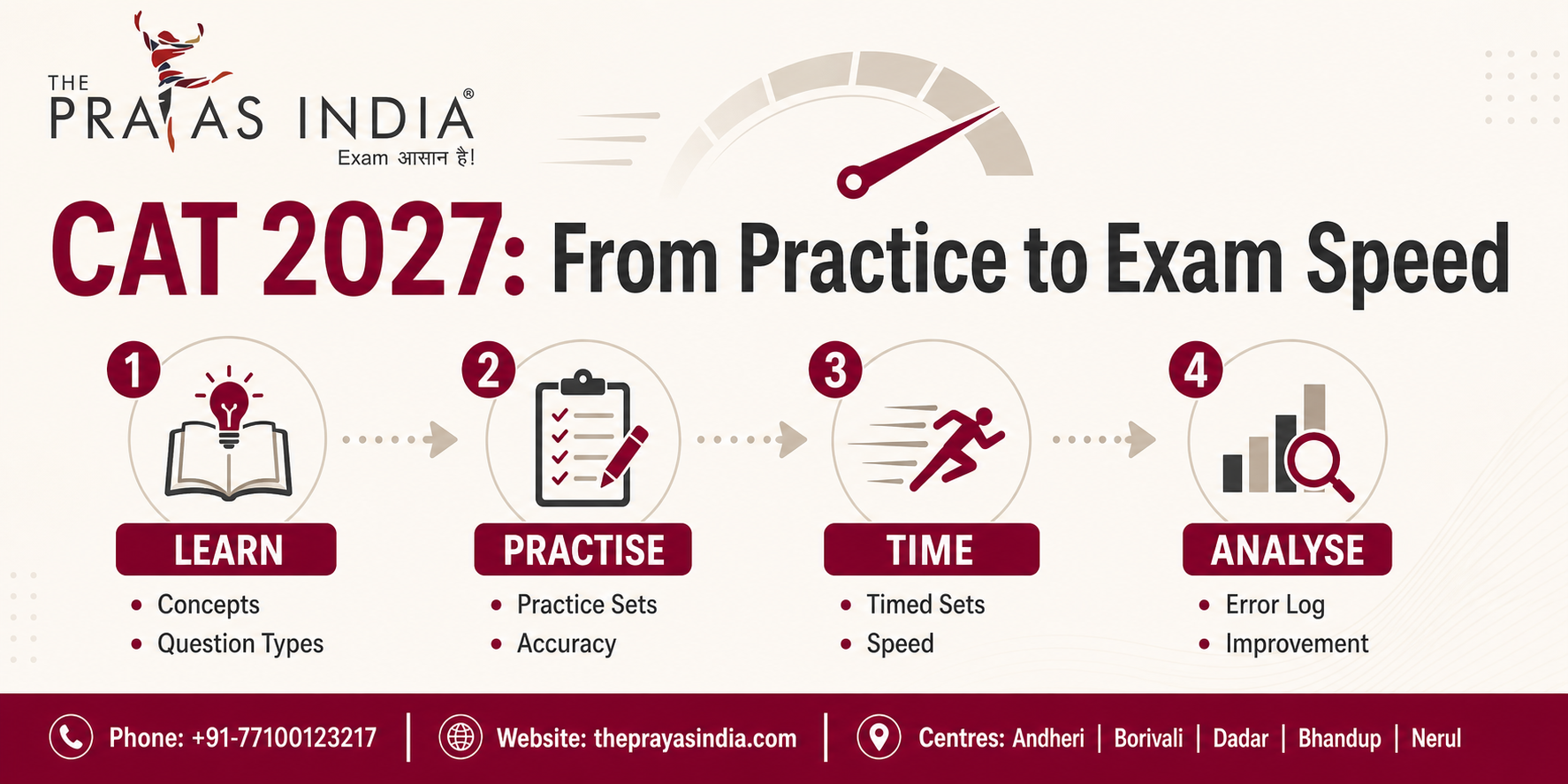
Section-Wise Speed Improvement Strategy
A single speed strategy cannot be applied to every CAT section. Your practice should reflect the nature of VARC, DILR and QA.
VARC Speed Strategy
For VARC, speed should primarily come from better reading and decision-making rather than simply trying to read every sentence faster.
During RC practice, begin by understanding the passage structure. Ask yourself what the author is trying to establish and how the different paragraphs contribute to the argument.
With regular practice, you should gradually become better at identifying passages where the argument is easier for you to follow and questions where the answer can be established directly from the passage.
For VA, familiarity with question structures is valuable. Instead of repeatedly solving random questions without analysis, group your practice according to the type of reasoning required.
A useful VARC speed-building exercise is to track:
- Reading time
- Question-solving time
- Correct answers
- Questions where two options seemed equally attractive
- Questions where the passage was misunderstood
- Questions where you changed the correct answer
This will help identify whether your problem is reading speed, comprehension or decision-making.
DILR Speed Strategy
DILR requires a different approach because one set can contain multiple questions.
Do not measure DILR speed only by individual questions. Measure the complete process:
Set Identification → Understanding → Setup → Calculation → Questions
During practice, expose yourself to different types of arrangements, tables, games, selection problems, networks, distributions and data-based sets.
After solving a set, ask whether you spent too long understanding the information before creating the right framework.
A major improvement can occur when you learn to represent information efficiently. Tables, cases, diagrams and structured notes can reduce repeated reading.
Most importantly, practise set selection. During mocks, not every set needs to be solved. The ability to recognise a manageable set can be as important as the ability to solve one.
Quantitative Aptitude Speed Strategy
In QA, build speed by strengthening your fundamentals and reducing unnecessary calculations.
Regularly practise:
- Percentage conversions
- Fractions and decimals
- Ratios
- Approximation
- Mental calculations
- Squares and cubes
- Algebraic manipulation
- Number properties
- Basic arithmetic relationships
Do not turn shortcuts into a substitute for understanding. A shortcut is useful when you know why it works and can apply it reliably.
Also practise multiple methods for selected questions. Sometimes the conventional method may be longer than using answer options, substitution, estimation or a suitable mathematical observation.
The Speed–Accuracy Trade-Off: How Much Should You Push?
One of the most important questions in CAT preparation is whether you should attempt more questions or focus on getting fewer questions correct.
There is no universal attempt number that guarantees a particular outcome. Your strategy should depend on the difficulty of the section, your own accuracy and the quality of the questions available.
Instead of setting a rigid target such as “I must attempt X questions,” focus on effective attempts.
An effective attempt is one where:
- you understand the question,
- you have a reasonable solving approach,
- you can execute it within a sensible time,
- and the probability of getting it right is sufficiently high.
This is why question selection is such an important part of speed and accuracy.
If increasing your attempts causes accuracy to fall substantially, you need to investigate the reason rather than simply attempting even more questions.
How to Improve Accuracy Without Becoming Too Slow
Some students become so concerned about mistakes that they start checking every calculation repeatedly. This can improve confidence temporarily but may damage overall time management.
Instead, develop structured checking habits.
For Quant:
- Check signs and units.
- Recheck calculations only when necessary.
- Use estimation to detect obviously incorrect results.
- Read the final requirement before selecting an option.
For DILR:
- Verify whether your arrangement satisfies every condition.
- Check whether you accidentally excluded a possible case.
- Re-read restrictive conditions before finalising.
For VARC:
- Return to the relevant portion of the passage when required.
- Avoid choosing an option merely because it sounds familiar.
- Distinguish between what the passage says and what you personally believe.
Accuracy should come from a reliable process rather than constant hesitation.
Use Mocks to Develop Decision-Making
Once you begin taking full-length CAT mocks, do not treat them merely as score-generating exercises.
A mock should answer practical questions about your strategy.
For example:
Did I spend too long on one question?
Did I leave easy questions because I became stuck on a difficult one?
Did I select the right DILR set?
Did I read VARC passages efficiently?
Did I make avoidable calculation mistakes?
Did my accuracy drop because I rushed near the end?
Did I spend too much time trying to recover from an early mistake?
These observations are more useful than simply comparing one mock score with another.
How to Analyse a CAT Mock Properly
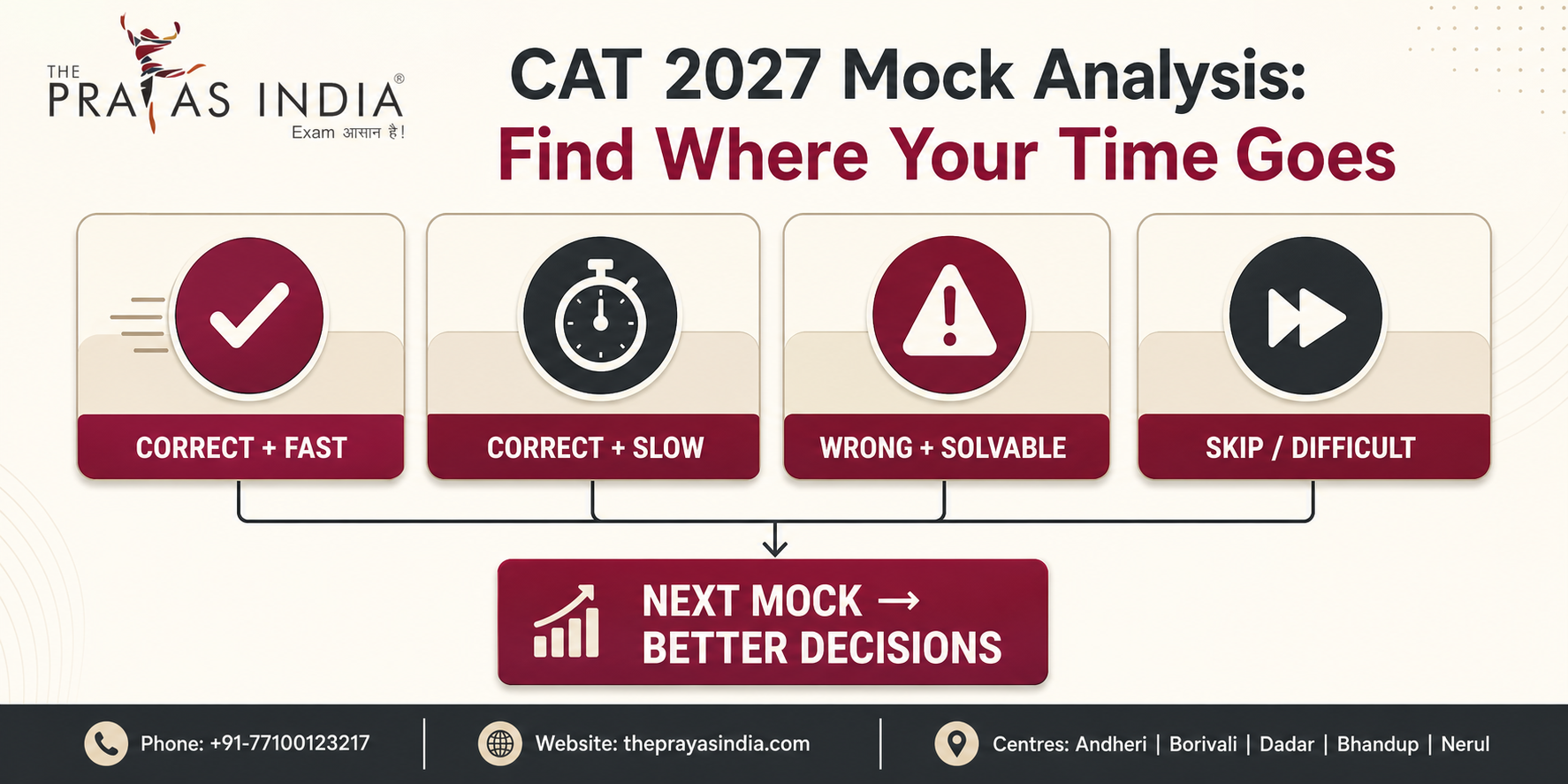
After a mock, divide your questions into four categories:
Category A: Correct and Efficient
You solved the question correctly within a reasonable time.
These questions show approaches that are working.
Category B: Correct but Too Slow
You eventually reached the correct answer, but the time spent was excessive.
These questions are particularly important for speed improvement.
Ask yourself whether another method could have reduced the solving time.
Category C: Incorrect but Solvable
You had the required knowledge but made an error.
These questions should be examined carefully because they may represent recoverable marks.
Category D: Incorrect or Not Attempted Because of Difficulty
You did not have a reliable approach or the question was not worth the time.
These questions are useful for understanding your current limits, but not every difficult question needs to become a priority immediately.
This classification creates a much clearer picture of performance than a single score.
What to Do When Your CAT Mock Score Is Low
A low mock score should be treated as diagnostic information rather than as a final statement about your preparation.
First, identify what caused the score.
There is a significant difference between:
- low attempts because of slow solving,
- low accuracy because of careless mistakes,
- low performance because of conceptual gaps,
- poor DILR set selection,
- slow RC reading,
- poor time allocation,
- or excessive attempts with too many incorrect answers.
Suppose your concepts are reasonably strong but you leave many questions because you cannot make decisions quickly. Your preparation should then include more timed sets and question-selection practice.
If you attempt enough questions but make frequent errors, increasing speed may not be the immediate priority. You may need accuracy-focused practice instead.
The key question is:
“What specifically caused this score?”
Once you can answer that, your next preparation step becomes much clearer.
How to Compare Two CAT Mocks
Do not compare mocks only on overall marks.
Two mocks can have different difficulty levels, question structures and section experiences. Instead, compare your own behaviour.
Track:
| Performance Area | Mock 1 | Mock 2 | What to Observe |
|---|---|---|---|
| Attempts | —— | —— | Did attempts become more effective? |
| Accuracy | —— | —— | Are mistakes reducing? |
| Average time | —— | —— | Are familiar questions becoming faster? |
| Easy questions missed | —— | —— | Is selection improving? |
| Time lost | —— | —— | Where are you getting stuck? |
| DILR set selection | —— | —— | Are you identifying workable sets? |
| VARC reading | —— | —— | Is reading becoming more efficient? |
| QA calculations | —— | —— | Are calculations becoming cleaner? |
This comparison helps you identify trends instead of becoming overly dependent on a single mock score.
A Practical Weekly CAT 2027 Speed and Accuracy Plan
A weekly routine can combine learning, practice and testing.
Monday: Quant Efficiency
Revise a topic and solve a focused set. After solving, identify questions where your method was unnecessarily long.
Tuesday: VARC
Practise RC and VA. Record reading time and question-solving accuracy.
Wednesday: DILR
Solve multiple sets and focus on recognising the structure before starting detailed calculations.
Thursday: Quant + Mixed Timed Practice
Work on calculation-heavy questions and complete a short timed mixed set.
Friday: VARC + DILR
Practise one RC set and one or more DILR sets under controlled timing.
Saturday: Sectional Test or Mock
Depending on your preparation stage, take a sectional test or full-length mock.
Sunday: Analysis and Revision
Spend substantial time analysing the test. Update your error log, identify recurring problems and prepare the next week’s priorities.
The exact schedule can be adjusted according to your available study hours. What matters is maintaining a cycle of practice → testing → analysis → correction.
CAT 2027 Speed Improvement Plan for Beginners
If you are starting from scratch, do not immediately compare your speed with students who have already completed substantial preparation.
Your first objective should be accuracy.
Month 1–2: Foundation
Focus on basic concepts across QA, DILR and VARC. Solve questions without excessive time pressure.
Month 3–5: Application
Increase the variety of questions and begin introducing short timed exercises.
Month 6–8: Timed Practice
Regularly practise sectional sets and topic-wise tests. Start identifying your preferred approaches and recurring mistakes.
Month 9–10: Mock Integration
Increase the role of sectional tests and full-length mocks. Work on question selection and time allocation.
Final Preparation Phase
Focus on revision, mock analysis, weak areas, accuracy and maintaining your established strategy.
The timeline can be adjusted according to your starting point and CAT 2027 preparation schedule.
The 30-Day Speed and Accuracy Improvement Challenge
A focused 30-day cycle can be useful when you already have basic conceptual familiarity.
Days 1–7: Diagnose
Take representative timed sets and identify your major problems.
Create categories for:
Concepts | Calculation | Reading | Selection | Time Management
Days 8–14: Correct
Work specifically on the two or three largest recurring problems.
Do not try to fix everything simultaneously.
Days 15–21: Increase Pressure
Introduce more timed sets and sectional tests.
Focus on maintaining accuracy while reducing unnecessary time.
Days 22–27: Simulate
Take full-length mocks under realistic conditions.
Practise your question-selection strategy rather than experimenting with a completely new approach every time.
Days 28–30: Consolidate
Review your error log, mock trends and preferred strategies.
The objective is to enter the next phase with a clearer understanding of what works for you.
Common Mistakes That Reduce CAT Speed and Accuracy
Trying to Solve Every Question
CAT rewards effective decision-making. Spending too much time on one question can negatively affect the rest of the section.
Using a Difficult Method for an Easy Question
If you know a shorter reliable approach, use it. Regular solution analysis can reveal opportunities to simplify your process.
Rushing Because You Are Behind on Time
Panic often causes reading mistakes and calculation errors. If you are behind, focus on selecting better questions rather than blindly increasing your speed.
Ignoring Easy Questions
Students sometimes become so focused on difficult questions that they miss questions they could have solved efficiently.
Changing Answers Without a Strong Reason
Second-guessing can turn a correct answer into an incorrect one. Change an answer when you identify a concrete mistake or a stronger reason—not simply because of anxiety.
Taking Mocks Without Analysing Them
A mock that is never analysed provides limited learning value.
Comparing Your Speed With Someone Else’s
Different students have different strengths. Your useful benchmark is your own performance trend.
Final CAT 2027 Speed and Accuracy Checklist
Before considering your strategy mature, ask yourself:
- Can I identify familiar question types quickly?
- Do I know which questions I should avoid spending too much time on?
- Can I solve standard questions without unnecessary steps?
- Are my calculation errors reducing?
- Can I read RCs with proper understanding under time pressure?
- Can I identify manageable DILR sets?
- Do I maintain an error log?
- Do I analyse my mocks beyond the score?
- Do I know my major recurring mistakes?
- Do I have a clear question-selection approach?
- Can I maintain accuracy when working against the clock?
- Am I improving through measurable changes rather than simply studying longer?
If several answers are still “no,” that does not mean your preparation is failing. It tells you exactly which part of your preparation system needs more attention.
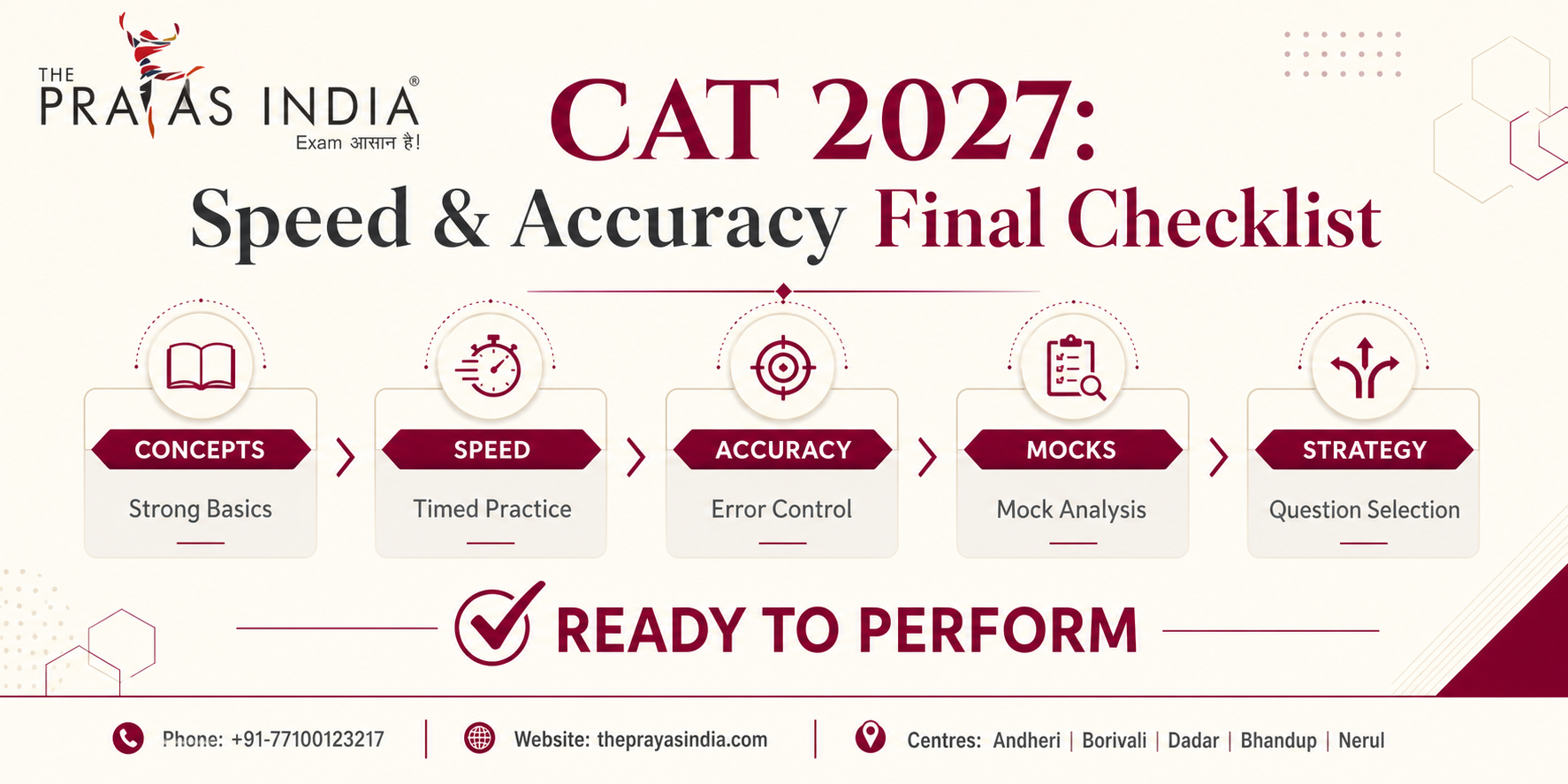
How The Prayas India Can Support Your CAT 2027 Preparation
Speed and accuracy are not developed through shortcuts alone. They come from a structured preparation process in which concepts are understood, questions are practised, timed performance is measured and mistakes are analysed.
For students preparing for CAT 2027, The Prayas India provides online and offline CAT coaching support with structured learning, practice resources, mock tests and exam-oriented guidance. A guided preparation environment can help students maintain consistency and systematically work on areas such as conceptual clarity, speed, accuracy and question selection.
Students can use the preparation period to identify their individual performance patterns rather than blindly following generic attempt or timing targets.
Final Takeaway
CAT 2027 preparation should not be viewed as a race to solve every question as quickly as possible.
The real skill is efficient decision-making under pressure.
You need enough conceptual clarity to recognise the problem, enough practice to identify the right approach, enough speed to use your available time effectively, enough accuracy to protect your score, and enough discipline to leave questions that are not worth the time.
A strong CAT speed-and-accuracy strategy therefore follows a simple cycle:
Learn → Practise → Time → Analyse → Correct → Repeat
Start by building accuracy. Gradually introduce time pressure. Analyse where your time is going. Improve your methods. Practise question selection. Then use mocks to test whether those improvements work under realistic conditions.
The earlier you develop this process for CAT 2027, the more time you have to turn individual improvements into consistent exam performance.
FAQs: CAT 2027 Speed & Accuracy Strategy
1. How can I improve speed for CAT 2027?
Start with conceptual clarity and regular practice. Once you are comfortable with common question types, introduce timed sets, sectional tests and mock exams. Analyse slow questions to identify inefficient approaches.
2. Should I focus on speed or accuracy first?
Accuracy should generally be established before aggressively increasing speed. Once your solving process becomes reliable, gradually introduce time pressure while monitoring whether accuracy remains stable.
3. How can I improve CAT accuracy?
Maintain an error log and classify mistakes into conceptual, calculation, interpretation, reading, selection and time-pressure errors. Then design practice around your most frequent mistake categories.
4. How important is question selection in CAT?
Question selection is an important part of time management because questions vary in difficulty and solving time. Identifying manageable questions can help you use the available time more efficiently.
5. How can I improve DILR speed?
Practise different types of DILR sets and focus on both set selection and set solving. Learn to represent information using efficient tables, cases or diagrams and analyse how long you spend understanding each set.
6. How can I improve Quantitative Aptitude calculation speed?
Practise basic calculations, fractions, percentages, ratios, approximation and algebraic manipulation regularly. Also learn to recognise when estimation, substitution or answer options can reduce unnecessary calculations.
7. Does reading faster automatically improve CAT VARC performance?
No. Reading speed needs to be combined with comprehension. The objective is to understand the argument, structure and tone of an RC passage efficiently enough to answer its questions accurately.
8. How often should I take CAT mocks?
The frequency should depend on your preparation stage. Early preparation can focus more on concepts and sectional practice, while later preparation can gradually increase full-length mocks and detailed analysis.
9. What should I do after getting a low CAT mock score?
Analyse the cause rather than focusing only on the score. Check attempts, accuracy, time spent, missed easy questions, question selection and recurring errors. Use those observations to define your next preparation priorities.
10. Should I solve every question in a CAT mock?
No fixed attempt strategy works for every student or every mock. Focus on selecting questions where you have a reasonable approach and can use your time effectively.
11. How long does it take to improve CAT speed?
There is no fixed duration. Improvement depends on your starting level, conceptual familiarity, practice consistency and the nature of your errors. Regular timed practice and mock analysis can help you track individual progress.
12. Can CAT coaching help improve speed and accuracy?
Structured coaching can provide systematic concept building, practice, timed tests, mock analysis and guidance on solving approaches. Students can combine this support with consistent individual practice to develop their own exam strategy.
Master the Perfect Balance of Speed & Accuracy for CAT 2027!
Cracking the 99+ percentile in CAT requires more than just solving questions—it demands strategic set selection and error elimination. Connect with the MBA exam experts at The Prayas India to build elite speed-building workflows, reduce negative marking, and supercharge your mock test accuracy.
Official Website: theprayasindia.com
Visit Our Mumbai Centres:
Andheri | Borivali | Dadar | Nerul | Bhandup